Intermediate Infrared Concepts and Best
Practices: Thermal Imaging in your
Maintenance Program
Sat Sandhu
Thermography Services Support Manager
Thermal / Infrared Thermography, Level III
Certified in compliance with (ASNT) SNT-TC-1A-2006
1
• Review and introduction to Thermal imaging
• The basics of performing an inspection with an infrared camera
• Tips on how to effectively spot issues with an infrared camera
• Causes and examples of Electrical, Mechanical, Process and
Building Diagnostics
• How to tie infrared inspections into your preventative
maintenance program
2
Agenda
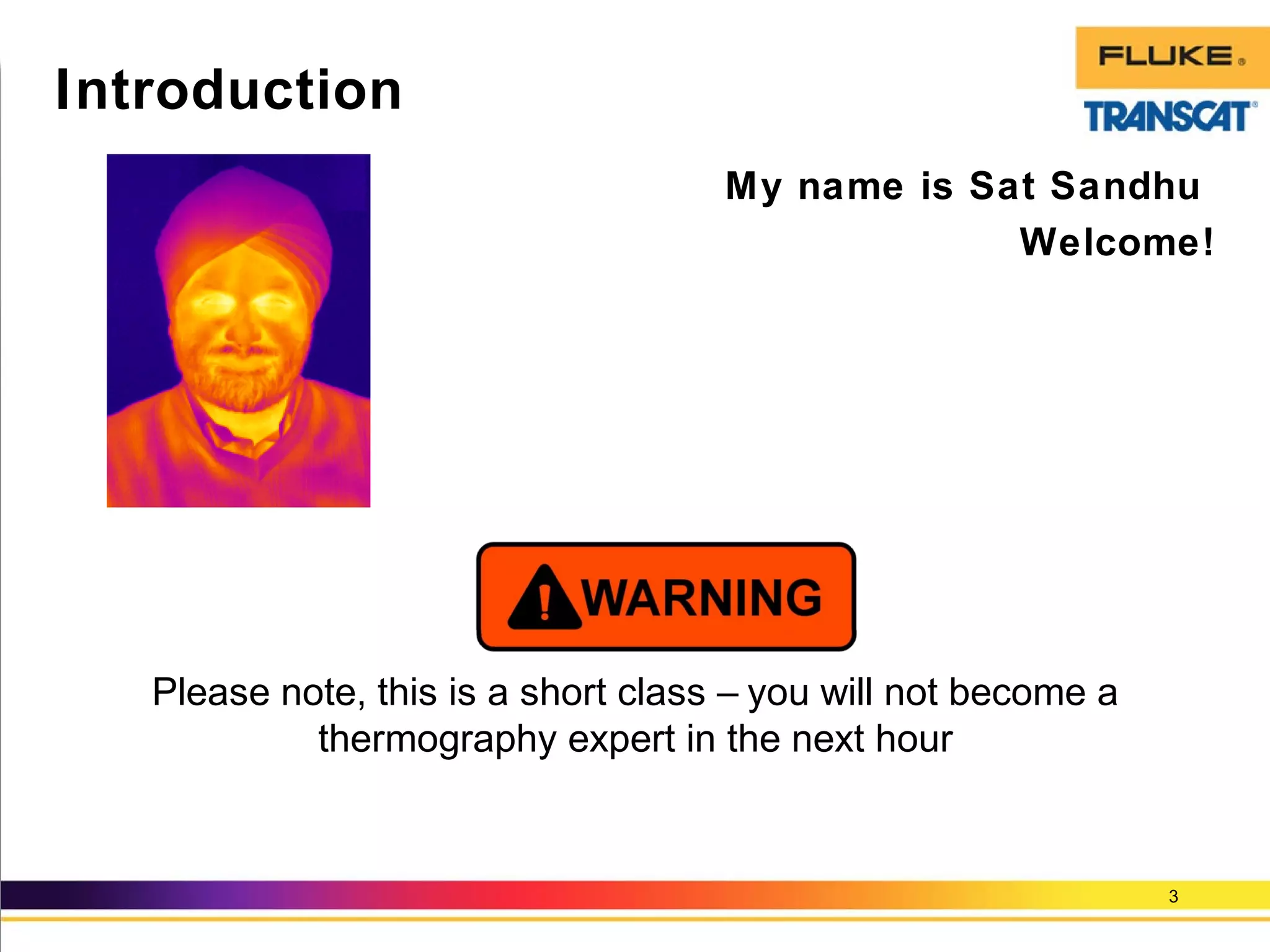
My name is Sat Sandhu
Welcome!
Please note, this is a short class – you will not become a
thermography expert in the next hour
3
Introduction
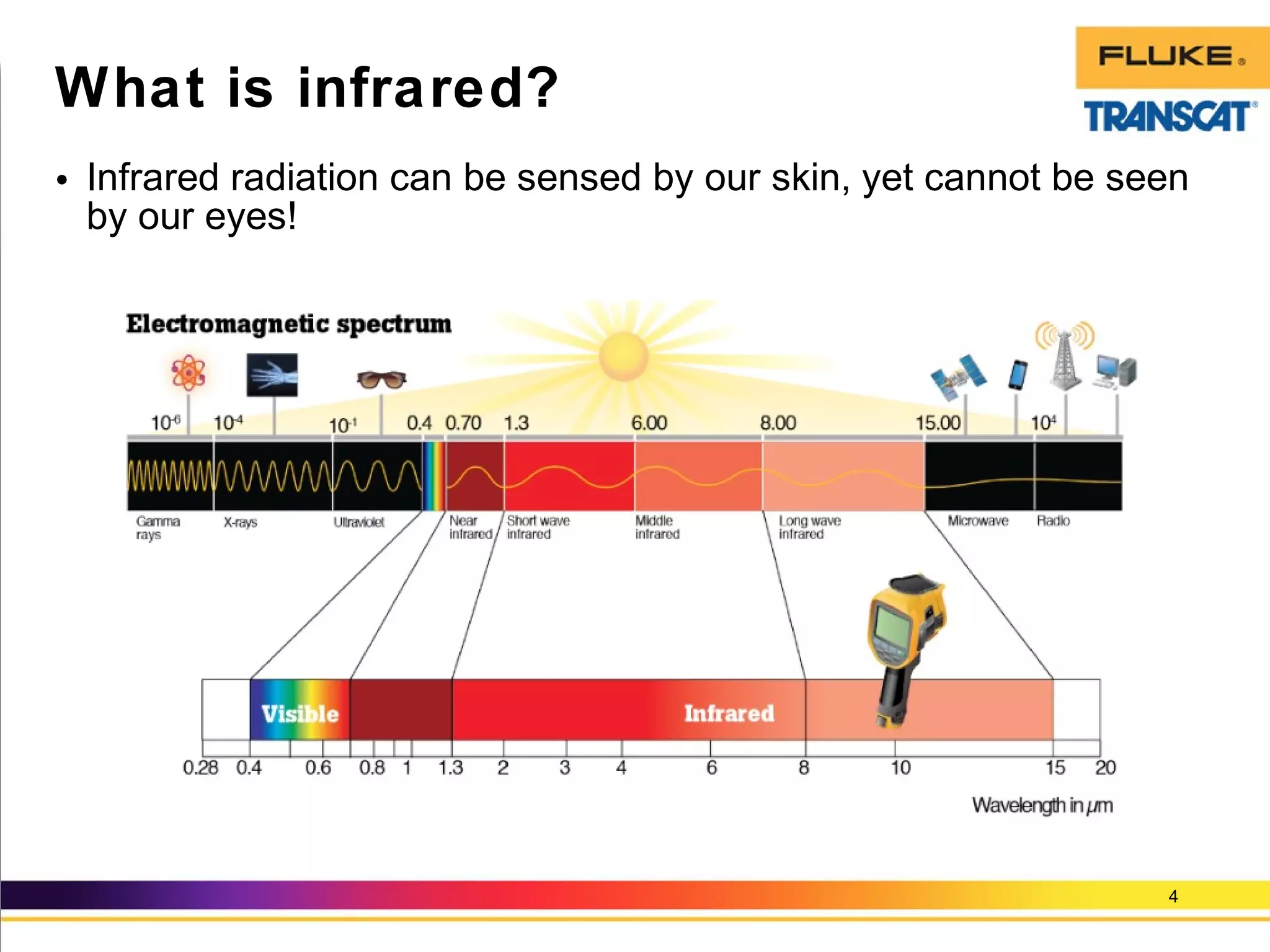
• Infrared radiation can be sensed by our skin, yet cannot be seen
by our eyes!
4
What is infrared?
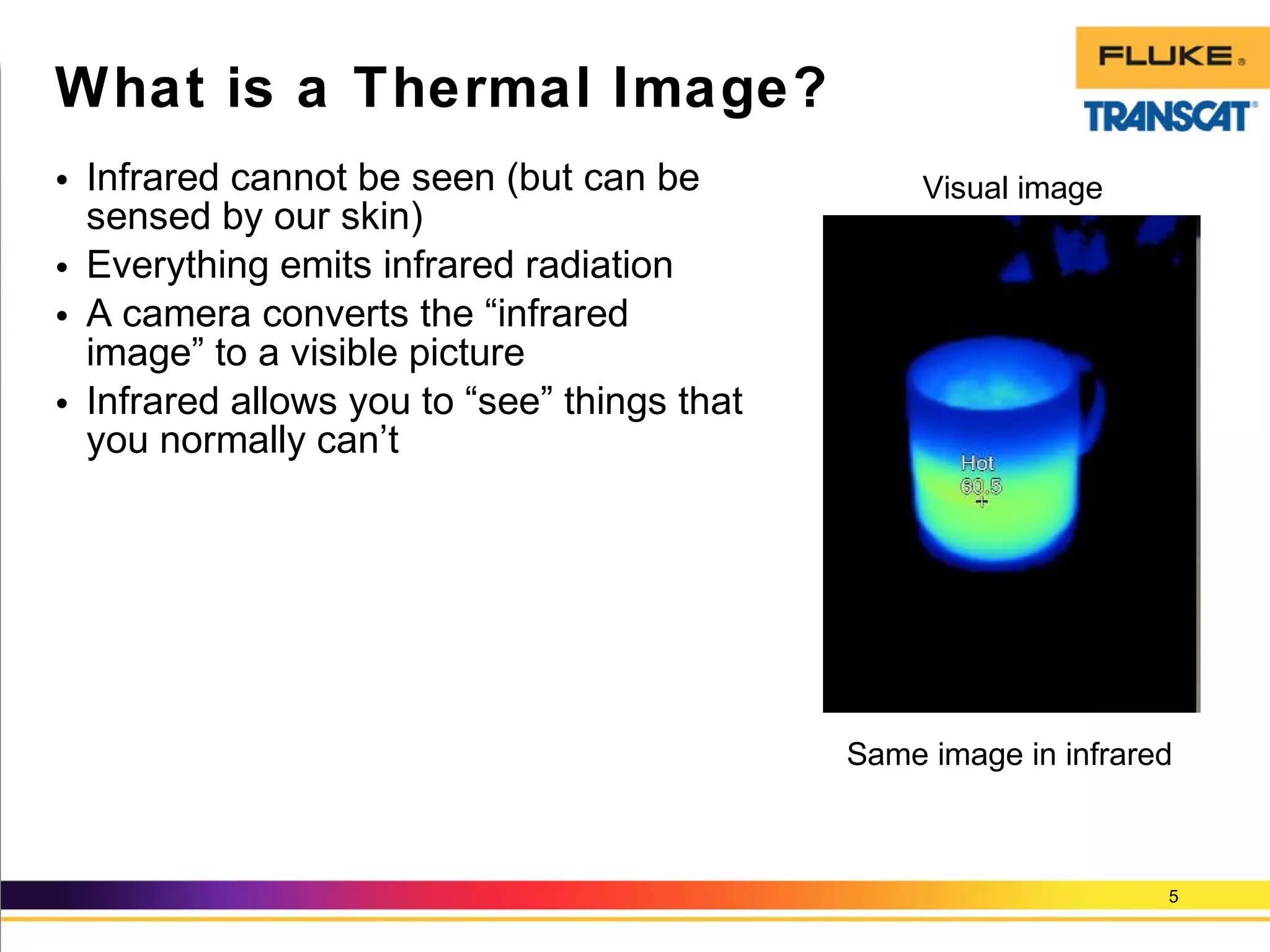
• Infrared cannot be seen (but can be
sensed by our skin)
• Everything emits infrared radiation
• A camera converts the “infrared
image” to a visible picture
• Infrared allows you to “see” things that
you normally can’t
5
What is a Thermal Image?
Visual image
Same image in infrared
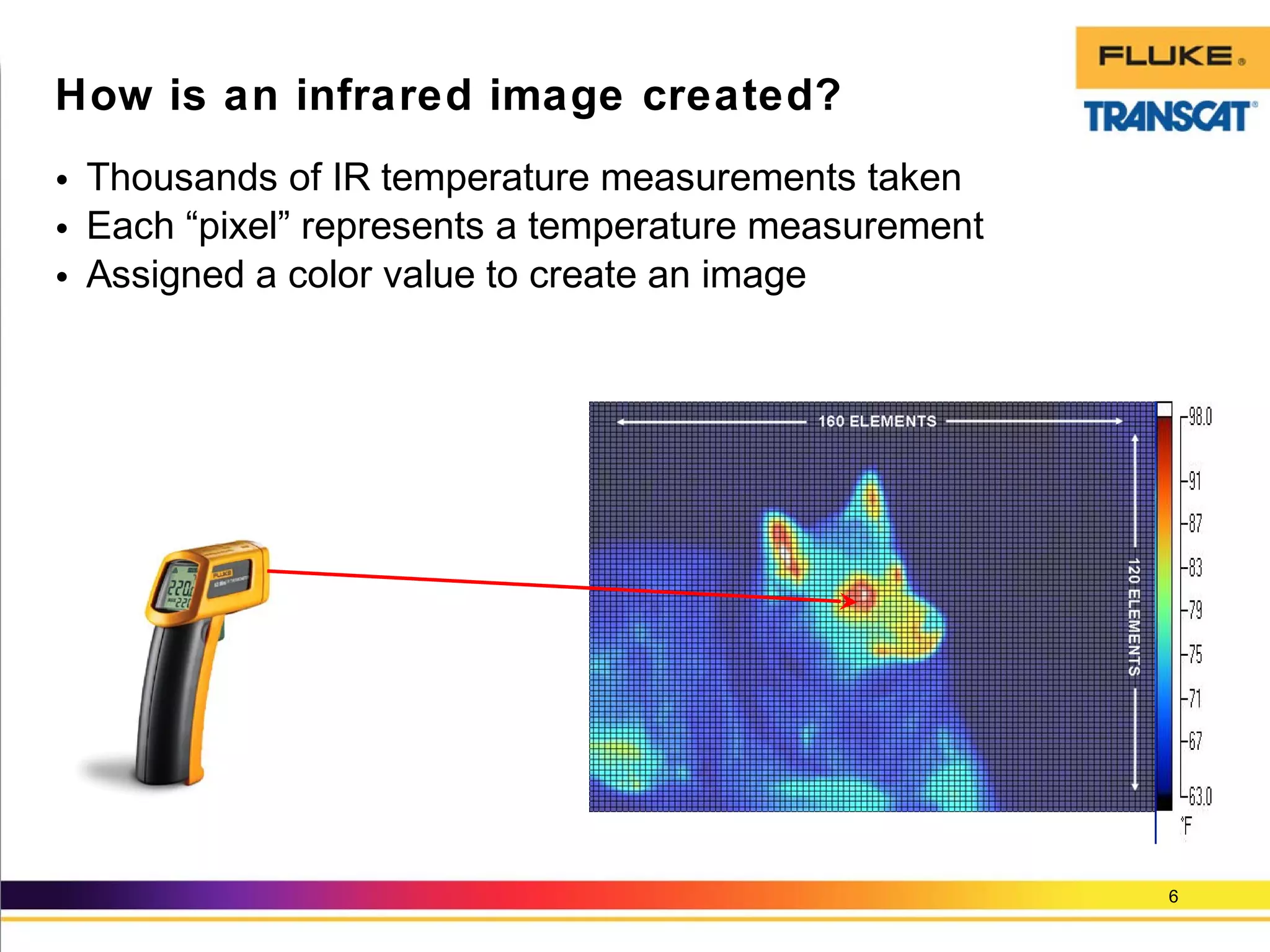
• Thousands of IR temperature measurements taken
• Each “pixel” represents a temperature measurement
• Assigned a color value to create an image
6
How is an infrared image created?
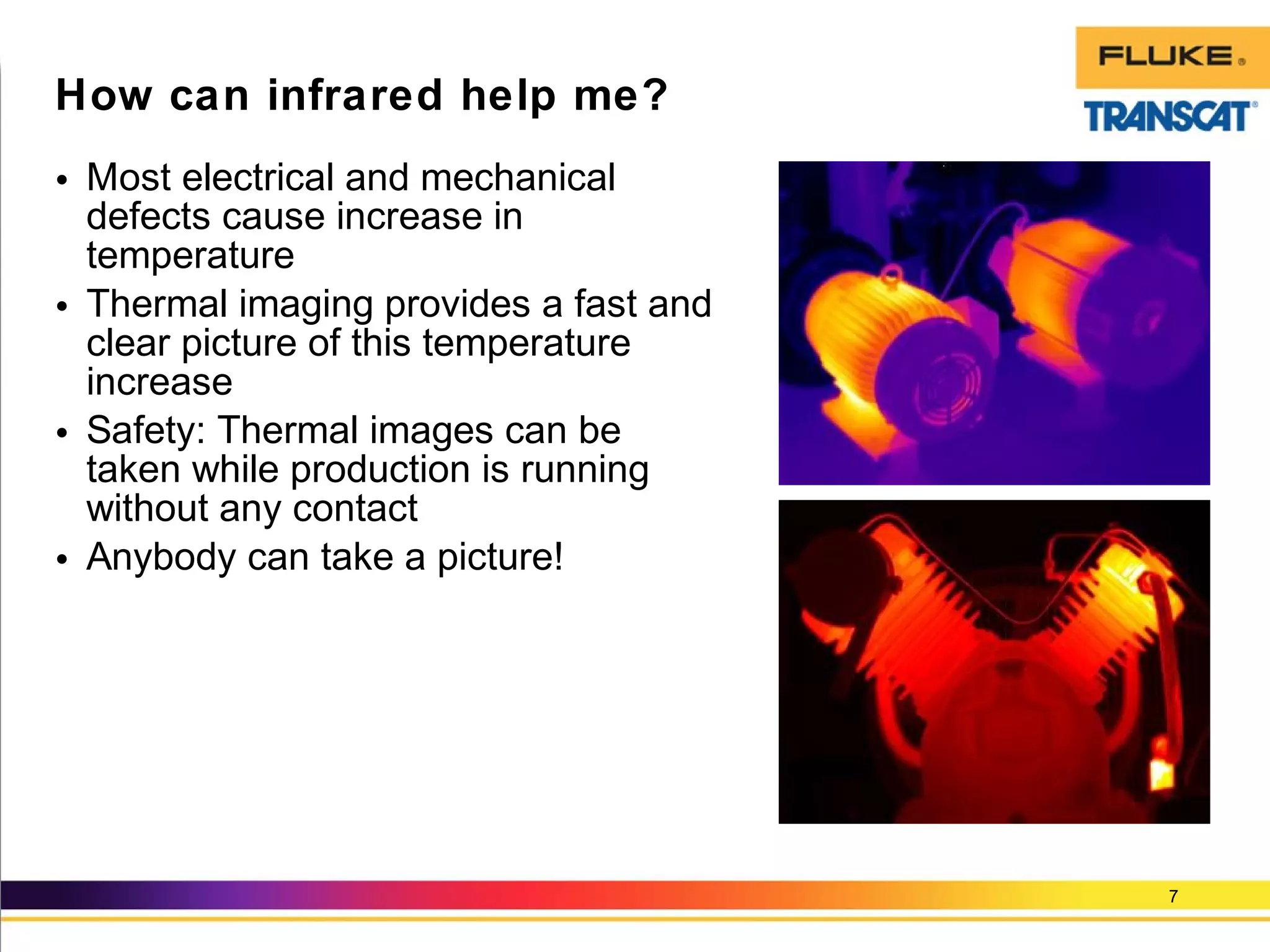
• Most electrical and mechanical
defects cause increase in
temperature
• Thermal imaging provides a fast and
clear picture of this temperature
increase
• Safety: Thermal images can be
taken while production is running
without any contact
• Anybody can take a picture!
7
How can infrared help me?
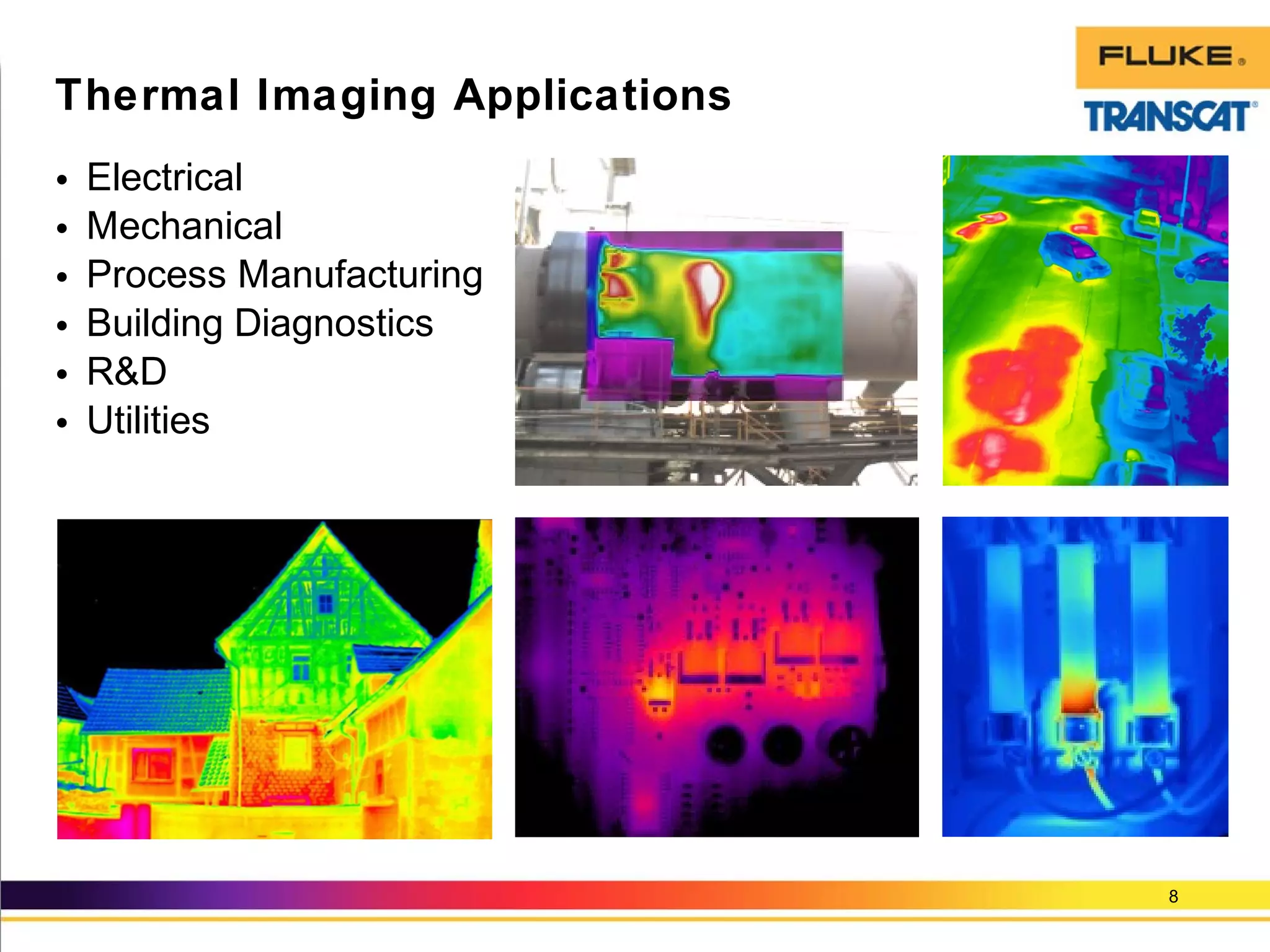
• Electrical
• Mechanical
• Process Manufacturing
• Building Diagnostics
• R&D
• Utilities
8
Thermal Imaging Applications
• Ensure adequate thermal gradients
• Understand thermal capacitance
• Account for wind effects
• Avoid angular variations
• Remember heat transfers from hot to
cold
• Be aware of your surroundings
• Know when qualitative
measurements are sufficient
• Compare similar components under
similar conditions
9
Thermal Imaging Considerations
• Understand present and future loading conditions
• Inspect with highest load possible (at least 40%)
10
Thermal Imaging Considerations
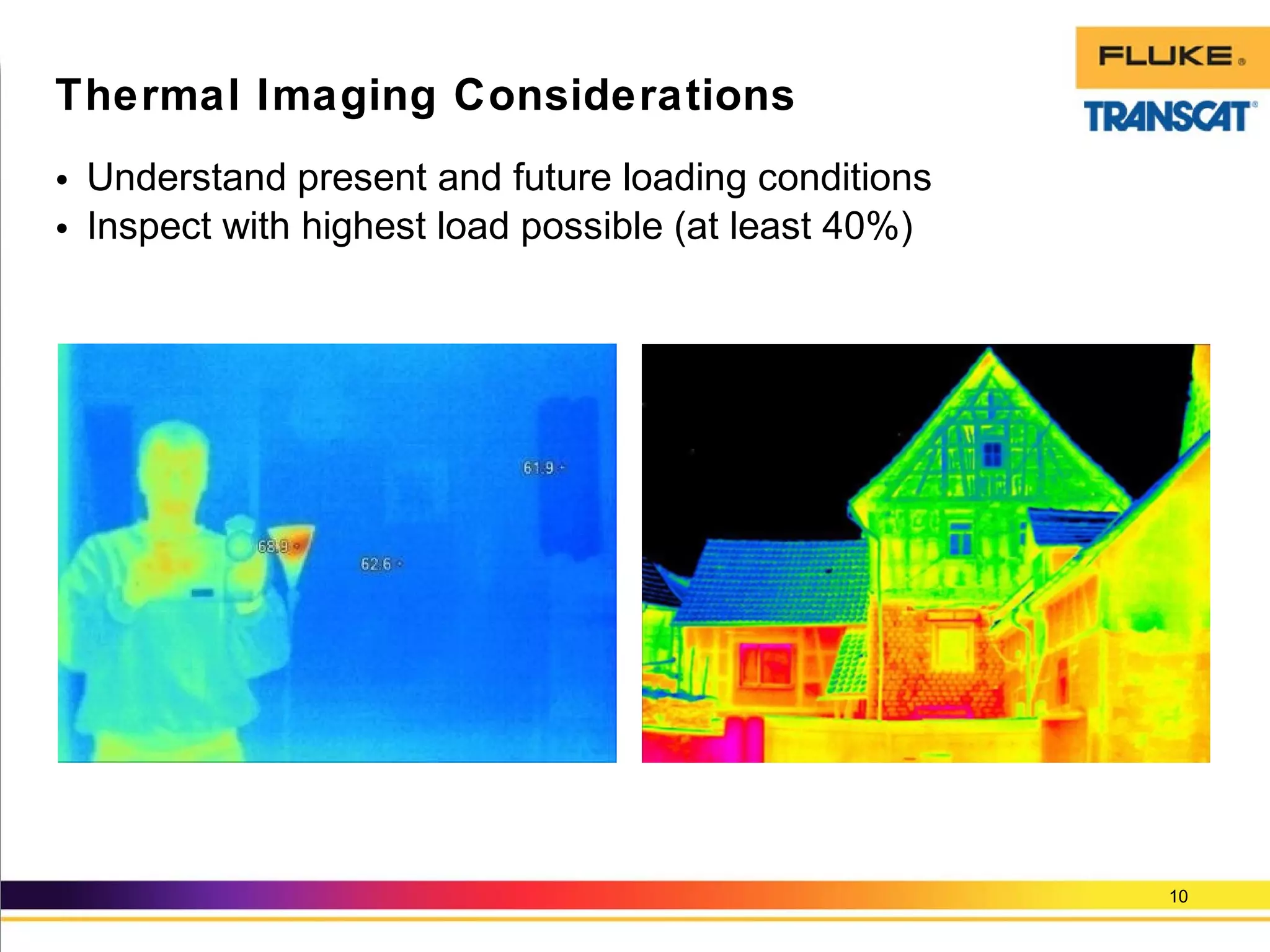
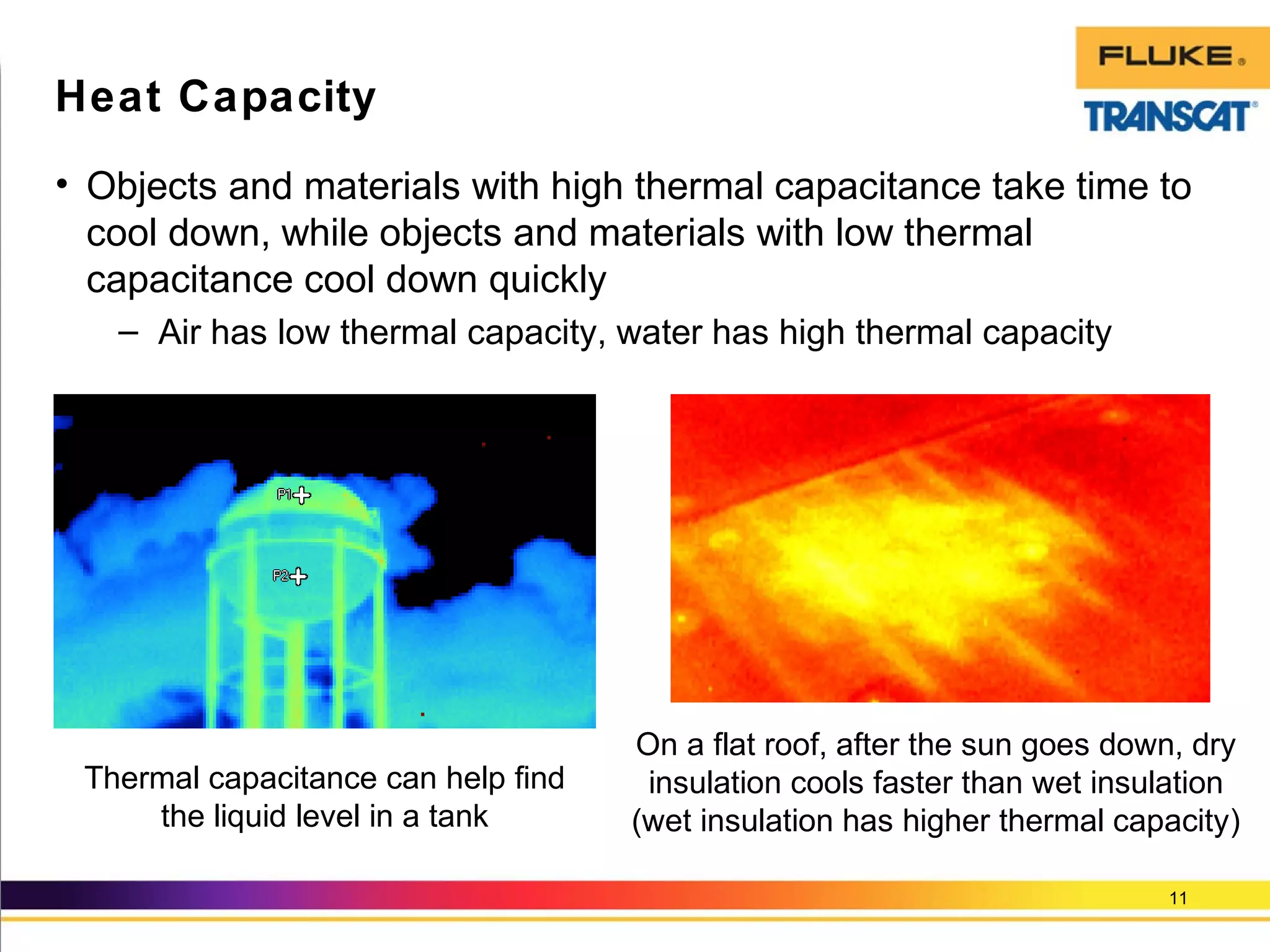
• Objects and materials with high thermal capacitance take time to
cool down, while objects and materials with low thermal
capacitance cool down quickly
– Air has low thermal capacity, water has high thermal capacity
11
Heat Capacity
On a flat roof, after the sun goes down, dry
insulation cools faster than wet insulation
(wet insulation has higher thermal capacity)
Thermal capacitance can help find
the liquid level in a tank
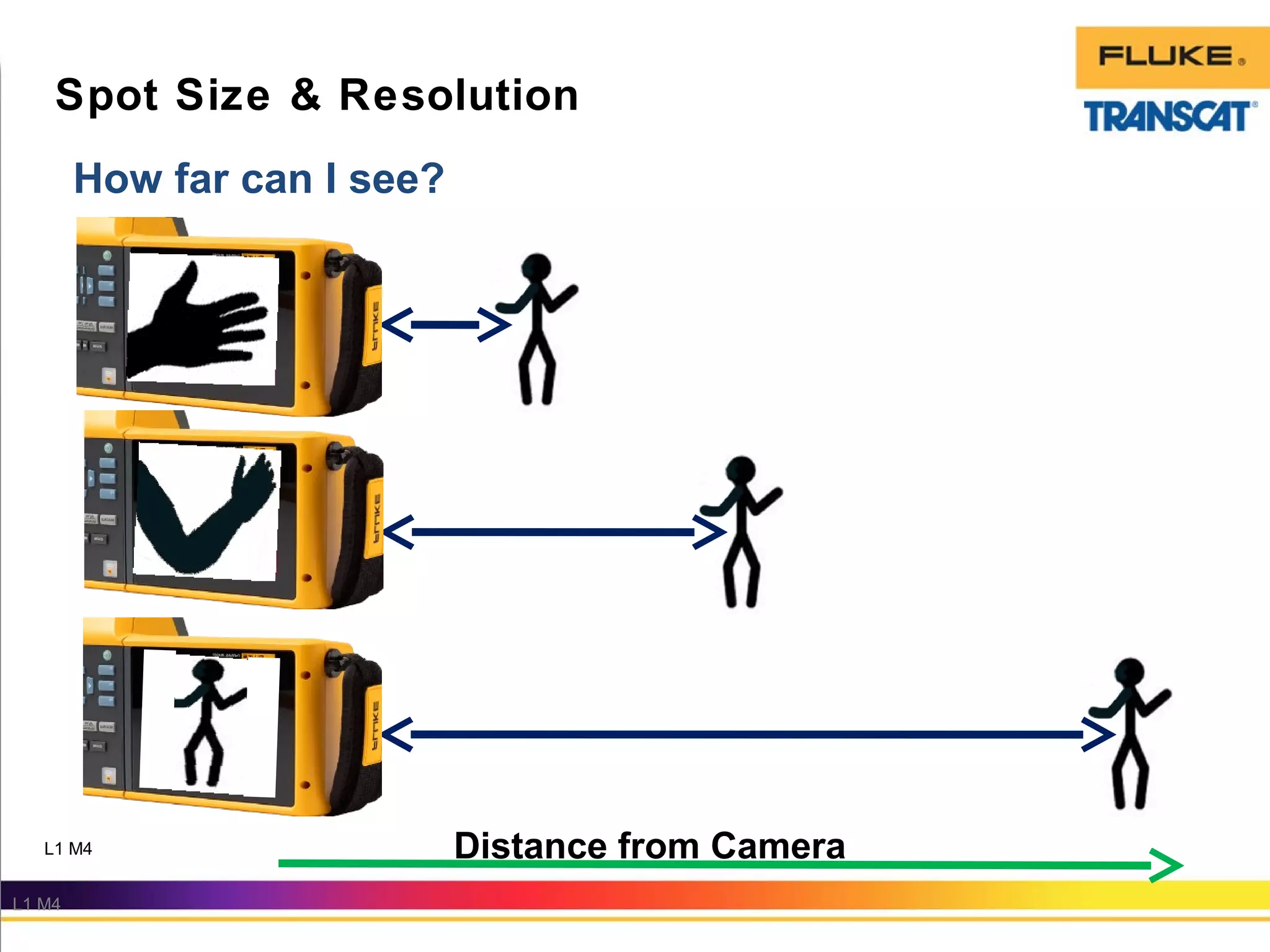
How far can I see?
Distance from CameraL1 M4
L1 M4
Spot Size & Resolution
• Larger area for
average temperature
when further away
• Distance to spot ratio
• Zoom lens decreases
spot size
13
Spot Size & Resolution
• Emissivity
• Understand the equipment
• Load conditions
• Comparative inspections
• Hot spots
• Cold spots
14
TIPS: How to Effectively Spot Issues with
an Infrared Camera
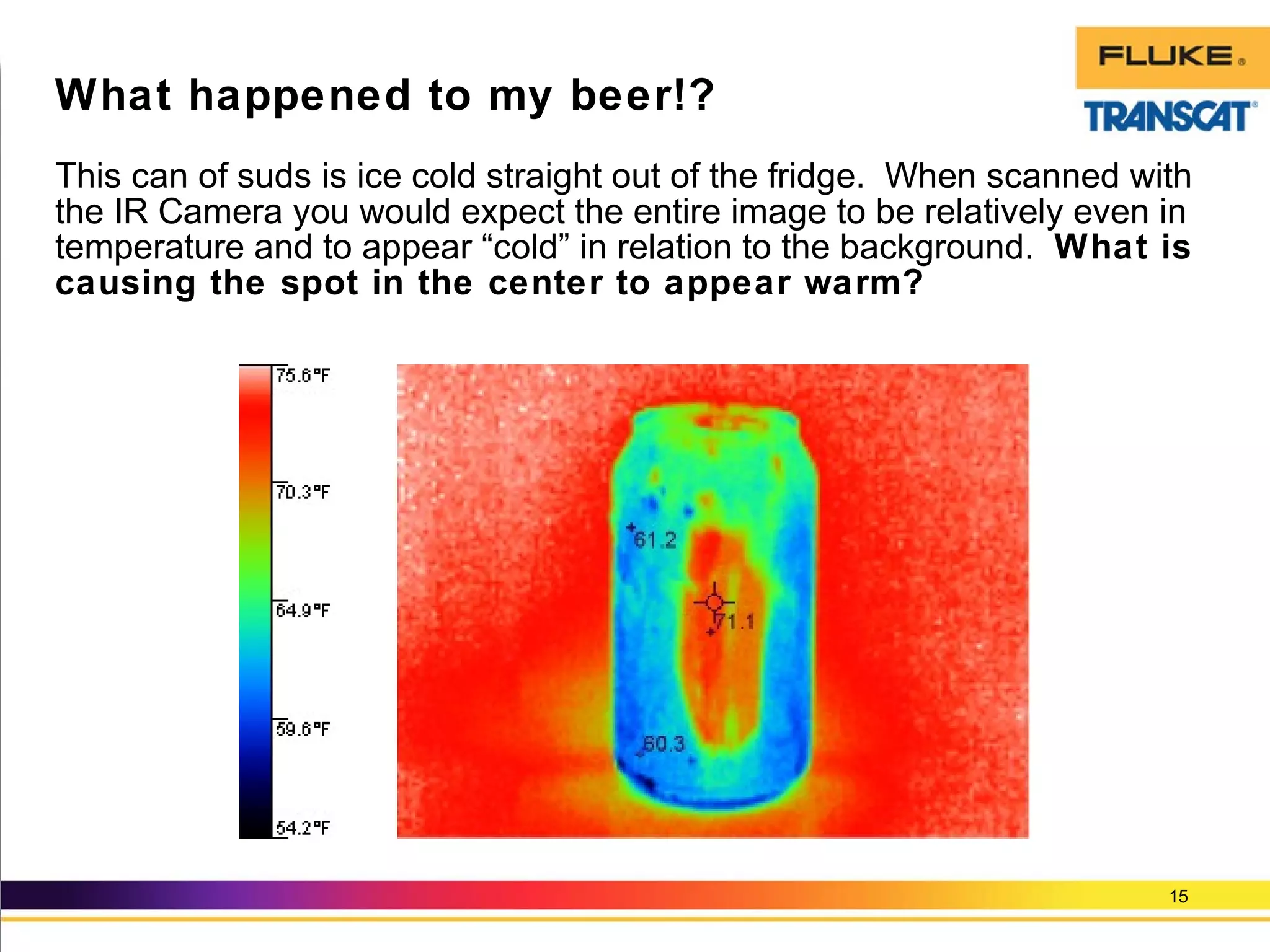
This can of suds is ice cold straight out of the fridge. When scanned with
the IR Camera you would expect the entire image to be relatively even in
temperature and to appear “cold” in relation to the background. What is
causing the spot in the center to appear warm?
15
What happened to my beer!?
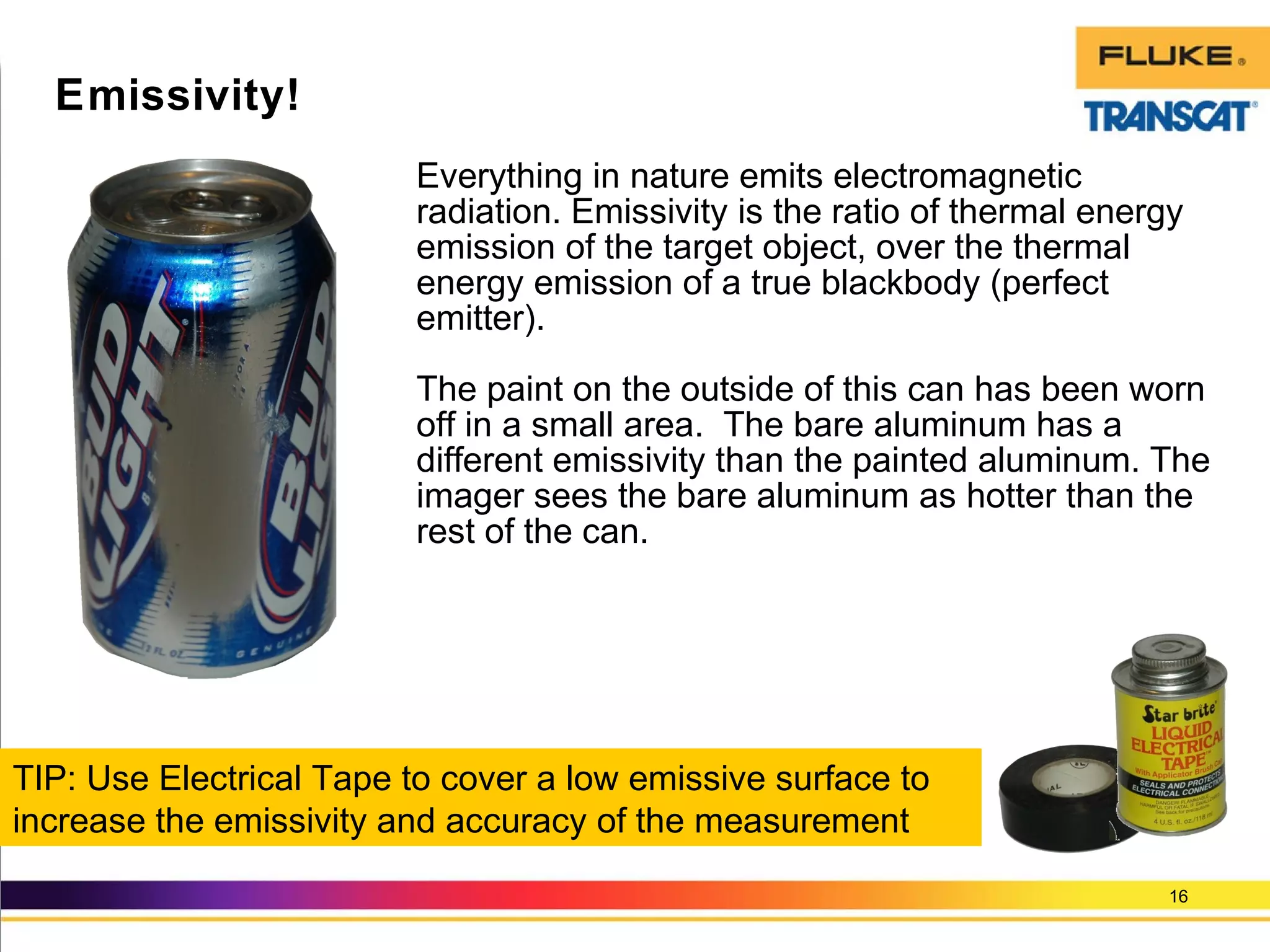
Everything in nature emits electromagnetic
radiation. Emissivity is the ratio of thermal energy
emission of the target object, over the thermal
energy emission of a true blackbody (perfect
emitter).
The paint on the outside of this can has been worn
off in a small area. The bare aluminum has a
different emissivity than the painted aluminum. The
imager sees the bare aluminum as hotter than the
rest of the can.
16
Emissivity!
TIP: Use Electrical Tape to cover a low emissive surface to
increase the emissivity and accuracy of the measurement
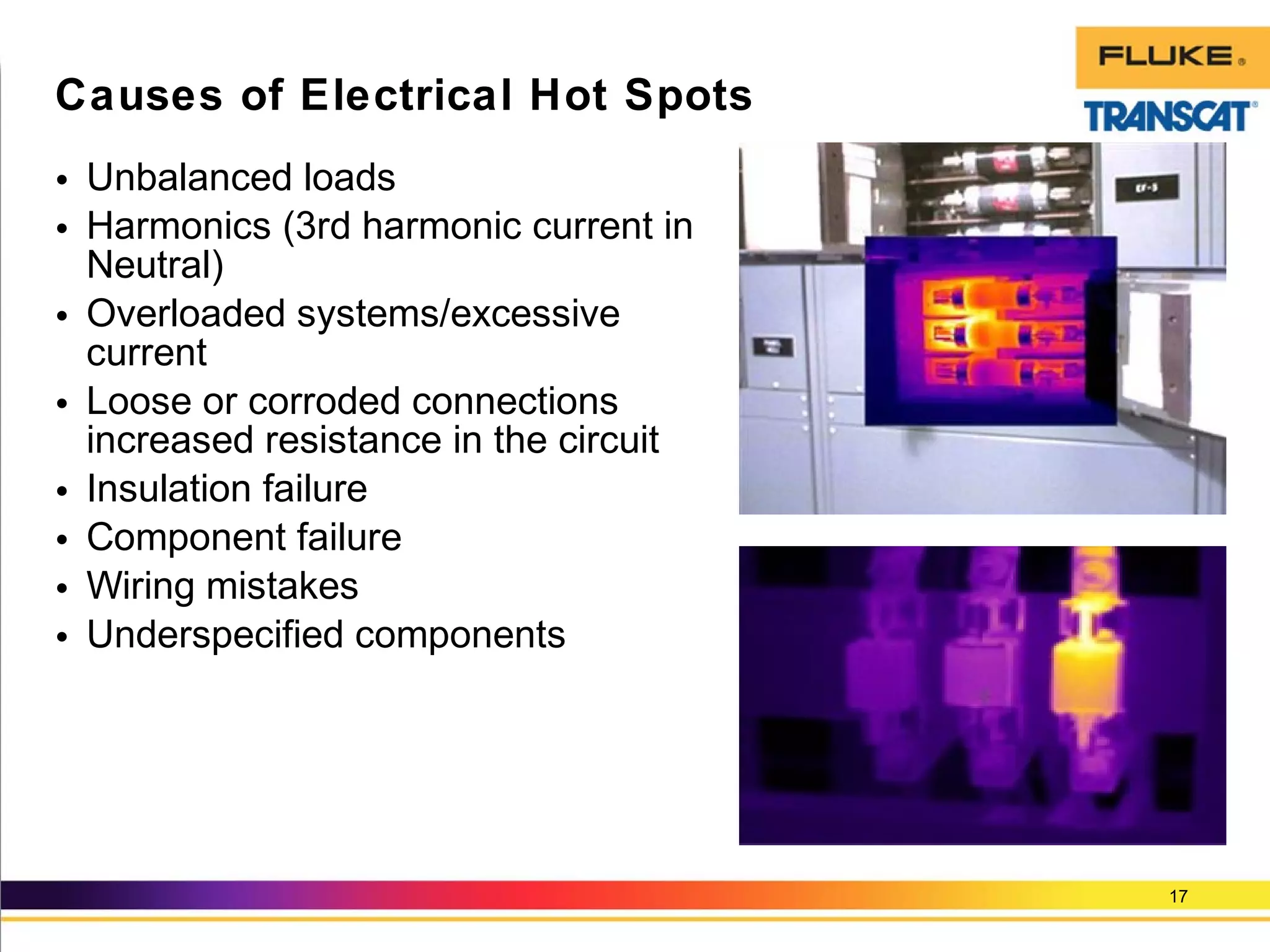
• Unbalanced loads
• Harmonics (3rd harmonic current in
Neutral)
• Overloaded systems/excessive
current
• Loose or corroded connections
increased resistance in the circuit
• Insulation failure
• Component failure
• Wiring mistakes
• Underspecified components
17
Causes of Electrical Hot Spots
18
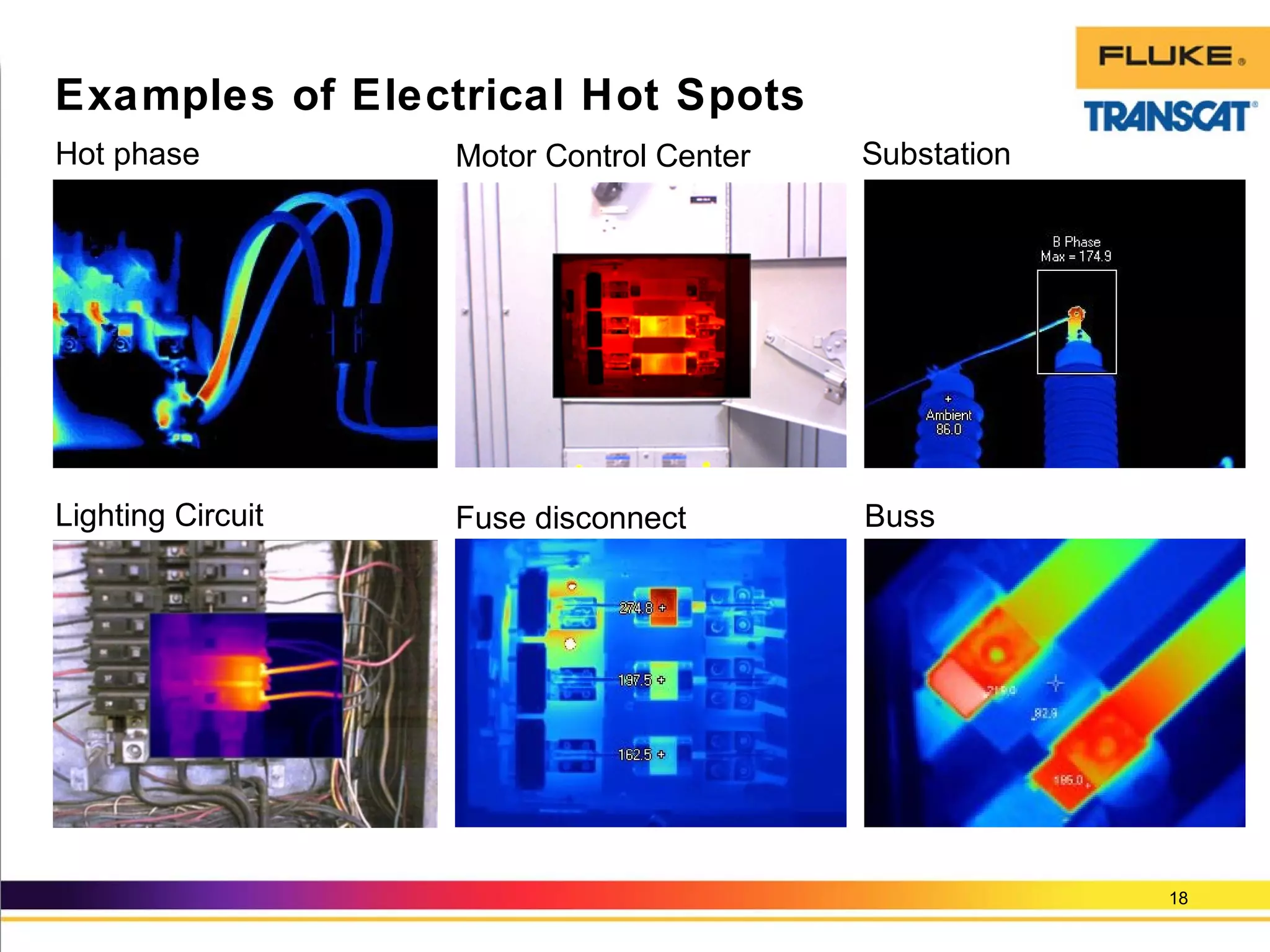
Examples of Electrical Hot Spots
Hot phase
Fuse disconnect
Substation
Lighting Circuit
Motor Control Center
Buss
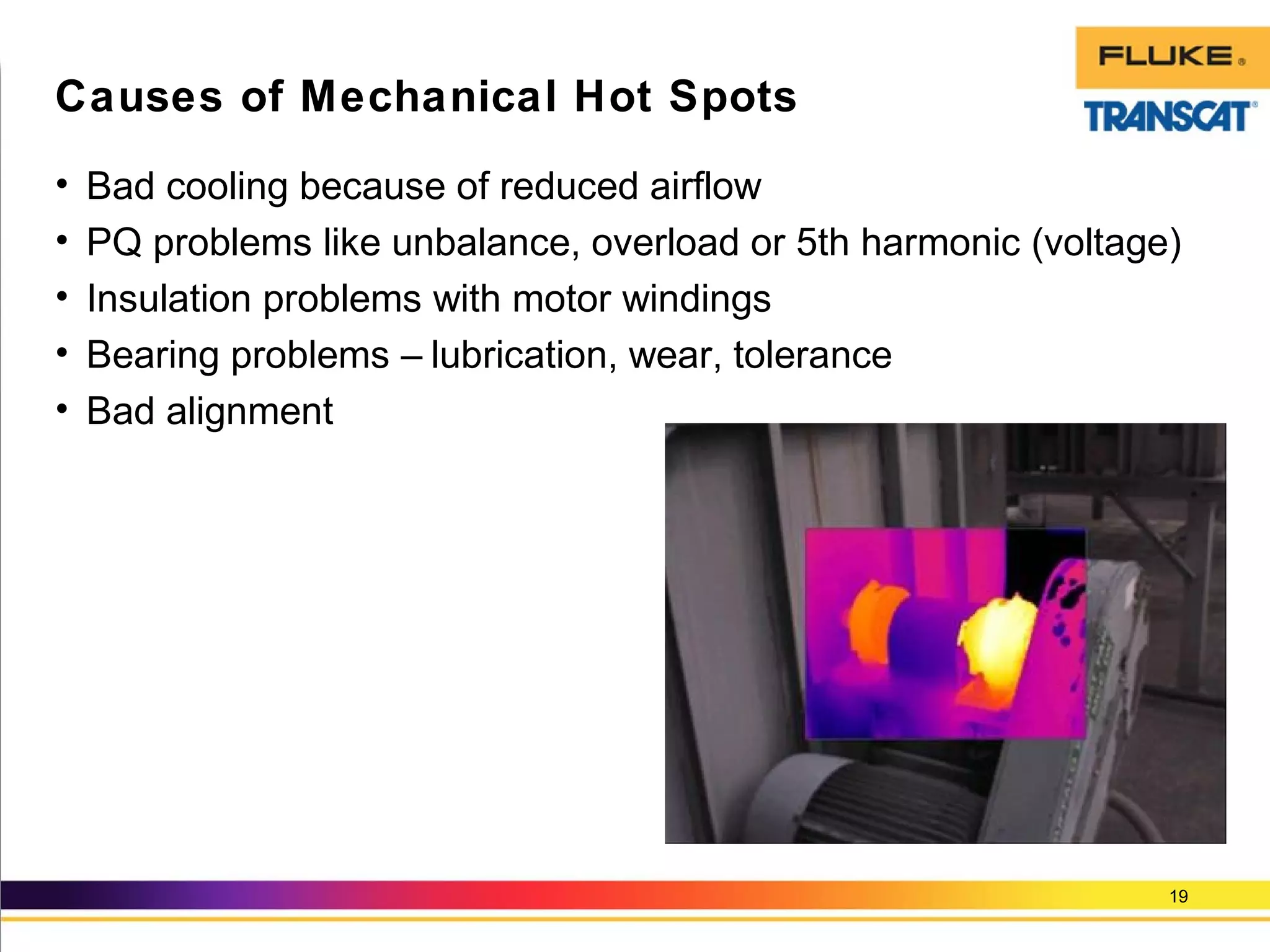
• Bad cooling because of reduced airflow
• PQ problems like unbalance, overload or 5th harmonic (voltage)
• Insulation problems with motor windings
• Bearing problems – lubrication, wear, tolerance
• Bad alignment
19
Causes of Mechanical Hot Spots
20
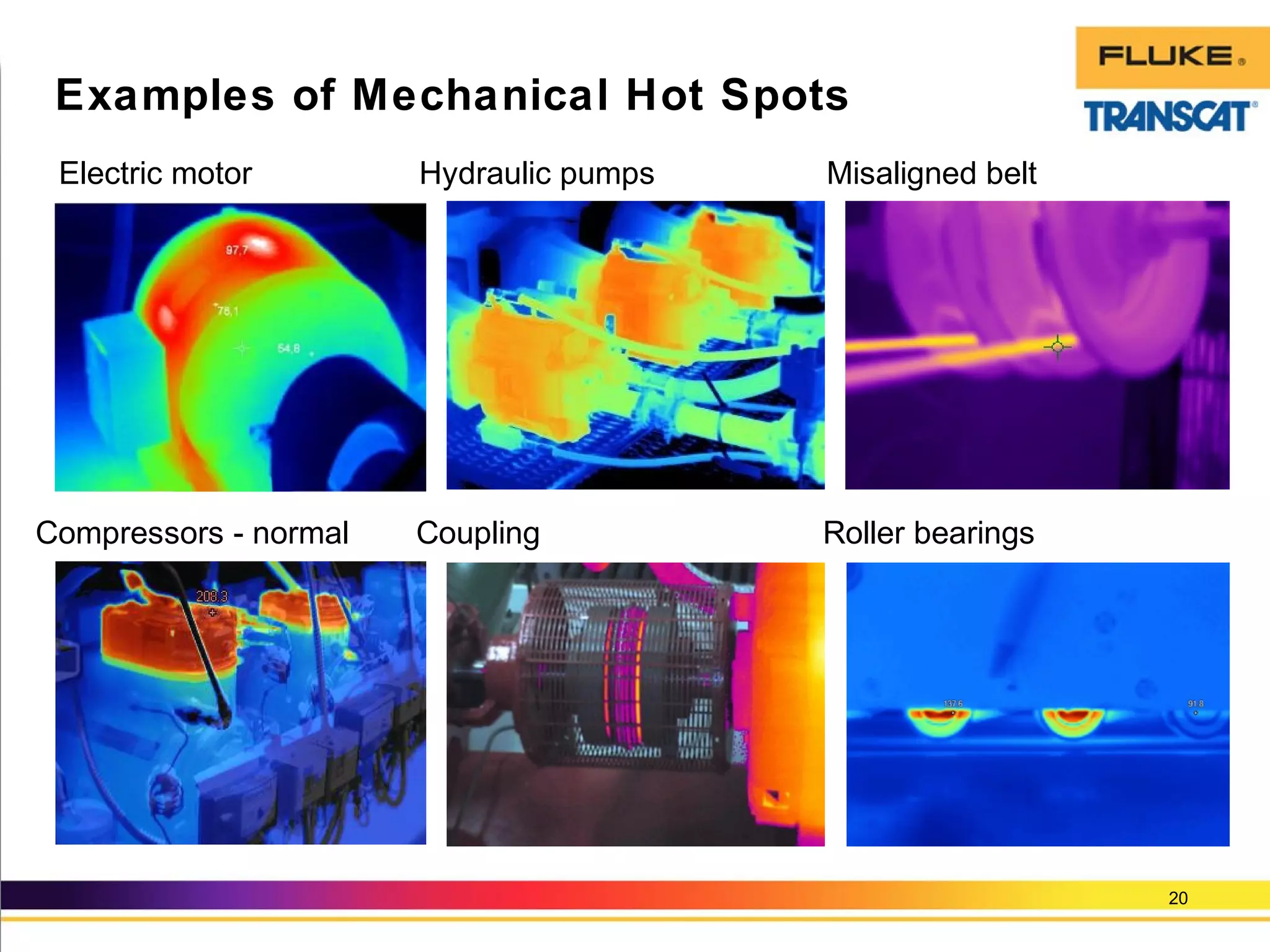
Examples of Mechanical Hot Spots
Compressors - normal
Hydraulic pumps Misaligned beltElectric motor
Roller bearingsCoupling
• Damaged structures caused by worn pipes
• Abnormal heat flow/heat gradients
• Defective valves/traps
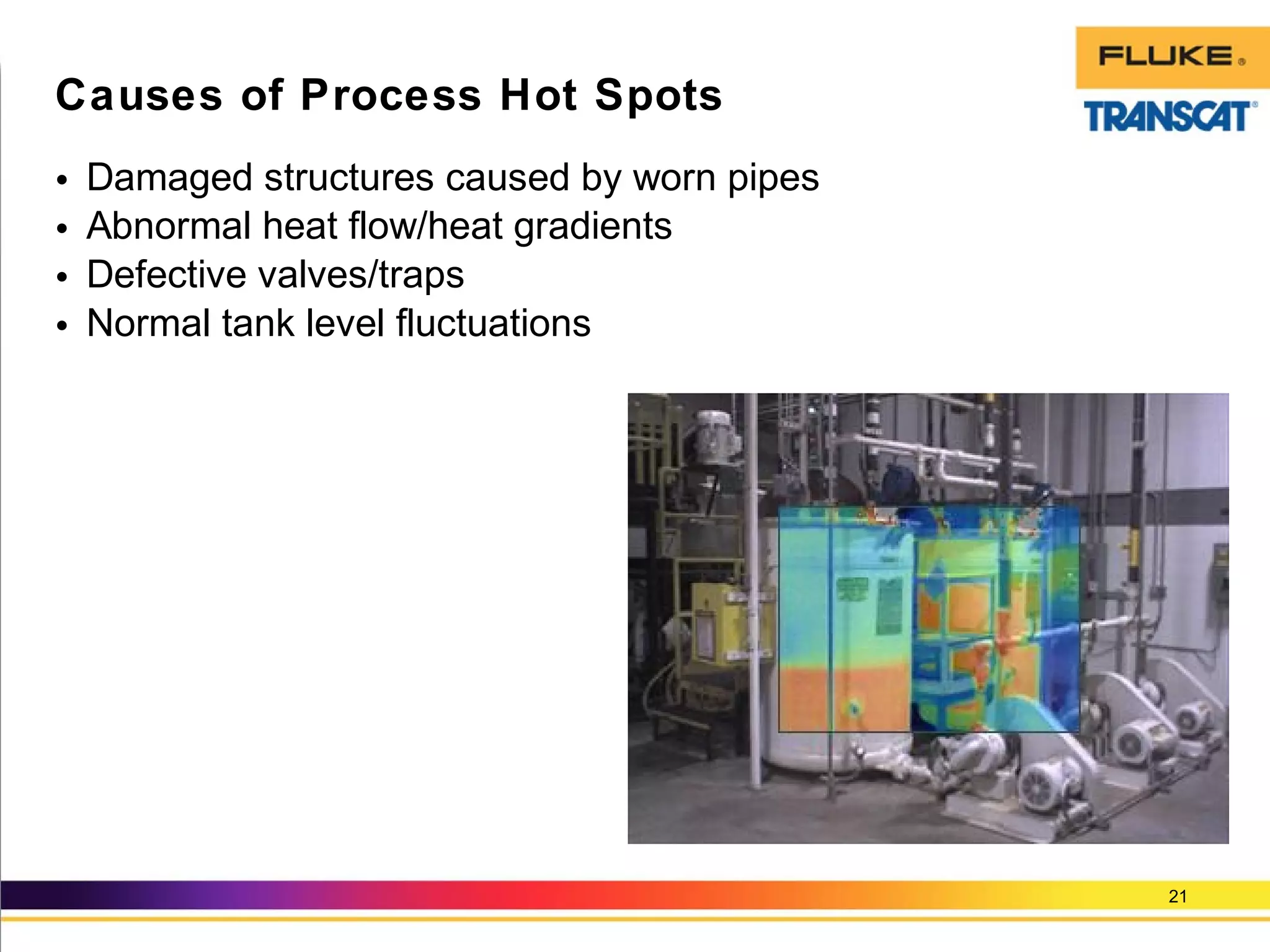
• Normal tank level fluctuations
21
Causes of Process Hot Spots
22
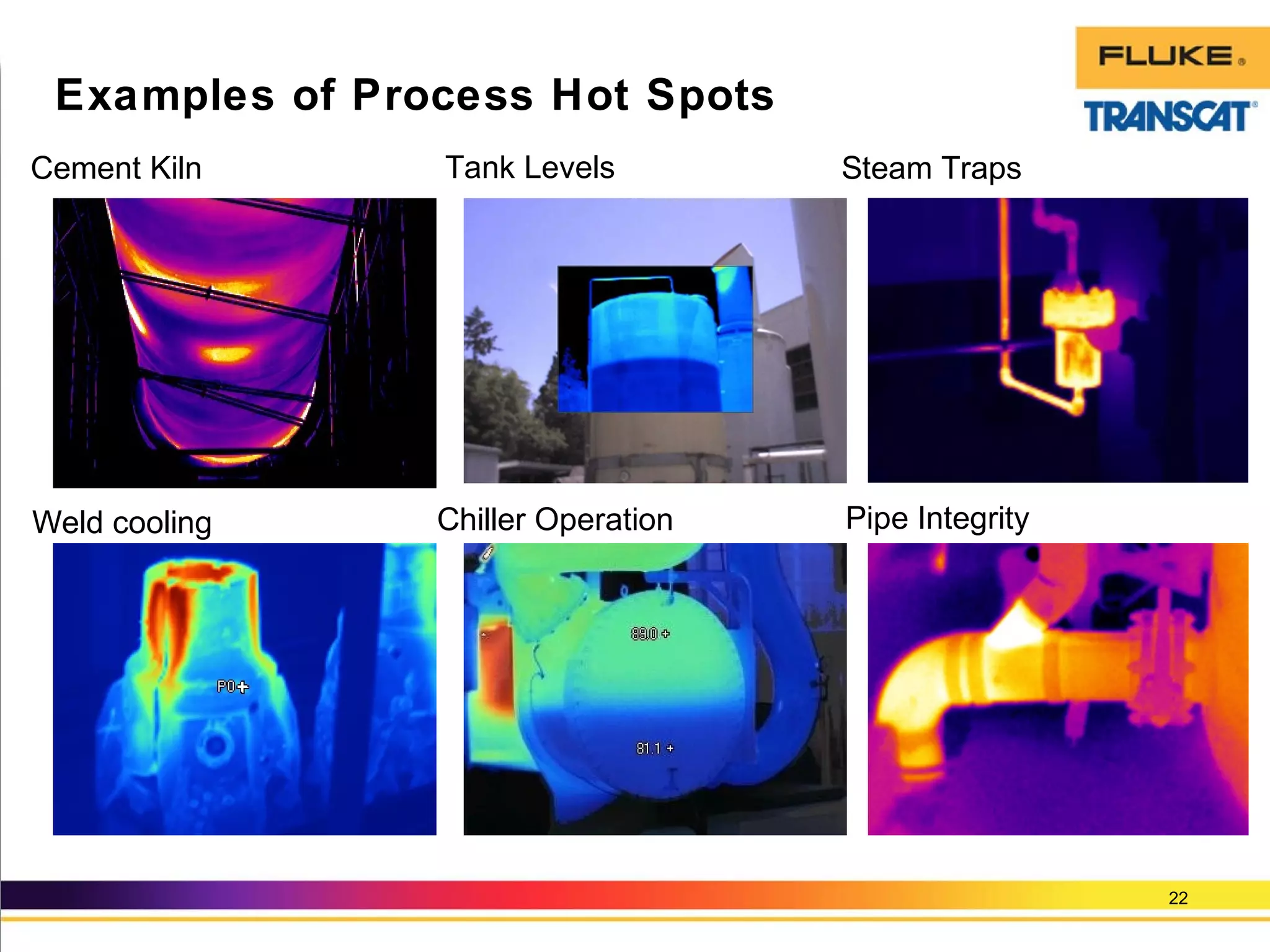
Examples of Process Hot Spots
Weld cooling
Tank Levels
119.7°C
302.2°C
150
200
250
300
Steam TrapsCement Kiln
Pipe IntegrityChiller Operation
• Roof leaks
• Air Leak
• In-floor heating
• Missing insulation
23
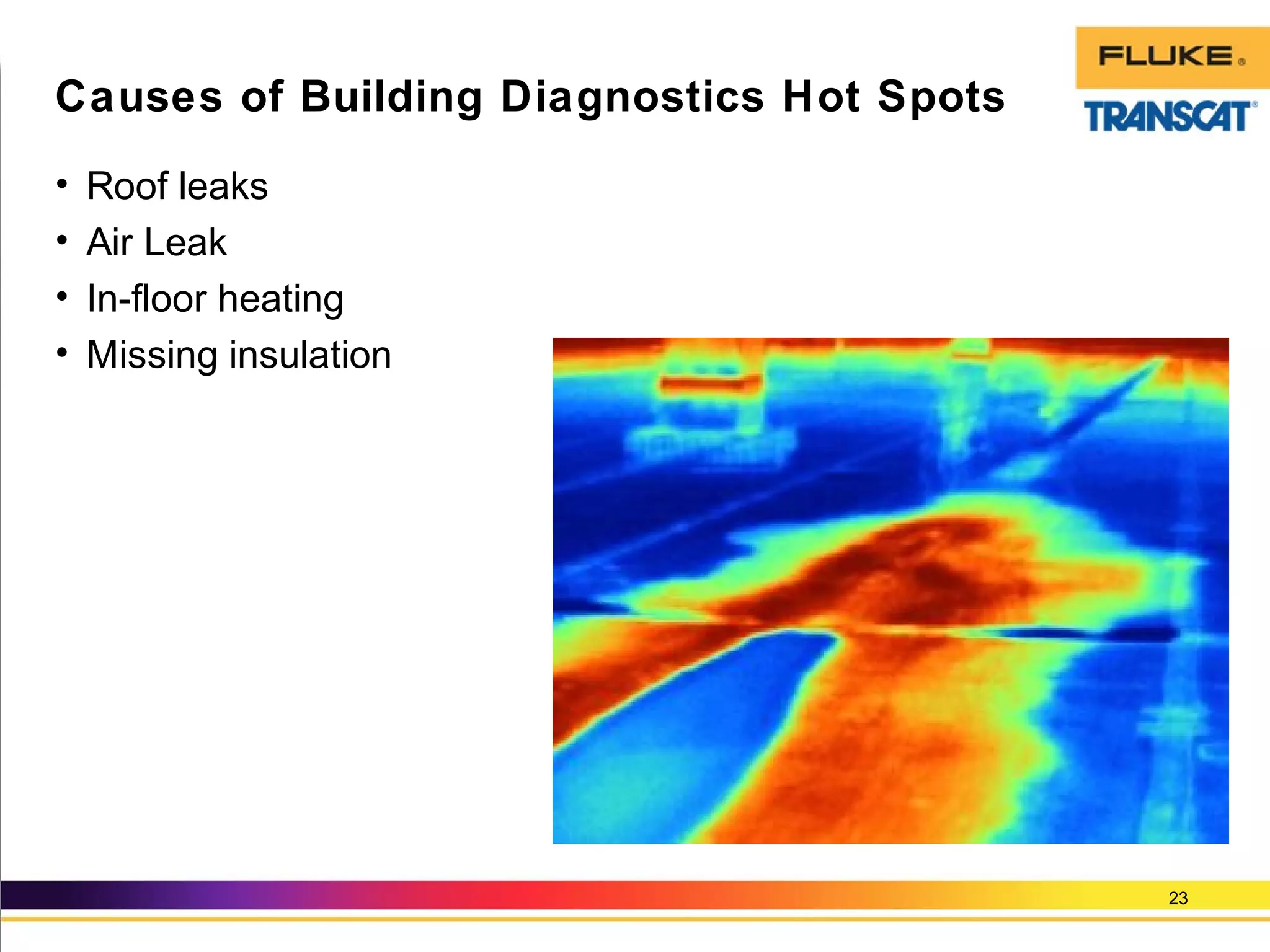
Causes of Building Diagnostics Hot Spots
24
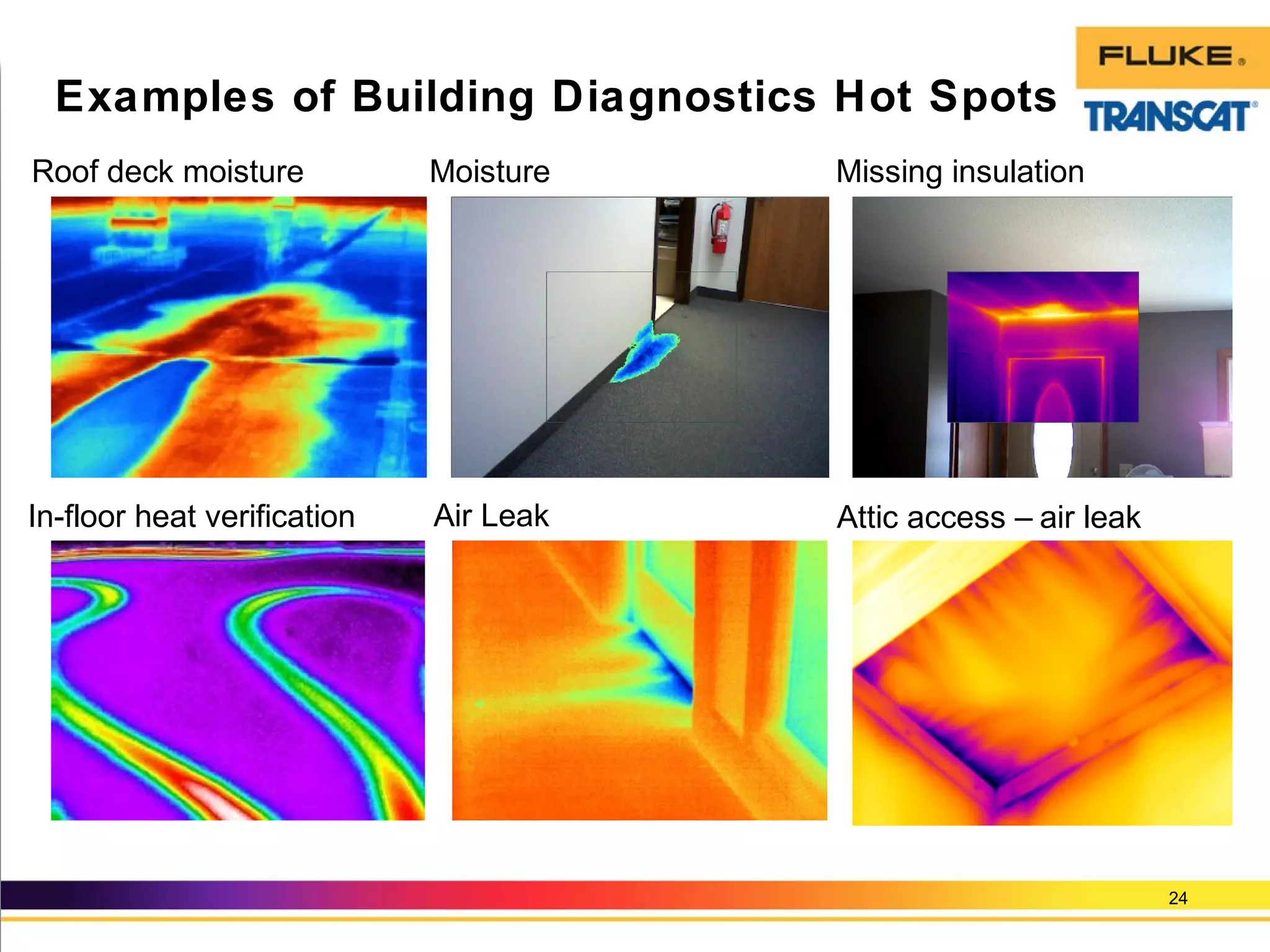
Examples of Building Diagnostics Hot Spots
Roof deck moisture
In-floor heat verification
Missing insulationMoisture
Air Leak Attic access – air leak
• Trends
• Maintenance programs
• Cost Savings
• Solutions
• Build a Successful program
25
How to Tie Infrared Inspections into your
Preventative Maintenance Program
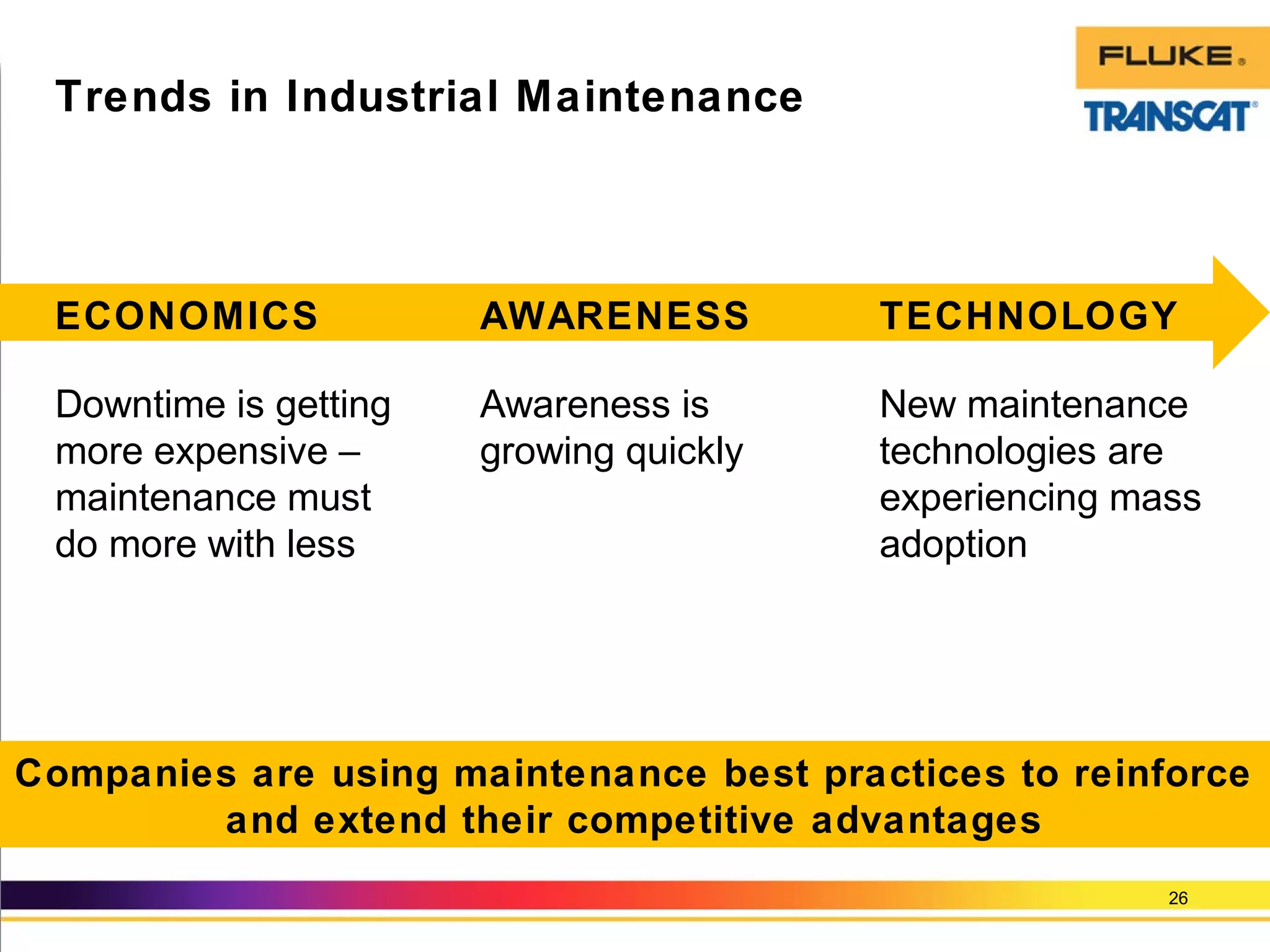
Downtime is getting
more expensive –
maintenance must
do more with less
26
Trends in Industrial Maintenance
Companies are using maintenance best practices to reinforce
and extend their competitive advantages
Awareness is
growing quickly
New maintenance
technologies are
experiencing mass
adoption
ECONOMICS AWARENESS TECHNOLOGY
27
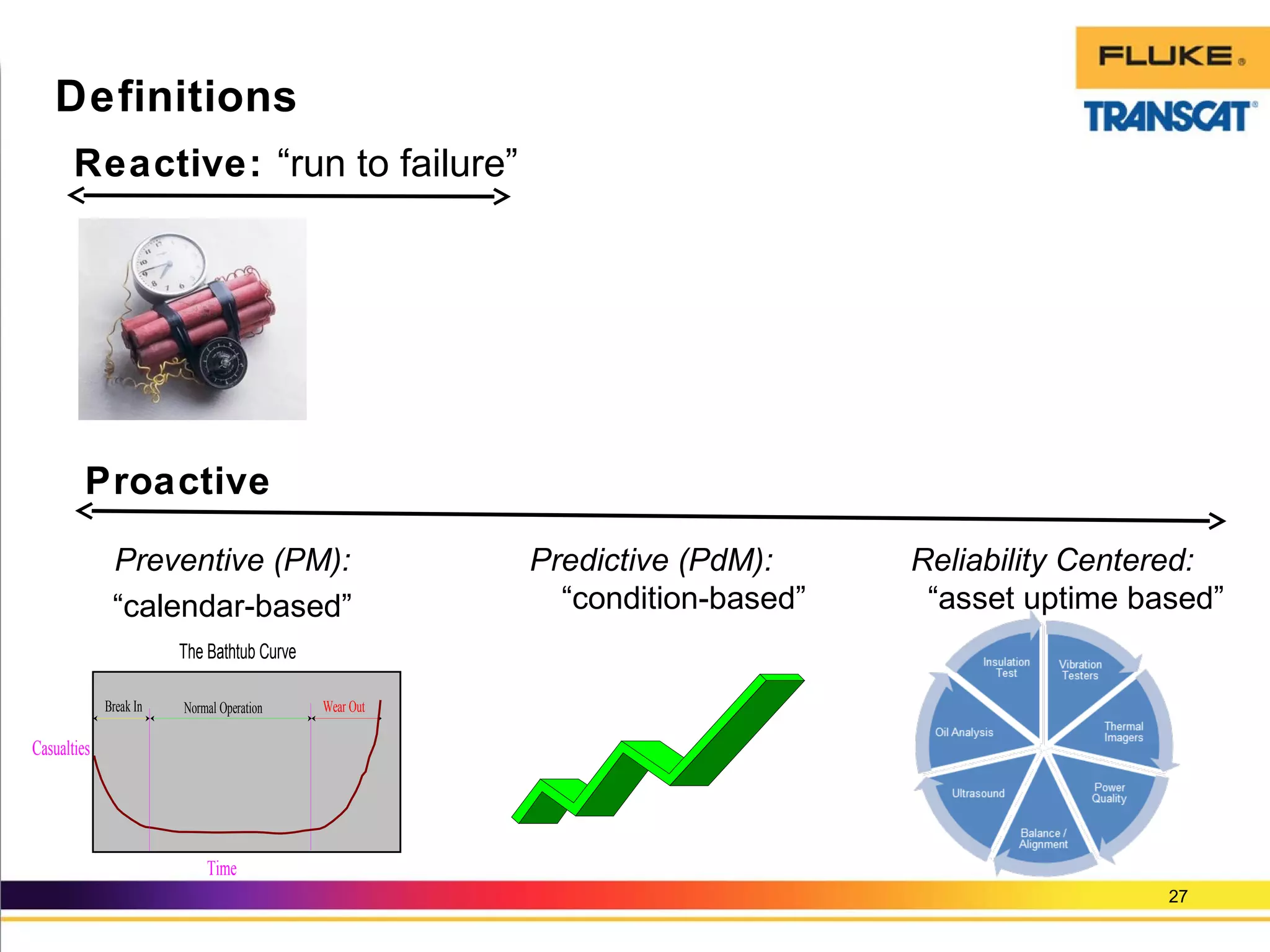
Definitions
Preventive (PM):
“calendar-based”
Predictive (PdM):
“condition-based”
Time
Normal Operation Wear OutBreak In
The Bathtub Curve
Casualties
Reactive: “run to failure”
Proactive
Reliability Centered:
“asset uptime based”
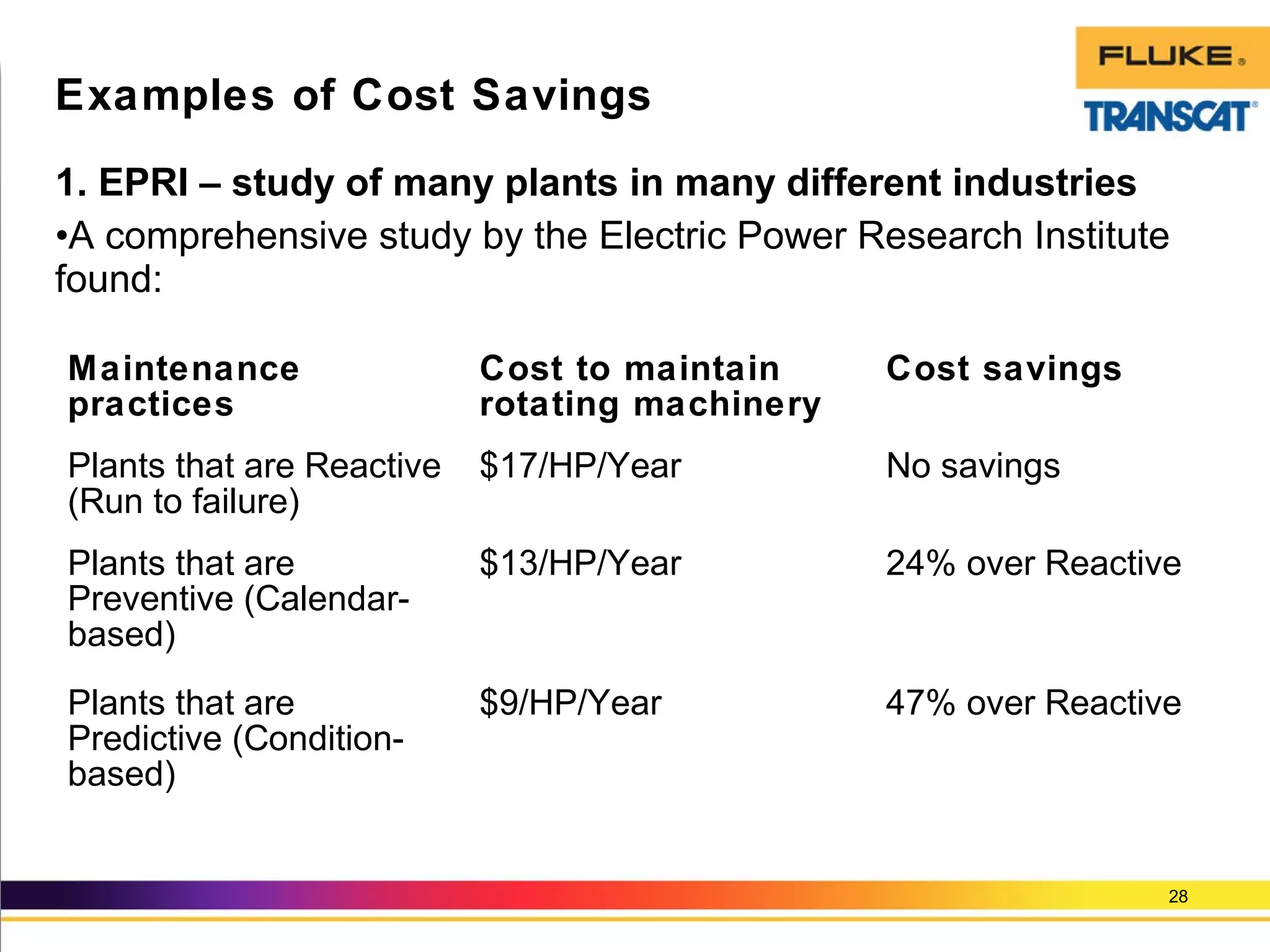
1. EPRI – study of many plants in many different industries
•A comprehensive study by the Electric Power Research Institute
found:
28
Examples of Cost Savings
Maintenance
practices
Cost to maintain
rotating machinery
Cost savings
Plants that are Reactive
(Run to failure)
$17/HP/Year No savings
Plants that are
Preventive (Calendar-
based)
$13/HP/Year 24% over Reactive
Plants that are
Predictive (Condition-
based)
$9/HP/Year 47% over Reactive
2. Cost to Benefit Studies
•A large company implemented a Predictive Maintenance program on hundreds of
their motors, pumps, fans, compressors and blowers
•This program has been successful for over 25 years
•They document the cost of the program and savings they enjoy
•Savings were many millions of dollars per year
•Every 2 years they conduct a Cost to Benefit study to compare the program cost
to the documented savings
•The average Cost to Benefit ratio for the past 30 years has been over 20:1
29
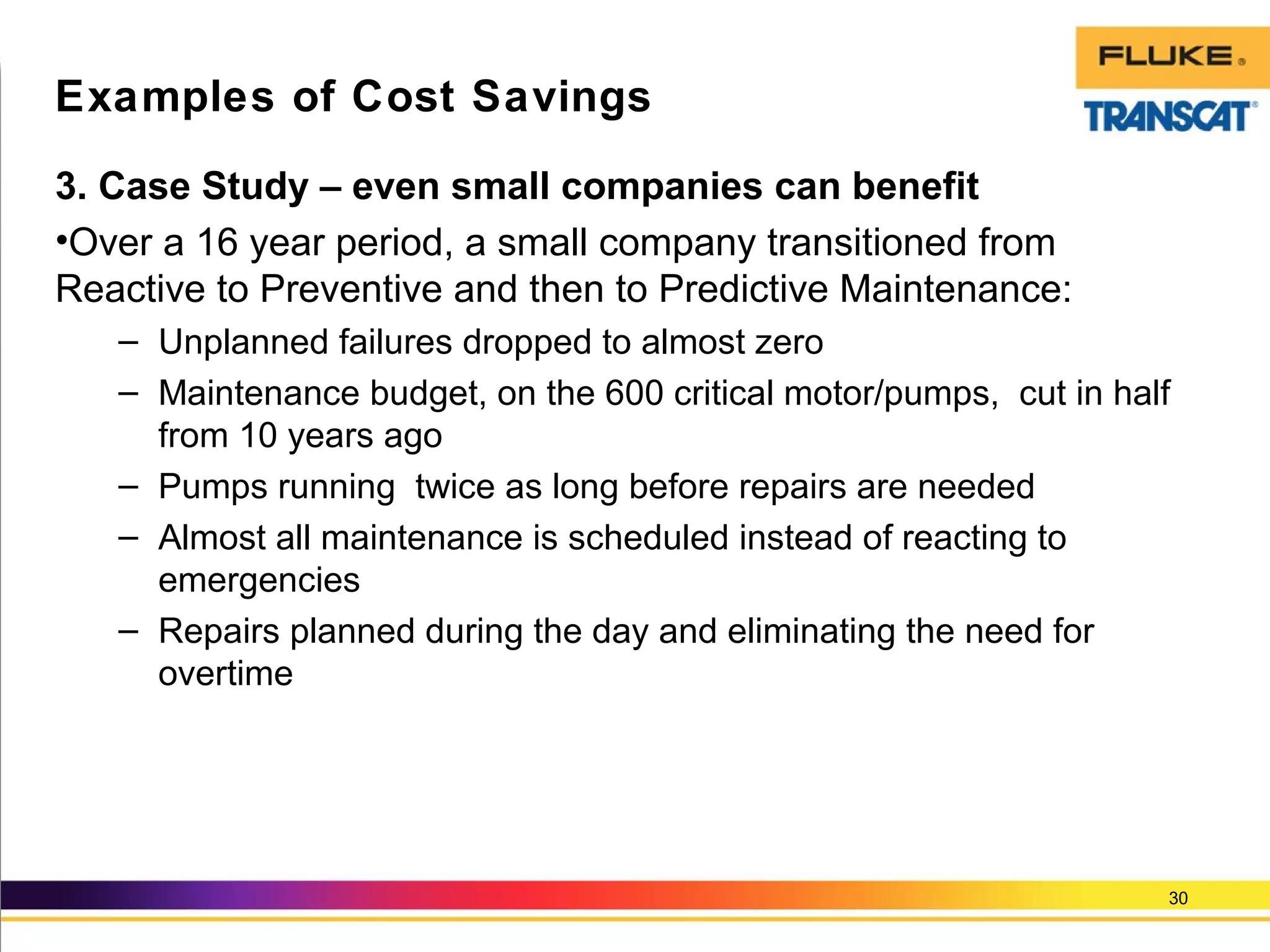
Examples of Cost Savings
The 6 benefits that they track include:
•Prevention of catastrophic failure due to early detection
•Ability to schedule repairs during plant shutdown periods
•Ability to order parts in advance of repairs
•Ability to repair exact fault instead of complete overhaul or replacement
•Planning of workers schedules
•Root cause analysis of recurring faults
3. Case Study – even small companies can benefit
•Over a 16 year period, a small company transitioned from
Reactive to Preventive and then to Predictive Maintenance:
– Unplanned failures dropped to almost zero
– Maintenance budget, on the 600 critical motor/pumps, cut in half
from 10 years ago
– Pumps running twice as long before repairs are needed
– Almost all maintenance is scheduled instead of reacting to
emergencies
– Repairs planned during the day and eliminating the need for
overtime
30
Examples of Cost Savings
• Predictability: give maintenance staff time to schedule repairs
• Safety: take faulty equipment offline
• Revenue: fewer unexpected failures prevent production
stoppages that cut into bottom line
• Increased maintenance intervals: life of equipment is extended
• Reliability: anticipate the problems coming
• Peace of mind: build confidence in maintenance schedules,
budgeting, and productivity estimates
31
Benefits of Proactive Maintenance
Different industries / companies will have different matrixes and targets. Which of
these benefits is most valuable to you?
• Ideal: Dedicated PdM or
reliability team at a large
industrial plant
– People, time and budget to do
proactive work
– Uses automated
systems/CMMS
– Determines when equipment
needs maintenance to prevent
failure
32
Solution: Asset Uptime for the Rest of Us
Technology is leveling the playing field for maintenance technicians across
facilities of all sizes: they can use the same techniques and tools to troubleshoot
as well as to inspect, log, and share – the basics of proactive maintenance
• The rest of us: Small
maintenance team at mid-sized
industrial or large commercial
facility with
– No dedicated people
– Broad responsibilities but not
the scope or budget to go full
SCADA
– Gather data by hand as the
job dictates
Don’t try to do the whole plant at once
•Start with simple machines with common problems
•Use simple check lists before moving to electronic programs
•Show success in early wins, gain buy-in and support to grow program
•Proactive maintenance measurements aren’t that different from
troubleshooting tests – only faster, easier, and no expert is needed
Simple steps
•Take “good” baseline data points – compare over time to good baseline
•Quick periodic inspections with screening tools to find problems
•Return with smart diagnostic tools – find fault and diagnose repair action
•Repair fault with smart corrective tools – fix it quickly & return to service
•Validate repair with screening tool
33
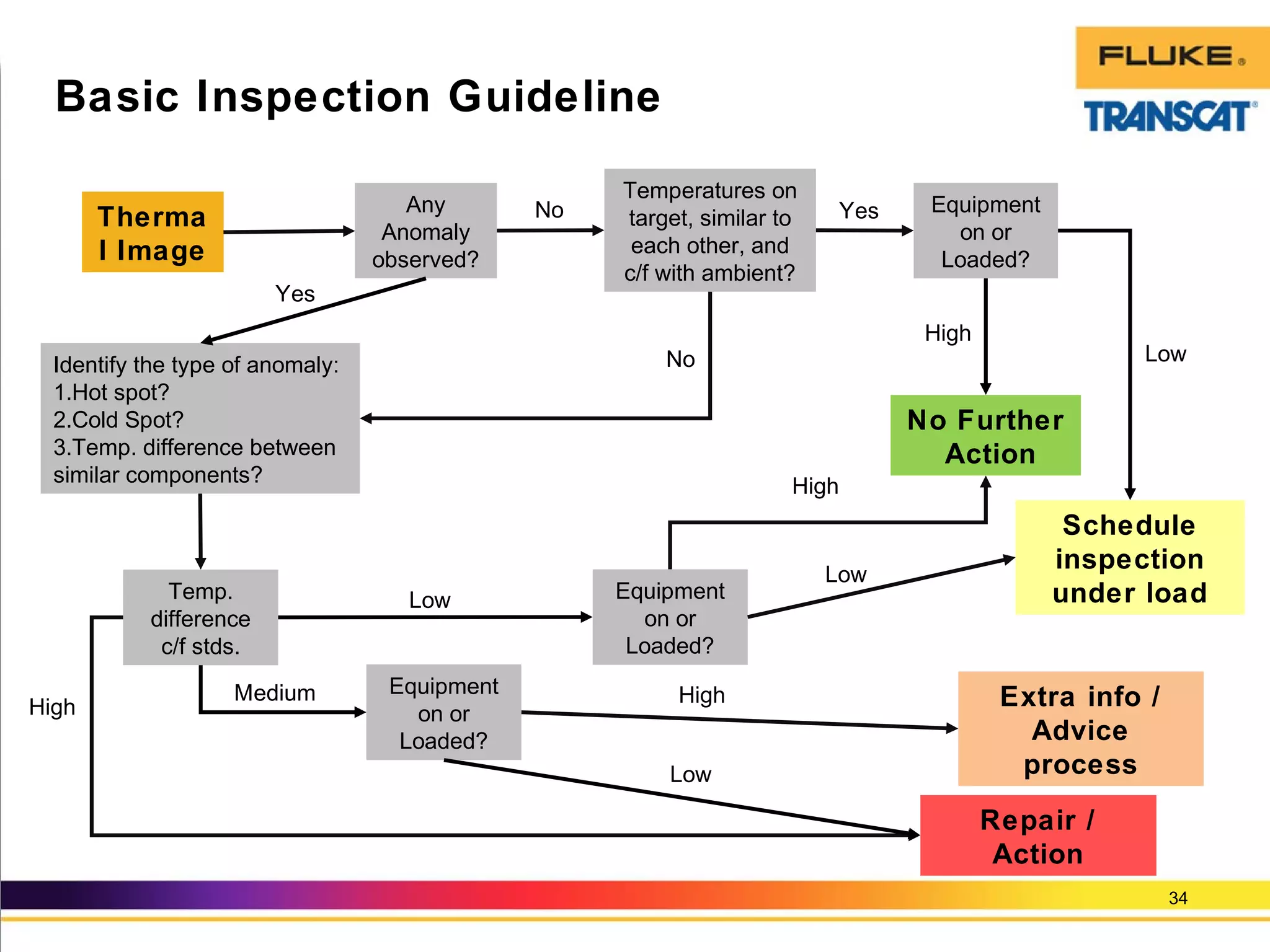
Program Start-up: Start Small and Grow
34
Basic Inspection Guideline
Schedule
inspection
under load
Therma
l Image
Any
Anomaly
observed?
Equipment
on or
Loaded?
Equipment
on or
Loaded?
Equipment
on or
Loaded?
Temperatures on
target, similar to
each other, and
c/f with ambient?
Temp.
difference
c/f stds.
Identify the type of anomaly:
1.Hot spot?
2.Cold Spot?
3.Temp. difference between
similar components?
No Further
Action
Extra info /
Advice
process
Repair /
Action
No
Yes
Yes
No Low
Low
Low
High
High
High
High
Low
Medium
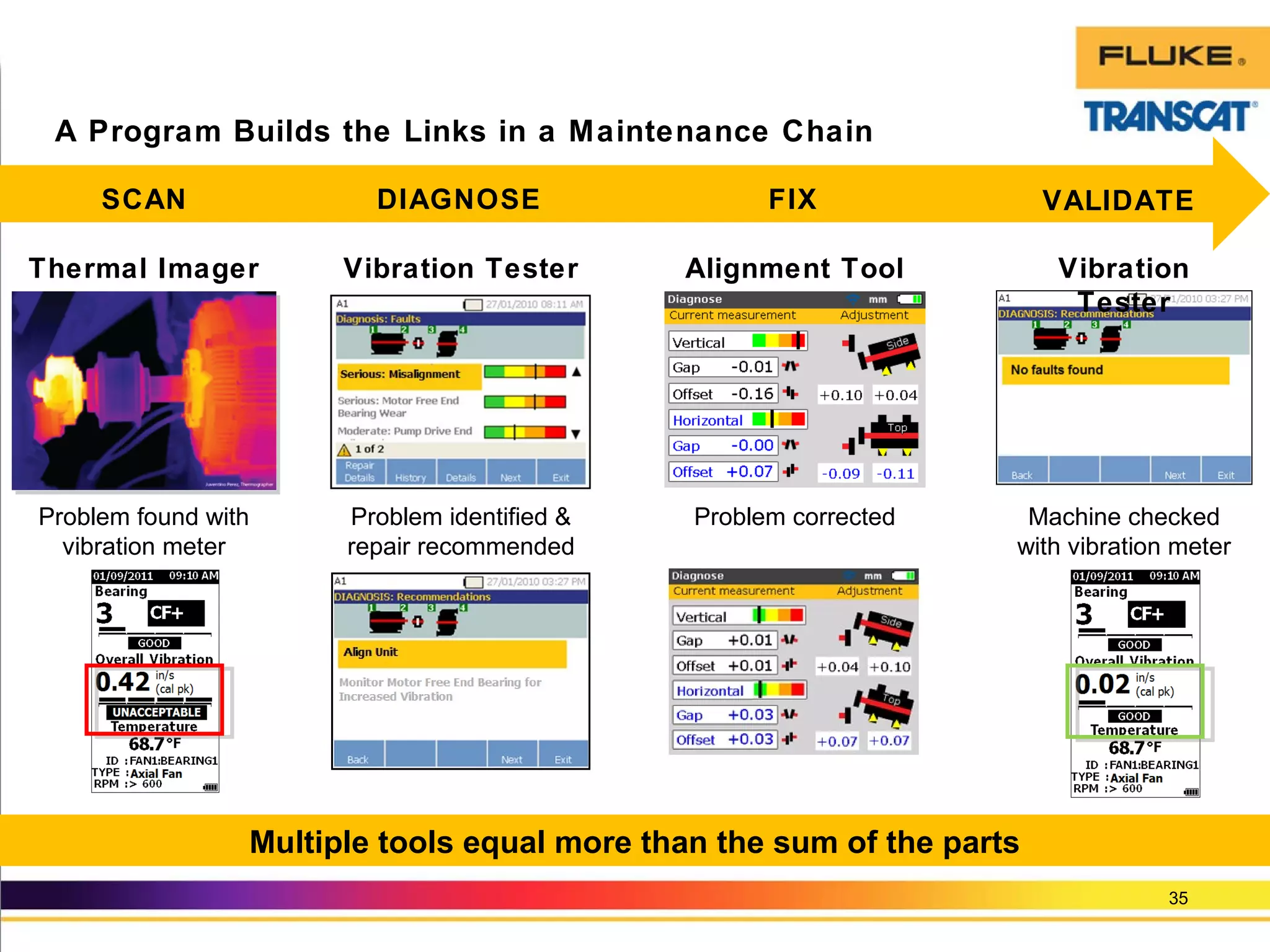
35
A Program Builds the Links in a Maintenance Chain
Multiple tools equal more than the sum of the parts
Alignment Tool
Problem corrected
Vibration Tester Vibration
Tester
Problem identified &
repair recommended
Machine checked
with vibration meter
Thermal Imager
Problem found with
vibration meter
SCAN DIAGNOSE FIX VALIDATE
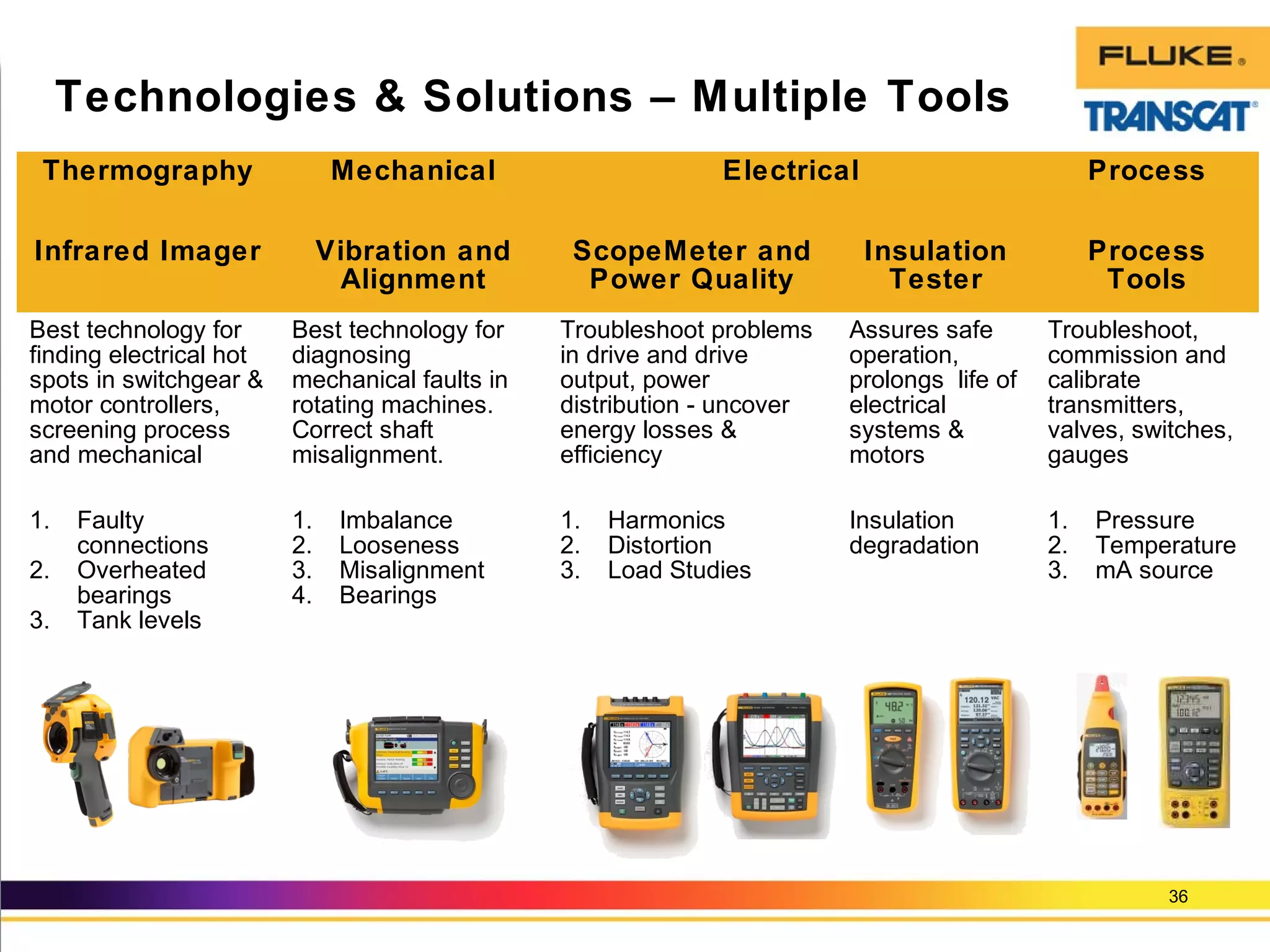
36
Technologies & Solutions – Multiple Tools
Thermography Mechanical Electrical Process
Infrared Imager Vibration and
Alignment
ScopeMeter and
Power Quality
Insulation
Tester
Process
Tools
Best technology for
finding electrical hot
spots in switchgear &
motor controllers,
screening process
and mechanical
Best technology for
diagnosing
mechanical faults in
rotating machines.
Correct shaft
misalignment.
Troubleshoot problems
in drive and drive
output, power
distribution - uncover
energy losses &
efficiency
Assures safe
operation,
prolongs life of
electrical
systems &
motors
Troubleshoot,
commission and
calibrate
transmitters,
valves, switches,
gauges
1. Faulty
connections
2. Overheated
bearings
3. Tank levels
1. Imbalance
2. Looseness
3. Misalignment
4. Bearings
1. Harmonics
2. Distortion
3. Load Studies
Insulation
degradation
1. Pressure
2. Temperature
3. mA source
• I want to see a camera?
• I want to learn more about thermal imaging?
• I want an IR camera?
• I want to talk about my specific application?
•  We have 2 certified Level I thermographers on staff
– Ben Goodhead
– Susan Garofalo
37
Before we dismiss…
Questions or Comments?
Email Nicole VanWert-Quinzi
nvanwert@Transcat.com
Transcat: 800-800-5001
www.Transcat.com
For related product information, go to:
www.Transcat.com/Fluke

Thermal Imaging in your Maintenance Program: Intermediate Infrared Concepts and Best Practices

  • 1.
    Intermediate Infrared Conceptsand Best Practices: Thermal Imaging in your Maintenance Program Sat Sandhu Thermography Services Support Manager Thermal / Infrared Thermography, Level III Certified in compliance with (ASNT) SNT-TC-1A-2006 1
  • 2.
    • Review andintroduction to Thermal imaging • The basics of performing an inspection with an infrared camera • Tips on how to effectively spot issues with an infrared camera • Causes and examples of Electrical, Mechanical, Process and Building Diagnostics • How to tie infrared inspections into your preventative maintenance program 2 Agenda
  • 3.
    My name isSat Sandhu Welcome! Please note, this is a short class – you will not become a thermography expert in the next hour 3 Introduction
  • 4.
    • Infrared radiationcan be sensed by our skin, yet cannot be seen by our eyes! 4 What is infrared?
  • 5.
    • Infrared cannotbe seen (but can be sensed by our skin) • Everything emits infrared radiation • A camera converts the “infrared image” to a visible picture • Infrared allows you to “see” things that you normally can’t 5 What is a Thermal Image? Visual image Same image in infrared
  • 6.
    • Thousands ofIR temperature measurements taken • Each “pixel” represents a temperature measurement • Assigned a color value to create an image 6 How is an infrared image created?
  • 7.
    • Most electricaland mechanical defects cause increase in temperature • Thermal imaging provides a fast and clear picture of this temperature increase • Safety: Thermal images can be taken while production is running without any contact • Anybody can take a picture! 7 How can infrared help me?
  • 8.
    • Electrical • Mechanical •Process Manufacturing • Building Diagnostics • R&D • Utilities 8 Thermal Imaging Applications
  • 9.
    • Ensure adequatethermal gradients • Understand thermal capacitance • Account for wind effects • Avoid angular variations • Remember heat transfers from hot to cold • Be aware of your surroundings • Know when qualitative measurements are sufficient • Compare similar components under similar conditions 9 Thermal Imaging Considerations
  • 10.
    • Understand presentand future loading conditions • Inspect with highest load possible (at least 40%) 10 Thermal Imaging Considerations
  • 11.
    • Objects andmaterials with high thermal capacitance take time to cool down, while objects and materials with low thermal capacitance cool down quickly – Air has low thermal capacity, water has high thermal capacity 11 Heat Capacity On a flat roof, after the sun goes down, dry insulation cools faster than wet insulation (wet insulation has higher thermal capacity) Thermal capacitance can help find the liquid level in a tank
  • 12.
    How far canI see? Distance from CameraL1 M4 L1 M4 Spot Size & Resolution
  • 13.
    • Larger areafor average temperature when further away • Distance to spot ratio • Zoom lens decreases spot size 13 Spot Size & Resolution
  • 14.
    • Emissivity • Understandthe equipment • Load conditions • Comparative inspections • Hot spots • Cold spots 14 TIPS: How to Effectively Spot Issues with an Infrared Camera
  • 15.
    This can ofsuds is ice cold straight out of the fridge. When scanned with the IR Camera you would expect the entire image to be relatively even in temperature and to appear “cold” in relation to the background. What is causing the spot in the center to appear warm? 15 What happened to my beer!?
  • 16.
    Everything in natureemits electromagnetic radiation. Emissivity is the ratio of thermal energy emission of the target object, over the thermal energy emission of a true blackbody (perfect emitter). The paint on the outside of this can has been worn off in a small area. The bare aluminum has a different emissivity than the painted aluminum. The imager sees the bare aluminum as hotter than the rest of the can. 16 Emissivity! TIP: Use Electrical Tape to cover a low emissive surface to increase the emissivity and accuracy of the measurement
  • 17.
    • Unbalanced loads •Harmonics (3rd harmonic current in Neutral) • Overloaded systems/excessive current • Loose or corroded connections increased resistance in the circuit • Insulation failure • Component failure • Wiring mistakes • Underspecified components 17 Causes of Electrical Hot Spots
  • 18.
    18 Examples of ElectricalHot Spots Hot phase Fuse disconnect Substation Lighting Circuit Motor Control Center Buss
  • 19.
    • Bad coolingbecause of reduced airflow • PQ problems like unbalance, overload or 5th harmonic (voltage) • Insulation problems with motor windings • Bearing problems – lubrication, wear, tolerance • Bad alignment 19 Causes of Mechanical Hot Spots
  • 20.
    20 Examples of MechanicalHot Spots Compressors - normal Hydraulic pumps Misaligned beltElectric motor Roller bearingsCoupling
  • 21.
    • Damaged structurescaused by worn pipes • Abnormal heat flow/heat gradients • Defective valves/traps • Normal tank level fluctuations 21 Causes of Process Hot Spots
  • 22.
    22 Examples of ProcessHot Spots Weld cooling Tank Levels 119.7°C 302.2°C 150 200 250 300 Steam TrapsCement Kiln Pipe IntegrityChiller Operation
  • 23.
    • Roof leaks •Air Leak • In-floor heating • Missing insulation 23 Causes of Building Diagnostics Hot Spots
  • 24.
    24 Examples of BuildingDiagnostics Hot Spots Roof deck moisture In-floor heat verification Missing insulationMoisture Air Leak Attic access – air leak
  • 25.
    • Trends • Maintenanceprograms • Cost Savings • Solutions • Build a Successful program 25 How to Tie Infrared Inspections into your Preventative Maintenance Program
  • 26.
    Downtime is getting moreexpensive – maintenance must do more with less 26 Trends in Industrial Maintenance Companies are using maintenance best practices to reinforce and extend their competitive advantages Awareness is growing quickly New maintenance technologies are experiencing mass adoption ECONOMICS AWARENESS TECHNOLOGY
  • 27.
    27 Definitions Preventive (PM): “calendar-based” Predictive (PdM): “condition-based” Time NormalOperation Wear OutBreak In The Bathtub Curve Casualties Reactive: “run to failure” Proactive Reliability Centered: “asset uptime based”
  • 28.
    1. EPRI –study of many plants in many different industries •A comprehensive study by the Electric Power Research Institute found: 28 Examples of Cost Savings Maintenance practices Cost to maintain rotating machinery Cost savings Plants that are Reactive (Run to failure) $17/HP/Year No savings Plants that are Preventive (Calendar- based) $13/HP/Year 24% over Reactive Plants that are Predictive (Condition- based) $9/HP/Year 47% over Reactive
  • 29.
    2. Cost toBenefit Studies •A large company implemented a Predictive Maintenance program on hundreds of their motors, pumps, fans, compressors and blowers •This program has been successful for over 25 years •They document the cost of the program and savings they enjoy •Savings were many millions of dollars per year •Every 2 years they conduct a Cost to Benefit study to compare the program cost to the documented savings •The average Cost to Benefit ratio for the past 30 years has been over 20:1 29 Examples of Cost Savings The 6 benefits that they track include: •Prevention of catastrophic failure due to early detection •Ability to schedule repairs during plant shutdown periods •Ability to order parts in advance of repairs •Ability to repair exact fault instead of complete overhaul or replacement •Planning of workers schedules •Root cause analysis of recurring faults
  • 30.
    3. Case Study– even small companies can benefit •Over a 16 year period, a small company transitioned from Reactive to Preventive and then to Predictive Maintenance: – Unplanned failures dropped to almost zero – Maintenance budget, on the 600 critical motor/pumps, cut in half from 10 years ago – Pumps running twice as long before repairs are needed – Almost all maintenance is scheduled instead of reacting to emergencies – Repairs planned during the day and eliminating the need for overtime 30 Examples of Cost Savings
  • 31.
    • Predictability: givemaintenance staff time to schedule repairs • Safety: take faulty equipment offline • Revenue: fewer unexpected failures prevent production stoppages that cut into bottom line • Increased maintenance intervals: life of equipment is extended • Reliability: anticipate the problems coming • Peace of mind: build confidence in maintenance schedules, budgeting, and productivity estimates 31 Benefits of Proactive Maintenance Different industries / companies will have different matrixes and targets. Which of these benefits is most valuable to you?
  • 32.
    • Ideal: DedicatedPdM or reliability team at a large industrial plant – People, time and budget to do proactive work – Uses automated systems/CMMS – Determines when equipment needs maintenance to prevent failure 32 Solution: Asset Uptime for the Rest of Us Technology is leveling the playing field for maintenance technicians across facilities of all sizes: they can use the same techniques and tools to troubleshoot as well as to inspect, log, and share – the basics of proactive maintenance • The rest of us: Small maintenance team at mid-sized industrial or large commercial facility with – No dedicated people – Broad responsibilities but not the scope or budget to go full SCADA – Gather data by hand as the job dictates
  • 33.
    Don’t try todo the whole plant at once •Start with simple machines with common problems •Use simple check lists before moving to electronic programs •Show success in early wins, gain buy-in and support to grow program •Proactive maintenance measurements aren’t that different from troubleshooting tests – only faster, easier, and no expert is needed Simple steps •Take “good” baseline data points – compare over time to good baseline •Quick periodic inspections with screening tools to find problems •Return with smart diagnostic tools – find fault and diagnose repair action •Repair fault with smart corrective tools – fix it quickly & return to service •Validate repair with screening tool 33 Program Start-up: Start Small and Grow
  • 34.
    34 Basic Inspection Guideline Schedule inspection underload Therma l Image Any Anomaly observed? Equipment on or Loaded? Equipment on or Loaded? Equipment on or Loaded? Temperatures on target, similar to each other, and c/f with ambient? Temp. difference c/f stds. Identify the type of anomaly: 1.Hot spot? 2.Cold Spot? 3.Temp. difference between similar components? No Further Action Extra info / Advice process Repair / Action No Yes Yes No Low Low Low High High High High Low Medium
  • 35.
    35 A Program Buildsthe Links in a Maintenance Chain Multiple tools equal more than the sum of the parts Alignment Tool Problem corrected Vibration Tester Vibration Tester Problem identified & repair recommended Machine checked with vibration meter Thermal Imager Problem found with vibration meter SCAN DIAGNOSE FIX VALIDATE
  • 36.
    36 Technologies & Solutions– Multiple Tools Thermography Mechanical Electrical Process Infrared Imager Vibration and Alignment ScopeMeter and Power Quality Insulation Tester Process Tools Best technology for finding electrical hot spots in switchgear & motor controllers, screening process and mechanical Best technology for diagnosing mechanical faults in rotating machines. Correct shaft misalignment. Troubleshoot problems in drive and drive output, power distribution - uncover energy losses & efficiency Assures safe operation, prolongs life of electrical systems & motors Troubleshoot, commission and calibrate transmitters, valves, switches, gauges 1. Faulty connections 2. Overheated bearings 3. Tank levels 1. Imbalance 2. Looseness 3. Misalignment 4. Bearings 1. Harmonics 2. Distortion 3. Load Studies Insulation degradation 1. Pressure 2. Temperature 3. mA source
  • 37.
    • I wantto see a camera? • I want to learn more about thermal imaging? • I want an IR camera? • I want to talk about my specific application? •  We have 2 certified Level I thermographers on staff – Ben Goodhead – Susan Garofalo 37 Before we dismiss…
  • 38.
    Questions or Comments? EmailNicole VanWert-Quinzi nvanwert@Transcat.com Transcat: 800-800-5001 www.Transcat.com For related product information, go to: www.Transcat.com/Fluke

Editor's Notes

  • #4 MENTION HOW TO ASK QUESTIONS
  • #5 Infrared is just one form of electromagnetic radiation. The visible part of the spectrum is what we see with our eyes. Other parts of the EM spectrum include Gamma rays, X-rays, Radio waves, microwaves. The infrared part of the EM spectrum is not visible to our eyes. Just like radio waves, gamma etc. Therefore just like our eyes are sensitive to a specific portion of the EM spectrum, equally Thermal imagers are only sensitive to the IR part of the EM spectrum. So for e.g. it is not a X-Ray camera, and cannot view through solids. Despite what is shown in James Bond or other sc-fi films. The main point to note is that IR radiation is E.M. radiation.
  • #6 Infrared radiation is radiated heat that cannot be seen by our eyes - but can be sensed by our skin. All objects emit infrared radiation and the amount of radiation increases with the objects temperature. When you look at the visible image to the right you can see it with your eyes because the light in the room reflects on the wall and reaches your eyes. It is a Reflected image you see! The corresponding infrared image (click) is Emitted by the object itself! Therefore it contains information about the thermal condition of the object! Thermal Imaging is the science of “seeing” temperature by measuring the radiation emitted from an object and converting this data to a corresponding visual image. The colors that you see on the IR image are a measurement of the temperature of the object. Each color corresponds to a different temperature.
  • #13 Just like a visible camera the nearer you are, the more detail you can see. Whilst the scene size will be smaller. So the distance you need to be from the object you are trying to view will vary depending on the size and the part of the object you are interested in.
  • #27 Next, let’s look at industry trends DOWNTIME IS GETTING MORE EXPENSIVE Scale of facilities is increasing and commodity costs are increasing Facilities are becoming more specialized MAINTENANCE MUST DO MORE WITH LESS Workforce becoming leaner – experts are retiring but not being replaced Production demands are up while budgets are continually decreasing Just In Time processes reduces room for error AWARENESS IS GROWING QUICKLY The value of maintenance best practices is gaining significant attention from industry influencers and professional associations NEW MAINTENANCE TECHNOLOGIES ARE EXPERIENCING MASS ADOPTION Tool prices continue to fall while performance goes up Complex tools are becoming smarter and easier to use Maintenance practices are shifting from outsourced to in-sourced. Economics are making it harder and harder to make a profit using run to failure maintenance Maintenance staff must do more with less – experts are retiring, production demands increase while budgets decrease, margins are getting closer and closer Awareness is growing – value of best practices are being talked about everywhere New technologies are getting adopted – complex tools are becoming smarter and easier to use Companies are using their best practices to extend their competitive advantage
  • #28 Examples An individual bought an incandescent light bulb. The manufacturing company mentioned that the life span of the bulb is 3 years. Just before the 3 years, the individual decided to replace the bulb with a new one. This is called preventive maintenance. On the other hand, the individual has the opportunity to observe the bulb operation daily. After two years, the bulb starts flickering. The individual predicts at that time that the bulb is going to fail very soon and decides to change it for a new one. This is called predictive maintenance. The individual ignores the flickering bulb and only goes out to buy another replacement light bulb when the current one fails. This is called corrective maintenance.

  • #36 In order to keep the plant up and running, we need to look at the various tools that make up the maintenance chain First, we screen our machines to find out which ones are good or bad – a thermal imager or vibration meter can Second, we need to diagnose the machine faults and, more importantly, determine a repair recommendation Third, we need to correct the problem And last, we need to check the machine to make sure the repair is good and return the machine to service