Field Pressure Calibration Tips
John Lopez, Fluke Calibration
Field Pressure Calibration Tips
What are we talking about anyway?
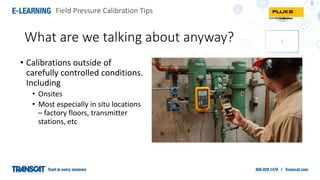
• Calibrations outside of
carefully controlled conditions.
Including
• Onsites
• Most especially in situ locations
– factory floors, transmitter
stations, etc
Field Pressure Calibration Tips
• Pressure ranges
• Accuracies
• Examples of standards, pros and cons
Overview
Field Pressure Calibration Tips
• How I think about it
• “High” pressure
• “Low” pressure
• “Draft” pressure
• “Hard” vacuum
• All of these in “quotes” because these are
not solid definitions but rather categories
Ranges
Field Pressure Calibration Tips
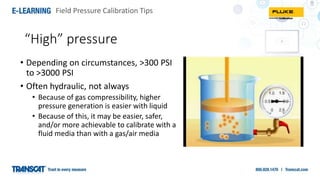
“High” pressure
• Depending on circumstances, >300 PSI
to >3000 PSI
• Often hydraulic, not always
• Because of gas compressibility, higher
pressure generation is easier with liquid
• Because of this, it may be easier, safer,
and/or more achievable to calibrate with a
fluid media than with a gas/air media
Field Pressure Calibration Tips
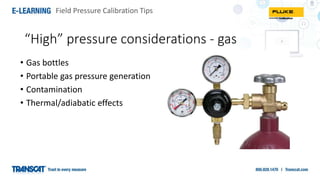
“High” pressure considerations - gas
• Gas bottles
• Portable gas pressure generation
• Contamination
• Thermal/adiabatic effects
Field Pressure Calibration Tips
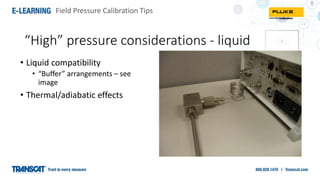
“High” pressure considerations - liquid
• Liquid compatibility
• “Buffer” arrangements – see
image
• Thermal/adiabatic effects
Field Pressure Calibration Tips
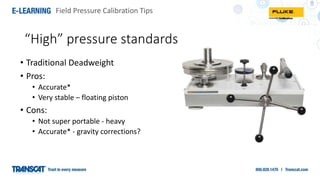
“High” pressure standards
• Traditional Deadweight
• Pros:
• Accurate*
• Very stable – floating piston
• Cons:
• Not super portable - heavy
• Accurate* - gravity corrections?
Field Pressure Calibration Tips
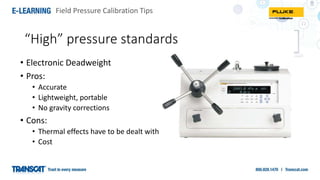
“High” pressure standards
• Electronic Deadweight
• Pros:
• Accurate
• Lightweight, portable
• No gravity corrections
• Cons:
• Thermal effects have to be dealt with
• Cost
Field Pressure Calibration Tips
“High” pressure standards
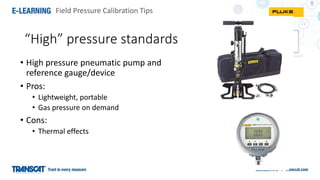
• High pressure pneumatic pump and
reference gauge/device
• Pros:
• Lightweight, portable
• Gas pressure on demand
• Cons:
• Thermal effects
Field Pressure Calibration Tips
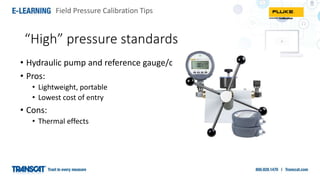
• Hydraulic pump and reference gauge/device
• Pros:
• Lightweight, portable
• Lowest cost of entry
• Cons:
• Thermal effects
“High” pressure standards
Field Pressure Calibration Tips
“Low” pressure
• From the “high” pressure cutoff region down to
a few PSI, plus vacuum
• Consider pneumatic media here, for several
reasons
• Easier to generate and control low pressure
• No fluid head calculations
• Compatibility with pneumatic devices
• Vacuum needs
Field Pressure Calibration Tips
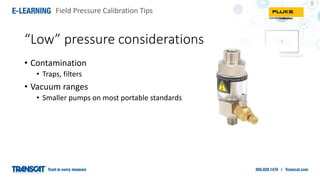
“Low” pressure considerations
• Contamination
• Traps, filters
• Vacuum ranges
• Smaller pumps on most portable standards
Field Pressure Calibration Tips
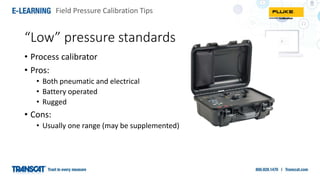
“Low” pressure standards
• Process calibrator
• Pros:
• Both pneumatic and electrical
• Battery operated
• Rugged
• Cons:
• Usually one range (may be supplemented)
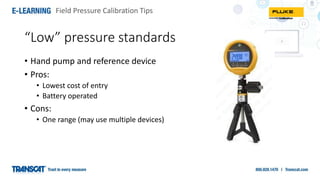
Field Pressure Calibration Tips
• Hand pump and reference device
• Pros:
• Lowest cost of entry
• Battery operated
• Cons:
• One range (may use multiple devices)
“Low” pressure standards
Field Pressure Calibration Tips
“Draft” pressure
• Less than a few PSI on each side of atmosphere
• Often delineated in units of inches of water, sometimes mBar
• Special considerations for range and stability
Field Pressure Calibration Tips
“Draft” pressure considerations
• Special considerations for range and stability
• Range: 10 inches of water is < 1/2 a PSI. A 100 PSI,
0.05% standard is >10% equivalent at this scale –
upside down against many DUTs.
• Pressure generation: how to do this safely?
• Stability: because of the relatively small difference
from draft pressures to atmosphere, environmental
influences can be significant.
• Pressure “waves”
• Thermal effects
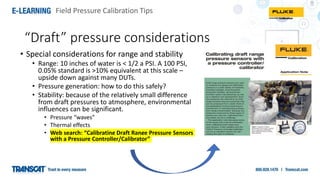
• Web search: “Calibrating Draft Range Pressure Sensors
with a Pressure Controller/Calibrator”
Field Pressure Calibration Tips
“Draft” pressure standards
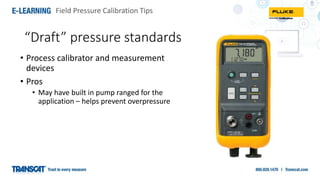
• Process calibrator and measurement
devices
• Pros
• May have built in pump ranged for the
application – helps prevent overpressure
Field Pressure Calibration Tips
“Hard” vacuum
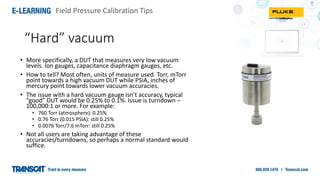
• More specifically, a DUT that measures very low vacuum
levels. Ion gauges, capacitance diaphragm gauges, etc.
• How to tell? Most often, units of measure used. Torr, mTorr
point towards a high vacuum DUT while PSIA, inches of
mercury point towards lower vacuum accuracies.
• The issue with a hard vacuum gauge isn’t accuracy, typical
“good” DUT would be 0.25% to 0.1%. Issue is turndown –
100,000:1 or more. For example:
• 760 Torr (atmosphere): 0.25%
• 0.76 Torr (0.015 PSIA): still 0.25%
• 0.0076 Torr/7.6 mTorr: still 0.25%
• Not all users are taking advantage of these
accuracies/turndowns, so perhaps a normal standard would
suffice.
Field Pressure Calibration Tips
“Hard” vacuum considerations
• Usage – specifically is calibration over full
range and accuracy required?
• If this can be treated as a “normal” vacuum
device, it makes things simpler
• Large diameter tubing
• Vacuum pumps, perhaps in series
• Dwell time
Field Pressure Calibration Tips
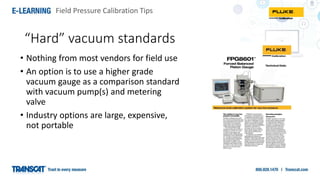
• Nothing from most vendors for field use
• An option is to use a higher grade
vacuum gauge as a comparison standard
with vacuum pump(s) and metering
valve
• Industry options are large, expensive,
not portable
“Hard” vacuum standards
Field Pressure Calibration Tips
Questions or Comments?
Email Christina Spearman christina.spearman@transcat.com
Transcat: 800-828-1470
www.transcat.com
For related product information, go to:
www.transcat.com/brand/fluke-calibration

Field Pressure Calibration Tips Webinar with Fluke Calibration

  • 1.
    Field Pressure CalibrationTips John Lopez, Fluke Calibration
  • 2.
    Field Pressure CalibrationTips What are we talking about anyway? • Calibrations outside of carefully controlled conditions. Including • Onsites • Most especially in situ locations – factory floors, transmitter stations, etc
  • 3.
    Field Pressure CalibrationTips • Pressure ranges • Accuracies • Examples of standards, pros and cons Overview
  • 4.
    Field Pressure CalibrationTips • How I think about it • “High” pressure • “Low” pressure • “Draft” pressure • “Hard” vacuum • All of these in “quotes” because these are not solid definitions but rather categories Ranges
  • 5.
    Field Pressure CalibrationTips “High” pressure • Depending on circumstances, >300 PSI to >3000 PSI • Often hydraulic, not always • Because of gas compressibility, higher pressure generation is easier with liquid • Because of this, it may be easier, safer, and/or more achievable to calibrate with a fluid media than with a gas/air media
  • 6.
    Field Pressure CalibrationTips “High” pressure considerations - gas • Gas bottles • Portable gas pressure generation • Contamination • Thermal/adiabatic effects
  • 7.
    Field Pressure CalibrationTips “High” pressure considerations - liquid • Liquid compatibility • “Buffer” arrangements – see image • Thermal/adiabatic effects
  • 8.
    Field Pressure CalibrationTips “High” pressure standards • Traditional Deadweight • Pros: • Accurate* • Very stable – floating piston • Cons: • Not super portable - heavy • Accurate* - gravity corrections?
  • 9.
    Field Pressure CalibrationTips “High” pressure standards • Electronic Deadweight • Pros: • Accurate • Lightweight, portable • No gravity corrections • Cons: • Thermal effects have to be dealt with • Cost
  • 10.
    Field Pressure CalibrationTips “High” pressure standards • High pressure pneumatic pump and reference gauge/device • Pros: • Lightweight, portable • Gas pressure on demand • Cons: • Thermal effects
  • 11.
    Field Pressure CalibrationTips • Hydraulic pump and reference gauge/device • Pros: • Lightweight, portable • Lowest cost of entry • Cons: • Thermal effects “High” pressure standards
  • 12.
    Field Pressure CalibrationTips “Low” pressure • From the “high” pressure cutoff region down to a few PSI, plus vacuum • Consider pneumatic media here, for several reasons • Easier to generate and control low pressure • No fluid head calculations • Compatibility with pneumatic devices • Vacuum needs
  • 13.
    Field Pressure CalibrationTips “Low” pressure considerations • Contamination • Traps, filters • Vacuum ranges • Smaller pumps on most portable standards
  • 14.
    Field Pressure CalibrationTips “Low” pressure standards • Process calibrator • Pros: • Both pneumatic and electrical • Battery operated • Rugged • Cons: • Usually one range (may be supplemented)
  • 15.
    Field Pressure CalibrationTips • Hand pump and reference device • Pros: • Lowest cost of entry • Battery operated • Cons: • One range (may use multiple devices) “Low” pressure standards
  • 16.
    Field Pressure CalibrationTips “Draft” pressure • Less than a few PSI on each side of atmosphere • Often delineated in units of inches of water, sometimes mBar • Special considerations for range and stability
  • 17.
    Field Pressure CalibrationTips “Draft” pressure considerations • Special considerations for range and stability • Range: 10 inches of water is < 1/2 a PSI. A 100 PSI, 0.05% standard is >10% equivalent at this scale – upside down against many DUTs. • Pressure generation: how to do this safely? • Stability: because of the relatively small difference from draft pressures to atmosphere, environmental influences can be significant. • Pressure “waves” • Thermal effects • Web search: “Calibrating Draft Range Pressure Sensors with a Pressure Controller/Calibrator”
  • 18.
    Field Pressure CalibrationTips “Draft” pressure standards • Process calibrator and measurement devices • Pros • May have built in pump ranged for the application – helps prevent overpressure
  • 19.
    Field Pressure CalibrationTips “Hard” vacuum • More specifically, a DUT that measures very low vacuum levels. Ion gauges, capacitance diaphragm gauges, etc. • How to tell? Most often, units of measure used. Torr, mTorr point towards a high vacuum DUT while PSIA, inches of mercury point towards lower vacuum accuracies. • The issue with a hard vacuum gauge isn’t accuracy, typical “good” DUT would be 0.25% to 0.1%. Issue is turndown – 100,000:1 or more. For example: • 760 Torr (atmosphere): 0.25% • 0.76 Torr (0.015 PSIA): still 0.25% • 0.0076 Torr/7.6 mTorr: still 0.25% • Not all users are taking advantage of these accuracies/turndowns, so perhaps a normal standard would suffice.
  • 20.
    Field Pressure CalibrationTips “Hard” vacuum considerations • Usage – specifically is calibration over full range and accuracy required? • If this can be treated as a “normal” vacuum device, it makes things simpler • Large diameter tubing • Vacuum pumps, perhaps in series • Dwell time
  • 21.
    Field Pressure CalibrationTips • Nothing from most vendors for field use • An option is to use a higher grade vacuum gauge as a comparison standard with vacuum pump(s) and metering valve • Industry options are large, expensive, not portable “Hard” vacuum standards
  • 22.
    Field Pressure CalibrationTips Questions or Comments? Email Christina Spearman christina.spearman@transcat.com Transcat: 800-828-1470 www.transcat.com For related product information, go to: www.transcat.com/brand/fluke-calibration