FUNCTION OF MAINTENANCE
  - The function of maintenance is to ensure that plant
    and equipment are available in a satisfactory condition for
    operation when required
  - Satisfactory condition for the rotating machinery depends
    on
       1. Type of industry ( determine the level of machine
          performance required)
       2. Process requirement ( the requirement of a machine
          that is critical to the process will be greater one for than
          non critical)
       3. Business objectives product demand and profit levels
          fluctuating demands on equipment and performance
          requirements

The performance of maintenance function can be judged by the
condition of machinery and by the following factors

  1. Performance: machines must be capable of performing the
     function
  2. Downtime: machine must operate with acceptable level of
     downtime
  3. Service life: machines must provide a satisfactory return on
     investment
  4. Efficiency: machine must operate with safety accuracy
     productivity and minimum power loss
  5. Safely: machine must operate safely and not dangerous to
     personnel
  6. Environmental impact: machine must operate in a manner
     to adjacent plant and equipment
  7. Cost: the cost of maintenance must be acceptable
Maintenance programs
There are three types;
1. Corrective maintenance (CrM)
 2. Preventive maintenance (PM)
3. Predictive maintenance (PdM)


Corrective maintenance: defined as the remedial action
carried out due to failure or deficiencies discovered during
preventive maintenance to repair an equipment to its
operational state


the activities of corrective maintenance? Explain with an
example.
1. fail-repair:
The failed item is restored to its operational state.
2. Salvage
This element of corrective maintenance is concerned with
disposal of non repairable material.
3. Rebuild:
This is concerned with restoring an item to a standard as
close as possible to original state.
4. Overhaul:
Restoring an item to its total serviceable state as per
maintenance serviceability standards.
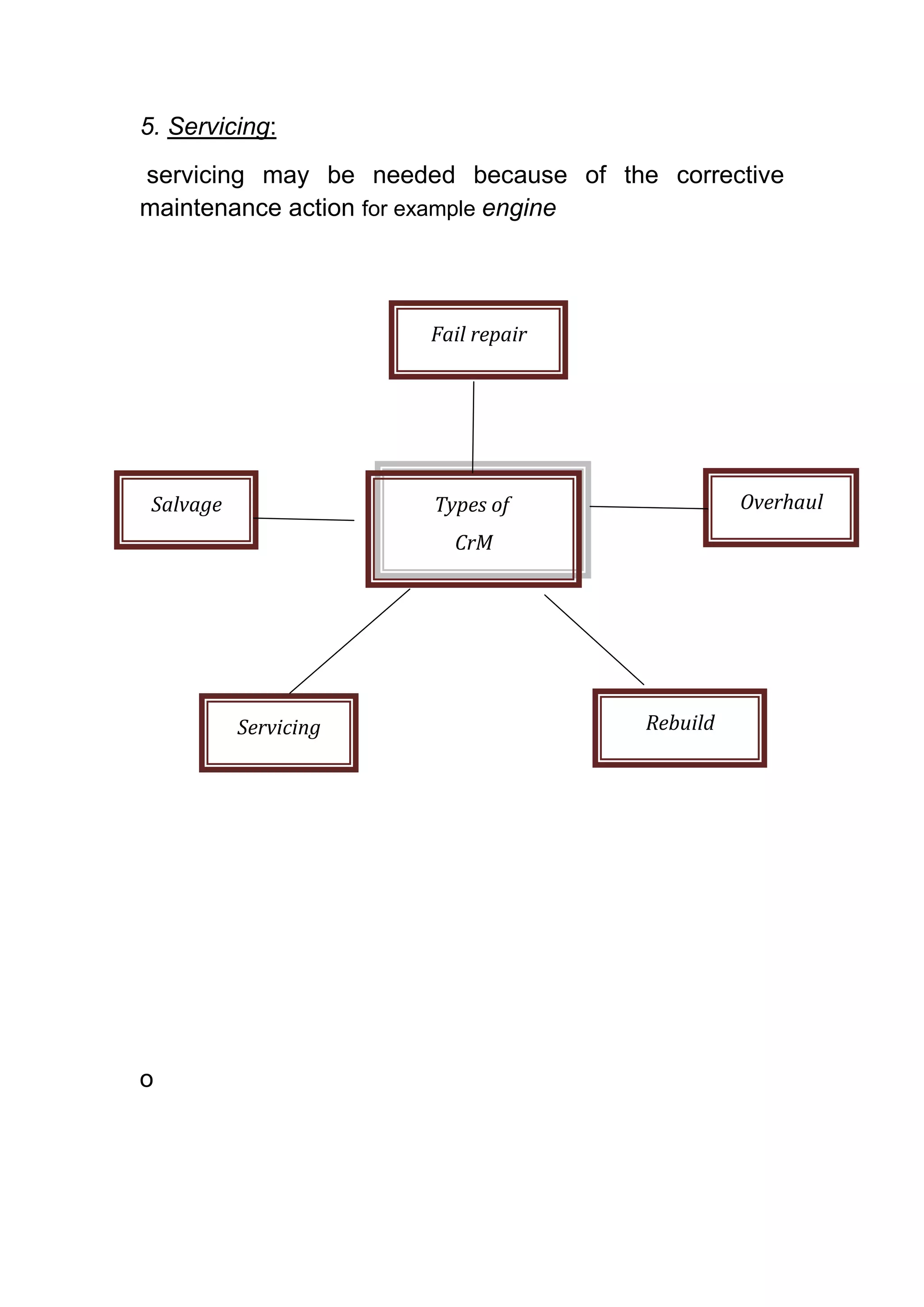
5. Servicing:
servicing may be needed because of the corrective
maintenance action for example engine


                       Fail repair


 Salvage               Types of                 Overhaul
                         CrM


           Servicing                  Rebuild


o
The advantage        and    disadvantages   of   corrective
maintenance
Advantages:
1. Low cost.
2. Less staff.
Disadvantages:
1. Increased cost due to unplanned downtime.
2. Increased labor cost.
3. Cost involved with repair.
4. Possible secondary equipment.
5. Inefficient use of staff resources


Preventive maintenance (PM) ( time – based)
Preventive maintenance can be defined as: actions
performed on a time or machine run based schedule that
detect delay or mitigate degradation of a component
Advantages

     Cost effective in many capital intensive processes
     Flexibility allows for the adjustment of maintenance
     periodicity
     Increased component life cycle
     Energy saving
     Reduced equipment failure
     Cost savings
Disadvantages

    Catastrophic failures still likely to occur
    Labor intensive
    Include performance of unneeded maintenance
    Potential for incidental damage to components in
    unneeded maintenance

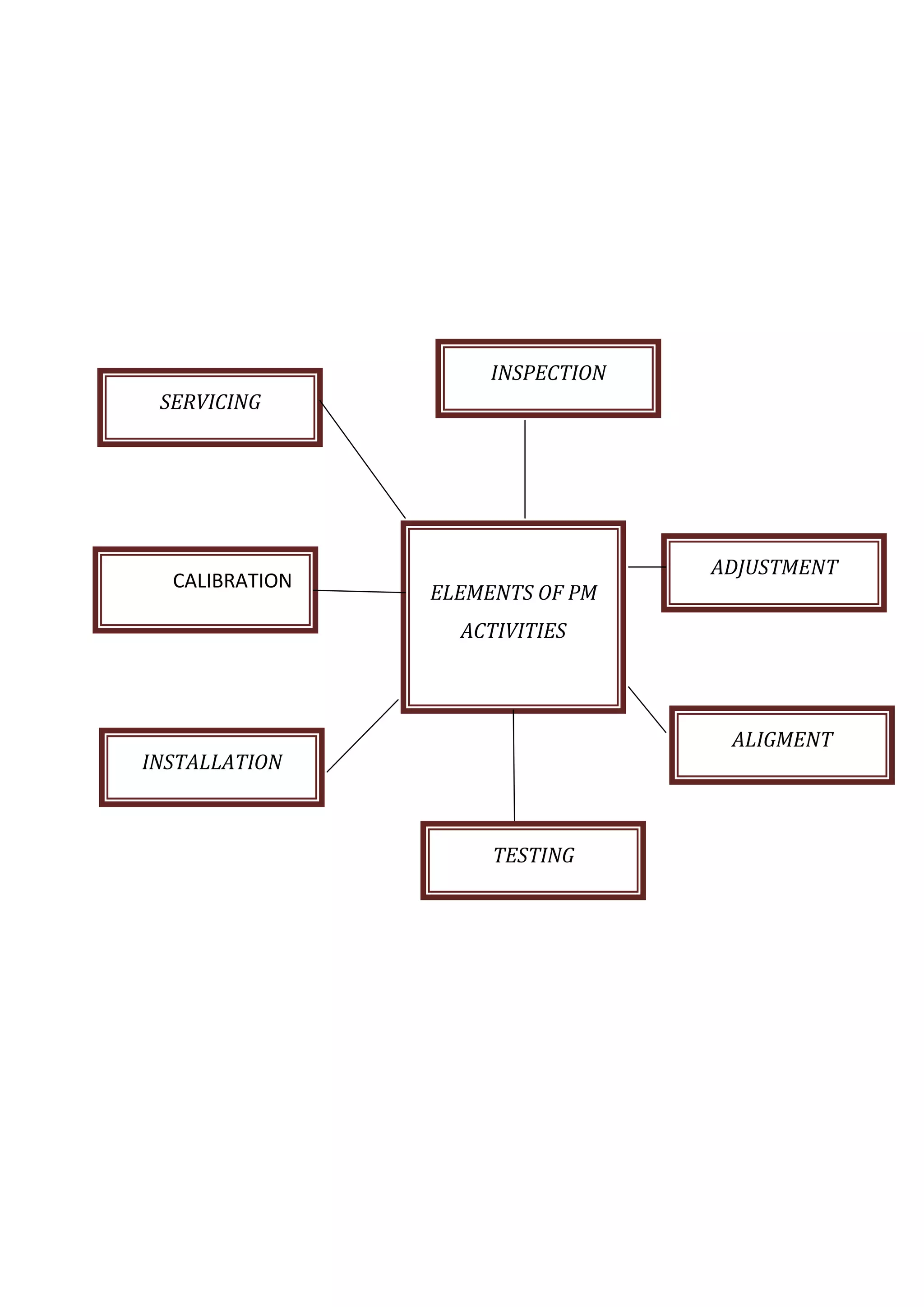
    main activities of preventive maintenance

    1. Inspection. To determine their serviceability

    2. Servicing. Cleaning, lubricating, charging

    3- Calibration periodically determining the value of
    characteristics of item

    4. Testing. Periodically testing or checking out to
    determine serviceability and detect degradation

    5. Alignment. Making change to achieving optimum
    performance

    6. Adjustment.      Periodically adjusting specified
    variable elements of material for the purpose of
    achieving the optimum performance

    7. Installation. Periodic replacement of limited life
    item to maintain the specified system tolerance
INSPECTION
 SERVICING


                                  ADJUSTMENT
  CALIBRATION
                ELEMENTS OF PM
                  ACTIVITIES


                                   ALIGMENT
INSTALLATION


                     TESTING
Predictive Maintenance (PM)
( based on quantified material/ equipment condition
Measurements that detect the onset of a degradation
mechanism results indicate current and future functional
capability
Difference between predictive maintenance and
preventive maintenance by using maintenance need on
the actual condition of the machine rather than on some
preset schedule


Advantages of predictive maintenance
1. Increased component operational life.
2. Allows for preemptive corrective actions.
3. Decrease in equipment or process downtime.
4. Decrease in costs for parts.
5. Better product quality.
6. Improved worker and environmental safety.
7. Improved worker moral.
8. Energy savings.
9. Estimated 8% to 12% cost savings over pm program


Disadvantages of predictive maintenance
1. Increased investment in diagnostic equipment.
2. Increased investment in staff training.
3. Savings potential not read.
Pro- active maintenance
Uses a variety of technologies to extend the operating
lives of machines and to virtually eliminate reactive
maintenance (root cause failure analysis)
Benefit:
1. Resulting in greatly extended machine life.
2. Reduced down time.
3. Expanded production capacity


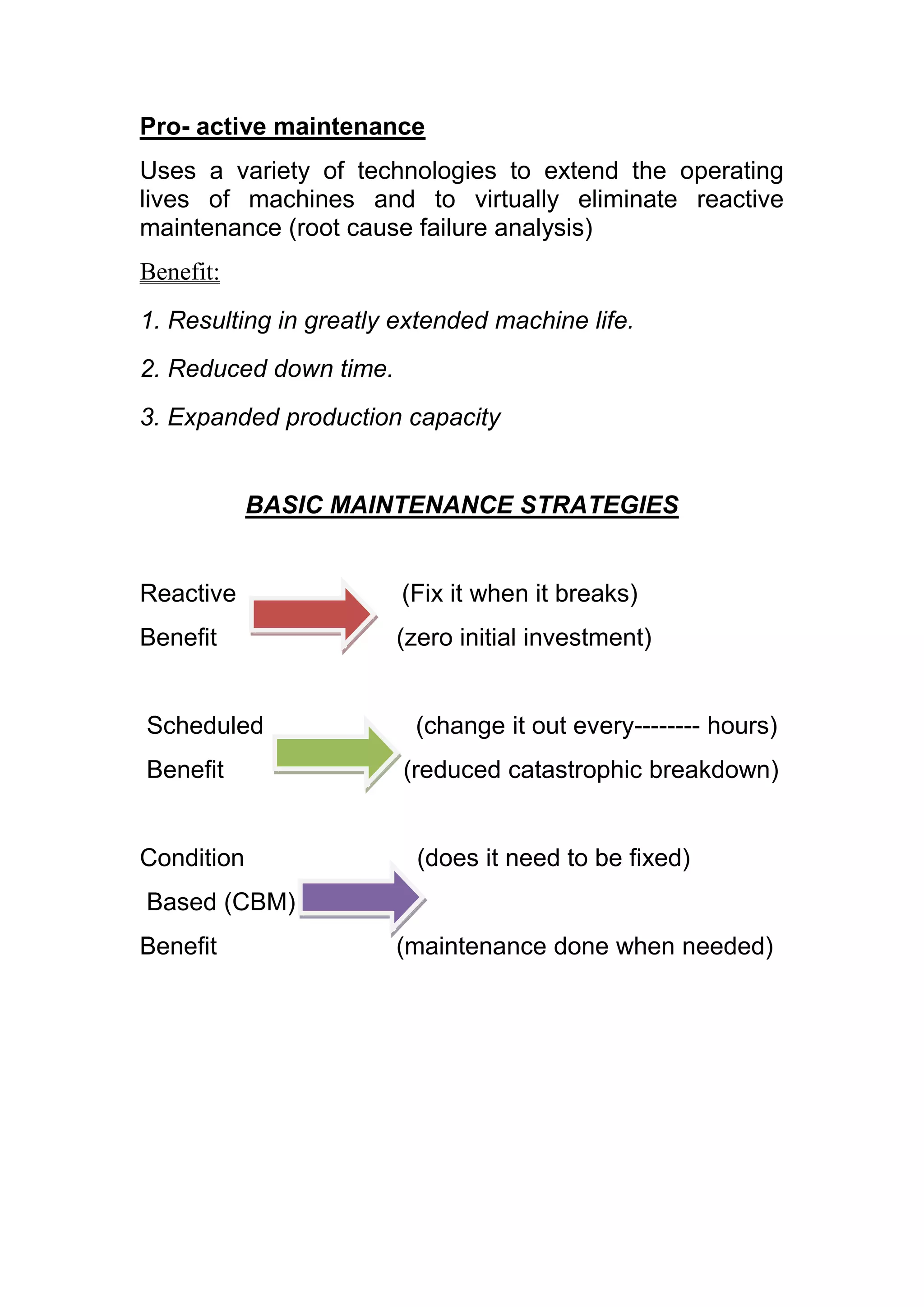
            BASIC MAINTENANCE STRATEGIES


Reactive                (Fix it when it breaks)
Benefit                 (zero initial investment)


Scheduled                (change it out every-------- hours)
Benefit                 (reduced catastrophic breakdown)


Condition                 (does it need to be fixed)
Based (CBM)
Benefit                 (maintenance done when needed)
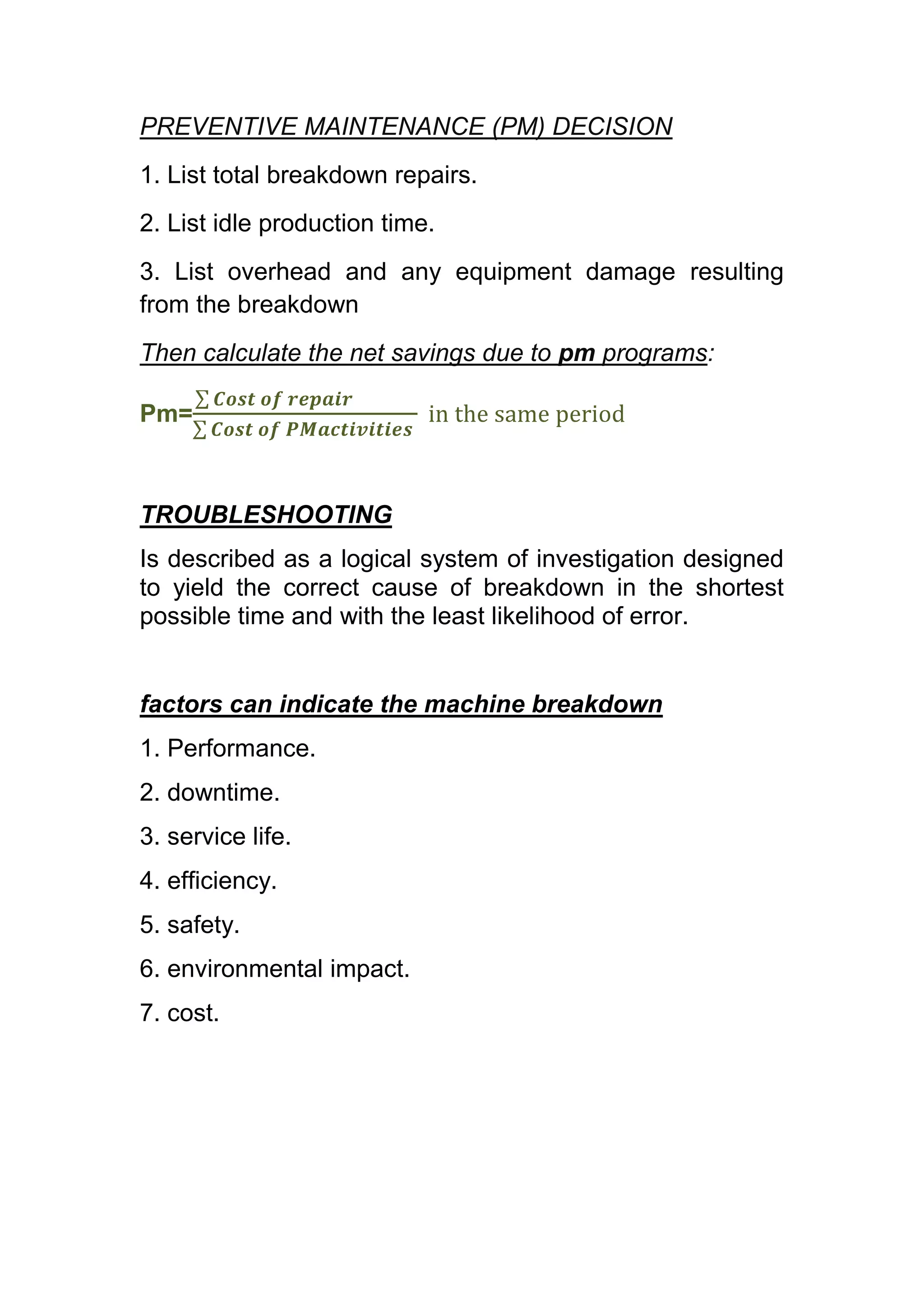
PREVENTIVE MAINTENANCE (PM) DECISION
1. List total breakdown repairs.
2. List idle production time.
3. List overhead and any equipment damage resulting
from the breakdown
Then calculate the net savings due to pm programs:

Pm=


TROUBLESHOOTING
Is described as a logical system of investigation designed
to yield the correct cause of breakdown in the shortest
possible time and with the least likelihood of error.


factors can indicate the machine breakdown
1. Performance.
2. downtime.
3. service life.
4. efficiency.
5. safety.
6. environmental impact.
7. cost.
The basic approach of Troubleshooting
1. Knowledge.
2. Logic.
3. Experience.


Data aids to troubleshooting
1. Background data sources.
2. Operational data sources.
3. Communication.
4. Systematic diagnosis.


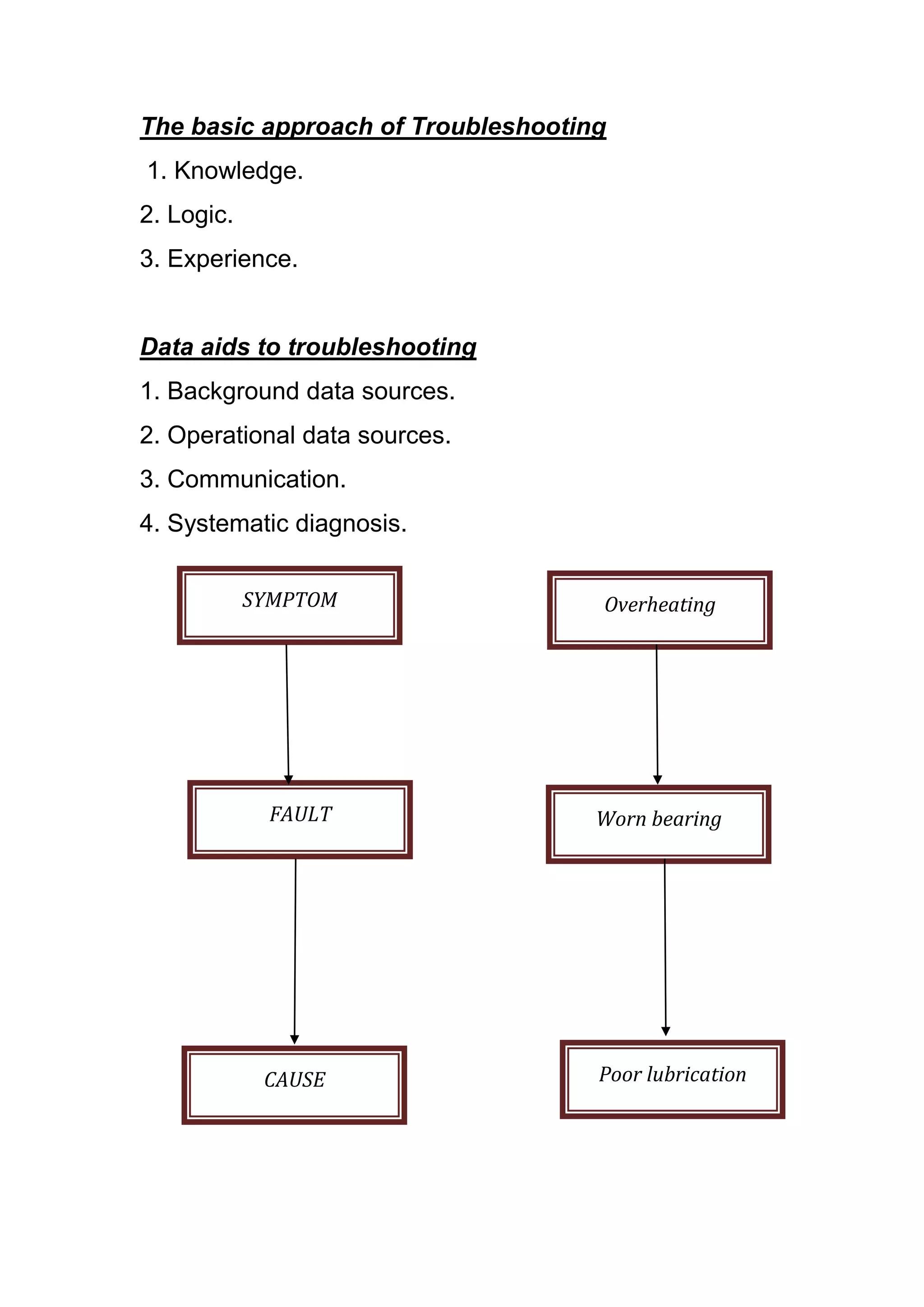
            SYMPTOM                 Overheating


             FAULT                  Worn bearing


             CAUSE                  Poor lubrication

MET 105 Module 1

  • 1.
    FUNCTION OF MAINTENANCE - The function of maintenance is to ensure that plant and equipment are available in a satisfactory condition for operation when required - Satisfactory condition for the rotating machinery depends on 1. Type of industry ( determine the level of machine performance required) 2. Process requirement ( the requirement of a machine that is critical to the process will be greater one for than non critical) 3. Business objectives product demand and profit levels fluctuating demands on equipment and performance requirements The performance of maintenance function can be judged by the condition of machinery and by the following factors 1. Performance: machines must be capable of performing the function 2. Downtime: machine must operate with acceptable level of downtime 3. Service life: machines must provide a satisfactory return on investment 4. Efficiency: machine must operate with safety accuracy productivity and minimum power loss 5. Safely: machine must operate safely and not dangerous to personnel 6. Environmental impact: machine must operate in a manner to adjacent plant and equipment 7. Cost: the cost of maintenance must be acceptable
  • 2.
    Maintenance programs There arethree types; 1. Corrective maintenance (CrM) 2. Preventive maintenance (PM) 3. Predictive maintenance (PdM) Corrective maintenance: defined as the remedial action carried out due to failure or deficiencies discovered during preventive maintenance to repair an equipment to its operational state the activities of corrective maintenance? Explain with an example. 1. fail-repair: The failed item is restored to its operational state. 2. Salvage This element of corrective maintenance is concerned with disposal of non repairable material. 3. Rebuild: This is concerned with restoring an item to a standard as close as possible to original state. 4. Overhaul: Restoring an item to its total serviceable state as per maintenance serviceability standards.
  • 3.
    5. Servicing: servicing maybe needed because of the corrective maintenance action for example engine Fail repair Salvage Types of Overhaul CrM Servicing Rebuild o
  • 4.
    The advantage and disadvantages of corrective maintenance Advantages: 1. Low cost. 2. Less staff. Disadvantages: 1. Increased cost due to unplanned downtime. 2. Increased labor cost. 3. Cost involved with repair. 4. Possible secondary equipment. 5. Inefficient use of staff resources Preventive maintenance (PM) ( time – based) Preventive maintenance can be defined as: actions performed on a time or machine run based schedule that detect delay or mitigate degradation of a component Advantages Cost effective in many capital intensive processes Flexibility allows for the adjustment of maintenance periodicity Increased component life cycle Energy saving Reduced equipment failure Cost savings
  • 5.
    Disadvantages Catastrophic failures still likely to occur Labor intensive Include performance of unneeded maintenance Potential for incidental damage to components in unneeded maintenance main activities of preventive maintenance 1. Inspection. To determine their serviceability 2. Servicing. Cleaning, lubricating, charging 3- Calibration periodically determining the value of characteristics of item 4. Testing. Periodically testing or checking out to determine serviceability and detect degradation 5. Alignment. Making change to achieving optimum performance 6. Adjustment. Periodically adjusting specified variable elements of material for the purpose of achieving the optimum performance 7. Installation. Periodic replacement of limited life item to maintain the specified system tolerance
  • 6.
    INSPECTION SERVICING ADJUSTMENT CALIBRATION ELEMENTS OF PM ACTIVITIES ALIGMENT INSTALLATION TESTING
  • 7.
    Predictive Maintenance (PM) (based on quantified material/ equipment condition Measurements that detect the onset of a degradation mechanism results indicate current and future functional capability Difference between predictive maintenance and preventive maintenance by using maintenance need on the actual condition of the machine rather than on some preset schedule Advantages of predictive maintenance 1. Increased component operational life. 2. Allows for preemptive corrective actions. 3. Decrease in equipment or process downtime. 4. Decrease in costs for parts. 5. Better product quality. 6. Improved worker and environmental safety. 7. Improved worker moral. 8. Energy savings. 9. Estimated 8% to 12% cost savings over pm program Disadvantages of predictive maintenance 1. Increased investment in diagnostic equipment. 2. Increased investment in staff training. 3. Savings potential not read.
  • 8.
    Pro- active maintenance Usesa variety of technologies to extend the operating lives of machines and to virtually eliminate reactive maintenance (root cause failure analysis) Benefit: 1. Resulting in greatly extended machine life. 2. Reduced down time. 3. Expanded production capacity BASIC MAINTENANCE STRATEGIES Reactive (Fix it when it breaks) Benefit (zero initial investment) Scheduled (change it out every-------- hours) Benefit (reduced catastrophic breakdown) Condition (does it need to be fixed) Based (CBM) Benefit (maintenance done when needed)
  • 9.
    PREVENTIVE MAINTENANCE (PM)DECISION 1. List total breakdown repairs. 2. List idle production time. 3. List overhead and any equipment damage resulting from the breakdown Then calculate the net savings due to pm programs: Pm= TROUBLESHOOTING Is described as a logical system of investigation designed to yield the correct cause of breakdown in the shortest possible time and with the least likelihood of error. factors can indicate the machine breakdown 1. Performance. 2. downtime. 3. service life. 4. efficiency. 5. safety. 6. environmental impact. 7. cost.
  • 10.
    The basic approachof Troubleshooting 1. Knowledge. 2. Logic. 3. Experience. Data aids to troubleshooting 1. Background data sources. 2. Operational data sources. 3. Communication. 4. Systematic diagnosis. SYMPTOM Overheating FAULT Worn bearing CAUSE Poor lubrication