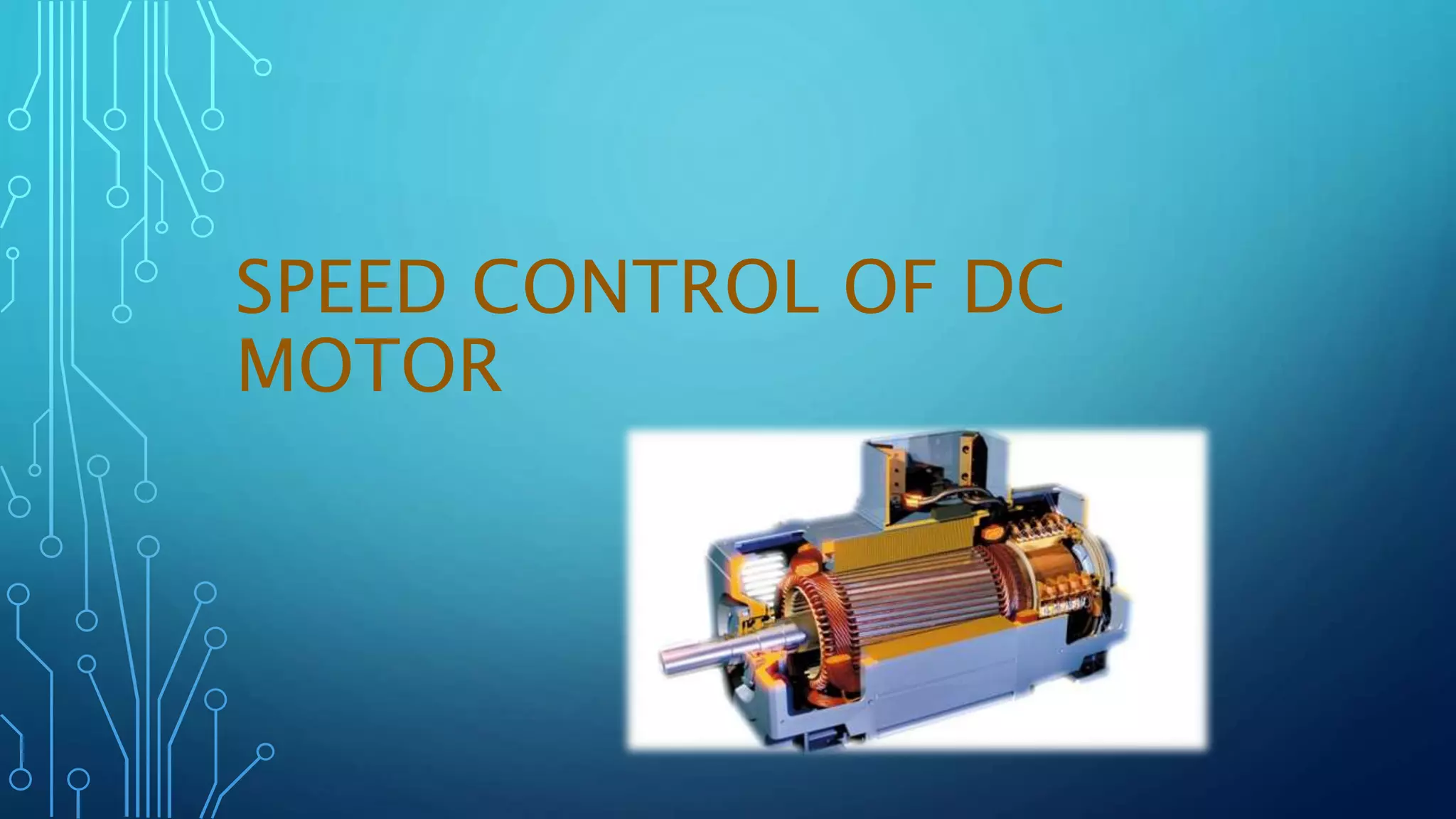
SPEED CONTROL OF DC
MOTOR
CONTENT
 Speed Of A DC Motor
 Speed Control Methods Of DC Motor
 Speed Control Of Shunt Motor
 Speed Control Of Series Motor
SPEED OF A DC MOTOR
We know, back emf of a DC motor Eb is the induced emf due to rotation of the
armature in magnetic field. Thus value of the Eb can be given by the EMF
equation of a DC generator.
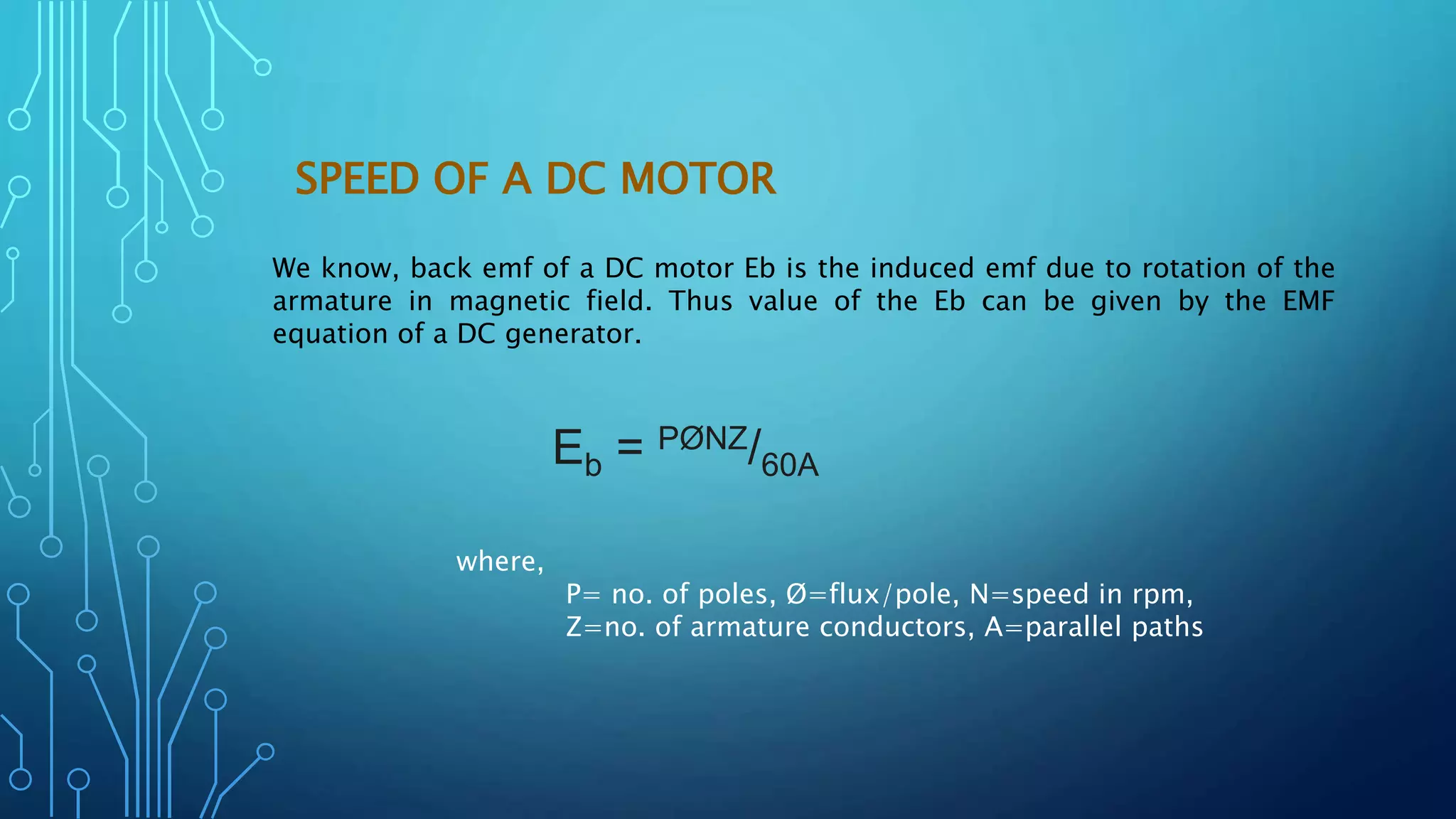
Eb = PØNZ/60A
where,
P= no. of poles, Ø=flux/pole, N=speed in rpm,
Z=no. of armature conductors, A=parallel paths
SPEED OF A DC MOTOR
Eb can also be given as,
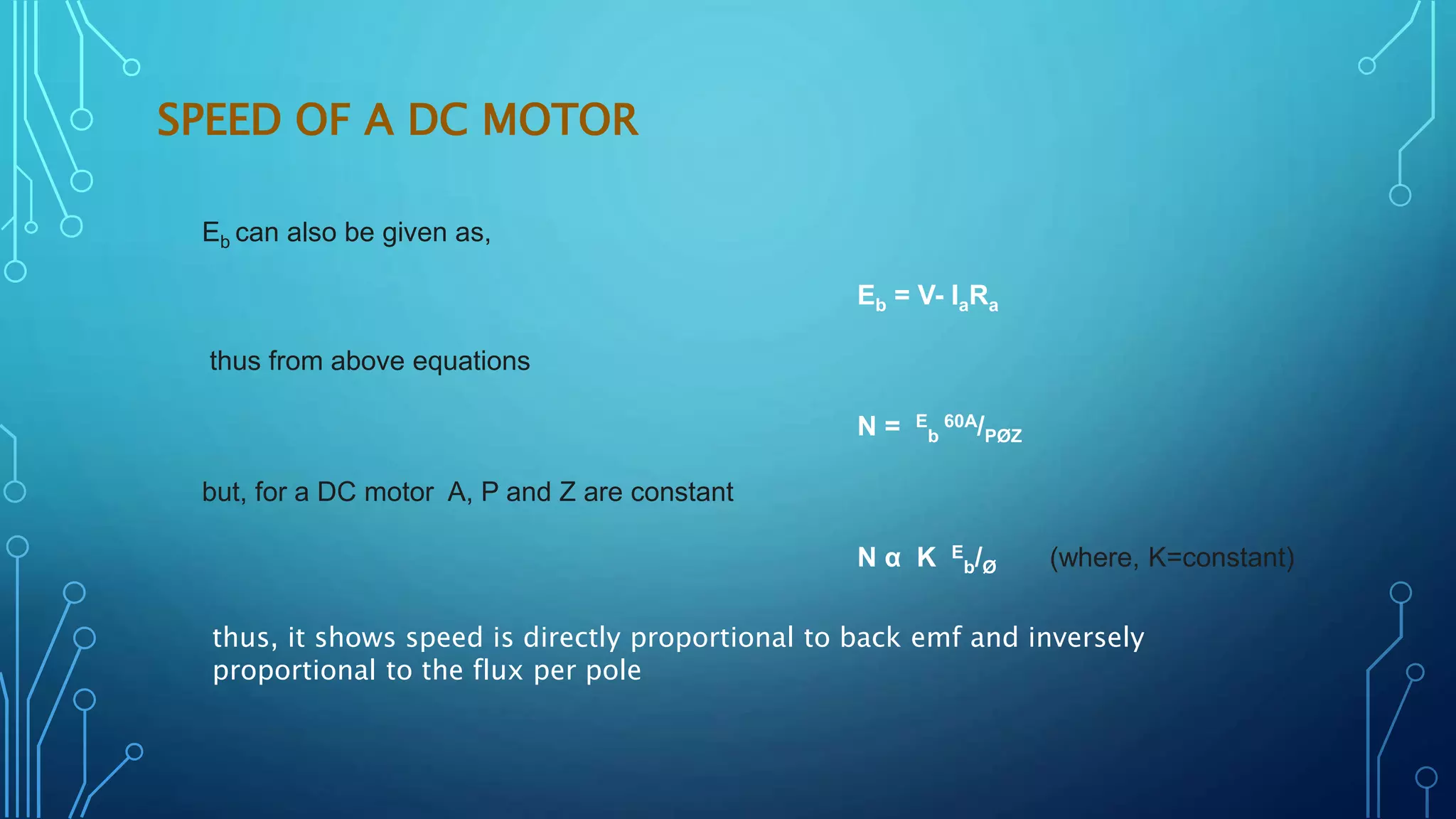
Eb = V- IaRa
thus from above equations
N = E
b
60A/PØZ
but, for a DC motor A, P and Z are constant
N α K E
b/Ø (where, K=constant)
thus, it shows speed is directly proportional to back emf and inversely
proportional to the flux per pole
SPEED CONTROL METHODS OF DC MOTOR
Speed Control Of
Shunt Motor
Speed Control
Of Series Motor
Flux Control Method
Armature Control
Method
Voltage Control Method
Flux Control Method
Variable Resistance In Series
With Armature
Series-Parallel Control
SPEED CONTROL OF SHUNT MOTOR
Flux Control Method
It is seen that speed of the motor is inversely proportional to flux. Thus by
decreasing flux speed can be increased and vice versa.
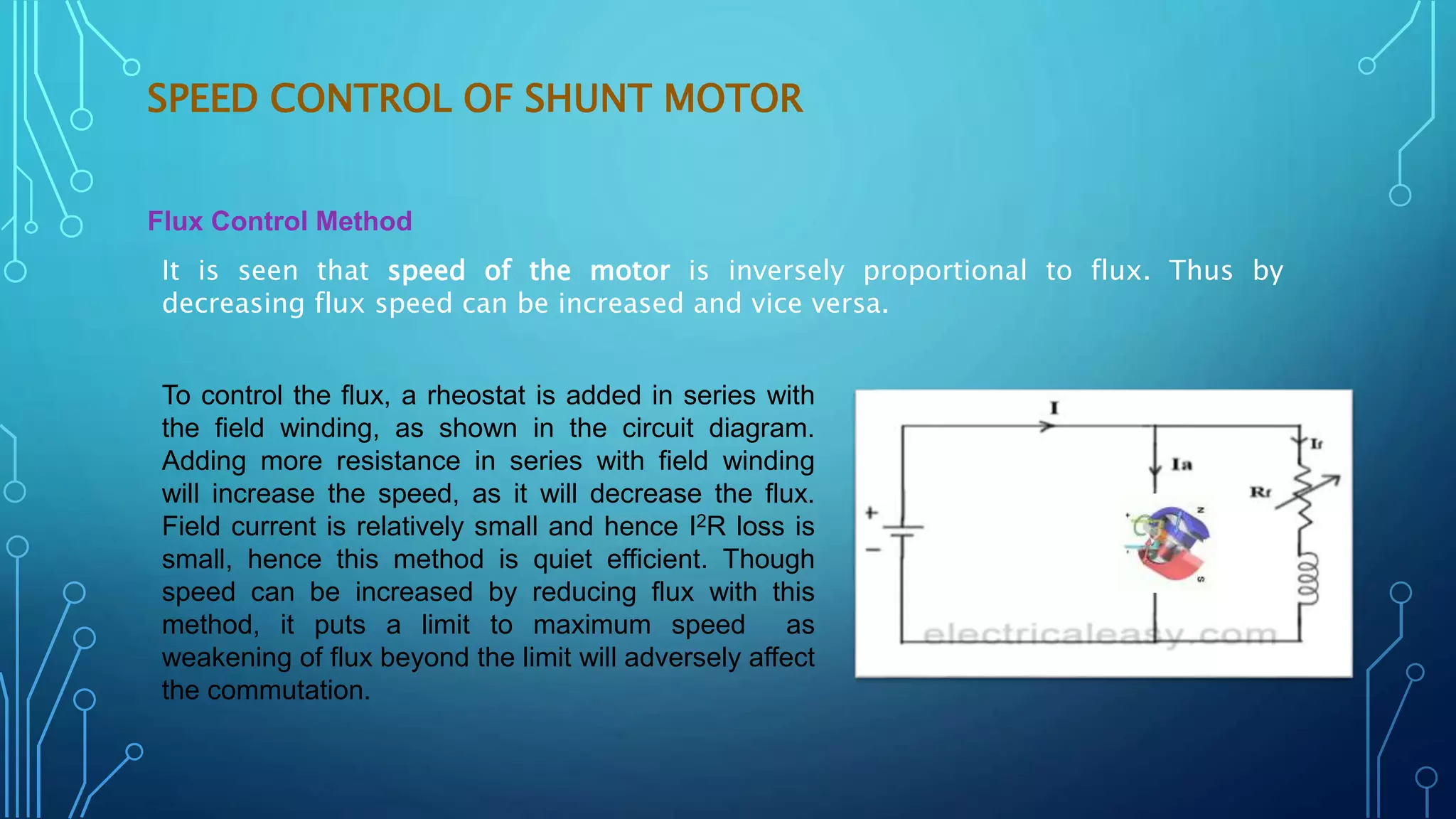
To control the flux, a rheostat is added in series with
the field winding, as shown in the circuit diagram.
Adding more resistance in series with field winding
will increase the speed, as it will decrease the flux.
Field current is relatively small and hence I2R loss is
small, hence this method is quiet efficient. Though
speed can be increased by reducing flux with this
method, it puts a limit to maximum speed as
weakening of flux beyond the limit will adversely affect
the commutation.
SPEED CONTROL OF SHUNT MOTOR
Armature Control Method
Speed of the motor is directly proportional to the back emf Eb and Eb = V- IaRa.
That is when supply voltage V and armature resistance Ra are kept constant,
speed is directly proportional to armature current Ia.
Thus if we add resistance in series with armature, Ia decreases and hence speed
decreases.
Greater the resistance in series with armature,
greater the decrease in speed.
SPEED CONTROL OF SHUNT MOTOR
Voltage Control Method
A) Multiple voltage control:
In this method the, shunt filed is connected to a
fixed exciting voltage, and armature is supplied
with different voltages. Voltage across armature is
changed with the help of a suitable switchgear.
The speed is approximately proportional to the
voltage across the armature.
B) Ward-Leonard System:
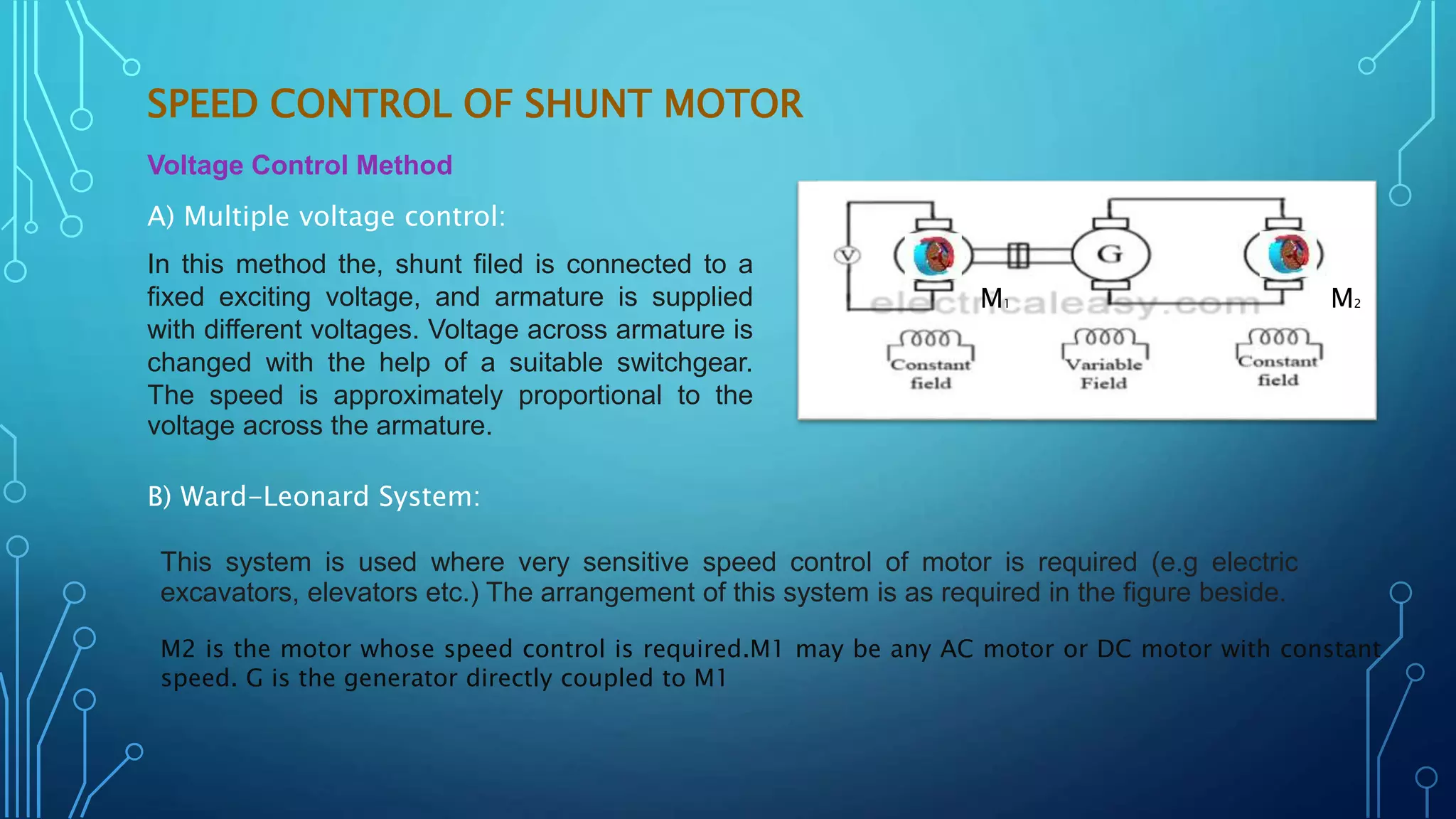
This system is used where very sensitive speed control of motor is required (e.g electric
excavators, elevators etc.) The arrangement of this system is as required in the figure beside.
M2 is the motor whose speed control is required.M1 may be any AC motor or DC motor with constant
speed. G is the generator directly coupled to M1
M2M1
SPEED CONTROL OF SHUNT MOTOR
Voltage Control Method
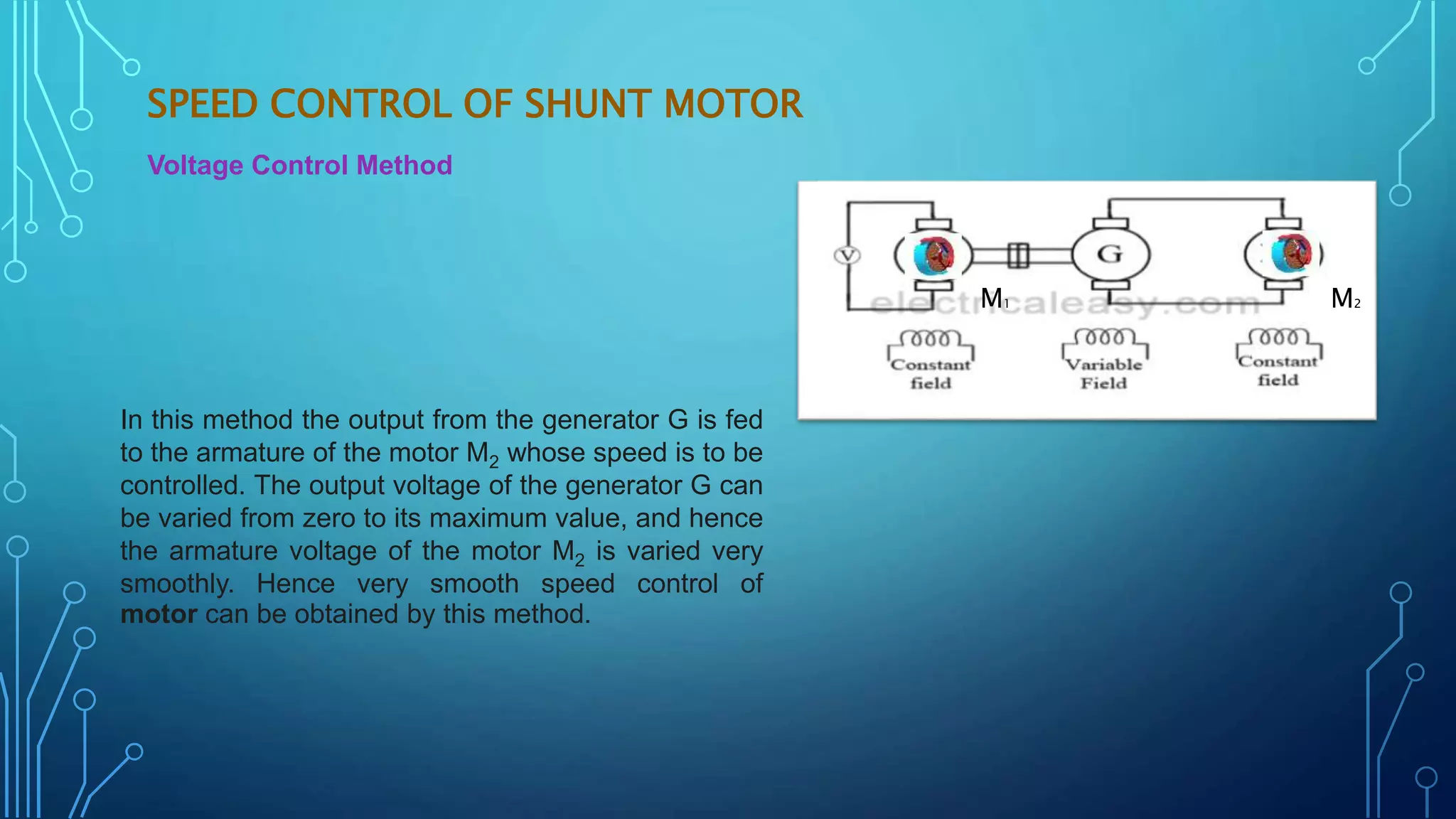
In this method the output from the generator G is fed
to the armature of the motor M2 whose speed is to be
controlled. The output voltage of the generator G can
be varied from zero to its maximum value, and hence
the armature voltage of the motor M2 is varied very
smoothly. Hence very smooth speed control of
motor can be obtained by this method.
M1 M2
SPEED CONTROL OF SERIES MOTOR
Flux Control Method
A) Field divertor :
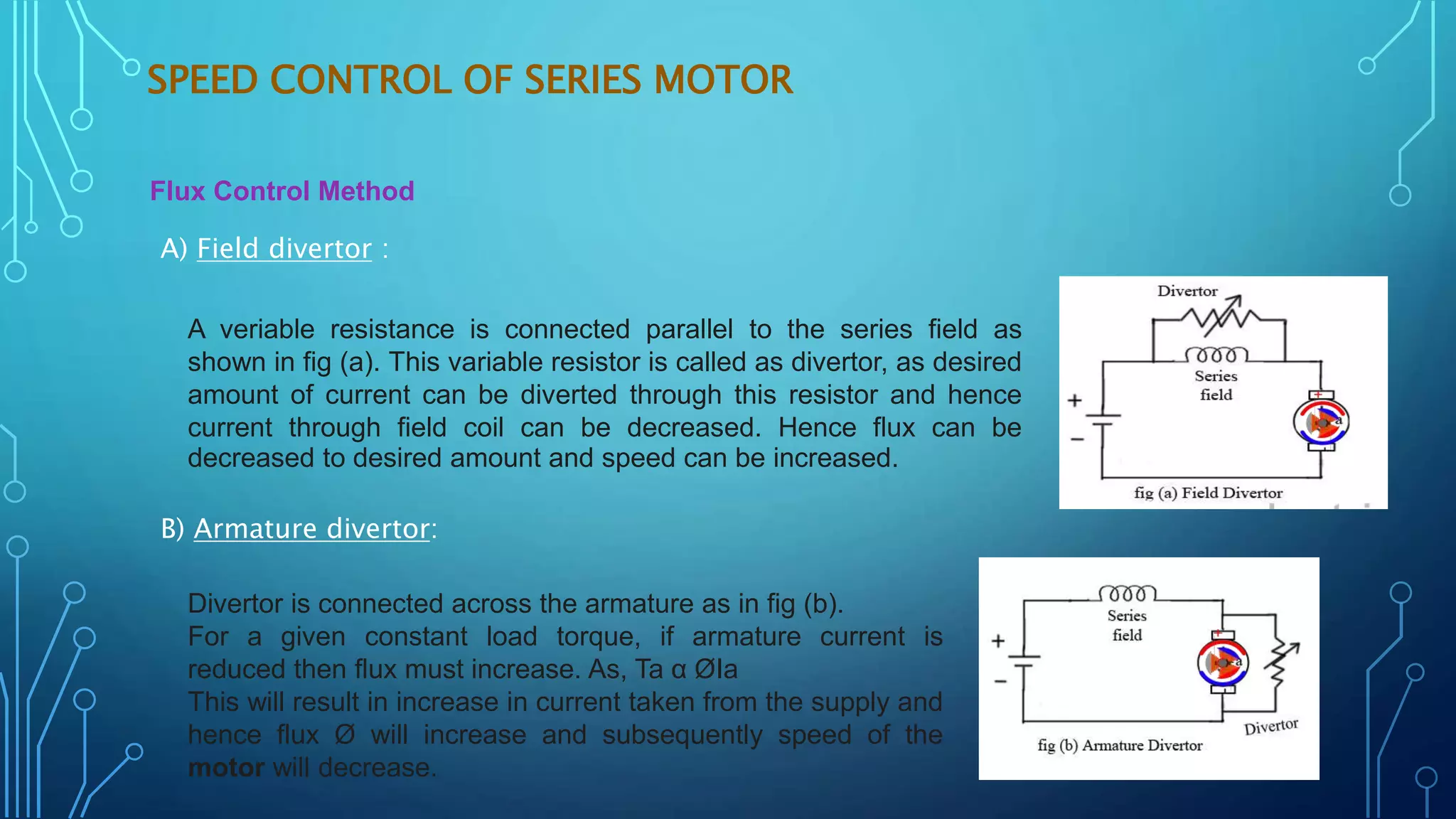
A veriable resistance is connected parallel to the series field as
shown in fig (a). This variable resistor is called as divertor, as desired
amount of current can be diverted through this resistor and hence
current through field coil can be decreased. Hence flux can be
decreased to desired amount and speed can be increased.
B) Armature divertor:
Divertor is connected across the armature as in fig (b).
For a given constant load torque, if armature current is
reduced then flux must increase. As, Ta α ØIa
This will result in increase in current taken from the supply and
hence flux Ø will increase and subsequently speed of the
motor will decrease.
SPEED CONTROL OF SERIES MOTOR
Flux Control Method
C) Tapped field control:
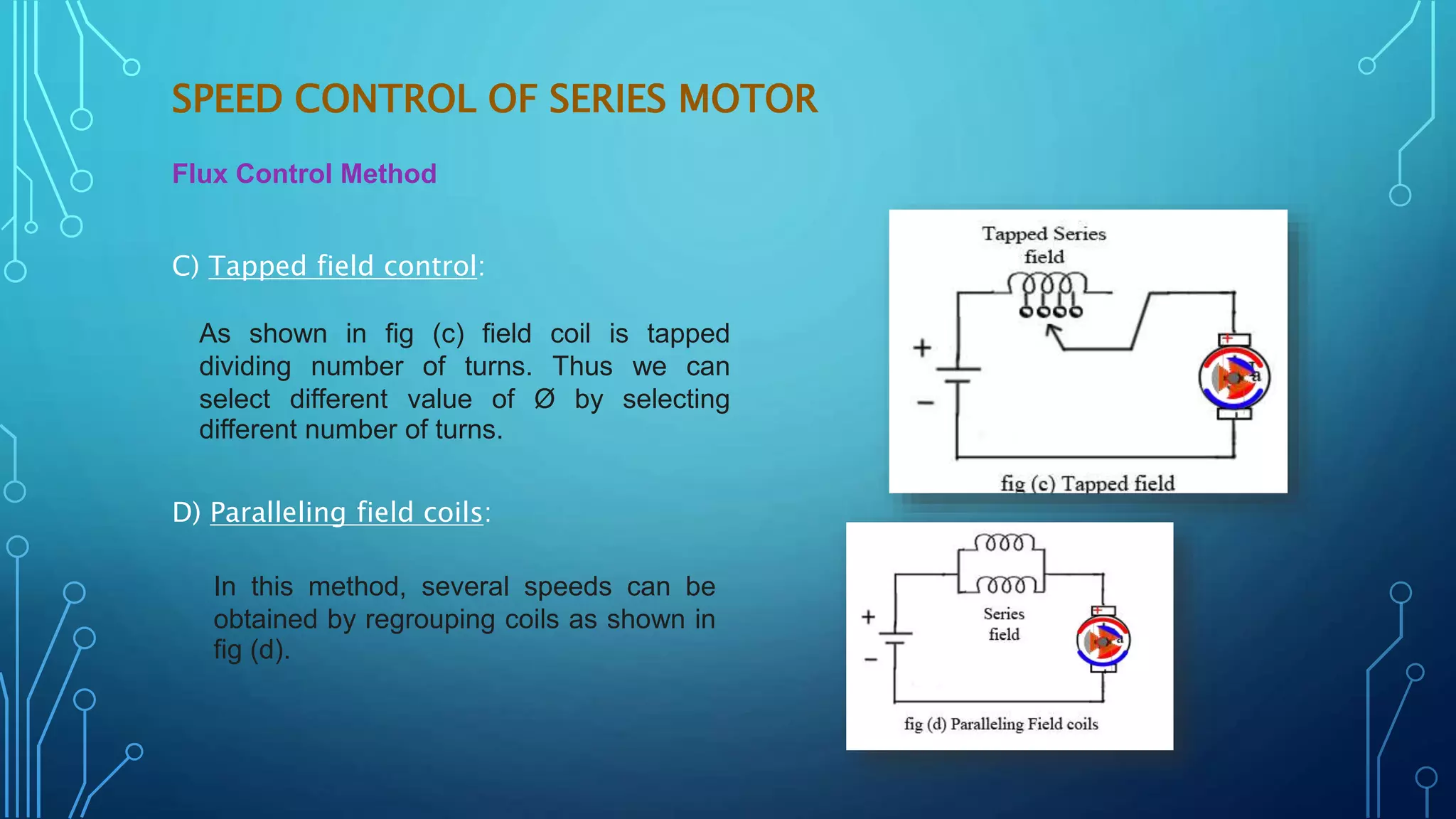
As shown in fig (c) field coil is tapped
dividing number of turns. Thus we can
select different value of Ø by selecting
different number of turns.
D) Paralleling field coils:
In this method, several speeds can be
obtained by regrouping coils as shown in
fig (d).
SPEED CONTROL OF SERIES MOTOR
Variable Resistance In Series With Armature
By introducing resistance in series with armature, voltage across the armature can be
reduced. And hence, speed reduces in proportion with it.
Series-Parallel Control
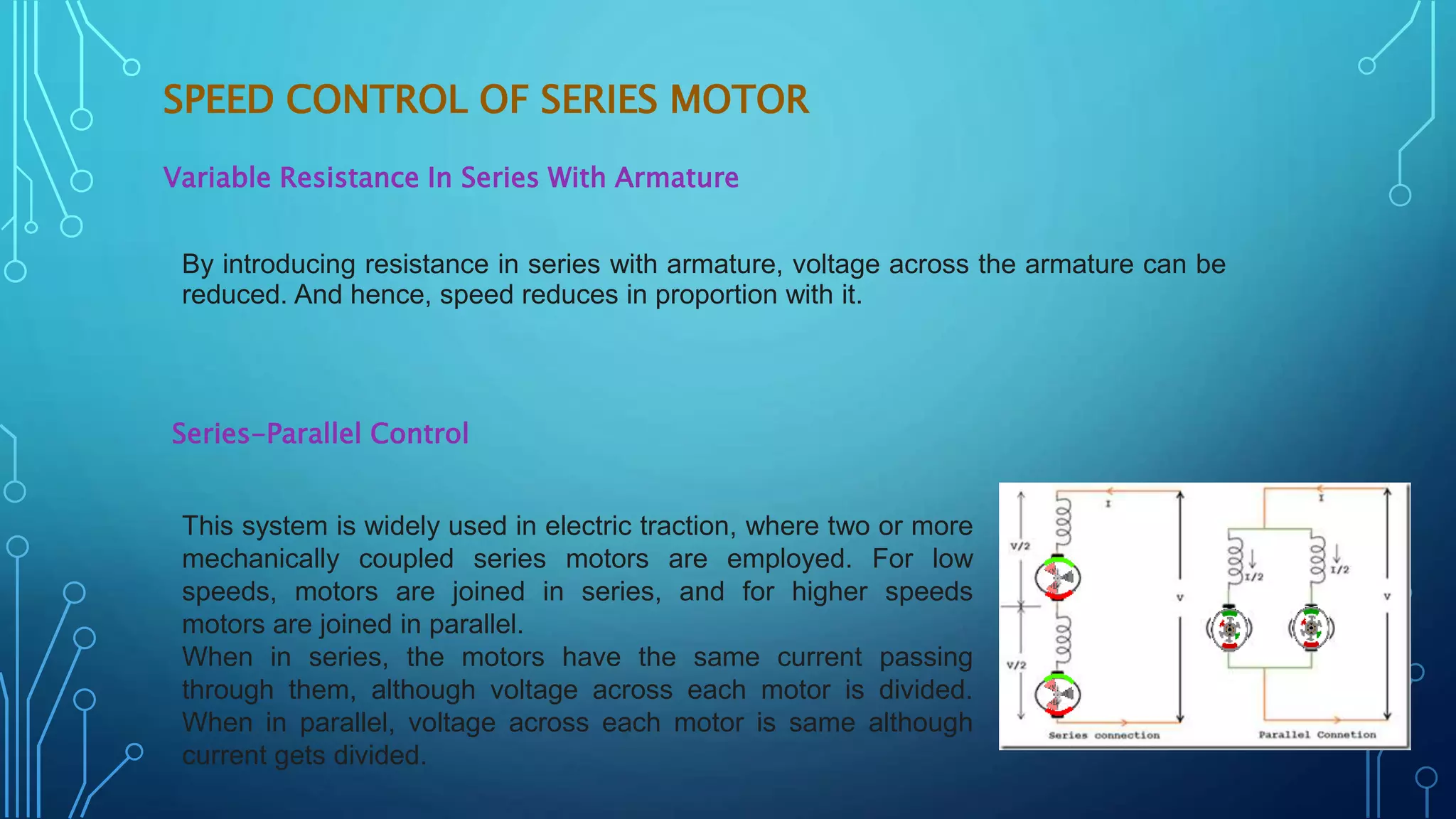
This system is widely used in electric traction, where two or more
mechanically coupled series motors are employed. For low
speeds, motors are joined in series, and for higher speeds
motors are joined in parallel.
When in series, the motors have the same current passing
through them, although voltage across each motor is divided.
When in parallel, voltage across each motor is same although
current gets divided.
REFERENCE
 http://www.electricaleasy.com/2014/01/speed-control-
methods-of-dc-motor.html
 https://www.google.com/search?client=opera&q=speed+co
ntrol+of+dc+motor&sourceid=opera&ie=UTF-8&oe=UTF-8
 http://www.electrical4u.com/speed-control-of-dc-motor/
END…
PRESENTED BY..
W.T. Darshana
Student at Higher National Diploma in
Engineering (HNDE) Sri Lanka

Speed control of dc motor

  • 1.
  • 2.
    CONTENT  Speed OfA DC Motor  Speed Control Methods Of DC Motor  Speed Control Of Shunt Motor  Speed Control Of Series Motor
  • 3.
    SPEED OF ADC MOTOR We know, back emf of a DC motor Eb is the induced emf due to rotation of the armature in magnetic field. Thus value of the Eb can be given by the EMF equation of a DC generator. Eb = PØNZ/60A where, P= no. of poles, Ø=flux/pole, N=speed in rpm, Z=no. of armature conductors, A=parallel paths
  • 4.
    SPEED OF ADC MOTOR Eb can also be given as, Eb = V- IaRa thus from above equations N = E b 60A/PØZ but, for a DC motor A, P and Z are constant N α K E b/Ø (where, K=constant) thus, it shows speed is directly proportional to back emf and inversely proportional to the flux per pole
  • 5.
    SPEED CONTROL METHODSOF DC MOTOR Speed Control Of Shunt Motor Speed Control Of Series Motor Flux Control Method Armature Control Method Voltage Control Method Flux Control Method Variable Resistance In Series With Armature Series-Parallel Control
  • 6.
    SPEED CONTROL OFSHUNT MOTOR Flux Control Method It is seen that speed of the motor is inversely proportional to flux. Thus by decreasing flux speed can be increased and vice versa. To control the flux, a rheostat is added in series with the field winding, as shown in the circuit diagram. Adding more resistance in series with field winding will increase the speed, as it will decrease the flux. Field current is relatively small and hence I2R loss is small, hence this method is quiet efficient. Though speed can be increased by reducing flux with this method, it puts a limit to maximum speed as weakening of flux beyond the limit will adversely affect the commutation.
  • 7.
    SPEED CONTROL OFSHUNT MOTOR Armature Control Method Speed of the motor is directly proportional to the back emf Eb and Eb = V- IaRa. That is when supply voltage V and armature resistance Ra are kept constant, speed is directly proportional to armature current Ia. Thus if we add resistance in series with armature, Ia decreases and hence speed decreases. Greater the resistance in series with armature, greater the decrease in speed.
  • 8.
    SPEED CONTROL OFSHUNT MOTOR Voltage Control Method A) Multiple voltage control: In this method the, shunt filed is connected to a fixed exciting voltage, and armature is supplied with different voltages. Voltage across armature is changed with the help of a suitable switchgear. The speed is approximately proportional to the voltage across the armature. B) Ward-Leonard System: This system is used where very sensitive speed control of motor is required (e.g electric excavators, elevators etc.) The arrangement of this system is as required in the figure beside. M2 is the motor whose speed control is required.M1 may be any AC motor or DC motor with constant speed. G is the generator directly coupled to M1 M2M1
  • 9.
    SPEED CONTROL OFSHUNT MOTOR Voltage Control Method In this method the output from the generator G is fed to the armature of the motor M2 whose speed is to be controlled. The output voltage of the generator G can be varied from zero to its maximum value, and hence the armature voltage of the motor M2 is varied very smoothly. Hence very smooth speed control of motor can be obtained by this method. M1 M2
  • 10.
    SPEED CONTROL OFSERIES MOTOR Flux Control Method A) Field divertor : A veriable resistance is connected parallel to the series field as shown in fig (a). This variable resistor is called as divertor, as desired amount of current can be diverted through this resistor and hence current through field coil can be decreased. Hence flux can be decreased to desired amount and speed can be increased. B) Armature divertor: Divertor is connected across the armature as in fig (b). For a given constant load torque, if armature current is reduced then flux must increase. As, Ta α ØIa This will result in increase in current taken from the supply and hence flux Ø will increase and subsequently speed of the motor will decrease.
  • 11.
    SPEED CONTROL OFSERIES MOTOR Flux Control Method C) Tapped field control: As shown in fig (c) field coil is tapped dividing number of turns. Thus we can select different value of Ø by selecting different number of turns. D) Paralleling field coils: In this method, several speeds can be obtained by regrouping coils as shown in fig (d).
  • 12.
    SPEED CONTROL OFSERIES MOTOR Variable Resistance In Series With Armature By introducing resistance in series with armature, voltage across the armature can be reduced. And hence, speed reduces in proportion with it. Series-Parallel Control This system is widely used in electric traction, where two or more mechanically coupled series motors are employed. For low speeds, motors are joined in series, and for higher speeds motors are joined in parallel. When in series, the motors have the same current passing through them, although voltage across each motor is divided. When in parallel, voltage across each motor is same although current gets divided.
  • 13.
  • 14.
  • 15.
    PRESENTED BY.. W.T. Darshana Studentat Higher National Diploma in Engineering (HNDE) Sri Lanka