BASIC COMPUTER
ORGANIZATION
Avishek Bose
Lecturer, Daffodil International University
Learning Objectives
• In this lecture you will learn about:
Basic operations performed by all types of computer systems
Basic organization of a computer system
Input unit and its functions
Output unit and its functions
Storage unit and its functions
Types of storage used in a computer system
Arithmetic Logic Unit (ALU)
Control Unit (CU)
Central Processing Unit (CPU)
Computer as a system
The Five Basic Operations of a
Computer System
• Inputting. The process of entering data and instructions into
the computer system
• Storing. Saving data and instructions to make them readily
available for initial or additional processing whenever
required
• Processing. Performing arithmetic operations (add,
subtract, multiply, divide, etc.) or logical operations
(comparisons like equal to, less than, greater than, etc.) on
data to convert them into useful information
• Outputting. The process of producing useful information or
results for the user such as a printed report or visual display
• Controlling. Directing the manner and sequence in which
all of the above operations are performed
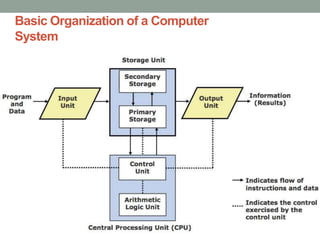
Basic Organization of a Computer
System
Input Unit
An input unit of a computer system performs the
following functions:
① It accepts (or reads) instructions and data from outside
world
② It converts these instructions and data in computer
acceptable form
③ It supplies the converted instructions and data to the
computer system for further processing
Output Unit
An output unit of a computer system performs the
following functions:
① It accepts the results produced by the computer, which are
in coded form and hence, cannot be easily understood by
us
② It converts these coded results to human acceptable
(readable) form
③ It supplies the converted results to outside world
Storage Unit
• The storage unit of a computer system holds
(or stores) the following :
① Data and instructions required for processing (received
from input devices)
② Intermediate results of processing
③ Final results of processing, before they are released to
an output device
Two Types of Storage
① Primary storage
• Used to hold running program instructions
• Used to hold data, intermediate results, and
results of ongoing processing of job(s)
• Fast in operation
• Small Capacity
• Expensive
• Volatile (looses data on power dissipation)
Two Types of Storage
② Secondary storage
• Used to hold stored program instructions
• Used to hold data and information of stored
jobs
• Slower than primary storage
• Large Capacity
• Lot cheaper than primary storage
• Retains data even without power
Arithmetic Logic Unit (ALU)
• Arithmetic Logic Unit of a computer system is the
place where the actual executions of instructions
takes place during processing operation
Control Unit (CU)
• Control Unit of a computer system manages and coordinates
the operations of all other components of the computer system
• The control unit is a component of a computer's central
processing unit (CPU) that directs operation of the processor. It
controls communication and co-ordination between input/output
devices. It reads and interprets instructions and determines the
sequence for processing the data.
• It directs the operation of the other units by providing timing and
control signals.
• All computer resources are managed by the CU (Control Unit).
• It directs the flow of data between the Central Processing Unit
(CPU) and the other devices.
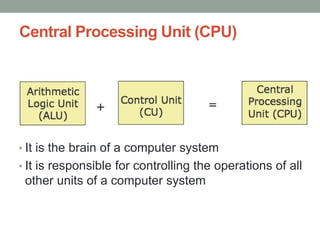
Central Processing Unit (CPU)
• It is the brain of a computer system
• It is responsible for controlling the operations of all
other units of a computer system
The System Concept
• A system has following three characteristics:
① A system has more than one element
② All elements of a system are logically related
③ All elements of a system are controlled in a manner to
achieve the system goal
• A computer is a system as it comprises of integrated
components (input unit, output unit, storage unit, and CPU)
that work together to perform the steps called for in the
executing program
Key Words/Phrases
• Arithmetic Logic Unit
(ALU)
• Output interface
• Auxiliary storage
• Output unit
• Central Processing
Unit (CPU)
• Outputting
• Computer system
• Primate storage
• Control Unit (CU)
• Processing
• Controlling
• Secondary storage
• Input interface
• Storage unit
• Input unit
• Storing
• Inputting
• System
• Main memory

L 2 basic computer organization

  • 1.
    BASIC COMPUTER ORGANIZATION Avishek Bose Lecturer,Daffodil International University
  • 2.
    Learning Objectives • Inthis lecture you will learn about: Basic operations performed by all types of computer systems Basic organization of a computer system Input unit and its functions Output unit and its functions Storage unit and its functions Types of storage used in a computer system Arithmetic Logic Unit (ALU) Control Unit (CU) Central Processing Unit (CPU) Computer as a system
  • 3.
    The Five BasicOperations of a Computer System • Inputting. The process of entering data and instructions into the computer system • Storing. Saving data and instructions to make them readily available for initial or additional processing whenever required • Processing. Performing arithmetic operations (add, subtract, multiply, divide, etc.) or logical operations (comparisons like equal to, less than, greater than, etc.) on data to convert them into useful information • Outputting. The process of producing useful information or results for the user such as a printed report or visual display • Controlling. Directing the manner and sequence in which all of the above operations are performed
  • 4.
    Basic Organization ofa Computer System
  • 5.
    Input Unit An inputunit of a computer system performs the following functions: ① It accepts (or reads) instructions and data from outside world ② It converts these instructions and data in computer acceptable form ③ It supplies the converted instructions and data to the computer system for further processing
  • 6.
    Output Unit An outputunit of a computer system performs the following functions: ① It accepts the results produced by the computer, which are in coded form and hence, cannot be easily understood by us ② It converts these coded results to human acceptable (readable) form ③ It supplies the converted results to outside world
  • 7.
    Storage Unit • Thestorage unit of a computer system holds (or stores) the following : ① Data and instructions required for processing (received from input devices) ② Intermediate results of processing ③ Final results of processing, before they are released to an output device
  • 8.
    Two Types ofStorage ① Primary storage • Used to hold running program instructions • Used to hold data, intermediate results, and results of ongoing processing of job(s) • Fast in operation • Small Capacity • Expensive • Volatile (looses data on power dissipation)
  • 9.
    Two Types ofStorage ② Secondary storage • Used to hold stored program instructions • Used to hold data and information of stored jobs • Slower than primary storage • Large Capacity • Lot cheaper than primary storage • Retains data even without power
  • 10.
    Arithmetic Logic Unit(ALU) • Arithmetic Logic Unit of a computer system is the place where the actual executions of instructions takes place during processing operation
  • 11.
    Control Unit (CU) •Control Unit of a computer system manages and coordinates the operations of all other components of the computer system • The control unit is a component of a computer's central processing unit (CPU) that directs operation of the processor. It controls communication and co-ordination between input/output devices. It reads and interprets instructions and determines the sequence for processing the data. • It directs the operation of the other units by providing timing and control signals. • All computer resources are managed by the CU (Control Unit). • It directs the flow of data between the Central Processing Unit (CPU) and the other devices.
  • 12.
    Central Processing Unit(CPU) • It is the brain of a computer system • It is responsible for controlling the operations of all other units of a computer system
  • 13.
    The System Concept •A system has following three characteristics: ① A system has more than one element ② All elements of a system are logically related ③ All elements of a system are controlled in a manner to achieve the system goal • A computer is a system as it comprises of integrated components (input unit, output unit, storage unit, and CPU) that work together to perform the steps called for in the executing program
  • 14.
    Key Words/Phrases • ArithmeticLogic Unit (ALU) • Output interface • Auxiliary storage • Output unit • Central Processing Unit (CPU) • Outputting • Computer system • Primate storage • Control Unit (CU) • Processing • Controlling • Secondary storage • Input interface • Storage unit • Input unit • Storing • Inputting • System • Main memory