PROCESS MANAGEMENT
By :
Birju Tank((141060753017)
IEEE Seminar on Operating System Programming
At: GTU PG SCHOOL,GANDHINAGAR
IEEE Papers Overview
 Paper:1 Process Management in Distribute
System [1] represents the how one process
executing step by step in Program and Distributed
Systems at initial stage.
 Paper:2 Developing Complex Systems -
Incorporating Human Variability into the Process
[2] represents the process with the comparison of
human variability.
 Paper:3 Dynamic Process Migration Framework
[3] represents the process migration from one
machine to other machine , basically work on the
Distributed Systems.
Contents
 IEEE Papers Overview
 What is Process?-Introduction
 Processes and Process Management
 Process Life Cycle
 Context Switching
 Process Control Block
 Scheduling
 Process Control and Process Handling Commands
 Advantages and Disadvantages
 Conclusion
 References
What is Process?
 A process is a program during execution.
o Program = static file (image) that contains code to execute
o Process = executing program = program + execution state.
 A process is the basic unit of execution in an operating system
o Each process has a number, its process identifier (pid).
 Different processes may run different instances of the same program
o E.g., my javac and your javac process both run the Java compiler
 At a minimum, process execution requires following resources:
o Memory to contain the program code and data
o A set of CPU registers to support execution
Process in Memory
(b, *p) - main
(a) - fun
heap (p)
(char[1000])
data (aa, buf)
text (code)
0
Process memory
Stack
Max
…
int aa;
char buf[1000];
void fun() {
int a;
…
}
main() {
int b;
char *p;
p = new char[1000];
fun();
}
Process and Process Management
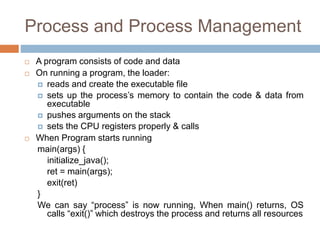
 A program consists of code and data
 On running a program, the loader:
 reads and create the executable file
 sets up the process’s memory to contain the code & data from
executable
 pushes arguments on the stack
 sets the CPU registers properly & calls
 When Program starts running
main(args) {
initialize_java();
ret = main(args);
exit(ret)
}
We can say “process” is now running, When main() returns, OS
calls “exit()” which destroys the process and returns all resources
Process Life Cycle
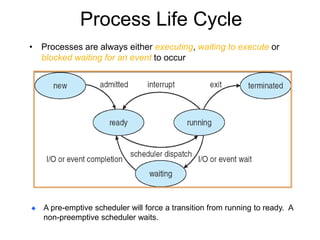
• Processes are always either executing, waiting to execute or
blocked waiting for an event to occur
A pre-emptive scheduler will force a transition from running to ready. A
non-preemptive scheduler waits.
Cont..
 Process has an execution state
 ready: waiting to be assigned to CPU
 running: executing on the CPU
 waiting: waiting for an event, e.g. I/O
 Blocked: waiting for another process execution, e.g. I/o one,
sleep over
 The OS maintains a collection of process state s
 typically one queue for each state – e.g., ready, waiting, …
 each PCB is put onto a queue according to its current state
 as a process changes state, its PCB is unlinked from one queue,
and linked to another
 Process states are change in response to events – interrupts, traps
Process Creation and Termination
 Processes are created …
o When the system boots
o By the actions of another process (more later)
o By the actions of a user
o By the actions of a batch manager
 Processes terminate …
o Normally – exit
o An error due to process Blocking
o An error due to Exceptions
o Terminated (killed) by the actions a user or a process
Process Control Block
PCB
 Contains:
o Process Identification
o Processor State Information
o Process Control Information
 Attributes of Process Control Block : Process
Id(Pid) , Parent Process Id(ppid), Name, Priority,
Memory Description, Active File Description,
Register Save Area, I/O resource Description
Context Switching
 Context switch is the act of switching the CPU
from one process to another .
 Reasons for Context Switching
 Completion of a process
 Completion of the time slice/quantum
 Blocking call like I/O, Sleep call
 Interrupt Occurs / An exception occurs
Scheduling
 Scheduler invokes only due to system calls.
 Which process can enter running state?
 Criteria depends on
– CPU Utilization
– Throughput
– Turnaround time
– Waiting time
– Response time
 Scheduler loads context from top of the stack
Process Control and Process
Handling System Calls()
OS must include calls to enable special control of a process:
 Priority manipulation:
 nice(), which specifies base process priority (initial priority)
 Debugging support:
 ptrace(), allows a process to be put under control of
another process
 The other process can set breakpoints, e.g. registers
 Alarms and time:
 Sleep puts a process on a timer queue waiting for some
number of seconds, supporting an alarm functionality
Cont..
 Process Handling System Calls
1. getpid():Used to get process id
2. getppid():Used to get Parent Process id
3. exit():Used to exit and calls pending buffer
contents
4. fork():Used to create child Process
5. waitpid():Used to block parent process till the
completion of child process.
6. execl():Used to overwrites current address
space of child process
Advantages and Disadvantages
 Advantages:
 Multi-Programming and Time sharing
 You Can explore complex processing in to
sub-Processing
 Due to that your system became faster
 Disadvantages:
 Deadlock
 Poor overlaps of I/O and Cpu
Conclusion
 We conclude that It is possible to build a
simple mechanism that is sufficient to realize
downloading,
migration,Exceptionhandling,checkpointhag,e
mulation and debugging in between multiple
processes are running at time. And the real
time examples are media player , Laptops ,
Cpu , TV , Mobiles etc..
References
1. Sape J. Mullender " Process Management in a Distributed
Operating System ", Centre for Mathematics & Computer Science
Amsterdam and Computer Laboratory,Cambridge University
2. IEEEConference and Workshop on Engineering of Computer Based
Systems,”Developing Complex Systems -Incorporating Human
Variability into the Process “ 1997, by Stephanie M. White, Jerry M.
Owens, Computer Science and Management Engineering C.W.
Post Campus, Long Island University
3. International Conference of Information and Communication
Technology (ICoICT) 2013 IEEE on “Dynamic Process Migration
Framework” By Amirreza Zarrabi, Khairulmizam Samsudin and
Amin Ziaeiy Department of Computer and Communication Systems,
Faculty of Engineering,Universiti Putra Malaysia, 43400 UPM
Serdang, Selangor, Malaysia
4. http://en.wikipedia.org/wiki/Process_Management(Computing)
THANKING YOU!..
Any Question???

Process management

  • 1.
    PROCESS MANAGEMENT By : BirjuTank((141060753017) IEEE Seminar on Operating System Programming At: GTU PG SCHOOL,GANDHINAGAR
  • 2.
    IEEE Papers Overview Paper:1 Process Management in Distribute System [1] represents the how one process executing step by step in Program and Distributed Systems at initial stage.  Paper:2 Developing Complex Systems - Incorporating Human Variability into the Process [2] represents the process with the comparison of human variability.  Paper:3 Dynamic Process Migration Framework [3] represents the process migration from one machine to other machine , basically work on the Distributed Systems.
  • 3.
    Contents  IEEE PapersOverview  What is Process?-Introduction  Processes and Process Management  Process Life Cycle  Context Switching  Process Control Block  Scheduling  Process Control and Process Handling Commands  Advantages and Disadvantages  Conclusion  References
  • 4.
    What is Process? A process is a program during execution. o Program = static file (image) that contains code to execute o Process = executing program = program + execution state.  A process is the basic unit of execution in an operating system o Each process has a number, its process identifier (pid).  Different processes may run different instances of the same program o E.g., my javac and your javac process both run the Java compiler  At a minimum, process execution requires following resources: o Memory to contain the program code and data o A set of CPU registers to support execution
  • 5.
    Process in Memory (b,*p) - main (a) - fun heap (p) (char[1000]) data (aa, buf) text (code) 0 Process memory Stack Max … int aa; char buf[1000]; void fun() { int a; … } main() { int b; char *p; p = new char[1000]; fun(); }
  • 6.
    Process and ProcessManagement  A program consists of code and data  On running a program, the loader:  reads and create the executable file  sets up the process’s memory to contain the code & data from executable  pushes arguments on the stack  sets the CPU registers properly & calls  When Program starts running main(args) { initialize_java(); ret = main(args); exit(ret) } We can say “process” is now running, When main() returns, OS calls “exit()” which destroys the process and returns all resources
  • 7.
    Process Life Cycle •Processes are always either executing, waiting to execute or blocked waiting for an event to occur A pre-emptive scheduler will force a transition from running to ready. A non-preemptive scheduler waits.
  • 8.
    Cont..  Process hasan execution state  ready: waiting to be assigned to CPU  running: executing on the CPU  waiting: waiting for an event, e.g. I/O  Blocked: waiting for another process execution, e.g. I/o one, sleep over  The OS maintains a collection of process state s  typically one queue for each state – e.g., ready, waiting, …  each PCB is put onto a queue according to its current state  as a process changes state, its PCB is unlinked from one queue, and linked to another  Process states are change in response to events – interrupts, traps
  • 9.
    Process Creation andTermination  Processes are created … o When the system boots o By the actions of another process (more later) o By the actions of a user o By the actions of a batch manager  Processes terminate … o Normally – exit o An error due to process Blocking o An error due to Exceptions o Terminated (killed) by the actions a user or a process
  • 10.
  • 11.
    PCB  Contains: o ProcessIdentification o Processor State Information o Process Control Information  Attributes of Process Control Block : Process Id(Pid) , Parent Process Id(ppid), Name, Priority, Memory Description, Active File Description, Register Save Area, I/O resource Description
  • 12.
    Context Switching  Contextswitch is the act of switching the CPU from one process to another .  Reasons for Context Switching  Completion of a process  Completion of the time slice/quantum  Blocking call like I/O, Sleep call  Interrupt Occurs / An exception occurs
  • 13.
    Scheduling  Scheduler invokesonly due to system calls.  Which process can enter running state?  Criteria depends on – CPU Utilization – Throughput – Turnaround time – Waiting time – Response time  Scheduler loads context from top of the stack
  • 14.
    Process Control andProcess Handling System Calls() OS must include calls to enable special control of a process:  Priority manipulation:  nice(), which specifies base process priority (initial priority)  Debugging support:  ptrace(), allows a process to be put under control of another process  The other process can set breakpoints, e.g. registers  Alarms and time:  Sleep puts a process on a timer queue waiting for some number of seconds, supporting an alarm functionality
  • 15.
    Cont..  Process HandlingSystem Calls 1. getpid():Used to get process id 2. getppid():Used to get Parent Process id 3. exit():Used to exit and calls pending buffer contents 4. fork():Used to create child Process 5. waitpid():Used to block parent process till the completion of child process. 6. execl():Used to overwrites current address space of child process
  • 16.
    Advantages and Disadvantages Advantages:  Multi-Programming and Time sharing  You Can explore complex processing in to sub-Processing  Due to that your system became faster  Disadvantages:  Deadlock  Poor overlaps of I/O and Cpu
  • 17.
    Conclusion  We concludethat It is possible to build a simple mechanism that is sufficient to realize downloading, migration,Exceptionhandling,checkpointhag,e mulation and debugging in between multiple processes are running at time. And the real time examples are media player , Laptops , Cpu , TV , Mobiles etc..
  • 18.
    References 1. Sape J.Mullender " Process Management in a Distributed Operating System ", Centre for Mathematics & Computer Science Amsterdam and Computer Laboratory,Cambridge University 2. IEEEConference and Workshop on Engineering of Computer Based Systems,”Developing Complex Systems -Incorporating Human Variability into the Process “ 1997, by Stephanie M. White, Jerry M. Owens, Computer Science and Management Engineering C.W. Post Campus, Long Island University 3. International Conference of Information and Communication Technology (ICoICT) 2013 IEEE on “Dynamic Process Migration Framework” By Amirreza Zarrabi, Khairulmizam Samsudin and Amin Ziaeiy Department of Computer and Communication Systems, Faculty of Engineering,Universiti Putra Malaysia, 43400 UPM Serdang, Selangor, Malaysia 4. http://en.wikipedia.org/wiki/Process_Management(Computing)
  • 19.