BASIC COMPUTER
ORGANIZATION
Dr.M.Karthika
In this chapter you will learn about:
 Basic operations performed by all types of computer
systems
 Basic organization of a computer system
 Input unit and its functions
 Output unit and its functions
 Storage unit and its functions
 Types of storage used in a computer system
Learning Objectives
(Continued on next slide)
10/1/2023 Dr.M.Karthika/MTNC 2
 Arithmetic Logic Unit (ALU)
 Control Unit (CU)
 Central Processing Unit (CPU)
 Computer as a system
Learning Objectives
(Continued from previous slide..)
10/1/2023 Dr.M.Karthika/MTNC 3
 Inputting. The process of entering data and instructions
into the computer system
 Storing. Saving data and instructions to make them
readily available for initial or additional processing
whenever required
 Processing. Performing arithmetic operations (add,
subtract, multiply, divide, etc.) or logical operations
(comparisons like equal to, less than, greater than, etc.)
on data to convert them into useful information
The Five Basic Operations of a
Computer System
(Continued on next slide)
10/1/2023 Dr.M.Karthika/MTNC 4
 Outputting. The process of producing useful information
or results for the user such as a printed report or visual
display
 Controlling. Directing the manner and sequence in which
all of the above operations are performed
The Five Basic Operations of a
Computer System
10/1/2023 Dr.M.Karthika/MTNC 5
Central Processing Unit (CPU)
Storage Unit
Secondary
Storage
Primary
Storage
Control
Unit
Arithmetic
Logic Unit
Input
Unit
Output
Unit
Program
and
Data
Information
(Results)
Indicates flow of
instructions and data
Indicates the control
exercised by the
control unit
Basic Organization of a Computer System
10/1/2023 Dr.M.Karthika/MTNC 6
An input unit of a computer system performs the
following functions:
1. It accepts (or reads) instructions and data from outside
world
2. It converts these instructions and data in computer
acceptable form
3. It supplies the converted instructions and data to the
computer system for further processing
InputUnit
10/1/2023 Dr.M.Karthika/MTNC 7
An output unit of a computer system performs the
following functions:
1. It accepts the results produced by the computer, which
are in coded form and hence, cannot be easily
understood by us
2. It converts these coded results to human acceptable
(readable) form
3. It supplies the converted results to outside world
OutputUnit
10/1/2023 Dr.M.Karthika/MTNC 8
The storage unit of a computer system holds (or stores)
the following :
1. Data and instructions required for processing (received
from input devices)
2. Intermediate results of processing
3. Final results of processing, before they are released to
an output device
Storage Unit
10/1/2023 Dr.M.Karthika/MTNC 9
 Primary storage
 Used to hold running program instructions
 Used to hold data, intermediate results, and
results of ongoing processing of job(s)
 Fast in operation
 Small Capacity
 Expensive
 Volatile (looses data on power dissipation)
TwoTypes of Storage
(Continued on next slide)
10/1/2023 Dr.M.Karthika/MTNC
 Secondary storage
 Used to hold stored program instructions
 Used to hold data and information of stored jobs
 Slower than primary storage
 Large Capacity
 Lot cheaper that primary storage
 Retains data even without power
TwoTypes of Storage
(Continued from previous slide..)
10/1/2023 Dr.M.Karthika/MTNC
Arithmetic Logic Unit of a computer system is the place
where the actual executions of instructions takes place during
processing operation
Arithmetic Logic Unit (ALU)
Control Unit of a computer system manages and coordinates
the operations of all other components of the computer
system
Control Unit (CU)
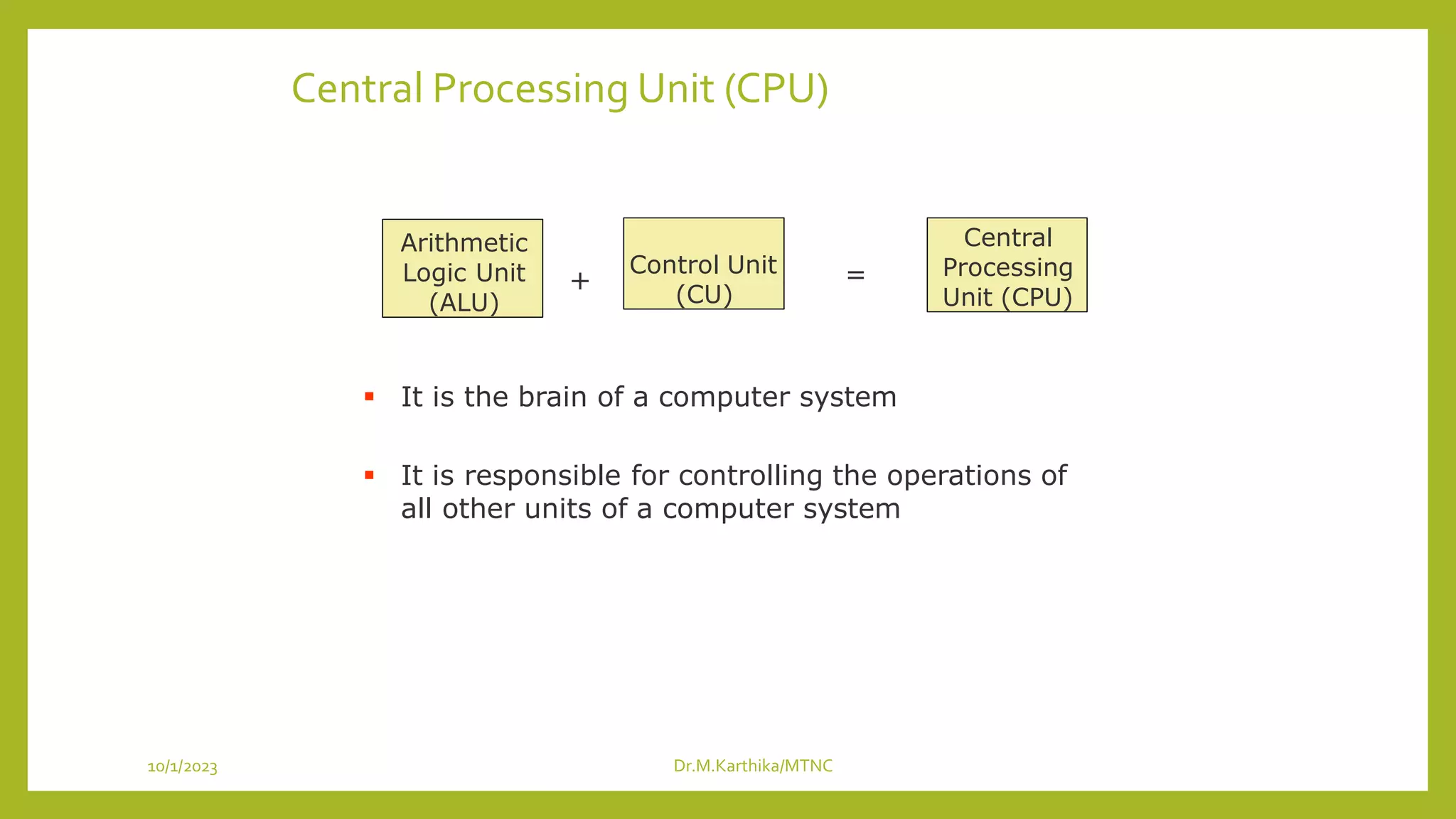
Arithmetic
Logic Unit
(ALU)
Central Processing Unit (CPU)
Control Unit
(CU)
=
Central
Processing
Unit (CPU)
 It is the brain of a computer system
 It is responsible for controlling the operations of
all other units of a computer system
+
10/1/2023 Dr.M.Karthika/MTNC
A system has following three characteristics:
1. A system has more than one element
2. All elements of a system are logically related
3. All elements of a system are controlled in a manner to
achieve the system goal
A computer is a system as it comprises of integrated
components (input unit, output unit, storage unit, and CPU)
that work together to perform the steps called for in the
executing program
The System Concept
10/1/2023 Dr.M.Karthika/MTNC
 Arithmetic Logic Unit (ALU)
 Auxiliary storage
 Central Processing Unit (CPU)
 Computer system
 Control Unit (CU)
 Controlling
 Input interface
 Input unit
 Inputting
 Main memory
KeyWords/Phrases
 Output interface
 Output unit
 Outputting
 Primate storage
 Processing
 Secondary storage
 Storage unit
 Storing
 System
10/1/2023 Dr.M.Karthika/MTNC
THANKYOU
10/1/2023 Dr.M.Karthika/MTNC 17

BASIC COMPUTER ORGANIZATION unit 1.pptx

  • 1.
  • 2.
    In this chapteryou will learn about:  Basic operations performed by all types of computer systems  Basic organization of a computer system  Input unit and its functions  Output unit and its functions  Storage unit and its functions  Types of storage used in a computer system Learning Objectives (Continued on next slide) 10/1/2023 Dr.M.Karthika/MTNC 2
  • 3.
     Arithmetic LogicUnit (ALU)  Control Unit (CU)  Central Processing Unit (CPU)  Computer as a system Learning Objectives (Continued from previous slide..) 10/1/2023 Dr.M.Karthika/MTNC 3
  • 4.
     Inputting. Theprocess of entering data and instructions into the computer system  Storing. Saving data and instructions to make them readily available for initial or additional processing whenever required  Processing. Performing arithmetic operations (add, subtract, multiply, divide, etc.) or logical operations (comparisons like equal to, less than, greater than, etc.) on data to convert them into useful information The Five Basic Operations of a Computer System (Continued on next slide) 10/1/2023 Dr.M.Karthika/MTNC 4
  • 5.
     Outputting. Theprocess of producing useful information or results for the user such as a printed report or visual display  Controlling. Directing the manner and sequence in which all of the above operations are performed The Five Basic Operations of a Computer System 10/1/2023 Dr.M.Karthika/MTNC 5
  • 6.
    Central Processing Unit(CPU) Storage Unit Secondary Storage Primary Storage Control Unit Arithmetic Logic Unit Input Unit Output Unit Program and Data Information (Results) Indicates flow of instructions and data Indicates the control exercised by the control unit Basic Organization of a Computer System 10/1/2023 Dr.M.Karthika/MTNC 6
  • 7.
    An input unitof a computer system performs the following functions: 1. It accepts (or reads) instructions and data from outside world 2. It converts these instructions and data in computer acceptable form 3. It supplies the converted instructions and data to the computer system for further processing InputUnit 10/1/2023 Dr.M.Karthika/MTNC 7
  • 8.
    An output unitof a computer system performs the following functions: 1. It accepts the results produced by the computer, which are in coded form and hence, cannot be easily understood by us 2. It converts these coded results to human acceptable (readable) form 3. It supplies the converted results to outside world OutputUnit 10/1/2023 Dr.M.Karthika/MTNC 8
  • 9.
    The storage unitof a computer system holds (or stores) the following : 1. Data and instructions required for processing (received from input devices) 2. Intermediate results of processing 3. Final results of processing, before they are released to an output device Storage Unit 10/1/2023 Dr.M.Karthika/MTNC 9
  • 10.
     Primary storage Used to hold running program instructions  Used to hold data, intermediate results, and results of ongoing processing of job(s)  Fast in operation  Small Capacity  Expensive  Volatile (looses data on power dissipation) TwoTypes of Storage (Continued on next slide) 10/1/2023 Dr.M.Karthika/MTNC
  • 11.
     Secondary storage Used to hold stored program instructions  Used to hold data and information of stored jobs  Slower than primary storage  Large Capacity  Lot cheaper that primary storage  Retains data even without power TwoTypes of Storage (Continued from previous slide..) 10/1/2023 Dr.M.Karthika/MTNC
  • 12.
    Arithmetic Logic Unitof a computer system is the place where the actual executions of instructions takes place during processing operation Arithmetic Logic Unit (ALU)
  • 13.
    Control Unit ofa computer system manages and coordinates the operations of all other components of the computer system Control Unit (CU)
  • 14.
    Arithmetic Logic Unit (ALU) Central ProcessingUnit (CPU) Control Unit (CU) = Central Processing Unit (CPU)  It is the brain of a computer system  It is responsible for controlling the operations of all other units of a computer system + 10/1/2023 Dr.M.Karthika/MTNC
  • 15.
    A system hasfollowing three characteristics: 1. A system has more than one element 2. All elements of a system are logically related 3. All elements of a system are controlled in a manner to achieve the system goal A computer is a system as it comprises of integrated components (input unit, output unit, storage unit, and CPU) that work together to perform the steps called for in the executing program The System Concept 10/1/2023 Dr.M.Karthika/MTNC
  • 16.
     Arithmetic LogicUnit (ALU)  Auxiliary storage  Central Processing Unit (CPU)  Computer system  Control Unit (CU)  Controlling  Input interface  Input unit  Inputting  Main memory KeyWords/Phrases  Output interface  Output unit  Outputting  Primate storage  Processing  Secondary storage  Storage unit  Storing  System 10/1/2023 Dr.M.Karthika/MTNC
  • 17.