
Evolution Of OS
Mohd Amir khan
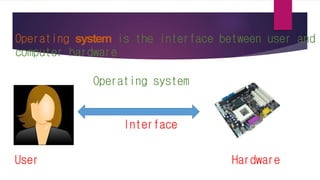
Operating system is the interface between user and
computer hardware
Operating system
Interface
User Hardware
Operating System Functions
 File Management
 Application Management
 Built-in Utility Programs
 Control of Computer Hardware
The First Operating System
 The first operating system used for real work was GM-NAA I/O, produced in 1956
by General Motors' Research division for its IBM 704. GM-NAA I/O was created in
1956 by Robert L. Patrick of General Motors Research and Owen Mock of North
American Aviation
 OS/360 officially known as IBM System/360 Operating System based on batch
processing system developed by IBM for their then-new System/360 mainframe
computer, announced in 1964, was the first operating system that was developed
Disk Operating System
( DOS )
 The first PC Operating System (1981)
 Not a Multitasking OS, only one program could run
at a time
 A command-line interface, no GUI.
 Early versions of Windows sat on top of DOS and
used it to communicate with the BIOS.
 Windows XP communicates directly with the BIOS,
but allows commands to be entered via a command
prompt.
What came first: Windows or Linux?
 Windows 1.0 was released in 1985.
 Linux kernel was first released in 1991.
Mainframe Computers
 Mainframes first appeared in the early 1940s.
 Vendors include IBM, Hitachi
 known for their large size, amount of storage, processing power and high level of
reliability.
 Common I/O devices were card reader and tape drives
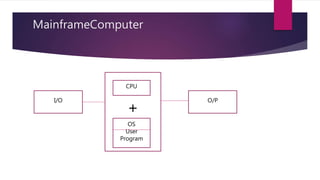
MainframeComputer
+
OS
User
Program
CPU
I/O O/P
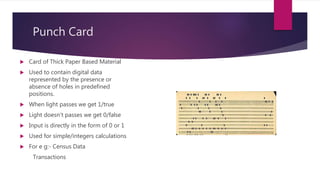
Punch Card
 Card of Thick Paper Based Material
 Used to contain digital data
represented by the presence or
absence of holes in predefined
positions.
 When light passes we get 1/true
 Light doesn’t passes we get 0/false
 Input is directly in the form of 0 or 1
 Used for simple/integers calculations
 For e g:- Census Data
Transactions
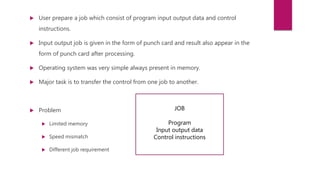
 User prepare a job which consist of program input output data and control
instructions.
 Input output job is given in the form of punch card and result also appear in the
form of punch card after processing.
 Operating system was very simple always present in memory.
 Major task is to transfer the control from one job to another.
 Problem
 Limited memory
 Speed mismatch
 Different job requirement
JOB
Program
Input output data
Control instructions
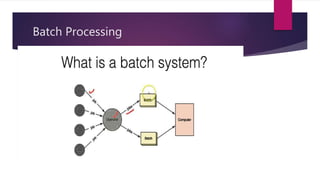
Batch Processing
Batch Processing
 Jobs with similar needs are batched together and executed through the processor
as a group
 Operator sort jobs as a deck of punch cards into the batch with similar needs
 For example Cobol batch portrait batch etc.
Advantages and disadvantages of batch
processing
Advantages
 In a batch job execute one after another
saving time from activities like loading
compiler
 During batch execution no manual
intervention is needed
Disadvantages
 Memory limitation
 Interaction input output devices directly
with the CPU
Spooling
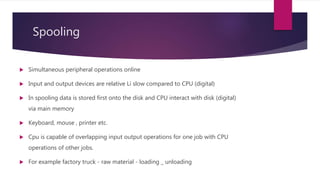
 Simultaneous peripheral operations online
 Input and output devices are relative Li slow compared to CPU (digital)
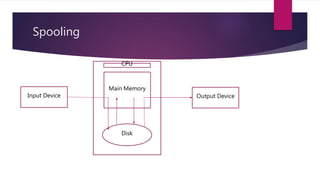
 In spooling data is stored first onto the disk and CPU interact with disk (digital)
via main memory
 Keyboard, mouse , printer etc.
 Cpu is capable of overlapping input output operations for one job with CPU
operations of other jobs.
 For example factory truck - raw material - loading _ unloading
Spooling
Input Device Output Device
Main Memory
Disk
CPU
Advantages and Disadvantages spooling
Advantages
 No interaction of input and output devices
with CPU
 CPU utilization is more as CPU is busy
most of the time
Disadvantages
 In starting spooling was uni-programming
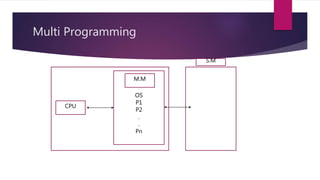
Multi programming operating system
 Maximize CPU utilization
 Multi programming means more than one process in main memory which are
ready to execute
 Process generally require CPU time and input output time so show running
process perform input output or some other event which do not require CPU then
sitting ideal. CPU make a context-switch and pics some other process and this
idea will continue
 CPU never idle unless there is not process ready to execute or at time of context
switch
Multi Programming
OS
P1
P2
.
.
Pn
CPU
M.M
S.M
Advantages and disadvantages of multi
programming
Advantages
 High CPU utilization
 Less weighting time, response time etc
 May executed to multiple users
 Now a days useful load is more
Disadvantages
 Difficult scheduling
 Main Memory management is required
 memory fragmentation
 Paging non-contagious memory allocation
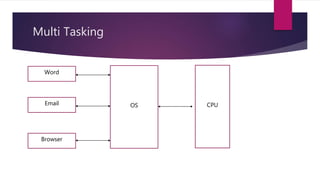
Multitasking Operating System time sharing/
fair share /multi programming with Round
Robin
 Multi tasking is multi programming with time sharing
 Only One CPU but switches between processes so quickly that it gives an illusion
that all executing at same time
 The task in multitasking may refer to multiple Threads of the same program
 Main idea is better response time and executing multiple process together
Multi Tasking
OS CPU
Word
Email
Browser
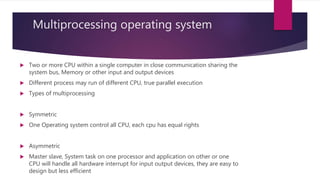
Multiprocessing operating system
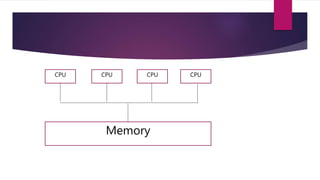
 Two or more CPU within a single computer in close communication sharing the
system bus, Memory or other input and output devices
 Different process may run of different CPU, true parallel execution
 Types of multiprocessing
 Symmetric
 One Operating system control all CPU, each cpu has equal rights
 Asymmetric
 Master slave, System task on one processor and application on other or one
CPU will handle all hardware interrupt for input output devices, they are easy to
design but less efficient
Memory
CPU CPU CPU CPU
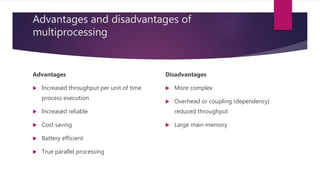
Advantages and disadvantages of
multiprocessing
Advantages
 Increased throughput per unit of time
process execution
 Increased reliable
 Cost saving
 Battery efficient
 True parallel processing
Disadvantages
 More complex
 Overhead or coupling (dependency)
reduced throughput
 Large main memory
THANK YOU

evolution of operating system

  • 1.
  • 2.
    Operating system isthe interface between user and computer hardware Operating system Interface User Hardware
  • 3.
    Operating System Functions File Management  Application Management  Built-in Utility Programs  Control of Computer Hardware
  • 4.
    The First OperatingSystem  The first operating system used for real work was GM-NAA I/O, produced in 1956 by General Motors' Research division for its IBM 704. GM-NAA I/O was created in 1956 by Robert L. Patrick of General Motors Research and Owen Mock of North American Aviation  OS/360 officially known as IBM System/360 Operating System based on batch processing system developed by IBM for their then-new System/360 mainframe computer, announced in 1964, was the first operating system that was developed
  • 5.
    Disk Operating System (DOS )  The first PC Operating System (1981)  Not a Multitasking OS, only one program could run at a time  A command-line interface, no GUI.  Early versions of Windows sat on top of DOS and used it to communicate with the BIOS.  Windows XP communicates directly with the BIOS, but allows commands to be entered via a command prompt.
  • 6.
    What came first:Windows or Linux?  Windows 1.0 was released in 1985.  Linux kernel was first released in 1991.
  • 7.
    Mainframe Computers  Mainframesfirst appeared in the early 1940s.  Vendors include IBM, Hitachi  known for their large size, amount of storage, processing power and high level of reliability.  Common I/O devices were card reader and tape drives
  • 8.
  • 9.
    Punch Card  Cardof Thick Paper Based Material  Used to contain digital data represented by the presence or absence of holes in predefined positions.  When light passes we get 1/true  Light doesn’t passes we get 0/false  Input is directly in the form of 0 or 1  Used for simple/integers calculations  For e g:- Census Data Transactions
  • 10.
     User preparea job which consist of program input output data and control instructions.  Input output job is given in the form of punch card and result also appear in the form of punch card after processing.  Operating system was very simple always present in memory.  Major task is to transfer the control from one job to another.  Problem  Limited memory  Speed mismatch  Different job requirement JOB Program Input output data Control instructions
  • 11.
  • 12.
    Batch Processing  Jobswith similar needs are batched together and executed through the processor as a group  Operator sort jobs as a deck of punch cards into the batch with similar needs  For example Cobol batch portrait batch etc.
  • 13.
    Advantages and disadvantagesof batch processing Advantages  In a batch job execute one after another saving time from activities like loading compiler  During batch execution no manual intervention is needed Disadvantages  Memory limitation  Interaction input output devices directly with the CPU
  • 14.
    Spooling  Simultaneous peripheraloperations online  Input and output devices are relative Li slow compared to CPU (digital)  In spooling data is stored first onto the disk and CPU interact with disk (digital) via main memory  Keyboard, mouse , printer etc.  Cpu is capable of overlapping input output operations for one job with CPU operations of other jobs.  For example factory truck - raw material - loading _ unloading
  • 15.
    Spooling Input Device OutputDevice Main Memory Disk CPU
  • 16.
    Advantages and Disadvantagesspooling Advantages  No interaction of input and output devices with CPU  CPU utilization is more as CPU is busy most of the time Disadvantages  In starting spooling was uni-programming
  • 17.
    Multi programming operatingsystem  Maximize CPU utilization  Multi programming means more than one process in main memory which are ready to execute  Process generally require CPU time and input output time so show running process perform input output or some other event which do not require CPU then sitting ideal. CPU make a context-switch and pics some other process and this idea will continue  CPU never idle unless there is not process ready to execute or at time of context switch
  • 18.
  • 19.
    Advantages and disadvantagesof multi programming Advantages  High CPU utilization  Less weighting time, response time etc  May executed to multiple users  Now a days useful load is more Disadvantages  Difficult scheduling  Main Memory management is required  memory fragmentation  Paging non-contagious memory allocation
  • 20.
    Multitasking Operating Systemtime sharing/ fair share /multi programming with Round Robin  Multi tasking is multi programming with time sharing  Only One CPU but switches between processes so quickly that it gives an illusion that all executing at same time  The task in multitasking may refer to multiple Threads of the same program  Main idea is better response time and executing multiple process together
  • 21.
  • 22.
    Multiprocessing operating system Two or more CPU within a single computer in close communication sharing the system bus, Memory or other input and output devices  Different process may run of different CPU, true parallel execution  Types of multiprocessing  Symmetric  One Operating system control all CPU, each cpu has equal rights  Asymmetric  Master slave, System task on one processor and application on other or one CPU will handle all hardware interrupt for input output devices, they are easy to design but less efficient
  • 23.
  • 24.
    Advantages and disadvantagesof multiprocessing Advantages  Increased throughput per unit of time process execution  Increased reliable  Cost saving  Battery efficient  True parallel processing Disadvantages  More complex  Overhead or coupling (dependency) reduced throughput  Large main memory
  • 25.

Editor's Notes

  • #7 The first distro appeared in 1992. It's worth mentioning that UNIX appeared way before any of these, in 1971 . The first BSD in 1978. The Berkeley Software Distribution (BSD) was an operating system based on Research Unix, developed and distributed by the Computer Systems Research Group (CSRG) at the University of California, Berkeley.
  • #21 Multiprogramming – A computer running more than one program at a time (like running Excel and Firefox simultaneously). Multiprocessing – A computer using more than one CPU at a time. Multitasking – Tasks sharing a common resource (like 1 CPU). Multithreading is an extension of multitasking.