Introduction to computer
chapter:01
Instructed by Noshaba Naseem
Computer
A computer is an electronic device, operating under the control of instructions
stored in its own memory that can accept data (input), process the data according
to specified rules, produce information (output), and store the information for
future use
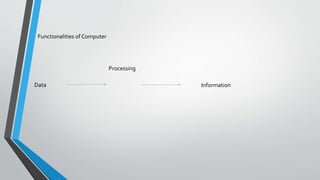
Functionalities of computer :
Any digital computer carries out five functions in gross terms:
Takes data as input.
Stores the data/instructions in its memory and use them when required.
Processes the data and converts it into useful information.
Generates the output
Controls all the above four steps
Data
Processing
Information
Functionalities of Computer
Computer Components
Software
Hardware
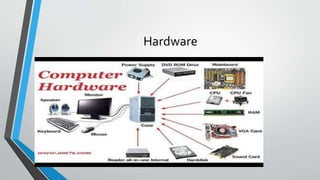
Hardware
Hardware, which is abbreviated as HW, refers to all physical components of a
computer system, including the devices connected to it.You cannot create a
computer or use software without using hardware.The screen on which you
are reading this information is also a hardware.
Hardware
Software
Software, which is abbreviated as SW or S/W, is a set of programs that enables
the hardware to perform a specific task. All the programs that run the
computer are software.The software can be of three types: system software,
application software, and programming software.
Types of Software:
1-Application Software
2-System Software
Computer of History
• Charles Babbage - father of computer
• 1800’s planned analytical engine
• ENIAC - developed at end ofWW II
• 1951 - 1963 1st and 2nd generation
• very large, used unreliable vacuum tubes
• 1963 - present - 3rd and 4th generation
• smaller, faster - use transistors and integrated circuits
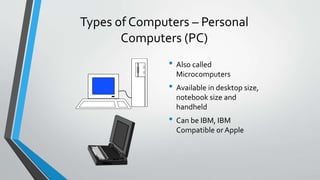
Types of Computers – Personal
Computers (PC)
• Also called
Microcomputers
• Available in desktop size,
notebook size and
handheld
• Can be IBM, IBM
Compatible or Apple
Types of Computers - Mainframes
• Very powerful
• Very fast
• Used by large corporations and governmental agencies
• Operated by computer specialist
Types of Computers-
Supercomputers
• Most powerful
• Fastest
• Most expensive
• Several million dollars each
• Used only by
• Governmental agencies
• Large international corporations
Types of Computers -
Minicomputers
• Size of filing cabinet
• Used by small and medium size companies and institutions
• Operated by computer specialist
• Terminals allow many people to use
Computer Units :
• Input Unit
• Central processing Unit
• Primary Memory Unit
• Secondary storage Unit
• Output Unit
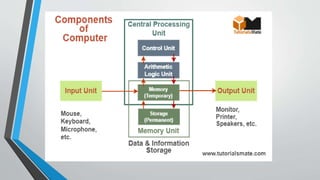
In the above diagram, both control (control unit or CU)
and arithmetic & logic unit (ALU) combinely called as
Central Processing Unit (CPU). Let's describe about all
the parts as included in the above diagram one by one.
The Processor Unit (CPU):
It is the brain of the computer system. All major
calculation and comparisons are made inside the CPU
and it is also responsible for activation and controlling
the operation of other unit.This unit consists of two
major components, that are arithmetic logic unit (ALU)
and control unit (CU).
Arithmetic Logic Unit (ALU):
Arithmetic logic unit performs all arithmetic operations such as addition,
subtraction, multiplication and division. It also uses logic operation for
comparison like comparison or decision making (>, <=, >=, = etc.).
Control Unit (CU) :
The control unit of a CPU controls the entire operation of the computer. It
also controls all devices such as memory, input/output devices connected
to the CPU. CU fetches instructions from memory, decodes the instruction,
interprets the instruction to know what the task are to be performed and
sends suitable control signals to the other components to perform for the
necessary steps to execute the instruction.
Input/Output Unit:
The input/output unit consists of devices used to transmit
information between the external world and computer memory.
The information fed through the input unit is stored in computer's
memory for processing and the final result stored in memory can
be recorded or display on the output medium.
Memory unit:
It is an essential component of a digital computer. It is where all
data intermediate and find results are stored.The data read from
the main storage or an input unit are transferred to the
computer's memory where they are available for processing.This
memory unit is used to hold the instructions to be executed and
data to be processes.
• Primary Memory:
Primary memory has direct link with input unit and output unit. It stores the
input data, intermediate calculation, result.
• Secondary Memory:
The primary storage is not able to store data permanently for future use. So
some other types of storage technology is required to store the data
permanently for long time, it is called secondary or auxiliary memory.

Introduction to computer.pptx

  • 1.
  • 2.
    Computer A computer isan electronic device, operating under the control of instructions stored in its own memory that can accept data (input), process the data according to specified rules, produce information (output), and store the information for future use
  • 3.
    Functionalities of computer: Any digital computer carries out five functions in gross terms: Takes data as input. Stores the data/instructions in its memory and use them when required. Processes the data and converts it into useful information. Generates the output Controls all the above four steps
  • 4.
  • 5.
  • 6.
    Hardware Hardware, which isabbreviated as HW, refers to all physical components of a computer system, including the devices connected to it.You cannot create a computer or use software without using hardware.The screen on which you are reading this information is also a hardware.
  • 7.
  • 8.
    Software Software, which isabbreviated as SW or S/W, is a set of programs that enables the hardware to perform a specific task. All the programs that run the computer are software.The software can be of three types: system software, application software, and programming software. Types of Software: 1-Application Software 2-System Software
  • 9.
    Computer of History •Charles Babbage - father of computer • 1800’s planned analytical engine • ENIAC - developed at end ofWW II • 1951 - 1963 1st and 2nd generation • very large, used unreliable vacuum tubes • 1963 - present - 3rd and 4th generation • smaller, faster - use transistors and integrated circuits
  • 10.
    Types of Computers– Personal Computers (PC) • Also called Microcomputers • Available in desktop size, notebook size and handheld • Can be IBM, IBM Compatible or Apple
  • 11.
    Types of Computers- Mainframes • Very powerful • Very fast • Used by large corporations and governmental agencies • Operated by computer specialist
  • 12.
    Types of Computers- Supercomputers •Most powerful • Fastest • Most expensive • Several million dollars each • Used only by • Governmental agencies • Large international corporations
  • 13.
    Types of Computers- Minicomputers • Size of filing cabinet • Used by small and medium size companies and institutions • Operated by computer specialist • Terminals allow many people to use
  • 14.
    Computer Units : •Input Unit • Central processing Unit • Primary Memory Unit • Secondary storage Unit • Output Unit
  • 16.
    In the abovediagram, both control (control unit or CU) and arithmetic & logic unit (ALU) combinely called as Central Processing Unit (CPU). Let's describe about all the parts as included in the above diagram one by one. The Processor Unit (CPU): It is the brain of the computer system. All major calculation and comparisons are made inside the CPU and it is also responsible for activation and controlling the operation of other unit.This unit consists of two major components, that are arithmetic logic unit (ALU) and control unit (CU).
  • 17.
    Arithmetic Logic Unit(ALU): Arithmetic logic unit performs all arithmetic operations such as addition, subtraction, multiplication and division. It also uses logic operation for comparison like comparison or decision making (>, <=, >=, = etc.). Control Unit (CU) : The control unit of a CPU controls the entire operation of the computer. It also controls all devices such as memory, input/output devices connected to the CPU. CU fetches instructions from memory, decodes the instruction, interprets the instruction to know what the task are to be performed and sends suitable control signals to the other components to perform for the necessary steps to execute the instruction.
  • 18.
    Input/Output Unit: The input/outputunit consists of devices used to transmit information between the external world and computer memory. The information fed through the input unit is stored in computer's memory for processing and the final result stored in memory can be recorded or display on the output medium. Memory unit: It is an essential component of a digital computer. It is where all data intermediate and find results are stored.The data read from the main storage or an input unit are transferred to the computer's memory where they are available for processing.This memory unit is used to hold the instructions to be executed and data to be processes.
  • 19.
    • Primary Memory: Primarymemory has direct link with input unit and output unit. It stores the input data, intermediate calculation, result. • Secondary Memory: The primary storage is not able to store data permanently for future use. So some other types of storage technology is required to store the data permanently for long time, it is called secondary or auxiliary memory.