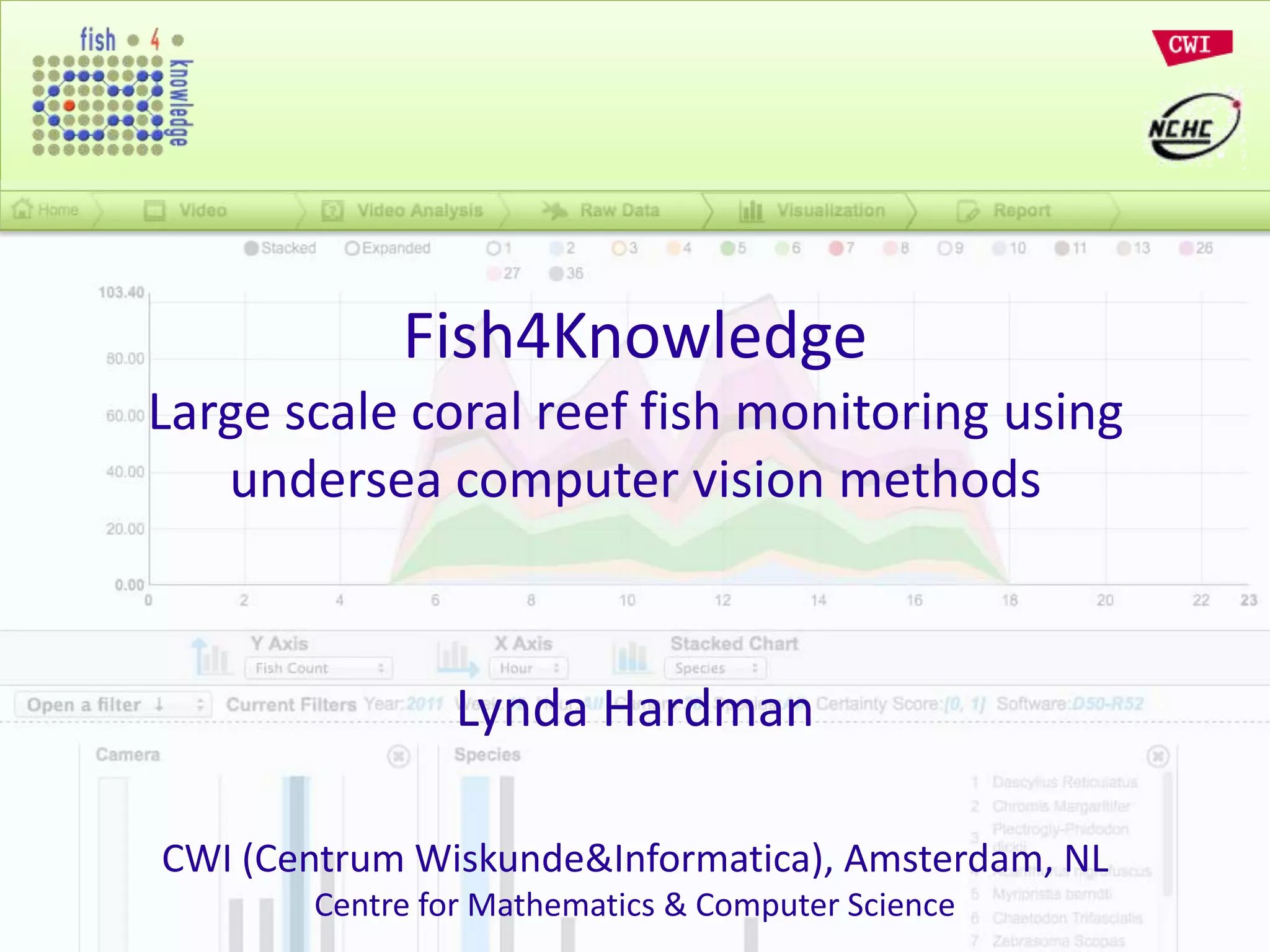
Fish4Knowledge
Large scale coral reef fish monitoring using
undersea computer vision methods
Lynda Hardman
CWI (Centrum Wiskunde&Informatica), Amsterdam, NL
Centre for Mathematics & Computer Science
THE FISH4KNOWLEDGE
PROJECT
1. Collecting Video Data
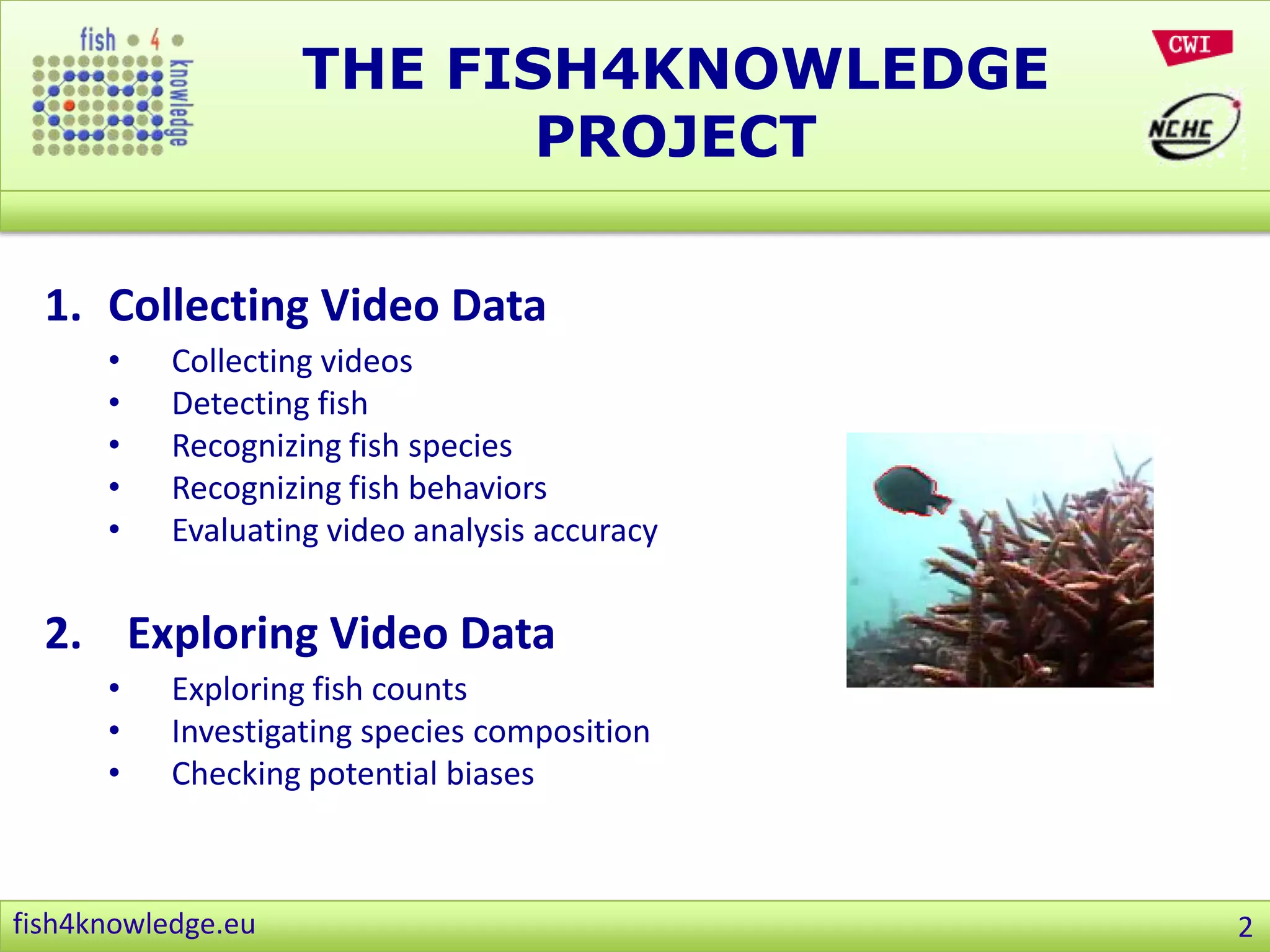
• Collecting videos
• Detecting fish
• Recognizing fish species
• Recognizing fish behaviors
• Evaluating video analysis accuracy
2. Exploring Video Data
• Exploring fish counts
• Investigating species composition
• Checking potential biases
2fish4knowledge.eu
THE FISH4KNOWLEDGE
PROJECT
1. Collecting Video Data
• Collecting videos
• Detecting fish
• Recognizing fish species
• Recognizing fish behaviors
• Evaluating video analysis accuracy
2. Exploring Video Data
• Exploring fish counts
• Investigating species composition
• Checking potential biases
3fish4knowledge.eu
COLLECTING VIDEO DATA
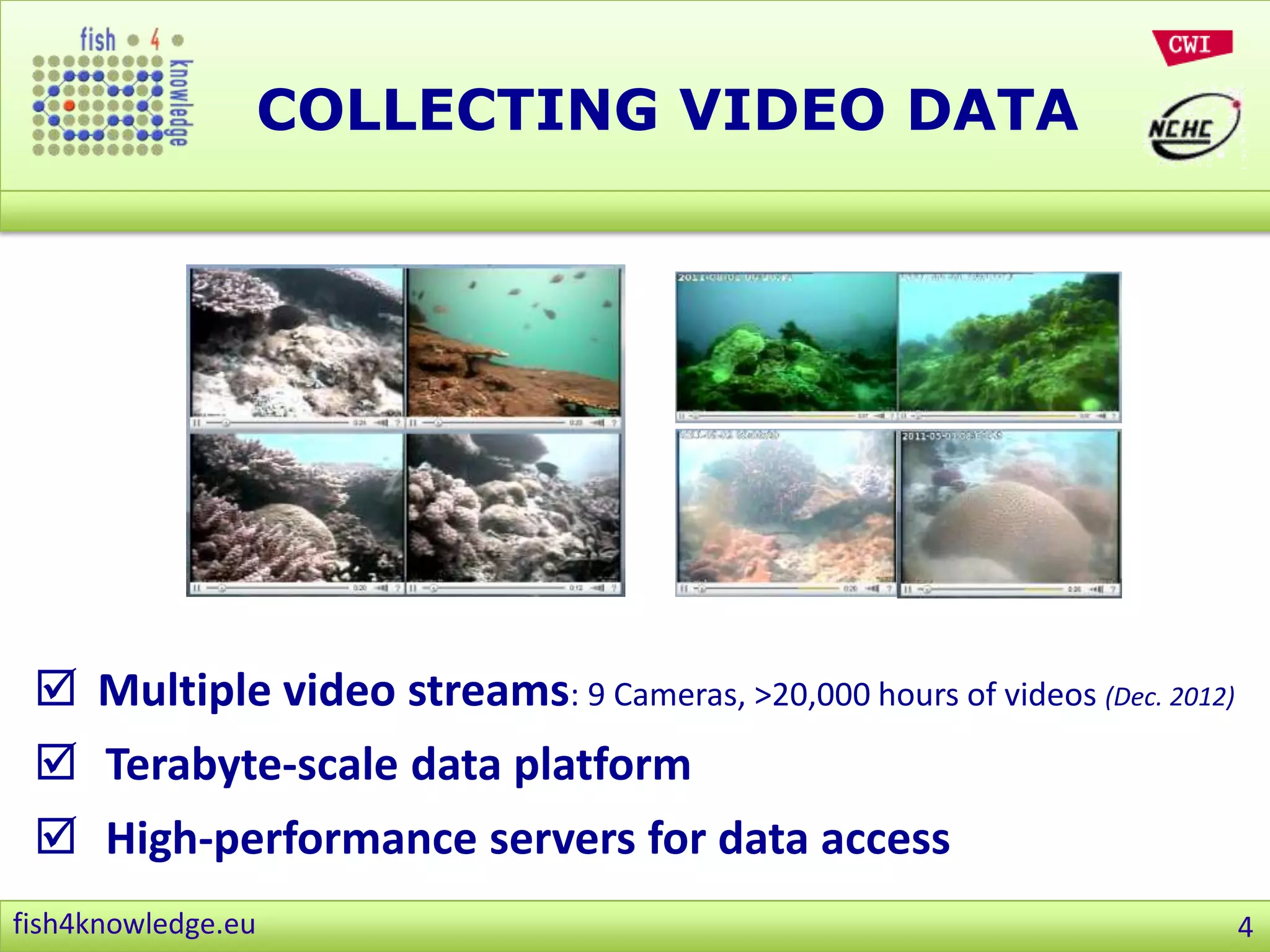
 Multiple video streams: 9 Cameras, >20,000 hours of videos (Dec. 2012)
 Terabyte-scale data platform
 High-performance servers for data access
4fish4knowledge.eu
DETECTING FISH
 Detection of fish in each frame
 Description of fish contour, color, texture... (>30 features)
 Tracking of single fish over several frames
 Handling partial and total occlusions
 Over 400 million fish detections
5fish4knowledge.eu
RECOGNIZING
FISH SPECIES
 Detection of body parts (head, tail…)
 Construction of a fish model for each species
 15 species detected (96% of total number of fish)
RECOGNIZING
FISH BEHAVIORS
 Detection of behaviors by analyzing trajectories
 Relation to background objects (feeding, hiding…)
 Relation to other fish (pairing, grouping, solitary…)
Fish Trajectories Description of scene’s background
THE FISH4KNOWLEDGE
PROJECT
1. Collecting Video Data
• Collecting videos
• Detecting fish
• Recognizing fish species
• Recognizing fish behaviors
• Evaluating video analysis accuracy
2. Exploring Video Data
• Exploring fish counts
• Investigating species composition
• Checking potential biases
8fish4knowledge.eu
EVALUATING VIDEO
ANALYSIS ACCURACY
9fish4knowledge.eu
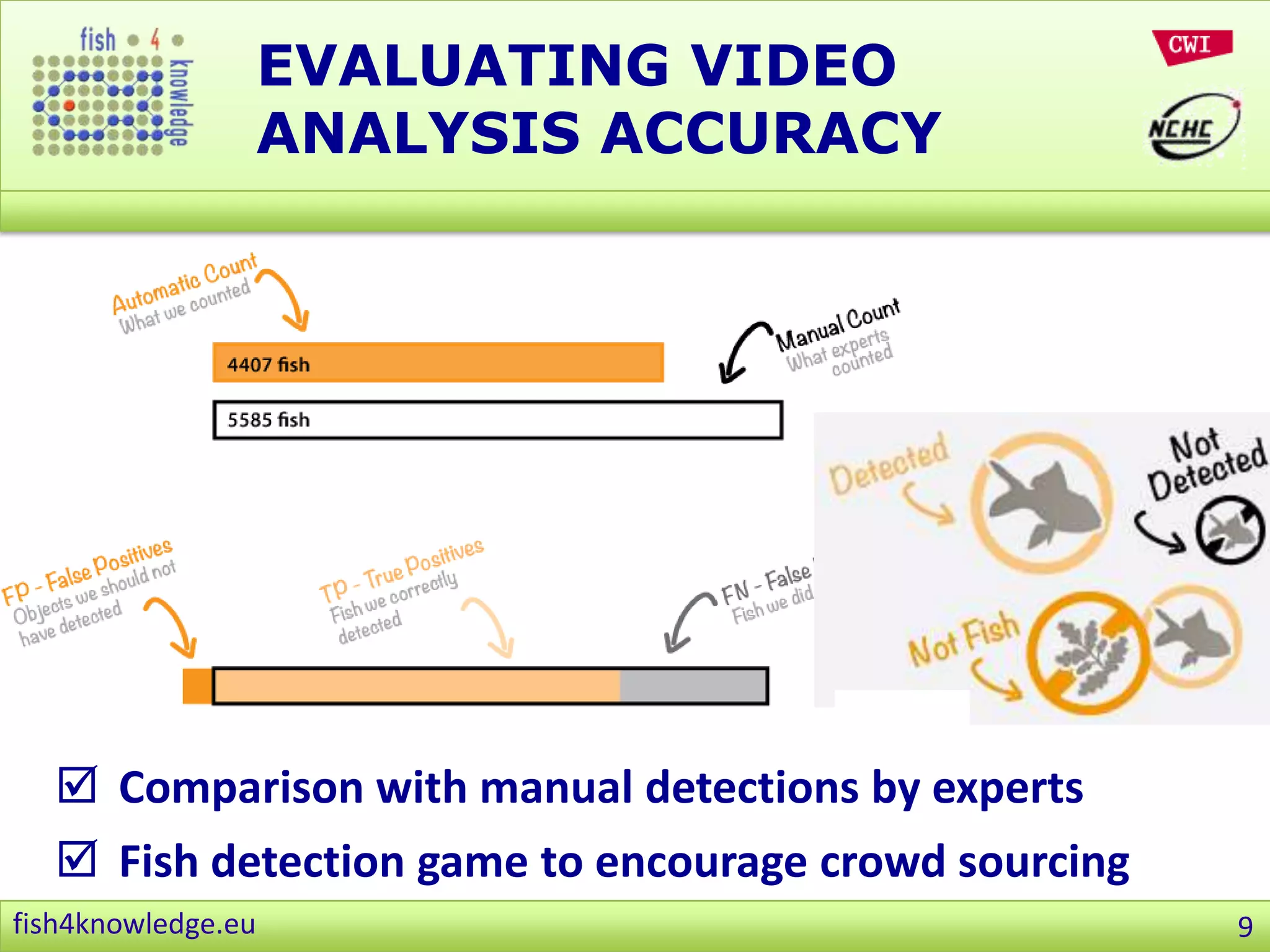
 Comparison with manual detections by experts
 Fish detection game to encourage crowd sourcing
EVALUATING VIDEO
ANALYSIS ACCURACY
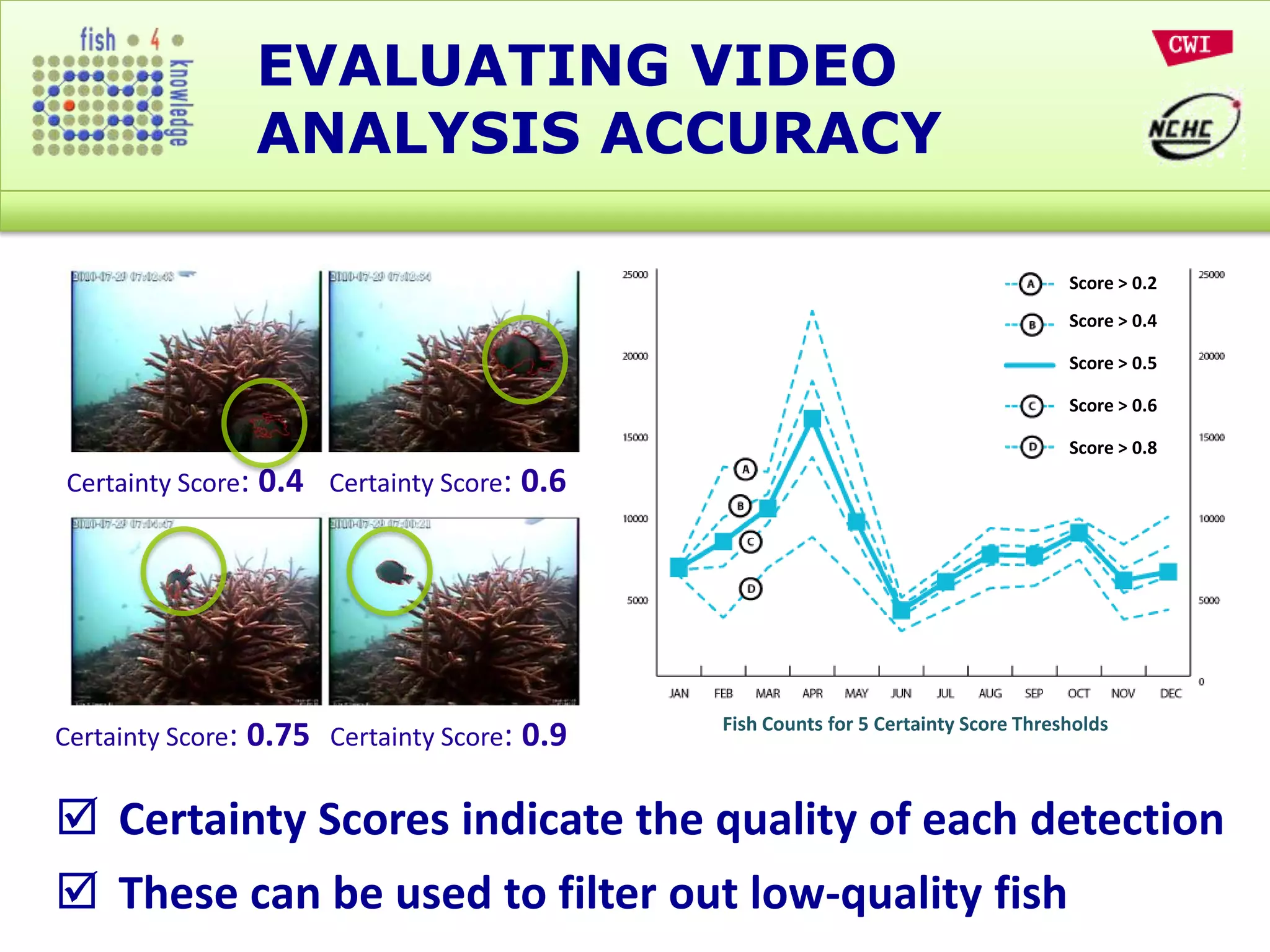
 Certainty Scores indicate the quality of each detection
 These can be used to filter out low-quality fish
Score > 0.8
Fish Counts for 5 Certainty Score Thresholds
Score > 0.2
Score > 0.4
Score > 0.5
Score > 0.6
Certainty Score: 0.4
Certainty Score: 0.9Certainty Score: 0.75
Certainty Score: 0.6
THE FISH4KNOWLEDGE
PROJECT
1. Collecting Video Data
• Collecting videos
• Detecting fish
• Recognizing fish species
• Recognizing fish behaviors
• Evaluating video analysis accuracy
2. Exploring Video Data
• Exploring fish counts
• Investigating species composition
• Checking potential biases
11fish4knowledge.eu
ABUNDANCE OF
DASCYLLUSRETICULATUS
ABUNDANCE OF
DASCYLLUSRETICULATUS
THE FISH4KNOWLEDGE
PROJECT
1. Collecting Video Data
• Collecting videos
• Detecting fish
• Recognizing fish species
• Recognizing fish behaviors
• Evaluating video analysis accuracy
2. Exploring Video Data
• Exploring fish counts
• Investigating species composition
• Checking potential biases
14fish4knowledge.eu
SPECIES COMPOSITION
DEPENDS ON LOCATION
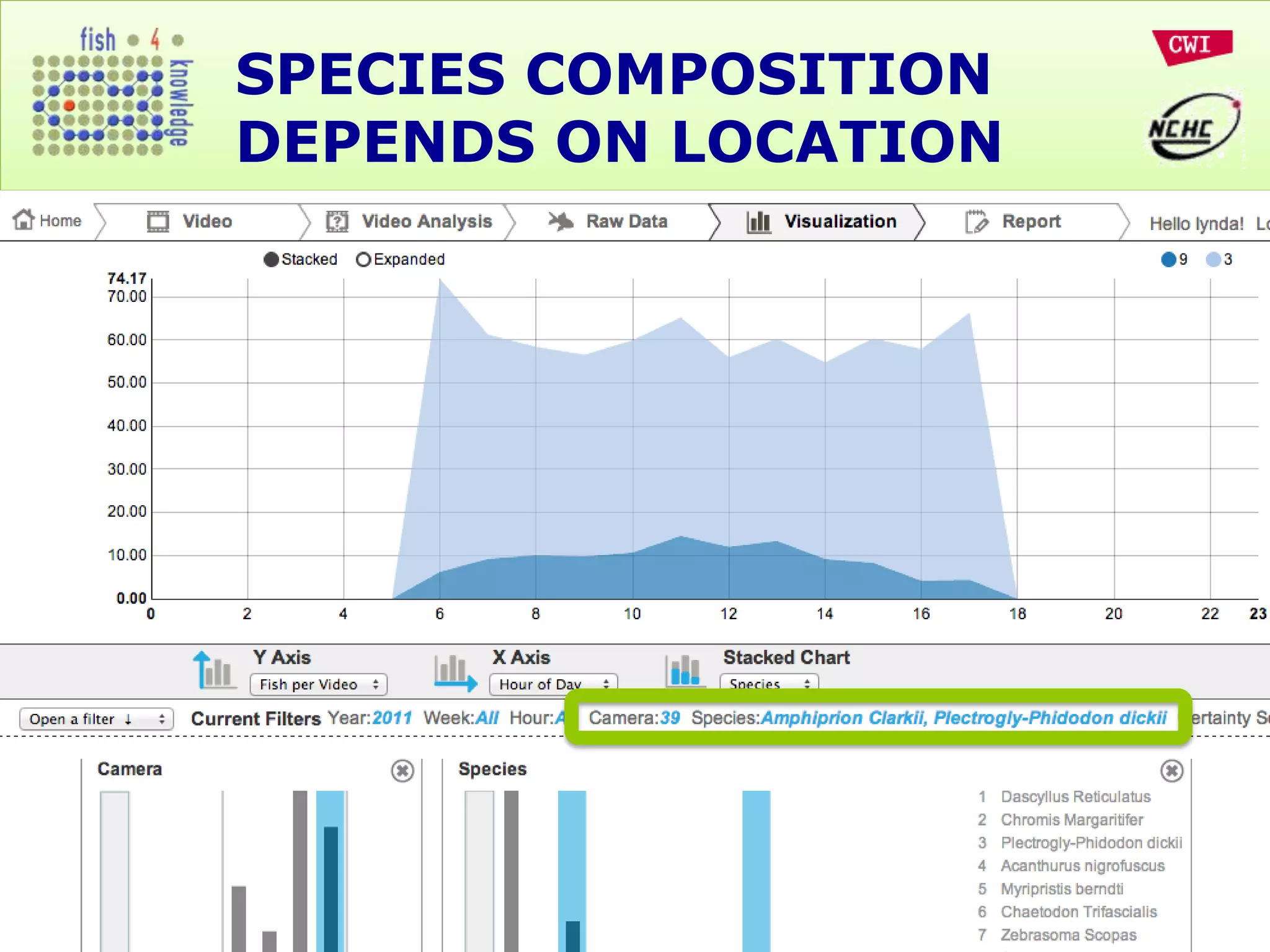
Amphiprionclarkii, Camera 38 Plectroglyphidodondickii, Camera 39
SPECIES COMPOSITION
DEPENDS ON LOCATION
THE FISH4KNOWLEDGE
PROJECT
1. Collecting Video Data
• Collecting videos
• Detecting fish
• Recognizing fish species
• Recognizing fish behaviors
• Evaluating video analysis accuracy
2. Exploring Video Data
• Exploring fish counts
• Investigating species composition
• Checking potential biases
18fish4knowledge.eu
SPECIES COMPOSITION
DEPENDS ON LOCATION
Plectroglyphidodondickii, Camera 38 Amphiprionclarkii, Camera 38
Plectroglyphidodondickii, Camera 39 Amphiprionclarkii, Camera 39
THE FISH4KNOWLEDGE
PROJECT
20fish4knowledge.eu
http://fish4knowledge.eu/people.htm
 University of Edinburgh (United Kingdom)
Universitàdi Catania (Italy)
 Centrum Wiskunde&Informatica (Netherlands)
 National Applied Research Laboratories (Taiwan)

Fish4Knowledge: large scale coral reef fish monitoring using undersea computer vision methods.

  • 1.
    Fish4Knowledge Large scale coralreef fish monitoring using undersea computer vision methods Lynda Hardman CWI (Centrum Wiskunde&Informatica), Amsterdam, NL Centre for Mathematics & Computer Science
  • 2.
    THE FISH4KNOWLEDGE PROJECT 1. CollectingVideo Data • Collecting videos • Detecting fish • Recognizing fish species • Recognizing fish behaviors • Evaluating video analysis accuracy 2. Exploring Video Data • Exploring fish counts • Investigating species composition • Checking potential biases 2fish4knowledge.eu
  • 3.
    THE FISH4KNOWLEDGE PROJECT 1. CollectingVideo Data • Collecting videos • Detecting fish • Recognizing fish species • Recognizing fish behaviors • Evaluating video analysis accuracy 2. Exploring Video Data • Exploring fish counts • Investigating species composition • Checking potential biases 3fish4knowledge.eu
  • 4.
    COLLECTING VIDEO DATA Multiple video streams: 9 Cameras, >20,000 hours of videos (Dec. 2012)  Terabyte-scale data platform  High-performance servers for data access 4fish4knowledge.eu
  • 5.
    DETECTING FISH  Detectionof fish in each frame  Description of fish contour, color, texture... (>30 features)  Tracking of single fish over several frames  Handling partial and total occlusions  Over 400 million fish detections 5fish4knowledge.eu
  • 6.
    RECOGNIZING FISH SPECIES  Detectionof body parts (head, tail…)  Construction of a fish model for each species  15 species detected (96% of total number of fish)
  • 7.
    RECOGNIZING FISH BEHAVIORS  Detectionof behaviors by analyzing trajectories  Relation to background objects (feeding, hiding…)  Relation to other fish (pairing, grouping, solitary…) Fish Trajectories Description of scene’s background
  • 8.
    THE FISH4KNOWLEDGE PROJECT 1. CollectingVideo Data • Collecting videos • Detecting fish • Recognizing fish species • Recognizing fish behaviors • Evaluating video analysis accuracy 2. Exploring Video Data • Exploring fish counts • Investigating species composition • Checking potential biases 8fish4knowledge.eu
  • 9.
    EVALUATING VIDEO ANALYSIS ACCURACY 9fish4knowledge.eu Comparison with manual detections by experts  Fish detection game to encourage crowd sourcing
  • 10.
    EVALUATING VIDEO ANALYSIS ACCURACY Certainty Scores indicate the quality of each detection  These can be used to filter out low-quality fish Score > 0.8 Fish Counts for 5 Certainty Score Thresholds Score > 0.2 Score > 0.4 Score > 0.5 Score > 0.6 Certainty Score: 0.4 Certainty Score: 0.9Certainty Score: 0.75 Certainty Score: 0.6
  • 11.
    THE FISH4KNOWLEDGE PROJECT 1. CollectingVideo Data • Collecting videos • Detecting fish • Recognizing fish species • Recognizing fish behaviors • Evaluating video analysis accuracy 2. Exploring Video Data • Exploring fish counts • Investigating species composition • Checking potential biases 11fish4knowledge.eu
  • 12.
  • 13.
  • 14.
    THE FISH4KNOWLEDGE PROJECT 1. CollectingVideo Data • Collecting videos • Detecting fish • Recognizing fish species • Recognizing fish behaviors • Evaluating video analysis accuracy 2. Exploring Video Data • Exploring fish counts • Investigating species composition • Checking potential biases 14fish4knowledge.eu
  • 15.
  • 16.
    Amphiprionclarkii, Camera 38Plectroglyphidodondickii, Camera 39
  • 17.
  • 18.
    THE FISH4KNOWLEDGE PROJECT 1. CollectingVideo Data • Collecting videos • Detecting fish • Recognizing fish species • Recognizing fish behaviors • Evaluating video analysis accuracy 2. Exploring Video Data • Exploring fish counts • Investigating species composition • Checking potential biases 18fish4knowledge.eu
  • 19.
    SPECIES COMPOSITION DEPENDS ONLOCATION Plectroglyphidodondickii, Camera 38 Amphiprionclarkii, Camera 38 Plectroglyphidodondickii, Camera 39 Amphiprionclarkii, Camera 39
  • 20.
    THE FISH4KNOWLEDGE PROJECT 20fish4knowledge.eu http://fish4knowledge.eu/people.htm  Universityof Edinburgh (United Kingdom) Universitàdi Catania (Italy)  Centrum Wiskunde&Informatica (Netherlands)  National Applied Research Laboratories (Taiwan)

Editor's Notes

  • #2 Good afternoon! As you may have noticed, I am not Bas Boom, but Lynda Hardman, and I’m not a marine biologist, I’m a computer scientist.I am at this conference, because I am a member of a European project that has spent the last 3 years building a system for automatically counting fish in fish videos.
  • #17 Here you can see the habitats for camera 38, on the left, and camera 39, on the right (also based near Kenting).