Magellan – Spark as a Geospatial
Analytics Engine
Ram Sriharsha
Hortonworks
Who Am I?
• Apache Spark PMC Member
• Hortonworks Architect, Spark + Data Science
• Prior to HWX, Principal Research Scientist @
Yahoo Labs (Large Scale Machine Learning)
– Login Risk Detection, Sponsored Search Click
Prediction, Advertising Effectiveness Models,
Online Learning, …
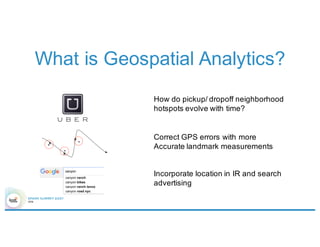
What is Geospatial Analytics?
How do pickup/ dropoff neighborhood
hotspots evolve with time?
Correct GPS errors with more
Accurate landmark measurements
Incorporate location in IR and search
advertising
Do we need one more library?
• Spatial Analytics at scale is challenging
– Simplicity + Scalability = Hard
• Ancient Data Formats
– metadata, indexing not handled well, inefficient storage
• Geospatial Analytics is not simply BI anymore
– Statistical + Machine Learning being leveraged in geospatial
• Now is the time to do it!
– Explosion of mobile data
– Finer granularity of data collection for geometries
– Analytics stretching the limits of traditional approaches
– Spark SQL + Catalyst + Tungsten makes extensible SQL engines easier
than ever before!
Introduction to Magellan
Shapefiles
*.shp
*.dbf
sqlContext.read.format(“magellan”)
.load(${neighborhoods.path})
GeoJSON
*.json
sqlContext.read.format(“magellan”)
.option(“type”, “geojson”)
.load(${neighborhoods.path})
polygon metadata
([0], [(-122.4413024, 7.8066277),
…])
neighborhood -> Marina
([0], [(-122.4111659, 37.8003388),
…])
neighborhood -> North Beach
Introduction to Magellan
polygon metadata
([0], [(-
122.4413024,
7.8066277), …])
neighborhood ->
Marina
([0], [(-
122.4111659,
37.8003388), …])
neighborhood ->
North Beach
neighborhoods.filter(
point(-122.4111659, 37.8003388)
within
‘polygon
).show()
polygon metadata
([0], [(-
122.4111659,
37.8003388), …])
neighborhood ->
North Beach
Shape literal
Boolean Expression
Introduction to Magellan
polygon metadata
([0], [(-122.4111659,
37.8003388),…])
neighborhood->
North Beach
([0], [(-122.4413024,
7.8066277),…])
neighborhood->
Marina
point
(-122.4111659,
37.8003388)
(-122.4343576,
37.8068007)
points.join(neighborhoods).
where(‘point within ‘polygon).
show()
point polygon metadata
(-122.4343576,
37.8068007)
([0], [(-
122.4111659,
37.8003388),
…])
neighborhood-
> North Beach
Introduction to Magellan
polygon metadata
([0], [(-122.4111659,
37.8003388),…])
neighborhood->
North Beach
([0], [(-122.4413024,
7.8066277),…])
neighborhood->
Marina
neighborhoods.filter(
point(-122.4111659, 37.8003388).buffer(0.1)
intersects
‘polygon
).show()
point polygon metadata
(-122.4343576,
37.8068007)
([0], [(-
122.4111659,
37.8003388),
…])
neighborhood-
> North Beach
‘point within ‘polygon
the join
• Inherits all join optimizations from Spark
SQL
– if neighborhoods table is small, Broadcast
Cartesian Join
– else Cartesian Join
Status
• Magellan 1.0.3 available as Spark Package.
• Scala
• Spark 1.4
• Spark Package: Magellan
• Github: https://github.com/harsha2010/magellan
• Blog: http://hortonworks.com/blog/magellan-geospatial-analytics-in-
spark/
• Notebook example: http://bit.ly/1GwLyrV
• Input Formats: ESRI Shapefile, GeoJSON, OSM-XML
• Please try it out and give feedback!
What is next?
• Magellan 1.0.4
– Spark 1.6
– Python
– Spatial Join
– Persistent Indices
– Better leverage Tungsten via codegen + memory
layout optimizations
– More operators: buffer, distance, area etc.
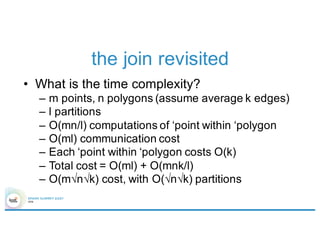
the join revisited
• What is the time complexity?
– m points, n polygons (assume average k edges)
– l partitions
– O(mn/l) computations of ‘point within ‘polygon
– O(ml) communication cost
– Each ‘point within ‘polygon costs O(k)
– Total cost = O(ml) + O(mnk/l)
– O(m√n√k) cost, with O(√n√k) partitions
Optimization?
• Do we need to send every point to every
partition?
• Do we need to compute ‘point in
‘neighborhood for each neighborhood
within a given partition?
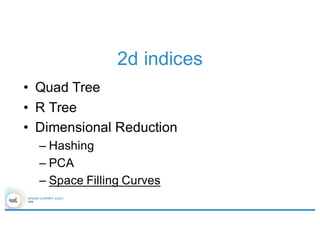
2d indices
• Quad Tree
• R Tree
• Dimensional Reduction
– Hashing
– PCA
– Space Filling Curves
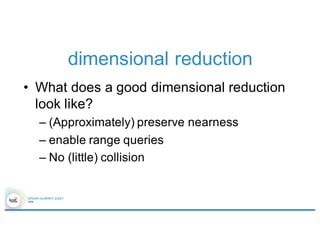
dimensional reduction
• What does a good dimensional reduction
look like?
– (Approximately) preserve nearness
– enable range queries
– No (little) collision
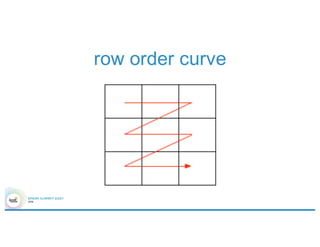
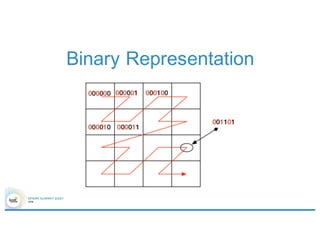
row order curve
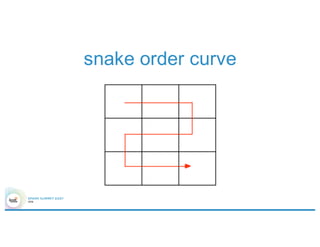
snake order curve
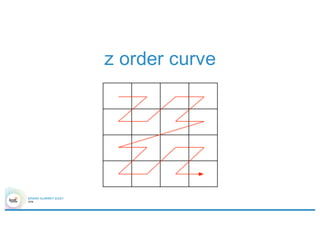
z order curve
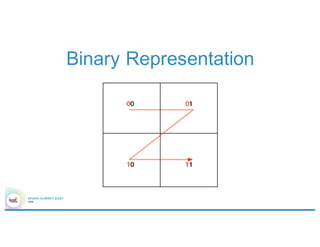
Binary Representation
properties
• Locality: Two points differing in a small # of
bits are near each other
– converse not necessarily true!
• Containment
• Efficient construction
• Nice bounds on precision
geohash
• Z order curve with base 32 encoding
• Start with world boundary (-90,90) X (-180,
180) and recursively subdivide based on
precision
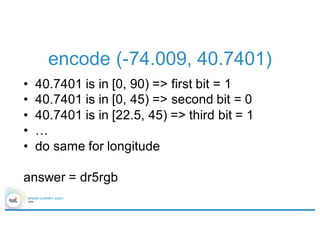
encode (-74.009, 40.7401)
• 40.7401 is in [0, 90) => first bit = 1
• 40.7401 is in [0, 45) => second bit = 0
• 40.7401 is in [22.5, 45) => third bit = 1
• …
• do same for longitude
answer = dr5rgb
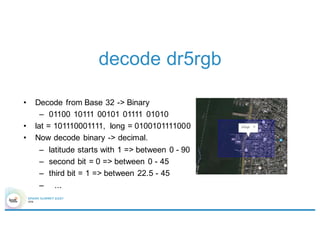
decode dr5rgb
• Decode from Base 32 -> Binary
– 01100 10111 00101 01111 01010
• lat = 101110001111, long = 0100101111000
• Now decode binary -> decimal.
– latitude starts with 1 => between 0 - 90
– second bit = 0 => between 0 - 45
– third bit = 1 => between 22.5 - 45
– ...
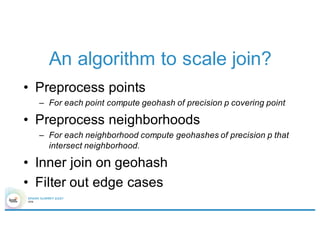
An algorithm to scale join?
• Preprocess points
– For each point compute geohash of precision p covering point
• Preprocess neighborhoods
– For each neighborhood compute geohashes of precision p that
intersect neighborhood.
• Inner join on geohash
• Filter out edge cases
Implementation in Spark SQL
• Override Strategy to define SpatialJoinStrategy
– Logic to decide when to trigger this join
• Only trigger if geospatial queries
• Only trigger if join is complex: if n ~ O(1) then broadcast join
is good enough
– Override BinaryNode to handle the physical execution
plan ourselves
• Override execute(): RDD to execute join and return results
– Stitch it up using Experimental Strategies in
SQLContext
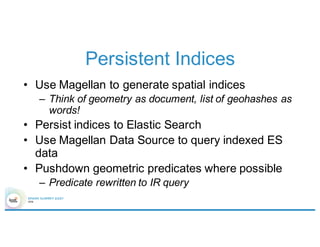
Persistent Indices
• Often, the geometry dataset does not
change… eg. neighborhoods
• Index the dataset once and for all?
Persistent Indices
• Use Magellan to generate spatial indices
– Think of geometry as document, list of geohashes as
words!
• Persist indices to Elastic Search
• Use Magellan Data Source to query indexed ES
data
• Pushdown geometric predicates where possible
– Predicate rewritten to IR query
Overall architecture
Elastic search
Shard Server
Spark Cluster
nbd.filter(
point(…)
within
‘polygon
)
curl –XGET ‘http://…’ –d ‘{
“query” : {
“filtered” : {
“filter” : {
“geohash” : [“dr5rgb”]
}
}
}
}’
THANK YOU.
Twitter: @halfabrane, Github: @harsha2010

Magellan-Spark as a Geospatial Analytics Engine by Ram Sriharsha

  • 1.
    Magellan – Sparkas a Geospatial Analytics Engine Ram Sriharsha Hortonworks
  • 2.
    Who Am I? •Apache Spark PMC Member • Hortonworks Architect, Spark + Data Science • Prior to HWX, Principal Research Scientist @ Yahoo Labs (Large Scale Machine Learning) – Login Risk Detection, Sponsored Search Click Prediction, Advertising Effectiveness Models, Online Learning, …
  • 3.
    What is GeospatialAnalytics? How do pickup/ dropoff neighborhood hotspots evolve with time? Correct GPS errors with more Accurate landmark measurements Incorporate location in IR and search advertising
  • 4.
    Do we needone more library? • Spatial Analytics at scale is challenging – Simplicity + Scalability = Hard • Ancient Data Formats – metadata, indexing not handled well, inefficient storage • Geospatial Analytics is not simply BI anymore – Statistical + Machine Learning being leveraged in geospatial • Now is the time to do it! – Explosion of mobile data – Finer granularity of data collection for geometries – Analytics stretching the limits of traditional approaches – Spark SQL + Catalyst + Tungsten makes extensible SQL engines easier than ever before!
  • 5.
  • 6.
  • 7.
    Introduction to Magellan Shapefiles *.shp *.dbf sqlContext.read.format(“magellan”) .load(${neighborhoods.path}) GeoJSON *.json sqlContext.read.format(“magellan”) .option(“type”,“geojson”) .load(${neighborhoods.path}) polygon metadata ([0], [(-122.4413024, 7.8066277), …]) neighborhood -> Marina ([0], [(-122.4111659, 37.8003388), …]) neighborhood -> North Beach
  • 8.
    Introduction to Magellan polygonmetadata ([0], [(- 122.4413024, 7.8066277), …]) neighborhood -> Marina ([0], [(- 122.4111659, 37.8003388), …]) neighborhood -> North Beach neighborhoods.filter( point(-122.4111659, 37.8003388) within ‘polygon ).show() polygon metadata ([0], [(- 122.4111659, 37.8003388), …]) neighborhood -> North Beach Shape literal Boolean Expression
  • 9.
    Introduction to Magellan polygonmetadata ([0], [(-122.4111659, 37.8003388),…]) neighborhood-> North Beach ([0], [(-122.4413024, 7.8066277),…]) neighborhood-> Marina point (-122.4111659, 37.8003388) (-122.4343576, 37.8068007) points.join(neighborhoods). where(‘point within ‘polygon). show() point polygon metadata (-122.4343576, 37.8068007) ([0], [(- 122.4111659, 37.8003388), …]) neighborhood- > North Beach
  • 10.
    Introduction to Magellan polygonmetadata ([0], [(-122.4111659, 37.8003388),…]) neighborhood-> North Beach ([0], [(-122.4413024, 7.8066277),…]) neighborhood-> Marina neighborhoods.filter( point(-122.4111659, 37.8003388).buffer(0.1) intersects ‘polygon ).show() point polygon metadata (-122.4343576, 37.8068007) ([0], [(- 122.4111659, 37.8003388), …]) neighborhood- > North Beach
  • 11.
  • 12.
    the join • Inheritsall join optimizations from Spark SQL – if neighborhoods table is small, Broadcast Cartesian Join – else Cartesian Join
  • 13.
    Status • Magellan 1.0.3available as Spark Package. • Scala • Spark 1.4 • Spark Package: Magellan • Github: https://github.com/harsha2010/magellan • Blog: http://hortonworks.com/blog/magellan-geospatial-analytics-in- spark/ • Notebook example: http://bit.ly/1GwLyrV • Input Formats: ESRI Shapefile, GeoJSON, OSM-XML • Please try it out and give feedback!
  • 14.
    What is next? •Magellan 1.0.4 – Spark 1.6 – Python – Spatial Join – Persistent Indices – Better leverage Tungsten via codegen + memory layout optimizations – More operators: buffer, distance, area etc.
  • 15.
    the join revisited •What is the time complexity? – m points, n polygons (assume average k edges) – l partitions – O(mn/l) computations of ‘point within ‘polygon – O(ml) communication cost – Each ‘point within ‘polygon costs O(k) – Total cost = O(ml) + O(mnk/l) – O(m√n√k) cost, with O(√n√k) partitions
  • 17.
    Optimization? • Do weneed to send every point to every partition? • Do we need to compute ‘point in ‘neighborhood for each neighborhood within a given partition?
  • 18.
    2d indices • QuadTree • R Tree • Dimensional Reduction – Hashing – PCA – Space Filling Curves
  • 19.
    dimensional reduction • Whatdoes a good dimensional reduction look like? – (Approximately) preserve nearness – enable range queries – No (little) collision
  • 20.
  • 21.
  • 22.
  • 23.
  • 24.
  • 25.
    properties • Locality: Twopoints differing in a small # of bits are near each other – converse not necessarily true! • Containment • Efficient construction • Nice bounds on precision
  • 26.
    geohash • Z ordercurve with base 32 encoding • Start with world boundary (-90,90) X (-180, 180) and recursively subdivide based on precision
  • 27.
    encode (-74.009, 40.7401) •40.7401 is in [0, 90) => first bit = 1 • 40.7401 is in [0, 45) => second bit = 0 • 40.7401 is in [22.5, 45) => third bit = 1 • … • do same for longitude answer = dr5rgb
  • 28.
    decode dr5rgb • Decodefrom Base 32 -> Binary – 01100 10111 00101 01111 01010 • lat = 101110001111, long = 0100101111000 • Now decode binary -> decimal. – latitude starts with 1 => between 0 - 90 – second bit = 0 => between 0 - 45 – third bit = 1 => between 22.5 - 45 – ...
  • 29.
    An algorithm toscale join? • Preprocess points – For each point compute geohash of precision p covering point • Preprocess neighborhoods – For each neighborhood compute geohashes of precision p that intersect neighborhood. • Inner join on geohash • Filter out edge cases
  • 30.
    Implementation in SparkSQL • Override Strategy to define SpatialJoinStrategy – Logic to decide when to trigger this join • Only trigger if geospatial queries • Only trigger if join is complex: if n ~ O(1) then broadcast join is good enough – Override BinaryNode to handle the physical execution plan ourselves • Override execute(): RDD to execute join and return results – Stitch it up using Experimental Strategies in SQLContext
  • 32.
    Persistent Indices • Often,the geometry dataset does not change… eg. neighborhoods • Index the dataset once and for all?
  • 33.
    Persistent Indices • UseMagellan to generate spatial indices – Think of geometry as document, list of geohashes as words! • Persist indices to Elastic Search • Use Magellan Data Source to query indexed ES data • Pushdown geometric predicates where possible – Predicate rewritten to IR query
  • 34.
    Overall architecture Elastic search ShardServer Spark Cluster nbd.filter( point(…) within ‘polygon ) curl –XGET ‘http://…’ –d ‘{ “query” : { “filtered” : { “filter” : { “geohash” : [“dr5rgb”] } } } }’
  • 36.