CDMACDMA
Submitted By
Shuvangkar Dhar (Id No: WUB09/12/51/2002)
Dept: EEE Batch: 51-B
World University of Bangladesh
Submitted To
Rajib Mondal
Senior Lecturer, Dept. of EEE
Introduction to CDMA
• CDMA – Code Division Multiple Access
• Fully digital wireless data transmission system
• Uses special random numbers to encode bits
of information.
• Allows multiple access by assigning different
users different random numbers on the same
channel.
• Users have control of a very wide channel
bandwidth 1.5 to 5 MHz
• Built-in interference minimization.
Background
• 1993, the first CDMA standard IS-95 was issued;1993, the first CDMA standard IS-95 was issued;
• In 1995, CDMA technology was put intoIn 1995, CDMA technology was put into
commercialization in Hong Kong and America oncommercialization in Hong Kong and America on
large scale.large scale.
• In April, 2001, China Unicom began to constructIn April, 2001, China Unicom began to construct
CDMA networks—the largest in the world (aboutCDMA networks—the largest in the world (about
70Million line now).70Million line now).
• At present, CDMA commercial networks areAt present, CDMA commercial networks are
established in about 40 countries or area, almostestablished in about 40 countries or area, almost
20% of all users in the world20% of all users in the world..
Executive Summary
• CDMA stands for Code Division Multiple Access.
• It provides a new dimension which represent the
Code.
• It works in two method which are Direct
sequence and Frequency Hopping.
• It has a huge application in cellular network.
• There are three evolution for CDMA:
1. IS-95
2. CDMA2000
3. WCDMA
• Soft handoff increases reliability of handovers.
Objective
•Introduce to CDMA Networks
• What is CDMA?
• How it works?
• To know about types of CDMA.
• To find the Advantages and
Disadvantages of CDMA.
• To know about application
Methodology
• Collection of information from books as
well as different websites such as
Wikipedia, Slideshare.com.
• Got help from the communication theory
classes taken by Rajib Mondal sir.
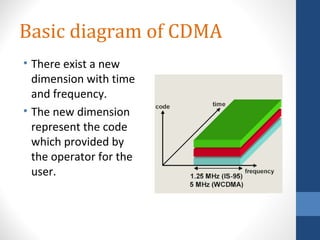
Basic diagram of CDMA
• There exist a new
dimension with time
and frequency.
• The new dimension
represent the code
which provided by
the operator for the
user.
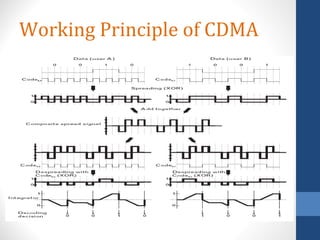
Working Principle of CDMA
CDMA transmitter:
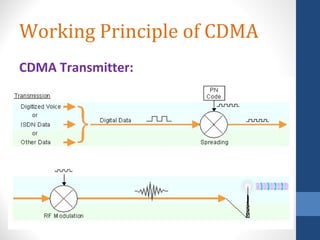
• The voice has to be digitalize (Pulse Code
Modulation (PCM) then compressed)
• Each user is given a unique PN code.
• The Codes must have low cross-correlation
• The transmitter multiplies the code by the data
to get the coded massage (bit)
Working Principle of CDMA
CDMA Transmitter:
Working Principle of CDMA
-5000 -4000 -3000 -2000 -1000 0 1000 2000 3000 4000 5000
0
0.1
0.2
0.3
0.4
0.5
0.6
0.7
0.8
0.9
1
noise
massege
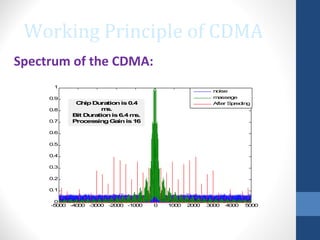
After SpredingChipDurationis0.4
ms.
Bit Durationis6.4ms.
ProcessingGainis16
Spectrum of the CDMA:
Working Principle of CDMA
CDMA Receiver:
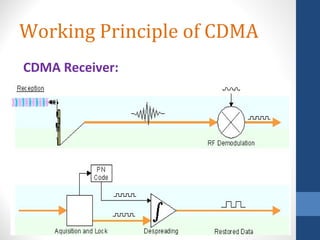
• The received signal is multiplied again by the same
code that used in the transmitter.
• Integrate over bit duration and, then using a hard
decision to get the transmitted massage (bit)
Working Principle of CDMA
CDMA Receiver:
Working Principle of CDMA
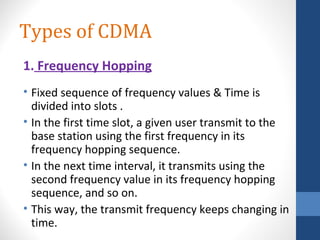
Types of CDMA
1. Frequency Hopping
• Fixed sequence of frequency values & Time is
divided into slots .
• In the first time slot, a given user transmit to the
base station using the first frequency in its
frequency hopping sequence.
• In the next time interval, it transmits using the
second frequency value in its frequency hopping
sequence, and so on.
• This way, the transmit frequency keeps changing in
time.
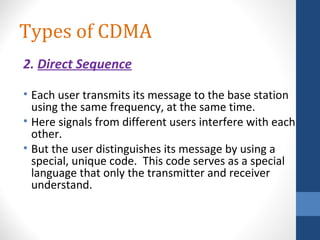
Types of CDMA
2. Direct Sequence
• Each user transmits its message to the base station
using the same frequency, at the same time.
• Here signals from different users interfere with each
other.
• But the user distinguishes its message by using a
special, unique code. This code serves as a special
language that only the transmitter and receiver
understand.
CDMA Application in Mobile Network
• IS-95
• Mainly used in U.S.A
• Standard was finished in 1993 and first
commercially launched in 1996
• Basic data rate is 9.6 kbps
• Chip rate of 1.2288 Mchip/s
• Allocated bandwidth is 1.25 MHz
• Fixed spreading code of length 64
CDMA Application in Mobile Network
• CDMA2000
• CDMA2000 1x
• Use same 1.25 MHz as IS-95
• CDMA2000 1xEV-DO
• CDMA2000 1xEV-DO delivers peak data speeds of 2.4Mbps
and supports
• Applications such as MP3 transfers and video conferencing
• CDMA2000 1xEV-DV
• CDMA2000 1xEV-DV provides integrated voice and
simultaneous high speed
• Packet data multimedia services at speeds of up to 3.09
Mbps.
CDMA Application in Mobile Network
• WCDMA
• The faster chip rate of 3,84 Mchips/s
• 5 MHz bandwidth
• Wider bandwidth implies greater frequency
diversity Rake Receiver
• Data rates
• Up to 2 Mbps for packet switched data
Advantages of CDMA
• Capacity is CDMA's biggest asset. It can
accommodate more users per MHz of bandwidth
than any other technology.
• 3 to 5 times more than GSM
• CDMA consumes less power and covers large areas
so cell size in CDMA is larger.
• CDMA is able to produce a reasonable call with lower
signal (cell phone reception) levels.
• CDMA uses Soft Handoff, reducing the likelihood of
dropped calls.
• Has a well-defined path to higher data rates.
Disadvantages of CDMA
• Most technologies are patented and must be
licensed from Qualcomm.
• Breathing of base stations, where coverage area
shrinks under load. As the number of subscribers
using a particular site goes up, the range of that
site goes down.
• Currently CDMA covers a smaller portion of the
world as compared to GSM which has more
subscribers and is in more countries overall
worldwide.
Conclusion
• The CDMA will allow many signals to be
transmitted at the same channel at the same
time. This done by giving each user a Pseudo-
Noise code which is a binary sequence. This code
should have low cross-correlation between each
other.
• Multiple access interference has bad effect on
the CDMA system so the multiple user detection
is used to reduce the MAI.
Recommendation
• To produce of the application of optical CDMA,
adhoc networks, dense wireless LANs.
• Now a days CDMA has lost its popularity in our
country though it has much better
communication system from the other
technologies. So if it provides the 4G network it
will be a masterpiece of mobile communication.

Presentation on CDMA

  • 1.
    CDMACDMA Submitted By Shuvangkar Dhar(Id No: WUB09/12/51/2002) Dept: EEE Batch: 51-B World University of Bangladesh Submitted To Rajib Mondal Senior Lecturer, Dept. of EEE
  • 2.
    Introduction to CDMA •CDMA – Code Division Multiple Access • Fully digital wireless data transmission system • Uses special random numbers to encode bits of information. • Allows multiple access by assigning different users different random numbers on the same channel. • Users have control of a very wide channel bandwidth 1.5 to 5 MHz • Built-in interference minimization.
  • 3.
    Background • 1993, thefirst CDMA standard IS-95 was issued;1993, the first CDMA standard IS-95 was issued; • In 1995, CDMA technology was put intoIn 1995, CDMA technology was put into commercialization in Hong Kong and America oncommercialization in Hong Kong and America on large scale.large scale. • In April, 2001, China Unicom began to constructIn April, 2001, China Unicom began to construct CDMA networks—the largest in the world (aboutCDMA networks—the largest in the world (about 70Million line now).70Million line now). • At present, CDMA commercial networks areAt present, CDMA commercial networks are established in about 40 countries or area, almostestablished in about 40 countries or area, almost 20% of all users in the world20% of all users in the world..
  • 4.
    Executive Summary • CDMAstands for Code Division Multiple Access. • It provides a new dimension which represent the Code. • It works in two method which are Direct sequence and Frequency Hopping. • It has a huge application in cellular network. • There are three evolution for CDMA: 1. IS-95 2. CDMA2000 3. WCDMA • Soft handoff increases reliability of handovers.
  • 5.
    Objective •Introduce to CDMANetworks • What is CDMA? • How it works? • To know about types of CDMA. • To find the Advantages and Disadvantages of CDMA. • To know about application
  • 6.
    Methodology • Collection ofinformation from books as well as different websites such as Wikipedia, Slideshare.com. • Got help from the communication theory classes taken by Rajib Mondal sir.
  • 7.
    Basic diagram ofCDMA • There exist a new dimension with time and frequency. • The new dimension represent the code which provided by the operator for the user.
  • 8.
    Working Principle ofCDMA CDMA transmitter: • The voice has to be digitalize (Pulse Code Modulation (PCM) then compressed) • Each user is given a unique PN code. • The Codes must have low cross-correlation • The transmitter multiplies the code by the data to get the coded massage (bit)
  • 9.
    Working Principle ofCDMA CDMA Transmitter:
  • 10.
    Working Principle ofCDMA -5000 -4000 -3000 -2000 -1000 0 1000 2000 3000 4000 5000 0 0.1 0.2 0.3 0.4 0.5 0.6 0.7 0.8 0.9 1 noise massege After SpredingChipDurationis0.4 ms. Bit Durationis6.4ms. ProcessingGainis16 Spectrum of the CDMA:
  • 11.
    Working Principle ofCDMA CDMA Receiver: • The received signal is multiplied again by the same code that used in the transmitter. • Integrate over bit duration and, then using a hard decision to get the transmitted massage (bit)
  • 12.
    Working Principle ofCDMA CDMA Receiver:
  • 13.
  • 14.
    Types of CDMA 1.Frequency Hopping • Fixed sequence of frequency values & Time is divided into slots . • In the first time slot, a given user transmit to the base station using the first frequency in its frequency hopping sequence. • In the next time interval, it transmits using the second frequency value in its frequency hopping sequence, and so on. • This way, the transmit frequency keeps changing in time.
  • 15.
    Types of CDMA 2.Direct Sequence • Each user transmits its message to the base station using the same frequency, at the same time. • Here signals from different users interfere with each other. • But the user distinguishes its message by using a special, unique code. This code serves as a special language that only the transmitter and receiver understand.
  • 16.
    CDMA Application inMobile Network • IS-95 • Mainly used in U.S.A • Standard was finished in 1993 and first commercially launched in 1996 • Basic data rate is 9.6 kbps • Chip rate of 1.2288 Mchip/s • Allocated bandwidth is 1.25 MHz • Fixed spreading code of length 64
  • 17.
    CDMA Application inMobile Network • CDMA2000 • CDMA2000 1x • Use same 1.25 MHz as IS-95 • CDMA2000 1xEV-DO • CDMA2000 1xEV-DO delivers peak data speeds of 2.4Mbps and supports • Applications such as MP3 transfers and video conferencing • CDMA2000 1xEV-DV • CDMA2000 1xEV-DV provides integrated voice and simultaneous high speed • Packet data multimedia services at speeds of up to 3.09 Mbps.
  • 18.
    CDMA Application inMobile Network • WCDMA • The faster chip rate of 3,84 Mchips/s • 5 MHz bandwidth • Wider bandwidth implies greater frequency diversity Rake Receiver • Data rates • Up to 2 Mbps for packet switched data
  • 19.
    Advantages of CDMA •Capacity is CDMA's biggest asset. It can accommodate more users per MHz of bandwidth than any other technology. • 3 to 5 times more than GSM • CDMA consumes less power and covers large areas so cell size in CDMA is larger. • CDMA is able to produce a reasonable call with lower signal (cell phone reception) levels. • CDMA uses Soft Handoff, reducing the likelihood of dropped calls. • Has a well-defined path to higher data rates.
  • 20.
    Disadvantages of CDMA •Most technologies are patented and must be licensed from Qualcomm. • Breathing of base stations, where coverage area shrinks under load. As the number of subscribers using a particular site goes up, the range of that site goes down. • Currently CDMA covers a smaller portion of the world as compared to GSM which has more subscribers and is in more countries overall worldwide.
  • 21.
    Conclusion • The CDMAwill allow many signals to be transmitted at the same channel at the same time. This done by giving each user a Pseudo- Noise code which is a binary sequence. This code should have low cross-correlation between each other. • Multiple access interference has bad effect on the CDMA system so the multiple user detection is used to reduce the MAI.
  • 22.
    Recommendation • To produceof the application of optical CDMA, adhoc networks, dense wireless LANs. • Now a days CDMA has lost its popularity in our country though it has much better communication system from the other technologies. So if it provides the 4G network it will be a masterpiece of mobile communication.