WIRELESS COMMUNICATION
BY
BAALA GAJAKREEDAN.L
CDMA 2000
WHAT IS CDMA???
 CDMA is a high speed data and voice network solution
for low cost easy to deploy high performance services.
CDMA can support high volume of voice and data traffic.
 Instead of being limited to narrow channel structure in a
given frequency, CDMA spreads signal across 1.25MHz
of spectrum and simultaneously transmits uniquely
encoded and encrypted signals over same RF carrier.
 Due to its efficient use of spectrum to provide high
quality voice and data services CDMA can be utilised for
fixed voice and data services.
CDMA 2000
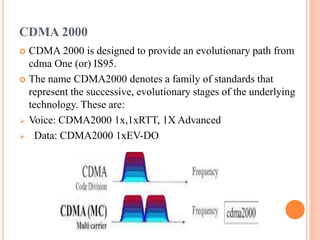
 CDMA 2000 is designed to provide an evolutionary path from
cdma One (or) IS95.
 The name CDMA2000 denotes a family of standards that
represent the successive, evolutionary stages of the underlying
technology. These are:
 Voice: CDMA2000 1x,1xRTT, 1X Advanced
 Data: CDMA2000 1xEV-DO
WHY CDMA???
 Higher capacity
 Improved performance in multipath by diversity
 Lower mobile transmit power = longer battery life
 Power control
 Variable transmission rate with voice activity detection
 Sectorization gain
 High peak data rates can be accommodated
 Combats other-user interference = lower reuse factors
FACTS ABOUT CDMA
 CDMA is a technology for the evolution of IS-95/IS-
95A to 3G services.
 The CDMA2000 cellular technology provides an
evolutionary high data rate upgrade path for current
users of 2G(IS-95)and 2.5G(IS-95A)CDMA technology.
 CDMA2000 represents a family of standards.
 A key component of CDMA2000 system is a new
packet core network(PCN) that allows for the delivery
of packet data with high speed and better security.
CONT..
 Multicarrier modulation is applied to 3G voice oriented
cellular network using CDMA technology.
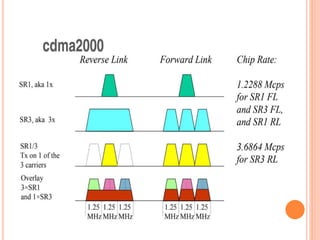
 CDMA2000 employs a multicarrier operation in which a user
is allowed to use 1,3,6,9 of the CDMA one channels to
support a more reliable voice and variety of data channels.
 The main advantage of using multicarrier modulation is to
provide higher data rates for data applications, wider BW and
consequently better voice quality and backward compatibility
with existing CDMA system.
 In CDMA2000 using 16-QAM digital modulation technique
the maximum data rate is increased.
CDMA 2000 LOGICAL CHANNELS
 Dedicated Traffic Channel
 Common Control Channel
 Dedicated Signalling Channel
 Common Signalling Channel
SPREADING AND MODULATION
 Uplink – spreading via Walsh functions
 Downlink – Downlink carriers can be operated independently –
Each carrier contains a pilot – spreading via Walsh functions –
spreading factors from 4 to 256 – PN sequences and Walsh
functions on parallel carriers are the same
USER DATA TRANSMISSION
 Fundamental Channel is specified, with a maximum data
rate of 14.4 kbps
 For increased data rates, use one or more Supplemental
Channels
– Supplemental Channel is a parallel code channel,
separated with a different Walsh function from the
Fundamental Channel
– Supplemental Channel has a fixed spreading factor for
a given data rate
KEY FEATURES
 Leading performance.
 Efficient use of spectrum.
 Support for advanced mobile services.
 CDMA2000 technology are compatible with IP having
more flexibility and higher BW efficiency.
 Device selection: CDMA2000 offer the broadest
selection of mobile devices and has a significant cost
advantage.
 CDMA2000 have been designed for urban as well as
remote rural areas for fixed wireless, WLL, limited and
full mobility application in multiple spectrum bands.
ADVANTAGES
 Superior voice quality.
 High speed broadband data connectivity.
 Improved security and privacy.
 Multi-mode, multiband global roaming features.
DISADVANTAGES
 Channel pollution: there are too many signals from cell sites in
subscribers phone, but none is dominant –degrading call quality.
 International roaming: another disadvantage of this technology is the
lack of international roaming capabilities and only CDMA2000
device that can be used internationally must also have a GSM radio.
Wireless Communication

Wireless Communication

  • 1.
  • 2.
    WHAT IS CDMA??? CDMA is a high speed data and voice network solution for low cost easy to deploy high performance services. CDMA can support high volume of voice and data traffic.  Instead of being limited to narrow channel structure in a given frequency, CDMA spreads signal across 1.25MHz of spectrum and simultaneously transmits uniquely encoded and encrypted signals over same RF carrier.  Due to its efficient use of spectrum to provide high quality voice and data services CDMA can be utilised for fixed voice and data services.
  • 3.
    CDMA 2000  CDMA2000 is designed to provide an evolutionary path from cdma One (or) IS95.  The name CDMA2000 denotes a family of standards that represent the successive, evolutionary stages of the underlying technology. These are:  Voice: CDMA2000 1x,1xRTT, 1X Advanced  Data: CDMA2000 1xEV-DO
  • 4.
    WHY CDMA???  Highercapacity  Improved performance in multipath by diversity  Lower mobile transmit power = longer battery life  Power control  Variable transmission rate with voice activity detection  Sectorization gain  High peak data rates can be accommodated  Combats other-user interference = lower reuse factors
  • 5.
    FACTS ABOUT CDMA CDMA is a technology for the evolution of IS-95/IS- 95A to 3G services.  The CDMA2000 cellular technology provides an evolutionary high data rate upgrade path for current users of 2G(IS-95)and 2.5G(IS-95A)CDMA technology.  CDMA2000 represents a family of standards.  A key component of CDMA2000 system is a new packet core network(PCN) that allows for the delivery of packet data with high speed and better security.
  • 6.
    CONT..  Multicarrier modulationis applied to 3G voice oriented cellular network using CDMA technology.  CDMA2000 employs a multicarrier operation in which a user is allowed to use 1,3,6,9 of the CDMA one channels to support a more reliable voice and variety of data channels.  The main advantage of using multicarrier modulation is to provide higher data rates for data applications, wider BW and consequently better voice quality and backward compatibility with existing CDMA system.  In CDMA2000 using 16-QAM digital modulation technique the maximum data rate is increased.
  • 8.
    CDMA 2000 LOGICALCHANNELS  Dedicated Traffic Channel  Common Control Channel  Dedicated Signalling Channel  Common Signalling Channel
  • 9.
    SPREADING AND MODULATION Uplink – spreading via Walsh functions  Downlink – Downlink carriers can be operated independently – Each carrier contains a pilot – spreading via Walsh functions – spreading factors from 4 to 256 – PN sequences and Walsh functions on parallel carriers are the same
  • 10.
    USER DATA TRANSMISSION Fundamental Channel is specified, with a maximum data rate of 14.4 kbps  For increased data rates, use one or more Supplemental Channels – Supplemental Channel is a parallel code channel, separated with a different Walsh function from the Fundamental Channel – Supplemental Channel has a fixed spreading factor for a given data rate
  • 11.
    KEY FEATURES  Leadingperformance.  Efficient use of spectrum.  Support for advanced mobile services.  CDMA2000 technology are compatible with IP having more flexibility and higher BW efficiency.  Device selection: CDMA2000 offer the broadest selection of mobile devices and has a significant cost advantage.  CDMA2000 have been designed for urban as well as remote rural areas for fixed wireless, WLL, limited and full mobility application in multiple spectrum bands.
  • 12.
    ADVANTAGES  Superior voicequality.  High speed broadband data connectivity.  Improved security and privacy.  Multi-mode, multiband global roaming features. DISADVANTAGES  Channel pollution: there are too many signals from cell sites in subscribers phone, but none is dominant –degrading call quality.  International roaming: another disadvantage of this technology is the lack of international roaming capabilities and only CDMA2000 device that can be used internationally must also have a GSM radio.