Oxygen Therapy:
Principles & Practice
 Anoxia.
 No oxygen availability in tissues
 Hypoxia.
 Lack of oxygen availability in tissues
 Hypoxemia.
 Lack of oxygen in the blood
 FiO2 (Fraction of O2 in Inspired gas) 21%
 PaO2?
 Partial pressure of oxygen (PaO2). This measures the pressure of oxygen dissolved in the blood.
 SaO2?
 A blood-oxygen saturation reading indicates the percentage of hemoglobin molecules in the arterial blood which are saturated with
oxygen.
 Oxygen should be regarded as a drug (BNF 2016).
 Oxygen must be prescribed in all situations (except for
the immediate management of critical illness in
accordance with BTS guidelines) (NPSA Oct 2019).
 If abused it can cause complication.
 PRECIOUS !!!!
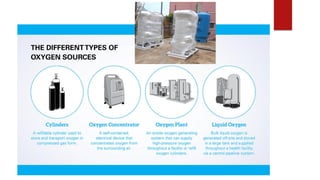
OXYGEN THERAPY
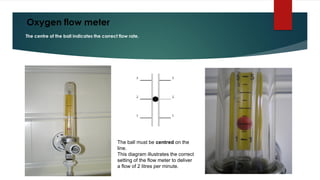
Oxygen flow meter
The centre of the ball indicates the correct flow rate.
The ball must be centred on the
line.
This diagram illustrates the correct
setting of the flow meter to deliver
a flow of 2 litres per minute.
SET UP….
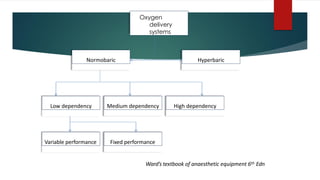
Oxygen
delivery
systems
Normobaric Hyperbaric
Low dependency Medium dependency High dependency
Variable performance Fixed performance
Ward’s textbook of anaesthetic equipment 6th Edn
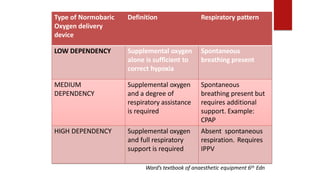
Type of Normobaric Definition Respiratory pattern
Oxygen delivery
device
LOW DEPENDENCY Supplemental oxygen
alone is sufficient to
correct hypoxia
Spontaneous
breathing present
MEDIUM
DEPENDENCY
Supplemental oxygen
and a degree of
respiratory assistance
is required
Spontaneous
breathing present but
requires additional
support. Example:
CPAP
HIGH DEPENDENCY Supplemental oxygen
and full respiratory
support is required
Absent spontaneous
respiration. Requires
IPPV
Ward’s textbook of anaesthetic equipment 6th Edn
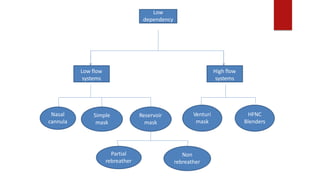
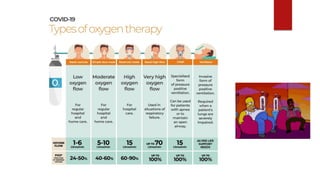
Low
dependency
Low flow
systems
High flow
systems
Nasal
cannula
Simple
mask
Reservoir
mask
Partial
rebreather
Non
rebreather
Venturi
mask
HFNC
Blenders
Low dependency
Oxygen Delivery Systems
LOW FLOW OXYGEN DEVICES HIGH FLOW OXYGEN DEVICES
Cannot deliver constant FiO2 Maintain constant FiO2
Flow 6 - 8 L/min Delivering O2 at very high flow
Mixture of oxygen + room air Flow usually 3-4 times the actual
Minute volume
FiO2 varies with tidal volume
-Shallow breathing = less entrainment
of room air (high FiO2)
- deep, hyperpneic breathing = more
entrainment of room air (less FiO2)
Used in – treatment of hypoxic
patients who depend on hypoxic drive
to breathe and require controlled
increments in FiO2
- Young and vigorous patients with
hypoxemia, with ventilatory
requirement exceeding the capability
of low flow systems
Eg : Nasal cannulae, oxygen masks,
mask with reservoir bags etc
Eg : jet-mixing venturi masks,
reservoir nebuliser, oxygen blender
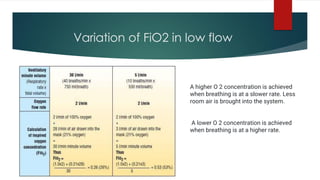
Variation of FiO2 in low flow
A higher O 2 concentration is achieved
when breathing is at a slower rate. Less
room air is brought into the system.
A lower O 2 concentration is achieved
when breathing is at a higher rate.
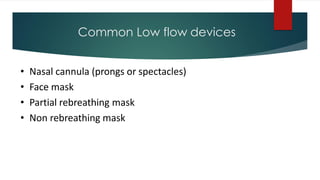
Common Low flow devices
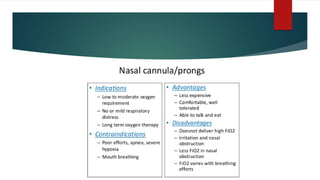
• Nasal cannula (prongs or spectacles)
• Face mask
• Partial rebreathing mask
• Non rebreathing mask
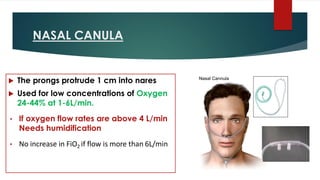
NASAL CANULA
 The prongs protrude 1 cm into nares
 Used for low concentrations of Oxygen
24-44% at 1-6L/min.
• If oxygen flow rates are above 4 L/min
Needs humidification
• No increase in FiO2 if flow is more than 6L/min
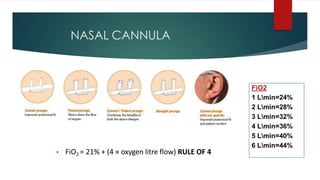
NASAL CANNULA
• FiO2 = 21% + (4 × oxygen litre flow) RULE OF 4
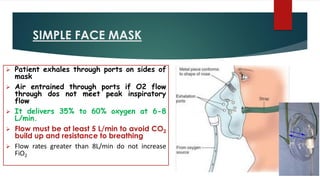
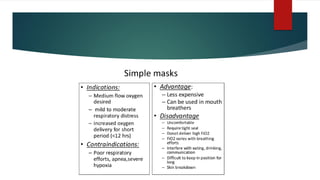
SIMPLE FACE MASK
➢ Patient exhales through ports on sides of
mask
➢ Air entrained through ports if O2 flow
through dos not meet peak inspiratory
flow
➢ It delivers 35% to 60% oxygen at 6-8
L/min.
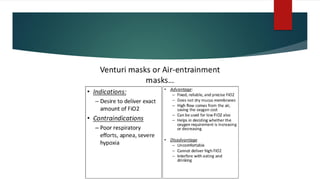
➢ Flow must be at least 5 L/min to avoid CO2
build up and resistance to breathing
➢ Flow rates greater than 8L/min do not increase
FiO2
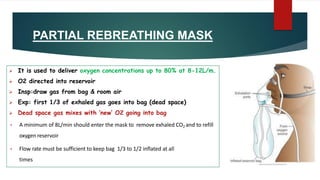
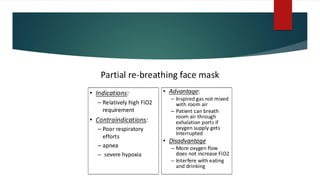
PARTIAL REBREATHING MASK
➢ It is used to deliver oxygen concentrations up to 80% at 8-12L/m.
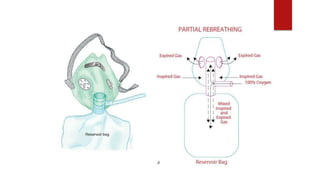
➢ O2 directed into reservoir
➢ Insp:draw gas from bag & room air
➢ Exp: first 1/3 of exhaled gas goes into bag (dead space)
➢ Dead space gas mixes with ‘new’ O2 going into bag
• A minimum of 8L/min should enter the mask to remove exhaled CO2 and to refill
oxygen reservoir
• Flow rate must be sufficient to keep bag 1/3 to 1/2 inflated at all
times
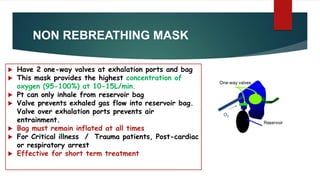
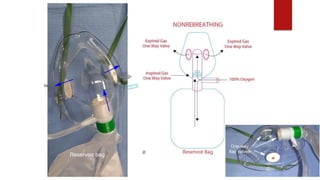
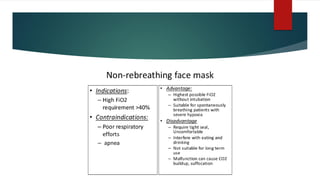
NON REBREATHING MASK
 Have 2 one-way valves at exhalation ports and bag
 This mask provides the highest concentration of
oxygen (95-100%) at 10-15L/min.
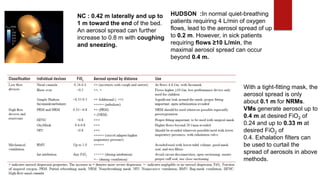
 Pt can only inhale from reservoir bag
 Valve prevents exhaled gas flow into reservoir bag.
Valve over exhalation ports prevents air
entrainment.
 Bag must remain inflated at all times
 For Critical illness / Trauma patients, Post-cardiac
or respiratory arrest
 Effective for short term treatment
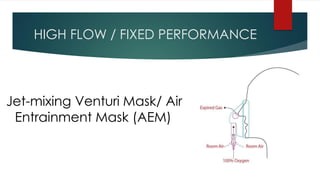
Jet-mixing Venturi Mask/ Air
Entrainment Mask (AEM)
HIGH FLOW / FIXED PERFORMANCE
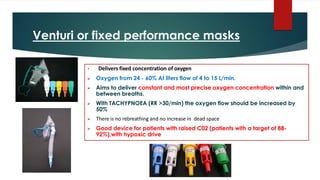
Venturi or fixed performance masks
• Delivers fixed concentration of oxygen
➢ Oxygen from 24 - 60% At liters flow of 4 to 15 L/min.
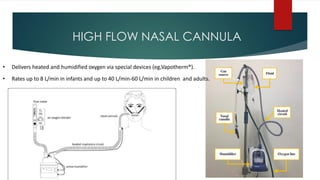
➢ Aims to deliver constant and most precise oxygen concentration within and
between breaths.
➢ With TACHYPNOEA (RR >30/min) the oxygen flow should be increased by
50%
➢ There is no rebreathing and no increase in dead space
➢ Good device for patients with raised C02 (patients with a target of 88-
92%),with hypoxic drive
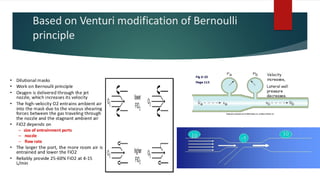
Based on Venturi modification of Bernoulli
principle
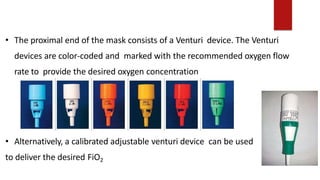
• The proximal end of the mask consists of a Venturi device. The Venturi
devices are color-coded and marked with the recommended oxygen flow
rate to provide the desired oxygen concentration
• Alternatively, a calibrated adjustable venturi device can be used
to deliver the desired FiO2
DEVICE FLOW RATE
• The air:O2 ratio for an air entrainment mask at FIO2 40%?
Air:oxygen= 100-FiO2 = 100-40 = 60 = 3.2
FiO2-21 40-21 19
• Ratio for 40% is (3.2 : 1)
• If the O2 Flow meter is set at 10 L/min
• Then the entrained air will be 10x3.2 = 32 L/min
• Total flow = (air + O2) = (10 + 32) = 42 L/min
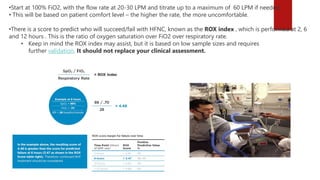
NC : 0.42 m laterally and up to
1 m toward the end of the bed.
An aerosol spread can further
increase to 0.8 m with coughing
and sneezing.
HUDSON :In normal quiet-breathing
patients requiring 4 L/min of oxygen
flows, lead to the aerosol spread of up
to 0.2 m. However, in sick patients
requiring flows ≥10 L/min, the
maximal aerosol spread can occur
beyond 0.4 m.
With a tight-fitting mask, the
aerosol spread is only
about 0.1 m for NRMs.
VMs generate aerosol up to
0.4 m at desired FiO2 of
0.24 and up to 0.33 m at
desired FiO2 of
0.4. Exhalation filters can
be used to curtail the
spread of aerosols in above
methods.
HIGH FLOW NASAL CANNULA
• Delivers heated and humidified oxygen via special devices (eg,Vapotherm®).
• Rates up to 8 L/min in infants and up to 40 L/min-60 L/min in children and adults.
•Start at 100% FiO2, with the flow rate at 20-30 LPM and titrate up to a maximum of 60 LPM if needed.
• This will be based on patient comfort level – the higher the rate, the more uncomfortable.
•There is a score to predict who will succeed/fail with HFNC, known as the ROX index , which is performed at 2, 6
and 12 hours . This is the ratio of oxygen saturation over FiO2 over respiratory rate.
• Keep in mind the ROX index may assist, but it is based on low sample sizes and requires
further validation. It should not replace your clinical assessment.
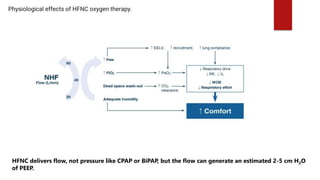
Physiological effects of HFNC oxygen therapy.
HFNC delivers flow, not pressure like CPAP or BiPAP, but the flow can generate an estimated 2-5 cm H2O
of PEEP.
 Aerosol generation
By increasing the flows from 10 L/min to 60 L/min, HFNC has shown to increase aerosol spread
from 65 to 172 mm in the sagittal plane. It can also cause air leakage around the mask up to 620
mm.[19] Some recommend avoiding the use of HFNC.[20] Aerosol dispersion can be lessened using
a surgical mask and asking patients to breathe through nose with mouth closed.[17] In a human
patient-simulator model, use of a surgical mask during normal cough reduced aerosol spread from
68 cm to 30 cm, and further reduction of diffusion distance was noted with the use of N95 mask.[8]
Recommendation
HFNC can be used to provide oxygen, preferably in patients with acute respiratory failure with P/F
ratio ≥200 mm Hg. It should be ensured that the nasal reservoir used with HFNC is snugly fit, and
the patients are instructed to wear surgical/N95 masks and breathe nasally. OxyMask should be
used at flows ≤20 L/min.
SELECTION OF DEVICE
3 P’s
• Purpose
• Patient
• Performance
- Goal is to match the performance characteristics of the equipment
to both the objectives of therapy (purpose) and the patient’s
specialneeds
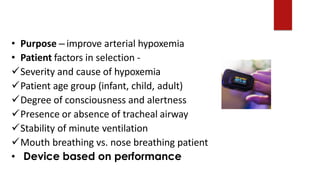
• Purpose – improve arterial hypoxemia
• Patient factors in selection -
✓Severity and cause of hypoxemia
✓Patient age group (infant, child, adult)
✓Degree of consciousness and alertness
✓Presence or absence of tracheal airway
✓Stability of minute ventilation
✓Mouth breathing vs. nose breathing patient
• Device based on performance
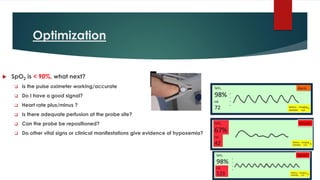
Optimization
 SpO2 is < 90%, what next?
❑ Is the pulse oximeter working/accurate
❑ Do I have a good signal?
❑ Heart rate plus/minus ?
❑ Is there adequate perfusion at the probe site?
❑ Can the probe be repositioned?
❑ Do other vital signs or clinical manifestations give evidence of hypoxemia?
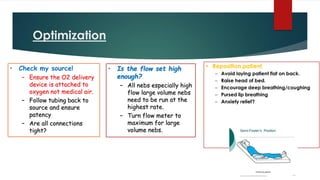
Optimization
• Check my source!
– Ensure the O2 delivery
device is attached to
oxygen not medical air.
– Follow tubing back to
source and ensure
patency
– Are all connections
tight?
• Is the flow set high
enough?
– All nebs especially high
flow large volume nebs
need to be run at the
highest rate.
– Turn flow meter to
maximum for large
volume nebs.
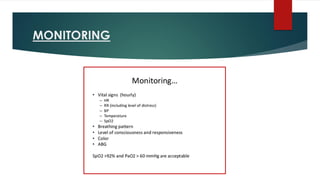
MONITORING
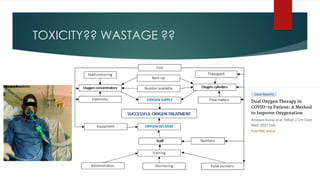
TOXICITY?? WASTAGE ??
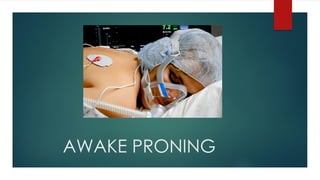
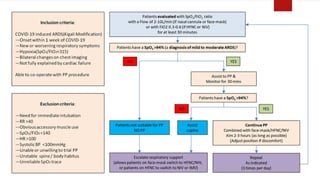
AWAKE PRONING
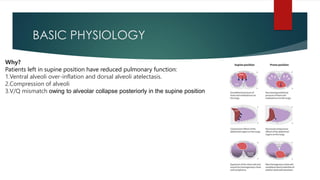
BASIC PHYSIOLOGY
Why?
Patients left in supine position have reduced pulmonary function:
1.Ventral alveoli over-inflation and dorsal alveoli atelectasis.
2.Compression of alveoli
3.V/Q mismatch owing to alveolar collapse posteriorly in the supine position
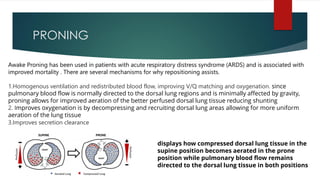
PRONING
displays how compressed dorsal lung tissue in the
supine position becomes aerated in the prone
position while pulmonary blood flow remains
directed to the dorsal lung tissue in both positions
Awake Proning has been used in patients with acute respiratory distress syndrome (ARDS) and is associated with
improved mortality . There are several mechanisms for why repositioning assists.
1.Homogenous ventilation and redistributed blood flow, improving V/Q matching and oxygenation. since
pulmonary blood flow is normally directed to the dorsal lung regions and is minimally affected by gravity,
proning allows for improved aeration of the better perfused dorsal lung tissue reducing shunting
2. Improves oxygenation is by decompressing and recruiting dorsal lung areas allowing for more uniform
aeration of the lung tissue
3.Improves secretion clearance
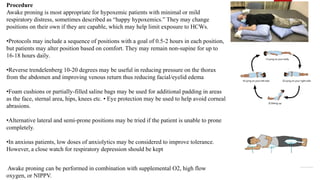
Procedure
Awake proning is most appropriate for hypoxemic patients with minimal or mild
respiratory distress, sometimes described as “happy hypoxemics.” They may change
positions on their own if they are capable, which may help limit exposure to HCWs.
•Protocols may include a sequence of positions with a goal of 0.5-2 hours in each position,
but patients may alter position based on comfort. They may remain non-supine for up to
16-18 hours daily.
•Reverse trendelenberg 10-20 degrees may be useful in reducing pressure on the thorax
from the abdomen and improving venous return thus reducing facial/eyelid edema
•Foam cushions or partially-filled saline bags may be used for additional padding in areas
as the face, sternal area, hips, knees etc. • Eye protection may be used to help avoid corneal
abrasions.
•Alternative lateral and semi-prone positions may be tried if the patient is unable to prone
completely.
•In anxious patients, low doses of anxiolytics may be considered to improve tolerance.
However, a close watch for respiratory depression should be kept
Awake proning can be performed in combination with supplemental O2, high flow
oxygen, or NIPPV.
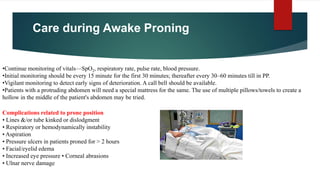
Care during Awake Proning
•Continue monitoring of vitals—SpO2, respiratory rate, pulse rate, blood pressure.
•Initial monitoring should be every 15 minute for the first 30 minutes; thereafter every 30–60 minutes till in PP.
•Vigilant monitoring to detect early signs of deterioration. A call bell should be available.
•Patients with a protruding abdomen will need a special mattress for the same. The use of multiple pillows/towels to create a
hollow in the middle of the patient's abdomen may be tried.
Complications related to prone position
• Lines &/or tube kinked or dislodgment
• Respiratory or hemodynamically instability
• Aspiration
• Pressure ulcers in patients proned for > 2 hours
• Facial/eyelid edema
• Increased eye pressure • Corneal abrasions
• Ulnar nerve damage
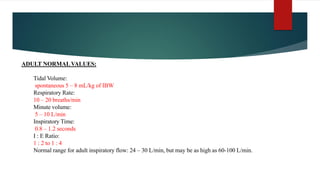
ADULT NORMAL VALUES:
Tidal Volume:
spontaneous 5 – 8 mL/kg of IBW
Respiratory Rate:
10 – 20 breaths/min
Minute volume:
5 – 10 L/min
Inspiratory Time:
0.8 – 1.2 seconds
I : E Ratio:
1 : 2 to 1 : 4
Normal range for adult inspiratory flow: 24 – 30 L/min, but may be as high as 60-100 L/min.
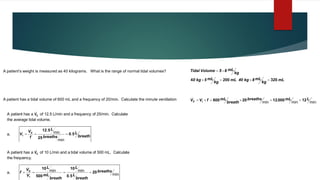
A patient’s weight is measured as 40 kilograms. What is the range of normal tidal volumes?
mL
kg
mL
8
kg
40
mL
kg
mL
5
kg
0
kg
mL
8
-
5
Volume
Tidal
320
200
4 =

=

=
min
min
,
min
L
mL
breaths
breath
mL
f
V
V t
E 12
000
12
20
600 =
=

=

=

A patient has a tidal volume of 600 mL and a frequency of 20/min. Calculate the minute ventilation
A patient has a E
V
 of 12.5 L/min and a frequency of 25/min. Calculate
the average tidal volume.
a. breath
L
breaths
L
f
V
V E
t 5
0
25
5
12
.
min
min
.
=
=
=

A patient has a E
V
 of 10 L/min and a tidal volume of 500 mL. Calculate
the frequency.
a. min
.
min
min breaths
breath
L
L
breath
mL
L
V
V
f
t
E
20
5
0
10
500
10
=
=
=
=

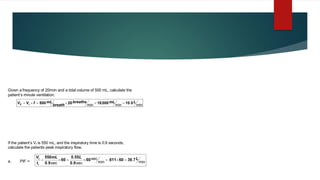
If the patient’s Vt is 550 mL, and the inspiratory time is 0.9 seconds,
calculate the patients peak inspiratory flow.
a. PIF = min
.
.
min
sec
sec
.
.
sec
.
L
L
mL
t
V
I
t
7
36
60
611
60
9
0
55
0
60
9
0
550
=

=

=

=
Given a frequency of 20/min and a tidal volume of 500 mL, calculate the
patient’s minute ventilation.
min
.
min
,
min
L
mL
breaths
breath
mL
f
V
V t
E 0
10
000
10
20
500 =
=

=

=

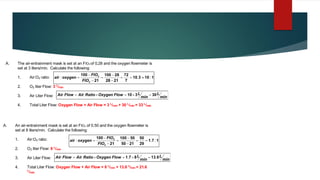
A. The air-entrainment mask is set at an FIO2 of 0,28 and the oxygen flowmeter is
set at 3 liters/min. Calculate the following:
1. Air:O2 ratio:
2. O2 liter Flow: 3 L
/min
3. Air Liter Flow:
4. Total Liter Flow: Oxygen Flow + Air Flow = 3 L
/min + 30 L
/min = 33 L
/min
min
L
min
L
Flow
Oxygen
Ratio
Air
Flow
Air 30
3
10 =

=

=
1
10
3
10
7
72
21
28
28
100
21
100
2
2
:
.
: 
=
=
−
−
=
−
−
=
FIO
FIO
oxygen
air
A. An air-entrainment mask is set at an FIO2 of 0.50 and the oxygen flowmeter is
set at 8 liters/min. Calculate the following:
1. Air:O2 ratio:
2. O2 liter Flow: 8 L
/min
3. Air Liter Flow:
4. Total Liter Flow: Oxygen Flow + Air Flow = 8 L
/min + 13.6 L
/min = 21.6
L
/min
min
L
min
L
Flow
Oxygen
Ratio
Air
Flow
Air 6
13
8
7
1 .
. =

=

=
1
7
1
29
50
21
50
50
100
21
100
2
2
:
.
: =
=
−
−
=
−
−
=
FIO
FIO
oxygen
air
Estimating Patient Flow Needs • One of two methods can be used to determine the patient’s inspiratory flow rate
and therefore the minimum flow needed by the device.
1. Patient peak inspiratory flow demand (PIF) = )
( E
I
VE +


2. Patient peak inspiratory flow demand (PIF) = 60

I
t
t
V
Ve = minute ventilation PIF = MV* 3
I= Inspiration
E = Expiration
Vt = tidal volume
Ti = inspiratory time
TCT(TOTAL CYCLE TIME) = 60/RR = sec per breath
TCT =(I+E)
Example: Patient Flow Needs??
Minute Ventilation = 8 L/min
Tidal Volume = 0. 4 L Respiratory Rate = 20 bpm Insp. Time = 1 sec
Is the device flow adequate?
• Device flow was 32 L/min
• Patient needs 24 L/min
• Device > patient; so flow adequate to meet the needs.
Device flow must meet or exceed PIF to be considered a “high flow” device
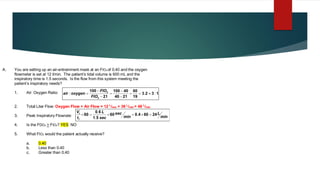
A. You are setting up an air-entrainment mask at an FIO2 of 0.40 and the oxygen
flowmeter is set at 12 l/min. The patient’s tidal volume is 600 mL and the
inspiratory time is 1.5 seconds. Is the flow from this system meeting the
patient’s inspiratory needs?
1. Air: Oxygen Ratio:
2. Total Liter Flow: Oxygen Flow + Air Flow = 12 L
/min + 36 L
/min = 48 L
/min
3. Peak Inspiratory Flowrate:
4. Is the FDO2 > FIO2? YES NO
5. What FIO2 would the patient actually receive?
a. 0.40
b. Less than 0.40
c. Greater than 0.40
1
3
2
3
19
60
21
40
40
100
21
100
2
2
:
.
: 
=
=
−
−
=
−
−
=
FIO
FIO
oxygen
air
min
L
min
sec
sec
L
t
V
I
t
24
60
4
0
60
5
1
6
0
60 =

=

=
 .
.
.
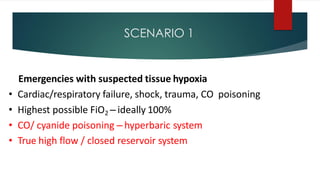
SCENARIO 1
Emergencies with suspected tissue hypoxia
• Cardiac/respiratory failure, shock, trauma, CO poisoning
• Highest possible FiO2 – ideally 100%
• CO/ cyanide poisoning – hyperbaric system
• True high flow / closed reservoir system
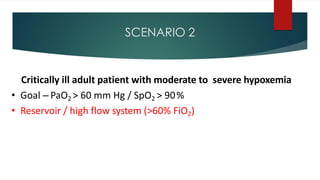
SCENARIO 2
Critically ill adult patient with moderate to severe hypoxemia
• Goal – PaO2 > 60 mm Hg / SpO2 > 90%
• Reservoir / high flow system (>60% FiO2)
SCENARIO 3
Critically ill adult patient with mild to moderate
hypoxemia
• Immediate post op phase, recovering from MI
• Stability of FiO2 is not critical
• System with low to moderate FiO2
• Nasal cannula / simple mask
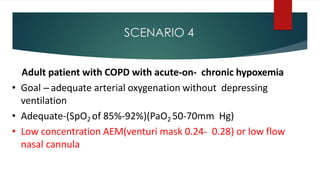
SCENARIO 4
Adult patient with COPD with acute-on- chronic hypoxemia
• Goal – adequate arterial oxygenation without depressing
ventilation
• Adequate-(SpO2 of 85%-92%)(PaO2 50-70mm Hg)
• Low concentration AEM(venturi mask 0.24- 0.28) or low flow
nasal cannula

Oxygen therapy principles_and_practice shahna ali

  • 1.
  • 2.
     Anoxia.  Nooxygen availability in tissues  Hypoxia.  Lack of oxygen availability in tissues  Hypoxemia.  Lack of oxygen in the blood  FiO2 (Fraction of O2 in Inspired gas) 21%  PaO2?  Partial pressure of oxygen (PaO2). This measures the pressure of oxygen dissolved in the blood.  SaO2?  A blood-oxygen saturation reading indicates the percentage of hemoglobin molecules in the arterial blood which are saturated with oxygen.
  • 3.
     Oxygen shouldbe regarded as a drug (BNF 2016).  Oxygen must be prescribed in all situations (except for the immediate management of critical illness in accordance with BTS guidelines) (NPSA Oct 2019).  If abused it can cause complication.  PRECIOUS !!!!
  • 4.
  • 8.
    Oxygen flow meter Thecentre of the ball indicates the correct flow rate. The ball must be centred on the line. This diagram illustrates the correct setting of the flow meter to deliver a flow of 2 litres per minute.
  • 9.
  • 10.
    Oxygen delivery systems Normobaric Hyperbaric Low dependencyMedium dependency High dependency Variable performance Fixed performance Ward’s textbook of anaesthetic equipment 6th Edn
  • 11.
    Type of NormobaricDefinition Respiratory pattern Oxygen delivery device LOW DEPENDENCY Supplemental oxygen alone is sufficient to correct hypoxia Spontaneous breathing present MEDIUM DEPENDENCY Supplemental oxygen and a degree of respiratory assistance is required Spontaneous breathing present but requires additional support. Example: CPAP HIGH DEPENDENCY Supplemental oxygen and full respiratory support is required Absent spontaneous respiration. Requires IPPV Ward’s textbook of anaesthetic equipment 6th Edn
  • 12.
  • 13.
    Low dependency Oxygen DeliverySystems LOW FLOW OXYGEN DEVICES HIGH FLOW OXYGEN DEVICES Cannot deliver constant FiO2 Maintain constant FiO2 Flow 6 - 8 L/min Delivering O2 at very high flow Mixture of oxygen + room air Flow usually 3-4 times the actual Minute volume FiO2 varies with tidal volume -Shallow breathing = less entrainment of room air (high FiO2) - deep, hyperpneic breathing = more entrainment of room air (less FiO2) Used in – treatment of hypoxic patients who depend on hypoxic drive to breathe and require controlled increments in FiO2 - Young and vigorous patients with hypoxemia, with ventilatory requirement exceeding the capability of low flow systems Eg : Nasal cannulae, oxygen masks, mask with reservoir bags etc Eg : jet-mixing venturi masks, reservoir nebuliser, oxygen blender
  • 14.
    Variation of FiO2in low flow A higher O 2 concentration is achieved when breathing is at a slower rate. Less room air is brought into the system. A lower O 2 concentration is achieved when breathing is at a higher rate.
  • 15.
    Common Low flowdevices • Nasal cannula (prongs or spectacles) • Face mask • Partial rebreathing mask • Non rebreathing mask
  • 16.
    NASAL CANULA  Theprongs protrude 1 cm into nares  Used for low concentrations of Oxygen 24-44% at 1-6L/min. • If oxygen flow rates are above 4 L/min Needs humidification • No increase in FiO2 if flow is more than 6L/min
  • 17.
    NASAL CANNULA • FiO2= 21% + (4 × oxygen litre flow) RULE OF 4
  • 19.
    SIMPLE FACE MASK ➢Patient exhales through ports on sides of mask ➢ Air entrained through ports if O2 flow through dos not meet peak inspiratory flow ➢ It delivers 35% to 60% oxygen at 6-8 L/min. ➢ Flow must be at least 5 L/min to avoid CO2 build up and resistance to breathing ➢ Flow rates greater than 8L/min do not increase FiO2
  • 21.
    PARTIAL REBREATHING MASK ➢It is used to deliver oxygen concentrations up to 80% at 8-12L/m. ➢ O2 directed into reservoir ➢ Insp:draw gas from bag & room air ➢ Exp: first 1/3 of exhaled gas goes into bag (dead space) ➢ Dead space gas mixes with ‘new’ O2 going into bag • A minimum of 8L/min should enter the mask to remove exhaled CO2 and to refill oxygen reservoir • Flow rate must be sufficient to keep bag 1/3 to 1/2 inflated at all times
  • 24.
    NON REBREATHING MASK Have 2 one-way valves at exhalation ports and bag  This mask provides the highest concentration of oxygen (95-100%) at 10-15L/min.  Pt can only inhale from reservoir bag  Valve prevents exhaled gas flow into reservoir bag. Valve over exhalation ports prevents air entrainment.  Bag must remain inflated at all times  For Critical illness / Trauma patients, Post-cardiac or respiratory arrest  Effective for short term treatment
  • 27.
    Jet-mixing Venturi Mask/Air Entrainment Mask (AEM) HIGH FLOW / FIXED PERFORMANCE
  • 28.
    Venturi or fixedperformance masks • Delivers fixed concentration of oxygen ➢ Oxygen from 24 - 60% At liters flow of 4 to 15 L/min. ➢ Aims to deliver constant and most precise oxygen concentration within and between breaths. ➢ With TACHYPNOEA (RR >30/min) the oxygen flow should be increased by 50% ➢ There is no rebreathing and no increase in dead space ➢ Good device for patients with raised C02 (patients with a target of 88- 92%),with hypoxic drive
  • 29.
    Based on Venturimodification of Bernoulli principle
  • 30.
    • The proximalend of the mask consists of a Venturi device. The Venturi devices are color-coded and marked with the recommended oxygen flow rate to provide the desired oxygen concentration • Alternatively, a calibrated adjustable venturi device can be used to deliver the desired FiO2
  • 31.
    DEVICE FLOW RATE •The air:O2 ratio for an air entrainment mask at FIO2 40%? Air:oxygen= 100-FiO2 = 100-40 = 60 = 3.2 FiO2-21 40-21 19 • Ratio for 40% is (3.2 : 1) • If the O2 Flow meter is set at 10 L/min • Then the entrained air will be 10x3.2 = 32 L/min • Total flow = (air + O2) = (10 + 32) = 42 L/min
  • 33.
    NC : 0.42m laterally and up to 1 m toward the end of the bed. An aerosol spread can further increase to 0.8 m with coughing and sneezing. HUDSON :In normal quiet-breathing patients requiring 4 L/min of oxygen flows, lead to the aerosol spread of up to 0.2 m. However, in sick patients requiring flows ≥10 L/min, the maximal aerosol spread can occur beyond 0.4 m. With a tight-fitting mask, the aerosol spread is only about 0.1 m for NRMs. VMs generate aerosol up to 0.4 m at desired FiO2 of 0.24 and up to 0.33 m at desired FiO2 of 0.4. Exhalation filters can be used to curtail the spread of aerosols in above methods.
  • 34.
    HIGH FLOW NASALCANNULA • Delivers heated and humidified oxygen via special devices (eg,Vapotherm®). • Rates up to 8 L/min in infants and up to 40 L/min-60 L/min in children and adults.
  • 35.
    •Start at 100%FiO2, with the flow rate at 20-30 LPM and titrate up to a maximum of 60 LPM if needed. • This will be based on patient comfort level – the higher the rate, the more uncomfortable. •There is a score to predict who will succeed/fail with HFNC, known as the ROX index , which is performed at 2, 6 and 12 hours . This is the ratio of oxygen saturation over FiO2 over respiratory rate. • Keep in mind the ROX index may assist, but it is based on low sample sizes and requires further validation. It should not replace your clinical assessment.
  • 36.
    Physiological effects ofHFNC oxygen therapy. HFNC delivers flow, not pressure like CPAP or BiPAP, but the flow can generate an estimated 2-5 cm H2O of PEEP.
  • 37.
     Aerosol generation Byincreasing the flows from 10 L/min to 60 L/min, HFNC has shown to increase aerosol spread from 65 to 172 mm in the sagittal plane. It can also cause air leakage around the mask up to 620 mm.[19] Some recommend avoiding the use of HFNC.[20] Aerosol dispersion can be lessened using a surgical mask and asking patients to breathe through nose with mouth closed.[17] In a human patient-simulator model, use of a surgical mask during normal cough reduced aerosol spread from 68 cm to 30 cm, and further reduction of diffusion distance was noted with the use of N95 mask.[8] Recommendation HFNC can be used to provide oxygen, preferably in patients with acute respiratory failure with P/F ratio ≥200 mm Hg. It should be ensured that the nasal reservoir used with HFNC is snugly fit, and the patients are instructed to wear surgical/N95 masks and breathe nasally. OxyMask should be used at flows ≤20 L/min.
  • 38.
    SELECTION OF DEVICE 3P’s • Purpose • Patient • Performance - Goal is to match the performance characteristics of the equipment to both the objectives of therapy (purpose) and the patient’s specialneeds
  • 39.
    • Purpose –improve arterial hypoxemia • Patient factors in selection - ✓Severity and cause of hypoxemia ✓Patient age group (infant, child, adult) ✓Degree of consciousness and alertness ✓Presence or absence of tracheal airway ✓Stability of minute ventilation ✓Mouth breathing vs. nose breathing patient • Device based on performance
  • 41.
    Optimization  SpO2 is< 90%, what next? ❑ Is the pulse oximeter working/accurate ❑ Do I have a good signal? ❑ Heart rate plus/minus ? ❑ Is there adequate perfusion at the probe site? ❑ Can the probe be repositioned? ❑ Do other vital signs or clinical manifestations give evidence of hypoxemia?
  • 42.
    Optimization • Check mysource! – Ensure the O2 delivery device is attached to oxygen not medical air. – Follow tubing back to source and ensure patency – Are all connections tight? • Is the flow set high enough? – All nebs especially high flow large volume nebs need to be run at the highest rate. – Turn flow meter to maximum for large volume nebs.
  • 43.
  • 44.
  • 45.
  • 46.
    BASIC PHYSIOLOGY Why? Patients leftin supine position have reduced pulmonary function: 1.Ventral alveoli over-inflation and dorsal alveoli atelectasis. 2.Compression of alveoli 3.V/Q mismatch owing to alveolar collapse posteriorly in the supine position
  • 47.
    PRONING displays how compresseddorsal lung tissue in the supine position becomes aerated in the prone position while pulmonary blood flow remains directed to the dorsal lung tissue in both positions Awake Proning has been used in patients with acute respiratory distress syndrome (ARDS) and is associated with improved mortality . There are several mechanisms for why repositioning assists. 1.Homogenous ventilation and redistributed blood flow, improving V/Q matching and oxygenation. since pulmonary blood flow is normally directed to the dorsal lung regions and is minimally affected by gravity, proning allows for improved aeration of the better perfused dorsal lung tissue reducing shunting 2. Improves oxygenation is by decompressing and recruiting dorsal lung areas allowing for more uniform aeration of the lung tissue 3.Improves secretion clearance
  • 48.
    Procedure Awake proning ismost appropriate for hypoxemic patients with minimal or mild respiratory distress, sometimes described as “happy hypoxemics.” They may change positions on their own if they are capable, which may help limit exposure to HCWs. •Protocols may include a sequence of positions with a goal of 0.5-2 hours in each position, but patients may alter position based on comfort. They may remain non-supine for up to 16-18 hours daily. •Reverse trendelenberg 10-20 degrees may be useful in reducing pressure on the thorax from the abdomen and improving venous return thus reducing facial/eyelid edema •Foam cushions or partially-filled saline bags may be used for additional padding in areas as the face, sternal area, hips, knees etc. • Eye protection may be used to help avoid corneal abrasions. •Alternative lateral and semi-prone positions may be tried if the patient is unable to prone completely. •In anxious patients, low doses of anxiolytics may be considered to improve tolerance. However, a close watch for respiratory depression should be kept Awake proning can be performed in combination with supplemental O2, high flow oxygen, or NIPPV.
  • 49.
    Care during AwakeProning •Continue monitoring of vitals—SpO2, respiratory rate, pulse rate, blood pressure. •Initial monitoring should be every 15 minute for the first 30 minutes; thereafter every 30–60 minutes till in PP. •Vigilant monitoring to detect early signs of deterioration. A call bell should be available. •Patients with a protruding abdomen will need a special mattress for the same. The use of multiple pillows/towels to create a hollow in the middle of the patient's abdomen may be tried. Complications related to prone position • Lines &/or tube kinked or dislodgment • Respiratory or hemodynamically instability • Aspiration • Pressure ulcers in patients proned for > 2 hours • Facial/eyelid edema • Increased eye pressure • Corneal abrasions • Ulnar nerve damage
  • 52.
    ADULT NORMAL VALUES: TidalVolume: spontaneous 5 – 8 mL/kg of IBW Respiratory Rate: 10 – 20 breaths/min Minute volume: 5 – 10 L/min Inspiratory Time: 0.8 – 1.2 seconds I : E Ratio: 1 : 2 to 1 : 4 Normal range for adult inspiratory flow: 24 – 30 L/min, but may be as high as 60-100 L/min.
  • 53.
    A patient’s weightis measured as 40 kilograms. What is the range of normal tidal volumes? mL kg mL 8 kg 40 mL kg mL 5 kg 0 kg mL 8 - 5 Volume Tidal 320 200 4 =  =  = min min , min L mL breaths breath mL f V V t E 12 000 12 20 600 = =  =  =  A patient has a tidal volume of 600 mL and a frequency of 20/min. Calculate the minute ventilation A patient has a E V  of 12.5 L/min and a frequency of 25/min. Calculate the average tidal volume. a. breath L breaths L f V V E t 5 0 25 5 12 . min min . = = =  A patient has a E V  of 10 L/min and a tidal volume of 500 mL. Calculate the frequency. a. min . min min breaths breath L L breath mL L V V f t E 20 5 0 10 500 10 = = = = 
  • 54.
    If the patient’sVt is 550 mL, and the inspiratory time is 0.9 seconds, calculate the patients peak inspiratory flow. a. PIF = min . . min sec sec . . sec . L L mL t V I t 7 36 60 611 60 9 0 55 0 60 9 0 550 =  =  =  = Given a frequency of 20/min and a tidal volume of 500 mL, calculate the patient’s minute ventilation. min . min , min L mL breaths breath mL f V V t E 0 10 000 10 20 500 = =  =  = 
  • 55.
    A. The air-entrainmentmask is set at an FIO2 of 0,28 and the oxygen flowmeter is set at 3 liters/min. Calculate the following: 1. Air:O2 ratio: 2. O2 liter Flow: 3 L /min 3. Air Liter Flow: 4. Total Liter Flow: Oxygen Flow + Air Flow = 3 L /min + 30 L /min = 33 L /min min L min L Flow Oxygen Ratio Air Flow Air 30 3 10 =  =  = 1 10 3 10 7 72 21 28 28 100 21 100 2 2 : . :  = = − − = − − = FIO FIO oxygen air A. An air-entrainment mask is set at an FIO2 of 0.50 and the oxygen flowmeter is set at 8 liters/min. Calculate the following: 1. Air:O2 ratio: 2. O2 liter Flow: 8 L /min 3. Air Liter Flow: 4. Total Liter Flow: Oxygen Flow + Air Flow = 8 L /min + 13.6 L /min = 21.6 L /min min L min L Flow Oxygen Ratio Air Flow Air 6 13 8 7 1 . . =  =  = 1 7 1 29 50 21 50 50 100 21 100 2 2 : . : = = − − = − − = FIO FIO oxygen air
  • 56.
    Estimating Patient FlowNeeds • One of two methods can be used to determine the patient’s inspiratory flow rate and therefore the minimum flow needed by the device. 1. Patient peak inspiratory flow demand (PIF) = ) ( E I VE +   2. Patient peak inspiratory flow demand (PIF) = 60  I t t V Ve = minute ventilation PIF = MV* 3 I= Inspiration E = Expiration Vt = tidal volume Ti = inspiratory time TCT(TOTAL CYCLE TIME) = 60/RR = sec per breath TCT =(I+E)
  • 57.
    Example: Patient FlowNeeds?? Minute Ventilation = 8 L/min Tidal Volume = 0. 4 L Respiratory Rate = 20 bpm Insp. Time = 1 sec Is the device flow adequate? • Device flow was 32 L/min • Patient needs 24 L/min • Device > patient; so flow adequate to meet the needs. Device flow must meet or exceed PIF to be considered a “high flow” device
  • 58.
    A. You aresetting up an air-entrainment mask at an FIO2 of 0.40 and the oxygen flowmeter is set at 12 l/min. The patient’s tidal volume is 600 mL and the inspiratory time is 1.5 seconds. Is the flow from this system meeting the patient’s inspiratory needs? 1. Air: Oxygen Ratio: 2. Total Liter Flow: Oxygen Flow + Air Flow = 12 L /min + 36 L /min = 48 L /min 3. Peak Inspiratory Flowrate: 4. Is the FDO2 > FIO2? YES NO 5. What FIO2 would the patient actually receive? a. 0.40 b. Less than 0.40 c. Greater than 0.40 1 3 2 3 19 60 21 40 40 100 21 100 2 2 : . :  = = − − = − − = FIO FIO oxygen air min L min sec sec L t V I t 24 60 4 0 60 5 1 6 0 60 =  =  =  . . .
  • 59.
    SCENARIO 1 Emergencies withsuspected tissue hypoxia • Cardiac/respiratory failure, shock, trauma, CO poisoning • Highest possible FiO2 – ideally 100% • CO/ cyanide poisoning – hyperbaric system • True high flow / closed reservoir system
  • 60.
    SCENARIO 2 Critically illadult patient with moderate to severe hypoxemia • Goal – PaO2 > 60 mm Hg / SpO2 > 90% • Reservoir / high flow system (>60% FiO2)
  • 61.
    SCENARIO 3 Critically illadult patient with mild to moderate hypoxemia • Immediate post op phase, recovering from MI • Stability of FiO2 is not critical • System with low to moderate FiO2 • Nasal cannula / simple mask
  • 62.
    SCENARIO 4 Adult patientwith COPD with acute-on- chronic hypoxemia • Goal – adequate arterial oxygenation without depressing ventilation • Adequate-(SpO2 of 85%-92%)(PaO2 50-70mm Hg) • Low concentration AEM(venturi mask 0.24- 0.28) or low flow nasal cannula