Dr. Rohit
OBJECTIVES
 Describe when oxygen (O2) therapy is needed.
 Assess the need for O2 therapy.
 Describe what precautions and complications are associated with O2
therapy.
 Select an O2 delivery system appropriate for the respiratory care plan.
 Describe how to administer O2 to adults, children, and infants.
 Describe how to identify and correct malfunctions of O2 delivery
systems.
 Assess and monitor a patient’s response to O2 therapy.
 Describe how and when to modify or recommend modification of O2
therapy.
 Describe how to implement protocol-based O2 therapy.
 Identify the indications, complications, and hazards of hyperbaric O2
therapy.
GOAL OF OXYGEN THERAPY
 The overall goal of O2 therapy is to maintain
adequate tissue oxygenation, while minimizing
cardiopulmonary work.
 Clinical objectives for O2 therapy are the following:
 Correct documented or suspected acute hypoxemia
Decrease symptoms associated with chronic
hypoxemia
 Decrease the workload hypoxemia imposes on the
cardiopulmonary system
 PaO2 at or below 60 mm Hg
 Saturation O2 < 90% resting
 A drop in PO2 10 mm Hg or 5% in O2 sat.
during sleep
 Symptoms or signs of heart failure (cor
pulmonale), pulmonary hypertension,
erythrocytosis, “P” pulmonale on EKG
O2 THERAPY : INDICATIONS
Barometric Pressure
•High altitude
PIO2
PAO2
Inc O2
Consumption
•Convulsions
•Thyrotoxicosis
•Shivering
•pyrexia
(7 % / o
C)
Alveolar Ventilation
decreased
•Resp. depression
•Resp. muscle
paresis
•Dec resp. effort
(trauma)
•Airway obstruction
FiO2
•Low FiO2 during
anaesthesia
•Rebreathing
Low VA/Q
• Abn. Pulmonary
shunt
•Pneumonia
•Lobar atelectasis
•ARDS
Normal Anat. shunt
• Abn.extra Pulm.
Shunt
•Cong. heart disease
•Right to left shunts
PaO2
Cell
PO2
Low Hb
concentration
•Anaemia
•CO poisoning
Low Perfusion
•local - PVD,
thrombosis
•gen – shock,Hypovol,
card. Failure
HYPOXIA
PaO2 AS AN INDICATOR FOR
OXYGEN THERAPY
 PaO2
 80 – 100 mm Hg : Normal
 60 – 80 mm Hg : cold, clammy
extremities
 < 60 mm Hg : cyanosis
 < 40 mm Hg : mental deficiency
memory loss
 < 30 mm Hg : bradycardia
cardiac arrest
PaO2 < 60 mm Hg IS A STRONG INDICATOR
FOR OXYGEN THERAPY
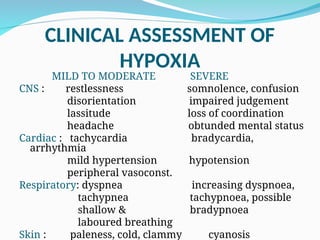
CLINICAL ASSESSMENT OF
HYPOXIA
MILD TO MODERATE SEVERE
CNS : restlessness somnolence, confusion
disorientation impaired judgement
lassitude loss of coordination
headache obtunded mental status
Cardiac : tachycardia bradycardia,
arrhythmia
mild hypertension hypotension
peripheral vasoconst.
Respiratory: dyspnea increasing dyspnoea,
tachypnea tachypnoea, possible
shallow & bradypnoea
laboured breathing
Skin : paleness, cold, clammy cyanosis
CLASSIFICATION
LOW FLOW SYSTEM
 The gas flow is insufficient to meet patient’s peak
inspiratory and minute ventilatory requirement
 O2 provided is always diluted with air
 FiO2 varies with the patient’s ventilatory pattern
 Deliver low and variable FiO2 → Variable
performance device
 Flow rates are <8 l/min
 Includes
 Nasal cannula
 Nasal catheter
 Transtracheal catheter
NASAL CANNULA
 A plastic disposable
device consisting of two
tips or prongs 1 cm long,
connected to oxygen
tubing
 Inserted into the
vestibule of the nose
 FiO2 – 24-40%
 Flow – ¼ - 8L/min (adult)
< 2 L/min(child)
ESTIMATION OF FiO2
O2
Flowrat
e
(L/min)
Fi O2
1 0.21 - 0.24
2 0.24 – 0.28
3 0.28 – 0.34
4 0.34 – 0.38
5 0.38 – 0.42
6 0.42 – 0.46
Patient of normal
ventilatory pattern -
each litre/min of
nasal O2 increases the
FiO2 approximately
4%.
E.g. A patient using
nasal cannula at 4
L/min, has an
estimated FiO2 of 37%
(21 + 16)
NASAL CATHETER
• A soft plastic tube
with several small
holes at the tip
• Inserted along the
floor of either nasal
passage under
visualization till the
tip is just above and
behind the uvula
• Blindly inserted to a depth equal to the
distance from nose to tragus
• Should be replaced every 8 hrs
• Avoided in patients with maxillofacial
trauma, basal skull #, nasal obstruction and
coagulation abnormalities
TRANSTRACHEAL CATHETER
 A thin Teflon catheter
 Inserted surgically with
a guidewire between 2nd
and 3rd
tracheal rings
 FiO2 – 22-35%
 Flow – ¼ - 4L/min
 Increased anatomic
reservoir
 Replace every 90 days
Estimation of Fio2 from a low-flow system for patient
with normal ventilatory pattern
Cannula 6 L/min VT, 500 mL
Mechanical reservoir None Rate, 20 breaths per min
Anatomic reservoir 50 mL I/E ratio, 1:2
100% O2 provided/sec 100 mL Inspiratory time, 1 sec
Volume inspired O2 expiratory time, 2 sec
Anatomic reservoir 50 mL
Flow/sec 100 mL
Inspired room air 0.2 × 350 mL = 70 mL
O2 inspired 220 mL
FiO2 220 O2 = 0.44
500 TV
A patient with ideal ventilatory pattern who receives 6L/min O2 by
nasal cannula is receiving FiO2 of 0.44.
If VT is decreased to 250 mL:
Volume inspired O2
Anatomic reservoir 50 mL
Flow/sec 100 mL
Inspired room air (0.20 × 100 cm3
) 0.2 × 100 mL = 20 mL
O2 inspired 170 mL
FiO2 170 = 0.68
250
The larger the Vt or faster the respiratory rate, the lower the Fio2.
The smaller the Vt or lower the respiratory rate, the higher the Fio2.
↑minute ventilation → ↓ Fio2
↓minute ventilation Fio
→ ↑ 2
RESERVOIR SYSTEM
 Reservoir system stores a reserve volume of O2,
that equals or exceeds the patient’s tidal volume
 Delivers moderate - high FiO2
 Variable performance device
To provide a fixed FiO2, the reservoir volume must
exceed the patient’s tidal volume
 Includes
 Reservoir cannula
 Simple face mask
 Partial rebreathing mask
 Non rebreathing mask
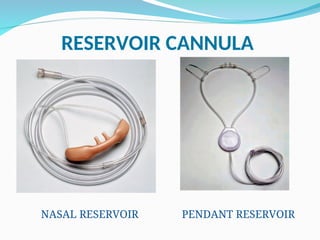
RESERVOIR CANNULA
NASAL RESERVOIR PENDANT RESERVOIR
RESERVOIR MASKS
 Commonly used reservoir system
 Simple face mask
 Partial rebreathing masks
 Non rebreathing masks
SIMPLE FACE MASK
 Reservoir - 100-200 ml
 Variable performance device
 FiO2 varies with
 O2 input flow
 mask volume
 extent of air leakage
 patient’s breathing pattern
 FiO2: 40 – 60%
 Input flow range is 5-10 L/min
 Minimum flow – 5L/min to
prevent CO2 rebreathing
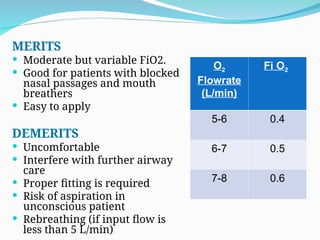
MERITS
 Moderate but variable FiO2.
 Good for patients with blocked
nasal passages and mouth
breathers
 Easy to apply
DEMERITS
 Uncomfortable
 Interfere with further airway
care
 Proper fitting is required
 Risk of aspiration in
unconscious patient
 Rebreathing (if input flow is
less than 5 L/min)
O2
Flowrate
(L/min)
Fi O2
5-6 0.4
6-7 0.5
7-8 0.6
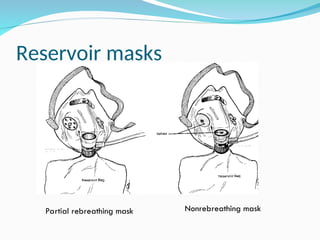
Reservoir masks
Partial rebreathing mask Nonrebreathing mask
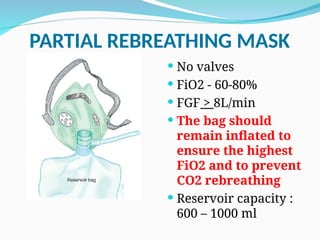
PARTIAL REBREATHING MASK
 No valves
 FiO2 - 60-80%
 FGF > 8L/min
 The bag should
remain inflated to
ensure the highest
FiO2 and to prevent
CO2 rebreathing
 Reservoir capacity :
600 – 1000 ml
 During expiration
 O2 + first 1/3 of exhaled gas (anatomic dead
space) enters the bag and last 2/3 of
exhalation escapes out through ports
 During inspiration
 The first exhaled gas and O2 are inhaled
NON REBREATHING MASK
 Has 3 unidirectional
valves
 FiO2 - 0.80 – 0.90
 FGF – 10 – 15L/min
 To deliver ~100% O2,
bag should remain
inflated
 Factors affecting FiO2
 air leakage
 patient’s breathing
pattern
 Expiratory valves allow the exhaled
gases to escape but prevent inhalation
of room air gases
 Inspiratory valve prevents exhaled gas
flow into reservoir bag
HIGH FLOW SYSTEM
• The gas flow is sufficient to meet patient’s
peak inspiratory and minute ventilatory
requirement
• FiO2 is independent of the the patient’s
ventilatory pattern
• Deliver low- moderate and fixed FiO2 →
Fixed performance device
High-Flow Devices
To qualify as a high-flow device, a system should
provide at least 60 L/min total flow. This flow criterion
is based on the fact that the average adult peak
inspiratory flow during tidal ventilation is
approximately three times the minute volume.
Because 20 L/min is close to the upper limit of
sustainable minute volume for an ill person, a flow of 3
× 20, or 60 L/min, should suffice in most situations.
 Usually flows are kept at >3 times
patient’s MV)
 Includes
 Ventimask (HAFOE)
 Aerosol mask and T-piece with
nebulizers
AIR ENTRAINMENT DEVICES
Based on Bernoulli principle –
For an inviscid flow of a nonconducting
fluid, an increase in the speed of the
fluid occurs simultaneously with a
decrease in pressure or a decrease in
the fluid's potential energy.
VENTURI PRINCIPLE
A rapid velocity of gas exiting from a restricted
orifice will create subatmospheric lateral
pressures, resulting in atmospheric air being
entrained into the mainstream.
CHARACHTERISITICS OF AIR
ENTRAINMENT DEVICES
 Amount of air entrained varies directly with
 Size of the port
 Velocity of O2 at jet
 They dilute O2 source with air - FiO2 < 100%
 The more air they entrain, the higher is the
total output flow but the lower is the
delivered FiO2
STEP 2: ADD THE AIR-TO-OXYGEN RATIO
PARTS
1.7 + 1 = 2.7
STEP 3: MULTIPLY THE SUM OF THE RATIO
PARTS BY THE OXYGEN INPUT FLOW
2.7 X 15L/min = 41L/min
Calculation of Air to O2
Entrainment Ratio using a magic
box
20
100
60
20
40 60 = 3 : 1
20
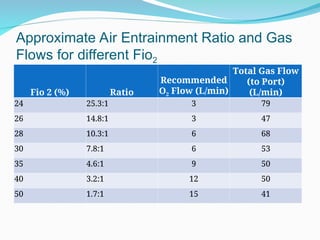
Approximate Air Entrainment Ratio and Gas
Flows for different Fio2
Fio 2 (%) Ratio
Recommended
O2 Flow (L/min)
Total Gas Flow
(to Port)
(L/min)
24 25.3:1 3 79
26 14.8:1 3 47
28 10.3:1 6 68
30 7.8:1 6 53
35 4.6:1 9 50
40 3.2:1 12 50
50 1.7:1 15 41
VENTURI / VENTI / HAFOE MASK
 Mask consists of a jet orifice around which is
an air entrainment port
 FiO2 regulated by size of jet orifice and air
entrainment port
 FiO2 – Low to moderate (0.24 – 0.60)
 HIGH FLOW FIXED PERFORMANCE DEVICE
Varieties of Venti Masks
A fixed Fio2 model A variable Fio2 model
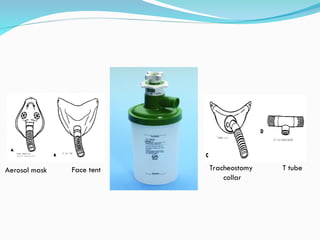
AIR ENTRAINMENT NEBULIZERS
 Have a fixed orifice, thus, air-to-O2 ratio can be
altered by varying entrainment port size.
 Fixed performance device
 FiO2 - 28-100%
 Max. gas flows – 14-16L/min
 Device of choice for delivering O2 to patients
with artificial tracheal airways.
 Provides humidity and temperature control
Aerosol mask Face tent Tracheostomy
collar
T tube
How to increase the FiO2 capabilities of
air-entrainment nebulizers?
 Adding open reservoir (50-150ml aerosol
tube)
 Provide inspiratory reservoir (a 3-5 L
anaesthesia bag) with a one way expiratory
valve
 Connect two or more nebulizers in parallel
 Set nebulizer to low conc (to generate high
flow) and providing supplemental O2 into
delivery tube
BLENDING SYSTEMS
 With a blending system,
separate pressurized air
and oxygen sources are
input.
 The gases are mixed
either manually or with a
blender
 FiO2 – 24 – 100%
 Provide flow > 60L/min
 Allows precise control
over both FiO2 and total
flow output - True fixed
performance devices
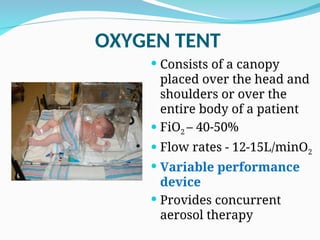
OXYGEN TENT
 Consists of a canopy
placed over the head and
shoulders or over the
entire body of a patient
 FiO2 – 40-50%
 Flow rates - 12-15L/minO2
 Variable performance
device
 Provides concurrent
aerosol therapy
 Disadvantage
 Expensive
 Cumbersome
 Difficult to clean
 Constant leakage
 Limits patient mobility
OXYGEN HOOD
 An oxygen hood covers only
the head of the infant
 O2 is delivered to hood
through either a heated
entrainment nebulizer or a
blending system
 Fixed performance device
 Fio2 – 21-100%
 Minimum Flow > 7/min to
prevent CO2 accumulation
INCUBATOR
 Incubators are polymethyl
methacrylate enclosures that
combine servo-controlled
convection heating with
supplemental O2
 Provides temperature control
 FiO2 – 40-50%
 Flow 8-15 L/min
 Variable performance
device
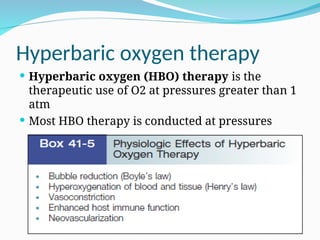
Hyperbaric oxygen therapy
 Hyperbaric oxygen (HBO) therapy is the
therapeutic use of O2 at pressures greater than 1
atm
 Most HBO therapy is conducted at pressures
between 2 ATA and 3 ATA
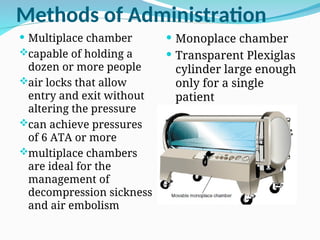
Methods of Administration
 Multiplace chamber
capable of holding a
dozen or more people
air locks that allow
entry and exit without
altering the pressure
can achieve pressures
of 6 ATA or more
multiplace chambers
are ideal for the
management of
decompression sickness
and air embolism
 Monoplace chamber
 Transparent Plexiglas
cylinder large enough
only for a single
patient
Complications of Oxygen therapy
1. Oxygen toxicity
2. Depression of ventilation
3. Retinopathy of Prematurity
4. Absorption atelectasis
5. Fire hazard
1.O2 Toxicity
 Primarily affects lung and CNS
 2 factors
 PaO2
 Exposure time
 CNS O2 toxicity (Paul Bert effect)
 occurs on breathing O2 at pressure > 1 atm
 tremors, twitching, convulsions
Pulmonary Oxygen toxicity
C/F
 Acute tracheobronchitis
 Cough and substernal pain
 ARDS like state
Pulmonary O2 Toxicity (Lorrain-
Smith effect)
 High pO2 for a prolonged period of time
 Intracellular generation of free radicals e.g.:
superoxide,H2O2 , singlet oxygen
 React with cellular DNA, sulphydryl proteins &lipids
 Cytotoxicity
 Damages capillary endothelium
 Interstitial edema
 Thickened alveolar capillary membrane
 Pulmonary fibrosis and hypertension
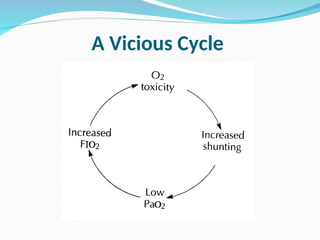
A Vicious Cycle
How much O2 is safe?
 Limit patient exposure to 100% O2 to less than 24 hours whenever
possible. High FiO2 is acceptable if the concentration can be decreased
to 70% within 2 days and 50% or less in 5 days.
Goal should be to use lowest possible FiO2
compatible with adequate tissue oxygenation
Indications for 70% - 100%
oxygen therapy
 Resuscitation
 Periods of acute cardiopulmonary instability
 Patient transport
 Seen in COPD patients with chronic hypercapnia
2. Depression of Ventilation
3. Retinopathy of prematurity
(ROP)
 Premature or low-birth-weight infants who receive
supplemental O2
 Mechanism
 Increased PaO2
 Retinal vasoconstriction
 Necrosis of blood vessels
 New vessels formation
 Hemorrhage retinal detachment and blindness
→
To minimize the risk of ROP - PaO2
below 80 mmHg
100% O2
oxygen
nitrogen
PO2 =673
PCO2 = 40
PH2O = 47
A B
A – UNDERVENTILATED
B – NORMAL VENTILATED
5. Fire hazard
 High FiO2 increases the risk of fire
 Preventive measures
 Lowest effective FiO2 should be used
 Use of scavenging systems
 Avoid use of outdated equipment such as
aluminium gas regulators
 Fire prevention protocols should be followed for
hyperbaric O2 therapy
Oxygen challenge concept
↑ FiO2 by 0.2
↑ PaO2 > 10 mmHg ↑PaO2 < 10 mmHg
( true shunt – 15 %) ( true shunt – 30 %)
↑PaO2 < 10 mmHg in response to an oxygen
challenge of 0.2 – refractory hypoxemia
Implications of Oxygen challenge
concept
 To identify refractory hypoxemia (as it does not
respond to increased FiO2)
 Refractory hypoxemia depends on increased
cardiac output to maintain acceptable PaO2
 Potentially deleterious effect of increased FiO2
can be avoided
SUMMARY
Therapeutic effectiveness of oxygen therapy is
limited to 25% - 50%
• Low V/Q hypoxemia is reversed with less than 50%
• DAA occurs with FiO2 more than 50%
• Pulmonary oxygen toxicity is a potential risk factor
with FiO2 more than 50%
Bronchodilators, bronchial hygiene therapy
and diuretic therapy decreases the need for
high FiO2
oxygen support devices...............ppt

oxygen support devices...............ppt

  • 1.
  • 2.
    OBJECTIVES  Describe whenoxygen (O2) therapy is needed.  Assess the need for O2 therapy.  Describe what precautions and complications are associated with O2 therapy.  Select an O2 delivery system appropriate for the respiratory care plan.  Describe how to administer O2 to adults, children, and infants.  Describe how to identify and correct malfunctions of O2 delivery systems.  Assess and monitor a patient’s response to O2 therapy.  Describe how and when to modify or recommend modification of O2 therapy.  Describe how to implement protocol-based O2 therapy.  Identify the indications, complications, and hazards of hyperbaric O2 therapy.

  • 3.
    GOAL OF OXYGENTHERAPY  The overall goal of O2 therapy is to maintain adequate tissue oxygenation, while minimizing cardiopulmonary work.  Clinical objectives for O2 therapy are the following:  Correct documented or suspected acute hypoxemia Decrease symptoms associated with chronic hypoxemia  Decrease the workload hypoxemia imposes on the cardiopulmonary system
  • 4.
     PaO2 ator below 60 mm Hg  Saturation O2 < 90% resting  A drop in PO2 10 mm Hg or 5% in O2 sat. during sleep  Symptoms or signs of heart failure (cor pulmonale), pulmonary hypertension, erythrocytosis, “P” pulmonale on EKG O2 THERAPY : INDICATIONS
  • 5.
    Barometric Pressure •High altitude PIO2 PAO2 IncO2 Consumption •Convulsions •Thyrotoxicosis •Shivering •pyrexia (7 % / o C) Alveolar Ventilation decreased •Resp. depression •Resp. muscle paresis •Dec resp. effort (trauma) •Airway obstruction FiO2 •Low FiO2 during anaesthesia •Rebreathing
  • 6.
    Low VA/Q • Abn.Pulmonary shunt •Pneumonia •Lobar atelectasis •ARDS Normal Anat. shunt • Abn.extra Pulm. Shunt •Cong. heart disease •Right to left shunts PaO2 Cell PO2 Low Hb concentration •Anaemia •CO poisoning Low Perfusion •local - PVD, thrombosis •gen – shock,Hypovol, card. Failure HYPOXIA
  • 7.
    PaO2 AS ANINDICATOR FOR OXYGEN THERAPY  PaO2  80 – 100 mm Hg : Normal  60 – 80 mm Hg : cold, clammy extremities  < 60 mm Hg : cyanosis  < 40 mm Hg : mental deficiency memory loss  < 30 mm Hg : bradycardia cardiac arrest PaO2 < 60 mm Hg IS A STRONG INDICATOR FOR OXYGEN THERAPY
  • 8.
    CLINICAL ASSESSMENT OF HYPOXIA MILDTO MODERATE SEVERE CNS : restlessness somnolence, confusion disorientation impaired judgement lassitude loss of coordination headache obtunded mental status Cardiac : tachycardia bradycardia, arrhythmia mild hypertension hypotension peripheral vasoconst. Respiratory: dyspnea increasing dyspnoea, tachypnea tachypnoea, possible shallow & bradypnoea laboured breathing Skin : paleness, cold, clammy cyanosis
  • 10.
  • 12.
    LOW FLOW SYSTEM The gas flow is insufficient to meet patient’s peak inspiratory and minute ventilatory requirement  O2 provided is always diluted with air  FiO2 varies with the patient’s ventilatory pattern  Deliver low and variable FiO2 → Variable performance device
  • 13.
     Flow ratesare <8 l/min  Includes  Nasal cannula  Nasal catheter  Transtracheal catheter
  • 15.
    NASAL CANNULA  Aplastic disposable device consisting of two tips or prongs 1 cm long, connected to oxygen tubing  Inserted into the vestibule of the nose  FiO2 – 24-40%  Flow – ¼ - 8L/min (adult) < 2 L/min(child)
  • 17.
    ESTIMATION OF FiO2 O2 Flowrat e (L/min) FiO2 1 0.21 - 0.24 2 0.24 – 0.28 3 0.28 – 0.34 4 0.34 – 0.38 5 0.38 – 0.42 6 0.42 – 0.46 Patient of normal ventilatory pattern - each litre/min of nasal O2 increases the FiO2 approximately 4%. E.g. A patient using nasal cannula at 4 L/min, has an estimated FiO2 of 37% (21 + 16)
  • 18.
    NASAL CATHETER • Asoft plastic tube with several small holes at the tip • Inserted along the floor of either nasal passage under visualization till the tip is just above and behind the uvula
  • 19.
    • Blindly insertedto a depth equal to the distance from nose to tragus • Should be replaced every 8 hrs • Avoided in patients with maxillofacial trauma, basal skull #, nasal obstruction and coagulation abnormalities
  • 21.
    TRANSTRACHEAL CATHETER  Athin Teflon catheter  Inserted surgically with a guidewire between 2nd and 3rd tracheal rings  FiO2 – 22-35%  Flow – ¼ - 4L/min  Increased anatomic reservoir  Replace every 90 days
  • 23.
    Estimation of Fio2from a low-flow system for patient with normal ventilatory pattern Cannula 6 L/min VT, 500 mL Mechanical reservoir None Rate, 20 breaths per min Anatomic reservoir 50 mL I/E ratio, 1:2 100% O2 provided/sec 100 mL Inspiratory time, 1 sec Volume inspired O2 expiratory time, 2 sec Anatomic reservoir 50 mL Flow/sec 100 mL Inspired room air 0.2 × 350 mL = 70 mL O2 inspired 220 mL FiO2 220 O2 = 0.44 500 TV A patient with ideal ventilatory pattern who receives 6L/min O2 by nasal cannula is receiving FiO2 of 0.44.
  • 24.
    If VT isdecreased to 250 mL: Volume inspired O2 Anatomic reservoir 50 mL Flow/sec 100 mL Inspired room air (0.20 × 100 cm3 ) 0.2 × 100 mL = 20 mL O2 inspired 170 mL FiO2 170 = 0.68 250 The larger the Vt or faster the respiratory rate, the lower the Fio2. The smaller the Vt or lower the respiratory rate, the higher the Fio2. ↑minute ventilation → ↓ Fio2 ↓minute ventilation Fio → ↑ 2
  • 27.
    RESERVOIR SYSTEM  Reservoirsystem stores a reserve volume of O2, that equals or exceeds the patient’s tidal volume  Delivers moderate - high FiO2  Variable performance device To provide a fixed FiO2, the reservoir volume must exceed the patient’s tidal volume
  • 28.
     Includes  Reservoircannula  Simple face mask  Partial rebreathing mask  Non rebreathing mask
  • 29.
  • 31.
    RESERVOIR MASKS  Commonlyused reservoir system  Simple face mask  Partial rebreathing masks  Non rebreathing masks
  • 32.
    SIMPLE FACE MASK Reservoir - 100-200 ml  Variable performance device  FiO2 varies with  O2 input flow  mask volume  extent of air leakage  patient’s breathing pattern  FiO2: 40 – 60%  Input flow range is 5-10 L/min  Minimum flow – 5L/min to prevent CO2 rebreathing
  • 33.
    MERITS  Moderate butvariable FiO2.  Good for patients with blocked nasal passages and mouth breathers  Easy to apply DEMERITS  Uncomfortable  Interfere with further airway care  Proper fitting is required  Risk of aspiration in unconscious patient  Rebreathing (if input flow is less than 5 L/min) O2 Flowrate (L/min) Fi O2 5-6 0.4 6-7 0.5 7-8 0.6
  • 34.
    Reservoir masks Partial rebreathingmask Nonrebreathing mask
  • 35.
    PARTIAL REBREATHING MASK No valves  FiO2 - 60-80%  FGF > 8L/min  The bag should remain inflated to ensure the highest FiO2 and to prevent CO2 rebreathing  Reservoir capacity : 600 – 1000 ml
  • 36.
     During expiration O2 + first 1/3 of exhaled gas (anatomic dead space) enters the bag and last 2/3 of exhalation escapes out through ports  During inspiration  The first exhaled gas and O2 are inhaled
  • 37.
    NON REBREATHING MASK Has 3 unidirectional valves  FiO2 - 0.80 – 0.90  FGF – 10 – 15L/min  To deliver ~100% O2, bag should remain inflated  Factors affecting FiO2  air leakage  patient’s breathing pattern
  • 38.
     Expiratory valvesallow the exhaled gases to escape but prevent inhalation of room air gases  Inspiratory valve prevents exhaled gas flow into reservoir bag
  • 40.
    HIGH FLOW SYSTEM •The gas flow is sufficient to meet patient’s peak inspiratory and minute ventilatory requirement • FiO2 is independent of the the patient’s ventilatory pattern • Deliver low- moderate and fixed FiO2 → Fixed performance device
  • 41.
    High-Flow Devices To qualifyas a high-flow device, a system should provide at least 60 L/min total flow. This flow criterion is based on the fact that the average adult peak inspiratory flow during tidal ventilation is approximately three times the minute volume. Because 20 L/min is close to the upper limit of sustainable minute volume for an ill person, a flow of 3 × 20, or 60 L/min, should suffice in most situations.
  • 42.
     Usually flowsare kept at >3 times patient’s MV)  Includes  Ventimask (HAFOE)  Aerosol mask and T-piece with nebulizers
  • 43.
    AIR ENTRAINMENT DEVICES Basedon Bernoulli principle – For an inviscid flow of a nonconducting fluid, an increase in the speed of the fluid occurs simultaneously with a decrease in pressure or a decrease in the fluid's potential energy.
  • 44.
    VENTURI PRINCIPLE A rapidvelocity of gas exiting from a restricted orifice will create subatmospheric lateral pressures, resulting in atmospheric air being entrained into the mainstream.
  • 46.
    CHARACHTERISITICS OF AIR ENTRAINMENTDEVICES  Amount of air entrained varies directly with  Size of the port  Velocity of O2 at jet  They dilute O2 source with air - FiO2 < 100%  The more air they entrain, the higher is the total output flow but the lower is the delivered FiO2
  • 47.
    STEP 2: ADDTHE AIR-TO-OXYGEN RATIO PARTS 1.7 + 1 = 2.7 STEP 3: MULTIPLY THE SUM OF THE RATIO PARTS BY THE OXYGEN INPUT FLOW 2.7 X 15L/min = 41L/min
  • 48.
    Calculation of Airto O2 Entrainment Ratio using a magic box 20 100 60 20 40 60 = 3 : 1 20
  • 49.
    Approximate Air EntrainmentRatio and Gas Flows for different Fio2 Fio 2 (%) Ratio Recommended O2 Flow (L/min) Total Gas Flow (to Port) (L/min) 24 25.3:1 3 79 26 14.8:1 3 47 28 10.3:1 6 68 30 7.8:1 6 53 35 4.6:1 9 50 40 3.2:1 12 50 50 1.7:1 15 41
  • 50.
    VENTURI / VENTI/ HAFOE MASK  Mask consists of a jet orifice around which is an air entrainment port  FiO2 regulated by size of jet orifice and air entrainment port  FiO2 – Low to moderate (0.24 – 0.60)  HIGH FLOW FIXED PERFORMANCE DEVICE
  • 51.
    Varieties of VentiMasks A fixed Fio2 model A variable Fio2 model
  • 52.
    AIR ENTRAINMENT NEBULIZERS Have a fixed orifice, thus, air-to-O2 ratio can be altered by varying entrainment port size.  Fixed performance device  FiO2 - 28-100%  Max. gas flows – 14-16L/min  Device of choice for delivering O2 to patients with artificial tracheal airways.  Provides humidity and temperature control
  • 53.
    Aerosol mask Facetent Tracheostomy collar T tube
  • 54.
    How to increasethe FiO2 capabilities of air-entrainment nebulizers?  Adding open reservoir (50-150ml aerosol tube)  Provide inspiratory reservoir (a 3-5 L anaesthesia bag) with a one way expiratory valve  Connect two or more nebulizers in parallel  Set nebulizer to low conc (to generate high flow) and providing supplemental O2 into delivery tube
  • 56.
    BLENDING SYSTEMS  Witha blending system, separate pressurized air and oxygen sources are input.  The gases are mixed either manually or with a blender  FiO2 – 24 – 100%  Provide flow > 60L/min  Allows precise control over both FiO2 and total flow output - True fixed performance devices
  • 58.
    OXYGEN TENT  Consistsof a canopy placed over the head and shoulders or over the entire body of a patient  FiO2 – 40-50%  Flow rates - 12-15L/minO2  Variable performance device  Provides concurrent aerosol therapy
  • 59.
     Disadvantage  Expensive Cumbersome  Difficult to clean  Constant leakage  Limits patient mobility
  • 60.
    OXYGEN HOOD  Anoxygen hood covers only the head of the infant  O2 is delivered to hood through either a heated entrainment nebulizer or a blending system  Fixed performance device  Fio2 – 21-100%  Minimum Flow > 7/min to prevent CO2 accumulation
  • 61.
    INCUBATOR  Incubators arepolymethyl methacrylate enclosures that combine servo-controlled convection heating with supplemental O2  Provides temperature control  FiO2 – 40-50%  Flow 8-15 L/min  Variable performance device
  • 62.
    Hyperbaric oxygen therapy Hyperbaric oxygen (HBO) therapy is the therapeutic use of O2 at pressures greater than 1 atm  Most HBO therapy is conducted at pressures between 2 ATA and 3 ATA
  • 63.
    Methods of Administration Multiplace chamber capable of holding a dozen or more people air locks that allow entry and exit without altering the pressure can achieve pressures of 6 ATA or more multiplace chambers are ideal for the management of decompression sickness and air embolism  Monoplace chamber  Transparent Plexiglas cylinder large enough only for a single patient
  • 65.
    Complications of Oxygentherapy 1. Oxygen toxicity 2. Depression of ventilation 3. Retinopathy of Prematurity 4. Absorption atelectasis 5. Fire hazard
  • 70.
    1.O2 Toxicity  Primarilyaffects lung and CNS  2 factors  PaO2  Exposure time  CNS O2 toxicity (Paul Bert effect)  occurs on breathing O2 at pressure > 1 atm  tremors, twitching, convulsions
  • 71.
    Pulmonary Oxygen toxicity C/F Acute tracheobronchitis  Cough and substernal pain  ARDS like state
  • 72.
    Pulmonary O2 Toxicity(Lorrain- Smith effect)  High pO2 for a prolonged period of time  Intracellular generation of free radicals e.g.: superoxide,H2O2 , singlet oxygen  React with cellular DNA, sulphydryl proteins &lipids  Cytotoxicity  Damages capillary endothelium  Interstitial edema  Thickened alveolar capillary membrane  Pulmonary fibrosis and hypertension
  • 73.
  • 74.
    How much O2is safe?  Limit patient exposure to 100% O2 to less than 24 hours whenever possible. High FiO2 is acceptable if the concentration can be decreased to 70% within 2 days and 50% or less in 5 days. Goal should be to use lowest possible FiO2 compatible with adequate tissue oxygenation
  • 75.
    Indications for 70%- 100% oxygen therapy  Resuscitation  Periods of acute cardiopulmonary instability  Patient transport
  • 76.
     Seen inCOPD patients with chronic hypercapnia 2. Depression of Ventilation
  • 77.
    3. Retinopathy ofprematurity (ROP)  Premature or low-birth-weight infants who receive supplemental O2  Mechanism  Increased PaO2  Retinal vasoconstriction  Necrosis of blood vessels  New vessels formation  Hemorrhage retinal detachment and blindness → To minimize the risk of ROP - PaO2 below 80 mmHg
  • 78.
    100% O2 oxygen nitrogen PO2 =673 PCO2= 40 PH2O = 47 A B A – UNDERVENTILATED B – NORMAL VENTILATED
  • 79.
    5. Fire hazard High FiO2 increases the risk of fire  Preventive measures  Lowest effective FiO2 should be used  Use of scavenging systems  Avoid use of outdated equipment such as aluminium gas regulators  Fire prevention protocols should be followed for hyperbaric O2 therapy
  • 80.
    Oxygen challenge concept ↑FiO2 by 0.2 ↑ PaO2 > 10 mmHg ↑PaO2 < 10 mmHg ( true shunt – 15 %) ( true shunt – 30 %) ↑PaO2 < 10 mmHg in response to an oxygen challenge of 0.2 – refractory hypoxemia
  • 81.
    Implications of Oxygenchallenge concept  To identify refractory hypoxemia (as it does not respond to increased FiO2)  Refractory hypoxemia depends on increased cardiac output to maintain acceptable PaO2  Potentially deleterious effect of increased FiO2 can be avoided
  • 82.
    SUMMARY Therapeutic effectiveness ofoxygen therapy is limited to 25% - 50% • Low V/Q hypoxemia is reversed with less than 50% • DAA occurs with FiO2 more than 50% • Pulmonary oxygen toxicity is a potential risk factor with FiO2 more than 50% Bronchodilators, bronchial hygiene therapy and diuretic therapy decreases the need for high FiO2

Editor's Notes

  • #4 Group I criteria include any of the following: Initial coverage for patients meeting Group I criteria is limited to 12 months or the physician-specified length of need, whichever is shorter. (Refer to the Documentation section for information on recertification.) An arterial PO2 at or below 55 mm Hg or an arterial oxygen saturation at or below 88 percent taken at rest (awake) An arterial PO2 at or below 55 mm Hg, or an arterial oxygen saturation at or below 88 percent, for at least 5 minutes taken during sleep for a patient who demonstrates an arterial PO2 at or above 56 mm Hg or an arterial oxygen saturation at or above 89% while awake A decrease in arterial PO2 more than 10 mm Hg, or a decrease in arterial oxygen saturation more than 5 percent, for at least 5 minutes taken during sleep associated with symptoms or signs reasonably attributable to hypoxemia (e.g., cor pulmonale, "P" pulmonale on EKG, documented pulmonary hypertension and erythrocytosis) An arterial PO2 at or below 55 mm Hg or an arterial oxygen saturation at or below 88 percent, taken during exercise for a patient who demonstrates an arterial PO2 at or above 56 mm Hg or an arterial oxygen saturation at or above 89 percent during the day while at rest. In this case, oxygen is provided for during exercise if it is documented that the use of oxygen improves the hypoxemia that was demonstrated during exercise when the patient was breathing room air.
  • #10 Performance is based on whether a device delivers a a fixed or variable FiO2
  • #12 Provide supplemental o2 directly to airway at a flow < 8L/min. because insp. Flow of a healthy adult exceeds 8L/min o2 provided by a low flow device is always diluted with air, result is low and variable fio2
  • #15 Nasal canula is aplastic disposable device consisting of two tips or prongs 1 cm long and is connected to oxygen tubing, is inserted into the vestibule of the nose, Humidifier is needed when the input flow exceeds 4 L/min.
  • #18 A soft plastic tube with several small holes at the tip. It is inserted along the floor of either nasal passage under visualiszation till the tip is just above and behind the uvula. Once in position it is taped to bridge of nose. It is blindly inserted to a depth equal to the distance from nose to tragus. Should be replaced every 8 hrs. avoided in pts with maxillofacial trauma, basal skull #, nasal obstruction and coag prob.
  • #21 Because the catheter resides directly in trachea, O2 builds up both there and in upper airway during expiration. expands anat reservoir and increases fio2 at any flow
  • #27 Incorporates a mechanism for gathering and storing O2 between patient breaths. Pt draws on this reserve supply whenever insp flow exceedsO2 flow into the device. Air dilution is reduced. Prov higher fio2. can decrease O2 use by prov comparable at a lower rate
  • #29 a reservoir that fills with 20ml of expired air at the initial       phase of expiration, which is then enriched or replaced with oxygen during the remainder of expiration. a diaphragm which immediately collapses on initial inspiration, delivering a dose of highly oxygen-enriched air to the deepest portion of the lungs. soft nasal prongs which offer maximum comfort and place less pressure on the septum. Fio2 22-35% flow ¼ - 4 l/min Pendant Reservoir hides under patients clothing on ant chest wall, extra wt can cause ear and facial discomfort
  • #32 Open ports for exhaled gas .Air entrained through ports if O2 flow does not meet peak insp flow Because air dilution easily occurs during inspiration through its ports and around its body, it provides a variable fiO2 Gas flow>8 doesn’t significantly inc. fio2 bcoz o2 reservoir is filled
  • #34 Have a 600 ml-1l reservoir bag attached to o2 inlet, because bag inc the reservoir vol, prov higher fio2
  • #35 If the total ventilatory demands are met without RA entrainment, it acts as fixed performance device
  • #40 Flows - 30 - 40 L/min (or > 3 times patient’s minute ventilation) thus provides a fixed FiO2.
  • #51 Have a restricted orifice or jet through which o2 flows at high velocity. The smaller the orifice, the greater is the velocity of o2 and the more air is entrained.
  • #52 These masks come in the following varieties:    1. A fixed Fio2 model, which requires specific inspiratory attachments that are color coded and have labeled jets that produce a known Fio2 with a given flow. 2. A variable Fio2 model, which has a graded adjustment of the air entrainment port that can be set to allow variation in delivered Fio2.
  • #54 O2 is delivered with a T tube, tracheostomy mask, aerosol mask or a face tent. Parts- container for water for humidification,o2 inlet connected to o2 flowmeter, air entrainment port, outlet for total outflow, attachment to pt- brigg’s apparatus,trach masketc
  • #55 to the expiratory side of T tube
  • #59 Cooled to provide a comfortable temp within a plastic sheet canopy