DR TR SHRESTHA, KMCTH
Contents
ā–Ŗ Introduction
ā–Ŗ Indications
ā–Ŗ Classification
ā–Ŗ Low flow system
ā–Ŗ High flow system
Introduction
ā–Ŗ Joseph Priestley, who discovered oxygen in 1774,
suggested that it might be ā€œpeculiarly salutary to
the lungs in certain morbid casesā€
ā–Ŗ Administration of oxygen at concentrations
greater than that in room air to treat or prevent
hypoxemia
O2 therapy: recommendations
ā–Ŗ Cardiac and respiratory arrest
ā–Ŗ Hypoxemia (PaO2 < 60 mm Hg, SaO2 < 90%)
ā–Ŗ Hypotension (systolic BP < 100 mm Hg)
ā–Ŗ Low cardiac output and metabolic acidosis
ā–Ŗ Respiratory distress (respiratory rate > 24/min)
Indications for postoperative patients
Patient factors
ā–Ŗ Cardiorespiratory disease, elderly, shivering,
obesity
Surgical factors
ā–Ŗ Thoracic surgery, upper abdominal surgery
Physiological factors
ā–Ŗ Hypovolemia, hypotension, anemia
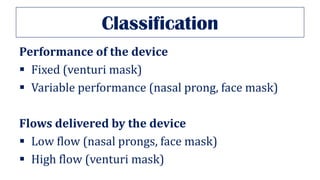
Classification
Performance of the device
ā–Ŗ Fixed (venturi mask)
ā–Ŗ Variable performance (nasal prong, face mask)
Flows delivered by the device
ā–Ŗ Low flow (nasal prongs, face mask)
ā–Ŗ High flow (venturi mask)
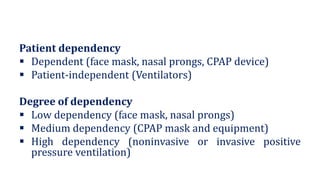
Patient dependency
ā–Ŗ Dependent (face mask, nasal prongs, CPAP device)
ā–Ŗ Patient-independent (Ventilators)
Degree of dependency
ā–Ŗ Low dependency (face mask, nasal prongs)
ā–Ŗ Medium dependency (CPAP mask and equipment)
ā–Ŗ High dependency (noninvasive or invasive positive
pressure ventilation)
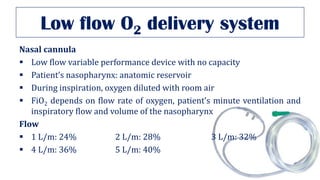
Low flow O2 delivery system
Nasal cannula
ā–Ŗ Low flow variable performance device with no capacity
ā–Ŗ Patient’s nasopharynx: anatomic reservoir
ā–Ŗ During inspiration, oxygen diluted with room air
ā–Ŗ FiO2 depends on flow rate of oxygen, patient’s minute ventilation and
inspiratory flow and volume of the nasopharynx
Flow
ā–Ŗ 1 L/m: 24% 2 L/m: 28% 3 L/m: 32%
ā–Ŗ 4 L/m: 36% 5 L/m: 40%
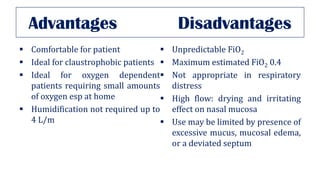
Advantages Disadvantages
ā–Ŗ Comfortable for patient
ā–Ŗ Ideal for claustrophobic patients
ā–Ŗ Ideal for oxygen dependent
patients requiring small amounts
of oxygen esp at home
ā–Ŗ Humidification not required up to
4 L/m
ā–Ŗ Unpredictable FiO2
ā–Ŗ Maximum estimated FiO2 0.4
ā–Ŗ Not appropriate in respiratory
distress
ā–Ŗ High flow: drying and irritating
effect on nasal mucosa
ā–Ŗ Use may be limited by presence of
excessive mucus, mucosal edema,
or a deviated septum
Face mask
ā–Ŗ Low flow variable performance device with small capacity
ā–Ŗ Pediatric face masks (70–100 mL), adult (100–250 mL)
ā–Ŗ Higher FiO2 →delivered if mask volume increased
ā–Ŗ O2 that gets collected in the apparatus dead space at the
end of expiration is inhaled at the beginning of the next
breath
ā–Ŗ Exhaled gases vented out through holes on each side of the
mask, which also serve as room-air entrainment ports.
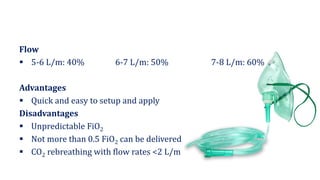
Flow
ā–Ŗ 5-6 L/m: 40% 6-7 L/m: 50% 7-8 L/m: 60%
Advantages
ā–Ŗ Quick and easy to setup and apply
Disadvantages
ā–Ŗ Unpredictable FiO2
ā–Ŗ Not more than 0.5 FiO2 can be delivered
ā–Ŗ CO2 rebreathing with flow rates <2 L/m
Reservoir Face mask
ā–Ŗ High capacity, low-flow, variable performance
device
ā–Ŗ Higher FiO2 due to reservoir bag attached
ā–Ŗ O2 flows directly into reservoir bag
ā–Ŗ Flow rate of O2 adjusted so that bag remains
completely/ partially distended
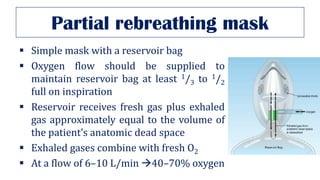
Partial rebreathing mask
ā–Ŗ Simple mask with a reservoir bag
ā–Ŗ Oxygen flow should be supplied to
maintain reservoir bag at least 1/3 to 1/2
full on inspiration
ā–Ŗ Reservoir receives fresh gas plus exhaled
gas approximately equal to the volume of
the patient’s anatomic dead space
ā–Ŗ Exhaled gases combine with fresh O2
ā–Ŗ At a flow of 6–10 L/min →40–70% oxygen
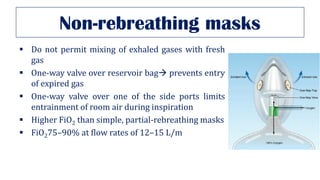
Non-rebreathing masks
ā–Ŗ Do not permit mixing of exhaled gases with fresh
gas
ā–Ŗ One-way valve over reservoir bag→ prevents entry
of expired gas
ā–Ŗ One-way valve over one of the side ports limits
entrainment of room air during inspiration
ā–Ŗ Higher FiO2 than simple, partial-rebreathing masks
ā–Ŗ FiO275–90% at flow rates of 12–15 L/m
Venturi mask
ā–Ŗ Venturi effect based on Bernoulli principle
ā–Ŗ As the velocity of a fluid ↑, pressure exerted ↓
ā–Ŗ When a fluid flows through a constriction the fluid
velocity must increase to satisfy the equation of
continuity
ā–Ŗ Describes how a second fluid can be entrained into the
stream of the first
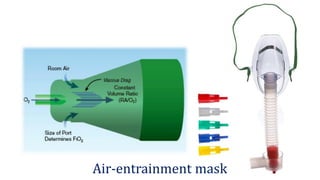
Air-entrainment mask
ā–Ŗ High-flow, fixed performance device
ā–Ŗ O2 supplied to mask through narrow bore oxygen tubing
ā–Ŗ A negative pressure created→room air entrained through
the apertures in the Venturi barrel
ā–Ŗ Resultant air-oxygen mixture containing the prescribed O2
concentration flows into face piece for patient breathing
ā–Ŗ Excess gas flushes out the expired CO2 through the holes on
the sides of the mask →No rebreathing
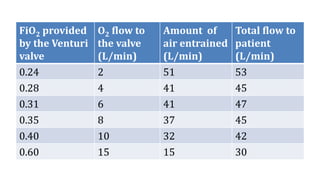
FiO2 provided
by the Venturi
valve
O2 flow to
the valve
(L/min)
Amount of
air entrained
(L/min)
Total flow to
patient
(L/min)
0.24 2 51 53
0.28 4 41 45
0.31 6 41 47
0.35 8 37 45
0.40 10 32 42
0.60 15 15 30
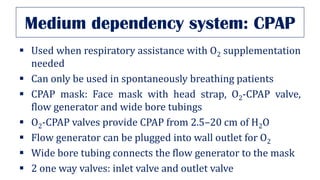
Medium dependency system: CPAP
ā–Ŗ Used when respiratory assistance with O2 supplementation
needed
ā–Ŗ Can only be used in spontaneously breathing patients
ā–Ŗ CPAP mask: Face mask with head strap, O2-CPAP valve,
flow generator and wide bore tubings
ā–Ŗ O2-CPAP valves provide CPAP from 2.5–20 cm of H2O
ā–Ŗ Flow generator can be plugged into wall outlet for O2
ā–Ŗ Wide bore tubing connects the flow generator to the mask
ā–Ŗ 2 one way valves: inlet valve and outlet valve
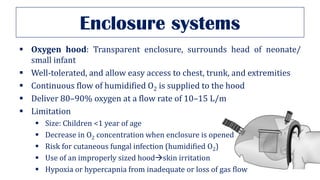
Enclosure systems
ā–Ŗ Oxygen hood: Transparent enclosure, surrounds head of neonate/
small infant
ā–Ŗ Well-tolerated, and allow easy access to chest, trunk, and extremities
ā–Ŗ Continuous flow of humidified O2 is supplied to the hood
ā–Ŗ Deliver 80–90% oxygen at a flow rate of 10–15 L/m
ā–Ŗ Limitation
ā–Ŗ Size: Children <1 year of age
ā–Ŗ Decrease in O2 concentration when enclosure is opened
ā–Ŗ Risk for cutaneous fungal infection (humidified O2)
ā–Ŗ Use of an improperly sized hood→skin irritation
ā–Ŗ Hypoxia or hypercapnia from inadequate or loss of gas flow
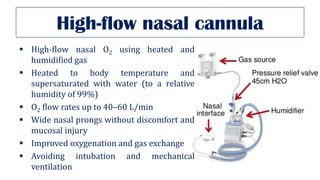
High-flow nasal cannula
ā–Ŗ High-flow nasal O2 using heated and
humidified gas
ā–Ŗ Heated to body temperature and
supersaturated with water (to a relative
humidity of 99%)
ā–Ŗ O2 flow rates up to 40–60 L/min
ā–Ŗ Wide nasal prongs without discomfort and
mucosal injury
ā–Ŗ Improved oxygenation and gas exchange
ā–Ŗ Avoiding intubation and mechanical
ventilation
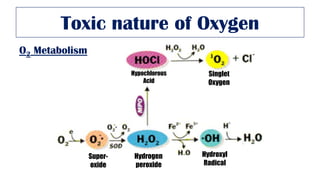
Toxic nature of Oxygen
Hydrogen
peroxide
Super-
oxide
Hydroxyl
Radical
Hypochlorous
Acid
Singlet
Oxygen
O2 Metabolism
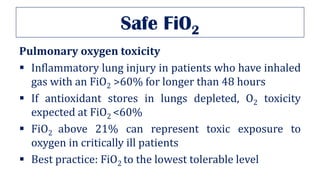
Safe FiO2
Pulmonary oxygen toxicity
ā–Ŗ Inflammatory lung injury in patients who have inhaled
gas with an FiO2 >60% for longer than 48 hours
ā–Ŗ If antioxidant stores in lungs depleted, O2 toxicity
expected at FiO2 <60%
ā–Ŗ FiO2 above 21% can represent toxic exposure to
oxygen in critically ill patients
ā–Ŗ Best practice: FiO2 to the lowest tolerable level
Oxygen therapy

Oxygen therapy

  • 1.
  • 2.
    Contents ā–Ŗ Introduction ā–Ŗ Indications ā–ŖClassification ā–Ŗ Low flow system ā–Ŗ High flow system
  • 3.
    Introduction ā–Ŗ Joseph Priestley,who discovered oxygen in 1774, suggested that it might be ā€œpeculiarly salutary to the lungs in certain morbid casesā€ ā–Ŗ Administration of oxygen at concentrations greater than that in room air to treat or prevent hypoxemia
  • 4.
    O2 therapy: recommendations ā–ŖCardiac and respiratory arrest ā–Ŗ Hypoxemia (PaO2 < 60 mm Hg, SaO2 < 90%) ā–Ŗ Hypotension (systolic BP < 100 mm Hg) ā–Ŗ Low cardiac output and metabolic acidosis ā–Ŗ Respiratory distress (respiratory rate > 24/min)
  • 5.
    Indications for postoperativepatients Patient factors ā–Ŗ Cardiorespiratory disease, elderly, shivering, obesity Surgical factors ā–Ŗ Thoracic surgery, upper abdominal surgery Physiological factors ā–Ŗ Hypovolemia, hypotension, anemia
  • 6.
    Classification Performance of thedevice ā–Ŗ Fixed (venturi mask) ā–Ŗ Variable performance (nasal prong, face mask) Flows delivered by the device ā–Ŗ Low flow (nasal prongs, face mask) ā–Ŗ High flow (venturi mask)
  • 7.
    Patient dependency ā–Ŗ Dependent(face mask, nasal prongs, CPAP device) ā–Ŗ Patient-independent (Ventilators) Degree of dependency ā–Ŗ Low dependency (face mask, nasal prongs) ā–Ŗ Medium dependency (CPAP mask and equipment) ā–Ŗ High dependency (noninvasive or invasive positive pressure ventilation)
  • 8.
    Low flow O2delivery system Nasal cannula ā–Ŗ Low flow variable performance device with no capacity ā–Ŗ Patient’s nasopharynx: anatomic reservoir ā–Ŗ During inspiration, oxygen diluted with room air ā–Ŗ FiO2 depends on flow rate of oxygen, patient’s minute ventilation and inspiratory flow and volume of the nasopharynx Flow ā–Ŗ 1 L/m: 24% 2 L/m: 28% 3 L/m: 32% ā–Ŗ 4 L/m: 36% 5 L/m: 40%
  • 9.
    Advantages Disadvantages ā–Ŗ Comfortablefor patient ā–Ŗ Ideal for claustrophobic patients ā–Ŗ Ideal for oxygen dependent patients requiring small amounts of oxygen esp at home ā–Ŗ Humidification not required up to 4 L/m ā–Ŗ Unpredictable FiO2 ā–Ŗ Maximum estimated FiO2 0.4 ā–Ŗ Not appropriate in respiratory distress ā–Ŗ High flow: drying and irritating effect on nasal mucosa ā–Ŗ Use may be limited by presence of excessive mucus, mucosal edema, or a deviated septum
  • 10.
    Face mask ā–Ŗ Lowflow variable performance device with small capacity ā–Ŗ Pediatric face masks (70–100 mL), adult (100–250 mL) ā–Ŗ Higher FiO2 →delivered if mask volume increased ā–Ŗ O2 that gets collected in the apparatus dead space at the end of expiration is inhaled at the beginning of the next breath ā–Ŗ Exhaled gases vented out through holes on each side of the mask, which also serve as room-air entrainment ports.
  • 11.
    Flow ā–Ŗ 5-6 L/m:40% 6-7 L/m: 50% 7-8 L/m: 60% Advantages ā–Ŗ Quick and easy to setup and apply Disadvantages ā–Ŗ Unpredictable FiO2 ā–Ŗ Not more than 0.5 FiO2 can be delivered ā–Ŗ CO2 rebreathing with flow rates <2 L/m
  • 12.
    Reservoir Face mask ā–ŖHigh capacity, low-flow, variable performance device ā–Ŗ Higher FiO2 due to reservoir bag attached ā–Ŗ O2 flows directly into reservoir bag ā–Ŗ Flow rate of O2 adjusted so that bag remains completely/ partially distended
  • 13.
    Partial rebreathing mask ā–ŖSimple mask with a reservoir bag ā–Ŗ Oxygen flow should be supplied to maintain reservoir bag at least 1/3 to 1/2 full on inspiration ā–Ŗ Reservoir receives fresh gas plus exhaled gas approximately equal to the volume of the patient’s anatomic dead space ā–Ŗ Exhaled gases combine with fresh O2 ā–Ŗ At a flow of 6–10 L/min →40–70% oxygen
  • 14.
    Non-rebreathing masks ā–Ŗ Donot permit mixing of exhaled gases with fresh gas ā–Ŗ One-way valve over reservoir bag→ prevents entry of expired gas ā–Ŗ One-way valve over one of the side ports limits entrainment of room air during inspiration ā–Ŗ Higher FiO2 than simple, partial-rebreathing masks ā–Ŗ FiO275–90% at flow rates of 12–15 L/m
  • 15.
    Venturi mask ā–Ŗ Venturieffect based on Bernoulli principle ā–Ŗ As the velocity of a fluid ↑, pressure exerted ↓ ā–Ŗ When a fluid flows through a constriction the fluid velocity must increase to satisfy the equation of continuity ā–Ŗ Describes how a second fluid can be entrained into the stream of the first
  • 16.
  • 17.
    ā–Ŗ High-flow, fixedperformance device ā–Ŗ O2 supplied to mask through narrow bore oxygen tubing ā–Ŗ A negative pressure created→room air entrained through the apertures in the Venturi barrel ā–Ŗ Resultant air-oxygen mixture containing the prescribed O2 concentration flows into face piece for patient breathing ā–Ŗ Excess gas flushes out the expired CO2 through the holes on the sides of the mask →No rebreathing
  • 18.
    FiO2 provided by theVenturi valve O2 flow to the valve (L/min) Amount of air entrained (L/min) Total flow to patient (L/min) 0.24 2 51 53 0.28 4 41 45 0.31 6 41 47 0.35 8 37 45 0.40 10 32 42 0.60 15 15 30
  • 19.
    Medium dependency system:CPAP ā–Ŗ Used when respiratory assistance with O2 supplementation needed ā–Ŗ Can only be used in spontaneously breathing patients ā–Ŗ CPAP mask: Face mask with head strap, O2-CPAP valve, flow generator and wide bore tubings ā–Ŗ O2-CPAP valves provide CPAP from 2.5–20 cm of H2O ā–Ŗ Flow generator can be plugged into wall outlet for O2 ā–Ŗ Wide bore tubing connects the flow generator to the mask ā–Ŗ 2 one way valves: inlet valve and outlet valve
  • 20.
    Enclosure systems ā–Ŗ Oxygenhood: Transparent enclosure, surrounds head of neonate/ small infant ā–Ŗ Well-tolerated, and allow easy access to chest, trunk, and extremities ā–Ŗ Continuous flow of humidified O2 is supplied to the hood ā–Ŗ Deliver 80–90% oxygen at a flow rate of 10–15 L/m ā–Ŗ Limitation ā–Ŗ Size: Children <1 year of age ā–Ŗ Decrease in O2 concentration when enclosure is opened ā–Ŗ Risk for cutaneous fungal infection (humidified O2) ā–Ŗ Use of an improperly sized hood→skin irritation ā–Ŗ Hypoxia or hypercapnia from inadequate or loss of gas flow
  • 21.
    High-flow nasal cannula ā–ŖHigh-flow nasal O2 using heated and humidified gas ā–Ŗ Heated to body temperature and supersaturated with water (to a relative humidity of 99%) ā–Ŗ O2 flow rates up to 40–60 L/min ā–Ŗ Wide nasal prongs without discomfort and mucosal injury ā–Ŗ Improved oxygenation and gas exchange ā–Ŗ Avoiding intubation and mechanical ventilation
  • 22.
    Toxic nature ofOxygen Hydrogen peroxide Super- oxide Hydroxyl Radical Hypochlorous Acid Singlet Oxygen O2 Metabolism
  • 23.
    Safe FiO2 Pulmonary oxygentoxicity ā–Ŗ Inflammatory lung injury in patients who have inhaled gas with an FiO2 >60% for longer than 48 hours ā–Ŗ If antioxidant stores in lungs depleted, O2 toxicity expected at FiO2 <60% ā–Ŗ FiO2 above 21% can represent toxic exposure to oxygen in critically ill patients ā–Ŗ Best practice: FiO2 to the lowest tolerable level