USE DATA WAREHOUSE AND
DATA MINING TO PREDICT
STUDENT ACADEMIC
PERFORMANCE IN SCHOOLS
Presented by
Ranjith G N
1SJ10IS070
Under the guidance of
Mr. Nagesh R
Assistant Professor
Dept of ISE,SJCIT
CONTENTS
• ABSTRACT
• INTRODUCTION
• METHODS
• RESULT AND DISCUSSION
• CONCLUSION
• REFERENCES
ABSTRACT
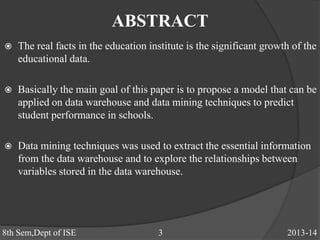
 The real facts in the education institute is the significant growth of the
educational data.
 Basically the main goal of this paper is to propose a model that can be
applied on data warehouse and data mining techniques to predict
student performance in schools.
 Data mining techniques was used to extract the essential information
from the data warehouse and to explore the relationships between
variables stored in the data warehouse.
8th Sem,Dept of ISE 3 2013-14
INTRODUCTION
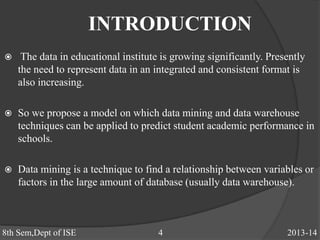
 The data in educational institute is growing significantly. Presently
the need to represent data in an integrated and consistent format is
also increasing.
 So we propose a model on which data mining and data warehouse
techniques can be applied to predict student academic performance in
schools.
 Data mining is a technique to find a relationship between variables or
factors in the large amount of database (usually data warehouse).
8th Sem,Dept of ISE 4 2013-14
 Here we implement the data mining techniques through data
warehouse to forecast for students progression status (progress,
retain, conditional progression) by analyzing student data.
 The information from a school system can be rapidly assessed to find
the performance of students in the school.
 The data and information gained from the learning system
can be used as an substantial indicator for monitoring of the
potential student failure in the school.
 Furthermore alerts can be sent to the parent and academic staff to
intimate them about the performance of the student.
8th Sem,Dept of ISE 5 2013-14
METHODS
 The implementation of this study consists of two types of methods:
(1) Analysis Method. (2) Methods for data warehouse design.
 The process of Analysis Method is done through several stages
including: Literature review, the study of literature discussing the
establishment of a data warehouse and data mining.
 In the design phase, design models and applications based on the
results of an analysis of the problem are used
8th Sem,Dept of ISE 6 2013-14
RESULT AND DISCUSSION
 The first objective of this study is to propose the data
mining techniques.
 The second objective is to propose the tools for the parents
or students to analysis their own data in the school.
 Data mining technique can give the input for the teachers
and students about the student academic results.
8th Sem,Dept of ISE 7 2013-14
8th Sem,Dept of ISE 8 2013-14
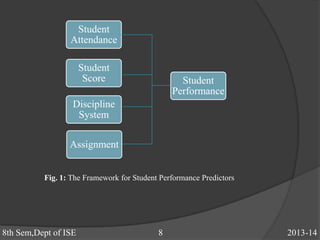
Student
Performance
Student
Attendance
Student
Score
Discipline
System
Assignment
Fig. 1: The Framework for Student Performance Predictors
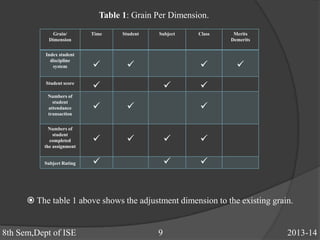
Grain/
Dimension
Time Student Subject Class Merits
Demerits
Index student
discipline
system    
Student score
  
Numbers of
student
attendance
transaction
  
Numbers of
student
completed
the assignment
   
Subject Rating   
8th Sem,Dept of ISE 9 2013-14
Table 1: Grain Per Dimension.
 The table 1 above shows the adjustment dimension to the existing grain.
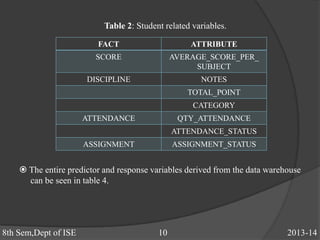
FACT ATTRIBUTE
SCORE AVERAGE_SCORE_PER_
SUBJECT
DISCIPLINE NOTES
TOTAL_POINT
CATEGORY
ATTENDANCE QTY_ATTENDANCE
ATTENDANCE_STATUS
ASSIGNMENT ASSIGNMENT_STATUS
8th Sem,Dept of ISE 10 2013-14
Table 2: Student related variables.
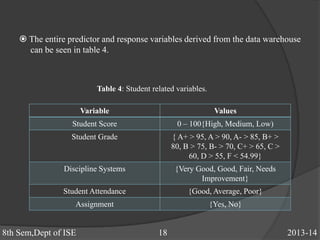
 The entire predictor and response variables derived from the data warehouse
can be seen in table 4.
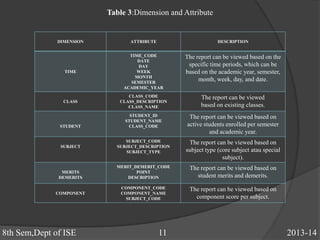
Table 3:Dimension and Attribute
DIMENSION ATTRIBUTE DESCRIPTION
TIME
TIME_CODE
DATE
DAY
WEEK
MONTH
SEMESTER
ACADEMIC_YEAR
The report can be viewed based on the
specific time periods, which can be
based on the academic year, semester,
month, week, day, and date.
CLASS
CLASS_CODE
CLASS_DESCRIPTION
CLASS_NAME
The report can be viewed
based on existing classes.
STUDENT
STUDENT_ID
STUDENT_NAME
CLASS_CODE
The report can be viewed based on
active students enrolled per semester
and academic year.
SUBJECT
SUBJECT_CODE
SUBJECT_DESCRIPTION
SUBJECT_TYPE
The report can be viewed based on
subject type (core subject atau special
subject).
MERITS
DEMERITS
MERIT_DEMERIT_CODE
POINT
DESCRIPTION
The report can be viewed based on
student merits and demerits.
COMPONENT
COMPONENT_CODE
COMPONENT_NAME
SUBJECT_CODE
The report can be viewed based on
component score per subject.
8th Sem,Dept of ISE 11 2013-14
8th Sem,Dept of ISE 12 2013-14
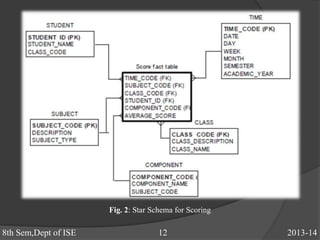
Fig. 2: Star Schema for Scoring
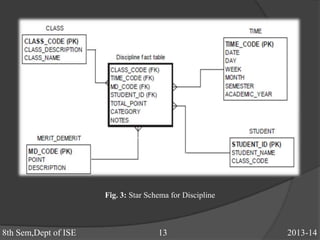
Fig. 3: Star Schema for Discipline
8th Sem,Dept of ISE 13 2013-14
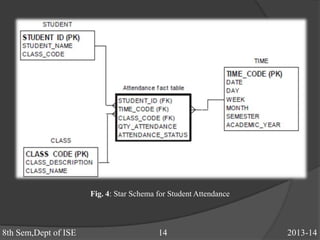
Fig. 4: Star Schema for Student Attendance
8th Sem,Dept of ISE 14 2013-14
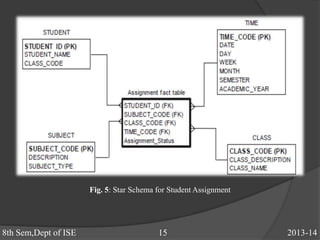
Fig. 5: Star Schema for Student Assignment
8th Sem,Dept of ISE 15 2013-14
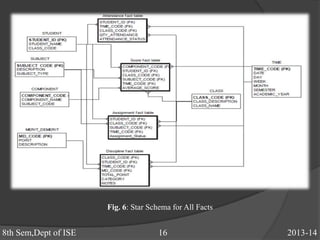
Fig. 6: Star Schema for All Facts
8th Sem,Dept of ISE 16 2013-14
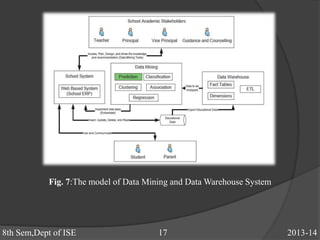
Fig. 7:The model of Data Mining and Data Warehouse System
8th Sem,Dept of ISE 17 2013-14
Table 4: Student related variables.
Variable Values
Student Score 0 – 100{High, Medium, Low)
Student Grade { A+ > 95, A > 90, A- > 85, B+ >
80, B > 75, B- > 70, C+ > 65, C >
60, D > 55, F < 54.99}
Discipline Systems {Very Good, Good, Fair, Needs
Improvement}
Student Attendance {Good, Average, Poor}
Assignment {Yes, No}
8th Sem,Dept of ISE 18 2013-14
 The entire predictor and response variables derived from the data warehouse
can be seen in table 4.
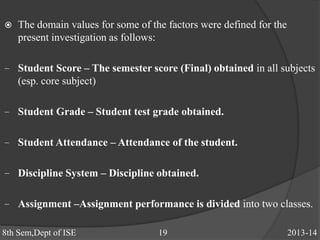
 The domain values for some of the factors were defined for the
present investigation as follows:
− Student Score – The semester score (Final) obtained in all subjects
(esp. core subject)
− Student Grade – Student test grade obtained.
− Student Attendance – Attendance of the student.
− Discipline System – Discipline obtained.
− Assignment –Assignment performance is divided into two classes.
8th Sem,Dept of ISE 19 2013-14
CONCLUSION
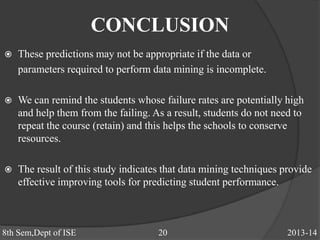
 These predictions may not be appropriate if the data or
parameters required to perform data mining is incomplete.
 We can remind the students whose failure rates are potentially high
and help them from the failing. As a result, students do not need to
repeat the course (retain) and this helps the schools to conserve
resources.
 The result of this study indicates that data mining techniques provide
effective improving tools for predicting student performance.
8th Sem,Dept of ISE 20 2013-14
REFERENCES
 S. Z. Erdogan and M. Timor, “A Data Mining Application in a Student
Database,” in Journal of Aeronautics and Space Technologies, 2005, vol.2, No.
2, 2005, pp. 53-57.
 K. B. Brijesh and P. Saurabh, “Mining Educational Data to Analyze Students
Performance,” In International Journal of Advanced Computer Science and
Applications, vol. 2, No. 6, 2011, pp. 63-69.
 Y. Zhang, S. Oussena, T. Clark, and H. Kim, “Use data mining to improve
student retention in higher education - a case study,” In ICEIS(1), 2010, pp.
190–197.
 C. Romero, S. Ventura, P. G. Espejo, and C. Hervás, “Data mining
algorithms to classify students,”. In EDM, 2008, pp. 8–17.
 W. H. Inmon, “Building the Data Warehouse,” 3rd edition, Canada: John
Wiley & Sons, Inc., 2005.
8th Sem,Dept of ISE 21 2013-14
Data mining to predict academic performance.

Data mining to predict academic performance.

  • 1.
    USE DATA WAREHOUSEAND DATA MINING TO PREDICT STUDENT ACADEMIC PERFORMANCE IN SCHOOLS Presented by Ranjith G N 1SJ10IS070 Under the guidance of Mr. Nagesh R Assistant Professor Dept of ISE,SJCIT
  • 2.
    CONTENTS • ABSTRACT • INTRODUCTION •METHODS • RESULT AND DISCUSSION • CONCLUSION • REFERENCES
  • 3.
    ABSTRACT  The realfacts in the education institute is the significant growth of the educational data.  Basically the main goal of this paper is to propose a model that can be applied on data warehouse and data mining techniques to predict student performance in schools.  Data mining techniques was used to extract the essential information from the data warehouse and to explore the relationships between variables stored in the data warehouse. 8th Sem,Dept of ISE 3 2013-14
  • 4.
    INTRODUCTION  The datain educational institute is growing significantly. Presently the need to represent data in an integrated and consistent format is also increasing.  So we propose a model on which data mining and data warehouse techniques can be applied to predict student academic performance in schools.  Data mining is a technique to find a relationship between variables or factors in the large amount of database (usually data warehouse). 8th Sem,Dept of ISE 4 2013-14
  • 5.
     Here weimplement the data mining techniques through data warehouse to forecast for students progression status (progress, retain, conditional progression) by analyzing student data.  The information from a school system can be rapidly assessed to find the performance of students in the school.  The data and information gained from the learning system can be used as an substantial indicator for monitoring of the potential student failure in the school.  Furthermore alerts can be sent to the parent and academic staff to intimate them about the performance of the student. 8th Sem,Dept of ISE 5 2013-14
  • 6.
    METHODS  The implementationof this study consists of two types of methods: (1) Analysis Method. (2) Methods for data warehouse design.  The process of Analysis Method is done through several stages including: Literature review, the study of literature discussing the establishment of a data warehouse and data mining.  In the design phase, design models and applications based on the results of an analysis of the problem are used 8th Sem,Dept of ISE 6 2013-14
  • 7.
    RESULT AND DISCUSSION The first objective of this study is to propose the data mining techniques.  The second objective is to propose the tools for the parents or students to analysis their own data in the school.  Data mining technique can give the input for the teachers and students about the student academic results. 8th Sem,Dept of ISE 7 2013-14
  • 8.
    8th Sem,Dept ofISE 8 2013-14 Student Performance Student Attendance Student Score Discipline System Assignment Fig. 1: The Framework for Student Performance Predictors
  • 9.
    Grain/ Dimension Time Student SubjectClass Merits Demerits Index student discipline system     Student score    Numbers of student attendance transaction    Numbers of student completed the assignment     Subject Rating    8th Sem,Dept of ISE 9 2013-14 Table 1: Grain Per Dimension.  The table 1 above shows the adjustment dimension to the existing grain.
  • 10.
    FACT ATTRIBUTE SCORE AVERAGE_SCORE_PER_ SUBJECT DISCIPLINENOTES TOTAL_POINT CATEGORY ATTENDANCE QTY_ATTENDANCE ATTENDANCE_STATUS ASSIGNMENT ASSIGNMENT_STATUS 8th Sem,Dept of ISE 10 2013-14 Table 2: Student related variables.  The entire predictor and response variables derived from the data warehouse can be seen in table 4.
  • 11.
    Table 3:Dimension andAttribute DIMENSION ATTRIBUTE DESCRIPTION TIME TIME_CODE DATE DAY WEEK MONTH SEMESTER ACADEMIC_YEAR The report can be viewed based on the specific time periods, which can be based on the academic year, semester, month, week, day, and date. CLASS CLASS_CODE CLASS_DESCRIPTION CLASS_NAME The report can be viewed based on existing classes. STUDENT STUDENT_ID STUDENT_NAME CLASS_CODE The report can be viewed based on active students enrolled per semester and academic year. SUBJECT SUBJECT_CODE SUBJECT_DESCRIPTION SUBJECT_TYPE The report can be viewed based on subject type (core subject atau special subject). MERITS DEMERITS MERIT_DEMERIT_CODE POINT DESCRIPTION The report can be viewed based on student merits and demerits. COMPONENT COMPONENT_CODE COMPONENT_NAME SUBJECT_CODE The report can be viewed based on component score per subject. 8th Sem,Dept of ISE 11 2013-14
  • 12.
    8th Sem,Dept ofISE 12 2013-14 Fig. 2: Star Schema for Scoring
  • 13.
    Fig. 3: StarSchema for Discipline 8th Sem,Dept of ISE 13 2013-14
  • 14.
    Fig. 4: StarSchema for Student Attendance 8th Sem,Dept of ISE 14 2013-14
  • 15.
    Fig. 5: StarSchema for Student Assignment 8th Sem,Dept of ISE 15 2013-14
  • 16.
    Fig. 6: StarSchema for All Facts 8th Sem,Dept of ISE 16 2013-14
  • 17.
    Fig. 7:The modelof Data Mining and Data Warehouse System 8th Sem,Dept of ISE 17 2013-14
  • 18.
    Table 4: Studentrelated variables. Variable Values Student Score 0 – 100{High, Medium, Low) Student Grade { A+ > 95, A > 90, A- > 85, B+ > 80, B > 75, B- > 70, C+ > 65, C > 60, D > 55, F < 54.99} Discipline Systems {Very Good, Good, Fair, Needs Improvement} Student Attendance {Good, Average, Poor} Assignment {Yes, No} 8th Sem,Dept of ISE 18 2013-14  The entire predictor and response variables derived from the data warehouse can be seen in table 4.
  • 19.
     The domainvalues for some of the factors were defined for the present investigation as follows: − Student Score – The semester score (Final) obtained in all subjects (esp. core subject) − Student Grade – Student test grade obtained. − Student Attendance – Attendance of the student. − Discipline System – Discipline obtained. − Assignment –Assignment performance is divided into two classes. 8th Sem,Dept of ISE 19 2013-14
  • 20.
    CONCLUSION  These predictionsmay not be appropriate if the data or parameters required to perform data mining is incomplete.  We can remind the students whose failure rates are potentially high and help them from the failing. As a result, students do not need to repeat the course (retain) and this helps the schools to conserve resources.  The result of this study indicates that data mining techniques provide effective improving tools for predicting student performance. 8th Sem,Dept of ISE 20 2013-14
  • 21.
    REFERENCES  S. Z.Erdogan and M. Timor, “A Data Mining Application in a Student Database,” in Journal of Aeronautics and Space Technologies, 2005, vol.2, No. 2, 2005, pp. 53-57.  K. B. Brijesh and P. Saurabh, “Mining Educational Data to Analyze Students Performance,” In International Journal of Advanced Computer Science and Applications, vol. 2, No. 6, 2011, pp. 63-69.  Y. Zhang, S. Oussena, T. Clark, and H. Kim, “Use data mining to improve student retention in higher education - a case study,” In ICEIS(1), 2010, pp. 190–197.  C. Romero, S. Ventura, P. G. Espejo, and C. Hervás, “Data mining algorithms to classify students,”. In EDM, 2008, pp. 8–17.  W. H. Inmon, “Building the Data Warehouse,” 3rd edition, Canada: John Wiley & Sons, Inc., 2005. 8th Sem,Dept of ISE 21 2013-14