Enhancing Teaching and
   Learning Through
Educational Data Mining
 and Learning Analytics
 An Issue Brief Prepared for the US Department of Education
               Office of Educational Technology

                       April 10, 2012
Purpose
 Look at data analytics techniques in the context of a
  new framework for educational evidence

 See how commercial techniques (state-of-the-practice)
  might apply to education

 Define educational data mining and learning analytics:
  What questions can they answer?

 Categorize applications and understand benefits, and
  challenges
Issue Brief Questions
 What is educational data mining, and how is it applied? What kinds of
   questions can it answer, and what kinds of data are needed to answer these
   questions?

 How does learning analytics differ from data mining? Does it answer different
   questions and use different data?

 What are the broad application areas for which educational data mining and
   learning analytics are used?

 What are the benefits of educational data mining and learning analytics, and
   what factors have enabled these new approaches to be adopted?

 What are the challenges and barriers to successful application of educational
   data mining and learning analytics?

 What new practices have to be adopted in order to successfully employ
   educational data mining and learning analytics for improving teaching and
   learning?
Data Sources
 A review of selected publications and fugitive or gray
  literature (Web pages and unpublished documents) on
  educational data mining and learning analytics
 Interviews of 15 data mining/analytics experts from
  learning software and learning management system
  companies and from companies offering other kinds of
  Web-based services
 Deliberations of a technical working group of eight
  academic experts in data mining and learning analytics.
Inspiration for Issue Brief
                National Educational Technology Plan

“When students are learning online, there are multiple opportunities to
exploit the power of technology for formative assessment. The same
technology that supports learning activities gathers data in the course
of learning that can be used for assessment…. An online system can
collect much more and much more detailed information about how
students are learning than manual methods. As students work, the
system can capture their inputs and collect evidence of their problem-
solving sequences, knowledge, and strategy use, as reflected by the
information each student selects or inputs, the number of attempts the
student makes, the number of hints and feedback given, and the time
allocation across parts of the problem.” (U.S. Department of
Education 2010, p. 30)
Interconnected Feedback
      System for Education
         National Educational Technology Plan

“The goal of creating an interconnected feedback system
would be to ensure that key decisions about learning are
informed by data and that data are aggregated and made
accessible at all levels of the education system for
continuous improvement.” (U.S. Department of Education
2010, p. 35)
Research Areas
 Educational Data Mining: develops new techniques, tests
  learning theories and informs educational practice. Looks for
  patterns in unstructured data. Generally automates
  responses to learners.

 Learning analytics: Applies techniques and takes a
  “system-level” view of teaching and learning, including at the
  institutional level. Generally supports human decision
  making vs. automating responses.

 Visual Data Analytics: taps the ability of humans to discern
  patterns in visually represented complex datasets.
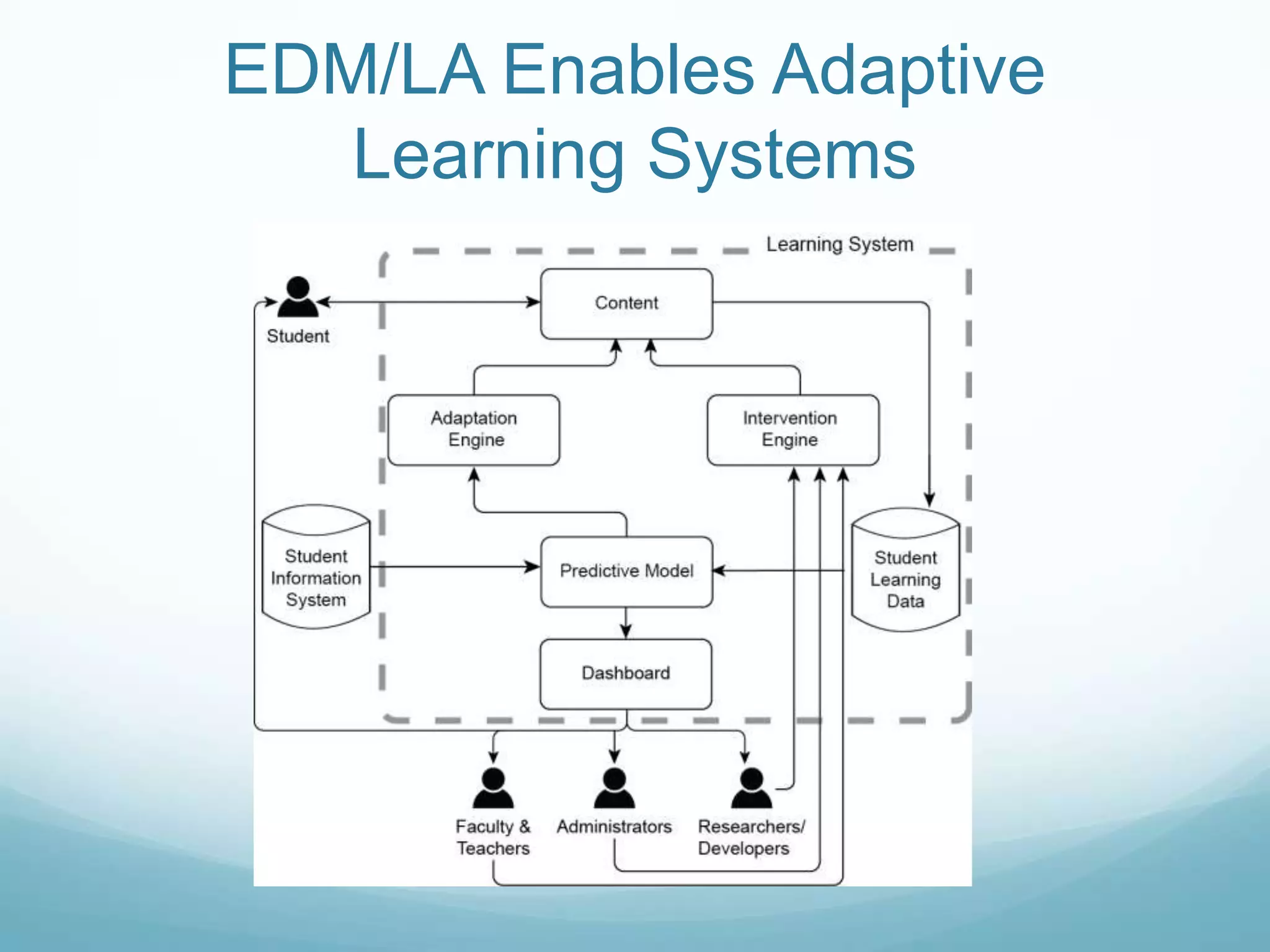
EDM/LA Enables Adaptive
   Learning Systems
Application Areas
 User Modeling: Model a learner’s knowledge, behavior,
  motivation, experience, and satisfaction.
 User Profiling: Cluster users into similar groups.
 Domain Modeling: Decompose content to be learned into
  components and sequences.
 Effectiveness: Test learning principles, curricula, etc.
 Trend Analysis: Track changes over time.
 Recommendations and Improvements: Suggest
  resources and actions to learners; adapt system to learners.
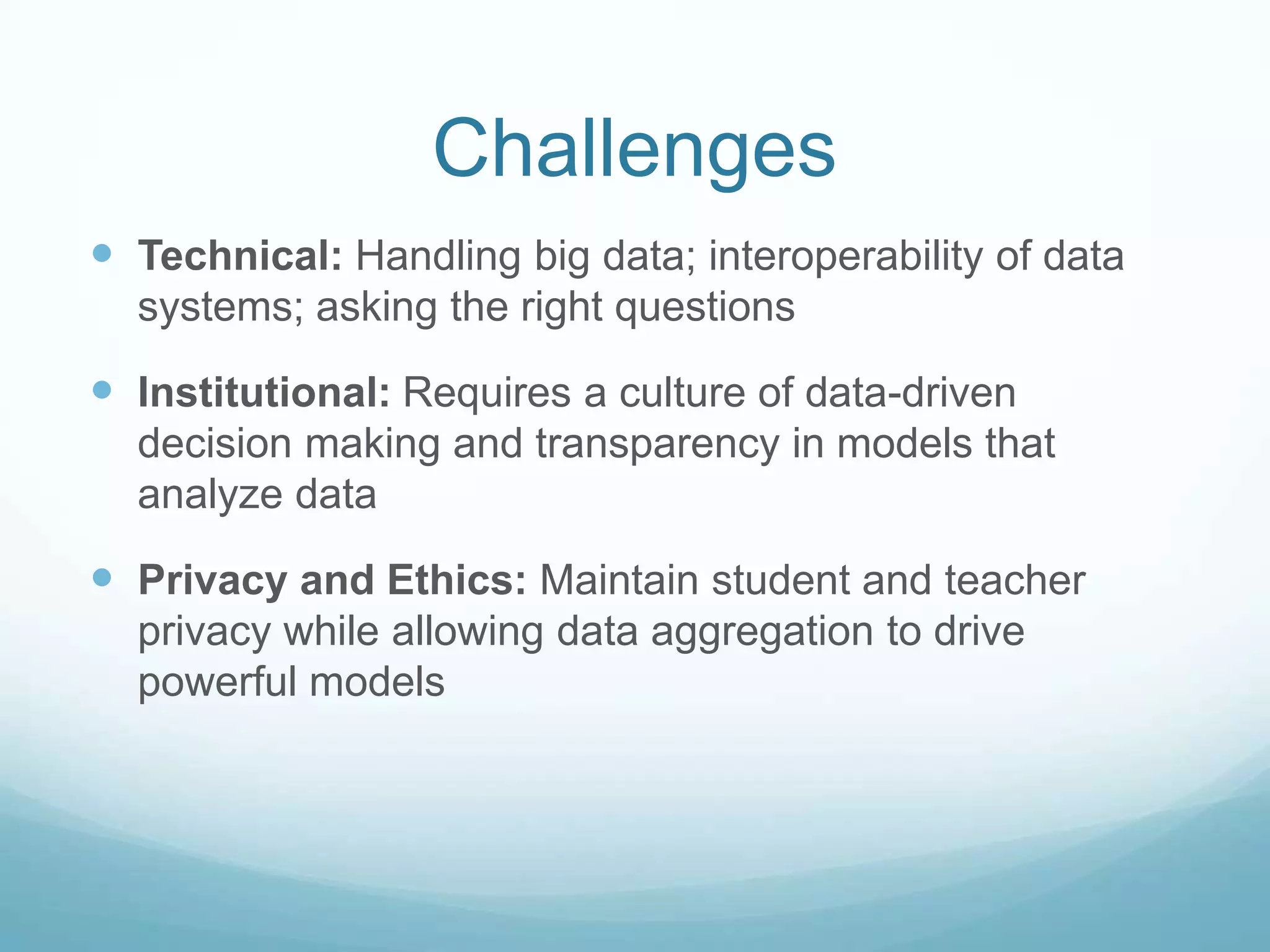
Challenges
 Technical: Handling big data; interoperability of data
  systems; asking the right questions

 Institutional: Requires a culture of data-driven
  decision making and transparency in models that
  analyze data

 Privacy and Ethics: Maintain student and teacher
  privacy while allowing data aggregation to drive
  powerful models
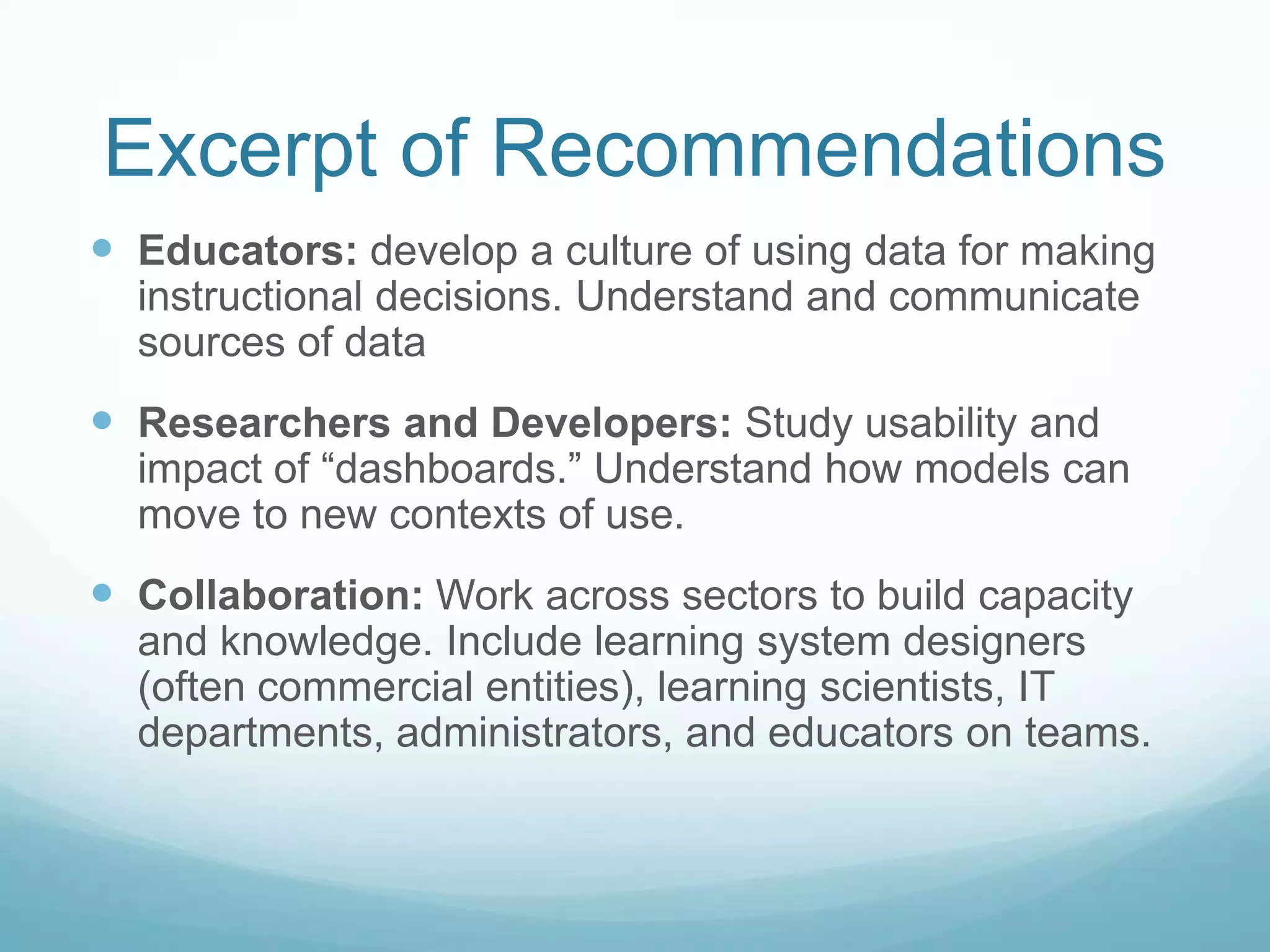
Excerpt of Recommendations
 Educators: develop a culture of using data for making
  instructional decisions. Understand and communicate
  sources of data
 Researchers and Developers: Study usability and
  impact of “dashboards.” Understand how models can
  move to new contexts of use.
 Collaboration: Work across sectors to build capacity
  and knowledge. Include learning system designers
  (often commercial entities), learning scientists, IT
  departments, administrators, and educators on teams.

Educational Data Mining/Learning Analytics issue brief overview

  • 1.
    Enhancing Teaching and Learning Through Educational Data Mining and Learning Analytics An Issue Brief Prepared for the US Department of Education Office of Educational Technology April 10, 2012
  • 2.
    Purpose  Look atdata analytics techniques in the context of a new framework for educational evidence  See how commercial techniques (state-of-the-practice) might apply to education  Define educational data mining and learning analytics: What questions can they answer?  Categorize applications and understand benefits, and challenges
  • 3.
    Issue Brief Questions What is educational data mining, and how is it applied? What kinds of questions can it answer, and what kinds of data are needed to answer these questions?  How does learning analytics differ from data mining? Does it answer different questions and use different data?  What are the broad application areas for which educational data mining and learning analytics are used?  What are the benefits of educational data mining and learning analytics, and what factors have enabled these new approaches to be adopted?  What are the challenges and barriers to successful application of educational data mining and learning analytics?  What new practices have to be adopted in order to successfully employ educational data mining and learning analytics for improving teaching and learning?
  • 4.
    Data Sources  Areview of selected publications and fugitive or gray literature (Web pages and unpublished documents) on educational data mining and learning analytics  Interviews of 15 data mining/analytics experts from learning software and learning management system companies and from companies offering other kinds of Web-based services  Deliberations of a technical working group of eight academic experts in data mining and learning analytics.
  • 5.
    Inspiration for IssueBrief National Educational Technology Plan “When students are learning online, there are multiple opportunities to exploit the power of technology for formative assessment. The same technology that supports learning activities gathers data in the course of learning that can be used for assessment…. An online system can collect much more and much more detailed information about how students are learning than manual methods. As students work, the system can capture their inputs and collect evidence of their problem- solving sequences, knowledge, and strategy use, as reflected by the information each student selects or inputs, the number of attempts the student makes, the number of hints and feedback given, and the time allocation across parts of the problem.” (U.S. Department of Education 2010, p. 30)
  • 6.
    Interconnected Feedback System for Education National Educational Technology Plan “The goal of creating an interconnected feedback system would be to ensure that key decisions about learning are informed by data and that data are aggregated and made accessible at all levels of the education system for continuous improvement.” (U.S. Department of Education 2010, p. 35)
  • 7.
    Research Areas  EducationalData Mining: develops new techniques, tests learning theories and informs educational practice. Looks for patterns in unstructured data. Generally automates responses to learners.  Learning analytics: Applies techniques and takes a “system-level” view of teaching and learning, including at the institutional level. Generally supports human decision making vs. automating responses.  Visual Data Analytics: taps the ability of humans to discern patterns in visually represented complex datasets.
  • 8.
    EDM/LA Enables Adaptive Learning Systems
  • 9.
    Application Areas  UserModeling: Model a learner’s knowledge, behavior, motivation, experience, and satisfaction.  User Profiling: Cluster users into similar groups.  Domain Modeling: Decompose content to be learned into components and sequences.  Effectiveness: Test learning principles, curricula, etc.  Trend Analysis: Track changes over time.  Recommendations and Improvements: Suggest resources and actions to learners; adapt system to learners.
  • 10.
    Challenges  Technical: Handlingbig data; interoperability of data systems; asking the right questions  Institutional: Requires a culture of data-driven decision making and transparency in models that analyze data  Privacy and Ethics: Maintain student and teacher privacy while allowing data aggregation to drive powerful models
  • 11.
    Excerpt of Recommendations Educators: develop a culture of using data for making instructional decisions. Understand and communicate sources of data  Researchers and Developers: Study usability and impact of “dashboards.” Understand how models can move to new contexts of use.  Collaboration: Work across sectors to build capacity and knowledge. Include learning system designers (often commercial entities), learning scientists, IT departments, administrators, and educators on teams.