PREDICTING STUDENTS
PERFORMANCE IN FINAL
EXAMINATION
RASHID ANSARI
170847980002
MTECH(ACDS)
CONTENTS
 INTRODUCTION
 DIFFERENT STUDIES
 CASE STUDY
 ATTRIBUTE USED
 ALGORITHM
 RESULT
INTRODUCTION
 Research involve educational data is highly increased. The
main objective of Educational data Mining includes
performance prediction, student modelling, domain
modelling, analysis and visualization of student data etc.
 Research on students’ performance prediction have been
studied from various attributes in students’ environment like:
 students’ behavior,
 demographics,
 students’ information,
 psychological and
 socio-economic.
INTRODUCTION
Each attributes consist of several elements :-
 The students’ demographics include place of residence, hobbies, family
size, employment and others.
 The students’ information similar to admission or enrolment data,
includes names, age, gender, etc.
 Psychological attributes concern with abilities, attitides, behavior .
 Socio-economic describe about the socio-economic background of the
student and family .
Different Studies
 To predict student recruitment
 Number of posts in discussion are significantly impact
students’ performance.
 Another one that predicted students’ tardiness to see who the
slow learners.
 The factor of ATND(Attendance in the class) was the most
influencing attribute, which affected the performance of
students.
Case Study
 The main objective of the study was to find the best
classification of algorithm between linear regression and
multilayer perceptron.
 The dataset collected from 50 undergraduate students
majoring in Information System Management.
 It was processed in WEKA, an open machine learning software
used for analyzing and predicting students’ performance.
ATTRIBUTES USED IN PREDICTING
STUDENTS’ FINAL EXAMINATION
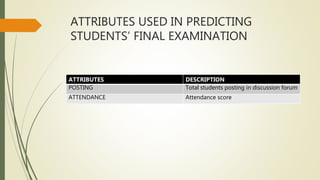
ATTRIBUTES DESCRIPTION
POSTING Total students posting in discussion forum
ATTENDANCE Attendance score
ALGORITHM
Two algorithm is used :-
 Linear Regression
 Multilayer Perceptron
Linear Regression
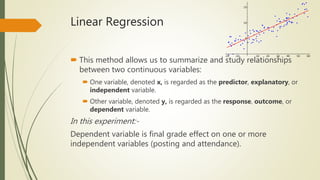
 This method allows us to summarize and study relationships
between two continuous variables:
 One variable, denoted x, is regarded as the predictor, explanatory, or
independent variable.
 Other variable, denoted y, is regarded as the response, outcome, or
dependent variable.
In this experiment:-
Dependent variable is final grade effect on one or more
independent variables (posting and attendance).
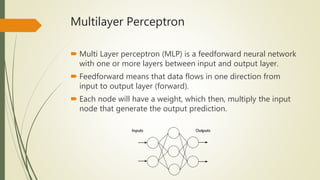
Multilayer Perceptron
 Multi Layer perceptron (MLP) is a feedforward neural network
with one or more layers between input and output layer.
 Feedforward means that data flows in one direction from
input to output layer (forward).
 Each node will have a weight, which then, multiply the input
node that generate the output prediction.
RESULTS
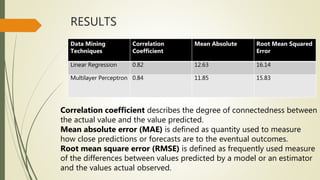
Data Mining
Techniques
Correlation
Coefficient
Mean Absolute Root Mean Squared
Error
Linear Regression 0.82 12.63 16.14
Multilayer Perceptron 0.84 11.85 15.83
Correlation coefficient describes the degree of connectedness between
the actual value and the value predicted.
Mean absolute error (MAE) is defined as quantity used to measure
how close predictions or forecasts are to the eventual outcomes.
Root mean square error (RMSE) is defined as frequently used measure
of the differences between values predicted by a model or an estimator
and the values actual observed.
RESULTS
 The result showed that multilayer perceptron give good
prediction results than linear regression.
 This study will contribute to the students to improve their
learning experiences through online discussion forums.
Lecturers can improve the ability to manage their class
through an online discussion forum as this forum can give a
great influence to the success of student learning.
REFERENCES
 Widyahastuti, Febrianti, and Viany Utami Tjhin. "Predicting students performance in final
examination using linear regression and multilayer perceptron." Human System
Interactions (HSI), 2017 10th International Conference on. IEEE, 2017.
 Widyahastuti, F., & Tjhin, V. U. (2017, July). Predicting students performance in final
examination using linear regression and multilayer perceptron. In Human System
Interactions (HSI), 2017 10th International Conference on (pp. 188-192). IEEE.
 Widyahastuti, Febrianti, and Viany Utami Tjhin. "Predicting students performance in final
examination using linear regression and multilayer perceptron." In Human System
Interactions (HSI), 2017 10th International Conference on, pp. 188-192. IEEE, 2017.
 Widyahastuti, F. and Tjhin, V.U., 2017, July. Predicting students performance in final
examination using linear regression and multilayer perceptron. In Human System
Interactions (HSI), 2017 10th International Conference on (pp. 188-192). IEEE.
THANKYOU

Predicting students performance in final examination

  • 1.
    PREDICTING STUDENTS PERFORMANCE INFINAL EXAMINATION RASHID ANSARI 170847980002 MTECH(ACDS)
  • 2.
    CONTENTS  INTRODUCTION  DIFFERENTSTUDIES  CASE STUDY  ATTRIBUTE USED  ALGORITHM  RESULT
  • 3.
    INTRODUCTION  Research involveeducational data is highly increased. The main objective of Educational data Mining includes performance prediction, student modelling, domain modelling, analysis and visualization of student data etc.  Research on students’ performance prediction have been studied from various attributes in students’ environment like:  students’ behavior,  demographics,  students’ information,  psychological and  socio-economic.
  • 4.
    INTRODUCTION Each attributes consistof several elements :-  The students’ demographics include place of residence, hobbies, family size, employment and others.  The students’ information similar to admission or enrolment data, includes names, age, gender, etc.  Psychological attributes concern with abilities, attitides, behavior .  Socio-economic describe about the socio-economic background of the student and family .
  • 5.
    Different Studies  Topredict student recruitment  Number of posts in discussion are significantly impact students’ performance.  Another one that predicted students’ tardiness to see who the slow learners.  The factor of ATND(Attendance in the class) was the most influencing attribute, which affected the performance of students.
  • 6.
    Case Study  Themain objective of the study was to find the best classification of algorithm between linear regression and multilayer perceptron.  The dataset collected from 50 undergraduate students majoring in Information System Management.  It was processed in WEKA, an open machine learning software used for analyzing and predicting students’ performance.
  • 7.
    ATTRIBUTES USED INPREDICTING STUDENTS’ FINAL EXAMINATION ATTRIBUTES DESCRIPTION POSTING Total students posting in discussion forum ATTENDANCE Attendance score
  • 8.
    ALGORITHM Two algorithm isused :-  Linear Regression  Multilayer Perceptron
  • 9.
    Linear Regression  Thismethod allows us to summarize and study relationships between two continuous variables:  One variable, denoted x, is regarded as the predictor, explanatory, or independent variable.  Other variable, denoted y, is regarded as the response, outcome, or dependent variable. In this experiment:- Dependent variable is final grade effect on one or more independent variables (posting and attendance).
  • 10.
    Multilayer Perceptron  MultiLayer perceptron (MLP) is a feedforward neural network with one or more layers between input and output layer.  Feedforward means that data flows in one direction from input to output layer (forward).  Each node will have a weight, which then, multiply the input node that generate the output prediction.
  • 11.
    RESULTS Data Mining Techniques Correlation Coefficient Mean AbsoluteRoot Mean Squared Error Linear Regression 0.82 12.63 16.14 Multilayer Perceptron 0.84 11.85 15.83 Correlation coefficient describes the degree of connectedness between the actual value and the value predicted. Mean absolute error (MAE) is defined as quantity used to measure how close predictions or forecasts are to the eventual outcomes. Root mean square error (RMSE) is defined as frequently used measure of the differences between values predicted by a model or an estimator and the values actual observed.
  • 12.
    RESULTS  The resultshowed that multilayer perceptron give good prediction results than linear regression.  This study will contribute to the students to improve their learning experiences through online discussion forums. Lecturers can improve the ability to manage their class through an online discussion forum as this forum can give a great influence to the success of student learning.
  • 13.
    REFERENCES  Widyahastuti, Febrianti,and Viany Utami Tjhin. "Predicting students performance in final examination using linear regression and multilayer perceptron." Human System Interactions (HSI), 2017 10th International Conference on. IEEE, 2017.  Widyahastuti, F., & Tjhin, V. U. (2017, July). Predicting students performance in final examination using linear regression and multilayer perceptron. In Human System Interactions (HSI), 2017 10th International Conference on (pp. 188-192). IEEE.  Widyahastuti, Febrianti, and Viany Utami Tjhin. "Predicting students performance in final examination using linear regression and multilayer perceptron." In Human System Interactions (HSI), 2017 10th International Conference on, pp. 188-192. IEEE, 2017.  Widyahastuti, F. and Tjhin, V.U., 2017, July. Predicting students performance in final examination using linear regression and multilayer perceptron. In Human System Interactions (HSI), 2017 10th International Conference on (pp. 188-192). IEEE.
  • 14.