


Students Academic
Performance
Knowledge Discovery from Data
Introduction..
 Our project aim is to find students academic performance
and find out whether there is any general pattern in their
marks and performance.
 So here ,We are analyzing both internal and external
marks of a student.
 We did the following KDD preprocessing steps to mine
our data.
Learning the application domain
 Learning the application domain is the first step in KDD
process .
 Need to have a clear understanding about the application
domain and our objectives.
 The institution considered for mining is MCA batch of Rajagiri
College of Social Sciences.
 We collected all previous year academic record from the
department of computer science
Create a target data set:
data selection
 We selected 2007-2010 batch marks for analysing the
pattern.
 There were around 45 records(45 students).
 Both the internal and external marks of each student were
selected, in order to find out the performance pattern.
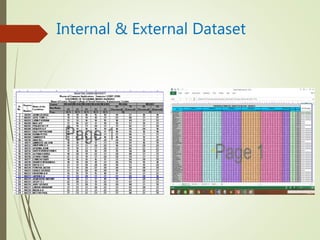
Internal & External Dataset
Data cleaning & preprocessing
 Data cleaning is the step where noise and irrelevant data are
removed from the large data set.
 This is a very important pre-processing step because our
outcome would be dependent on the quality of selected data.
 Remove duplicate records, enter logically correct values for
missing records(absent students), remove unnecessary data
fields and standardize data format.
 There was no much duplicate data or unnecessary data in the
collected record . The dataset was partially cleaned.
 Student internal mark and external mark were stored in
different records.
 By applying data integration these records were integrated
into one record.
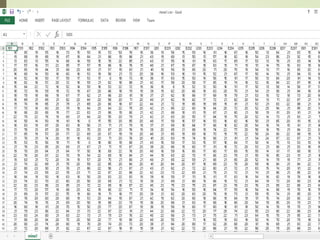
 The new dataset consist of internal mark details and external
mark details of each student in one record.
Data reduction & transformation
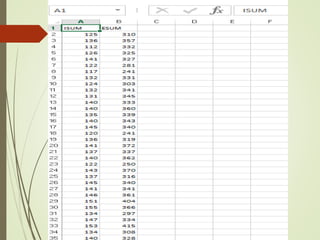
 Data is transformed into appropriate form for making it ready for
data mining step.
 The dataset contains marks of 5 theory paper and 2 lab paper of
all 5 semesters.
 These marks are transformed into sum of internal marks and sum
of external marks of each student for the easiness of analysing
the pattern.
Cluster Analysis
 The data mining technique we used here is clustering.
 A cluster is a collection of data objects that are similar to
one another within same cluster and are dissimilar to
objects in other cluster.
 We first partitioned the set of data into groups based on
data similarity and then assign labels
Choosing functions of data mining
K-MEANS Partitioning
 The K-means algorithm takes input parameter k and
partitions the set of n objects into k clusters.
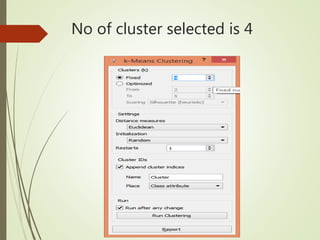
 Here we selected no: of cluster as 4
 Objects are distributed to a cluster based on cluster
center to which it is nearest.
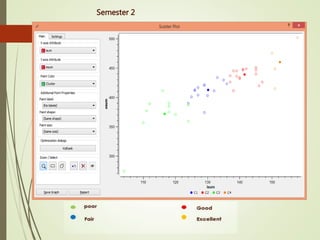
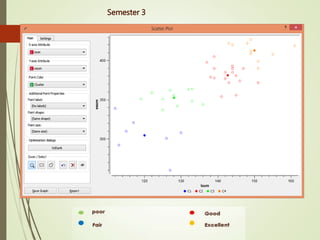
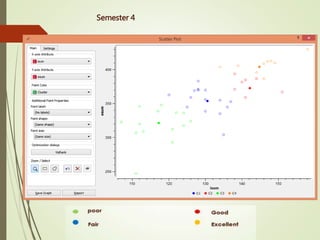
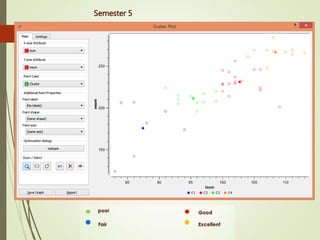
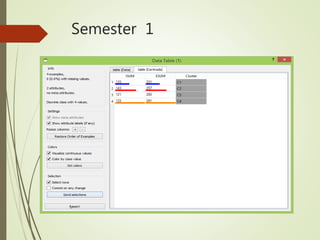
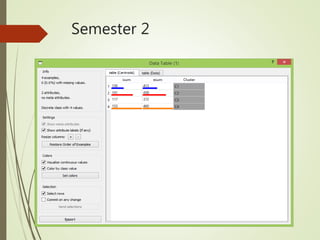
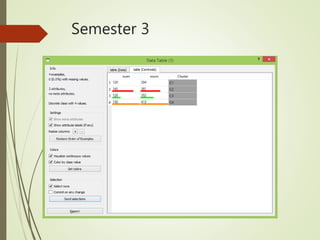
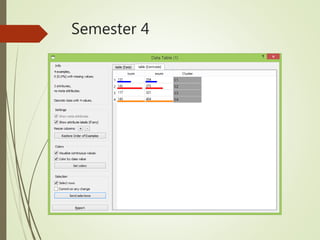
 For each semester we found out the clusters separately
and labeled them as students Excellent, Good, Fair and
Poor
Choosing mining algorithms
The Tool used for pattern evaluation is ORANGE
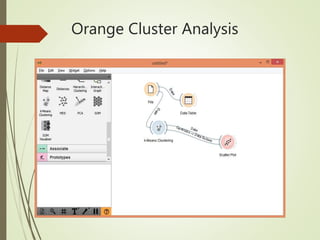
Orange Cluster Analysis
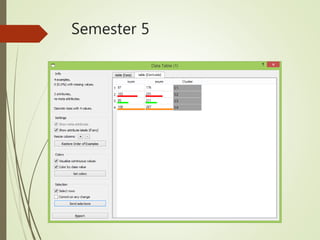
No of cluster selected is 4
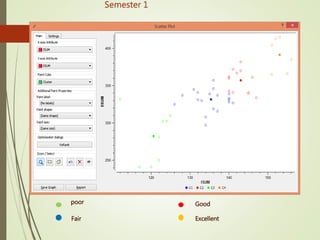
Semester 1
poor
Fair
Good
Excellent
Semester 2
Semester 3
Semester 4
Semester 5
Centroid Analysis
Semester 1
Semester 2
Semester 3
Semester 4
Semester 5
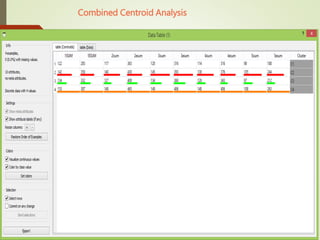
Combined Centroid Analysis
Data mining search for patterns of
interest
 From the mining process we found that “All the 5 semester
clusters followed the same pattern of performance”.
 A student with high internal mark has higher external
marks and a student with less internal marks has less
external marks.
 There is a direct relation between the internal and the
external marks.
 At some case this evaluation is not valid, cases like
 Being absent for internal exam and scoring high marks for
the externals (vice versa)
CONCLUSION
 A students performance in his university exam can be
predicted with the help of his internal marks. There is
a direct relation between the internal and the external
marks.
 A student with low internals will get low marks for
externals too
Use of discovered knowledge
representation
Thank You

Students academic performance using clustering technique

  • 1.
  • 2.
    Introduction..  Our projectaim is to find students academic performance and find out whether there is any general pattern in their marks and performance.  So here ,We are analyzing both internal and external marks of a student.  We did the following KDD preprocessing steps to mine our data.
  • 3.
    Learning the applicationdomain  Learning the application domain is the first step in KDD process .  Need to have a clear understanding about the application domain and our objectives.  The institution considered for mining is MCA batch of Rajagiri College of Social Sciences.  We collected all previous year academic record from the department of computer science
  • 4.
    Create a targetdata set: data selection  We selected 2007-2010 batch marks for analysing the pattern.  There were around 45 records(45 students).  Both the internal and external marks of each student were selected, in order to find out the performance pattern.
  • 5.
  • 6.
    Data cleaning &preprocessing  Data cleaning is the step where noise and irrelevant data are removed from the large data set.  This is a very important pre-processing step because our outcome would be dependent on the quality of selected data.  Remove duplicate records, enter logically correct values for missing records(absent students), remove unnecessary data fields and standardize data format.
  • 7.
     There wasno much duplicate data or unnecessary data in the collected record . The dataset was partially cleaned.  Student internal mark and external mark were stored in different records.  By applying data integration these records were integrated into one record.  The new dataset consist of internal mark details and external mark details of each student in one record.
  • 9.
    Data reduction &transformation  Data is transformed into appropriate form for making it ready for data mining step.  The dataset contains marks of 5 theory paper and 2 lab paper of all 5 semesters.  These marks are transformed into sum of internal marks and sum of external marks of each student for the easiness of analysing the pattern.
  • 11.
    Cluster Analysis  Thedata mining technique we used here is clustering.  A cluster is a collection of data objects that are similar to one another within same cluster and are dissimilar to objects in other cluster.  We first partitioned the set of data into groups based on data similarity and then assign labels Choosing functions of data mining
  • 12.
    K-MEANS Partitioning  TheK-means algorithm takes input parameter k and partitions the set of n objects into k clusters.  Here we selected no: of cluster as 4  Objects are distributed to a cluster based on cluster center to which it is nearest.  For each semester we found out the clusters separately and labeled them as students Excellent, Good, Fair and Poor Choosing mining algorithms
  • 13.
    The Tool usedfor pattern evaluation is ORANGE
  • 14.
  • 15.
    No of clusterselected is 4
  • 16.
  • 17.
  • 18.
  • 19.
  • 20.
  • 21.
  • 22.
  • 23.
  • 24.
  • 25.
  • 26.
  • 27.
  • 28.
    Data mining searchfor patterns of interest  From the mining process we found that “All the 5 semester clusters followed the same pattern of performance”.  A student with high internal mark has higher external marks and a student with less internal marks has less external marks.  There is a direct relation between the internal and the external marks.  At some case this evaluation is not valid, cases like  Being absent for internal exam and scoring high marks for the externals (vice versa)
  • 29.
    CONCLUSION  A studentsperformance in his university exam can be predicted with the help of his internal marks. There is a direct relation between the internal and the external marks.  A student with low internals will get low marks for externals too
  • 30.
    Use of discoveredknowledge representation
  • 31.