Download to read offline
![International Research Journal of Engineering and Technology (IRJET) e-ISSN: 2395-0056
Volume: 05 Issue: 09 | Sep 2018 www.irjet.net p-ISSN: 2395-0072
© 2019, IRJET | Impact Factor value: 7.211 | ISO 9001:2008 Certified Journal | Page 6747
Using Data Mining to Predict Students Performance
Madhumitha S1, Vaishali Roy2, Vinitha B3,Vijayakumar S4
1,2,3Department of Computer Science and Engineering, R.M.K. Engineering College,
Tamil Nadu, India
4Associate Professor, Department of Computer Science and Engineering,
R.M.K. Engineering College, Tamil Nadu, India
Abstract - Educational data mining is used to extract student data from dataset and transform it into a meaningful and useful
structure for further use. In this project, we are using Logistic Regression algorithm to predict student’s performance.Theexisting
system uses decision tree, Naive Bayes algorithms to classify the student data. As the decision tree algorithm makes use of
numerical values to analyse the data, so it is inefficient in prediction. On the other hand, though the Naive Bayes approach uses
textual attributes there exists dependencies among the variables. Hence these algorithms are comparatively inaccurate. The
proposed system uses Logistic Regression which is a statistical method for analysing a dataset in which there are one or more
independent variables that determines an outcome. Individual attributes are also analysed that influences students’ final
performance.
Key Words: Educational Data Mining, dataset, Predict student performance, Logistic Regression.
1. INTRODUCTION
Analyzing the huge amount of data to form useful information is a tedious task for human. Data Mining is the area which
analyses large volume of data to extract necessary or useful information. Computers can process data like texts, images, and
numbers. This performs analysis based on patterns, association, relations in these data to get useful information. The
prediction in students' performance is beneficial as it helps in identifying studentswithlowacademicperformance attheearly
stage of academics. In universities, high students’ performance results in job opportunities for studentsandhelpscollegewith
increased admission rate for the next academic year. The steps to assist the low academic students with better education are:
(a) Generation of data source which consists of predictive variables. (b) Identification of various factors which affects the
performance of student’s learning.
(c) Construction of a prediction model with the help of data mining technique on the basis of predictive variables which were
identified.
(d) Validation of the model. Data Mining can assist in the field of education to extend our understanding of learning process by
identifying variables and evaluating them. Mining in the field of education is known as Educational Data Mining. Students’
attendance in college, hours spent on a daily basis after college, grades, study
hours, family income of the students are significantly relatedtostudentperformance. Bymeansof LogisticRegressionmodel,it
has been found that the factors like attendance and study hours are highly correlatedwiththe performanceofthe student.This
helps us to, increase students’ academic achievements. Students’ performance prediction helps to identify the most effective
factors which work with student’s test score and then tune these factors to make better student test performance.
2. RELATED WORK
J K Jothi and K Venkatalakshmi conducted the students’ performance analysis on the students’ data collected from the
Villupuram college of Engineering and Technology.
The data included five year period and applied clustering methods on the data to overcome the problem of low score of
students, and to increase students’ academic performance [1].
Sheik and Gadage have done the analysis related to the student learning behavior by using different data mining models,
namely classification, clustering, decision tree, pattern mining and text mining [2].
Mythili M S and Shanavas A R applied classification algorithms to analyze and evaluate school students’ performance using
weka. They came with various classification algorithms, namely J48, Random Forest, Multilayer perception, IBI and decision
tree with data collected from the student management system [3].
Suyal and Mohod applied the association and classification rule to identify the students’ performance. They mainly focused to
find students who need special attention to reduce failure rate [4].](https://image.slidesharecdn.com/irjet-v6i3724-190913102106/85/IRJET-Using-Data-Mining-to-Predict-Students-Performance-1-320.jpg)
![International Research Journal of Engineering and Technology (IRJET) e-ISSN: 2395-0056
Volume: 05 Issue: 09 | Sep 2018 www.irjet.net p-ISSN: 2395-0072
© 2019, IRJET | Impact Factor value: 7.211 | ISO 9001:2008 Certified Journal | Page 6747
Using Data Mining to Predict Students Performance
Madhumitha S1, Vaishali Roy2, Vinitha B3,Vijayakumar S4
1,2,3Department of Computer Science and Engineering, R.M.K. Engineering College,
Tamil Nadu, India
4Associate Professor, Department of Computer Science and Engineering,
R.M.K. Engineering College, Tamil Nadu, India
Abstract - Educational data mining is used to extract student data from dataset and transform it into a meaningful and useful
structure for further use. In this project, we are using Logistic Regression algorithm to predict student’s performance.Theexisting
system uses decision tree, Naive Bayes algorithms to classify the student data. As the decision tree algorithm makes use of
numerical values to analyse the data, so it is inefficient in prediction. On the other hand, though the Naive Bayes approach uses
textual attributes there exists dependencies among the variables. Hence these algorithms are comparatively inaccurate. The
proposed system uses Logistic Regression which is a statistical method for analysing a dataset in which there are one or more
independent variables that determines an outcome. Individual attributes are also analysed that influences students’ final
performance.
Key Words: Educational Data Mining, dataset, Predict student performance, Logistic Regression.
1. INTRODUCTION
Analyzing the huge amount of data to form useful information is a tedious task for human. Data Mining is the area which
analyses large volume of data to extract necessary or useful information. Computers can process data like texts, images, and
numbers. This performs analysis based on patterns, association, relations in these data to get useful information. The
prediction in students' performance is beneficial as it helps in identifying studentswithlowacademicperformance attheearly
stage of academics. In universities, high students’ performance results in job opportunities for studentsandhelpscollegewith
increased admission rate for the next academic year. The steps to assist the low academic students with better education are:
(a) Generation of data source which consists of predictive variables. (b) Identification of various factors which affects the
performance of student’s learning.
(c) Construction of a prediction model with the help of data mining technique on the basis of predictive variables which were
identified.
(d) Validation of the model. Data Mining can assist in the field of education to extend our understanding of learning process by
identifying variables and evaluating them. Mining in the field of education is known as Educational Data Mining. Students’
attendance in college, hours spent on a daily basis after college, grades, study
hours, family income of the students are significantly relatedtostudentperformance. Bymeansof LogisticRegressionmodel,it
has been found that the factors like attendance and study hours are highly correlatedwiththe performanceofthe student.This
helps us to, increase students’ academic achievements. Students’ performance prediction helps to identify the most effective
factors which work with student’s test score and then tune these factors to make better student test performance.
2. RELATED WORK
J K Jothi and K Venkatalakshmi conducted the students’ performance analysis on the students’ data collected from the
Villupuram college of Engineering and Technology.
The data included five year period and applied clustering methods on the data to overcome the problem of low score of
students, and to increase students’ academic performance [1].
Sheik and Gadage have done the analysis related to the student learning behavior by using different data mining models,
namely classification, clustering, decision tree, pattern mining and text mining [2].
Mythili M S and Shanavas A R applied classification algorithms to analyze and evaluate school students’ performance using
weka. They came with various classification algorithms, namely J48, Random Forest, Multilayer perception, IBI and decision
tree with data collected from the student management system [3].
Suyal and Mohod applied the association and classification rule to identify the students’ performance. They mainly focused to
find students who need special attention to reduce failure rate [4].](https://image.slidesharecdn.com/irjet-v6i3724-190913102106/75/IRJET-Using-Data-Mining-to-Predict-Students-Performance-1-2048.jpg)
![International Research Journal of Engineering and Technology (IRJET) e-ISSN: 2395-0056
Volume: 05 Issue: 09 | Sep 2018 www.irjet.net p-ISSN: 2395-0072
© 2019, IRJET | Impact Factor value: 7.211 | ISO 9001:2008 Certified Journal | Page 6748
Noah, Barida and Egerton conducted a study to evaluate students’ performance by grouping the grading into various classes
using CGPA. They used different methods like Neural network, Regression and K-means to identify the weak
performers for improving performance [5].
Backer and Yacef conducted a study for identifyingthebestmodel forEDM.Theyanalyzeddata andreachedtheconclusionthat
most of the papers includes prediction than relationship mining [6].
Angeline D M conducted a study on the students’ performance by using Apriori algorithm that extracts set of rules specific to
each category and analyze the knowledge to classify the student based on their involvement in assignment,
internal assessment test, group action etc. It helps to identify the students’ range like average, below average, and good
performance [7].
Remesh, Parkavi, and Yasodha conducted a study on the placement chance prediction byapplyingdifferenttechniquessuchas
Naive Bayes Simple, MultiLayerPerception, SMO, J48, and REPTree by its accuracy. From the result they concluded that
MultiLayerPerception is more suitable than other algorithms [8].
Bhise, Thorat and Supekar suggested a method using K-means clustering algorithm by describingitstep bystep.Thisresearch
focused on reducing drop-out-ratio of the students and improve it by considering the factors like midterm and final exam
assignment. They considered clustering techniques namely hierarchical, partitions, and categorical [9].
ElGamal A F presented a study for predicting students performance ina programmingrelatedcourse.Herethedata iscollected
from the department of computer science from Mansoura University and applied extract rules for predicting students’
performance in programming related course [10].
3. METHODOLOGY
Data mining is the knowledge discovery process from huge volume of data. The mechanism works using data set where the
student performance in the end semester is evaluated.
3.1 Data preparation
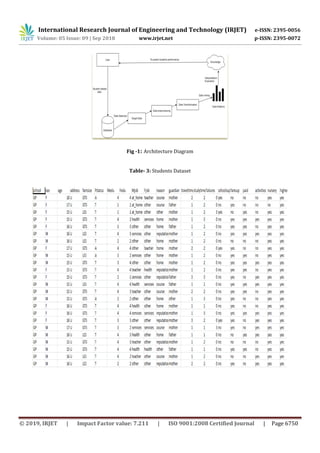
Student related data were collected from a large data set. In this step, data is checked for null values, errors and corrected if
any.
3.2 Data selection and transformation
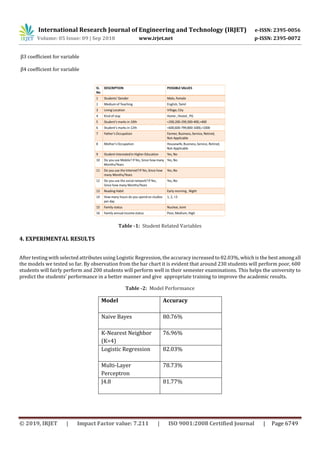
In this step only fields which were necessary for the data mining processwereselected.Thestudent's10th,12th,degreemarks
in each semester, assignment, study hours, parent’s education, income were taken as attribute values for prediction.
3.3 Logistic Regression Algorithm
Logistic regression is a classification method where thedependentvariablecanhaveonlytwopossiblevalues.Whencompared
with linear regression, Logistic Regression is preferred because data plotting shows that it does not suit linear regression
pattern.
The logistic regression equation will be
Π(x) = 1/1+ -y (1)
Where y = β0 + β1X1 + β2X2 + β3X3 + β4X4 and e being Euler’s number
β0 is the constant
β1 is coefficient for variable X1
β2 coefficient for X2](https://image.slidesharecdn.com/irjet-v6i3724-190913102106/85/IRJET-Using-Data-Mining-to-Predict-Students-Performance-2-320.jpg)
![International Research Journal of Engineering and Technology (IRJET) e-ISSN: 2395-0056
Volume: 05 Issue: 09 | Sep 2018 www.irjet.net p-ISSN: 2395-0072
© 2019, IRJET | Impact Factor value: 7.211 | ISO 9001:2008 Certified Journal | Page 6751
Chart -1: Final Grade Distribution
5. CONCLUSION
In this paper, the Logistic Regression is employed for students’ data to predict the students' performance. This study can
facilitate the students and the professors to motivate the students of all categories to perform well. Thisstudyhelps toidentify
students who require special attention, minimize the failure rate and take relevantactiontosucceedintheupcomingsemester
examination.
Future work includes employing big data to help decision makers in education sectortomakebetterandmore intelligent
decision in education big data environment.
REFERENCES
[1] J.K.Jothi and K.Venkatalakshmi, “Intellectual performance analysis of students by using data mining techniques”,
International Journal of Innovative Research in Science, Engineering and Technology, vol 3, Special iss 3, March 2014.
[2] Nikitaben Shelke and Shriniwas Gadage, “A survey of data mining approaches in performance analysis and evaluation”,
International Journal of Advanced Research in Computer Science and Software Engineering , vol 5, iss 4, 2015K.
[3] M.S. Mythili and A.R.Mohamed Shanavas , “An analysis of students’ Performance usingclassificationalgorithms”,IOSR-JCE,
Volume 16, iss1, Jan. 2014.
[4] A.Dinesh Kumar and V.Radhika, “A survey on predicting student performance”, International Journal of Computer Science
and Information Technologies, Vol. 5, 2014.
[5] E. Osmanbegović and M. Suljić, '”Data mining approach for predicting students performance”, Economic Review, vol 10,iss
1, 2012.
[6] Sayali Rajesh Suyal and Mohini Mukund Mohod, “Quality improvisation of student performance using data mining
techniques”,
International Journal of Scientific and Research Publications, vol 4,iss 4, April 2014.
[7] OTOBO Firstman Noah, BAAH Barida and Taylor OnateEgerton,“Evaluationofstudentperformanceusingdata miningover
a given data space”, International Journal of Recent Technology and Engineering
(IJRTE) ISSN: 2277-3878, Volume-2, iss 4, September 2013.
[8] Brijesh Kumar Baradwaj and Saurabh Pal, “Mining educational data to analyze Students’ performance”, (IJACSA)
International Journal of Advanced Computer Science and Applications, Vol. 2, No. 6, 2011.](https://image.slidesharecdn.com/irjet-v6i3724-190913102106/85/IRJET-Using-Data-Mining-to-Predict-Students-Performance-5-320.jpg)
![International Research Journal of Engineering and Technology (IRJET) e-ISSN: 2395-0056
Volume: 05 Issue: 09 | Sep 2018 www.irjet.net p-ISSN: 2395-0072
© 2019, IRJET | Impact Factor value: 7.211 | ISO 9001:2008 Certified Journal | Page 6752
[9] T.Jeevalatha, N. Ananthi and D.Saravana Kumar, “Performance analysis of undergraduate students placement selection
using Decision Tree Algorithms”, International Journal of Computer Applications (0975- 8887), vol 108, December 2012.
[10] Ryan J.D.B.Baker and Kalina Yacef , “The state of educational data mining in 2009: A review and future revisions”, Journal
of Educational
Data Mining , Vol.1,No.1, February 2009.
[11] A.F . ElGamal, “An educational data mining model for predicting student performance in programming course”,
International Journal of
Computer Applications(0975-8887), Vol.70, No.17, May 2013.
[12] D.Magdalene Delighta Angeline, “Association rule generation for student performance analysis using Apriori Algorithm”,
The SIJ Transactions on Computer Science Engineering And Applications(CSEA), vol.1, March-April 2013.
[13] Bhise R.B, Thorat S.S and Supekar A.K, “Importanceofdata mininginhighereducationsystem”,IOSRJournal ofHumanities
and Social
Science, ISSN: 2279-0837, vol.6, iss 6, January-February 2013.
[14] V.Ramesh, P.Parkavi and P.Yasodha, “Performance analysis of data mining techniques for placement chance prediction”,
International Journal of Scientific and Egineering Research , Vol.2, iss 8, August 2011.
[15] Mohammed M.Abu Tair and Alaa M.El-Halees, ‘Mining Educational Data to Improve Students’ Performance: A case
Study’, International journal of information and Communication Technology Research,
ISSN: 2223-4985, vol.2 no.2, February 2012
.](https://image.slidesharecdn.com/irjet-v6i3724-190913102106/85/IRJET-Using-Data-Mining-to-Predict-Students-Performance-6-320.jpg)

This document describes a study that used logistic regression to predict student performance based on educational data. The researchers collected student data including exam scores, attendance, study hours, family income, etc. from a large dataset. Logistic regression achieved the best prediction accuracy of 82.03% compared to other models like naive bayes, K-nearest neighbor, and multi-layer perceptron. The results indicate that around 230 students would perform poorly, 600 would perform fairly, and 200 would perform well based on the predictive model. This analysis can help identify students needing extra support and help universities improve academic outcomes.


