IT Rep Meeting – April 23rd, 2015
Rafael Scapin, Ph.D.
Coordinator of Educational Technology
Dawson College
Learning Analytics in Education:
Using Student’s Big Data to Improve Teaching
• Definitions: What’s Learning Analytics and Big Data ?
• The Importance of Learning Analytics in Education
• What Learning Analytics Can Do and Can Not Do
• Using Learning Analytics in Moodle
• Using the Results to Improve Teaching
• Questions
Content
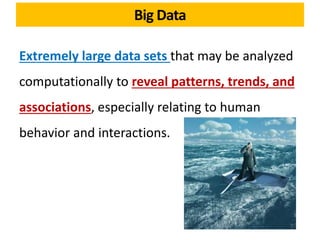
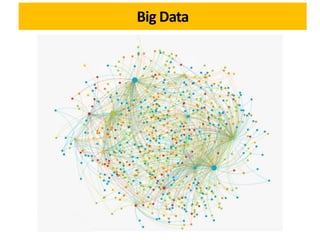
Extremely large data sets that may be analyzed
computationally to reveal patterns, trends, and
associations, especially relating to human
behavior and interactions.
Big Data
Big Data
Big Data
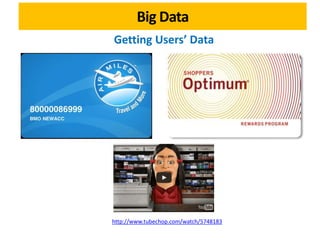
Getting Users’ Data
http://www.tubechop.com/watch/5748183
Big Data
Big Data
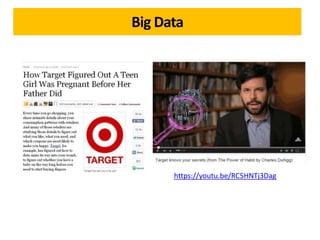
https://youtu.be/RC5HNTj3Dag
Big Data
Big Data
Getting Users’ Data
“Likeosphere”
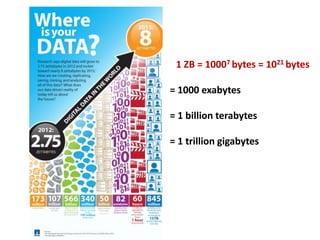
1 ZB = 10007 bytes = 1021 bytes
= 1000 exabytes
= 1 billion terabytes
= 1 trillion gigabytes
Big Data
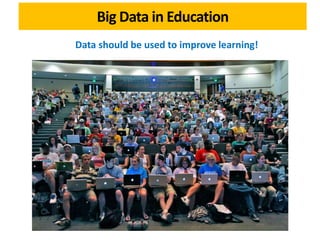
Big Data in Education
Data should be used to improve learning!
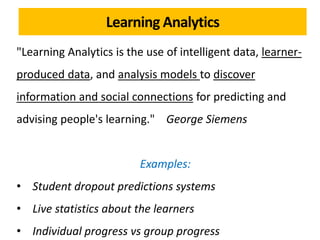
"Learning Analytics is the use of intelligent data, learner-
produced data, and analysis models to discover
information and social connections for predicting and
advising people's learning." George Siemens
Examples:
• Student dropout predictions systems
• Live statistics about the learners
• Individual progress vs group progress
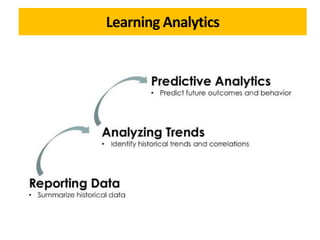
Learning Analytics
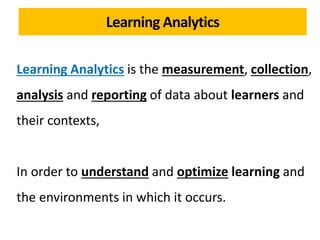
Learning Analytics is the measurement, collection,
analysis and reporting of data about learners and
their contexts,
In order to understand and optimize learning and
the environments in which it occurs.
Learning Analytics
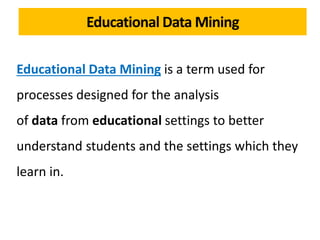
Educational Data Mining is a term used for
processes designed for the analysis
of data from educational settings to better
understand students and the settings which they
learn in.
Educational Data Mining
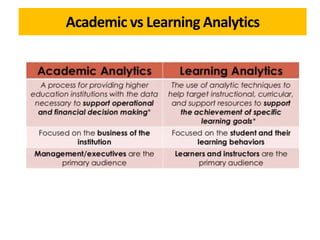
Academic vs Learning Analytics
Learning Analytics
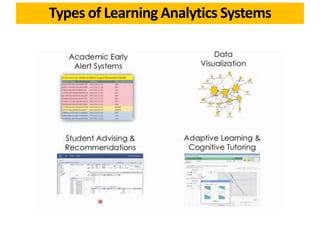
Types of Learning Analytics Systems
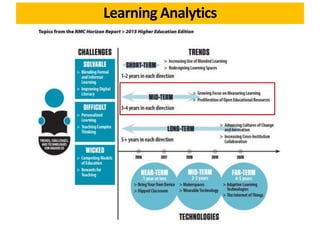
Learning Analytics
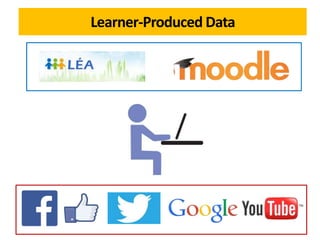
Learner-Produced Data
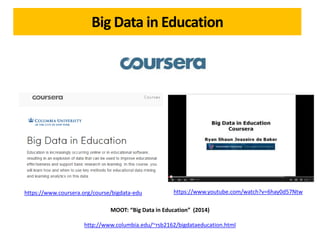
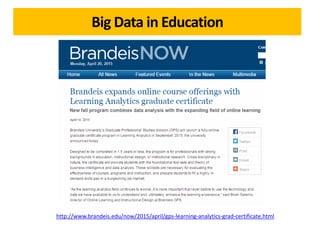
Big Data in Education
https://www.coursera.org/course/bigdata-edu https://www.youtube.com/watch?v=6hay0d57Ntw
MOOT: “Big Data in Education” (2014)
http://www.columbia.edu/~rsb2162/bigdataeducation.html
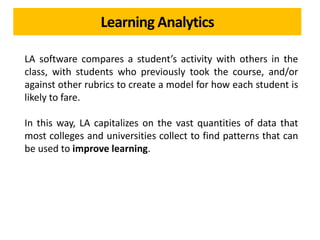
Big Data in Education
http://www.brandeis.edu/now/2015/april/gps-learning-analytics-grad-certificate.html
Learning Analytics
LA software compares a student’s activity with others in the
class, with students who previously took the course, and/or
against other rubrics to create a model for how each student is
likely to fare.
In this way, LA capitalizes on the vast quantities of data that
most colleges and universities collect to find patterns that can
be used to improve learning.
Learning Analytics: What it Can Do?
• Predict future student performance (based on past
patterns of learning across diverse student bodies)
• Intervene when students are struggling to provide
unique feedback tailored to their answers
• Personalize the learning process for each and every
student, playing to their strengths and encouraging
improvement
• Adapt teaching and learning styles via socialization,
pedagogy and technology
Learning Analytics
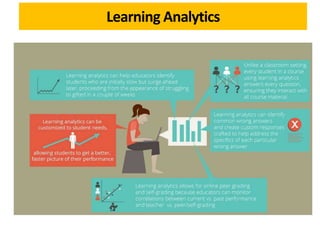
The most common use of learning analytics is to identify
students who appear less likely to succeed academically and to
enable—or even initiate—targeted interventions to help them
achieve better outcomes.
LA tools to identify specific units of study or assignments in a
course that cause students difficulty generally. Instructors can
then make curricular changes or modify learning activities to
improve learning on the part of all students.
Learning Analytics
Much of the data on which LA applications depend
comes from the learning management system (LMS),
including:
• log-in information
• rates of participation in specific activities
• time students spend interacting with online
resources or others in the class,
• grades
Learning Analytics
• Applications that perform data collection and analysis are
frequently either built into or added onto the LMS from
which they draw primary data.
• Analytics tools: tied to their software, built by colleges or
universities or by third parties to work with the LMS.
Learning Analytics
LA applications gather data, analyze that data, generate
reports, and enable interventions. In most cases, this happens
without an opt-in by students.
The types of analyses performed vary, but one approach
involves the evaluation of historical student data to create
predictive models of successful and at-risk students.
Learning Analytics
Reports can take various forms, but most feature data
visualizations designed to facilitate quick understanding of
which students are likely to succeed.
Some systems proactively notify users; other systems require
users to take some action to access the reports.
System-generated interventions can range from a simple alert
about a student’s likelihood of success to requiring at-risk
students to take specific actions to address concerns.
Learning Analytics
Learning Analytics
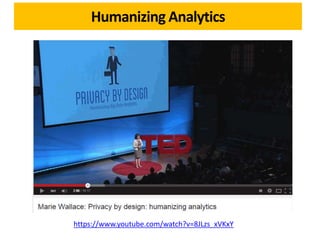
Humanizing Analytics
https://www.youtube.com/watch?v=8JLzs_xVKxY
What Learning Analytics Can’t Do?
Data from tracking systems is not inherently intelligent
Hit counts and access patterns do not really explain
anything.
The intelligence is in the interpretation of the data by a
skilled analyst.
Ideally, data mining enables the visualization of interesting
data that in turn sparks the investigation of apparent
What Learning Analytics Can’t Do?
Another thing analytics can not do by themselves is
improve instruction
While they can point to areas in need of improvement and
they can identify engaging practices, the numbers can not
make suggestion for improvements.
This requires a human intervention – usually in the form of
a focus group or by soliciting suggestions from the learners
themselves.
Learning Analytics Outcomes
• Prediction purposes, for example to identify 'at risk' students
in terms of drop out or course failure
• Personalization & Adaptation, to provide students with
tailored learning pathways, or assessment materials
• Intervention purposes, providing educators with information
to intervene to support students
• Information visualization, typically in the form of so-called
learning dashboards which provide overview learning data
through data visualisation tools
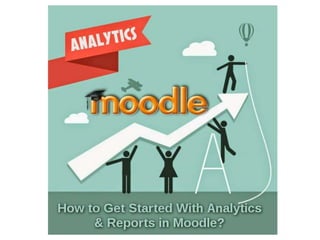
Analytics & Reports in Moodle
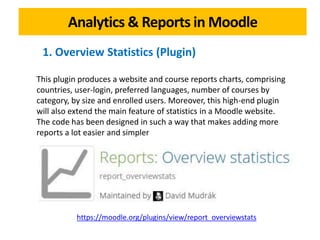
https://moodle.org/plugins/view/report_overviewstats
This plugin produces a website and course reports charts, comprising
countries, user-login, preferred languages, number of courses by
category, by size and enrolled users. Moreover, this high-end plugin
will also extend the main feature of statistics in a Moodle website.
The code has been designed in such a way that makes adding more
reports a lot easier and simpler
1. Overview Statistics (Plugin)
Analytics & Reports in Moodle
https://www.youtube.com/watch?t=35&v=yiJkTDwmIn8
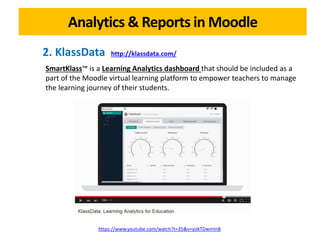
2. KlassData http://klassdata.com/
SmartKlass™ is a Learning Analytics dashboard that should be included as a
part of the Moodle virtual learning platform to empower teachers to manage
the learning journey of their students.
Analytics & Reports in Moodle
A new feature introduced within Moodle 2.8, events
monitoring allows admins and teachers to receive
notification when certain events happen in Moodle.
Watch the events monitor in action here and explore some
event examples.
3. Events Monitoring
Analytics & Reports in Moodle
Moodle administrators have access to a variety of powerful
and useful site-wide reports for learning analytics, including
security, question instances, logs and comments.
More info: site-wide reports
4. Site-Wide Reports
Analytics & Reports in Moodle
Engagement Analytics block provides information about
student progress against a range of indicators and student
activities which have been identified by current research to
have an impact on student success in an online course.
This plugin is not yet supported for Moodle 2.8 and requires
mod and block plugins.
More info: Engagement Analytics plugin
5. Engagement Analytics (Plugin)
Analytics & Reports in Moodle
These activity reports can be viewed by the administrator at
the teacher level, site level and with live logs.
More info: documentation on Logs
6. Logs
Analytics & Reports in Moodle
The Forum Graph Report analyses interactions in a single
Forum activity and create a force-directed graph using the
D3.js Javascript library.
This plugin is not yet supported for Moodle 2.8.
More info: Forum Graph plugin
7. Forum Graph
Analytics & Reports in Moodle
This local Moodle Module adds Analytics, currently supports
3 Analytics modes: Piwik, Google Universal Analytics and
Google Legacy Analytics.
This plugin is not yet supported for Moodle 2.8.
Read more about the plugin here.
8. Analytics (Piwik & Google)
Analytics & Reports in Moodle
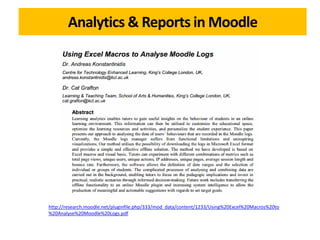
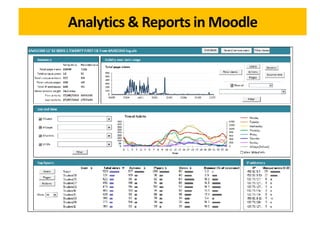
http://research.moodle.net/pluginfile.php/333/mod_data/content/1233/Using%20Excel%20Macros%20to
%20Analyse%20Moodle%20Logs.pdf
Analytics & Reports in Moodle
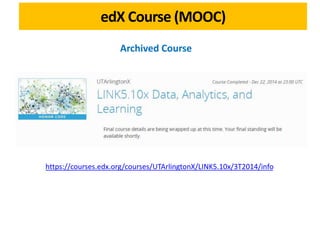
edX Course (MOOC)
Archived Course
https://courses.edx.org/courses/UTArlingtonX/LINK5.10x/3T2014/info
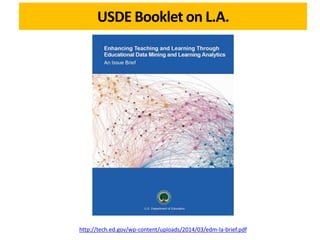
USDE Booklet on L.A.
http://tech.ed.gov/wp-content/uploads/2014/03/edm-la-brief.pdf
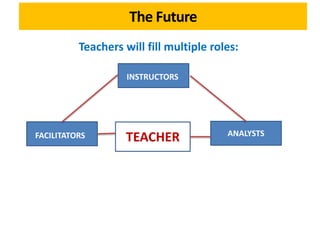
The Future
Teachers will fill multiple roles:
TEACHER
INSTRUCTORS
FACILITATORS ANALYSTS
Questions
rscapin@dawsoncollege.qc.ca
rscapin
DawsonITE Blog
http://dawsonite.dawsoncollege.qc.ca
Contact Me
Rafael Scapin, Ph.D.
Learning Analytics in Education:  Using Student’s Big Data to Improve Teaching

Learning Analytics in Education: Using Student’s Big Data to Improve Teaching

  • 1.
    IT Rep Meeting– April 23rd, 2015 Rafael Scapin, Ph.D. Coordinator of Educational Technology Dawson College Learning Analytics in Education: Using Student’s Big Data to Improve Teaching
  • 2.
    • Definitions: What’sLearning Analytics and Big Data ? • The Importance of Learning Analytics in Education • What Learning Analytics Can Do and Can Not Do • Using Learning Analytics in Moodle • Using the Results to Improve Teaching • Questions Content
  • 3.
    Extremely large datasets that may be analyzed computationally to reveal patterns, trends, and associations, especially relating to human behavior and interactions. Big Data
  • 4.
  • 5.
    Big Data Getting Users’Data http://www.tubechop.com/watch/5748183
  • 6.
  • 7.
  • 8.
  • 9.
    Big Data Getting Users’Data “Likeosphere”
  • 10.
    1 ZB =10007 bytes = 1021 bytes = 1000 exabytes = 1 billion terabytes = 1 trillion gigabytes
  • 11.
  • 12.
    Big Data inEducation Data should be used to improve learning!
  • 13.
    "Learning Analytics isthe use of intelligent data, learner- produced data, and analysis models to discover information and social connections for predicting and advising people's learning." George Siemens Examples: • Student dropout predictions systems • Live statistics about the learners • Individual progress vs group progress Learning Analytics
  • 14.
    Learning Analytics isthe measurement, collection, analysis and reporting of data about learners and their contexts, In order to understand and optimize learning and the environments in which it occurs. Learning Analytics
  • 15.
    Educational Data Miningis a term used for processes designed for the analysis of data from educational settings to better understand students and the settings which they learn in. Educational Data Mining
  • 16.
  • 17.
  • 18.
    Types of LearningAnalytics Systems
  • 19.
  • 20.
  • 21.
    Big Data inEducation https://www.coursera.org/course/bigdata-edu https://www.youtube.com/watch?v=6hay0d57Ntw MOOT: “Big Data in Education” (2014) http://www.columbia.edu/~rsb2162/bigdataeducation.html
  • 22.
    Big Data inEducation http://www.brandeis.edu/now/2015/april/gps-learning-analytics-grad-certificate.html
  • 23.
    Learning Analytics LA softwarecompares a student’s activity with others in the class, with students who previously took the course, and/or against other rubrics to create a model for how each student is likely to fare. In this way, LA capitalizes on the vast quantities of data that most colleges and universities collect to find patterns that can be used to improve learning.
  • 24.
    Learning Analytics: Whatit Can Do? • Predict future student performance (based on past patterns of learning across diverse student bodies) • Intervene when students are struggling to provide unique feedback tailored to their answers • Personalize the learning process for each and every student, playing to their strengths and encouraging improvement • Adapt teaching and learning styles via socialization, pedagogy and technology
  • 25.
    Learning Analytics The mostcommon use of learning analytics is to identify students who appear less likely to succeed academically and to enable—or even initiate—targeted interventions to help them achieve better outcomes. LA tools to identify specific units of study or assignments in a course that cause students difficulty generally. Instructors can then make curricular changes or modify learning activities to improve learning on the part of all students.
  • 26.
    Learning Analytics Much ofthe data on which LA applications depend comes from the learning management system (LMS), including: • log-in information • rates of participation in specific activities • time students spend interacting with online resources or others in the class, • grades
  • 27.
    Learning Analytics • Applicationsthat perform data collection and analysis are frequently either built into or added onto the LMS from which they draw primary data. • Analytics tools: tied to their software, built by colleges or universities or by third parties to work with the LMS.
  • 28.
    Learning Analytics LA applicationsgather data, analyze that data, generate reports, and enable interventions. In most cases, this happens without an opt-in by students. The types of analyses performed vary, but one approach involves the evaluation of historical student data to create predictive models of successful and at-risk students.
  • 29.
    Learning Analytics Reports cantake various forms, but most feature data visualizations designed to facilitate quick understanding of which students are likely to succeed. Some systems proactively notify users; other systems require users to take some action to access the reports. System-generated interventions can range from a simple alert about a student’s likelihood of success to requiring at-risk students to take specific actions to address concerns.
  • 30.
  • 31.
  • 32.
  • 33.
    What Learning AnalyticsCan’t Do? Data from tracking systems is not inherently intelligent Hit counts and access patterns do not really explain anything. The intelligence is in the interpretation of the data by a skilled analyst. Ideally, data mining enables the visualization of interesting data that in turn sparks the investigation of apparent
  • 34.
    What Learning AnalyticsCan’t Do? Another thing analytics can not do by themselves is improve instruction While they can point to areas in need of improvement and they can identify engaging practices, the numbers can not make suggestion for improvements. This requires a human intervention – usually in the form of a focus group or by soliciting suggestions from the learners themselves.
  • 35.
    Learning Analytics Outcomes •Prediction purposes, for example to identify 'at risk' students in terms of drop out or course failure • Personalization & Adaptation, to provide students with tailored learning pathways, or assessment materials • Intervention purposes, providing educators with information to intervene to support students • Information visualization, typically in the form of so-called learning dashboards which provide overview learning data through data visualisation tools
  • 37.
    Analytics & Reportsin Moodle https://moodle.org/plugins/view/report_overviewstats This plugin produces a website and course reports charts, comprising countries, user-login, preferred languages, number of courses by category, by size and enrolled users. Moreover, this high-end plugin will also extend the main feature of statistics in a Moodle website. The code has been designed in such a way that makes adding more reports a lot easier and simpler 1. Overview Statistics (Plugin)
  • 38.
    Analytics & Reportsin Moodle https://www.youtube.com/watch?t=35&v=yiJkTDwmIn8 2. KlassData http://klassdata.com/ SmartKlass™ is a Learning Analytics dashboard that should be included as a part of the Moodle virtual learning platform to empower teachers to manage the learning journey of their students.
  • 39.
    Analytics & Reportsin Moodle A new feature introduced within Moodle 2.8, events monitoring allows admins and teachers to receive notification when certain events happen in Moodle. Watch the events monitor in action here and explore some event examples. 3. Events Monitoring
  • 40.
    Analytics & Reportsin Moodle Moodle administrators have access to a variety of powerful and useful site-wide reports for learning analytics, including security, question instances, logs and comments. More info: site-wide reports 4. Site-Wide Reports
  • 41.
    Analytics & Reportsin Moodle Engagement Analytics block provides information about student progress against a range of indicators and student activities which have been identified by current research to have an impact on student success in an online course. This plugin is not yet supported for Moodle 2.8 and requires mod and block plugins. More info: Engagement Analytics plugin 5. Engagement Analytics (Plugin)
  • 42.
    Analytics & Reportsin Moodle These activity reports can be viewed by the administrator at the teacher level, site level and with live logs. More info: documentation on Logs 6. Logs
  • 43.
    Analytics & Reportsin Moodle The Forum Graph Report analyses interactions in a single Forum activity and create a force-directed graph using the D3.js Javascript library. This plugin is not yet supported for Moodle 2.8. More info: Forum Graph plugin 7. Forum Graph
  • 44.
    Analytics & Reportsin Moodle This local Moodle Module adds Analytics, currently supports 3 Analytics modes: Piwik, Google Universal Analytics and Google Legacy Analytics. This plugin is not yet supported for Moodle 2.8. Read more about the plugin here. 8. Analytics (Piwik & Google)
  • 45.
    Analytics & Reportsin Moodle http://research.moodle.net/pluginfile.php/333/mod_data/content/1233/Using%20Excel%20Macros%20to %20Analyse%20Moodle%20Logs.pdf
  • 46.
  • 47.
    edX Course (MOOC) ArchivedCourse https://courses.edx.org/courses/UTArlingtonX/LINK5.10x/3T2014/info
  • 48.
    USDE Booklet onL.A. http://tech.ed.gov/wp-content/uploads/2014/03/edm-la-brief.pdf
  • 49.
    The Future Teachers willfill multiple roles: TEACHER INSTRUCTORS FACILITATORS ANALYSTS
  • 50.
  • 51.