









Attendance and Student
Performance
Action Research Project
MEL 550
Cindy Paynter
Introduction/Rationale
“Common sense and research suggest that attending school regularly is important to ensuring
children develop a strong foundation for subsequent learning. During the early elementary
years, children are gaining basic social and academic skills critical to ongoing academic success.
Unless students attain these essential skills by third grade, they often require extra help to
catch up and are at grave risk of eventually dropping out of school. Moreover, when chronic
absence occurs (missing 10% – nearly a month – or more of school over the course of a year
counting both excused and unexcused absences), everyone pays. The educational experiences
of children who attend school regularly can be diminished when teachers must divert their
attention to meet the learning and social needs of children who miss substantial amounts of
school.”(Present, Engaged and Accounted for)
Research Question
• Do students with higher rates of absenteeism show
lower performance on high stakes testing?
• What approaches can be taken to improve student
attendance?
Background
• One of 18 schools in the Logan County School system.
• Total enrollment of 469 students in grades 5-8.
• Man, WV is a rural area located in the Southern West Virginia coal fields the current unemployment rate
is around 10%
• 56% of its students coming from low income families
• Students with disabilities and or IEP’s is around 9%.
• The current attendance rate is 95% with an average class size of 22 students.
• In Accordance to the ESEA flexibility waiver and the West Accountability Index and Annual Targets,
Man Middle School has been designated as a Support School. Indicating that progress on both index
and a majority of subgroups was not on target. Man Middle received a total score of 33.93 out of a
possible 100.
Literature Review
“A growing consensus of research points to chronic
absence—defined by the national policy group Attendance
Counts as missing 10 percent of school or more—as one
of the strongest and most often overlooked indicators of a
student’s risk of becoming disengaged, failing courses, and
eventually dropping out of school.”
The Critical Importance of Addressing Chronic Absence in the Early Grades, written
by Hedy Chang and Maria José Romero (2008) states that:
“schools often track average daily attendance or
unexcused absences (truancy), but few monitor the
combination of excused and unexcused absence for
individual students. High overall school-wide attendance
rates can easily mask significant numbers of chronically
absent students.”
• Current laws only require schools to keep a record of daily attendance rates which can be somewhat
misleading. For example, Man Middle School has a 95% attendance rate, with a student enrollment
of 469 students. This means that on average there are 24 students absent daily. If you look at that
information for a year, you have 4,320 absences. Which should indicate a potential problem.
• If these students have chronic attendance issues, they will eventually have learning
gaps that will make it challenging if not impossible for these kids to catch up. This
can affect the educational process for all students because teachers are spending
most of their time focusing on students with these learning gaps.
• Our school districts need to realize that student absences can stem from several issues
include health care, poor living conditions, parent work schedules, poor parenting skills,
or other issues that may be out of the student’s control.
“Improving attendance and reducing chronic absence is not rocket science, but
it does take commitment, collaboration, and tailored approaches to the
particular challenges and strengths of each school community. Schools,
communities, and advocates across the nation have successfully taken steps to
ensure children are attending school more regularly.”
The attendance works organization in an attempt to help schools across
the Nation succeed in their efforts of improving attendance, have
identified the key strategies for reducing chronic absences and the key
ingredients for systematic change. The organization states that using
these strategies simultaneously will drastically improve student
attendance.
Key Strategies for Reducing Chronic Absences
• Recognize Good and Improved Attendance
• Engage Students and Parents
• Monitor Attendance Data and Practice
• Provide Personalized Early Outreach
• Develop Programmatic Response to Barriers.
• Positive Messaging
• Actionable Data
• Capacity Building
• Shared Accountability.
Key Ingredients for Systematic Change
The data used for this research was collected from the 2012, 5th grade class at Man Middle School.
This class consisted of 93 students, 6% of these students received special education services.
The 93 students were divided into two groups by attendance.
Group 1
Missed 18 or more days of school
25 students
Total number of absences of 648 days.
Group 2
Missed less than 7.5 days of school
25 students
Total number of absences of 87.5.
The Math, Science, Social Studies, and RLA scores for each student was collected and divided into the performance level
descriptors from the Westest. Novice, Partial Mastery, Mastery, Above Mastery, Distinguished.
Method/Data Collection
Data Analysis
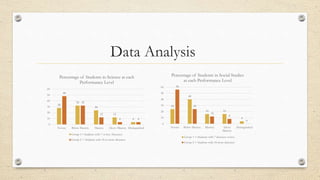
28
32
24
12
4
48
32
12
4 4
0
10
20
30
40
50
60
Novice Below Mastery Mastery Above Mastery Distinguished
Percentage of Students in Science at each
Performance Level
Group 1= Students with 7 or less Absences
Group 2 = Students with 18 or more absences
24
40
16 16
4
56
24
12
8
0
0
10
20
30
40
50
60
Novice Below Mastery Mastery Above
Mastery
Distinguished
Percentage of Students in Social Studies
at each Performance Level
Group 1 = Students with 7 absences or less
Group 2 = Students with 18 more absences
Analysis/Discussion
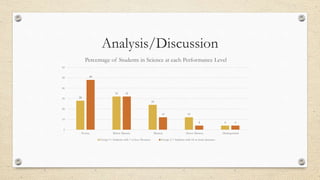
28
32
24
12
4
48
32
12
4 4
0
10
20
30
40
50
60
Novice Below Mastery Mastery Above Mastery Distinguished
Percentage of Students in Science at each Performance Level
Group 1= Students with 7 or less Absences Group 2 = Students with 18 or more absences
Questions/Future Studies
The data shows a moderate correlation between attendance and
student performance. So, in conclusion attendance does affect
student performance and Man Middle School will need to work
with stakeholders on implementing strategies that will improve
student attendance. In the future, I would like to broaden the
study to track students over a couple of years to identify
students who truly have chronic attendance issues and see if the
correlation between attendance and performance increases.
Works Cited
"Attendance Works." Attendance Works. N.p., n.d. Web. 11 Dec.
2013. <http://www.attendanceworks.org/>.
"Present, Engaged, and Accounted for." NCCP. N.p., n.d. Web.
11 Dec. 2013.
<http://www.nccp.org/publications/pub_837.html>.
"Spurred By Statistics." Edweek. Vol. 30, Issue 06, Pages 1,12-
13, 1 Oct. 2010. Web. 15 Oct. 2013.
<http://www.edweek.org/ew/articles/2010/10/01/06absent
eeism_ep.h30.html?tkn=YMNFCRBmmfu5Ibx5Bc777lr0J
IaHvSHobwtn&print=1>.
"What Works." Attendance Works. N.p., n.d. Web. 15 Oct. 2013.
<http://www.attendanceworks.org/what-works/>.
MLA formatting by BibMe.org.

Attendance and student performance arp (1)

  • 1.
    Attendance and Student Performance ActionResearch Project MEL 550 Cindy Paynter
  • 2.
    Introduction/Rationale “Common sense andresearch suggest that attending school regularly is important to ensuring children develop a strong foundation for subsequent learning. During the early elementary years, children are gaining basic social and academic skills critical to ongoing academic success. Unless students attain these essential skills by third grade, they often require extra help to catch up and are at grave risk of eventually dropping out of school. Moreover, when chronic absence occurs (missing 10% – nearly a month – or more of school over the course of a year counting both excused and unexcused absences), everyone pays. The educational experiences of children who attend school regularly can be diminished when teachers must divert their attention to meet the learning and social needs of children who miss substantial amounts of school.”(Present, Engaged and Accounted for)
  • 3.
    Research Question • Dostudents with higher rates of absenteeism show lower performance on high stakes testing? • What approaches can be taken to improve student attendance?
  • 4.
    Background • One of18 schools in the Logan County School system. • Total enrollment of 469 students in grades 5-8. • Man, WV is a rural area located in the Southern West Virginia coal fields the current unemployment rate is around 10% • 56% of its students coming from low income families • Students with disabilities and or IEP’s is around 9%. • The current attendance rate is 95% with an average class size of 22 students. • In Accordance to the ESEA flexibility waiver and the West Accountability Index and Annual Targets, Man Middle School has been designated as a Support School. Indicating that progress on both index and a majority of subgroups was not on target. Man Middle received a total score of 33.93 out of a possible 100.
  • 5.
    Literature Review “A growingconsensus of research points to chronic absence—defined by the national policy group Attendance Counts as missing 10 percent of school or more—as one of the strongest and most often overlooked indicators of a student’s risk of becoming disengaged, failing courses, and eventually dropping out of school.”
  • 6.
    The Critical Importanceof Addressing Chronic Absence in the Early Grades, written by Hedy Chang and Maria José Romero (2008) states that: “schools often track average daily attendance or unexcused absences (truancy), but few monitor the combination of excused and unexcused absence for individual students. High overall school-wide attendance rates can easily mask significant numbers of chronically absent students.”
  • 7.
    • Current lawsonly require schools to keep a record of daily attendance rates which can be somewhat misleading. For example, Man Middle School has a 95% attendance rate, with a student enrollment of 469 students. This means that on average there are 24 students absent daily. If you look at that information for a year, you have 4,320 absences. Which should indicate a potential problem. • If these students have chronic attendance issues, they will eventually have learning gaps that will make it challenging if not impossible for these kids to catch up. This can affect the educational process for all students because teachers are spending most of their time focusing on students with these learning gaps. • Our school districts need to realize that student absences can stem from several issues include health care, poor living conditions, parent work schedules, poor parenting skills, or other issues that may be out of the student’s control.
  • 8.
    “Improving attendance andreducing chronic absence is not rocket science, but it does take commitment, collaboration, and tailored approaches to the particular challenges and strengths of each school community. Schools, communities, and advocates across the nation have successfully taken steps to ensure children are attending school more regularly.” The attendance works organization in an attempt to help schools across the Nation succeed in their efforts of improving attendance, have identified the key strategies for reducing chronic absences and the key ingredients for systematic change. The organization states that using these strategies simultaneously will drastically improve student attendance.
  • 9.
    Key Strategies forReducing Chronic Absences • Recognize Good and Improved Attendance • Engage Students and Parents • Monitor Attendance Data and Practice • Provide Personalized Early Outreach • Develop Programmatic Response to Barriers.
  • 10.
    • Positive Messaging •Actionable Data • Capacity Building • Shared Accountability. Key Ingredients for Systematic Change
  • 11.
    The data usedfor this research was collected from the 2012, 5th grade class at Man Middle School. This class consisted of 93 students, 6% of these students received special education services. The 93 students were divided into two groups by attendance. Group 1 Missed 18 or more days of school 25 students Total number of absences of 648 days. Group 2 Missed less than 7.5 days of school 25 students Total number of absences of 87.5. The Math, Science, Social Studies, and RLA scores for each student was collected and divided into the performance level descriptors from the Westest. Novice, Partial Mastery, Mastery, Above Mastery, Distinguished. Method/Data Collection
  • 12.
    Data Analysis 28 32 24 12 4 48 32 12 4 4 0 10 20 30 40 50 60 NoviceBelow Mastery Mastery Above Mastery Distinguished Percentage of Students in Science at each Performance Level Group 1= Students with 7 or less Absences Group 2 = Students with 18 or more absences 24 40 16 16 4 56 24 12 8 0 0 10 20 30 40 50 60 Novice Below Mastery Mastery Above Mastery Distinguished Percentage of Students in Social Studies at each Performance Level Group 1 = Students with 7 absences or less Group 2 = Students with 18 more absences
  • 13.
    Analysis/Discussion 28 32 24 12 4 48 32 12 4 4 0 10 20 30 40 50 60 Novice BelowMastery Mastery Above Mastery Distinguished Percentage of Students in Science at each Performance Level Group 1= Students with 7 or less Absences Group 2 = Students with 18 or more absences
  • 14.
    Questions/Future Studies The datashows a moderate correlation between attendance and student performance. So, in conclusion attendance does affect student performance and Man Middle School will need to work with stakeholders on implementing strategies that will improve student attendance. In the future, I would like to broaden the study to track students over a couple of years to identify students who truly have chronic attendance issues and see if the correlation between attendance and performance increases.
  • 15.
    Works Cited "Attendance Works."Attendance Works. N.p., n.d. Web. 11 Dec. 2013. <http://www.attendanceworks.org/>. "Present, Engaged, and Accounted for." NCCP. N.p., n.d. Web. 11 Dec. 2013. <http://www.nccp.org/publications/pub_837.html>. "Spurred By Statistics." Edweek. Vol. 30, Issue 06, Pages 1,12- 13, 1 Oct. 2010. Web. 15 Oct. 2013. <http://www.edweek.org/ew/articles/2010/10/01/06absent eeism_ep.h30.html?tkn=YMNFCRBmmfu5Ibx5Bc777lr0J IaHvSHobwtn&print=1>. "What Works." Attendance Works. N.p., n.d. Web. 15 Oct. 2013. <http://www.attendanceworks.org/what-works/>. MLA formatting by BibMe.org.