Abstract:
Machine Learning (ML) is expected, in the near future, to provide various venues and effective
tools to improve education in general, and Science-Technology-Engineering- Mathematics
(STEM) education in particular. The Gartner Analytics Ascendancy Model requires the use of
four types of data analytics to be considered comprehensive: descriptive, diagnostic, predictive
and prescriptive data analytics. This paper presents the outcomes of a research and development
project at Bradley University (Peoria, IL, USA) aimed at the setup and benchmarking of eight
ML algorithms for predictive learning analytics, specifically, a prediction of student academic
performance in a course. The analyzed and tested ML algorithms include linear regression,
logistic regression, k- nearest neighbor classification, naïve Bayes classification, artificial
neural network regression and classification, decision tree classification, random forest
classification, and support vector machine classification. Based on the obtained accuracy of
the analyzed and tested ML algorithms, we have formulated a set of recommendations for faculty
and practitioners in terms of selection, setup and utilization of ML algorithms in predictive
analytics in STEM education. We also performed formative and summative surveys of
undergraduate and graduate students in Computer Science and Computer Information Systems
courses to understand their opinion about utilization of ML-based predictive analytics in
education; a summary of obtained student feedback is presented in this paper.
Existing System:
Predicting student’s performance becomes more challenging due to the large volume of data in
educational databases. Currently in Malaysia, the lack of existing system to analyze and monitor
the student progress and performance is not being addressed. There are two main reasons of why
this is happening. First, the study on existing prediction methods is still insufficient to identify
the most suitable methods for predicting the performance of students in Malaysian institutions.
Second is due to the lack of investigations on the factors affecting student’s achievements in
particular courses within Malaysian context. Therefore, a systematical literature review on
predicting student performance by using ML techniques is proposed to improve student’s
achievements.
Proposed System:
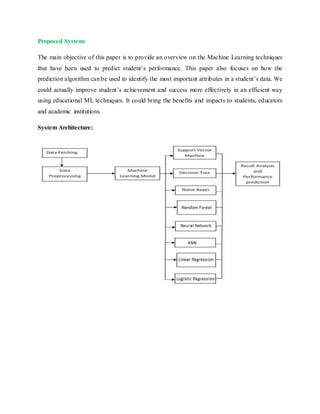
The main objective of this paper is to provide an overview on the Machine Learning techniques
that have been used to predict student’s performance. This paper also focuses on how the
prediction algorithm can be used to identify the most important attributes in a student’s data. We
could actually improve student’s achievement and success more effectively in an efficient way
using educational ML techniques. It could bring the benefits and impacts to students, educators
and academic institutions.
System Architecture:
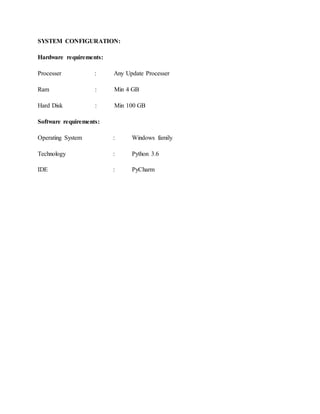
SYSTEM CONFIGURATION:
Hardware requirements:
Processer : Any Update Processer
Ram : Min 4 GB
Hard Disk : Min 100 GB
Software requirements:
Operating System : Windows family
Technology : Python 3.6
IDE : PyCharm

machine learning based predictive analytics of student academic performance in stem education

  • 1.
    Abstract: Machine Learning (ML)is expected, in the near future, to provide various venues and effective tools to improve education in general, and Science-Technology-Engineering- Mathematics (STEM) education in particular. The Gartner Analytics Ascendancy Model requires the use of four types of data analytics to be considered comprehensive: descriptive, diagnostic, predictive and prescriptive data analytics. This paper presents the outcomes of a research and development project at Bradley University (Peoria, IL, USA) aimed at the setup and benchmarking of eight ML algorithms for predictive learning analytics, specifically, a prediction of student academic performance in a course. The analyzed and tested ML algorithms include linear regression, logistic regression, k- nearest neighbor classification, naïve Bayes classification, artificial neural network regression and classification, decision tree classification, random forest classification, and support vector machine classification. Based on the obtained accuracy of the analyzed and tested ML algorithms, we have formulated a set of recommendations for faculty and practitioners in terms of selection, setup and utilization of ML algorithms in predictive analytics in STEM education. We also performed formative and summative surveys of undergraduate and graduate students in Computer Science and Computer Information Systems courses to understand their opinion about utilization of ML-based predictive analytics in education; a summary of obtained student feedback is presented in this paper. Existing System: Predicting student’s performance becomes more challenging due to the large volume of data in educational databases. Currently in Malaysia, the lack of existing system to analyze and monitor the student progress and performance is not being addressed. There are two main reasons of why this is happening. First, the study on existing prediction methods is still insufficient to identify the most suitable methods for predicting the performance of students in Malaysian institutions. Second is due to the lack of investigations on the factors affecting student’s achievements in particular courses within Malaysian context. Therefore, a systematical literature review on predicting student performance by using ML techniques is proposed to improve student’s achievements.
  • 2.
    Proposed System: The mainobjective of this paper is to provide an overview on the Machine Learning techniques that have been used to predict student’s performance. This paper also focuses on how the prediction algorithm can be used to identify the most important attributes in a student’s data. We could actually improve student’s achievement and success more effectively in an efficient way using educational ML techniques. It could bring the benefits and impacts to students, educators and academic institutions. System Architecture:
  • 3.
    SYSTEM CONFIGURATION: Hardware requirements: Processer: Any Update Processer Ram : Min 4 GB Hard Disk : Min 100 GB Software requirements: Operating System : Windows family Technology : Python 3.6 IDE : PyCharm