Photooxidation and
Photoreduction
Reactions
RABIA AZIZ
BS-IV ORGANIC CHEMISTRY
MOLECULAR ORBITAL SYMMETRY AND
ORGANIC REACTIONS
JINNAH UNIVERSITY FOR WOMEN
Introduction
• Photochemistry : The study of chemical reactions,
isomerizations and physical behavior that may occur under
the influence of visible and/or ultraviolet light is called
Photochemistry.
Laws:
• The first law of photochemistry, the Grotthuss-Draper
law, states that light must be absorbed by a compound in
order for a photochemical reaction to take place.
• The second law of photochemistry, the Stark-Einstein
law, states that for each photon of light absorbed by a
chemical system, only one molecule is activated for
subsequent reaction. This "photoequivalence law" was
derived by Albert Einstein during his development of the
quantum (photon) theory of light.
Quantum Yield:
• "The number of moles of a stated reactant disappearing, or
the number of moles of a stated product produced, per
Einstein of monochromatic light absorbed.” where an
Einstein is one mole of photons.
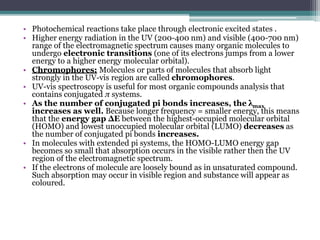
• Photochemical reactions take place through electronic excited states .
• Higher energy radiation in the UV (200-400 nm) and visible (400-700 nm)
range of the electromagnetic spectrum causes many organic molecules to
undergo electronic transitions (one of its electrons jumps from a lower
energy to a higher energy molecular orbital).
• Chromophores: Molecules or parts of molecules that absorb light
strongly in the UV-vis region are called chromophores.
• UV-vis spectroscopy is useful for most organic compounds analysis that
contains conjugated π systems.
• As the number of conjugated pi bonds increases, the λmax
increases as well. Because longer frequency = smaller energy, this means
that the energy gap ΔE between the highest-occupied molecular orbital
(HOMO) and lowest unoccupied molecular orbital (LUMO) decreases as
the number of conjugated pi bonds increases.
• In molecules with extended pi systems, the HOMO-LUMO energy gap
becomes so small that absorption occurs in the visible rather then the UV
region of the electromagnetic spectrum.
• If the electrons of molecule are loosely bound as in unsaturated compound.
Such absorption may occur in visible region and substance will appear as
coloured.
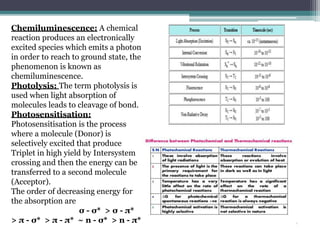
Chemiluminescence: A chemical
reaction produces an electronically
excited species which emits a photon
in order to reach to ground state, the
phenomenon is known as
chemiluminescence.
Photolysis: The term photolysis is
used when light absorption of
molecules leads to cleavage of bond.
Photosensitisation:
Photosensitisation is the process
where a molecule (Donor) is
selectively excited that produce
Triplet in high yield by Intersystem
crossing and then the energy can be
transferred to a second molecule
(Acceptor).
The order of decreasing energy for
the absorption are
σ - σ* > σ - π*
> π - σ* > π - π* ~ n - σ* > n - π*
Photochemical Name Reactions
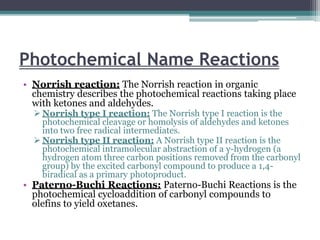
• Norrish reaction: The Norrish reaction in organic
chemistry describes the photochemical reactions taking place
with ketones and aldehydes.
 Norrish type I reaction: The Norrish type I reaction is the
photochemical cleavage or homolysis of aldehydes and ketones
into two free radical intermediates.
 Norrish type II reaction: A Norrish type II reaction is the
photochemical intramolecular abstraction of a γ-hydrogen (a
hydrogen atom three carbon positions removed from the carbonyl
group) by the excited carbonyl compound to produce a 1,4-
biradical as a primary photoproduct.
• Paterno-Buchi Reactions: Paterno-Buchi Reactions is the
photochemical cycloaddition of carbonyl compounds to
olefins to yield oxetanes.
Photochemical Reaction Types
1. Photoreduction
• Photoreduction is defined as the addition of
one or more electrons to a photoexcited
species or the photochemical
hydrogenation of a substance.
2. Photooxidation
• Photooxidation refers to the loss of one or
more electrons from a species as a result of
photoexcitation. This can also refer to the
reaction of a species with molecular oxygen
as a result of light irradiation.
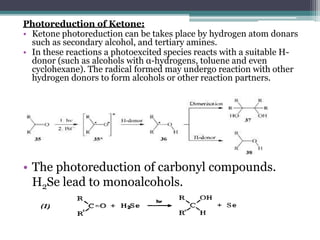
Photoreduction of Ketone:
• Ketone photoreduction can be takes place by hydrogen atom donars
such as secondary alcohol, and tertiary amines.
• In these reactions a photoexcited species reacts with a suitable H-
donor (such as alcohols with α-hydrogens, toluene and even
cyclohexane). The radical formed may undergo reaction with other
hydrogen donors to form alcohols or other reaction partners.
• The photoreduction of carbonyl compounds.
H2Se lead to monoalcohols.
Photoreduction of Aromatic
Hydrocarbons
• Many hydrocarbons benzene, biphenyl,
naphthalene and anthracene react with amine to
give reduction products.
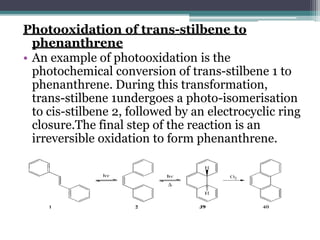
Photooxidation of trans-stilbene to
phenanthrene
• An example of photooxidation is the
photochemical conversion of trans-stilbene 1 to
phenanthrene. During this transformation,
trans-stilbene 1undergoes a photo-isomerisation
to cis-stilbene 2, followed by an electrocyclic ring
closure.The final step of the reaction is an
irreversible oxidation to form phenanthrene.
Photooxidation and
Photoreduction Reactions
in Organic Synthesis
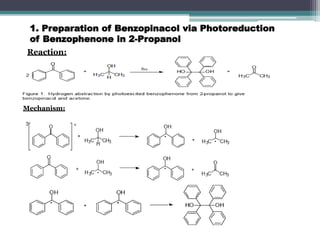
Mechanism:
Reaction:
1. Preparation of Benzopinacol via Photoreduction
of Benzophenone in 2-Propanol
Procedure:
1. Prepare a solution of benzophenone (0.8 g, 4.36 mmol), 2-propanol (8 mL,
104 mmol) and glacial acetic acid (1 drop) in a test tube. In order to achieve
complete dissolution, gentle heating in a water bath is required.
2. Tightly stopper the test tube using either a cork which is then wrapped in
parafilm, or a rubber stopper/septa.It is important that the solution not
come into direct contact with the rubber as it may leach out some
compounds which can quench benzophenone excited states.
3. Place the test tube in the Luzchem photoreactor using all 10 lamps and
irradiate until the amount of solid which has precipitated from solution
does not change (2.5-3hours).
4. After the irradiation, cool the test tube in an ice-bath to precipitate more of
the solid. Collect the solid by suction filtration and wash with 1 mL of cold
2-propanol. Allow the solid to air dry. Weigh the solid and determine the
percent yield for the reaction.
5. Take the melting point, infrared spectrum and 1H NMR spectrum of your
sample, an authentic sample of benzopinacol, and that of the starting
material, benzophenone.
6. Weigh the remaining amount of solid and then recrystallize by dissolving in
a minimum amount of methylene chloride and adding petroleum ether
until the solution becomes cloudy. Allow the solution to cool to room
temperature, then cool in an ice-bath. Collect the solid and weigh it as
described in Step 4.
2. CdIn2S4 photocatalyst for selective
photosynthesis of organic aromatic
compounds under visible light
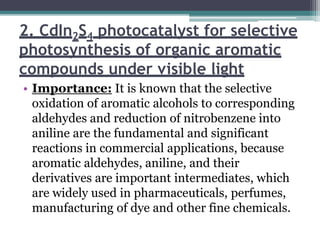
• Importance: It is known that the selective
oxidation of aromatic alcohols to corresponding
aldehydes and reduction of nitrobenzene into
aniline are the fundamental and significant
reactions in commercial applications, because
aromatic aldehydes, aniline, and their
derivatives are important intermediates, which
are widely used in pharmaceuticals, perfumes,
manufacturing of dye and other fine chemicals.
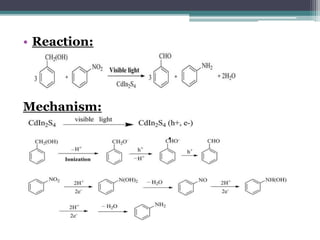
• Reaction:
Mechanism:
Advantages:
• When the irradiation time is 2 h, the conversion,
yield, and selectivity is 80.2%, 80.0%, and 99%,
respectively.
• CdIn2S4 photocatalyst is relatively stable and can
be used repeatedly through cyclic experiments.
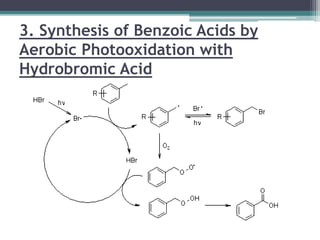
3. Synthesis of Benzoic Acids by
Aerobic Photooxidation with
Hydrobromic Acid
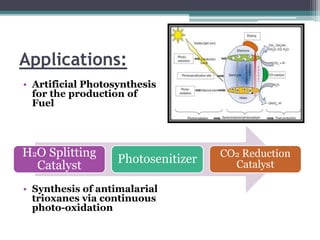
Applications:
• Artificial Photosynthesis
for the production of
Fuel
• Synthesis of antimalarial
trioxanes via continuous
photo-oxidation
H2O Splitting
Catalyst
Photosenitizer CO2 Reduction
Catalyst

Photo redox reactions

  • 1.
    Photooxidation and Photoreduction Reactions RABIA AZIZ BS-IVORGANIC CHEMISTRY MOLECULAR ORBITAL SYMMETRY AND ORGANIC REACTIONS JINNAH UNIVERSITY FOR WOMEN
  • 2.
    Introduction • Photochemistry :The study of chemical reactions, isomerizations and physical behavior that may occur under the influence of visible and/or ultraviolet light is called Photochemistry. Laws: • The first law of photochemistry, the Grotthuss-Draper law, states that light must be absorbed by a compound in order for a photochemical reaction to take place. • The second law of photochemistry, the Stark-Einstein law, states that for each photon of light absorbed by a chemical system, only one molecule is activated for subsequent reaction. This "photoequivalence law" was derived by Albert Einstein during his development of the quantum (photon) theory of light. Quantum Yield: • "The number of moles of a stated reactant disappearing, or the number of moles of a stated product produced, per Einstein of monochromatic light absorbed.” where an Einstein is one mole of photons.
  • 3.
    • Photochemical reactionstake place through electronic excited states . • Higher energy radiation in the UV (200-400 nm) and visible (400-700 nm) range of the electromagnetic spectrum causes many organic molecules to undergo electronic transitions (one of its electrons jumps from a lower energy to a higher energy molecular orbital). • Chromophores: Molecules or parts of molecules that absorb light strongly in the UV-vis region are called chromophores. • UV-vis spectroscopy is useful for most organic compounds analysis that contains conjugated π systems. • As the number of conjugated pi bonds increases, the λmax increases as well. Because longer frequency = smaller energy, this means that the energy gap ΔE between the highest-occupied molecular orbital (HOMO) and lowest unoccupied molecular orbital (LUMO) decreases as the number of conjugated pi bonds increases. • In molecules with extended pi systems, the HOMO-LUMO energy gap becomes so small that absorption occurs in the visible rather then the UV region of the electromagnetic spectrum. • If the electrons of molecule are loosely bound as in unsaturated compound. Such absorption may occur in visible region and substance will appear as coloured.
  • 4.
    Chemiluminescence: A chemical reactionproduces an electronically excited species which emits a photon in order to reach to ground state, the phenomenon is known as chemiluminescence. Photolysis: The term photolysis is used when light absorption of molecules leads to cleavage of bond. Photosensitisation: Photosensitisation is the process where a molecule (Donor) is selectively excited that produce Triplet in high yield by Intersystem crossing and then the energy can be transferred to a second molecule (Acceptor). The order of decreasing energy for the absorption are σ - σ* > σ - π* > π - σ* > π - π* ~ n - σ* > n - π*
  • 5.
    Photochemical Name Reactions •Norrish reaction: The Norrish reaction in organic chemistry describes the photochemical reactions taking place with ketones and aldehydes.  Norrish type I reaction: The Norrish type I reaction is the photochemical cleavage or homolysis of aldehydes and ketones into two free radical intermediates.  Norrish type II reaction: A Norrish type II reaction is the photochemical intramolecular abstraction of a γ-hydrogen (a hydrogen atom three carbon positions removed from the carbonyl group) by the excited carbonyl compound to produce a 1,4- biradical as a primary photoproduct. • Paterno-Buchi Reactions: Paterno-Buchi Reactions is the photochemical cycloaddition of carbonyl compounds to olefins to yield oxetanes.
  • 6.
    Photochemical Reaction Types 1.Photoreduction • Photoreduction is defined as the addition of one or more electrons to a photoexcited species or the photochemical hydrogenation of a substance. 2. Photooxidation • Photooxidation refers to the loss of one or more electrons from a species as a result of photoexcitation. This can also refer to the reaction of a species with molecular oxygen as a result of light irradiation.
  • 7.
    Photoreduction of Ketone: •Ketone photoreduction can be takes place by hydrogen atom donars such as secondary alcohol, and tertiary amines. • In these reactions a photoexcited species reacts with a suitable H- donor (such as alcohols with α-hydrogens, toluene and even cyclohexane). The radical formed may undergo reaction with other hydrogen donors to form alcohols or other reaction partners. • The photoreduction of carbonyl compounds. H2Se lead to monoalcohols.
  • 8.
    Photoreduction of Aromatic Hydrocarbons •Many hydrocarbons benzene, biphenyl, naphthalene and anthracene react with amine to give reduction products.
  • 9.
    Photooxidation of trans-stilbeneto phenanthrene • An example of photooxidation is the photochemical conversion of trans-stilbene 1 to phenanthrene. During this transformation, trans-stilbene 1undergoes a photo-isomerisation to cis-stilbene 2, followed by an electrocyclic ring closure.The final step of the reaction is an irreversible oxidation to form phenanthrene.
  • 10.
  • 11.
    Mechanism: Reaction: 1. Preparation ofBenzopinacol via Photoreduction of Benzophenone in 2-Propanol
  • 12.
    Procedure: 1. Prepare asolution of benzophenone (0.8 g, 4.36 mmol), 2-propanol (8 mL, 104 mmol) and glacial acetic acid (1 drop) in a test tube. In order to achieve complete dissolution, gentle heating in a water bath is required. 2. Tightly stopper the test tube using either a cork which is then wrapped in parafilm, or a rubber stopper/septa.It is important that the solution not come into direct contact with the rubber as it may leach out some compounds which can quench benzophenone excited states. 3. Place the test tube in the Luzchem photoreactor using all 10 lamps and irradiate until the amount of solid which has precipitated from solution does not change (2.5-3hours). 4. After the irradiation, cool the test tube in an ice-bath to precipitate more of the solid. Collect the solid by suction filtration and wash with 1 mL of cold 2-propanol. Allow the solid to air dry. Weigh the solid and determine the percent yield for the reaction. 5. Take the melting point, infrared spectrum and 1H NMR spectrum of your sample, an authentic sample of benzopinacol, and that of the starting material, benzophenone. 6. Weigh the remaining amount of solid and then recrystallize by dissolving in a minimum amount of methylene chloride and adding petroleum ether until the solution becomes cloudy. Allow the solution to cool to room temperature, then cool in an ice-bath. Collect the solid and weigh it as described in Step 4.
  • 13.
    2. CdIn2S4 photocatalystfor selective photosynthesis of organic aromatic compounds under visible light • Importance: It is known that the selective oxidation of aromatic alcohols to corresponding aldehydes and reduction of nitrobenzene into aniline are the fundamental and significant reactions in commercial applications, because aromatic aldehydes, aniline, and their derivatives are important intermediates, which are widely used in pharmaceuticals, perfumes, manufacturing of dye and other fine chemicals.
  • 14.
  • 15.
    Advantages: • When theirradiation time is 2 h, the conversion, yield, and selectivity is 80.2%, 80.0%, and 99%, respectively. • CdIn2S4 photocatalyst is relatively stable and can be used repeatedly through cyclic experiments.
  • 16.
    3. Synthesis ofBenzoic Acids by Aerobic Photooxidation with Hydrobromic Acid
  • 17.
    Applications: • Artificial Photosynthesis forthe production of Fuel • Synthesis of antimalarial trioxanes via continuous photo-oxidation H2O Splitting Catalyst Photosenitizer CO2 Reduction Catalyst