Presented by:
Pranjal Protim Dutta
B.Sc 4th sem
Roll no:14
Introduction
Preparation
Physical Properties
Chemical properties
Keto-enol tautomerism
Stability of keto form
Keto-enol tautomerism in EAA
Synthetic uses
Conclusion
References
Acknowledgement
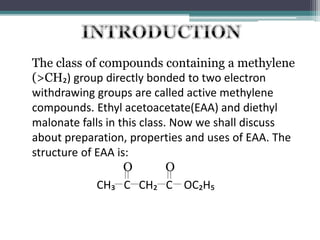
The class of compounds containing a methylene
(>CH₂) group directly bonded to two electron
withdrawing groups are called active methylene
compounds. Ethyl acetoacetate(EAA) and diethyl
malonate falls in this class. Now we shall discuss
about preparation, properties and uses of EAA. The
structure of EAA is:
CH₃ C CH₂ C OC₂H₅
O O
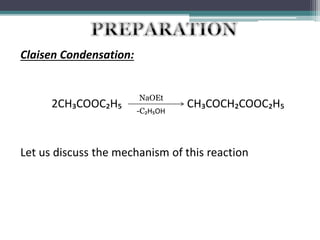
Claisen Condensation:
2CH₃COOC₂H₅ CH₃COCH₂COOC₂H₅
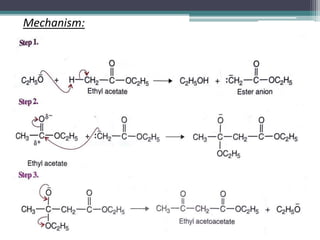
Let us discuss the mechanism of this reaction
NaOEt
-C₂H₅OH
Mechanism:
Ethyl acetoacetate is a colourless, pleasant smelling liquid
with b.p 180.4°C and density 1.0282. It is sparingly
soluble in water but freely soluble in organic solvents.
As the methylene hydrogen is acidic in nature, hence it
can be easily replaced by some other groups. Hence
from ethyl acetoacetate we can synthesize large number
of compounds.
Now why the methylene hydrogen is acidic in
nature?
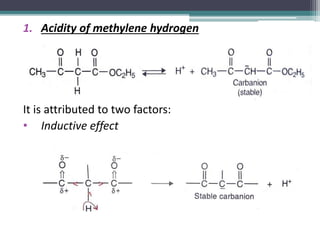
1. Acidity of methylene hydrogen
It is attributed to two factors:
• Inductive effect
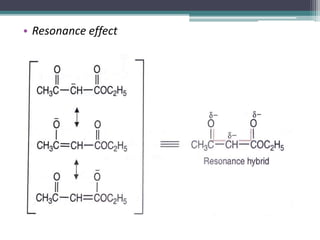
• Resonance effect
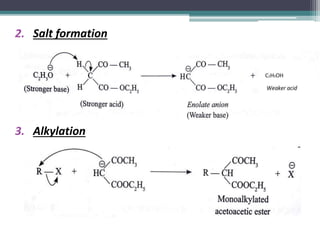
2. Salt formation
3. Alkylation
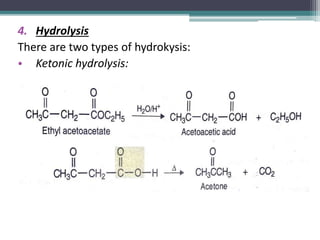
4. Hydrolysis
There are two types of hydrokysis:
• Ketonic hydrolysis:
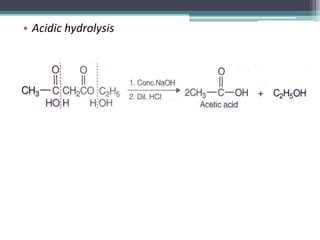
• Acidic hydrolysis
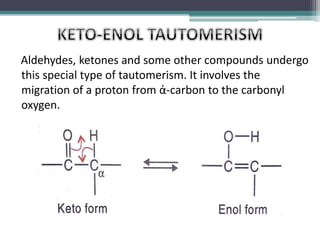
Aldehydes, ketones and some other compounds undergo
this special type of tautomerism. It involves the
migration of a proton from ἀ-carbon to the carbonyl
oxygen.
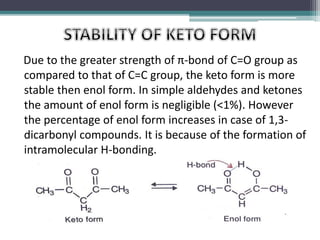
Due to the greater strength of π-bond of C=O group as
compared to that of C=C group, the keto form is more
stable then enol form. In simple aldehydes and ketones
the amount of enol form is negligible (<1%). However
the percentage of enol form increases in case of 1,3-
dicarbonyl compounds. It is because of the formation of
intramolecular H-bonding.
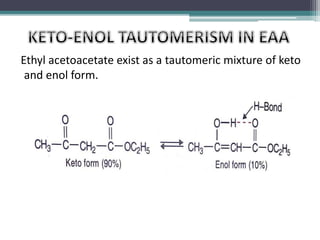
Ethyl acetoacetate exist as a tautomeric mixture of keto
and enol form.
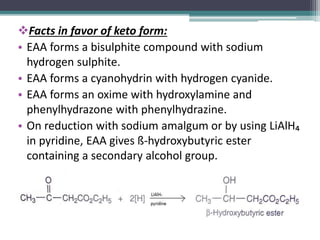
Facts in favor of keto form:
• EAA forms a bisulphite compound with sodium
hydrogen sulphite.
• EAA forms a cyanohydrin with hydrogen cyanide.
• EAA forms an oxime with hydroxylamine and
phenylhydrazone with phenylhydrazine.
• On reduction with sodium amalgum or by using LiAlH₄
in pyridine, EAA gives ß-hydroxybutyric ester
containing a secondary alcohol group.
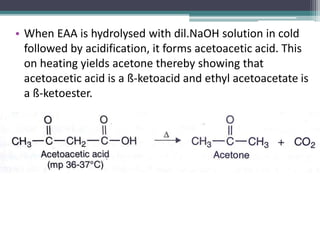
• When EAA is hydrolysed with dil.NaOH solution in cold
followed by acidification, it forms acetoacetic acid. This
on heating yields acetone thereby showing that
acetoacetic acid is a ß-ketoacid and ethyl acetoacetate is
a ß-ketoester.
Facts in favor of enol form:
• EAA reacts with sodium metal to form sodium derivative
and hydrogen gas is evolved. This indicates the presence
of –OH group.
• EAA forms an acetyl derivative with acetyl chloride
which shows the presence of –OH group.
• When EAA is treated with alcoholic bromine solution,
the brown color of the later is discharged. This indicates
the presence of C=C bond.
• EAA forms a reddish violet color when treated with
FeCl₃. This indicates the presence of C=C-OH structural
unit as in phenol.
EAA is used for the synthesis of various compounds such
as:
• Mono and dicarboxyllic acid.
• α,ß-unsaturated acids.
• Ketones .
• 4-Methyl uracil
• Antipyrine
From the above discussion we can conclude that:
• Ethyl acetoacetate is the ethyl ester of acetoacetic
acid.
• It is used for the synthesis of large number of
compounds.
• It is also as flavouring for food.
 Advanced Organic Chemistry-Arun Bahl, B.S Bahl
Organic Chemistry-Mukherji,Singh,Kapoor
At the point of completion of my presentation, I
would like to pay my sincere thanks to our honorable
teacher Dr. Porinita Borah mam for her valuable
guidance.
Pranjal Protim Dutta
Ethyl acetoacetate

Ethyl acetoacetate

  • 1.
    Presented by: Pranjal ProtimDutta B.Sc 4th sem Roll no:14
  • 2.
    Introduction Preparation Physical Properties Chemical properties Keto-enoltautomerism Stability of keto form Keto-enol tautomerism in EAA Synthetic uses Conclusion References Acknowledgement
  • 3.
    The class ofcompounds containing a methylene (>CH₂) group directly bonded to two electron withdrawing groups are called active methylene compounds. Ethyl acetoacetate(EAA) and diethyl malonate falls in this class. Now we shall discuss about preparation, properties and uses of EAA. The structure of EAA is: CH₃ C CH₂ C OC₂H₅ O O
  • 4.
    Claisen Condensation: 2CH₃COOC₂H₅ CH₃COCH₂COOC₂H₅ Letus discuss the mechanism of this reaction NaOEt -C₂H₅OH
  • 5.
  • 6.
    Ethyl acetoacetate isa colourless, pleasant smelling liquid with b.p 180.4°C and density 1.0282. It is sparingly soluble in water but freely soluble in organic solvents.
  • 7.
    As the methylenehydrogen is acidic in nature, hence it can be easily replaced by some other groups. Hence from ethyl acetoacetate we can synthesize large number of compounds. Now why the methylene hydrogen is acidic in nature?
  • 8.
    1. Acidity ofmethylene hydrogen It is attributed to two factors: • Inductive effect
  • 9.
  • 10.
  • 11.
    4. Hydrolysis There aretwo types of hydrokysis: • Ketonic hydrolysis:
  • 12.
  • 13.
    Aldehydes, ketones andsome other compounds undergo this special type of tautomerism. It involves the migration of a proton from ἀ-carbon to the carbonyl oxygen.
  • 14.
    Due to thegreater strength of π-bond of C=O group as compared to that of C=C group, the keto form is more stable then enol form. In simple aldehydes and ketones the amount of enol form is negligible (<1%). However the percentage of enol form increases in case of 1,3- dicarbonyl compounds. It is because of the formation of intramolecular H-bonding.
  • 15.
    Ethyl acetoacetate existas a tautomeric mixture of keto and enol form.
  • 16.
    Facts in favorof keto form: • EAA forms a bisulphite compound with sodium hydrogen sulphite. • EAA forms a cyanohydrin with hydrogen cyanide. • EAA forms an oxime with hydroxylamine and phenylhydrazone with phenylhydrazine. • On reduction with sodium amalgum or by using LiAlH₄ in pyridine, EAA gives ß-hydroxybutyric ester containing a secondary alcohol group.
  • 17.
    • When EAAis hydrolysed with dil.NaOH solution in cold followed by acidification, it forms acetoacetic acid. This on heating yields acetone thereby showing that acetoacetic acid is a ß-ketoacid and ethyl acetoacetate is a ß-ketoester.
  • 18.
    Facts in favorof enol form: • EAA reacts with sodium metal to form sodium derivative and hydrogen gas is evolved. This indicates the presence of –OH group. • EAA forms an acetyl derivative with acetyl chloride which shows the presence of –OH group. • When EAA is treated with alcoholic bromine solution, the brown color of the later is discharged. This indicates the presence of C=C bond. • EAA forms a reddish violet color when treated with FeCl₃. This indicates the presence of C=C-OH structural unit as in phenol.
  • 19.
    EAA is usedfor the synthesis of various compounds such as: • Mono and dicarboxyllic acid. • α,ß-unsaturated acids. • Ketones . • 4-Methyl uracil • Antipyrine
  • 20.
    From the abovediscussion we can conclude that: • Ethyl acetoacetate is the ethyl ester of acetoacetic acid. • It is used for the synthesis of large number of compounds. • It is also as flavouring for food.
  • 21.
     Advanced OrganicChemistry-Arun Bahl, B.S Bahl Organic Chemistry-Mukherji,Singh,Kapoor
  • 22.
    At the pointof completion of my presentation, I would like to pay my sincere thanks to our honorable teacher Dr. Porinita Borah mam for her valuable guidance. Pranjal Protim Dutta