SOME IMPORTANT CARBON COMPOUNDS INCLUDE SATURATED COMPOUNDS, ORGANIC CARBON, ORGANOMETALLIC COMPOUNDS, METHANE, ALKANES, ALKYNES, ETHANOL, ETHANOIC ACID, GRAPHITE, AND ALDEHYDES.
2
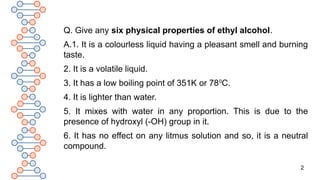
Q. Give anysix physical properties of ethyl alcohol.
A.1. It is a colourless liquid having a pleasant smell and burning
taste.
2. It is a volatile liquid.
3. It has a low boiling point of 351K or 780
C.
4. It is lighter than water.
5. It mixes with water in any proportion. This is due to the
presence of hydroxyl (-OH) group in it.
6. It has no effect on any litmus solution and so, it is a neutral
compound.
3.
3
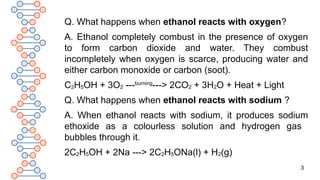
Q. What happenswhen ethanol reacts with oxygen?
A. Ethanol completely combust in the presence of oxygen
to form carbon dioxide and water. They combust
incompletely when oxygen is scarce, producing water and
either carbon monoxide or carbon (soot).
C2H5OH + 3O2 ---burning
---> 2CO2 + 3H2O + Heat + Light
Q. What happens when ethanol reacts with sodium ?
A. When ethanol reacts with sodium, it produces sodium
ethoxide as a colourless solution and hydrogen gas
bubbles through it.
2C2H5OH + 2Na ---> 2C2H5ONa(l) + H2(g)
4.
4
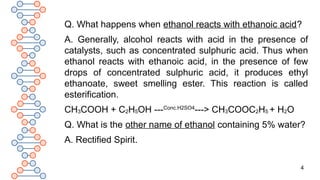
Q. What happenswhen ethanol reacts with ethanoic acid?
A. Generally, alcohol reacts with acid in the presence of
catalysts, such as concentrated sulphuric acid. Thus when
ethanol reacts with ethanoic acid, in the presence of few
drops of concentrated sulphuric acid, it produces ethyl
ethanoate, sweet smelling ester. This reaction is called
esterification.
CH3COOH + C2H5OH ---Conc.H2SO4
---> CH3COOC2H5 + H2O
Q. What is the other name of ethanol containing 5% water?
A. Rectified Spirit.
5.
5
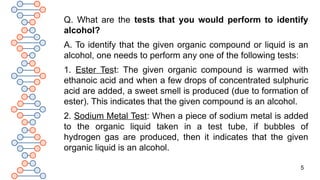
Q. What arethe tests that you would perform to identify
alcohol?
A. To identify that the given organic compound or liquid is an
alcohol, one needs to perform any one of the following tests:
1. Ester Test: The given organic compound is warmed with
ethanoic acid and when a few drops of concentrated sulphuric
acid are added, a sweet smell is produced (due to formation of
ester). This indicates that the given compound is an alcohol.
2. Sodium Metal Test: When a piece of sodium metal is added
to the organic liquid taken in a test tube, if bubbles of
hydrogen gas are produced, then it indicates that the given
organic liquid is an alcohol.
6.
6
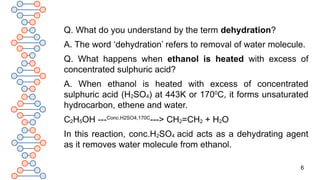
Q. What doyou understand by the term dehydration?
A. The word ‘dehydration’ refers to removal of water molecule.
Q. What happens when ethanol is heated with excess of
concentrated sulphuric acid?
A. When ethanol is heated with excess of concentrated
sulphuric acid (H2SO4) at 443K or 1700
C, it forms unsaturated
hydrocarbon, ethene and water.
C2H5OH ---Conc.H2SO4,170C
---> CH2=CH2 + H2O
In this reaction, conc.H2SO4 acid acts as a dehydrating agent
as it removes water molecule from ethanol.
7.
7
Q. Give thebalanced equation for the reaction of
ethanol with alkaline potassium permanganate in the
presence of heat.
A. When ethanol is heated with alkaline potassium
permanganate, it gets oxidized to ethanoic acid along
with water.
C2H5OH + 2[O] ---Alk.KMnO4,Heat
---> CH3COOH + H2O
Q. What is meant by absolute alcohol?
A. 1OO% pure ethanol is called absolute alcohol.
8.
8
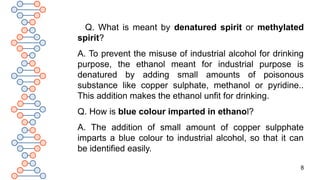
Q. What ismeant by denatured spirit or methylated
spirit?
A. To prevent the misuse of industrial alcohol for drinking
purpose, the ethanol meant for industrial purpose is
denatured by adding small amounts of poisonous
substance like copper sulphate, methanol or pyridine..
This addition makes the ethanol unfit for drinking.
Q. How is blue colour imparted in ethanol?
A. The addition of small amount of copper sulpphate
imparts a blue colour to industrial alcohol, so that it can
be identified easily.
9.
9
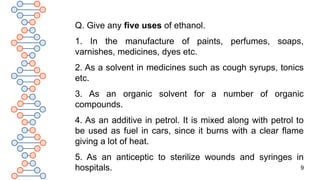
Q. Give anyfive uses of ethanol.
1. In the manufacture of paints, perfumes, soaps,
varnishes, medicines, dyes etc.
2. As a solvent in medicines such as cough syrups, tonics
etc.
3. As an organic solvent for a number of organic
compounds.
4. As an additive in petrol. It is mixed along with petrol to
be used as fuel in cars, since it burns with a clear flame
giving a lot of heat.
5. As an anticeptic to sterilize wounds and syringes in
hospitals.
10.
10
Q. What isthe formula of ethanoic acid? Give any five
physical properties of it.
A. The formula of ethanoic acid is CH3COOH.
Physical properties:
1. It is a colourless and pungent smelling liquid.
2. It has sour taste and smell of vinegar.
3. The acid boils at 1180
C (391K).
4. It is soluble with water in all proportions.
5. When cooled, it freezes to form colourless ice-like flakes
resembling glacier, therefore it is often called glacial acetic
acid.
11.
11
Q. How willyou show the acidic nature of acetic acid?
A. In order to show the acetic nature of acetic acid, litmus
test is done. Acetic acid turns blue litmus to red. Besides
this, dilute acetic acid turns universal indicator paper to
orange showing that pH is about 4, which proves it’s
acidic nature.
Q. What is vinegar?
A. The dilute solution of acetic acid in water is called
vinegar. In other words, vinegar contains about 5-8%
acetic acid and it is widely used for the preservation of
pickles, sauces etc.
12.
12
Q. Give thereaction of ethanoic acid with 1)
Sodium, 2) Calcium.
A.1. When sodium reacts with ethanoic acid, it forms
sodium ethanoate, with the evolution of hydrogen gas.
2CH3COOH + 2Na ---> 2CH3COONa + H2
2. When calcium reacts with ethanoic acid, it forms
calcium ethanoate, with the evolution of hydrogen
gas.
2CH3COOH + Ca ---> (CH3COO)2Ca + H2
13.
13
Q. What happenswhen ethanoic acid reacts with sodium
hydroxide?
A. When ethanoic acid is treated with sodium hydroxide,
neutralization reaction takes place forming a salt sodium
ethanoate and water.
CH3COOH + NaOH ---> CH3COONa + H2O
Q. What happens when ethanoic acid reacts with sodium
carbonate?
A. When ethanoic acid reacts with sodium carbonate, a brisk
effervescence of carbon dioxide gas is observed. The salt
formed due to this reaction is sodium ethanoate.
2CH3COOH + Na2CO3 ---> 2CH3COONa + CO2 + H2O
14.
14
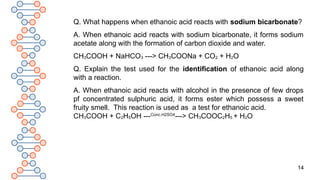
Q. What happenswhen ethanoic acid reacts with sodium bicarbonate?
A. When ethanoic acid reacts with sodium bicarbonate, it forms sodium
acetate along with the formation of carbon dioxide and water.
CH3COOH + NaHCO3 ---> CH3COONa + CO2 + H2O
Q. Explain the test used for the identification of ethanoic acid along
with a reaction.
A. When ethanoic acid reacts with alcohol in the presence of few drops
pf concentrated sulphuric acid, it forms ester which possess a sweet
fruity smell. This reaction is used as a test for ethanoic acid.
CH3COOH + C2H5OH ---Conc.H2SO4
---> CH3COOC2H5 + H2O
15.
15
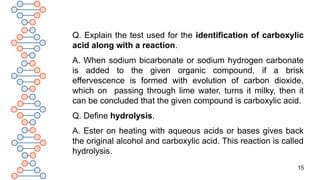
Q. Explain thetest used for the identification of carboxylic
acid along with a reaction.
A. When sodium bicarbonate or sodium hydrogen carbonate
is added to the given organic compound, if a brisk
effervescence is formed with evolution of carbon dioxide,
which on passing through lime water, turns it milky, then it
can be concluded that the given compound is carboxylic acid.
Q. Define hydrolysis.
A. Ester on heating with aqueous acids or bases gives back
the original alcohol and carboxylic acid. This reaction is called
hydrolysis.
16.
16
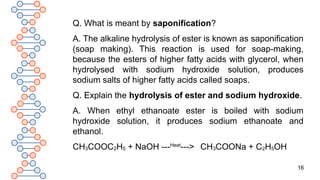
Q. What ismeant by saponification?
A. The alkaline hydrolysis of ester is known as saponification
(soap making). This reaction is used for soap-making,
because the esters of higher fatty acids with glycerol, when
hydrolysed with sodium hydroxide solution, produces
sodium salts of higher fatty acids called soaps.
Q. Explain the hydrolysis of ester and sodium hydroxide.
A. When ethyl ethanoate ester is boiled with sodium
hydroxide solution, it produces sodium ethanoate and
ethanol.
CH3COOC2H5 + NaOH ---Heat
---> CH3COONa + C2H5OH
17.
17
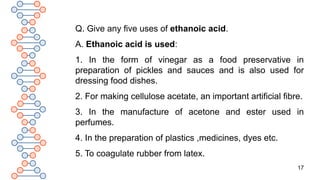
Q. Give anyfive uses of ethanoic acid.
A. Ethanoic acid is used:
1. In the form of vinegar as a food preservative in
preparation of pickles and sauces and is also used for
dressing food dishes.
2. For making cellulose acetate, an important artificial fibre.
3. In the manufacture of acetone and ester used in
perfumes.
4. In the preparation of plastics ,medicines, dyes etc.
5. To coagulate rubber from latex.
18.
18
Q. What aredetergents?
A. A substance capable of removing dirt and grease is
called detergent.
Q. Why soaps and detergents are called cleansing
agent?
A. Soaps and detergents are called cleansing agent as
they are capable of removing any dirt or grease.
Q. What are two types of detergents. Differentiate them.
A. Two types of detergents are: 1) Soapy detergents 2)
Non-soapy detergents. The soapy detergents are ‘soaps’
whereas the non-soapy detergents are ‘detergents’.
19.
19
Q. What aresoaps?
A. Soaps are sodium and potassium salts of long chain of
carboxylic acid.
Q. What are fatty acids?
A. Carboxylic acids containing long chain of carbon atoms
are fatty acids. They are obtained by hydrolyzing oils and
fats.
20.
20
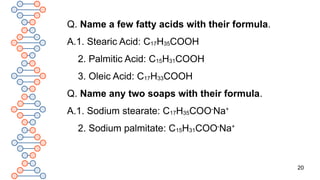
Q. Name afew fatty acids with their formula.
A.1. Stearic Acid: C17H35COOH
2. Palmitic Acid: C15H31COOH
3. Oleic Acid: C17H33COOH
Q. Name any two soaps with their formula.
A.1. Sodium stearate: C17H35COO-
Na+
2. Sodium palmitate: C15H31COO-
Na+
21.
21
Q. Why isthe solution of soap in water is basic in nature?
A. The solution of soap in water is basic in nature
because soap is the salt of a strong base, sodium
hydroxide and a weak acid i.e. carboxylic acid.
Q. What is meant by glycerol?
A. Animal fats or vegetable oils are naturally esters of
long chain carboxylic acids and an alcohol are called
glycerol. When animal fats or vegetable oils are heated
with sodium hydroxide solution, they form sodium salt of
fatty acid called soap along with glycerol.
22.
22
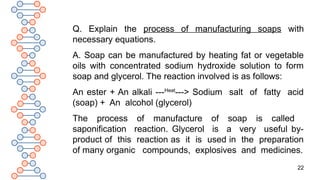
Q. Explain theprocess of manufacturing soaps with
necessary equations.
A. Soap can be manufactured by heating fat or vegetable
oils with concentrated sodium hydroxide solution to form
soap and glycerol. The reaction involved is as follows:
An ester + An alkali ---Heat
---> Sodium salt of fatty acid
(soap) + An alcohol (glycerol)
The process of manufacture of soap is called
saponification reaction. Glycerol is a very useful by-
product of this reaction as it is used in the preparation
of many organic compounds, explosives and medicines.
23.
23
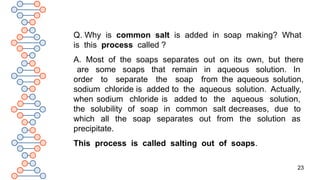
Q. Why iscommon salt is added in soap making? What
is this process called ?
A. Most of the soaps separates out on its own, but there
are some soaps that remain in aqueous solution. In
order to separate the soap from the aqueous solution,
sodium chloride is added to the aqueous solution. Actually,
when sodium chloride is added to the aqueous solution,
the solubility of soap in common salt decreases, due to
which all the soap separates out from the solution as
precipitate.
This process is called salting out of soaps.
24.
24
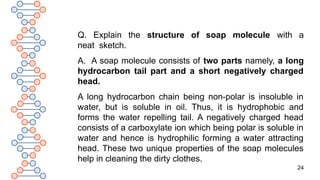
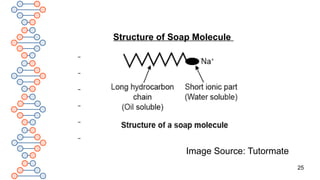
Q. Explain thestructure of soap molecule with a
neat sketch.
A. A soap molecule consists of two parts namely, a long
hydrocarbon tail part and a short negatively charged
head.
A long hydrocarbon chain being non-polar is insoluble in
water, but is soluble in oil. Thus, it is hydrophobic and
forms the water repelling tail. A negatively charged head
consists of a carboxylate ion which being polar is soluble in
water and hence is hydrophilic forming a water attracting
head. These two unique properties of the soap molecules
help in cleaning the dirty clothes.
26
Q. Define micelle.
A.A spherical cluster of soap molecules in a colloidal
state, when soap is dissolved in water, is called a micelle.
When soap is dissolved in water, it results in the formation
of colloidal suspension in water. The soap molecules
aggregate together in the soap solution with water to form
spherical micelle. In this micelles, the soap molecules are
arranged in such a way that hydrocarbon end is directed
towards the centre, while the ionic ends are directed
outwards. The ionic ends are directed outwards because
negative charged head repel one another.
27.
27
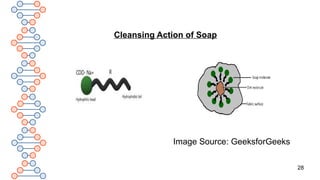
Q. Explain thecleansing action of soap.
A. When soap is mixed with water, it dissolves to give
carboxylate ions (RCOO-
) or sulphonate ions (RSO-
3) and the
cations Na+
. The molecules of soap have a unique direction in
water. They actually aggregate together in a cluster forming
a micelle. Now, the hydrocarbon ends of the soap molecule
in the micelle attach to the oil or grease particles present on
the surface of the dirty cloth. Thus the micelle entraps the oil
particles and the ionic ends remain in water. In this way,when
the dirty clothes is agitated in soap solution, the oily and
greasy particles present on its surface is entrapped by soap
micelles and get dispersed in water due to which the soap
water becomes dirty, but the cloth gets cleaned.
29
Q. What arethe factors of hardness of water?
A. Water has the ability to dissolve a large number of
salts in it. The hardness of water is due to the
presence of bicarbonates, chlorides and sulphates of
calcium and magnesium.
Q. On what basis, water is classified?
A. Based on the formation of lather or foam, water is
classified into two types, namely:
1. Hard water
2. Soft water.
30.
30
Q. Why soapsdoes not lather easily in hard water?
Give reaction involved.
A. When soap is added to water containing calcium or
magnesium salts, the calcium ions Ca2+
or
magnesium ions Mg2+
gets interchanged with sodium
ions Na+
to form corresponding Ca2+
or Mg2+
salts
which forms white precipitate called scum. Thus, hard
water does not give any lather with soap and is not fit
for washing clothes.
Ca2+
+ 2RCOONa ---> (RCOO)2Ca + 2Na
(Hard water) (soap) (Scum)
31.
31
Q. Define detergents.
A.Detergents are made of long chain hydrocarbons obtained
from petroleum. It is a sodium salt of long chain benzene
sulphonic acid or alkyl hydrogen sulphonate which has the
cleaning property in water.
Q. What are the two parts of detergents?
A. The detergents has two main parts, namely:
1. A large non-ionic hydrocarbon group,which is hydrophobic.
2. A short ionic group such as sulphate group[SO-
4Na+
] or
sulphonate group[SO-
3Na+
], which is hydrophilic.
32.
32
Q. Why detergentsare better cleansing agent
than soap?
A. Detergents are better cleansing agent than soaps.
This is because they do not form insoluble calcium
and magnesium salts with hard water. Hence,
detergents can be used for washing even with hard
water as they give lather even with hard water.
33.
33
Q. Differentiate hardand soft water with examples.
A.1. Water that does not produce lather with soap is
called hard water. Examples: well water, lake water,
spring water, sea water, river water, tube-well etc.
2. Water that produces lather with soap is called
soft water. Examples: rain water, distilled water and
demineralized water etc.
34.
34
Q. Give anyfive advantages of detergents over soap.
A.1. Synthetic detergents do not cause irritation to the skin.
2. Synthetic detergents have better cleansing action than
soap.
3. Synthetic detergents are more soluble in water and hence
produce more lather than soaps.
4. Synthetic detergents can also be used in acidic medium as
they are salts of strong acids and are not decomposed in
acidic medium.
5. Synthetic detergents can be used even in hard water
whereas soaps get washed if water is hard.
35.
35
Q. Differentiate soapsand detergents.
A.1. Synthetic detergents are sodium salts of long chain
benzene sulphonic acids or long chain alkyl hydrogen-sulphate.
Soaps are the sodium or potassium salts of long chain of
carboxylic acids.
2. In case of synthetic detergents, the ionic group is, SO-
3Na+
or
SO-
4Na+
.
In case of soaps, the ionic group is, -COONa+
.
Contd.
36.
36
3. Synthetic detergentsare non-biodegradable.
Soaps are biodegradable.
4. Synthetic detergents possess a strong cleansing
action than soap.
Soaps possess a weak cleansing action than
synthetic detergents.
5. Synthetic detergents are prepared from the
hydrocarbons of petroleum.
Soaps are prepared from natural oils and fats.
37.
37
Q. What isscum?
A. Hardness is the property present in water due to which it
does not lather easily with the soap. Due to hardness of
water, a large amount of soap is washed out during
reaction with the calcium and magnesium ions present in
hard water to form an insoluble precipitate called soap film
or scum. The scum so formed, sticks to the cloth being
washed and interferes with the cleaning action of soap.
Q. What are the harmful effects of detergents?
A. It is non-biodegradable and causes water pollution.

![7
Q. Give the balanced equation for the reaction of
ethanol with alkaline potassium permanganate in the
presence of heat.
A. When ethanol is heated with alkaline potassium
permanganate, it gets oxidized to ethanoic acid along
with water.
C2H5OH + 2[O] ---Alk.KMnO4,Heat
---> CH3COOH + H2O
Q. What is meant by absolute alcohol?
A. 1OO% pure ethanol is called absolute alcohol.](https://image.slidesharecdn.com/carbon3n-250220044841-f59038d0/85/IMPORTANT-CARBON-COMPOUND-CLASS-10-SCIENCE-7-320.jpg)
![31
Q. Define detergents.
A. Detergents are made of long chain hydrocarbons obtained
from petroleum. It is a sodium salt of long chain benzene
sulphonic acid or alkyl hydrogen sulphonate which has the
cleaning property in water.
Q. What are the two parts of detergents?
A. The detergents has two main parts, namely:
1. A large non-ionic hydrocarbon group,which is hydrophobic.
2. A short ionic group such as sulphate group[SO-
4Na+
] or
sulphonate group[SO-
3Na+
], which is hydrophilic.](https://image.slidesharecdn.com/carbon3n-250220044841-f59038d0/85/IMPORTANT-CARBON-COMPOUND-CLASS-10-SCIENCE-31-320.jpg)



![CHEMICAL EQUILIBRIUM [PART 2], CLASS 11 CHEMISTRY](https://cdn.slidesharecdn.com/ss_thumbnails/eql2-250303040749-4cd334d1-thumbnail.jpg?width=640&height=640&fit=bounds)


![CHEMICAL BONDING AND MOLECULAR STRUCTURE [PART: 3], CLASS 11 CHEMISTRY](https://cdn.slidesharecdn.com/ss_thumbnails/cb4-250226043559-bf93a4b4-thumbnail.jpg?width=640&height=640&fit=bounds)
![CHEMICAL BONDING & MOLECULAR STRUCTURE [PART 2], CLASS 11 CHEMISTRY](https://cdn.slidesharecdn.com/ss_thumbnails/cb2-250225044619-e600ad65-thumbnail.jpg?width=640&height=640&fit=bounds)

![CARBON AND IT'S COMPOUNDS[CHAPTER 1], CLASS 10, SCIENCE](https://cdn.slidesharecdn.com/ss_thumbnails/carbon-250220043655-8b9e92b9-thumbnail.jpg?width=640&height=640&fit=bounds)
![CARBON AND IT'S COMPOUND[PART 2], CLASS 10, SCIENCE](https://cdn.slidesharecdn.com/ss_thumbnails/carbon2-250220041032-3c163d1d-thumbnail.jpg?width=640&height=640&fit=bounds)

![THERMODYNAMICS[PART 3], CLASS 11, CHEMISTRY](https://cdn.slidesharecdn.com/ss_thumbnails/therm3a-250219054445-0147ea61-thumbnail.jpg?width=640&height=640&fit=bounds)
![THERMODYNAMICS[PART 2], CLASS 11, CHEMISTRY](https://cdn.slidesharecdn.com/ss_thumbnails/therm2-250219053401-f44db038-thumbnail.jpg?width=640&height=640&fit=bounds)
![THERMODYNAMICS[PART 1], CLASS 11, CHEMISTRY](https://cdn.slidesharecdn.com/ss_thumbnails/therm1-250219052302-b7910fcf-thumbnail.jpg?width=640&height=640&fit=bounds)
![STRUCTURE OF ATOM[PART1], CLASS 11, CHEMISTRY](https://cdn.slidesharecdn.com/ss_thumbnails/atm-250217055227-e54ddbe4-thumbnail.jpg?width=640&height=640&fit=bounds)
![ATOMIC STRUCTURE[PART2] CLASS 11, CHEMISTRY](https://cdn.slidesharecdn.com/ss_thumbnails/atm2-250217052334-efd626ba-thumbnail.jpg?width=640&height=640&fit=bounds)


![谷歌留痕技术 [ 𝙩𝙤𝙥 𝟮𝟯𝟯. 𝙘 𝙤𝙢 ]](https://cdn.slidesharecdn.com/ss_thumbnails/top233-260130174328-3833018c-thumbnail.jpg?width=640&height=640&fit=bounds)

