TREMORS
DR. PIYUSH OJHA
DM RESIDENT
DEPARTMENT OF NEUROLOGY
GOVT MEDICAL COLLEGE, KOTA
• Most common form of involuntary
movements.
• Definition – rhythmic, oscillatory, repititive
movement , produced by alternating or
synchronous contractions of antagonist
muscles.
• Also defined as rhythmic oscillation of at least
one functional body region.
• Classification is by : -
– Distribution – according to the body part affected
– Pattern of occurrence – rest, postural, action or
kinetic, task specific
– Tremor frequency (although considerable overlap)
– Etiology
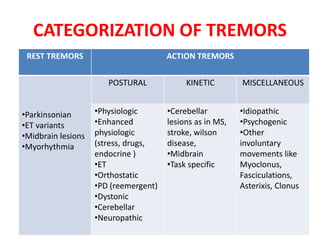
CATEGORIZATION OF TREMORS
REST TREMORS ACTION TREMORS
•Parkinsonian
•ET variants
•Midbrain lesions
•Myorhythmia
POSTURAL KINETIC MISCELLANEOUS
•Physiologic
•Enhanced
physiologic
(stress, drugs,
endocrine )
•ET
•Orthostatic
•PD (reemergent)
•Dystonic
•Cerebellar
•Neuropathic
•Cerebellar
lesions as in MS,
stroke, wilson
disease,
•Midbrain
•Task specific
•Idiopathic
•Psychogenic
•Other
involuntary
movements like
Myoclonus,
Fasciculations,
Asterixis, Clonus
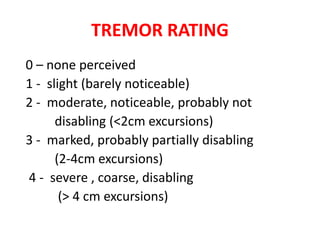
TREMOR RATING
0 – none perceived
1 - slight (barely noticeable)
2 - moderate, noticeable, probably not
disabling (<2cm excursions)
3 - marked, probably partially disabling
(2-4cm excursions)
4 - severe , coarse, disabling
(> 4 cm excursions)
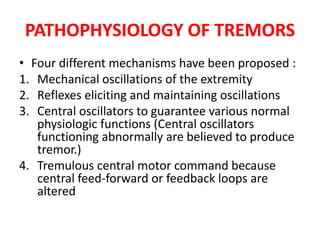
PATHOPHYSIOLOGY OF TREMORS
• Four different mechanisms have been proposed :
1. Mechanical oscillations of the extremity
2. Reflexes eliciting and maintaining oscillations
3. Central oscillators to guarantee various normal
physiologic functions (Central oscillators
functioning abnormally are believed to produce
tremor.)
4. Tremulous central motor command because
central feed-forward or feedback loops are
altered
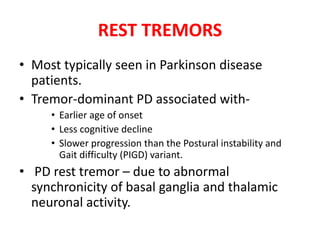
REST TREMORS
• Most typically seen in Parkinson disease
patients.
• Tremor-dominant PD associated with-
• Earlier age of onset
• Less cognitive decline
• Slower progression than the Postural instability and
Gait difficulty (PIGD) variant.
• PD rest tremor – due to abnormal
synchronicity of basal ganglia and thalamic
neuronal activity.
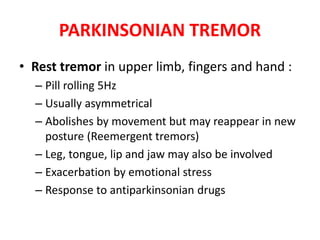
PARKINSONIAN TREMOR
• Rest tremor in upper limb, fingers and hand :
– Pill rolling 5Hz
– Usually asymmetrical
– Abolishes by movement but may reappear in new
posture (Reemergent tremors)
– Leg, tongue, lip and jaw may also be involved
– Exacerbation by emotional stress
– Response to antiparkinsonian drugs
PARKINSONIAN TREMOR
• Postural, Action tremor upper limb tremor:
– Frequency 6-8 Hz
TREMOR DOMINANT PARKINSON DISEASE
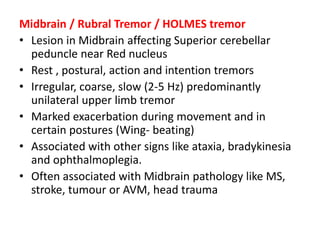
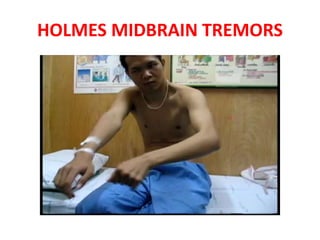
Midbrain / Rubral Tremor / HOLMES tremor
• Lesion in Midbrain affecting Superior cerebellar
peduncle near Red nucleus
• Rest , postural, action and intention tremors
• Irregular, coarse, slow (2-5 Hz) predominantly
unilateral upper limb tremor
• Marked exacerbation during movement and in
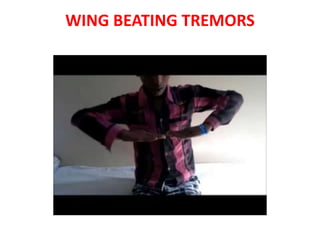
certain postures (Wing- beating)
• Associated with other signs like ataxia, bradykinesia
and ophthalmoplegia.
• Often associated with Midbrain pathology like MS,
stroke, tumour or AVM, head trauma
HOLMES MIDBRAIN TREMORS
MYORHYTHMIA :-
• slow(1-3 Hz) frequency
• Continuous or intermittent
• Relatively rhythmic movements present at rest
but may persist during activity.
• Disappears with sleep.
• May be associated with palatal myoclonus.
Differences from PD tremor – slower frequency ,
flexion-extension movements rather than
supination-pronation movements, absence of
other PD features
Causes – Brainstem lesions, Wilson disease,
Whipple disease, cerebellar degeneration
PALATAL MYOCLONUS/ PALATAL TREMORS : -
• Produced by regular,rhythmic (1-3 Hz),
continuous contractions of soft palate.
SYMPTOMATIC PALATAL
MYOCLONUS
ESSENTIAL PALATAL
MYOCLONUS
•Persists during sleep •Disappears with sleep
•Complaints of self audible
clicking sounds.
•Muscle involved – Levator veli
palatini (facial nerve)
•Associated with
pseudohypertrophy of
ipsilateral olivary nucleus on
MRI
•Tensor veli palatini (Trigeminal
nerve)
•No olivary hypertrophy.
TREATMENT OF REST TREMORS :-
• Secondary and potentially curable causes
should be excluded.
• Anticholinergic and Dopaminergic drugs –
most effective treatment
• Other drugs – Clozapine, Mirtazapine
• Botox injection in the involved muscle
• Ventral Lateral Thalamotomy involving VIM
nucleus of thalamus was earlier treatment of
choice for drug resisitant disabling Tremors.
• Now replaced by Deep Brain Stimulation (DBS)
• Thalamic Deep Brain Stimulation (DBS) is now the
surgical treatment of choice in disabling tremors.
• High frequency stimulation (100Hz) to VIM
contralateral to the disabling tremor using tip of a
stereotactically placed monopolar electrode.
• Can be done in elderly patients
• Useful when bilateral effects are desirable.
• DBS associated with fewer complications than
with thalamotomy.
• Reduces / controls rest tremor in 75-85% patients
• Chief advantage of DBS – stimulation can be
customised by the patient according his needs
• Thalamic DBS doesnot improve any other PD
symptom except tremor.
• Benefits may persist for 6 months
• VIM DBS also controls ET head tremors which
usually donot respond to drugs.
• DBS – NOT effective in patients with
predominant kinetic and axial tremors.
ESSENTIAL TREMOR TREATMENT
WITH DBS ON/OFF
POSTURAL TREMORS
• Normal and enhanced physiologic tremor
– most common form of postural tremor
– Rarely require medical attention
– In contrast to Essential tremor, frequency of
physiologic tremor slowed by mass loading
ENHANCED PHYSIOLOGIC TREMOR (EPT)
• Rapid 8-12 Hz small amplitude, fine postural and
kinetic tremors
• Typically affects upper limb and hands
• Etiology :
– Exaggerated physiological response – anxiety, fatigue,
fright, sternous exertion
– Drugs like amphetamines, amiodarone, caffeine,
valproate, theophylline, thyroxine, alcohol withdrawl
– Metabolic – hypoglycemia,pheochromocytoma,
thyrotoxicosis
– Toxins – mercury, MPTP
• No known cause (Idiopathic)
• Prevalence – 4.6% in >65 yrs (males> females)
• Family history in 50% cases.
• Hereditary factors also involved (Autosomal dominant
inheritance) , responsible genes not known
• Age of onset : Bimodal, young adults and 40-60 years
• Can cause marked physical and psychosocial disability.
• Amplitude increases and frequency decreases with age
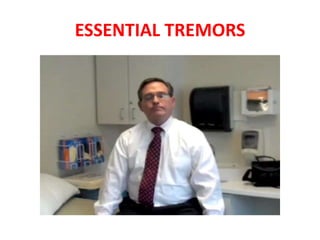
ESSENTIAL TREMORS (ET)
• ET is typically a postural or kinetic tremor of fingers,
hands and forearms when held outstretched, during
specific fine motor tasks.
• Other sites – head (30-40%), voice (15-20%)
• Frequency 4-10 Hz.
• Bilateral, may be asymmetric
• No other neurological signs
• Frequency is relatively constant while amplitude may
vary and may be suppressed by mental concentration,
stress and distraction in some cases.
• Improves by alcohol in 50% cases.
ESSENTIAL TREMORS (ET)
• No characteristic pathologic or biochemical
findings
• Functional imaging – increased olivary glucose
metabolism, increased blood flow in cerebellum
and red nucleus and in contralateral globus
pallidus, thalamus and sensorimotor cortex.
• Lesions of ipsilateral cerebellum and contralateral
VIM thalamus – reduces or abolishes tremors.
ESSENTIAL TREMORS (ET)
PROPOSED CLASSIFICATION OF
ESSENTIAL TREMOR
A. DEFINITE ESSENTIAL TREMOR
1. INCLUSIONS :-
a. Bilateral postural tremor with/without kinetic tremor involving
hands/forearms, which is visible and persistent and long
standing (> 5 years)
b. Tremors involving body parts other than upper limbs may be
present, the tremor may be asymmetrical, amplitude may
fluctuate, and tremor may/maynot produce disability
2. EXCLUSIONS : -
a. Neurologic signs, except for Froment sign ( a Cogwheel
phenomenon on passive movement of the affected limb
with voluntary movement of the contralateral limb)
b. Causes of Enhanced Physiologic tremors
c. Concurrent or recent exposure to tremorogenic drugs
d. Direct or indirect trauma to central or Peripheral nervous
system
e. Historical or clinical evidence of psychogenic tremor
f. Convincing evidence of sudden onset or evidence of
stepwise deterioration
A. PROBABLE ESSENTIAL TREMOR
1. INCLUSIONS :-
same as for definite ET, but the tremor may be confined to body
parts other than hands and duration > 3 years
2. EXCLUSIONS : -
a. Primary Orthostatic tremor – an isolated, high frequency
(14-18 Hz), bilaterally synchronous leg tremor on standing or
voluntary contraction of leg muscles
b. Isolated voice, tongue or chin tremors
c. Position and task specific tremors
ESSENTIAL TREMORS
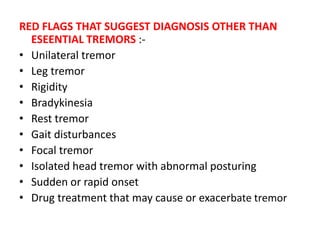
RED FLAGS THAT SUGGEST DIAGNOSIS OTHER THAN
ESEENTIAL TREMORS :-
• Unilateral tremor
• Leg tremor
• Rigidity
• Bradykinesia
• Rest tremor
• Gait disturbances
• Focal tremor
• Isolated head tremor with abnormal posturing
• Sudden or rapid onset
• Drug treatment that may cause or exacerbate tremor
EVIDENCE BASED RECOMMENDATIONS FOR
TREATMENT OF ESSENTIAL TREMORS
(by AAN subcomittee)
• Propranolol and Primidone reduces limb tremor
(Level A)
• Alprazolam, atenolol, Gabapentin, Sotalol and
Topiramate (Level B)
• Propranolol reduces head tremor (Level B)
• Clonazepam, clozapine, Nimodipine (Level C)
• Botulinum Toxin A in limb,head and voice tremor
(Level C)
• Chronic DBS and Thalamotomy (Level C)
• Gamma knife Thalamotomy (Level U)
TREATMENT OF ESSENTIAL TREMORS
• Treatment mainly depends on severity.
• Many patients require reassurance.
• Many patients consume alcohol for its calming effect
and prophylactically too (60 ml 10-15 mins prior to
anticipated event to avoid embarassment).
• Alcohol – central effect – potentiates GABA activity.
• But regular alcohol consumption – NOT recommended.
• Long term alcohol consumption – may have substantial
risk of developing ET (cerebellar toxicity)
• Drugs mainly reduce tremor amplitude with no
effect on tremor frequency.
• Large amplitude and slow frequency tremor –
usually donot respond to pharmacological
therapy.
• Propranolol – beta-blocker – most effective drug
for ET and enhanced physiologic tremors.
• Propranolol – less effective in head tremors.
• Therapeutic effect may be mediated by
peripheral beta adrenergic receptors.
• DOSE – 20-60 mg/day initially, increase to 120
mg/day
• PRIMIDONE
– also reduce limb tremors.
– Started at low dose (25mg HS) to avoid acute
idiosyncratic reactions (nausea, vomiting,
confusion, ataxia)
– dose > 250 mg are usually not required.
– no head to head comparisions with Propranolol.
• BENZODIAZEPINES (Clonazepam, Lorazepam,
Alprazolam)
– Also reduce ET and other postural tremors
ORTHOSTATIC TREMORS
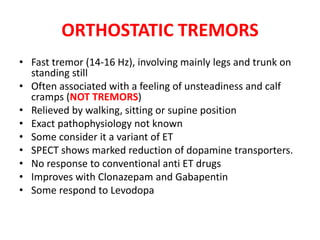
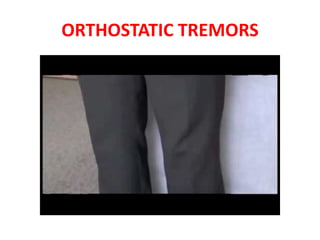
• Fast tremor (14-16 Hz), involving mainly legs and trunk on
standing still
• Often associated with a feeling of unsteadiness and calf
cramps (NOT TREMORS)
• Relieved by walking, sitting or supine position
• Exact pathophysiology not known
• Some consider it a variant of ET
• SPECT shows marked reduction of dopamine transporters.
• No response to conventional anti ET drugs
• Improves with Clonazepam and Gabapentin
• Some respond to Levodopa
ORTHOSTATIC TREMORS
KINETIC TREMORS
• Typically associated with lesions or diseases
that involve cerebellum or its outflow
pathways.
• Implies tremors that are present when “
contemplating, initiating, performing or
completing a movement” (Jankovic 1993)
• May also exhibit postural tremors and
titubations
• Causes such as alcohol withdrawl, drug
toxicity (eg. Phenytoin) should be treated
accordingly.
• No drug has shown to reduce cerebellar
tremor satisfactorily.
• Attaching weights to wrist may have limited
improvement.
• Stereotactic thalamotomy – successfully
relieves kinetic tremors in MS and other
etiologies
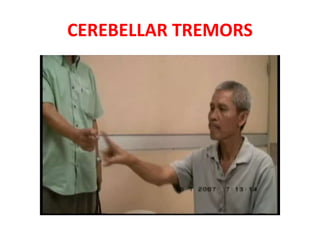
CEREBELLAR TREMORS
• Coarse 3-5 Hz tremor of upper limbs :
– Postural tremor
– Action and Kinetic(during movement) tremor
– Characteristic Intention tremor
– Amplitude increases on approaching target during
goal directed movement
• Head and trunk tremor : Titubation (yes-yes or
no-no )
• May be incapacitating
• Poorly responsive to treatment
CEREBELLAR TREMORS
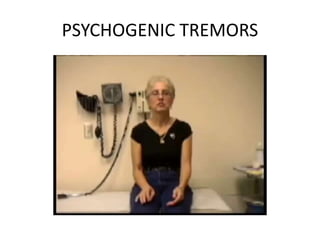
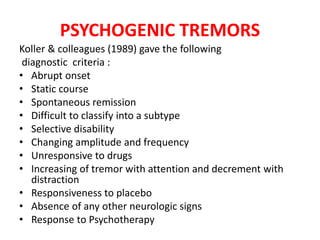
PSYCHOGENIC TREMORS
Koller & colleagues (1989) gave the following
diagnostic criteria :
• Abrupt onset
• Static course
• Spontaneous remission
• Difficult to classify into a subtype
• Selective disability
• Changing amplitude and frequency
• Unresponsive to drugs
• Increasing of tremor with attention and decrement with
distraction
• Responsiveness to placebo
• Absence of any other neurologic signs
• Response to Psychotherapy
PSYCHOGENIC TREMORS
WING BEATING TREMORS
DYSTONIC TREMORS
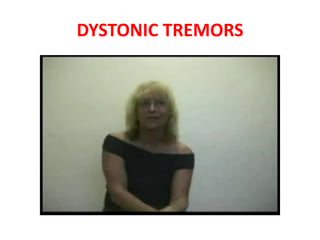
• Asymmetrical postural, kinetic and rarely rest
tremors
• Occurs in association with focal or generalised
dystonias
• Frequency 2-6 Hz
DYSTONIC TREMORS
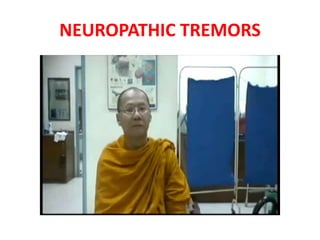
NEUROPATHIC TREMORS
• Postural, kinetic tremor, upper limbs > lower
limbs
– Coarse flapping (3-6 Hz)
– Typically demyelinating neuropathy (Ig M
paraproteinemia, CIDP)
– Signs of neuropathy ( muscle wasting, Weakness,
areflexia, sensory loss)
NEUROPATHIC TREMORS
ISOLATED TASK SPECIFIC OR POSITION
SPECIFIC TREMORS
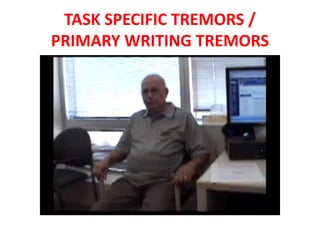
• Kinetic tremors during specific tasks (6 Hz)
• Upper limb : occupational tremors
(musicians), primary writing tremors
• Head and lips : musicians (wind instruments)
• Task specificity is characteristic.
• May respond to anticholinergics.
TASK SPECIFIC TREMORS /
PRIMARY WRITING TREMORS
THANK YOU
REFERENCES
• Principles and practice of Movement
Disorders 2nd edition
• Bradley’s Neurology in clinical practice 6th
edition
• Hankey’s clinical neurology 2nd edition
• Current Clinical Neurology : Movement
disorders : Roongroj Bhidyasiri, Daniel Tarsy

Tremors

  • 1.
    TREMORS DR. PIYUSH OJHA DMRESIDENT DEPARTMENT OF NEUROLOGY GOVT MEDICAL COLLEGE, KOTA
  • 2.
    • Most commonform of involuntary movements. • Definition – rhythmic, oscillatory, repititive movement , produced by alternating or synchronous contractions of antagonist muscles. • Also defined as rhythmic oscillation of at least one functional body region.
  • 3.
    • Classification isby : - – Distribution – according to the body part affected – Pattern of occurrence – rest, postural, action or kinetic, task specific – Tremor frequency (although considerable overlap) – Etiology
  • 4.
    CATEGORIZATION OF TREMORS RESTTREMORS ACTION TREMORS •Parkinsonian •ET variants •Midbrain lesions •Myorhythmia POSTURAL KINETIC MISCELLANEOUS •Physiologic •Enhanced physiologic (stress, drugs, endocrine ) •ET •Orthostatic •PD (reemergent) •Dystonic •Cerebellar •Neuropathic •Cerebellar lesions as in MS, stroke, wilson disease, •Midbrain •Task specific •Idiopathic •Psychogenic •Other involuntary movements like Myoclonus, Fasciculations, Asterixis, Clonus
  • 5.
    TREMOR RATING 0 –none perceived 1 - slight (barely noticeable) 2 - moderate, noticeable, probably not disabling (<2cm excursions) 3 - marked, probably partially disabling (2-4cm excursions) 4 - severe , coarse, disabling (> 4 cm excursions)
  • 6.
    PATHOPHYSIOLOGY OF TREMORS •Four different mechanisms have been proposed : 1. Mechanical oscillations of the extremity 2. Reflexes eliciting and maintaining oscillations 3. Central oscillators to guarantee various normal physiologic functions (Central oscillators functioning abnormally are believed to produce tremor.) 4. Tremulous central motor command because central feed-forward or feedback loops are altered
  • 7.
    REST TREMORS • Mosttypically seen in Parkinson disease patients. • Tremor-dominant PD associated with- • Earlier age of onset • Less cognitive decline • Slower progression than the Postural instability and Gait difficulty (PIGD) variant. • PD rest tremor – due to abnormal synchronicity of basal ganglia and thalamic neuronal activity.
  • 8.
    PARKINSONIAN TREMOR • Resttremor in upper limb, fingers and hand : – Pill rolling 5Hz – Usually asymmetrical – Abolishes by movement but may reappear in new posture (Reemergent tremors) – Leg, tongue, lip and jaw may also be involved – Exacerbation by emotional stress – Response to antiparkinsonian drugs
  • 9.
    PARKINSONIAN TREMOR • Postural,Action tremor upper limb tremor: – Frequency 6-8 Hz
  • 10.
  • 11.
    Midbrain / RubralTremor / HOLMES tremor • Lesion in Midbrain affecting Superior cerebellar peduncle near Red nucleus • Rest , postural, action and intention tremors • Irregular, coarse, slow (2-5 Hz) predominantly unilateral upper limb tremor • Marked exacerbation during movement and in certain postures (Wing- beating) • Associated with other signs like ataxia, bradykinesia and ophthalmoplegia. • Often associated with Midbrain pathology like MS, stroke, tumour or AVM, head trauma
  • 12.
  • 13.
    MYORHYTHMIA :- • slow(1-3Hz) frequency • Continuous or intermittent • Relatively rhythmic movements present at rest but may persist during activity. • Disappears with sleep. • May be associated with palatal myoclonus. Differences from PD tremor – slower frequency , flexion-extension movements rather than supination-pronation movements, absence of other PD features Causes – Brainstem lesions, Wilson disease, Whipple disease, cerebellar degeneration
  • 14.
    PALATAL MYOCLONUS/ PALATALTREMORS : - • Produced by regular,rhythmic (1-3 Hz), continuous contractions of soft palate. SYMPTOMATIC PALATAL MYOCLONUS ESSENTIAL PALATAL MYOCLONUS •Persists during sleep •Disappears with sleep •Complaints of self audible clicking sounds. •Muscle involved – Levator veli palatini (facial nerve) •Associated with pseudohypertrophy of ipsilateral olivary nucleus on MRI •Tensor veli palatini (Trigeminal nerve) •No olivary hypertrophy.
  • 15.
    TREATMENT OF RESTTREMORS :- • Secondary and potentially curable causes should be excluded. • Anticholinergic and Dopaminergic drugs – most effective treatment • Other drugs – Clozapine, Mirtazapine • Botox injection in the involved muscle • Ventral Lateral Thalamotomy involving VIM nucleus of thalamus was earlier treatment of choice for drug resisitant disabling Tremors. • Now replaced by Deep Brain Stimulation (DBS)
  • 16.
    • Thalamic DeepBrain Stimulation (DBS) is now the surgical treatment of choice in disabling tremors. • High frequency stimulation (100Hz) to VIM contralateral to the disabling tremor using tip of a stereotactically placed monopolar electrode. • Can be done in elderly patients • Useful when bilateral effects are desirable. • DBS associated with fewer complications than with thalamotomy. • Reduces / controls rest tremor in 75-85% patients
  • 17.
    • Chief advantageof DBS – stimulation can be customised by the patient according his needs • Thalamic DBS doesnot improve any other PD symptom except tremor. • Benefits may persist for 6 months • VIM DBS also controls ET head tremors which usually donot respond to drugs. • DBS – NOT effective in patients with predominant kinetic and axial tremors.
  • 18.
  • 19.
    POSTURAL TREMORS • Normaland enhanced physiologic tremor – most common form of postural tremor – Rarely require medical attention – In contrast to Essential tremor, frequency of physiologic tremor slowed by mass loading
  • 20.
    ENHANCED PHYSIOLOGIC TREMOR(EPT) • Rapid 8-12 Hz small amplitude, fine postural and kinetic tremors • Typically affects upper limb and hands • Etiology : – Exaggerated physiological response – anxiety, fatigue, fright, sternous exertion – Drugs like amphetamines, amiodarone, caffeine, valproate, theophylline, thyroxine, alcohol withdrawl – Metabolic – hypoglycemia,pheochromocytoma, thyrotoxicosis – Toxins – mercury, MPTP
  • 21.
    • No knowncause (Idiopathic) • Prevalence – 4.6% in >65 yrs (males> females) • Family history in 50% cases. • Hereditary factors also involved (Autosomal dominant inheritance) , responsible genes not known • Age of onset : Bimodal, young adults and 40-60 years • Can cause marked physical and psychosocial disability. • Amplitude increases and frequency decreases with age ESSENTIAL TREMORS (ET)
  • 22.
    • ET istypically a postural or kinetic tremor of fingers, hands and forearms when held outstretched, during specific fine motor tasks. • Other sites – head (30-40%), voice (15-20%) • Frequency 4-10 Hz. • Bilateral, may be asymmetric • No other neurological signs • Frequency is relatively constant while amplitude may vary and may be suppressed by mental concentration, stress and distraction in some cases. • Improves by alcohol in 50% cases. ESSENTIAL TREMORS (ET)
  • 23.
    • No characteristicpathologic or biochemical findings • Functional imaging – increased olivary glucose metabolism, increased blood flow in cerebellum and red nucleus and in contralateral globus pallidus, thalamus and sensorimotor cortex. • Lesions of ipsilateral cerebellum and contralateral VIM thalamus – reduces or abolishes tremors. ESSENTIAL TREMORS (ET)
  • 24.
    PROPOSED CLASSIFICATION OF ESSENTIALTREMOR A. DEFINITE ESSENTIAL TREMOR 1. INCLUSIONS :- a. Bilateral postural tremor with/without kinetic tremor involving hands/forearms, which is visible and persistent and long standing (> 5 years) b. Tremors involving body parts other than upper limbs may be present, the tremor may be asymmetrical, amplitude may fluctuate, and tremor may/maynot produce disability
  • 25.
    2. EXCLUSIONS :- a. Neurologic signs, except for Froment sign ( a Cogwheel phenomenon on passive movement of the affected limb with voluntary movement of the contralateral limb) b. Causes of Enhanced Physiologic tremors c. Concurrent or recent exposure to tremorogenic drugs d. Direct or indirect trauma to central or Peripheral nervous system e. Historical or clinical evidence of psychogenic tremor f. Convincing evidence of sudden onset or evidence of stepwise deterioration
  • 26.
    A. PROBABLE ESSENTIALTREMOR 1. INCLUSIONS :- same as for definite ET, but the tremor may be confined to body parts other than hands and duration > 3 years 2. EXCLUSIONS : - a. Primary Orthostatic tremor – an isolated, high frequency (14-18 Hz), bilaterally synchronous leg tremor on standing or voluntary contraction of leg muscles b. Isolated voice, tongue or chin tremors c. Position and task specific tremors
  • 27.
  • 28.
    RED FLAGS THATSUGGEST DIAGNOSIS OTHER THAN ESEENTIAL TREMORS :- • Unilateral tremor • Leg tremor • Rigidity • Bradykinesia • Rest tremor • Gait disturbances • Focal tremor • Isolated head tremor with abnormal posturing • Sudden or rapid onset • Drug treatment that may cause or exacerbate tremor
  • 29.
    EVIDENCE BASED RECOMMENDATIONSFOR TREATMENT OF ESSENTIAL TREMORS (by AAN subcomittee) • Propranolol and Primidone reduces limb tremor (Level A) • Alprazolam, atenolol, Gabapentin, Sotalol and Topiramate (Level B) • Propranolol reduces head tremor (Level B) • Clonazepam, clozapine, Nimodipine (Level C) • Botulinum Toxin A in limb,head and voice tremor (Level C) • Chronic DBS and Thalamotomy (Level C) • Gamma knife Thalamotomy (Level U)
  • 30.
    TREATMENT OF ESSENTIALTREMORS • Treatment mainly depends on severity. • Many patients require reassurance. • Many patients consume alcohol for its calming effect and prophylactically too (60 ml 10-15 mins prior to anticipated event to avoid embarassment). • Alcohol – central effect – potentiates GABA activity. • But regular alcohol consumption – NOT recommended. • Long term alcohol consumption – may have substantial risk of developing ET (cerebellar toxicity)
  • 31.
    • Drugs mainlyreduce tremor amplitude with no effect on tremor frequency. • Large amplitude and slow frequency tremor – usually donot respond to pharmacological therapy. • Propranolol – beta-blocker – most effective drug for ET and enhanced physiologic tremors. • Propranolol – less effective in head tremors. • Therapeutic effect may be mediated by peripheral beta adrenergic receptors. • DOSE – 20-60 mg/day initially, increase to 120 mg/day
  • 32.
    • PRIMIDONE – alsoreduce limb tremors. – Started at low dose (25mg HS) to avoid acute idiosyncratic reactions (nausea, vomiting, confusion, ataxia) – dose > 250 mg are usually not required. – no head to head comparisions with Propranolol. • BENZODIAZEPINES (Clonazepam, Lorazepam, Alprazolam) – Also reduce ET and other postural tremors
  • 33.
    ORTHOSTATIC TREMORS • Fasttremor (14-16 Hz), involving mainly legs and trunk on standing still • Often associated with a feeling of unsteadiness and calf cramps (NOT TREMORS) • Relieved by walking, sitting or supine position • Exact pathophysiology not known • Some consider it a variant of ET • SPECT shows marked reduction of dopamine transporters. • No response to conventional anti ET drugs • Improves with Clonazepam and Gabapentin • Some respond to Levodopa
  • 34.
  • 35.
    KINETIC TREMORS • Typicallyassociated with lesions or diseases that involve cerebellum or its outflow pathways. • Implies tremors that are present when “ contemplating, initiating, performing or completing a movement” (Jankovic 1993) • May also exhibit postural tremors and titubations
  • 36.
    • Causes suchas alcohol withdrawl, drug toxicity (eg. Phenytoin) should be treated accordingly. • No drug has shown to reduce cerebellar tremor satisfactorily. • Attaching weights to wrist may have limited improvement. • Stereotactic thalamotomy – successfully relieves kinetic tremors in MS and other etiologies
  • 37.
    CEREBELLAR TREMORS • Coarse3-5 Hz tremor of upper limbs : – Postural tremor – Action and Kinetic(during movement) tremor – Characteristic Intention tremor – Amplitude increases on approaching target during goal directed movement • Head and trunk tremor : Titubation (yes-yes or no-no ) • May be incapacitating • Poorly responsive to treatment
  • 38.
  • 39.
    PSYCHOGENIC TREMORS Koller &colleagues (1989) gave the following diagnostic criteria : • Abrupt onset • Static course • Spontaneous remission • Difficult to classify into a subtype • Selective disability • Changing amplitude and frequency • Unresponsive to drugs • Increasing of tremor with attention and decrement with distraction • Responsiveness to placebo • Absence of any other neurologic signs • Response to Psychotherapy
  • 40.
  • 41.
  • 42.
    DYSTONIC TREMORS • Asymmetricalpostural, kinetic and rarely rest tremors • Occurs in association with focal or generalised dystonias • Frequency 2-6 Hz
  • 43.
  • 44.
    NEUROPATHIC TREMORS • Postural,kinetic tremor, upper limbs > lower limbs – Coarse flapping (3-6 Hz) – Typically demyelinating neuropathy (Ig M paraproteinemia, CIDP) – Signs of neuropathy ( muscle wasting, Weakness, areflexia, sensory loss)
  • 45.
  • 46.
    ISOLATED TASK SPECIFICOR POSITION SPECIFIC TREMORS • Kinetic tremors during specific tasks (6 Hz) • Upper limb : occupational tremors (musicians), primary writing tremors • Head and lips : musicians (wind instruments) • Task specificity is characteristic. • May respond to anticholinergics.
  • 47.
    TASK SPECIFIC TREMORS/ PRIMARY WRITING TREMORS
  • 48.
  • 49.
    REFERENCES • Principles andpractice of Movement Disorders 2nd edition • Bradley’s Neurology in clinical practice 6th edition • Hankey’s clinical neurology 2nd edition • Current Clinical Neurology : Movement disorders : Roongroj Bhidyasiri, Daniel Tarsy