Movement Disorders (pract)
• What are the components of the basal
ganglia?
• The basal ganglia are a group of nuclei situated
in the deep part of the cerebrum and upper part
of the brain stem. Included among these nuclei
are the striatum, which is composed of the
caudate, putamen, and ventral striatum; the
pallidum, which is composed of the internal
(medial) and external (lateral) parts of the globus
pallidus (GP); the subthalamic nucleus (STN);
and the substantia nigra (SN), with the pars
compacta (SNc) and pars reticulata (SNr).
• What are the cardinal symptoms and
signs of parkinsonism?
• Tremor at rest is one of the most typical signs of parkinsonism. It is
characterized by an oscillatory pronation-supination at a 3-5 Hz
frequency. In addition to the hands, where it assumes an
appearance of pill rolling, this type of tremor is commonly observed
in the facial musculature (lips and chin) as well as in the legs. Head
tremor, however, is rare in parkinsonism, and its presence should
suggest the diagnosis of essential tremor (ET).
• The term bradykinesia is used to describe slowness of movements
that often causes difficulties for the patients in getting dressed,
feeding, and maintaining personal hygiene. Bradykinesia is evident
when a patient performs rapid alternating movements, such as
pronation and supination of the forearms.
• Rigidity, often associated with the cogwheel phenomenon, is
another hallmark of parkinsonism. Impairment of the postural
reflexes is responsible for the falls that are frequently experienced
by parkinsonian patients. Parkinsonian gait often reflects a
combination of bradykinesia, rigidity, and postural instability.
• What are the most common causes of
parkinsonism?
• In a highly selected population, such as
that attending a movement disorders
clinic, PD is responsible for 77.7% of the
cases of parkinsonism. The other most
frequent causes are parkinsonism-plus
syndrome (12.2%), secondary
parkinsonism (8.2%), and
heredodegenerative parkinsonism (0.6%).
• When should levodopa therapy be
started in the treatment of PD?
• A rational strategy is to start levodopa when the
parkinsonian symptoms begin to impair activities of daily
living or to interfere with social and occupational
functioning.
• A typical starting dose is Sinemet CR 25/100 2 or 3
times/day. Maintenance doses of 200-600 mg/day of
levodopa may be needed in patients with moderately
advanced Parkinson's disease. Other formulations
include Sinemet 10/100, Sinemet 25/250, and Sinemet
CR 50/200.
• The dosage of carbidopa should be kept at less than 150
mg/day because it may penetrate the blood-brain barrier
and inhibit central dopa-decarboxylase at higher levels.
Thus, use of the 25/250 tablets may be preferred over
the 25/100 tablets if sufficiently high levodopa doses are
needed.
• What are the most common peripheral
side effects of levodopa therapy? How
are they managed?
• Nausea and vomiting are common side effects in the
beginning of the use of levodopa. Most of the patients
overcome this difficulty by taking the medication after
meals. In some patients, extra amounts of carbidopa
(typically, one 25-mg tablet with each dose of Sinemet)
may be necessary. A small proportion of patients have
nausea and vomiting despite these measures. Treatment
of the gastrointestinal (GI) side effects should not include
dopamine blockers, such as metoclopramide, because
they may cause worsening of PD. Diphenidol and
cyclizine are useful alternatives.
• The most common cardiovascular side effect is
orthostatic hypotension. The management of this
complication involves adding salt to the diet, wearing
elastic stockings, and using medications such as
fluodrocortisone, indomethacin, or midodrine.
• What clinical fluctuations are
recognized in PD?
• Although the most dramatic fluctuations in patients with
PD are related to levodopa therapy, some who have not
been previously treated with dopaminergic drugs exhibit
fluctuations in severity of their symptoms and signs.
Fluctuations are not exclusively motor phenomena.
Mood and autonomic functions also fluctuate. For
example, some patients display depression when they
are "off" and euphoria when they are "on." Fatigue and
stress usually make these symptoms more prominent.
The most dramatic example of spontaneous fluctuations
is paradoxical dyskinesia: under extreme stress, patients
completely immobilized by parkinsonism are suddenly
able to stand up and run.
• Is it possible to distinguish drug-
induced parkinsonism from PD on
clinical grounds?
• Drugs are one of the most common causes of
parkinsonism in the general population. Drugs
that block postsynaptic dopamine receptors
and/or deplete presynaptic dopamine may cause
parkinsonism. Clinical studies indicate that drug-
induced parkinsonism is indistinguishable from
PD. Discontinuation of the offending drug
promotes remission of the syndrome in most
cases, although sometimes the parkinsonism
persists. Such patients may have subclinical PD
and require dopaminergic therapy.
• What is multiple system atrophy
(MSA)?
• Multiple system atrophy is a neuropathologic term that
includes Shy-Drager syndrome (SDS), sporadic forms of
olivopontocerebellar atrophy (OPCA), and striatonigral
degeneration (SND). SDS is characterized by
parkinsonism, which occasionally responds to
dopaminergic therapy, and dysautonomia. Although
cerebellar findings dominate in OPCA, mild parkinsonism
and pyramidal signs are also usually recognized.
Patients with SND typically have parkinsonism and
pyramidal signs with laryngeal stridor, although in some
cases, SND is indistinguishable from PD.
• The division of MSA into SDS, OPCA, and SND is
controversial. Although usually clinically distinct at onset,
with progression symptoms overlap substantially. The
three syndromes have a common pathologic substratum.
• What is essential tremor (ET)?
• Essential tremor is a neurologic disease characterized
by action tremor of the hands in the absence of any
identifiable causes, such as drugs or toxins. Other types
of tremor, such as isolated head and voice tremor, are
also expressions of ET. It is estimated that at least 5
million Americans are affected by ET. Characterized by
action-postural tremor of the hands and arms, ET may
be asymmetric at onset and have a kinetic component.
Patients with severe forms of ET may display tremor at
rest.
• ET is presumably transmitted by an autosomal dominant
gene with variable expression. Recently, a familial ET
gene (in Icelandic families) was mapped to chromosome
3. However, about 35% of patients with ET have a
negative family history. Supportive criteria for diagnosis
of ET include improvement with alcohol, propranolol, and
primidone.
• How can enhanced physiologic tremor
be differentiated from ET?
• Physiologic tremor is a rhythmic oscillation
with a frequency of 8-12 Hz, determined
largely by the mechanical properties of the
oscillating limb. Under several
circumstances, the tremor may be
enhanced and appears identical to ET.
Enhanced physiologic tremor is the most
common cause of postural tremor.
However, unlike ET, its frequency can be
reduced by mass loading
• What are the characteristics and most
common causes of kinetic tremor?
• Kinetic tremors result from lesions of the cerebellar
outflow pathways. The tremor has a 3-4 Hz frequency
and is typically observed on the finger-to-nose test. In
patients with cerebellar lesions, titubation
(anterior/posterior oscillation of the trunk and head) and
postural tremor of the hands are often seen in addition to
the kinetic tremor. Patients who have lesions in the
midbrain, involving the superior cerebellar peduncle and
nigrostriatal system, also display tremor at rest (midbrain
tremor).
• Multiple sclerosis, trauma, stroke, Wilson's disease,
phenytoin intoxication, acute alcoholic intoxication,
cerebellar parenchymatous alcoholic degeneration, and
tumor are the most important causes of kinetic tremor.
• What is torsion dystonia?
• Torsion dystonia is a neurologic condition characterized
by sustained contractions of both agonist and antagonist
muscles, frequently causing twisting and repetitive
movements or abnormal postures. Because there is no
biochemical, pathologic, or radiologic marker for
dystonia, the diagnosis is based on the recognition of
clinical features. A characteristic feature of dystonia that
helps to differentiate it from other hyperkinetic movement
disorders is that dystonic movements are repetitive and
patterned. For reasons that are poorly understood,
patients with dystonia have the ability to suppress or
decrease the involuntary movements by gently touching
the affected area (sensory trick or geste antagonistique).
Stress and fatigue make dystonia worse, whereas sleep
and relaxation improve it.
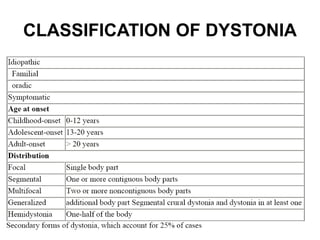
CLASSIFICATION OF DYSTONIA
• What is the most common form of focal
dystonia?
• The cervical region is the area most frequently
affected by dystonia. Among 1000 patients with
dystonia at the Baylor College of Medicine
Parkinson's Disease Center and Movement
Disorders Clinic, 76% have cervical dystonia,
alone (33% patients) or associated with
involvement of other areas. It is slightly more
common in women (61%). Depending on the
muscles involved, different types of postures are
observed. Most patients with cervical dystonia
have a combination of abnormal postures, such
as torticollis, laterocollis, and anterocollis. Pain is
a feature in about 70% of the patients with neck
dystonia, whereas tremor, either dystonic or
essential-type, is observed in 60%.
• What are the other forms of focal
dystonia?
• Blepharospasm, either isolated (11%) or combined with
oromandibular dystonia (23%), is the second most
common form of focal dystonia. It is defined as an
involuntary, bilateral eye closure produced by dystonic
contractions of the orbicularis oculi muscles.
Blepharospasm is three times more common in women
than men. Onset is usually gradual; often, before the
onset of sustained eyelid closure, patients experience
excessive blinking triggered by bright light, wind, and
stress. With progression, most patients develop dystonia
involving other facial muscles as well as the masticatory
and cervical musculature. Sensory tricks that help to
maintain the eyes open include pulling on the upper
eyelids, talking, and yawning. Up to 15% of patients with
blepharospasm become legally blind because of inability
to keep their eyes open.
• What are tics?
• Tics are relatively brief, sudden, rapid, and intermittent
movements (motor tics) or sounds (vocal tics). They may
be repetitive and stereotypic. Tics are usually abrupt in
onset and brief (clonic tics) but may be slow and
sustained (dystonic tics). Examples of even more
prolonged tics (tonic tics) include abdominal or limb
tensing. Simple tics are caused by contractions of only
one group of muscles and result in a brief, jerk-like
movement or single, meaningless sound. Motor tics may
also be complex, consisting of coordinated sequenced
movements that resemble normal motor acts but are
inappropriately intense and timed. Unlike other
hyperkinetic dyskinesias, tics may be temporarily
suppressed, leading some authors to suggest that in
many patients they are purposefully, albeit irresistibly,
performed.
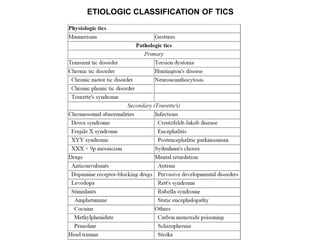
ETIOLOGIC CLASSIFICATION OF TICS
• What are common causes of chorea?
• It is probable that levodopa-induced chorea in
parkinsonism is the most common cause of chorea.
Usually this diagnosis is not difficult once the history is
available.
• The combination of chorea and psychiatric symptoms
can be found in Wilson's disease. However, the
diagnosis is easily made by finding a Kayser-Fleischer
ring, low-plasma ceruloplasmin, and evidence of hepatic
dysfunction. Sydenham's chorea is a form of
autoimmune chorea, preceded by a group A
streptococcal infection. Systemic lupus erythematosus
and primary antiphospholipid antibody syndrome are
other causes of autoimmune chorea. Senile chorea is a
condition in which chorea is the only feature; no family
history of HD is present
• What is an acute dystonic reaction?
• Acute dystonic reaction is an abrupt, drug-
induced dystonia, especially of the head and
neck. About 2.5% of patients treated with
neuroleptics develop ADR within the first 48 h of
treatment. Cocaine use increases the likelihood
of ADR. Although it is one of the first described
neuroleptic induced-movement disorders, the
pathophysiology of ADR remains unknown.
Because it follows the use of dopamine receptor-
blocking drugs and improves with
anticholinergics, it is presumed that changes in
the striatal dopamine and acetylcholine are
important in the genesis of ADR.
• What is tardive dyskinesia?
• Tardive dyskinesia is a hyperkinetic movement
disorder caused by dopamine receptor-blocking
drugs. According to current criteria, it is possible
to make the diagnosis of TD when the
hyperkinesia develops during treatment with
neuroleptics or within 6 months of their
discontinuation and persists for at least 1 month
after stopping all neuroleptic agents. It is
estimated that 20% of patients exposed to
neuroleptics develop TD, but the values range
from 13% to 49%. Severe TD seems to be more
common in young males and elderly females.

Movement Disorders (pract).ppt...... .....

  • 1.
  • 2.
    • What arethe components of the basal ganglia?
  • 3.
    • The basalganglia are a group of nuclei situated in the deep part of the cerebrum and upper part of the brain stem. Included among these nuclei are the striatum, which is composed of the caudate, putamen, and ventral striatum; the pallidum, which is composed of the internal (medial) and external (lateral) parts of the globus pallidus (GP); the subthalamic nucleus (STN); and the substantia nigra (SN), with the pars compacta (SNc) and pars reticulata (SNr).
  • 4.
    • What arethe cardinal symptoms and signs of parkinsonism?
  • 5.
    • Tremor atrest is one of the most typical signs of parkinsonism. It is characterized by an oscillatory pronation-supination at a 3-5 Hz frequency. In addition to the hands, where it assumes an appearance of pill rolling, this type of tremor is commonly observed in the facial musculature (lips and chin) as well as in the legs. Head tremor, however, is rare in parkinsonism, and its presence should suggest the diagnosis of essential tremor (ET). • The term bradykinesia is used to describe slowness of movements that often causes difficulties for the patients in getting dressed, feeding, and maintaining personal hygiene. Bradykinesia is evident when a patient performs rapid alternating movements, such as pronation and supination of the forearms. • Rigidity, often associated with the cogwheel phenomenon, is another hallmark of parkinsonism. Impairment of the postural reflexes is responsible for the falls that are frequently experienced by parkinsonian patients. Parkinsonian gait often reflects a combination of bradykinesia, rigidity, and postural instability.
  • 6.
    • What arethe most common causes of parkinsonism?
  • 7.
    • In ahighly selected population, such as that attending a movement disorders clinic, PD is responsible for 77.7% of the cases of parkinsonism. The other most frequent causes are parkinsonism-plus syndrome (12.2%), secondary parkinsonism (8.2%), and heredodegenerative parkinsonism (0.6%).
  • 8.
    • When shouldlevodopa therapy be started in the treatment of PD?
  • 9.
    • A rationalstrategy is to start levodopa when the parkinsonian symptoms begin to impair activities of daily living or to interfere with social and occupational functioning. • A typical starting dose is Sinemet CR 25/100 2 or 3 times/day. Maintenance doses of 200-600 mg/day of levodopa may be needed in patients with moderately advanced Parkinson's disease. Other formulations include Sinemet 10/100, Sinemet 25/250, and Sinemet CR 50/200. • The dosage of carbidopa should be kept at less than 150 mg/day because it may penetrate the blood-brain barrier and inhibit central dopa-decarboxylase at higher levels. Thus, use of the 25/250 tablets may be preferred over the 25/100 tablets if sufficiently high levodopa doses are needed.
  • 10.
    • What arethe most common peripheral side effects of levodopa therapy? How are they managed?
  • 11.
    • Nausea andvomiting are common side effects in the beginning of the use of levodopa. Most of the patients overcome this difficulty by taking the medication after meals. In some patients, extra amounts of carbidopa (typically, one 25-mg tablet with each dose of Sinemet) may be necessary. A small proportion of patients have nausea and vomiting despite these measures. Treatment of the gastrointestinal (GI) side effects should not include dopamine blockers, such as metoclopramide, because they may cause worsening of PD. Diphenidol and cyclizine are useful alternatives. • The most common cardiovascular side effect is orthostatic hypotension. The management of this complication involves adding salt to the diet, wearing elastic stockings, and using medications such as fluodrocortisone, indomethacin, or midodrine.
  • 12.
    • What clinicalfluctuations are recognized in PD?
  • 13.
    • Although themost dramatic fluctuations in patients with PD are related to levodopa therapy, some who have not been previously treated with dopaminergic drugs exhibit fluctuations in severity of their symptoms and signs. Fluctuations are not exclusively motor phenomena. Mood and autonomic functions also fluctuate. For example, some patients display depression when they are "off" and euphoria when they are "on." Fatigue and stress usually make these symptoms more prominent. The most dramatic example of spontaneous fluctuations is paradoxical dyskinesia: under extreme stress, patients completely immobilized by parkinsonism are suddenly able to stand up and run.
  • 14.
    • Is itpossible to distinguish drug- induced parkinsonism from PD on clinical grounds?
  • 15.
    • Drugs areone of the most common causes of parkinsonism in the general population. Drugs that block postsynaptic dopamine receptors and/or deplete presynaptic dopamine may cause parkinsonism. Clinical studies indicate that drug- induced parkinsonism is indistinguishable from PD. Discontinuation of the offending drug promotes remission of the syndrome in most cases, although sometimes the parkinsonism persists. Such patients may have subclinical PD and require dopaminergic therapy.
  • 16.
    • What ismultiple system atrophy (MSA)?
  • 17.
    • Multiple systematrophy is a neuropathologic term that includes Shy-Drager syndrome (SDS), sporadic forms of olivopontocerebellar atrophy (OPCA), and striatonigral degeneration (SND). SDS is characterized by parkinsonism, which occasionally responds to dopaminergic therapy, and dysautonomia. Although cerebellar findings dominate in OPCA, mild parkinsonism and pyramidal signs are also usually recognized. Patients with SND typically have parkinsonism and pyramidal signs with laryngeal stridor, although in some cases, SND is indistinguishable from PD. • The division of MSA into SDS, OPCA, and SND is controversial. Although usually clinically distinct at onset, with progression symptoms overlap substantially. The three syndromes have a common pathologic substratum.
  • 18.
    • What isessential tremor (ET)?
  • 19.
    • Essential tremoris a neurologic disease characterized by action tremor of the hands in the absence of any identifiable causes, such as drugs or toxins. Other types of tremor, such as isolated head and voice tremor, are also expressions of ET. It is estimated that at least 5 million Americans are affected by ET. Characterized by action-postural tremor of the hands and arms, ET may be asymmetric at onset and have a kinetic component. Patients with severe forms of ET may display tremor at rest. • ET is presumably transmitted by an autosomal dominant gene with variable expression. Recently, a familial ET gene (in Icelandic families) was mapped to chromosome 3. However, about 35% of patients with ET have a negative family history. Supportive criteria for diagnosis of ET include improvement with alcohol, propranolol, and primidone.
  • 20.
    • How canenhanced physiologic tremor be differentiated from ET?
  • 21.
    • Physiologic tremoris a rhythmic oscillation with a frequency of 8-12 Hz, determined largely by the mechanical properties of the oscillating limb. Under several circumstances, the tremor may be enhanced and appears identical to ET. Enhanced physiologic tremor is the most common cause of postural tremor. However, unlike ET, its frequency can be reduced by mass loading
  • 22.
    • What arethe characteristics and most common causes of kinetic tremor?
  • 23.
    • Kinetic tremorsresult from lesions of the cerebellar outflow pathways. The tremor has a 3-4 Hz frequency and is typically observed on the finger-to-nose test. In patients with cerebellar lesions, titubation (anterior/posterior oscillation of the trunk and head) and postural tremor of the hands are often seen in addition to the kinetic tremor. Patients who have lesions in the midbrain, involving the superior cerebellar peduncle and nigrostriatal system, also display tremor at rest (midbrain tremor). • Multiple sclerosis, trauma, stroke, Wilson's disease, phenytoin intoxication, acute alcoholic intoxication, cerebellar parenchymatous alcoholic degeneration, and tumor are the most important causes of kinetic tremor.
  • 24.
    • What istorsion dystonia?
  • 25.
    • Torsion dystoniais a neurologic condition characterized by sustained contractions of both agonist and antagonist muscles, frequently causing twisting and repetitive movements or abnormal postures. Because there is no biochemical, pathologic, or radiologic marker for dystonia, the diagnosis is based on the recognition of clinical features. A characteristic feature of dystonia that helps to differentiate it from other hyperkinetic movement disorders is that dystonic movements are repetitive and patterned. For reasons that are poorly understood, patients with dystonia have the ability to suppress or decrease the involuntary movements by gently touching the affected area (sensory trick or geste antagonistique). Stress and fatigue make dystonia worse, whereas sleep and relaxation improve it.
  • 26.
  • 27.
    • What isthe most common form of focal dystonia?
  • 28.
    • The cervicalregion is the area most frequently affected by dystonia. Among 1000 patients with dystonia at the Baylor College of Medicine Parkinson's Disease Center and Movement Disorders Clinic, 76% have cervical dystonia, alone (33% patients) or associated with involvement of other areas. It is slightly more common in women (61%). Depending on the muscles involved, different types of postures are observed. Most patients with cervical dystonia have a combination of abnormal postures, such as torticollis, laterocollis, and anterocollis. Pain is a feature in about 70% of the patients with neck dystonia, whereas tremor, either dystonic or essential-type, is observed in 60%.
  • 30.
    • What arethe other forms of focal dystonia?
  • 31.
    • Blepharospasm, eitherisolated (11%) or combined with oromandibular dystonia (23%), is the second most common form of focal dystonia. It is defined as an involuntary, bilateral eye closure produced by dystonic contractions of the orbicularis oculi muscles. Blepharospasm is three times more common in women than men. Onset is usually gradual; often, before the onset of sustained eyelid closure, patients experience excessive blinking triggered by bright light, wind, and stress. With progression, most patients develop dystonia involving other facial muscles as well as the masticatory and cervical musculature. Sensory tricks that help to maintain the eyes open include pulling on the upper eyelids, talking, and yawning. Up to 15% of patients with blepharospasm become legally blind because of inability to keep their eyes open.
  • 32.
  • 33.
    • Tics arerelatively brief, sudden, rapid, and intermittent movements (motor tics) or sounds (vocal tics). They may be repetitive and stereotypic. Tics are usually abrupt in onset and brief (clonic tics) but may be slow and sustained (dystonic tics). Examples of even more prolonged tics (tonic tics) include abdominal or limb tensing. Simple tics are caused by contractions of only one group of muscles and result in a brief, jerk-like movement or single, meaningless sound. Motor tics may also be complex, consisting of coordinated sequenced movements that resemble normal motor acts but are inappropriately intense and timed. Unlike other hyperkinetic dyskinesias, tics may be temporarily suppressed, leading some authors to suggest that in many patients they are purposefully, albeit irresistibly, performed.
  • 34.
  • 35.
    • What arecommon causes of chorea?
  • 36.
    • It isprobable that levodopa-induced chorea in parkinsonism is the most common cause of chorea. Usually this diagnosis is not difficult once the history is available. • The combination of chorea and psychiatric symptoms can be found in Wilson's disease. However, the diagnosis is easily made by finding a Kayser-Fleischer ring, low-plasma ceruloplasmin, and evidence of hepatic dysfunction. Sydenham's chorea is a form of autoimmune chorea, preceded by a group A streptococcal infection. Systemic lupus erythematosus and primary antiphospholipid antibody syndrome are other causes of autoimmune chorea. Senile chorea is a condition in which chorea is the only feature; no family history of HD is present

  • 37.
    • What isan acute dystonic reaction?
  • 38.
    • Acute dystonicreaction is an abrupt, drug- induced dystonia, especially of the head and neck. About 2.5% of patients treated with neuroleptics develop ADR within the first 48 h of treatment. Cocaine use increases the likelihood of ADR. Although it is one of the first described neuroleptic induced-movement disorders, the pathophysiology of ADR remains unknown. Because it follows the use of dopamine receptor- blocking drugs and improves with anticholinergics, it is presumed that changes in the striatal dopamine and acetylcholine are important in the genesis of ADR.
  • 39.
    • What istardive dyskinesia?
  • 40.
    • Tardive dyskinesiais a hyperkinetic movement disorder caused by dopamine receptor-blocking drugs. According to current criteria, it is possible to make the diagnosis of TD when the hyperkinesia develops during treatment with neuroleptics or within 6 months of their discontinuation and persists for at least 1 month after stopping all neuroleptic agents. It is estimated that 20% of patients exposed to neuroleptics develop TD, but the values range from 13% to 49%. Severe TD seems to be more common in young males and elderly females.