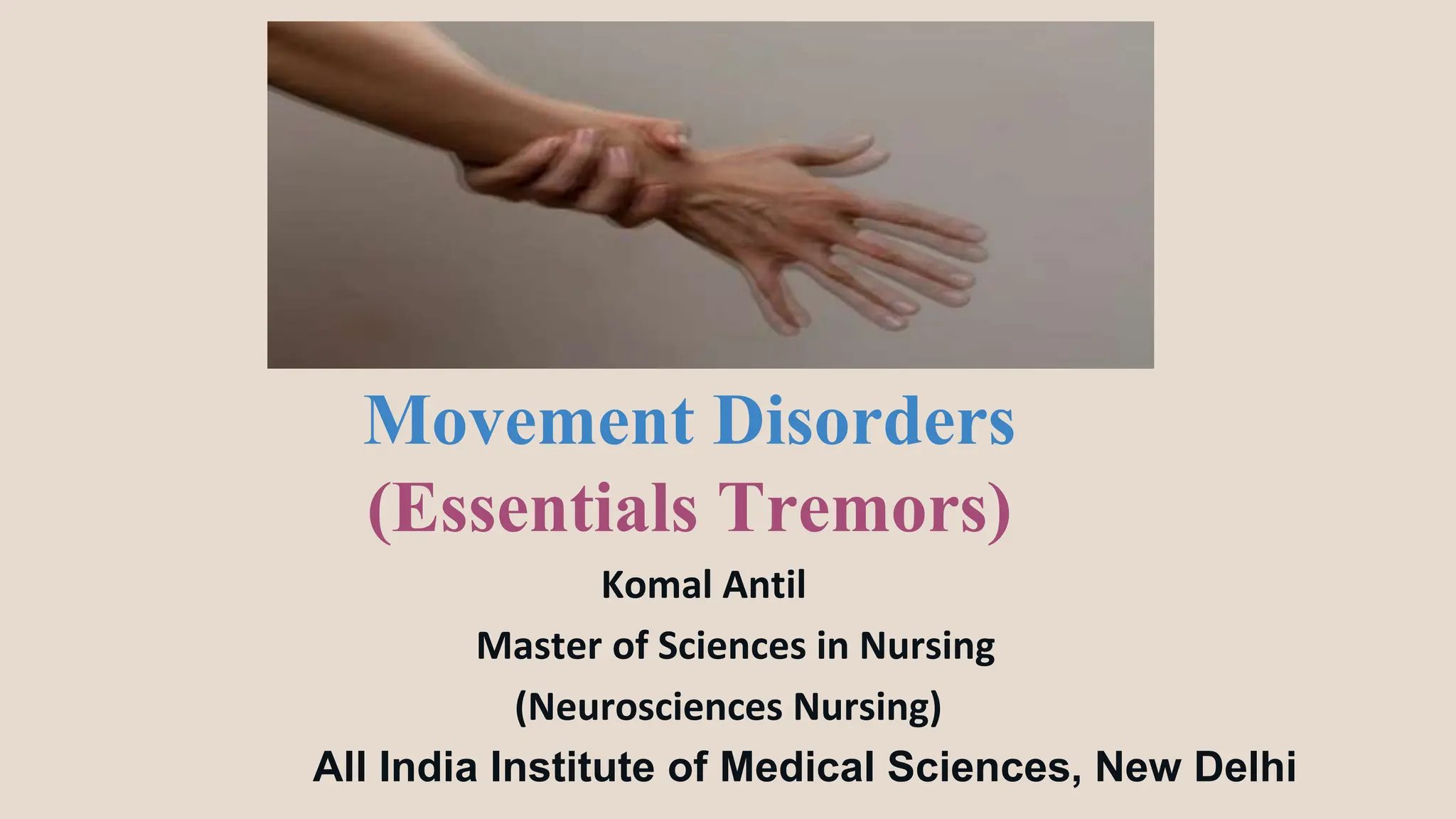
Movement Disorders
(Essentials Tremors)
Komal Antil
Master of Sciences in Nursing
(Neurosciences Nursing)
All India Institute of Medical Sciences, New Delhi
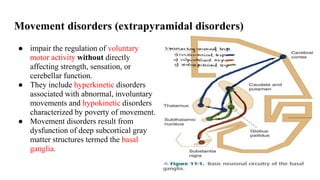
Movement disorders (extrapyramidal disorders)
● impair the regulation of voluntary
motor activity without directly
affecting strength, sensation, or
cerebellar function.
● They include hyperkinetic disorders
associated with abnormal, involuntary
movements and hypokinetic disorders
characterized by poverty of movement.
● Movement disorders result from
dysfunction of deep subcortical gray
matter structures termed the basal
ganglia.
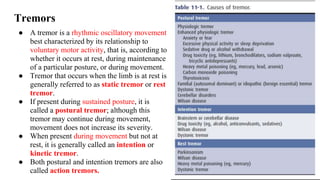
Tremors
● A tremor is a rhythmic oscillatory movement
best characterized by its relationship to
voluntary motor activity, that is, according to
whether it occurs at rest, during maintenance
of a particular posture, or during movement.
● Tremor that occurs when the limb is at rest is
generally referred to as static tremor or rest
tremor.
● If present during sustained posture, it is
called a postural tremor; although this
tremor may continue during movement,
movement does not increase its severity.
● When present during movement but not at
rest, it is generally called an intention or
kinetic tremor.
● Both postural and intention tremors are also
called action tremors.
Familial or Benign Essential Tremors
Introduction
● Most common cause of action tremor in adults.
● classically involves the hands and is brought out by arm
movement and sustained antigravity postures, affecting
common daily activities such as writing, drinking from a
glass, and handling eating utensils.
● slowly progressive and can also involve the head, voice, and,
uncommonly, the legs.
● It often has a familial basis with an autosomal dominant
mode of inheritance. At least three gene loci have been
implicated; in some cases (ETM1), the disorder is related to a
polymorphism in the D3 dopamine receptor gene (DRD3).
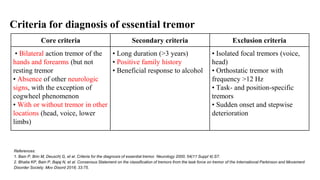
Criteria for diagnosis of essential tremor
Core criteria Secondary criteria Exclusion criteria
• Bilateral action tremor of the
hands and forearms (but not
resting tremor
• Absence of other neurologic
signs, with the exception of
cogwheel phenomenon
• With or without tremor in other
locations (head, voice, lower
limbs)
• Long duration (>3 years)
• Positive family history
• Beneficial response to alcohol
• Isolated focal tremors (voice,
head)
• Orthostatic tremor with
frequency >12 Hz
• Task- and position-specific
tremors
• Sudden onset and stepwise
deterioration
References:
1. Bain P, Brin M, Deusch| G, et al. Criteria for the diagnosis of essential tremor. Neurology 2000; 54(11 Suppl 4):S7.
2. Bhatia KP, Bain P, Bajaj N, et al. Consensus Statement on the classification of tremors from the task force on tremor of the International Parkinson and Movement
Disorder Society. Mov Disord 2018; 33:75.
Goals & Expectations
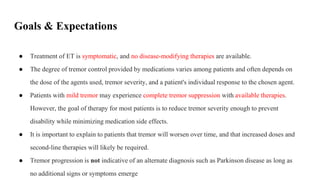
● Treatment of ET is symptomatic, and no disease-modifying therapies are available.
● The degree of tremor control provided by medications varies among patients and often depends on
the dose of the agents used, tremor severity, and a patient's individual response to the chosen agent.
● Patients with mild tremor may experience complete tremor suppression with available therapies.
However, the goal of therapy for most patients is to reduce tremor severity enough to prevent
disability while minimizing medication side effects.
● It is important to explain to patients that tremor will worsen over time, and that increased doses and
second-line therapies will likely be required.
● Tremor progression is not indicative of an alternate diagnosis such as Parkinson disease as long as
no additional signs or symptoms emerge
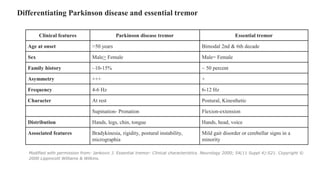
Differentiating Parkinson disease and essential tremor
Clinical features Parkinson disease tremor Essential tremor
Age at onset >50 years Bimodal 2nd & 6th decade
Sex Male> Female Male= Female
Family history ~10-15% ~ 50 percent
Asymmetry +++ +
Frequency 4-6 Hz 6-12 Hz
Character At rest Postural, Kinesthetic
Supination- Pronation Flexion-extension
Distribution Hands, legs, chin, tongue Hands, head, voice
Associated features Bradykinesia, rigidity, postural instability,
micrographia
Mild gait disorder or cerebellar signs in a
minority
Modified with permission from: Jankovic J. Essential tremor: Clinical characteristics. Neurology 2000; 54(11 Suppl 4):S21. Copyright ©
2000 Lippincott Williams & Wilkins.
Treatment approach
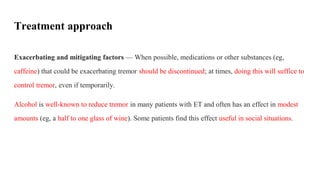
Exacerbating and mitigating factors — When possible, medications or other substances (eg,
caffeine) that could be exacerbating tremor should be discontinued; at times, doing this will suffice to
control tremor, even if temporarily.
Alcohol is well-known to reduce tremor in many patients with ET and often has an effect in modest
amounts (eg, a half to one glass of wine). Some patients find this effect useful in social situations.
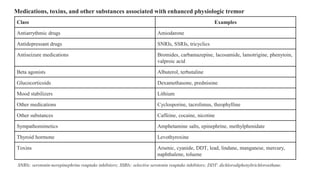
Medications, toxins, and other substances associated with enhanced physiologic tremor
Class Examples
Antiarrythmic drugs Amiodarone
Antidepressant drugs SNRIs, SSRIs, tricyclics
Antiseizure medications Bromides, carbamazepine, lacosamide, lamotrigine, phenytoin,
valproic acid
Beta agonists Albuterol, terbutaline
Glucocorticoids Dexamethasone, prednisone
Mood stabilizers Lithium
Other medications Cyclosporine, tacrolimus, theophylline
Other substances Caffeine, cocaine, nicotine
Sympathomimetics Amphetamine salts, epinephrine, methylphenidate
Thyroid hormone Levothyroxine
Toxins Arsenic, cyanide, DDT, lead, lindane, manganese, mercury,
naphthalene, toluene
SNRIs: serotonin-norepinephrine reuptake inhibitors; SSRIs: selective serotonin reuptake inhibitors; DDT: dichlorodiphenyltrichloroethane.
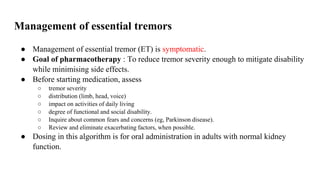
Management of essential tremors
● Management of essential tremor (ET) is symptomatic.
● Goal of pharmacotherapy : To reduce tremor severity enough to mitigate disability
while minimising side effects.
● Before starting medication, assess
○ tremor severity
○ distribution (limb, head, voice)
○ impact on activities of daily living
○ degree of functional and social disability.
○ Inquire about common fears and concerns (eg, Parkinson disease).
○ Review and eliminate exacerbating factors, when possible.
● Dosing in this algorithm is for oral administration in adults with normal kidney
function.
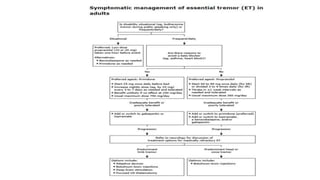
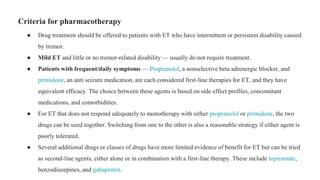
Criteria for pharmacotherapy
● Drug treatment should be offered to patients with ET who have intermittent or persistent disability caused
by tremor.
● Mild ET and little or no tremor-related disability — usually do not require treatment.
● Patients with frequent/daily symptoms — Propranolol, a nonselective beta adrenergic blocker, and
primidone, an anti seizure medication, are each considered first-line therapies for ET, and they have
equivalent efficacy. The choice between these agents is based on side effect profiles, concomitant
medications, and comorbidities.
● For ET that does not respond adequately to monotherapy with either propranolol or primidone, the two
drugs can be used together. Switching from one to the other is also a reasonable strategy if either agent is
poorly tolerated.
● Several additional drugs or classes of drugs have more limited evidence of benefit for ET but can be tried
as second-line agents, either alone or in combination with a first-line therapy. These include topiramate,
benzodiazepines, and gabapentin.
Administration and efficacy
Propranolol — Propranolol is the best-studied beta blocker for ET.
Beta blockers are thought to impact tremor severity through action on adrenoreceptors in a
deep compartment within muscle spindles. In mice, propranolol has been shown to
modulate the spiking activity of Purkinje cells and cerebellar nuclei neurons.
Propranolol
● Dose and formulation – The usual starting dose of propranolol for ET is 60 or 80 mg daily
(divided two to four times per day for immediate-release). If a starting dose lower than 60 mg is
desired due to comorbidities or advanced age, the immediate-release formulation can be used
initially. The dose may be increased as needed at ≥1-week intervals up to a usual maximum of
360 mg daily. The mean end-titration dose of propranolol for ET in nine trials was
approximately 185 mg per day.
○ Single doses of immediate-release propranolol taken in anticipation of social situations
that are likely to exacerbate tremor are useful in some patients. A single starting dose of 10
or 20 mg is suggested, which may be reasonably effective within an hour of taking the
● Side effects – Side effects attributable to propranolol, including lightheadedness, fatigue,
impotence, and bradycardia, occurred in 12 to 66 percent of patients in clinical trials. As an
example, one open-label study reported that such side effects led to discontinuation in 4 of
23 patients (17 percent) taking propranolol.
Propranolol is relatively contraindicated in the presence of heart block, unstable heart
failure, asthma, and type 1 diabetes mellitus.
Propranolol
Primidone — Primidone is an anti seizure medication that is metabolized to phenobarbital and
phenylethylmalonamide. The mechanism of action for ET is unknown, and neither metabolite appears
to influence tremor when used alone. Primidone is used less commonly than propranolol but has
similar efficacy and is a reasonable alternative first-line agent for ET.
Primidone is a potent inducer of hepatic microsomal metabolizing enzymes. Thus, drug-drug
interactions should be checked before primidone is added to existing medications.
Primidone
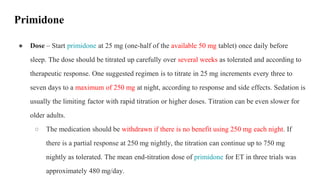
● Dose – Start primidone at 25 mg (one-half of the available 50 mg tablet) once daily before
sleep. The dose should be titrated up carefully over several weeks as tolerated and according to
therapeutic response. One suggested regimen is to titrate in 25 mg increments every three to
seven days to a maximum of 250 mg at night, according to response and side effects. Sedation is
usually the limiting factor with rapid titration or higher doses. Titration can be even slower for
older adults.
○ The medication should be withdrawn if there is no benefit using 250 mg each night. If
there is a partial response at 250 mg nightly, the titration can continue up to 750 mg
nightly as tolerated. The mean end-titration dose of primidone for ET in three trials was
approximately 480 mg/day.
Primidone
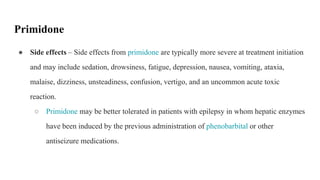
● Side effects – Side effects from primidone are typically more severe at treatment initiation
and may include sedation, drowsiness, fatigue, depression, nausea, vomiting, ataxia,
malaise, dizziness, unsteadiness, confusion, vertigo, and an uncommon acute toxic
reaction.
○ Primidone may be better tolerated in patients with epilepsy in whom hepatic enzymes
have been induced by the previous administration of phenobarbital or other
antiseizure medications.
Primidone
Second-line therapies
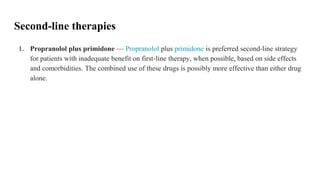
1. Propranolol plus primidone — Propranolol plus primidone is preferred second-line strategy
for patients with inadequate benefit on first-line therapy, when possible, based on side effects
and comorbidities. The combined use of these drugs is possibly more effective than either drug
alone.
2. Topiramate
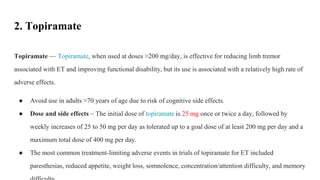
Topiramate — Topiramate, when used at doses >200 mg/day, is effective for reducing limb tremor
associated with ET and improving functional disability, but its use is associated with a relatively high rate of
adverse effects.
● Avoid use in adults >70 years of age due to risk of cognitive side effects.
● Dose and side effects – The initial dose of topiramate is 25 mg once or twice a day, followed by
weekly increases of 25 to 50 mg per day as tolerated up to a goal dose of at least 200 mg per day and a
maximum total dose of 400 mg per day.
● The most common treatment-limiting adverse events in trials of topiramate for ET included
paresthesias, reduced appetite, weight loss, somnolence, concentration/attention difficulty, and memory
3. Benzodiazepines
Benzodiazepines — Benzodiazepines are widely used because of the usually mistaken
belief that tremor is due to anxiety. Be that as it may, in patients in whom tremor is
aggravated by anxiety, an anxiolytic may partially reduce tremor.
Caution is urged with the use of benzodiazepines for ET because of the potential for abuse
and dependence, as well as the potential for drug discontinuation to cause withdrawal
symptoms (including seizures) and tremor rebound. These problems make
benzodiazepines a second-line choice for the chronic treatment of ET. The two
benzodiazepines that have been studied for ET are alprazolam and clonazepam.
Cont..
● Alprazolam may be useful for the treatment of limb tremor associated with ET in select patients,
although high-quality data are lacking. Two small clinical trials found that alprazolam, 0.125 to
3 mg/day, was associated with an improvement in clinical rating scales of 25 to 34 percent
compared with placebo. Side effects included mild sedation and fatigue. A tremor reduction of
69 and 76 percent (according to electromyography [EMG] data recorded at 40 and 80 minutes,
respectively, after a dose of alprazolam) was documented in a study involving eight patients.
● Clonazepam is occasionally used for the treatment of limb tremor associated with ET, although
data are mixed. One clinical trial found that clonazepam 0.5 to 6 mg/day significantly reduced
tremor, while another study found that clonazepam 0.4 to 4 mg/day was ineffective and resulted
4. Gabapentin
Gabapentin — Gabapentin as monotherapy has anti tremors effects in some patients with ET, but
supporting data are very limited.
● Dose and side effects – If using gabapentin for ET, start with initial dose of 100 to 300 mg
three times daily, using the low end of the range for older adult patients. The dose can be titrated
upwards as tolerated, typically by increasing the total daily dose by 300 mg every four to seven
days. An effective range is not well established for ET, but 1200 mg daily was used in the only
monotherapy trial. Gabapentin may have fewer side effects than primidone but can cause
sleepiness, dizziness, and gait unsteadiness, particularly in older adults.
Refractory Tremor
Adaptive devices — Several different devices are being developed to noninvasively modulate
and/or compensate for tremor severity. All patients with ET may find benefit from adaptive
devices, but patients with disabling tremor who either are not candidates for other treatment
modalities or have suboptimal tremor control with them may be the best candidates for these
technologies.
Adaptive devices
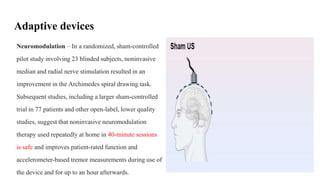
Neuromodulation – In a randomized, sham-controlled
pilot study involving 23 blinded subjects, noninvasive
median and radial nerve stimulation resulted in an
improvement in the Archimedes spiral drawing task.
Subsequent studies, including a larger sham-controlled
trial in 77 patients and other open-label, lower quality
studies, suggest that noninvasive neuromodulation
therapy used repeatedly at home in 40-minute sessions
is safe and improves patient-rated function and
accelerometer-based tremor measurements during use of
the device and for up to an hour afterwards.
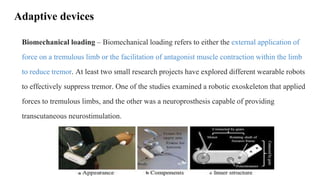
Biomechanical loading – Biomechanical loading refers to either the external application of
force on a tremulous limb or the facilitation of antagonist muscle contraction within the limb
to reduce tremor. At least two small research projects have explored different wearable robots
to effectively suppress tremor. One of the studies examined a robotic exoskeleton that applied
forces to tremulous limbs, and the other was a neuroprosthesis capable of providing
transcutaneous neurostimulation.
Adaptive devices
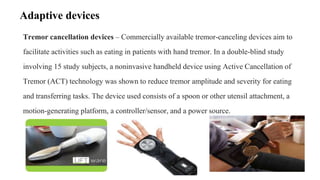
Tremor cancellation devices – Commercially available tremor-canceling devices aim to
facilitate activities such as eating in patients with hand tremor. In a double-blind study
involving 15 study subjects, a noninvasive handheld device using Active Cancellation of
Tremor (ACT) technology was shown to reduce tremor amplitude and severity for eating
and transferring tasks. The device used consists of a spoon or other utensil attachment, a
motion-generating platform, a controller/sensor, and a power source.
Adaptive devices
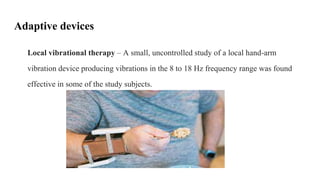
Local vibrational therapy – A small, uncontrolled study of a local hand-arm
vibration device producing vibrations in the 8 to 18 Hz frequency range was found
effective in some of the study subjects.
Adaptive devices
Botulinum toxin
Botulinum toxin — Botulinum toxin (BoNT) injections have shown variable benefits in
trials for hand, voice, and head tremor and are associated with dose-dependent risk of
weakness in the injected muscles. However, they are endorsed by an International
Parkinson and Movement Disorder Society (MDS) evidence-based review as possibly
useful in clinical practice with specialized monitoring.
BoNT therapy -patients who cannot tolerate or are uninterested in trying oral medications
for tremor.
Cont…
Patient selection —
● The best candidates for upper limb injections are patients whose tremor amplitude is mild
enough to respond to low doses of BoNT type A (BoNT-A) or patients with severe and
disabling upper limb tremor who would prefer hand weakness over tremor. Although
reversible once the effects of BoNT wear off, hand weakness can be disabling while
present, particularly when the dominant hand is affected. Only experienced limb injectors
should administer this procedure.
● For head and vocal tremor, there are also trade-offs between benefits and side effects.
BoNT-A for voice tremor is associated with side effects that include breathiness,
hoarseness, and swallowing difficulty, and common side effects with head tremor
injections include dysphagia and neck weakness, stiffness, and/or pain.
● BoNT for vocal tremor is best administered by an otolaryngology specialist with expertise
References
Familial, or Benign, Essential Tremor
● Benito-León J, Louis ED. Essential tremor: emerging views of a common disorder. Nat Clin Pract Neurol. 2006;2:666-678.
● Deng H, Le W, Jankovic J. Genetics of essential tremor. Brain. 2007;130:1456-1464.
● Deuschl G, Raethjen J, Hellriegel H, Elble R. Treatment of patients with essential tremor. Lancet Neurol. 2011;10:148-161.
● Elble RJ. Characteristics of physiologic tremor in young and elderly adults. Clin Neurophysiol. 2003;114:624-635.
● Flora ED, Perera CL, Cameron AL, Maddern GJ. Deep brain stimulation for essential tremor: a systematic review. MovDisord.
2010;25:1550-1559.
● Lorenz D, Deuschl G. Update on pathogenesis and treatment of essential tremor. Curr Opin Neurol. 2007;20:447-452.
● Louis ED. Essential tremor: evolving clinicopathological concepts in an era of intensive post-mortem enquiry. Lancet Neurol. 2010; 9:613-
622.
● Pahwa R, Lyons KE. Essential tremor: differential diagnosis and current therapy. Am J Med. 2003;115:134-142.
● Sadeghi R, Ondo WG. Pharmacological management of essential tremor. Drugs. 2010;70:2215-2228.
● Sethi KD. Tremor. Curr Opin Neurol. 2003;16:481-485. Zesiewicz TA, Elble RJ, Louis ED, et al. Evidence-based guideline update:
treatment of essential tremor: report of the Quality Standards subcommittee of the American Academy of Neurology. Neurology.
2011;77:1752-1755.
● Zesiewicz TA, Chari A, Jahan I, Miller AM, Sullivan KL. Overview of essential tremor. Neuropsychiatr Dis Treat. 2010;6:401-418.
THANKS
Do you have any questions ?
For Query: komalantil000@gmail.com

Essential Tremors (Movement Disorder).pptx

  • 1.
    Movement Disorders (Essentials Tremors) KomalAntil Master of Sciences in Nursing (Neurosciences Nursing) All India Institute of Medical Sciences, New Delhi
  • 2.
    Movement disorders (extrapyramidaldisorders) ● impair the regulation of voluntary motor activity without directly affecting strength, sensation, or cerebellar function. ● They include hyperkinetic disorders associated with abnormal, involuntary movements and hypokinetic disorders characterized by poverty of movement. ● Movement disorders result from dysfunction of deep subcortical gray matter structures termed the basal ganglia.
  • 3.
    Tremors ● A tremoris a rhythmic oscillatory movement best characterized by its relationship to voluntary motor activity, that is, according to whether it occurs at rest, during maintenance of a particular posture, or during movement. ● Tremor that occurs when the limb is at rest is generally referred to as static tremor or rest tremor. ● If present during sustained posture, it is called a postural tremor; although this tremor may continue during movement, movement does not increase its severity. ● When present during movement but not at rest, it is generally called an intention or kinetic tremor. ● Both postural and intention tremors are also called action tremors.
  • 4.
    Familial or BenignEssential Tremors
  • 5.
    Introduction ● Most commoncause of action tremor in adults. ● classically involves the hands and is brought out by arm movement and sustained antigravity postures, affecting common daily activities such as writing, drinking from a glass, and handling eating utensils. ● slowly progressive and can also involve the head, voice, and, uncommonly, the legs. ● It often has a familial basis with an autosomal dominant mode of inheritance. At least three gene loci have been implicated; in some cases (ETM1), the disorder is related to a polymorphism in the D3 dopamine receptor gene (DRD3).
  • 6.
    Criteria for diagnosisof essential tremor Core criteria Secondary criteria Exclusion criteria • Bilateral action tremor of the hands and forearms (but not resting tremor • Absence of other neurologic signs, with the exception of cogwheel phenomenon • With or without tremor in other locations (head, voice, lower limbs) • Long duration (>3 years) • Positive family history • Beneficial response to alcohol • Isolated focal tremors (voice, head) • Orthostatic tremor with frequency >12 Hz • Task- and position-specific tremors • Sudden onset and stepwise deterioration References: 1. Bain P, Brin M, Deusch| G, et al. Criteria for the diagnosis of essential tremor. Neurology 2000; 54(11 Suppl 4):S7. 2. Bhatia KP, Bain P, Bajaj N, et al. Consensus Statement on the classification of tremors from the task force on tremor of the International Parkinson and Movement Disorder Society. Mov Disord 2018; 33:75.
  • 7.
    Goals & Expectations ●Treatment of ET is symptomatic, and no disease-modifying therapies are available. ● The degree of tremor control provided by medications varies among patients and often depends on the dose of the agents used, tremor severity, and a patient's individual response to the chosen agent. ● Patients with mild tremor may experience complete tremor suppression with available therapies. However, the goal of therapy for most patients is to reduce tremor severity enough to prevent disability while minimizing medication side effects. ● It is important to explain to patients that tremor will worsen over time, and that increased doses and second-line therapies will likely be required. ● Tremor progression is not indicative of an alternate diagnosis such as Parkinson disease as long as no additional signs or symptoms emerge
  • 8.
    Differentiating Parkinson diseaseand essential tremor Clinical features Parkinson disease tremor Essential tremor Age at onset >50 years Bimodal 2nd & 6th decade Sex Male> Female Male= Female Family history ~10-15% ~ 50 percent Asymmetry +++ + Frequency 4-6 Hz 6-12 Hz Character At rest Postural, Kinesthetic Supination- Pronation Flexion-extension Distribution Hands, legs, chin, tongue Hands, head, voice Associated features Bradykinesia, rigidity, postural instability, micrographia Mild gait disorder or cerebellar signs in a minority Modified with permission from: Jankovic J. Essential tremor: Clinical characteristics. Neurology 2000; 54(11 Suppl 4):S21. Copyright © 2000 Lippincott Williams & Wilkins.
  • 9.
    Treatment approach Exacerbating andmitigating factors — When possible, medications or other substances (eg, caffeine) that could be exacerbating tremor should be discontinued; at times, doing this will suffice to control tremor, even if temporarily. Alcohol is well-known to reduce tremor in many patients with ET and often has an effect in modest amounts (eg, a half to one glass of wine). Some patients find this effect useful in social situations.
  • 10.
    Medications, toxins, andother substances associated with enhanced physiologic tremor Class Examples Antiarrythmic drugs Amiodarone Antidepressant drugs SNRIs, SSRIs, tricyclics Antiseizure medications Bromides, carbamazepine, lacosamide, lamotrigine, phenytoin, valproic acid Beta agonists Albuterol, terbutaline Glucocorticoids Dexamethasone, prednisone Mood stabilizers Lithium Other medications Cyclosporine, tacrolimus, theophylline Other substances Caffeine, cocaine, nicotine Sympathomimetics Amphetamine salts, epinephrine, methylphenidate Thyroid hormone Levothyroxine Toxins Arsenic, cyanide, DDT, lead, lindane, manganese, mercury, naphthalene, toluene SNRIs: serotonin-norepinephrine reuptake inhibitors; SSRIs: selective serotonin reuptake inhibitors; DDT: dichlorodiphenyltrichloroethane.
  • 11.
    Management of essentialtremors ● Management of essential tremor (ET) is symptomatic. ● Goal of pharmacotherapy : To reduce tremor severity enough to mitigate disability while minimising side effects. ● Before starting medication, assess ○ tremor severity ○ distribution (limb, head, voice) ○ impact on activities of daily living ○ degree of functional and social disability. ○ Inquire about common fears and concerns (eg, Parkinson disease). ○ Review and eliminate exacerbating factors, when possible. ● Dosing in this algorithm is for oral administration in adults with normal kidney function.
  • 13.
    Criteria for pharmacotherapy ●Drug treatment should be offered to patients with ET who have intermittent or persistent disability caused by tremor. ● Mild ET and little or no tremor-related disability — usually do not require treatment. ● Patients with frequent/daily symptoms — Propranolol, a nonselective beta adrenergic blocker, and primidone, an anti seizure medication, are each considered first-line therapies for ET, and they have equivalent efficacy. The choice between these agents is based on side effect profiles, concomitant medications, and comorbidities. ● For ET that does not respond adequately to monotherapy with either propranolol or primidone, the two drugs can be used together. Switching from one to the other is also a reasonable strategy if either agent is poorly tolerated. ● Several additional drugs or classes of drugs have more limited evidence of benefit for ET but can be tried as second-line agents, either alone or in combination with a first-line therapy. These include topiramate, benzodiazepines, and gabapentin.
  • 14.
    Administration and efficacy Propranolol— Propranolol is the best-studied beta blocker for ET. Beta blockers are thought to impact tremor severity through action on adrenoreceptors in a deep compartment within muscle spindles. In mice, propranolol has been shown to modulate the spiking activity of Purkinje cells and cerebellar nuclei neurons.
  • 15.
    Propranolol ● Dose andformulation – The usual starting dose of propranolol for ET is 60 or 80 mg daily (divided two to four times per day for immediate-release). If a starting dose lower than 60 mg is desired due to comorbidities or advanced age, the immediate-release formulation can be used initially. The dose may be increased as needed at ≥1-week intervals up to a usual maximum of 360 mg daily. The mean end-titration dose of propranolol for ET in nine trials was approximately 185 mg per day. ○ Single doses of immediate-release propranolol taken in anticipation of social situations that are likely to exacerbate tremor are useful in some patients. A single starting dose of 10 or 20 mg is suggested, which may be reasonably effective within an hour of taking the
  • 16.
    ● Side effects– Side effects attributable to propranolol, including lightheadedness, fatigue, impotence, and bradycardia, occurred in 12 to 66 percent of patients in clinical trials. As an example, one open-label study reported that such side effects led to discontinuation in 4 of 23 patients (17 percent) taking propranolol. Propranolol is relatively contraindicated in the presence of heart block, unstable heart failure, asthma, and type 1 diabetes mellitus. Propranolol
  • 17.
    Primidone — Primidoneis an anti seizure medication that is metabolized to phenobarbital and phenylethylmalonamide. The mechanism of action for ET is unknown, and neither metabolite appears to influence tremor when used alone. Primidone is used less commonly than propranolol but has similar efficacy and is a reasonable alternative first-line agent for ET. Primidone is a potent inducer of hepatic microsomal metabolizing enzymes. Thus, drug-drug interactions should be checked before primidone is added to existing medications. Primidone
  • 18.
    ● Dose –Start primidone at 25 mg (one-half of the available 50 mg tablet) once daily before sleep. The dose should be titrated up carefully over several weeks as tolerated and according to therapeutic response. One suggested regimen is to titrate in 25 mg increments every three to seven days to a maximum of 250 mg at night, according to response and side effects. Sedation is usually the limiting factor with rapid titration or higher doses. Titration can be even slower for older adults. ○ The medication should be withdrawn if there is no benefit using 250 mg each night. If there is a partial response at 250 mg nightly, the titration can continue up to 750 mg nightly as tolerated. The mean end-titration dose of primidone for ET in three trials was approximately 480 mg/day. Primidone
  • 19.
    ● Side effects– Side effects from primidone are typically more severe at treatment initiation and may include sedation, drowsiness, fatigue, depression, nausea, vomiting, ataxia, malaise, dizziness, unsteadiness, confusion, vertigo, and an uncommon acute toxic reaction. ○ Primidone may be better tolerated in patients with epilepsy in whom hepatic enzymes have been induced by the previous administration of phenobarbital or other antiseizure medications. Primidone
  • 20.
    Second-line therapies 1. Propranololplus primidone — Propranolol plus primidone is preferred second-line strategy for patients with inadequate benefit on first-line therapy, when possible, based on side effects and comorbidities. The combined use of these drugs is possibly more effective than either drug alone.
  • 21.
    2. Topiramate Topiramate —Topiramate, when used at doses >200 mg/day, is effective for reducing limb tremor associated with ET and improving functional disability, but its use is associated with a relatively high rate of adverse effects. ● Avoid use in adults >70 years of age due to risk of cognitive side effects. ● Dose and side effects – The initial dose of topiramate is 25 mg once or twice a day, followed by weekly increases of 25 to 50 mg per day as tolerated up to a goal dose of at least 200 mg per day and a maximum total dose of 400 mg per day. ● The most common treatment-limiting adverse events in trials of topiramate for ET included paresthesias, reduced appetite, weight loss, somnolence, concentration/attention difficulty, and memory
  • 22.
    3. Benzodiazepines Benzodiazepines —Benzodiazepines are widely used because of the usually mistaken belief that tremor is due to anxiety. Be that as it may, in patients in whom tremor is aggravated by anxiety, an anxiolytic may partially reduce tremor. Caution is urged with the use of benzodiazepines for ET because of the potential for abuse and dependence, as well as the potential for drug discontinuation to cause withdrawal symptoms (including seizures) and tremor rebound. These problems make benzodiazepines a second-line choice for the chronic treatment of ET. The two benzodiazepines that have been studied for ET are alprazolam and clonazepam.
  • 23.
    Cont.. ● Alprazolam maybe useful for the treatment of limb tremor associated with ET in select patients, although high-quality data are lacking. Two small clinical trials found that alprazolam, 0.125 to 3 mg/day, was associated with an improvement in clinical rating scales of 25 to 34 percent compared with placebo. Side effects included mild sedation and fatigue. A tremor reduction of 69 and 76 percent (according to electromyography [EMG] data recorded at 40 and 80 minutes, respectively, after a dose of alprazolam) was documented in a study involving eight patients. ● Clonazepam is occasionally used for the treatment of limb tremor associated with ET, although data are mixed. One clinical trial found that clonazepam 0.5 to 6 mg/day significantly reduced tremor, while another study found that clonazepam 0.4 to 4 mg/day was ineffective and resulted
  • 24.
    4. Gabapentin Gabapentin —Gabapentin as monotherapy has anti tremors effects in some patients with ET, but supporting data are very limited. ● Dose and side effects – If using gabapentin for ET, start with initial dose of 100 to 300 mg three times daily, using the low end of the range for older adult patients. The dose can be titrated upwards as tolerated, typically by increasing the total daily dose by 300 mg every four to seven days. An effective range is not well established for ET, but 1200 mg daily was used in the only monotherapy trial. Gabapentin may have fewer side effects than primidone but can cause sleepiness, dizziness, and gait unsteadiness, particularly in older adults.
  • 25.
    Refractory Tremor Adaptive devices— Several different devices are being developed to noninvasively modulate and/or compensate for tremor severity. All patients with ET may find benefit from adaptive devices, but patients with disabling tremor who either are not candidates for other treatment modalities or have suboptimal tremor control with them may be the best candidates for these technologies.
  • 26.
    Adaptive devices Neuromodulation –In a randomized, sham-controlled pilot study involving 23 blinded subjects, noninvasive median and radial nerve stimulation resulted in an improvement in the Archimedes spiral drawing task. Subsequent studies, including a larger sham-controlled trial in 77 patients and other open-label, lower quality studies, suggest that noninvasive neuromodulation therapy used repeatedly at home in 40-minute sessions is safe and improves patient-rated function and accelerometer-based tremor measurements during use of the device and for up to an hour afterwards.
  • 27.
    Biomechanical loading –Biomechanical loading refers to either the external application of force on a tremulous limb or the facilitation of antagonist muscle contraction within the limb to reduce tremor. At least two small research projects have explored different wearable robots to effectively suppress tremor. One of the studies examined a robotic exoskeleton that applied forces to tremulous limbs, and the other was a neuroprosthesis capable of providing transcutaneous neurostimulation. Adaptive devices
  • 28.
    Tremor cancellation devices– Commercially available tremor-canceling devices aim to facilitate activities such as eating in patients with hand tremor. In a double-blind study involving 15 study subjects, a noninvasive handheld device using Active Cancellation of Tremor (ACT) technology was shown to reduce tremor amplitude and severity for eating and transferring tasks. The device used consists of a spoon or other utensil attachment, a motion-generating platform, a controller/sensor, and a power source. Adaptive devices
  • 29.
    Local vibrational therapy– A small, uncontrolled study of a local hand-arm vibration device producing vibrations in the 8 to 18 Hz frequency range was found effective in some of the study subjects. Adaptive devices
  • 30.
    Botulinum toxin Botulinum toxin— Botulinum toxin (BoNT) injections have shown variable benefits in trials for hand, voice, and head tremor and are associated with dose-dependent risk of weakness in the injected muscles. However, they are endorsed by an International Parkinson and Movement Disorder Society (MDS) evidence-based review as possibly useful in clinical practice with specialized monitoring. BoNT therapy -patients who cannot tolerate or are uninterested in trying oral medications for tremor.
  • 31.
    Cont… Patient selection — ●The best candidates for upper limb injections are patients whose tremor amplitude is mild enough to respond to low doses of BoNT type A (BoNT-A) or patients with severe and disabling upper limb tremor who would prefer hand weakness over tremor. Although reversible once the effects of BoNT wear off, hand weakness can be disabling while present, particularly when the dominant hand is affected. Only experienced limb injectors should administer this procedure. ● For head and vocal tremor, there are also trade-offs between benefits and side effects. BoNT-A for voice tremor is associated with side effects that include breathiness, hoarseness, and swallowing difficulty, and common side effects with head tremor injections include dysphagia and neck weakness, stiffness, and/or pain. ● BoNT for vocal tremor is best administered by an otolaryngology specialist with expertise
  • 32.
    References Familial, or Benign,Essential Tremor ● Benito-León J, Louis ED. Essential tremor: emerging views of a common disorder. Nat Clin Pract Neurol. 2006;2:666-678. ● Deng H, Le W, Jankovic J. Genetics of essential tremor. Brain. 2007;130:1456-1464. ● Deuschl G, Raethjen J, Hellriegel H, Elble R. Treatment of patients with essential tremor. Lancet Neurol. 2011;10:148-161. ● Elble RJ. Characteristics of physiologic tremor in young and elderly adults. Clin Neurophysiol. 2003;114:624-635. ● Flora ED, Perera CL, Cameron AL, Maddern GJ. Deep brain stimulation for essential tremor: a systematic review. MovDisord. 2010;25:1550-1559. ● Lorenz D, Deuschl G. Update on pathogenesis and treatment of essential tremor. Curr Opin Neurol. 2007;20:447-452. ● Louis ED. Essential tremor: evolving clinicopathological concepts in an era of intensive post-mortem enquiry. Lancet Neurol. 2010; 9:613- 622. ● Pahwa R, Lyons KE. Essential tremor: differential diagnosis and current therapy. Am J Med. 2003;115:134-142. ● Sadeghi R, Ondo WG. Pharmacological management of essential tremor. Drugs. 2010;70:2215-2228. ● Sethi KD. Tremor. Curr Opin Neurol. 2003;16:481-485. Zesiewicz TA, Elble RJ, Louis ED, et al. Evidence-based guideline update: treatment of essential tremor: report of the Quality Standards subcommittee of the American Academy of Neurology. Neurology. 2011;77:1752-1755. ● Zesiewicz TA, Chari A, Jahan I, Miller AM, Sullivan KL. Overview of essential tremor. Neuropsychiatr Dis Treat. 2010;6:401-418.
  • 33.
    THANKS Do you haveany questions ? For Query: komalantil000@gmail.com