WOOD

MATERIALS TECHNOLOGY
4th Edition
Chapter 12
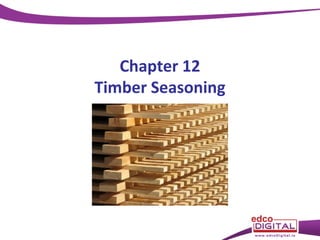
Timber Seasoning
Seasoning
− The controlled drying out of timber
 Why is timber seasoned?
− To allow drying process to be controlled
− Helps to prevent splits in the wood
− Fungi do not attack dry timber
− Dry wood doesn't shrink as much
− Dry wood is easier to work with
− Dry wood is lighter, harder and stronger
Moisture content
The amount of moisture present in wood is
shown as a percentage (%) of the weight of the
wood when dry.
While seasoning is taking place boards must be
checked for moisture content at intervals to
make sure that the wood is being dried properly.
The boards to be checked are taken from the
middle of the stack. A loose board is withdrawn
so samples can be taken at intervals.
Finding the MC
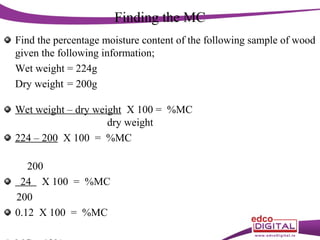
Find the percentage moisture content of the following sample of wood
given the following information;
Wet weight = 224g
Dry weight = 200g
Wet weight – dry weight X 100 = %MC
dry weight
224 – 200 X 100 = %MC
200
24 X 100 = %MC
200
0.12 X 100 = %MC
Finding the MC
A moisture meter is most commonly used
to establish the MC of a particular batch of
timber. These meters are usually
attached to
two probes which
send an electrical signal
through the wood. Water is a conductor of
electricity and therefore – the more water
present the higher the conductivity
and this
can be read from the
display.
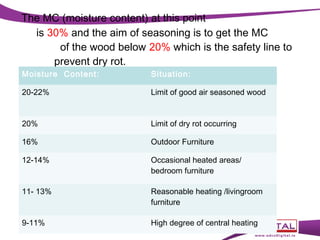
The MC (moisture content) at this point
is 30% and the aim of seasoning is to get the MC
of the wood below 20% which is the safety line to
prevent dry rot.
Moisture Content:

Situation:

20-22%

Limit of good air seasoned wood

20%

Limit of dry rot occurring

16%

Outdoor Furniture

12-14%

Occasional heated areas/
bedroom furniture

11- 13%

Reasonable heating /livingroom
furniture

9-11%

High degree of central heating
There are two main ways of seasoning timber,
1. Natural (Air) and
2. Artificial (Kiln) drying.
Timber will dry naturally but placing it in a kiln
allows us to control the process as well as speed it
up. Both methods require the timber be stacked
and separated to allow the air to flow around the
stack.
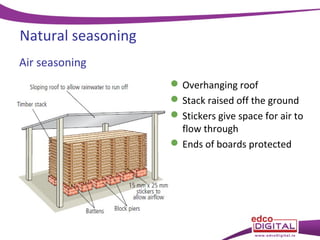
Natural seasoning
Air seasoning
 Overhanging roof
 Stack raised off the ground
 Stickers give space for air to
flow through
 Ends of boards protected
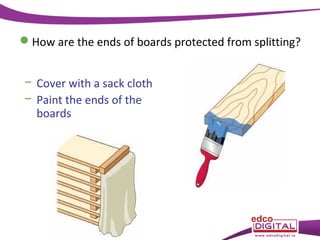
How are the ends of boards protected from splitting?
− Cover with a sack cloth
− Paint the ends of the
boards
Air seasoning
 Advantages
− No expensive equipment
needed
− Little labour cost
− Not energy dependent
Disadvantages
− Slow drying process
− Large area required
− Depends on the weather
− Cannot be controlled
− Only dries to 20% – 22%
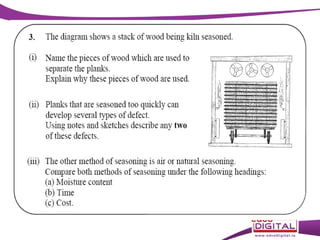
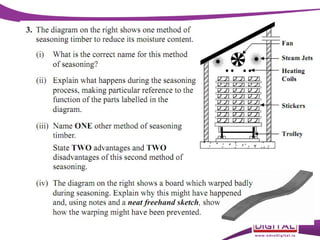
Kiln seasoning

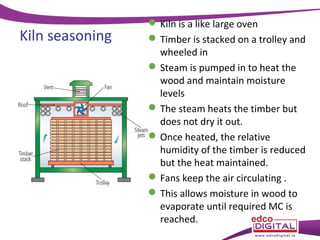
 Kiln is a like large oven
 Timber is stacked on a trolley and
wheeled in
 Steam is pumped in to heat the
wood and maintain moisture
levels
 The steam heats the timber but
does not dry it out.
 Once heated, the relative
humidity of the timber is reduced
but the heat maintained.
 Fans keep the air circulating .
 This allows moisture in wood to
evaporate until required MC is
reached.
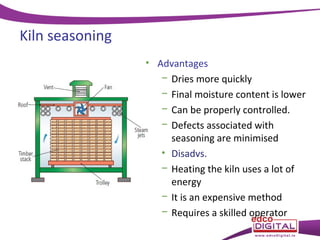
Kiln seasoning
• Advantages
− Dries more quickly
− Final moisture content is lower
− Can be properly controlled.
− Defects associated with
seasoning are minimised
• Disadvs.
− Heating the kiln uses a lot of
energy
− It is an expensive method
− Requires a skilled operator
Relative humidity
• The rate of drying of the wood depends on the
relative humidity
• There is a certain amount of water vapour in
the air at all times. The exact amount depends
on the time of year.
• You cannot see this water vapour, but it effects
things like the speed clothes dry on a line or the
drying of wood.
Equilibrium moisture content
EMC
Equilibrium moisture content.
How the mc of the wood will reach a
balance with the air, eg winter and
summer drying.
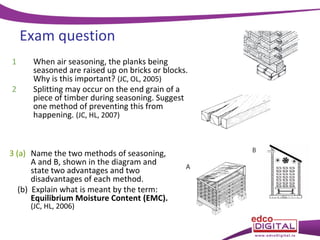
Exam question
1
2

When air seasoning, the planks being
seasoned are raised up on bricks or blocks.
Why is this important? (JC, OL, 2005)
Splitting may occur on the end grain of a
piece of timber during seasoning. Suggest
one method of preventing this from
happening. (JC, HL, 2007)

3 (a) Name the two methods of seasoning,
A and B, shown in the diagram and
state two advantages and two
disadvantages of each method.
(b) Explain what is meant by the term:
Equilibrium Moisture Content (EMC).
(JC, HL, 2006)
Sample answer to exam question
1

The planks are raised on bricks to keep them off the ground. This
keeps them clean and dry.

2

Splitting can be prevented by painting the end grain or by
hanging sackcloth over the end of the stack of boards. This stops
the ends drying too quickly.

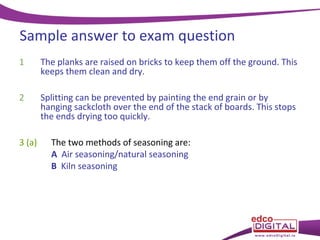
3 (a)

The two methods of seasoning are:
A Air seasoning/natural seasoning
B Kiln seasoning
Sample answer to exam question
3 (a) Advantages of air seasoning
•
•

Low labour cost once the stack is made
Low energy method as it does not require any heating

Disadvantages of air seasoning
•
•

It takes a lot of time and so uses a lot of space to store the
stacks
It is dependent on weather conditions and it is difficult to
control the drying rate
Sample answer to exam question
3 (a) Advantages of kiln seasoning
•
•

A quick method
Careful controlled drying is possible

Disadvantages of kiln seasoning
•
•

Requires a skilled operator
High energy cost so it is an expensive method

3 (b) Equilibrium Moisture Content
Wood absorbs moisture and releases it through evaporation into
the air all the time. As boards of wood dry out, they reach a
balance (equilibrium) with the air and so are neither absorbing
nor releasing moisture. This balance or equilibrium moisture
content will change as the humidity of the air changes.

12 seasoning

  • 1.
  • 2.
  • 3.
    Seasoning − The controlleddrying out of timber  Why is timber seasoned? − To allow drying process to be controlled − Helps to prevent splits in the wood − Fungi do not attack dry timber − Dry wood doesn't shrink as much − Dry wood is easier to work with − Dry wood is lighter, harder and stronger
  • 4.
    Moisture content The amountof moisture present in wood is shown as a percentage (%) of the weight of the wood when dry. While seasoning is taking place boards must be checked for moisture content at intervals to make sure that the wood is being dried properly. The boards to be checked are taken from the middle of the stack. A loose board is withdrawn so samples can be taken at intervals.
  • 5.
    Finding the MC Findthe percentage moisture content of the following sample of wood given the following information; Wet weight = 224g Dry weight = 200g Wet weight – dry weight X 100 = %MC dry weight 224 – 200 X 100 = %MC 200 24 X 100 = %MC 200 0.12 X 100 = %MC
  • 6.
    Finding the MC Amoisture meter is most commonly used to establish the MC of a particular batch of timber. These meters are usually attached to two probes which send an electrical signal through the wood. Water is a conductor of electricity and therefore – the more water present the higher the conductivity and this can be read from the display.
  • 7.
    The MC (moisturecontent) at this point is 30% and the aim of seasoning is to get the MC of the wood below 20% which is the safety line to prevent dry rot. Moisture Content: Situation: 20-22% Limit of good air seasoned wood 20% Limit of dry rot occurring 16% Outdoor Furniture 12-14% Occasional heated areas/ bedroom furniture 11- 13% Reasonable heating /livingroom furniture 9-11% High degree of central heating
  • 8.
    There are twomain ways of seasoning timber, 1. Natural (Air) and 2. Artificial (Kiln) drying. Timber will dry naturally but placing it in a kiln allows us to control the process as well as speed it up. Both methods require the timber be stacked and separated to allow the air to flow around the stack.
  • 9.
    Natural seasoning Air seasoning Overhanging roof  Stack raised off the ground  Stickers give space for air to flow through  Ends of boards protected
  • 10.
    How are theends of boards protected from splitting? − Cover with a sack cloth − Paint the ends of the boards
  • 11.
    Air seasoning  Advantages −No expensive equipment needed − Little labour cost − Not energy dependent Disadvantages − Slow drying process − Large area required − Depends on the weather − Cannot be controlled − Only dries to 20% – 22%
  • 12.
    Kiln seasoning  Kilnis a like large oven  Timber is stacked on a trolley and wheeled in  Steam is pumped in to heat the wood and maintain moisture levels  The steam heats the timber but does not dry it out.  Once heated, the relative humidity of the timber is reduced but the heat maintained.  Fans keep the air circulating .  This allows moisture in wood to evaporate until required MC is reached.
  • 13.
    Kiln seasoning • Advantages −Dries more quickly − Final moisture content is lower − Can be properly controlled. − Defects associated with seasoning are minimised • Disadvs. − Heating the kiln uses a lot of energy − It is an expensive method − Requires a skilled operator
  • 14.
    Relative humidity • Therate of drying of the wood depends on the relative humidity • There is a certain amount of water vapour in the air at all times. The exact amount depends on the time of year. • You cannot see this water vapour, but it effects things like the speed clothes dry on a line or the drying of wood.
  • 15.
    Equilibrium moisture content EMC Equilibriummoisture content. How the mc of the wood will reach a balance with the air, eg winter and summer drying.
  • 16.
    Exam question 1 2 When airseasoning, the planks being seasoned are raised up on bricks or blocks. Why is this important? (JC, OL, 2005) Splitting may occur on the end grain of a piece of timber during seasoning. Suggest one method of preventing this from happening. (JC, HL, 2007) 3 (a) Name the two methods of seasoning, A and B, shown in the diagram and state two advantages and two disadvantages of each method. (b) Explain what is meant by the term: Equilibrium Moisture Content (EMC). (JC, HL, 2006)
  • 19.
    Sample answer toexam question 1 The planks are raised on bricks to keep them off the ground. This keeps them clean and dry. 2 Splitting can be prevented by painting the end grain or by hanging sackcloth over the end of the stack of boards. This stops the ends drying too quickly. 3 (a) The two methods of seasoning are: A Air seasoning/natural seasoning B Kiln seasoning
  • 20.
    Sample answer toexam question 3 (a) Advantages of air seasoning • • Low labour cost once the stack is made Low energy method as it does not require any heating Disadvantages of air seasoning • • It takes a lot of time and so uses a lot of space to store the stacks It is dependent on weather conditions and it is difficult to control the drying rate
  • 21.
    Sample answer toexam question 3 (a) Advantages of kiln seasoning • • A quick method Careful controlled drying is possible Disadvantages of kiln seasoning • • Requires a skilled operator High energy cost so it is an expensive method 3 (b) Equilibrium Moisture Content Wood absorbs moisture and releases it through evaporation into the air all the time. As boards of wood dry out, they reach a balance (equilibrium) with the air and so are neither absorbing nor releasing moisture. This balance or equilibrium moisture content will change as the humidity of the air changes.