SEMINAR
Basic Civil
Engineering
Decay of Timber1
Seasoning of Timber2
Advantages3
Overview
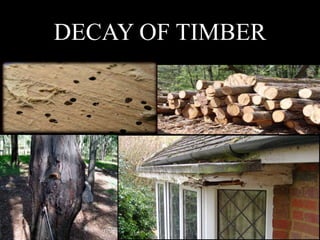
DECAY OF TIMBER
When timber loses its value as
engineering material, it is said to
be decayed.
The decayed timber cannot be
used for engineering purposes.
Decay of timber
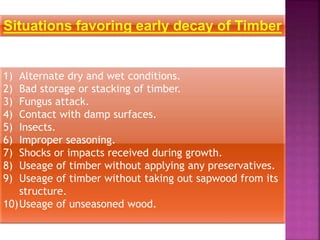
Situations favoring early decay of Timber
1) Alternate dry and wet conditions.
2) Bad storage or stacking of timber.
3) Fungus attack.
4) Contact with damp surfaces.
5) Insects.
6) Improper seasoning.
7) Shocks or impacts received during growth.
8) Useage of timber without applying any preservatives.
9) Useage of timber without taking out sapwood from its
structure.
10)Useage of unseasoned wood.
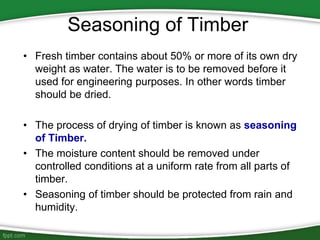
Seasoning of Timber
• Fresh timber contains about 50% or more of its own dry
weight as water. The water is to be removed before it
used for engineering purposes. In other words timber
should be dried.
• The process of drying of timber is known as seasoning
of Timber.
• The moisture content should be removed under
controlled conditions at a uniform rate from all parts of
timber.
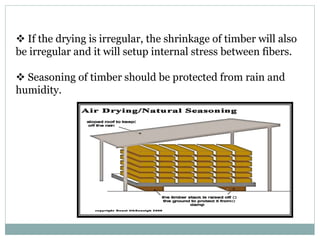
• Seasoning of timber should be protected from rain and
humidity.
 If the drying is irregular, the shrinkage of timber will also
be irregular and it will setup internal stress between fibers.
 Seasoning of timber should be protected from rain and
humidity.
OBJECTS OF SEASONING
1. To impart hardness, stiffness, strength and better electrical
resistance to timber.
2. To maintain the shape and size of the components of the timber
articles, which are expected to remain unchanged in form.
3. To decrease the weight of timber and their by to reduce the cost of
transportation.
4. To make timber easily workable and to facilitate operations during
conversions.
5. To make timber suitable for receiving treatment of paints,
preservatives, varnishes etc.
6. To make timber safe from the act of fungi and insects.
7. To make suitable for joinery works.
8. To reduce the tendency of timber to crack, shrink and warp.
Free Powerpoint Templates
Page 9
METHODS OF SEASONING
Natural seasoning
Artificial seasoning
NATURAL SEASONING
 When seasoning of timber is carried out
by natural air, it is called natural
seasoning or air seasoning.
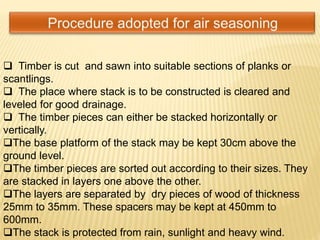
 Timber is cut and sawn into suitable sections of planks or
scantlings.
 The place where stack is to be constructed is cleared and
leveled for good drainage.
 The timber pieces can either be stacked horizontally or
vertically.
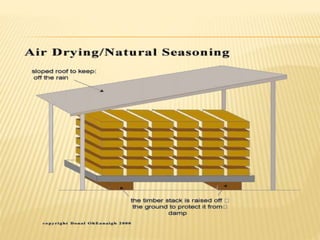
The base platform of the stack may be kept 30cm above the
ground level.
The timber pieces are sorted out according to their sizes. They
are stacked in layers one above the other.
The layers are separated by dry pieces of wood of thickness
25mm to 35mm. These spacers may be kept at 450mm to
600mm.
The stack is protected from rain, sunlight and heavy wind.
Advantages of natural seasoning
The moisture content of wood can be brought down
to about 10 to 20 percent.
It does not require skilled supervision.
For thicker sections artificial seasoning is
uneconomical where natural seasoning can be
adopted.
This method is cheap and simple.
Disadvantages of natural seasoning
1.Less control over air
2.The drying of different surfaces may not be
uniform
3.Chance of attack of fungi and insects during
seasoning.
Artificial Seasoning
To make the drying more uniform and even, by
controlled conditions artificial seasoning is adopted.
It reduces the time for seasoning.
Shrinkage, cracking and warping are minimized in
artificial seasoning.
The wood with desired moisture content may be
obtained by the artificial seasoning.
1.Water seasoning
2.Boiling
3.Electrical seasoning
4.Kiln seasoning
Water Seasoning
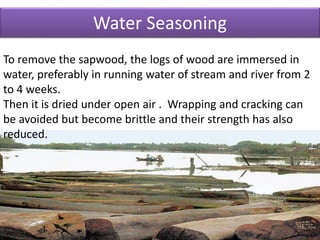
To remove the sapwood, the logs of wood are immersed in
water, preferably in running water of stream and river from 2
to 4 weeks.
Then it is dried under open air . Wrapping and cracking can
be avoided but become brittle and their strength has also
reduced.
Boiling
In this method the timber is boiled in water for
about 3 to 4 hours. It is then taken out and slowly
dried. Even though the period of seasoning is less it
is an expensive method.
Timber may be exposed to hot stream also.
Electrical Seasoning
This is done by passing high frequency AC current through
the timber. The timber gets heated and dries out.
This method results in uniform seasoning of wood but the
capital cost of equipment needed is more.
It is a very rapid method. This method is used in the
manufacture of plywood.
It is an established fact that a green timber offers less resistance
to the flow of electric current as compared to a dry timber.
Chemical Seasoning
In this method, green timber is soaked in
saturated solution of suitable salt and then
removed and seasoned.
 The interior moisture is drawn out by the
saturated salt solution and the interior part dries
before the outer part. Less chance of external
cracks.
Kiln Seasoning
In this method timber is carried out inside an air tight chamber.
Various process in Kiln seasoning
1) The timber is arranged inside the chamber such that
spaces are left for free air circulation.
2) Humid and heated air of temperature of about 350 C to
380 C is then forced inside a chamber by suitable
arrangement.
3) It is allowed to circulate around the timber pieces.
4) Evaporation from the surface of timber pieces is
prevented because of high humidity of air.
5) The heat gradually reaches inside the timber pieces. The
relative humidity is now gradually reduced.
6) The temperature is then increased and maintained till the
desired degree of moisture content is obtained.
NOTE
Depending upon the mode of construction and operation
Kilns are divided as ,
1. Stationary Kilns
2. Progressive kilns
Advantages of Seasoning
1) Handling and transportation cost of wood can be reduced.
2) Seasoned timbre shows good resistance to decay.
3) The timbre should be seasoned before the application of
paints, varnishes, preservatives, glues etc.
4) Ease the workability of timbre.
5) Dimensional stability of furnished products can be maintained.
6) Improved the engineering properties of wood.
Timbre seasoning

Timbre seasoning

  • 1.
  • 2.
    Decay of Timber1 Seasoningof Timber2 Advantages3 Overview
  • 3.
  • 4.
    When timber losesits value as engineering material, it is said to be decayed. The decayed timber cannot be used for engineering purposes. Decay of timber
  • 5.
    Situations favoring earlydecay of Timber 1) Alternate dry and wet conditions. 2) Bad storage or stacking of timber. 3) Fungus attack. 4) Contact with damp surfaces. 5) Insects. 6) Improper seasoning. 7) Shocks or impacts received during growth. 8) Useage of timber without applying any preservatives. 9) Useage of timber without taking out sapwood from its structure. 10)Useage of unseasoned wood.
  • 6.
    Seasoning of Timber •Fresh timber contains about 50% or more of its own dry weight as water. The water is to be removed before it used for engineering purposes. In other words timber should be dried. • The process of drying of timber is known as seasoning of Timber. • The moisture content should be removed under controlled conditions at a uniform rate from all parts of timber. • Seasoning of timber should be protected from rain and humidity.
  • 7.
     If thedrying is irregular, the shrinkage of timber will also be irregular and it will setup internal stress between fibers.  Seasoning of timber should be protected from rain and humidity.
  • 8.
    OBJECTS OF SEASONING 1.To impart hardness, stiffness, strength and better electrical resistance to timber. 2. To maintain the shape and size of the components of the timber articles, which are expected to remain unchanged in form. 3. To decrease the weight of timber and their by to reduce the cost of transportation. 4. To make timber easily workable and to facilitate operations during conversions. 5. To make timber suitable for receiving treatment of paints, preservatives, varnishes etc. 6. To make timber safe from the act of fungi and insects. 7. To make suitable for joinery works. 8. To reduce the tendency of timber to crack, shrink and warp.
  • 9.
    Free Powerpoint Templates Page9 METHODS OF SEASONING Natural seasoning Artificial seasoning
  • 10.
    NATURAL SEASONING  Whenseasoning of timber is carried out by natural air, it is called natural seasoning or air seasoning.
  • 11.
     Timber iscut and sawn into suitable sections of planks or scantlings.  The place where stack is to be constructed is cleared and leveled for good drainage.  The timber pieces can either be stacked horizontally or vertically. The base platform of the stack may be kept 30cm above the ground level. The timber pieces are sorted out according to their sizes. They are stacked in layers one above the other. The layers are separated by dry pieces of wood of thickness 25mm to 35mm. These spacers may be kept at 450mm to 600mm. The stack is protected from rain, sunlight and heavy wind.
  • 13.
    Advantages of naturalseasoning The moisture content of wood can be brought down to about 10 to 20 percent. It does not require skilled supervision. For thicker sections artificial seasoning is uneconomical where natural seasoning can be adopted. This method is cheap and simple.
  • 14.
    Disadvantages of naturalseasoning 1.Less control over air 2.The drying of different surfaces may not be uniform 3.Chance of attack of fungi and insects during seasoning.
  • 15.
    Artificial Seasoning To makethe drying more uniform and even, by controlled conditions artificial seasoning is adopted. It reduces the time for seasoning. Shrinkage, cracking and warping are minimized in artificial seasoning. The wood with desired moisture content may be obtained by the artificial seasoning.
  • 16.
  • 17.
    Water Seasoning To removethe sapwood, the logs of wood are immersed in water, preferably in running water of stream and river from 2 to 4 weeks. Then it is dried under open air . Wrapping and cracking can be avoided but become brittle and their strength has also reduced.
  • 18.
    Boiling In this methodthe timber is boiled in water for about 3 to 4 hours. It is then taken out and slowly dried. Even though the period of seasoning is less it is an expensive method. Timber may be exposed to hot stream also.
  • 19.
    Electrical Seasoning This isdone by passing high frequency AC current through the timber. The timber gets heated and dries out. This method results in uniform seasoning of wood but the capital cost of equipment needed is more. It is a very rapid method. This method is used in the manufacture of plywood. It is an established fact that a green timber offers less resistance to the flow of electric current as compared to a dry timber.
  • 20.
    Chemical Seasoning In thismethod, green timber is soaked in saturated solution of suitable salt and then removed and seasoned.  The interior moisture is drawn out by the saturated salt solution and the interior part dries before the outer part. Less chance of external cracks.
  • 21.
    Kiln Seasoning In thismethod timber is carried out inside an air tight chamber.
  • 22.
    Various process inKiln seasoning 1) The timber is arranged inside the chamber such that spaces are left for free air circulation. 2) Humid and heated air of temperature of about 350 C to 380 C is then forced inside a chamber by suitable arrangement. 3) It is allowed to circulate around the timber pieces. 4) Evaporation from the surface of timber pieces is prevented because of high humidity of air.
  • 23.
    5) The heatgradually reaches inside the timber pieces. The relative humidity is now gradually reduced. 6) The temperature is then increased and maintained till the desired degree of moisture content is obtained. NOTE Depending upon the mode of construction and operation Kilns are divided as , 1. Stationary Kilns 2. Progressive kilns
  • 24.
    Advantages of Seasoning 1)Handling and transportation cost of wood can be reduced. 2) Seasoned timbre shows good resistance to decay. 3) The timbre should be seasoned before the application of paints, varnishes, preservatives, glues etc. 4) Ease the workability of timbre. 5) Dimensional stability of furnished products can be maintained. 6) Improved the engineering properties of wood.