AIR SEASONING
SWAGATIKA SAHOO
2015-17-012
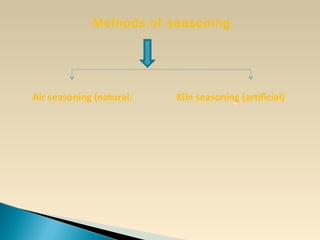
Methods of seasoning
-
Air seasoning (natural) Kiln seasoning (artificial)
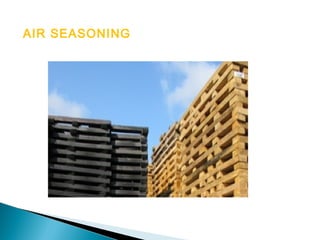
AIR SEASONING
Air seasoning involves the stacking of sawn timber on raised
foundation with the help of crossers (battens ) in a clean and
dry place.
 Condition- shady
 Drying agent- air
The rate and quality of seasoning depends on climatic factors such
as:
 Relative humidity.
 Prevailing temperatures and their variation.
 Wind conditions.
 Sunshine hours and their duration.
It is possible to minimize losses from cracking, splitting,
warping, fungal and insect attacks if adequate care is taken with
regard to the following:
 Adopting the best method of stacking.
 Protecting the stacks against the sun and hot and dry winds.
 Sanitary conditions in the seasoning yard.
Methods of stacking
Horizontal stacking Vertical stacking
a) Planks
b)Poles
c)Railway sleepers
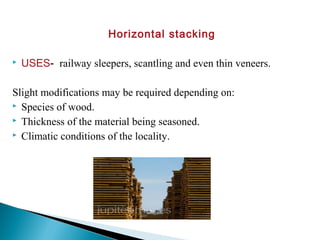
Horizontal stacking
 USES- railway sleepers, scantling and even thin veneers.
Slight modifications may be required depending on:
 Species of wood.
 Thickness of the material being seasoned.
 Climatic conditions of the locality.
Non-refractory woods: care is taken to ensure a good circulation of air
though the stack.
Refractory woods: under a hot and dry climate- decreasing the
circulation of air –for keeping the rate of drying as slow as possible.
CONDITION FOR DIFFERENT WOOD
END COATING
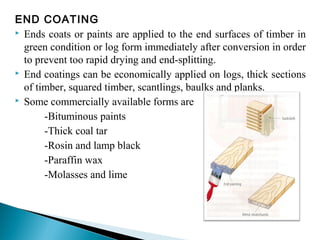
 Ends coats or paints are applied to the end surfaces of timber in
green condition or log form immediately after conversion in order
to prevent too rapid drying and end-splitting.
 End coatings can be economically applied on logs, thick sections
of timber, squared timber, scantlings, baulks and planks.
 Some commercially available forms are
-Bituminous paints
-Thick coal tar
-Rosin and lamp black
-Paraffin wax
-Molasses and lime
Planks
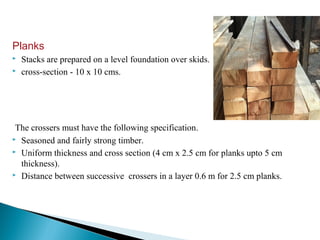
 Stacks are prepared on a level foundation over skids.
 cross-section - 10 x 10 cms.
The crossers must have the following specification.
 Seasoned and fairly strong timber.
 Uniform thickness and cross section (4 cm x 2.5 cm for planks upto 5 cm
thickness).
 Distance between successive crossers in a layer 0.6 m for 2.5 cm planks.
ARRANGEMENT OF PLANKS
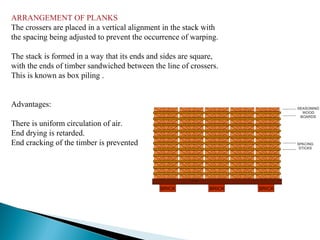
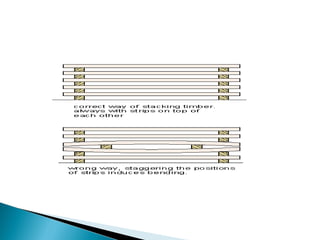
The crossers are placed in a vertical alignment in the stack with
the spacing being adjusted to prevent the occurrence of warping.
The stack is formed in a way that its ends and sides are square,
with the ends of timber sandwiched between the line of crossers.
This is known as box piling .
Advantages:
There is uniform circulation of air.
End drying is retarded.
End cracking of the timber is prevented
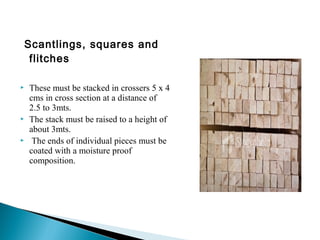
Scantlings, squares and
flitches
 These must be stacked in crossers 5 x 4
cms in cross section at a distance of
2.5 to 3mts.
 The stack must be raised to a height of
about 3mts.
 The ends of individual pieces must be
coated with a moisture proof
composition.
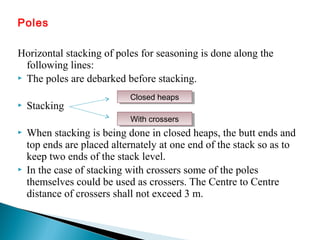
Poles
Horizontal stacking of poles for seasoning is done along the
following lines:
 The poles are debarked before stacking.
 Stacking
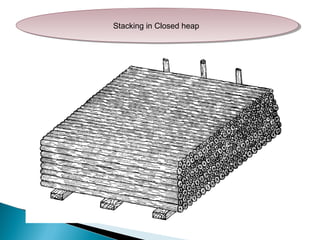
 When stacking is being done in closed heaps, the butt ends and
top ends are placed alternately at one end of the stack so as to
keep two ends of the stack level.
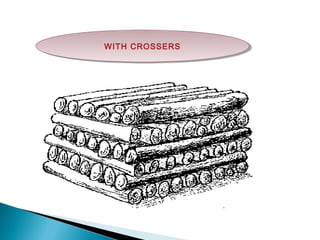
 In the case of stacking with crossers some of the poles
themselves could be used as crossers. The Centre to Centre
distance of crossers shall not exceed 3 m.
Closed heapsClosed heaps
With crossersWith crossers
Stacking in Closed heapStacking in Closed heap
WITH CROSSERSWITH CROSSERS
Railway sleepers
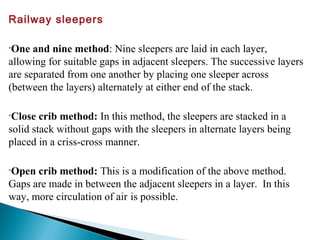
•One and nine method: Nine sleepers are laid in each layer,
allowing for suitable gaps in adjacent sleepers. The successive layers
are separated from one another by placing one sleeper across
(between the layers) alternately at either end of the stack.
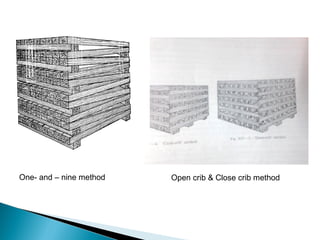
•Close crib method: In this method, the sleepers are stacked in a
solid stack without gaps with the sleepers in alternate layers being
placed in a criss-cross manner.
•Open crib method: This is a modification of the above method.
Gaps are made in between the adjacent sleepers in a layer. In this
way, more circulation of air is possible.
One- and – nine method Open crib & Close crib method
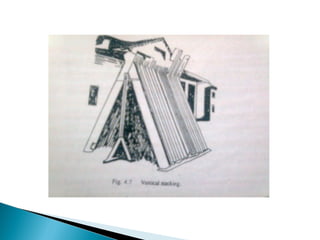
Vertical stacking
 Suited for rapid surface drying of specific species of non-
refractory woods.
 Initially can be stacked by the horizontal methods or can be left
standing in a vertical position till completion of the drying process.
Factors effecting vertical stacking
 Species.
 Climatic conditions of the locality.
Points considered while seasoning wood through vertical stacking
•The planks stacked vertically are turned at least two times in a day.
• Lower end of the planks should not rest directly on the soil.
Time required for air seasoning
The time required for air seasoning depends on the following
variables:
 Species of the wood being seasoned.
 The dimensions (width, length and thickness) of the material that
is being seasoned.
 Prevailing climatic conditions of the locality.
 The time of the year when the seasoning has been started.
 Form in which the material is being sleepers viz, sleepers, scants
baulks etc.
TIMBER SEASONING
YARDS
TIMBER SEASONING YARDS
 Used for air seasoning of timber.
General requisites
a) Location
 Level with good drainage.
 Away from residential areas but readily approachable by rail and / or
road.
 Well-fenced to prevent cattle from straying inside ( so as to avoid
dung which is a source of serious infection ).
 To protect the stack of timber from direct sun, there should be some
big shady trees in the yard.
b) Foundation
i) The floor of the yard must be free of weeds and surfaced with
concrete or gravel or sand.
ii)The foundation on which the stacks are to be laid must be raised.
Vertical pillars of treated timber or concrete may form a part of the
foundation.
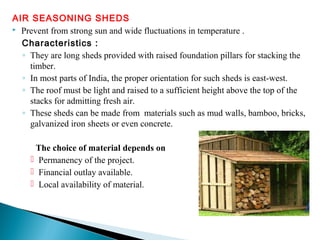
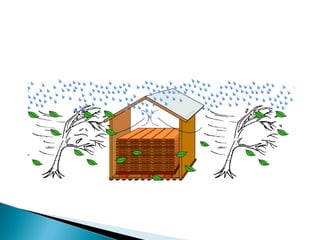
AIR SEASONING SHEDS
 Prevent from strong sun and wide fluctuations in temperature .
Characteristics :
◦ They are long sheds provided with raised foundation pillars for stacking the
timber.
◦ In most parts of India, the proper orientation for such sheds is east-west.
◦ The roof must be light and raised to a sufficient height above the top of the
stacks for admitting fresh air.
◦ These sheds can be made from materials such as mud walls, bamboo, bricks,
galvanized iron sheets or even concrete.
The choice of material depends on
 Permanency of the project.
 Financial outlay available.
 Local availability of material.
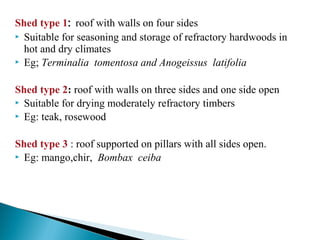
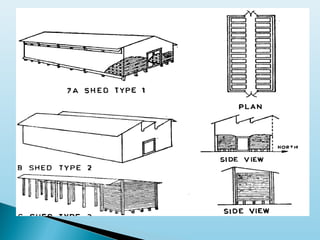
Shed type 1: roof with walls on four sides
 Suitable for seasoning and storage of refractory hardwoods in
hot and dry climates
 Eg; Terminalia tomentosa and Anogeissus latifolia
Shed type 2: roof with walls on three sides and one side open
 Suitable for drying moderately refractory timbers
 Eg: teak, rosewood
Shed type 3 : roof supported on pillars with all sides open.
 Eg: mango,chir, Bombax ceiba
THANK YOUTHANK YOU

Air seasoning

  • 1.
  • 2.
    Methods of seasoning - Airseasoning (natural) Kiln seasoning (artificial)
  • 3.
  • 4.
    Air seasoning involvesthe stacking of sawn timber on raised foundation with the help of crossers (battens ) in a clean and dry place.  Condition- shady  Drying agent- air The rate and quality of seasoning depends on climatic factors such as:  Relative humidity.  Prevailing temperatures and their variation.  Wind conditions.  Sunshine hours and their duration.
  • 5.
    It is possibleto minimize losses from cracking, splitting, warping, fungal and insect attacks if adequate care is taken with regard to the following:  Adopting the best method of stacking.  Protecting the stacks against the sun and hot and dry winds.  Sanitary conditions in the seasoning yard.
  • 6.
    Methods of stacking Horizontalstacking Vertical stacking a) Planks b)Poles c)Railway sleepers
  • 7.
    Horizontal stacking  USES-railway sleepers, scantling and even thin veneers. Slight modifications may be required depending on:  Species of wood.  Thickness of the material being seasoned.  Climatic conditions of the locality.
  • 8.
    Non-refractory woods: careis taken to ensure a good circulation of air though the stack. Refractory woods: under a hot and dry climate- decreasing the circulation of air –for keeping the rate of drying as slow as possible. CONDITION FOR DIFFERENT WOOD
  • 9.
    END COATING  Endscoats or paints are applied to the end surfaces of timber in green condition or log form immediately after conversion in order to prevent too rapid drying and end-splitting.  End coatings can be economically applied on logs, thick sections of timber, squared timber, scantlings, baulks and planks.  Some commercially available forms are -Bituminous paints -Thick coal tar -Rosin and lamp black -Paraffin wax -Molasses and lime
  • 10.
    Planks  Stacks areprepared on a level foundation over skids.  cross-section - 10 x 10 cms. The crossers must have the following specification.  Seasoned and fairly strong timber.  Uniform thickness and cross section (4 cm x 2.5 cm for planks upto 5 cm thickness).  Distance between successive crossers in a layer 0.6 m for 2.5 cm planks.
  • 11.
    ARRANGEMENT OF PLANKS Thecrossers are placed in a vertical alignment in the stack with the spacing being adjusted to prevent the occurrence of warping. The stack is formed in a way that its ends and sides are square, with the ends of timber sandwiched between the line of crossers. This is known as box piling . Advantages: There is uniform circulation of air. End drying is retarded. End cracking of the timber is prevented
  • 13.
    Scantlings, squares and flitches These must be stacked in crossers 5 x 4 cms in cross section at a distance of 2.5 to 3mts.  The stack must be raised to a height of about 3mts.  The ends of individual pieces must be coated with a moisture proof composition.
  • 14.
    Poles Horizontal stacking ofpoles for seasoning is done along the following lines:  The poles are debarked before stacking.  Stacking  When stacking is being done in closed heaps, the butt ends and top ends are placed alternately at one end of the stack so as to keep two ends of the stack level.  In the case of stacking with crossers some of the poles themselves could be used as crossers. The Centre to Centre distance of crossers shall not exceed 3 m. Closed heapsClosed heaps With crossersWith crossers
  • 15.
    Stacking in ClosedheapStacking in Closed heap
  • 16.
  • 17.
    Railway sleepers •One andnine method: Nine sleepers are laid in each layer, allowing for suitable gaps in adjacent sleepers. The successive layers are separated from one another by placing one sleeper across (between the layers) alternately at either end of the stack. •Close crib method: In this method, the sleepers are stacked in a solid stack without gaps with the sleepers in alternate layers being placed in a criss-cross manner. •Open crib method: This is a modification of the above method. Gaps are made in between the adjacent sleepers in a layer. In this way, more circulation of air is possible.
  • 18.
    One- and –nine method Open crib & Close crib method
  • 19.
    Vertical stacking  Suitedfor rapid surface drying of specific species of non- refractory woods.  Initially can be stacked by the horizontal methods or can be left standing in a vertical position till completion of the drying process. Factors effecting vertical stacking  Species.  Climatic conditions of the locality.
  • 20.
    Points considered whileseasoning wood through vertical stacking •The planks stacked vertically are turned at least two times in a day. • Lower end of the planks should not rest directly on the soil.
  • 22.
    Time required forair seasoning The time required for air seasoning depends on the following variables:  Species of the wood being seasoned.  The dimensions (width, length and thickness) of the material that is being seasoned.  Prevailing climatic conditions of the locality.  The time of the year when the seasoning has been started.  Form in which the material is being sleepers viz, sleepers, scants baulks etc.
  • 23.
  • 24.
    TIMBER SEASONING YARDS Used for air seasoning of timber. General requisites a) Location  Level with good drainage.  Away from residential areas but readily approachable by rail and / or road.  Well-fenced to prevent cattle from straying inside ( so as to avoid dung which is a source of serious infection ).  To protect the stack of timber from direct sun, there should be some big shady trees in the yard. b) Foundation i) The floor of the yard must be free of weeds and surfaced with concrete or gravel or sand. ii)The foundation on which the stacks are to be laid must be raised. Vertical pillars of treated timber or concrete may form a part of the foundation.
  • 25.
    AIR SEASONING SHEDS Prevent from strong sun and wide fluctuations in temperature . Characteristics : ◦ They are long sheds provided with raised foundation pillars for stacking the timber. ◦ In most parts of India, the proper orientation for such sheds is east-west. ◦ The roof must be light and raised to a sufficient height above the top of the stacks for admitting fresh air. ◦ These sheds can be made from materials such as mud walls, bamboo, bricks, galvanized iron sheets or even concrete. The choice of material depends on  Permanency of the project.  Financial outlay available.  Local availability of material.
  • 27.
    Shed type 1:roof with walls on four sides  Suitable for seasoning and storage of refractory hardwoods in hot and dry climates  Eg; Terminalia tomentosa and Anogeissus latifolia Shed type 2: roof with walls on three sides and one side open  Suitable for drying moderately refractory timbers  Eg: teak, rosewood Shed type 3 : roof supported on pillars with all sides open.  Eg: mango,chir, Bombax ceiba
  • 29.