1
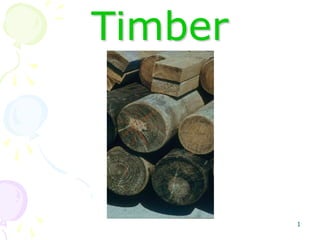
Timber
2
General
Timber is one of the oldest building
materials, along with stone, earth and
various vegetable materials.
Timber has continued until today the most
versatile and, in terms of indoor comfort
and health aspects, most acceptable
material.
3
Cont’d
Timber is an extremely complex
material, available in a great variety
of species and forms, suitable for all
kinds of applications.
4
Classification of Timber
There are two main groups of timber
producing trees:
 Softwoods
Hardwoods
5
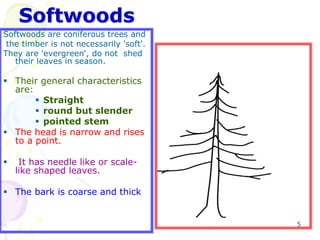
Softwoods
Softwoods are coniferous trees and
the timber is not necessarily 'soft'.
They are 'evergreen‘, do not shed
their leaves in season.
 Their general characteristics
are:
 Straight
 round but slender
 pointed stem
 The head is narrow and rises
to a point.
 It has needle like or scale-
like shaped leaves.
 The bark is coarse and thick
6
Hardwoods
Hardwood trees are:
 Broadleaf and
generally deciduous.
 Their timber is not
necessarily hard.
 The general
characteristics are:
Stout base which
divides into branches
to form a wide, round
crown.
 The leaves are broad
 The bark may be
smooth or course and
varies in thickness
and colors.
7
Timber for construction
Timber for building construction is
divided into two categories:
 Primary timber
Secondary timber
8
Primary timbers
Primary timbers are:
 Slow-grown
 Aesthetically attractive
 Have considerable natural resistance
to biological attack, moisture
movement and distortion.
 Expensive and in short supply.
9
Secondary timbers
Secondary timbers are:
Mainly fast-grown species
Low natural durability
With appropriate seasoning and
preservative treatment, physical
properties and durability of
secondary timbers can be greatly
improved.
10
Seasoning of timber
Seasoning is the process by which
the moisture content of timber is
reduced to its equilibrium moisture –
11
Cont’d
Time required for seasoning process
depends on:
 Timber species and age,
Time of harvesting,
Climate,
Method of seasoning,
etc.
12
Reasons for seasoning
Seasoning makes the timber suitable
for the environment and intended
use.
The moisture content of timber needs
to be reduced for the following
reasons:
13
Cont’d
• Makes the timber more resistant to
biological decay, increases its
strength, stiffness and dimensional
stability, and reduces its weight (and
consequently transportation costs).
14
Cont’d
• Seasoned timber show fewer
tendencies to warp, split or shake.
• Seasoned timber although lighter will
be stronger and more reliable.
15
Cont’d
• The sap in timber is a food for fungi
and wood parasites.
* Removing the sap and the wood
will be less attractive to these
dangers!
• To reduce the chances of fungi
infestations and produce a good grade
construction timber, the MC of timber
must be below 20%
16
Cont’d
• Dry and well seasoned timber is
stronger.
• Dry and well seasoned timber is
easier to work with and consequently
safer especially for machine working.
• Timber with higher moisture content
is difficult to finish i.e. paint, varnish,
etc.
17
Methods of seasoning timber
There are two main ways of
seasoning timber:
 Air seasoning
 Kiln seasoning
Both methods require the timber be
stacked and separated to allow the
full circulation of air, etc. around the
stack.
18
Air seasoning
- Air seasoning is done by
stacking timber such that
air can pass around
every piece.
- Protection from rain and
avoidance of contact with
the ground are essential.
19
Kiln seasoning
There are two main methods used in kiln
seasoning:
 Compartmental
 Progressive
- Both methods rely on the controlled environment
to dry out the timber, and require the following
factors:
20
Cont’d
Kiln seasoning require the following factors:
 Forced air circulation by using large fans,
blowers, etc.
 Heat of some form provided by piped steam.
 Humidity control provided by steam jets.
The amount and duration of air, heat and
humidity again depends on species, size,
quantity, etc.
21
Compartmental kiln
- A compartment kiln is a single enclosed
container or building, etc. The timber is
stacked and the whole stack is seasoned using
a program of settings until the whole stack is
reduced to the required MC.
22
Progressive kiln
- A progressive kiln has the stack on trolleys that
‘progressively’ travel through chambers that
change the conditions as it travels through the
varying atmospheres.
- The advantage of this system, although much
larger, has a continuous flow of seasoned timber
coming off line.
23
Cont’d
Kiln seasoning
achieves accelerated
seasoning in closed
chambers by heating
and controlling air
circulation and
humidity, thus
reducing the time by
50 to 75 %, but
incurring higher costs.
An economical
alternative is to use
solar heated kilns.
24
Preservative treatment
- Seasoning alone is not always sufficient
to protect secondary timbers from fungal
decay and insect attack.
- Protection from these biological hazards
is effectively achieved by preservative
treatments with certain chemicals.
- There are many chemicals, used singly or
in combination, which preserve timber
against insect and/or fungal attack.
25
- Preservatives fall into two main groups:
i. Tar oils
- Dark color, smelly, tendency to bleed out of
the treated wood
- Generally suitable for outside uses (fence
posts, transmission poles, ..)
ii. Preservative treatment
- Chemicals are applied using a variety of
methods (pressure impregnation, hot and
cold soaking, dipping, spraying, brushing, ..)
26
Properties of timber
Timber, as a natural material is variable!
The disadvantages of variability are
overcome by selection or grading
processes and by the application of safety
factors in structural calculations.
Strength
Durability
Permeability
Fire resistance
27
Strength
The structural strength of timber is a
measure of its ability to resist external
forces, such as compression, tension and
shear.
The density is reliable indicator of many
structural and mechanical properties.
There is a particularly strong relationship
between density and compressive
strength, bending strength and hardness.
28
Factors affecting strength
The strength of a piece of timber is affected
by characteristics such as
 Knots
 Direction and slope of grain (diagonal or
sloping grain reduces strength,
particularly bending and stiffness),
 Moisture content (generally timber is more
flexible when wet but increases in strength
as it dries):
The strength of timber is broadly
related to its density.
29
Durability
- The durability of timber is a measure of
its resistance to attack by insects and
fungi.
- The most effective means of preventing
fungal attack is to ensure that the
moisture of timber remains below 22%
when there is not enough moisture for
the fungus to survive. Insect attack is
often associated with fungal decay.
30
Permeability
- Permeability is an important factor in
the treatment of timber with chemicals
such as preservatives and flame retardants.
- Permeability varies enormously between
species although the sapwood of all
specious is more permeable than the
heartwood.
31
Fire resistance
- Fire resistance is an important
consideration in using timber.
- Although wood is used as a fuel, large
sections of timber are difficult to ignite
and the charcoal produced on the
surface provides protection for the wood
underneath.
32
Application of Timber
i. Structural member
- beams, trusses, poles (columns, …
ii. Non-structural member
- ceilings, roofs, decorations, …
iii. Insulating layer
- wood wool slab, soft boards, …
iv. Facing of other material
- brick work, concrete, etc. with boards and shingles
v. Door and window frames
vi. Scaffolding, formworks, …
vii. Furniture works, …
33
Advantages
i. Suitable construction material in all climatic conditions
ii. Renewable material (reforestation)
iii. Most species posses high strength to weight ratio
iv. Construction is compatible with traditional skills and
rarely requires sophisticated equipment
v. Production and processing of timber requires less
energy than most building materials
vi. Provides good thermal insulation and sound absorption
and thicker sections are high fire resistance
vii. Demolished timber structures can often be recycled as
building material, fuel wood, ash being used as a
fertilizer, …
34
Disadvantages
i. Deforestation  environmental degradation
ii. Extremely hard timber  Make sawing difficult and
requires special saws
iii. Thermal and moisture movements (perpendicular to
the grain) causes distortion, shrinkage and splitting
iv. Fungal decay and insect attacks  especially on soft
woods
v. Small dimension members  susceptible for fire
vi. High toxicity of most effective chemical preservatives
vii. Failure of joints between timber members due to
shrinkage or corrosion of metal connectors
viii. Discoloration and embrittlement or erosion of surface
due to exposure to sunlight, wind-borne abrasives or
chemicals

Timber.ppt

  • 1.
  • 2.
    2 General Timber is oneof the oldest building materials, along with stone, earth and various vegetable materials. Timber has continued until today the most versatile and, in terms of indoor comfort and health aspects, most acceptable material.
  • 3.
    3 Cont’d Timber is anextremely complex material, available in a great variety of species and forms, suitable for all kinds of applications.
  • 4.
    4 Classification of Timber Thereare two main groups of timber producing trees:  Softwoods Hardwoods
  • 5.
    5 Softwoods Softwoods are coniferoustrees and the timber is not necessarily 'soft'. They are 'evergreen‘, do not shed their leaves in season.  Their general characteristics are:  Straight  round but slender  pointed stem  The head is narrow and rises to a point.  It has needle like or scale- like shaped leaves.  The bark is coarse and thick
  • 6.
    6 Hardwoods Hardwood trees are: Broadleaf and generally deciduous.  Their timber is not necessarily hard.  The general characteristics are: Stout base which divides into branches to form a wide, round crown.  The leaves are broad  The bark may be smooth or course and varies in thickness and colors.
  • 7.
    7 Timber for construction Timberfor building construction is divided into two categories:  Primary timber Secondary timber
  • 8.
    8 Primary timbers Primary timbersare:  Slow-grown  Aesthetically attractive  Have considerable natural resistance to biological attack, moisture movement and distortion.  Expensive and in short supply.
  • 9.
    9 Secondary timbers Secondary timbersare: Mainly fast-grown species Low natural durability With appropriate seasoning and preservative treatment, physical properties and durability of secondary timbers can be greatly improved.
  • 10.
    10 Seasoning of timber Seasoningis the process by which the moisture content of timber is reduced to its equilibrium moisture –
  • 11.
    11 Cont’d Time required forseasoning process depends on:  Timber species and age, Time of harvesting, Climate, Method of seasoning, etc.
  • 12.
    12 Reasons for seasoning Seasoningmakes the timber suitable for the environment and intended use. The moisture content of timber needs to be reduced for the following reasons:
  • 13.
    13 Cont’d • Makes thetimber more resistant to biological decay, increases its strength, stiffness and dimensional stability, and reduces its weight (and consequently transportation costs).
  • 14.
    14 Cont’d • Seasoned timbershow fewer tendencies to warp, split or shake. • Seasoned timber although lighter will be stronger and more reliable.
  • 15.
    15 Cont’d • The sapin timber is a food for fungi and wood parasites. * Removing the sap and the wood will be less attractive to these dangers! • To reduce the chances of fungi infestations and produce a good grade construction timber, the MC of timber must be below 20%
  • 16.
    16 Cont’d • Dry andwell seasoned timber is stronger. • Dry and well seasoned timber is easier to work with and consequently safer especially for machine working. • Timber with higher moisture content is difficult to finish i.e. paint, varnish, etc.
  • 17.
    17 Methods of seasoningtimber There are two main ways of seasoning timber:  Air seasoning  Kiln seasoning Both methods require the timber be stacked and separated to allow the full circulation of air, etc. around the stack.
  • 18.
    18 Air seasoning - Airseasoning is done by stacking timber such that air can pass around every piece. - Protection from rain and avoidance of contact with the ground are essential.
  • 19.
    19 Kiln seasoning There aretwo main methods used in kiln seasoning:  Compartmental  Progressive - Both methods rely on the controlled environment to dry out the timber, and require the following factors:
  • 20.
    20 Cont’d Kiln seasoning requirethe following factors:  Forced air circulation by using large fans, blowers, etc.  Heat of some form provided by piped steam.  Humidity control provided by steam jets. The amount and duration of air, heat and humidity again depends on species, size, quantity, etc.
  • 21.
    21 Compartmental kiln - Acompartment kiln is a single enclosed container or building, etc. The timber is stacked and the whole stack is seasoned using a program of settings until the whole stack is reduced to the required MC.
  • 22.
    22 Progressive kiln - Aprogressive kiln has the stack on trolleys that ‘progressively’ travel through chambers that change the conditions as it travels through the varying atmospheres. - The advantage of this system, although much larger, has a continuous flow of seasoned timber coming off line.
  • 23.
    23 Cont’d Kiln seasoning achieves accelerated seasoningin closed chambers by heating and controlling air circulation and humidity, thus reducing the time by 50 to 75 %, but incurring higher costs. An economical alternative is to use solar heated kilns.
  • 24.
    24 Preservative treatment - Seasoningalone is not always sufficient to protect secondary timbers from fungal decay and insect attack. - Protection from these biological hazards is effectively achieved by preservative treatments with certain chemicals. - There are many chemicals, used singly or in combination, which preserve timber against insect and/or fungal attack.
  • 25.
    25 - Preservatives fallinto two main groups: i. Tar oils - Dark color, smelly, tendency to bleed out of the treated wood - Generally suitable for outside uses (fence posts, transmission poles, ..) ii. Preservative treatment - Chemicals are applied using a variety of methods (pressure impregnation, hot and cold soaking, dipping, spraying, brushing, ..)
  • 26.
    26 Properties of timber Timber,as a natural material is variable! The disadvantages of variability are overcome by selection or grading processes and by the application of safety factors in structural calculations. Strength Durability Permeability Fire resistance
  • 27.
    27 Strength The structural strengthof timber is a measure of its ability to resist external forces, such as compression, tension and shear. The density is reliable indicator of many structural and mechanical properties. There is a particularly strong relationship between density and compressive strength, bending strength and hardness.
  • 28.
    28 Factors affecting strength Thestrength of a piece of timber is affected by characteristics such as  Knots  Direction and slope of grain (diagonal or sloping grain reduces strength, particularly bending and stiffness),  Moisture content (generally timber is more flexible when wet but increases in strength as it dries): The strength of timber is broadly related to its density.
  • 29.
    29 Durability - The durabilityof timber is a measure of its resistance to attack by insects and fungi. - The most effective means of preventing fungal attack is to ensure that the moisture of timber remains below 22% when there is not enough moisture for the fungus to survive. Insect attack is often associated with fungal decay.
  • 30.
    30 Permeability - Permeability isan important factor in the treatment of timber with chemicals such as preservatives and flame retardants. - Permeability varies enormously between species although the sapwood of all specious is more permeable than the heartwood.
  • 31.
    31 Fire resistance - Fireresistance is an important consideration in using timber. - Although wood is used as a fuel, large sections of timber are difficult to ignite and the charcoal produced on the surface provides protection for the wood underneath.
  • 32.
    32 Application of Timber i.Structural member - beams, trusses, poles (columns, … ii. Non-structural member - ceilings, roofs, decorations, … iii. Insulating layer - wood wool slab, soft boards, … iv. Facing of other material - brick work, concrete, etc. with boards and shingles v. Door and window frames vi. Scaffolding, formworks, … vii. Furniture works, …
  • 33.
    33 Advantages i. Suitable constructionmaterial in all climatic conditions ii. Renewable material (reforestation) iii. Most species posses high strength to weight ratio iv. Construction is compatible with traditional skills and rarely requires sophisticated equipment v. Production and processing of timber requires less energy than most building materials vi. Provides good thermal insulation and sound absorption and thicker sections are high fire resistance vii. Demolished timber structures can often be recycled as building material, fuel wood, ash being used as a fertilizer, …
  • 34.
    34 Disadvantages i. Deforestation environmental degradation ii. Extremely hard timber  Make sawing difficult and requires special saws iii. Thermal and moisture movements (perpendicular to the grain) causes distortion, shrinkage and splitting iv. Fungal decay and insect attacks  especially on soft woods v. Small dimension members  susceptible for fire vi. High toxicity of most effective chemical preservatives vii. Failure of joints between timber members due to shrinkage or corrosion of metal connectors viii. Discoloration and embrittlement or erosion of surface due to exposure to sunlight, wind-borne abrasives or chemicals