Appraoch to
Metabolic Acidosis
Dr. Nadia Mohsen Abdu Ibrahim
Specialist of Nephrology.
NMGH
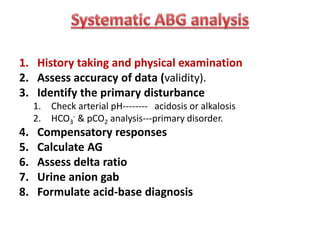
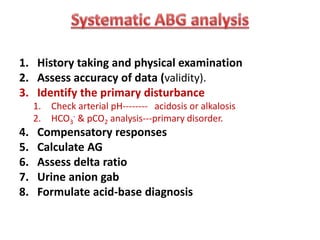
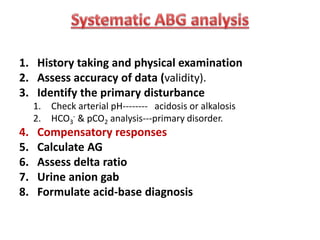
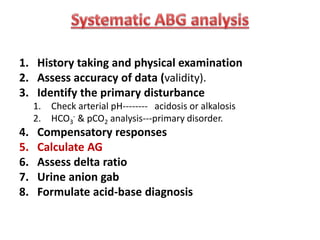
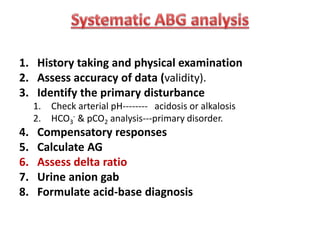
1. History taking and physical examination
2. Assess accuracy of data (validity).
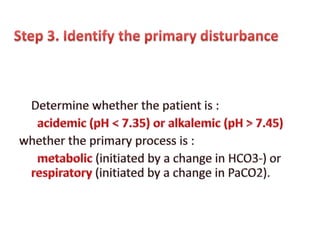
3. Identify the primary disturbance
1. Check arterial pH-------- acidosis or alkalosis
2. HCO3
- & pCO2 analysis---primary disorder.
4. Compensatory responses
5. Calculate AG
6. Assess delta ratio
7. Urine anion gab
8. Formulate acid-base diagnosis
• Step 1.
History taking and physical examination
Comprehensive history taking and physical
examination can often give clues as to the
underlying acid-base disorder
1. History taking and physical examination
2. Assess accuracy of data (validity).
3. Identify the primary disturbance
1. Check arterial pH-------- acidosis or alkalosis
2. HCO3
- & pCO2 analysis---primary disorder.
4. Compensatory responses
5. Calculate AG
6. Assess delta ratio
7. Urine anion gab
8. Formulate acid-base diagnosis
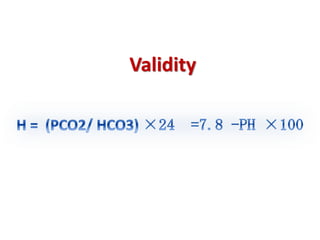
Validity
1. History taking and physical examination
2. Assess accuracy of data (validity).
3. Identify the primary disturbance
1. Check arterial pH-------- acidosis or alkalosis
2. HCO3
- & pCO2 analysis---primary disorder.
4. Compensatory responses
5. Calculate AG
6. Assess delta ratio
7. Urine anion gab
8. Formulate acid-base diagnosis
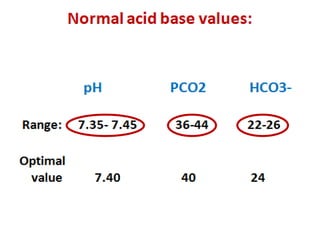
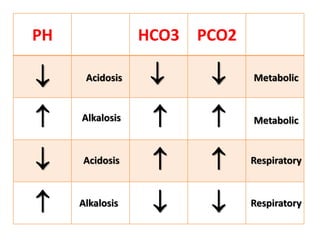
PCO2HCO3PH


 
 




Acidosis
Acidosis
Alkalosis
Alkalosis
Metabolic
Metabolic
Respiratory
Respiratory
1. History taking and physical examination
2. Assess accuracy of data (validity).
3. Identify the primary disturbance
1. Check arterial pH-------- acidosis or alkalosis
2. HCO3
- & pCO2 analysis---primary disorder.
4. Compensatory responses
5. Calculate AG
6. Assess delta ratio
7. Urine anion gab
8. Formulate acid-base diagnosis
Metabolic acidosis
Expected pCO2 = 1.5 x [HCO3] + 8 (range: +/- 2)
Metabolic alkalosis
Expected pCO2 = 0.7 [HCO3] + 20 (range: +/- 5)
“If the actual pCO2 or [HCO3
-]
is different from the predicted values,
You must suspect a 2nd acid-base disorder”
1. History taking and physical examination
2. Assess accuracy of data (validity).
3. Identify the primary disturbance
1. Check arterial pH-------- acidosis or alkalosis
2. HCO3
- & pCO2 analysis---primary disorder.
4. Compensatory responses
5. Calculate AG
6. Assess delta ratio
7. Urine anion gab
8. Formulate acid-base diagnosis
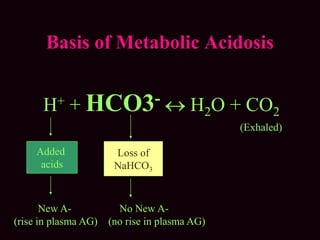
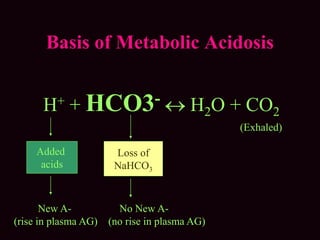
Basis of Metabolic Acidosis
H+ + HCO3-  H2O + CO2
Added
acids
Loss of
NaHCO3
New A- No New A-
(rise in plasma AG) (no rise in plasma AG)
(Exhaled)
Electrochemical Balance in Blood
0%
10%
20%
30%
40%
50%
60%
70%
80%
90%
100%
CATIONS ANIONS
Sulfate
Phosphate
Mg- OA
K - Proteins
Ca-HCO3
Na- Cl
UAUC
Na
Cl
HCO3
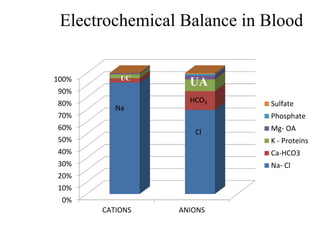
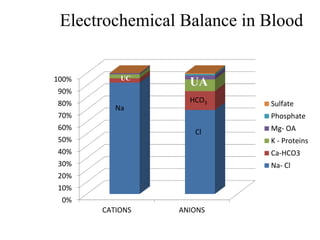
• (Na + K) + UC = (Cl + HCO3) + UA
• The anion gap is defined as the quantity of
anions not balanced by cations.
• Anion Gap= measured cation- measured
anion.
• AG = [Na + K] – (Cl + HCO3) = 12 ± 4 meq/L
• Corrected AG (in Hypoalbuminemia):
4-alb*2.5
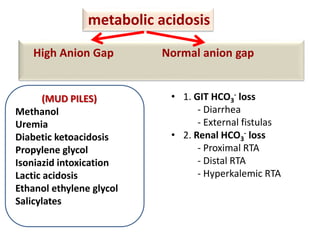
High Anion Gap Normal anion gap
• 1. Ketoacidosis
- Diabetic
- Alcoholic
- Starvation
• 2. Lactic acidosis
• 3. Toxicosis
- Ethylene glycol
- Methanol
- Salicylates
• 4. Advanced renal failure
• 1. GIT HCO3
- loss
- Diarrhea
- External fistulas
• 2. Renal HCO3
- loss
- Proximal RTA
- Distal RTA
- Hyperkalemic RTA
metabolic acidosis
(MUD PILES)
Methanol
Uremia
Diabetic ketoacidosis
Propylene glycol
Isoniazid intoxication
Lactic acidosis
Ethanol ethylene glycol
Salicylates
Basis of Metabolic Acidosis
H+ + HCO3-  H2O + CO2
Added
acids
Loss of
NaHCO3
New A- No New A-
(rise in plasma AG) (no rise in plasma AG)
(Exhaled)
Electrochemical Balance in Blood
0%
10%
20%
30%
40%
50%
60%
70%
80%
90%
100%
CATIONS ANIONS
Sulfate
Phosphate
Mg- OA
K - Proteins
Ca-HCO3
Na- Cl
UAUC
Na
Cl
HCO3
1. History taking and physical examination
2. Assess accuracy of data (validity).
3. Identify the primary disturbance
1. Check arterial pH-------- acidosis or alkalosis
2. HCO3
- & pCO2 analysis---primary disorder.
4. Compensatory responses
5. Calculate AG
6. Assess delta ratio
7. Urine anion gab
8. Formulate acid-base diagnosis
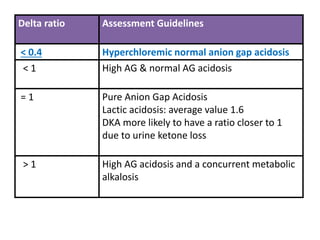
Delta ratio= ∆ Anion gap/∆ [HCO3-]
∆ Anion gap = (AG-12)
∆ [HCO3-] = (24 - [HCO3-])
Delta ratio Assessment Guidelines
< 0.4 Hyperchloremic normal anion gap acidosis
< 1 High AG & normal AG acidosis
= 1 Pure Anion Gap Acidosis
Lactic acidosis: average value 1.6
DKA more likely to have a ratio closer to 1
due to urine ketone loss
> 1 High AG acidosis and a concurrent metabolic
alkalosis
s
Ketoacidosis
• In patients with IDDM, alcoholics and pts undergoing fasting or
starvation
• due to the overproduction of ketone bodies (Ketosis) leading to
accumulation of ketones in plasma (Ketonemia) and urine
(Ketonuria).
• In starvation states where plasma glucose levels are low or in states of
low plasma insulin where uptake of glucose by cells is diminished,
fatty acids will be mobilized and transported to tissues (brain, skeletal
muscle, heart) for fatty acid oxidation and energy production.
• acetyl CoA from fatty acid oxidation can not be oxidized and is instead
converted to the generation of ketone bodies. (acetoacetate and β-
hydroxybutyrate) Which serve as a source of fuel
Treatment of KA
• Fluids: IVF
• Insulin infusion
• Potassium replacement
• Bicarb replacement: If pH < 7.1 and/or cardiac instability
present
Lactic Acidosis
• Dead-end product of glycolysis
• Occurs when the body must regenerate ATP without oxygen
• Normal lactic level is maintained at 0.7-1.3 mEq/L
• Eliminated in liver (50%), kidneys (25%), heart and skeletal
muscles
• Normal Lactate/Pyruvate ratio suggest that the cause is not related
to anaerobic metabolism or anoxia
Treatment for Lactic Acidosis
1. Identification of the primary illness and correction of that
disturbance.
2. Restoration of tissue oxygen delivery through hemodynamic
and/or respiratory support is the key therapeutic goal in type A
lactic acidosis.
3. the use of sodium bicarbonate in lactic acidosis is controversial,
particularly in patients with circulatory and respiratory failure.
Despite the controversy most physicians support administration
of NaHCO3 for very severe acidemia and will give small
amounts of NaHCO3 to maintain the arterial pH above 7.10,
since a pH beyond this value will promote the development of
arrhythmias and cardiac depression.
Actual Bicarbonate Loss
Normal Plasma Anion Gap
• Direct loss of NaHCO3
• Gastrointestinal tract (diarrhea, ileus, fistula or T-tube
drainage, villous adenoma)
• Urinary tract (RTA, use of carbonic anhydrase inhibitors)
Renal Tubular Acidosis
• Inability of the kidney to reabsorb
the filtered HCO3
-
• Inability of the kidney to excrete
NH4
+
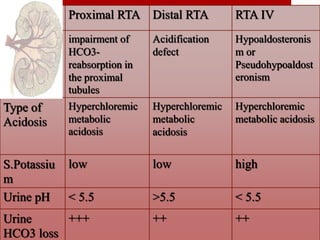
Proximal RTA Distal RTA RTA IV
cause impairment of
HCO3-
reabsorption in
the proximal
tubules
Acidification
defect
Hypoaldosteronis
m or
Pseudohypoaldost
eronism
Type of
Acidosis
Hyperchloremic
metabolic
acidosis
Hyperchloremic
metabolic
acidosis
Hyperchloremic
metabolic acidosis
S.Potassiu
m
low low high
Urine pH < 5.5 >5.5 < 5.5
Urine
HCO3 loss
+++ ++ ++
Metabolic Acidosis in
Renal Failure
• Normal AG acidosis results from failure of the kidney to
generate new HCO3
- from a reduced rate of synthesis and
excretion of NH4
+
• Increased AG acidosis results from the reduced GFR,
with accumulation of anions: HPO4
MANAGEMENT OF METABOLIC
ACIDOSIS
Cause
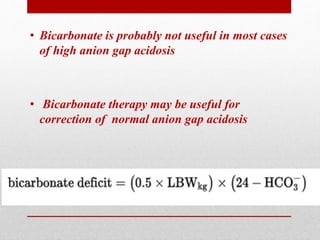
• Bicarbonate is probably not useful in most cases
of high anion gap acidosis
• Bicarbonate therapy may be useful for
correction of normal anion gap acidosis
THANK YOU

Metabolic acidosis ABG

  • 1.
    Appraoch to Metabolic Acidosis Dr.Nadia Mohsen Abdu Ibrahim Specialist of Nephrology. NMGH
  • 3.
    1. History takingand physical examination 2. Assess accuracy of data (validity). 3. Identify the primary disturbance 1. Check arterial pH-------- acidosis or alkalosis 2. HCO3 - & pCO2 analysis---primary disorder. 4. Compensatory responses 5. Calculate AG 6. Assess delta ratio 7. Urine anion gab 8. Formulate acid-base diagnosis
  • 4.
    • Step 1. Historytaking and physical examination Comprehensive history taking and physical examination can often give clues as to the underlying acid-base disorder
  • 5.
    1. History takingand physical examination 2. Assess accuracy of data (validity). 3. Identify the primary disturbance 1. Check arterial pH-------- acidosis or alkalosis 2. HCO3 - & pCO2 analysis---primary disorder. 4. Compensatory responses 5. Calculate AG 6. Assess delta ratio 7. Urine anion gab 8. Formulate acid-base diagnosis
  • 6.
  • 7.
    1. History takingand physical examination 2. Assess accuracy of data (validity). 3. Identify the primary disturbance 1. Check arterial pH-------- acidosis or alkalosis 2. HCO3 - & pCO2 analysis---primary disorder. 4. Compensatory responses 5. Calculate AG 6. Assess delta ratio 7. Urine anion gab 8. Formulate acid-base diagnosis
  • 9.
  • 10.
    1. History takingand physical examination 2. Assess accuracy of data (validity). 3. Identify the primary disturbance 1. Check arterial pH-------- acidosis or alkalosis 2. HCO3 - & pCO2 analysis---primary disorder. 4. Compensatory responses 5. Calculate AG 6. Assess delta ratio 7. Urine anion gab 8. Formulate acid-base diagnosis
  • 11.
    Metabolic acidosis Expected pCO2= 1.5 x [HCO3] + 8 (range: +/- 2) Metabolic alkalosis Expected pCO2 = 0.7 [HCO3] + 20 (range: +/- 5) “If the actual pCO2 or [HCO3 -] is different from the predicted values, You must suspect a 2nd acid-base disorder”
  • 13.
    1. History takingand physical examination 2. Assess accuracy of data (validity). 3. Identify the primary disturbance 1. Check arterial pH-------- acidosis or alkalosis 2. HCO3 - & pCO2 analysis---primary disorder. 4. Compensatory responses 5. Calculate AG 6. Assess delta ratio 7. Urine anion gab 8. Formulate acid-base diagnosis
  • 14.
    Basis of MetabolicAcidosis H+ + HCO3-  H2O + CO2 Added acids Loss of NaHCO3 New A- No New A- (rise in plasma AG) (no rise in plasma AG) (Exhaled)
  • 15.
    Electrochemical Balance inBlood 0% 10% 20% 30% 40% 50% 60% 70% 80% 90% 100% CATIONS ANIONS Sulfate Phosphate Mg- OA K - Proteins Ca-HCO3 Na- Cl UAUC Na Cl HCO3
  • 16.
    • (Na +K) + UC = (Cl + HCO3) + UA • The anion gap is defined as the quantity of anions not balanced by cations. • Anion Gap= measured cation- measured anion. • AG = [Na + K] – (Cl + HCO3) = 12 ± 4 meq/L • Corrected AG (in Hypoalbuminemia): 4-alb*2.5
  • 17.
    High Anion GapNormal anion gap • 1. Ketoacidosis - Diabetic - Alcoholic - Starvation • 2. Lactic acidosis • 3. Toxicosis - Ethylene glycol - Methanol - Salicylates • 4. Advanced renal failure • 1. GIT HCO3 - loss - Diarrhea - External fistulas • 2. Renal HCO3 - loss - Proximal RTA - Distal RTA - Hyperkalemic RTA metabolic acidosis (MUD PILES) Methanol Uremia Diabetic ketoacidosis Propylene glycol Isoniazid intoxication Lactic acidosis Ethanol ethylene glycol Salicylates
  • 18.
    Basis of MetabolicAcidosis H+ + HCO3-  H2O + CO2 Added acids Loss of NaHCO3 New A- No New A- (rise in plasma AG) (no rise in plasma AG) (Exhaled)
  • 19.
    Electrochemical Balance inBlood 0% 10% 20% 30% 40% 50% 60% 70% 80% 90% 100% CATIONS ANIONS Sulfate Phosphate Mg- OA K - Proteins Ca-HCO3 Na- Cl UAUC Na Cl HCO3
  • 20.
    1. History takingand physical examination 2. Assess accuracy of data (validity). 3. Identify the primary disturbance 1. Check arterial pH-------- acidosis or alkalosis 2. HCO3 - & pCO2 analysis---primary disorder. 4. Compensatory responses 5. Calculate AG 6. Assess delta ratio 7. Urine anion gab 8. Formulate acid-base diagnosis
  • 21.
    Delta ratio= ∆Anion gap/∆ [HCO3-] ∆ Anion gap = (AG-12) ∆ [HCO3-] = (24 - [HCO3-])
  • 22.
    Delta ratio AssessmentGuidelines < 0.4 Hyperchloremic normal anion gap acidosis < 1 High AG & normal AG acidosis = 1 Pure Anion Gap Acidosis Lactic acidosis: average value 1.6 DKA more likely to have a ratio closer to 1 due to urine ketone loss > 1 High AG acidosis and a concurrent metabolic alkalosis
  • 24.
  • 25.
    Ketoacidosis • In patientswith IDDM, alcoholics and pts undergoing fasting or starvation • due to the overproduction of ketone bodies (Ketosis) leading to accumulation of ketones in plasma (Ketonemia) and urine (Ketonuria). • In starvation states where plasma glucose levels are low or in states of low plasma insulin where uptake of glucose by cells is diminished, fatty acids will be mobilized and transported to tissues (brain, skeletal muscle, heart) for fatty acid oxidation and energy production. • acetyl CoA from fatty acid oxidation can not be oxidized and is instead converted to the generation of ketone bodies. (acetoacetate and β- hydroxybutyrate) Which serve as a source of fuel
  • 26.
    Treatment of KA •Fluids: IVF • Insulin infusion • Potassium replacement • Bicarb replacement: If pH < 7.1 and/or cardiac instability present
  • 27.
    Lactic Acidosis • Dead-endproduct of glycolysis • Occurs when the body must regenerate ATP without oxygen • Normal lactic level is maintained at 0.7-1.3 mEq/L • Eliminated in liver (50%), kidneys (25%), heart and skeletal muscles • Normal Lactate/Pyruvate ratio suggest that the cause is not related to anaerobic metabolism or anoxia
  • 28.
    Treatment for LacticAcidosis 1. Identification of the primary illness and correction of that disturbance. 2. Restoration of tissue oxygen delivery through hemodynamic and/or respiratory support is the key therapeutic goal in type A lactic acidosis. 3. the use of sodium bicarbonate in lactic acidosis is controversial, particularly in patients with circulatory and respiratory failure. Despite the controversy most physicians support administration of NaHCO3 for very severe acidemia and will give small amounts of NaHCO3 to maintain the arterial pH above 7.10, since a pH beyond this value will promote the development of arrhythmias and cardiac depression.
  • 29.
    Actual Bicarbonate Loss NormalPlasma Anion Gap • Direct loss of NaHCO3 • Gastrointestinal tract (diarrhea, ileus, fistula or T-tube drainage, villous adenoma) • Urinary tract (RTA, use of carbonic anhydrase inhibitors)
  • 30.
    Renal Tubular Acidosis •Inability of the kidney to reabsorb the filtered HCO3 - • Inability of the kidney to excrete NH4 +
  • 31.
    Proximal RTA DistalRTA RTA IV cause impairment of HCO3- reabsorption in the proximal tubules Acidification defect Hypoaldosteronis m or Pseudohypoaldost eronism Type of Acidosis Hyperchloremic metabolic acidosis Hyperchloremic metabolic acidosis Hyperchloremic metabolic acidosis S.Potassiu m low low high Urine pH < 5.5 >5.5 < 5.5 Urine HCO3 loss +++ ++ ++
  • 32.
    Metabolic Acidosis in RenalFailure • Normal AG acidosis results from failure of the kidney to generate new HCO3 - from a reduced rate of synthesis and excretion of NH4 + • Increased AG acidosis results from the reduced GFR, with accumulation of anions: HPO4
  • 34.
  • 35.
    • Bicarbonate isprobably not useful in most cases of high anion gap acidosis • Bicarbonate therapy may be useful for correction of normal anion gap acidosis
  • 36.