Dr Bikal Lamichhane
1st yr resident
Internal medicine, NAMS, Bir Hospital.
Metabolic acidosis and alkalosis
Introduction
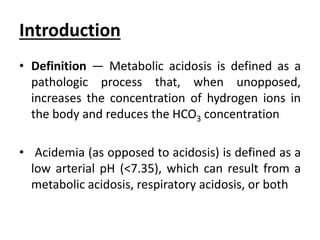
• Definition — Metabolic acidosis is defined as a
pathologic process that, when unopposed,
increases the concentration of hydrogen ions in
the body and reduces the HCO3 concentration
• Acidemia (as opposed to acidosis) is defined as a
low arterial pH (<7.35), which can result from a
metabolic acidosis, respiratory acidosis, or both
Pathogenesis
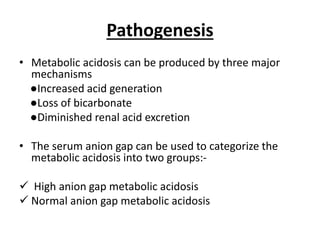
• Metabolic acidosis can be produced by three major
mechanisms
●Increased acid generation
●Loss of bicarbonate
●Diminished renal acid excretion
• The serum anion gap can be used to categorize the
metabolic acidosis into two groups:-
 High anion gap metabolic acidosis
 Normal anion gap metabolic acidosis
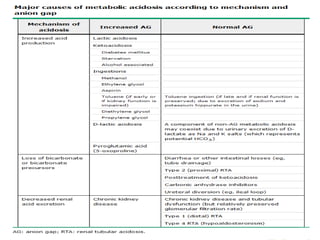
Increased acid generation
●Lactic acidosis
●Ketoacidosis due to uncontrolled diabetes mellitus, excess alcohol
intake (generally in a malnourished patient), or fasting
●Ingestions or infusions
 Methanol, ethylene glycol, diethylene glycol, or propylene glycol
 Aspirin poisoning
 Chronic acetaminophen ingestion, especially in malnourished
women
 D-lactic acid, generated from carbohydrates by gastrointestinal
bacteria
 Toluene
Loss of bicarbonate
• Severe diarrhea
• When urine is exposed to gastrointestinal mucosa,
which occurs after ureteral implantation into the
sigmoid colon or the creation of replacement urinary
bladder using a short loop of ileum
• Proximal (type 2) renal tubular acidosis (RTA), in which
proximal bicarbonate reabsorption is impaired
Diminished renal acid excretion
• Reduced acid excretion that occurs in
conjunction with a reduction in glomerular
filtration rate (ie, the acidosis of renal failure).
• Distal (type 1) RTA and type 4 RTA, in which
tubular dysfunction is the primary problem
and glomerular filtration is initially preserved
• Dilution acidosis — Dilution acidosis refers to
a fall in serum bicarbonate concentration that
is solely due to expansion of the extracellular
fluid volume with large volumes of
intravenous fluids containing neither
bicarbonate nor the sodium salts of organic
anions that can be metabolized to bicarbonate
(such as lactate or acetate)
DIAGNOSIS AND EVALUATION
• Diagnosis —
• A metabolic acidosis is diagnosed when the
serum pH is reduced and the serum bicarbonate
concentration is abnormally low (often defined as
<22 mEq/L.
• if metabolic acidosis coexists with respiratory
acidosis or metabolic alkalosis, then the serum
bicarbonate may be normal or elevated
Evaluation
• Definitive evaluation of metabolic acidosis usually
requires the following:-
●Measurement of the arterial pH and pCO2
●Determining whether respiratory
compensation is appropriate.
●Assessment of the serum anion gap to help
identify the cause of acidosis and calculation of
the delta anion gap/delta HCO3 ratio in patients
who have an elevated anion gap
Measurement of the arterial pH and
pCO2
• Measurement of the serum bicarbonate concentration alone may
not be sufficient since a low serum bicarbonate concentration can
reflect a primary metabolic acidosis or, alternatively, the
compensatory response to a primary respiratory alkalosis.
• If the patient has a simple metabolic acidosis, rather than metabolic
compensation for a respiratory alkalosis, then the arterial pH should
be low.
• In contrast, if the patient has a mixed disorder consisting of a
metabolic acidosis plus an alkalosis (respiratory, metabolic, or
both), then the arterial pH may not be low and can even be
elevated.
Determination of whether respiratory
compensation is appropriate
• The development of metabolic acidosis will normally generate a
compensatory respiratory response.
• The reduction in the serum bicarbonate and pH caused by the
metabolic acidosis results in hyperventilation and a reduction of the
pCO2.
• the primary abnormality will cause a compensatory response such
that the HCO3concentration and pCO2 will move in the same
direction (either both will increase or both will decrease)
• This respiratory response to metabolic acidosis begins within the
first 30 minutes and is complete by 12 to 24 hours
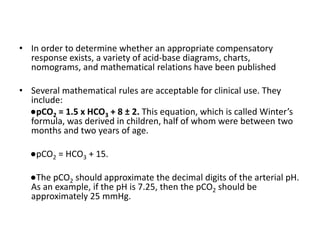
• In order to determine whether an appropriate compensatory
response exists, a variety of acid-base diagrams, charts,
nomograms, and mathematical relations have been published
• Several mathematical rules are acceptable for clinical use. They
include:
●pCO2 = 1.5 x HCO3 + 8 ± 2. This equation, which is called Winter’s
formula, was derived in children, half of whom were between two
months and two years of age.
●pCO2 = HCO3 + 15.
●The pCO2 should approximate the decimal digits of the arterial pH.
As an example, if the pH is 7.25, then the pCO2 should be
approximately 25 mmHg.
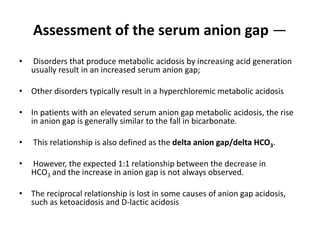
Assessment of the serum anion gap —
• Disorders that produce metabolic acidosis by increasing acid generation
usually result in an increased serum anion gap;
• Other disorders typically result in a hyperchloremic metabolic acidosis
• In patients with an elevated serum anion gap metabolic acidosis, the rise
in anion gap is generally similar to the fall in bicarbonate.
• This relationship is also defined as the delta anion gap/delta HCO3.
• However, the expected 1:1 relationship between the decrease in
HCO3 and the increase in anion gap is not always observed.
• The reciprocal relationship is lost in some causes of anion gap acidosis,
such as ketoacidosis and D-lactic acidosis
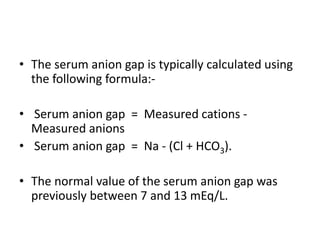
• The serum anion gap is typically calculated using
the following formula:-
• Serum anion gap = Measured cations -
Measured anions
• Serum anion gap = Na - (Cl + HCO3).
• The normal value of the serum anion gap was
previously between 7 and 13 mEq/L.
• The expected "normal" value for the anion gap must be adjusted
downward in patients with hypoalbuminemia. The serum anion gap
falls by 2.3 to 2.5 mEq/L for every 1 g/dL (10 g/L) reduction in the
serum albumin concentration.
• Corrected serum anion gap = (Serum anion gap measured) +
(2.5 x [4.5 - Observed serum albumin])
• In addition to hypoalbuminemia, marked hyperkalemia may affect
the interpretation of the anion gap. Potassium is an "unmeasured"
cation using the equation that does not include the serum K.
• Thus, a serum K of 6 mEq/L will reduce the anion gap by 2 mEq/L.
Hypercalcemia and/or hypermagnesemia will similarly reduce the
anion gap.
• Much less commonly, negatively charged proteins
such as immunoglobulin A in IgA myeloma or
hyperalbuminemia with volume contraction
accumulate and raise the anion gap.
• Conversely, a decrease in the concentration of
unmeasured anions (eg, hypoalbuminemia as
noted above) or an increase in the concentration
of unmeasured cations (eg, some
immunoglobulin G proteins in IgG multiple
myeloma) will decrease the anion gap.
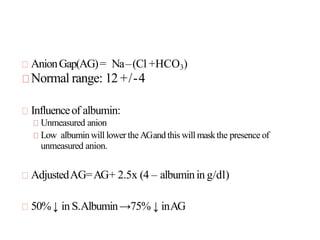
AnionGap(AG)= Na–(Cl +HCO3)
Normal range: 12 +/-4
Influenceof albumin:
Unmeasured anion
Low albuminwill lowertheAGand this will maskthe presence of
unmeasured anion.
AdjustedAG=AG+ 2.5x (4 – albuminin g/dl)
50%↓ in S.Albumin→75% ↓ inAG
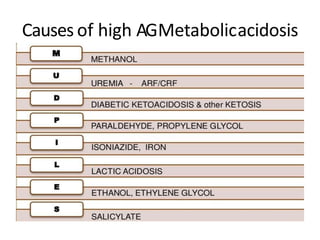
Causes of high AGMetabolicacidosis
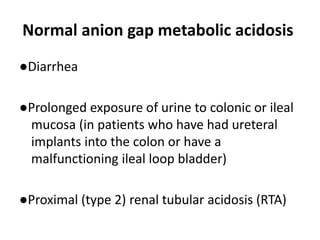
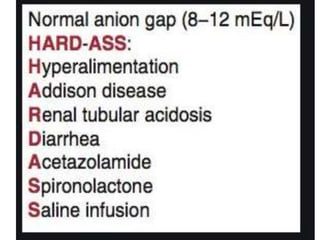
Normal anion gap metabolic acidosis
●Diarrhea
●Prolonged exposure of urine to colonic or ileal
mucosa (in patients who have had ureteral
implants into the colon or have a
malfunctioning ileal loop bladder)
●Proximal (type 2) renal tubular acidosis (RTA)
Treatment
• Treatment of metabolic acidosis with alkali should be
reserved for severe acidemia except when the patient has
no “potential HCO3 −” in plasma.
The potential [HCO3 −] can be estimated from the increment
(Δ) in the AG (ΔAG = patient’s AG – 10), only if the acid
anion that has accumulated in plasma is metabolizable
(i.e., β-hydroxybutyrate, acetoacetate, and lactate).
Conversely nonmetabolizable anions that may accumulate in
advanced stage CKD or after toxin ingestion are not
metabolizable and do not represent “potential” HCO3−
• With acute CKD improvement in kidney function to
replenish the [HCO3 −] deficit is a slow and often
unpredictable process.
• Consequently, patients with a normal AG acidosis
(hyperchloremic acidosis) or an AG attributable to a
nonmetabolizable anion due to advanced kidney failure
should receive alkali therapy, either PO (NaHCO3 or Shohl’s
solution) or IV (NaHCO3), in an amount necessary to slowly
increase the plasma [HCO3 −] to a target value of 22
mmol/L.
• Nevertheless, overcorrection should be avoided.
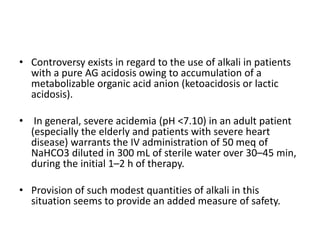
• Controversy exists in regard to the use of alkali in patients
with a pure AG acidosis owing to accumulation of a
metabolizable organic acid anion (ketoacidosis or lactic
acidosis).
• In general, severe acidemia (pH <7.10) in an adult patient
(especially the elderly and patients with severe heart
disease) warrants the IV administration of 50 meq of
NaHCO3 diluted in 300 mL of sterile water over 30–45 min,
during the initial 1–2 h of therapy.
• Provision of such modest quantities of alkali in this
situation seems to provide an added measure of safety.
• Administration of alkali requires careful monitoring of
plasma electrolytes, especially the plasma [K+], during the
course of therapy.
• A reasonable initial goal is to increase the [HCO3 −] to 10–
12 mmol/L and the pH to ∼7.20, but clearly not to increase
these values to normal.
• Estimation of the “bicarbonate deficit” by calculation of the
volume of distribution of bicarbonate is often taught but is
unnecessary and may result in administration of excessive
amounts of alkali.
Metabolic alkalosis
• Metabolic alkalosis is defined as a disorder that
causes elevations in the serum bicarbonate
concentration and arterial pH.
• In a patient with an uncomplicated (simple)
metabolic alkalosis, both parameters are above
normal.
• However, this may not be present in patients with
mixed acid-base disorders.
Metabolic alkalosis
• Metabolic alkalosis can result from several
mechanisms:-
 intracellular shift of hydrogen ions;
 gastrointestinal loss of hydrogen ions;
 excessive renal hydrogen ion loss;
administration and retention of bicarbonate ions
 volume contraction around a constant amount of
extracellular bicarbonate (contraction alkalosis)
INTRACELLULAR SHIFT OF HYDROGEN
• Metabolic alkalosis can be generated by a shift of
hydrogen ions into the cells.
• This most often occurs in patients with potassium
deficits and hypokalemia.
• This may be an important pathophysiologic
mechanism in patients with metabolic alkalosis
due to vomiting or nasogastric suction
GASTROINTESTINAL HYDROGEN LOSS
• Gastrointestinal hydrogen loss can result from
 loss of gastric secretions
vomiting
nasogastric suction
 diarrhea in patients with rare disorders that
block intestinal chloride absorption
congenital chloridorrhea
in some patients with villous adenomas.
EXCESSIVE RENAL HYDROGEN LOSS
• Primary mineralocorticoid excess
• Loop or thiazide diuretics
• Bartter and Gitelman syndromes
• Pendred syndrome
• Posthypercapnic alkalosis
• Hypercalcemia and the milk (or calcium)-
alkali syndrome
CONTRACTION ALKALOSIS
• A contraction alkalosis occurs when there is
loss of relatively large volumes of fluid that
has a high sodium chloride concentration but
a low bicarbonate concentration
CLINICAL FEATURES
• may be asymptomatic or
• may complain of symptoms
 due to volume depletion (which may produce lassitude, easy
fatigability, muscle cramps, and postural dizziness) and
 hypokalemia (which may produce muscle weakness, cardiac
arrhythmias, and
 if persistent, polyuria and polydipsia due to impaired urinary
concentrating ability and/or direct stimulation of thirst
• Muscular spasms, tetany, and paresthesia can occur with severe
metabolic alkalosis
• Arterial blood gases — Metabolic alkalosis is
associated with a respiratory compensation
that should raise the PCO2 by approximately
0.7 mmHg for every 1 mEq/L elevation in the
plasma bicarbonate concentration, thereby
minimizing the increase in arterial pH. The
respiratory compensation is most effective
acutely and then becomes less effective over
time
• Common causes of metabolic alkalosis in the
INTENSIVE CARE UNITFrusemide infusion, use of thiazides
• High volume NG aspirates
• Diarrhoea
• Severe hypokalemia (eg. insulin infusion)
• Corticosteroid therapy
• Overcorrection of chronic respiratory acidosis
• Recovery phase post organic acidosis (excess
regeneration of HCO3)
• Large doses of IV penicillin-based drugs
•
• Consequences of metabolic alkalosisIn critically ill patients, significant
increase in morbidity and mortality
• Decreased myocardial contractiity
• Arrhythmias
• Decreased cerebral blood flow (vasoconstriction)
• Neuromuscular excitability ? tetany ? difficult
ventilation
• Impaired peripheral oxygen unloading
(oxygen-hemoglobin dissociation curve shifts to
the left, thus hemoglobin is less inclined to
part with oxygen in the tissues)
• Confusion, obtundation, seizures
• Hypoventilation, thus atelectasis
• Increased V/Q mismatch (alkalosis inhibits
hypoxic pulmonary vasoconstriction)
• Compensation for metabolic alkalosisThe
normal response is hypoventilation
• The key is to compensate by increasing pCO2
• How much pCO2 is enough?
• Expected pCO2 0.7 HCO3 20 mmHg (range /-
5)
• Clinical features of metabolic
alkalosisHypoventilation, even hypoxia
• Other changes are similar to those of
hypercalcemia
• confusion, obtundation, seizures
• paraesthesia
• Muscle cramps, tetany
•
• Diagnosis of metabolic alkalosis in the
ICUSUSPICION
• Is the patient vomiting, is the NG sucking?
• Is the pt on frusemide? Whose week is it?
• Has there recently been a massive transfusion?
• ABGS routine and frequent
•
Management of metabolic alkalosis in
the
Intensive Care Unit• More basic management
• REPLACE POTASSIUM / OTHER ELECTROLYTES
• AVOID HYPERVENTILATION
•
Advanced management strategies
• Hydrochloric acid infusion
• Via a central line just make sure it doesnt
extravasate
• The H will consume HCO3 then its all about
blowing off enough of the created CO2
• Acetazolamide
• Carbonic anhydrase inhibitor forces kidneys to
excrete HCO3 and H to enter the bloodstream
together with CL-
• Increases losses of Na, K, and water.
• Thank you

Metabolic acidosis

  • 1.
    Dr Bikal Lamichhane 1styr resident Internal medicine, NAMS, Bir Hospital. Metabolic acidosis and alkalosis
  • 2.
    Introduction • Definition —Metabolic acidosis is defined as a pathologic process that, when unopposed, increases the concentration of hydrogen ions in the body and reduces the HCO3 concentration • Acidemia (as opposed to acidosis) is defined as a low arterial pH (<7.35), which can result from a metabolic acidosis, respiratory acidosis, or both
  • 3.
    Pathogenesis • Metabolic acidosiscan be produced by three major mechanisms ●Increased acid generation ●Loss of bicarbonate ●Diminished renal acid excretion • The serum anion gap can be used to categorize the metabolic acidosis into two groups:-  High anion gap metabolic acidosis  Normal anion gap metabolic acidosis
  • 5.
    Increased acid generation ●Lacticacidosis ●Ketoacidosis due to uncontrolled diabetes mellitus, excess alcohol intake (generally in a malnourished patient), or fasting ●Ingestions or infusions  Methanol, ethylene glycol, diethylene glycol, or propylene glycol  Aspirin poisoning  Chronic acetaminophen ingestion, especially in malnourished women  D-lactic acid, generated from carbohydrates by gastrointestinal bacteria  Toluene
  • 6.
    Loss of bicarbonate •Severe diarrhea • When urine is exposed to gastrointestinal mucosa, which occurs after ureteral implantation into the sigmoid colon or the creation of replacement urinary bladder using a short loop of ileum • Proximal (type 2) renal tubular acidosis (RTA), in which proximal bicarbonate reabsorption is impaired
  • 7.
    Diminished renal acidexcretion • Reduced acid excretion that occurs in conjunction with a reduction in glomerular filtration rate (ie, the acidosis of renal failure). • Distal (type 1) RTA and type 4 RTA, in which tubular dysfunction is the primary problem and glomerular filtration is initially preserved
  • 8.
    • Dilution acidosis— Dilution acidosis refers to a fall in serum bicarbonate concentration that is solely due to expansion of the extracellular fluid volume with large volumes of intravenous fluids containing neither bicarbonate nor the sodium salts of organic anions that can be metabolized to bicarbonate (such as lactate or acetate)
  • 9.
    DIAGNOSIS AND EVALUATION •Diagnosis — • A metabolic acidosis is diagnosed when the serum pH is reduced and the serum bicarbonate concentration is abnormally low (often defined as <22 mEq/L. • if metabolic acidosis coexists with respiratory acidosis or metabolic alkalosis, then the serum bicarbonate may be normal or elevated
  • 10.
    Evaluation • Definitive evaluationof metabolic acidosis usually requires the following:- ●Measurement of the arterial pH and pCO2 ●Determining whether respiratory compensation is appropriate. ●Assessment of the serum anion gap to help identify the cause of acidosis and calculation of the delta anion gap/delta HCO3 ratio in patients who have an elevated anion gap
  • 11.
    Measurement of thearterial pH and pCO2 • Measurement of the serum bicarbonate concentration alone may not be sufficient since a low serum bicarbonate concentration can reflect a primary metabolic acidosis or, alternatively, the compensatory response to a primary respiratory alkalosis. • If the patient has a simple metabolic acidosis, rather than metabolic compensation for a respiratory alkalosis, then the arterial pH should be low. • In contrast, if the patient has a mixed disorder consisting of a metabolic acidosis plus an alkalosis (respiratory, metabolic, or both), then the arterial pH may not be low and can even be elevated.
  • 12.
    Determination of whetherrespiratory compensation is appropriate • The development of metabolic acidosis will normally generate a compensatory respiratory response. • The reduction in the serum bicarbonate and pH caused by the metabolic acidosis results in hyperventilation and a reduction of the pCO2. • the primary abnormality will cause a compensatory response such that the HCO3concentration and pCO2 will move in the same direction (either both will increase or both will decrease) • This respiratory response to metabolic acidosis begins within the first 30 minutes and is complete by 12 to 24 hours
  • 13.
    • In orderto determine whether an appropriate compensatory response exists, a variety of acid-base diagrams, charts, nomograms, and mathematical relations have been published • Several mathematical rules are acceptable for clinical use. They include: ●pCO2 = 1.5 x HCO3 + 8 ± 2. This equation, which is called Winter’s formula, was derived in children, half of whom were between two months and two years of age. ●pCO2 = HCO3 + 15. ●The pCO2 should approximate the decimal digits of the arterial pH. As an example, if the pH is 7.25, then the pCO2 should be approximately 25 mmHg.
  • 14.
    Assessment of theserum anion gap — • Disorders that produce metabolic acidosis by increasing acid generation usually result in an increased serum anion gap; • Other disorders typically result in a hyperchloremic metabolic acidosis • In patients with an elevated serum anion gap metabolic acidosis, the rise in anion gap is generally similar to the fall in bicarbonate. • This relationship is also defined as the delta anion gap/delta HCO3. • However, the expected 1:1 relationship between the decrease in HCO3 and the increase in anion gap is not always observed. • The reciprocal relationship is lost in some causes of anion gap acidosis, such as ketoacidosis and D-lactic acidosis
  • 15.
    • The serumanion gap is typically calculated using the following formula:- • Serum anion gap = Measured cations - Measured anions • Serum anion gap = Na - (Cl + HCO3). • The normal value of the serum anion gap was previously between 7 and 13 mEq/L.
  • 16.
    • The expected"normal" value for the anion gap must be adjusted downward in patients with hypoalbuminemia. The serum anion gap falls by 2.3 to 2.5 mEq/L for every 1 g/dL (10 g/L) reduction in the serum albumin concentration. • Corrected serum anion gap = (Serum anion gap measured) + (2.5 x [4.5 - Observed serum albumin]) • In addition to hypoalbuminemia, marked hyperkalemia may affect the interpretation of the anion gap. Potassium is an "unmeasured" cation using the equation that does not include the serum K. • Thus, a serum K of 6 mEq/L will reduce the anion gap by 2 mEq/L. Hypercalcemia and/or hypermagnesemia will similarly reduce the anion gap.
  • 17.
    • Much lesscommonly, negatively charged proteins such as immunoglobulin A in IgA myeloma or hyperalbuminemia with volume contraction accumulate and raise the anion gap. • Conversely, a decrease in the concentration of unmeasured anions (eg, hypoalbuminemia as noted above) or an increase in the concentration of unmeasured cations (eg, some immunoglobulin G proteins in IgG multiple myeloma) will decrease the anion gap.
  • 18.
    AnionGap(AG)= Na–(Cl +HCO3) Normalrange: 12 +/-4 Influenceof albumin: Unmeasured anion Low albuminwill lowertheAGand this will maskthe presence of unmeasured anion. AdjustedAG=AG+ 2.5x (4 – albuminin g/dl) 50%↓ in S.Albumin→75% ↓ inAG
  • 19.
    Causes of highAGMetabolicacidosis
  • 20.
    Normal anion gapmetabolic acidosis ●Diarrhea ●Prolonged exposure of urine to colonic or ileal mucosa (in patients who have had ureteral implants into the colon or have a malfunctioning ileal loop bladder) ●Proximal (type 2) renal tubular acidosis (RTA)
  • 22.
    Treatment • Treatment ofmetabolic acidosis with alkali should be reserved for severe acidemia except when the patient has no “potential HCO3 −” in plasma. The potential [HCO3 −] can be estimated from the increment (Δ) in the AG (ΔAG = patient’s AG – 10), only if the acid anion that has accumulated in plasma is metabolizable (i.e., β-hydroxybutyrate, acetoacetate, and lactate). Conversely nonmetabolizable anions that may accumulate in advanced stage CKD or after toxin ingestion are not metabolizable and do not represent “potential” HCO3−
  • 23.
    • With acuteCKD improvement in kidney function to replenish the [HCO3 −] deficit is a slow and often unpredictable process. • Consequently, patients with a normal AG acidosis (hyperchloremic acidosis) or an AG attributable to a nonmetabolizable anion due to advanced kidney failure should receive alkali therapy, either PO (NaHCO3 or Shohl’s solution) or IV (NaHCO3), in an amount necessary to slowly increase the plasma [HCO3 −] to a target value of 22 mmol/L. • Nevertheless, overcorrection should be avoided.
  • 24.
    • Controversy existsin regard to the use of alkali in patients with a pure AG acidosis owing to accumulation of a metabolizable organic acid anion (ketoacidosis or lactic acidosis). • In general, severe acidemia (pH <7.10) in an adult patient (especially the elderly and patients with severe heart disease) warrants the IV administration of 50 meq of NaHCO3 diluted in 300 mL of sterile water over 30–45 min, during the initial 1–2 h of therapy. • Provision of such modest quantities of alkali in this situation seems to provide an added measure of safety.
  • 25.
    • Administration ofalkali requires careful monitoring of plasma electrolytes, especially the plasma [K+], during the course of therapy. • A reasonable initial goal is to increase the [HCO3 −] to 10– 12 mmol/L and the pH to ∼7.20, but clearly not to increase these values to normal. • Estimation of the “bicarbonate deficit” by calculation of the volume of distribution of bicarbonate is often taught but is unnecessary and may result in administration of excessive amounts of alkali.
  • 26.
    Metabolic alkalosis • Metabolicalkalosis is defined as a disorder that causes elevations in the serum bicarbonate concentration and arterial pH. • In a patient with an uncomplicated (simple) metabolic alkalosis, both parameters are above normal. • However, this may not be present in patients with mixed acid-base disorders.
  • 27.
    Metabolic alkalosis • Metabolicalkalosis can result from several mechanisms:-  intracellular shift of hydrogen ions;  gastrointestinal loss of hydrogen ions;  excessive renal hydrogen ion loss; administration and retention of bicarbonate ions  volume contraction around a constant amount of extracellular bicarbonate (contraction alkalosis)
  • 28.
    INTRACELLULAR SHIFT OFHYDROGEN • Metabolic alkalosis can be generated by a shift of hydrogen ions into the cells. • This most often occurs in patients with potassium deficits and hypokalemia. • This may be an important pathophysiologic mechanism in patients with metabolic alkalosis due to vomiting or nasogastric suction
  • 29.
    GASTROINTESTINAL HYDROGEN LOSS •Gastrointestinal hydrogen loss can result from  loss of gastric secretions vomiting nasogastric suction  diarrhea in patients with rare disorders that block intestinal chloride absorption congenital chloridorrhea in some patients with villous adenomas.
  • 30.
    EXCESSIVE RENAL HYDROGENLOSS • Primary mineralocorticoid excess • Loop or thiazide diuretics • Bartter and Gitelman syndromes • Pendred syndrome • Posthypercapnic alkalosis • Hypercalcemia and the milk (or calcium)- alkali syndrome
  • 31.
    CONTRACTION ALKALOSIS • Acontraction alkalosis occurs when there is loss of relatively large volumes of fluid that has a high sodium chloride concentration but a low bicarbonate concentration
  • 32.
    CLINICAL FEATURES • maybe asymptomatic or • may complain of symptoms  due to volume depletion (which may produce lassitude, easy fatigability, muscle cramps, and postural dizziness) and  hypokalemia (which may produce muscle weakness, cardiac arrhythmias, and  if persistent, polyuria and polydipsia due to impaired urinary concentrating ability and/or direct stimulation of thirst • Muscular spasms, tetany, and paresthesia can occur with severe metabolic alkalosis
  • 33.
    • Arterial bloodgases — Metabolic alkalosis is associated with a respiratory compensation that should raise the PCO2 by approximately 0.7 mmHg for every 1 mEq/L elevation in the plasma bicarbonate concentration, thereby minimizing the increase in arterial pH. The respiratory compensation is most effective acutely and then becomes less effective over time
  • 34.
    • Common causesof metabolic alkalosis in the INTENSIVE CARE UNITFrusemide infusion, use of thiazides • High volume NG aspirates • Diarrhoea • Severe hypokalemia (eg. insulin infusion) • Corticosteroid therapy • Overcorrection of chronic respiratory acidosis • Recovery phase post organic acidosis (excess regeneration of HCO3) • Large doses of IV penicillin-based drugs •
  • 35.
    • Consequences ofmetabolic alkalosisIn critically ill patients, significant increase in morbidity and mortality • Decreased myocardial contractiity • Arrhythmias • Decreased cerebral blood flow (vasoconstriction) • Neuromuscular excitability ? tetany ? difficult ventilation • Impaired peripheral oxygen unloading (oxygen-hemoglobin dissociation curve shifts to the left, thus hemoglobin is less inclined to part with oxygen in the tissues) • Confusion, obtundation, seizures • Hypoventilation, thus atelectasis • Increased V/Q mismatch (alkalosis inhibits hypoxic pulmonary vasoconstriction)
  • 36.
    • Compensation formetabolic alkalosisThe normal response is hypoventilation • The key is to compensate by increasing pCO2 • How much pCO2 is enough? • Expected pCO2 0.7 HCO3 20 mmHg (range /- 5)
  • 37.
    • Clinical featuresof metabolic alkalosisHypoventilation, even hypoxia • Other changes are similar to those of hypercalcemia • confusion, obtundation, seizures • paraesthesia • Muscle cramps, tetany •
  • 38.
    • Diagnosis ofmetabolic alkalosis in the ICUSUSPICION • Is the patient vomiting, is the NG sucking? • Is the pt on frusemide? Whose week is it? • Has there recently been a massive transfusion? • ABGS routine and frequent •
  • 39.
    Management of metabolicalkalosis in the Intensive Care Unit• More basic management • REPLACE POTASSIUM / OTHER ELECTROLYTES • AVOID HYPERVENTILATION • Advanced management strategies • Hydrochloric acid infusion • Via a central line just make sure it doesnt extravasate • The H will consume HCO3 then its all about blowing off enough of the created CO2 • Acetazolamide • Carbonic anhydrase inhibitor forces kidneys to excrete HCO3 and H to enter the bloodstream together with CL- • Increases losses of Na, K, and water.
  • 40.