Dr. Hamed Ezzat El-Eraky
Nephrology Specialist
Mansoura International Hospital
CME Director of Dakahlia Medical
Syndicate
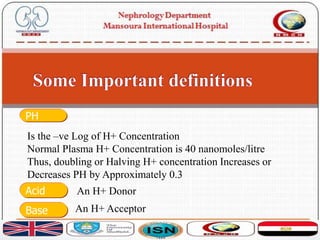
PH
Is the –ve Log of H+ Concentration
Normal Plasma H+ Concentration is 40 nanomoles/litre
Thus, doubling or Halving H+ concentration Increases or
Decreases PH by Approximately 0.3
Acid An H+ Donor
Base An H+ Acceptor
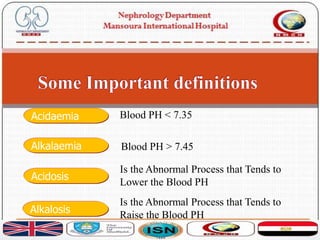
Blood PH > 7.45Alkalaemia
Blood PH < 7.35Acidaemia
Acidosis
Is the Abnormal Process that Tends to
Lower the Blood PH
Alkalosis
Is the Abnormal Process that Tends to
Raise the Blood PH
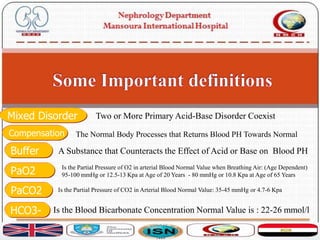
PaO2 Is the Partial Pressure of O2 in arterial Blood Normal Value when Breathing Air: (Age Dependent)
95-100 mmHg or 12.5-13 Kpa at Age of 20 Years - 80 mmHg or 10.8 Kpa at Age of 65 Years
A Substance that Counteracts the Effect of Acid or Base on Blood PHBuffer
HCO3- Is the Blood Bicarbonate Concentration Normal Value is : 22-26 mmol/l
PaCO2 Is the Partial Pressure of CO2 in Arterial Blood Normal Value: 35-45 mmHg or 4.7-6 Kpa
Mixed Disorder Two or More Primary Acid-Base Disorder Coexist
Compensation The Normal Body Processes that Returns Blood PH Towards Normal
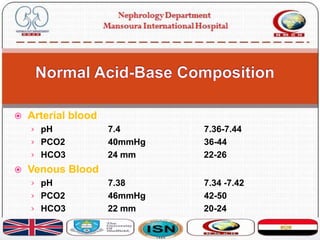
 Arterial blood
› pH 7.4 7.36-7.44
› PCO2 40mmHg 36-44
› HCO3 24 mm 22-26
 Venous Blood
› pH 7.38 7.34 -7.42
› PCO2 46mmHg 42-50
› HCO3 22 mm 20-24
 Acid-base balance is assessed in terms of CO2-HCO3
buffer system. It is expressed in pH:
pH = 6.10 + log ([HCO3-] ÷ [0.03 x PCO2])
 Large number of metabolic events are sensitive to pH
mainly brain and heart
 That is why a number of mechanisms are present in acid
base regulation holding blood pH in narrow limits
7.38-7.42
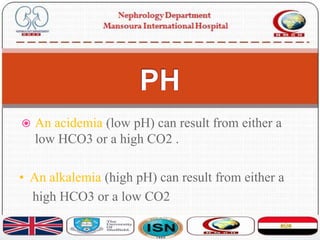
 An acidemia (low pH) can result from either a
low HCO3 or a high CO2 .
• An alkalemia (high pH) can result from either a
high HCO3 or a low CO2
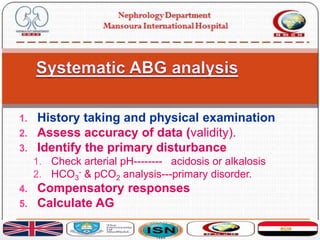
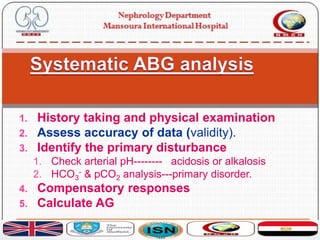
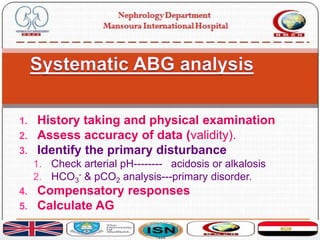
1. History taking and physical examination
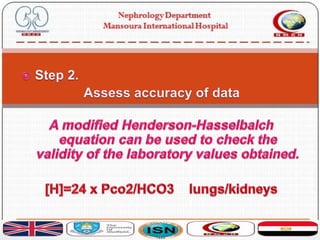
2. Assess accuracy of data (validity).
3. Identify the primary disturbance
1. Check arterial pH-------- acidosis or alkalosis
2. HCO3
- & pCO2 analysis---primary disorder.
4. Compensatory responses
5. Calculate AG
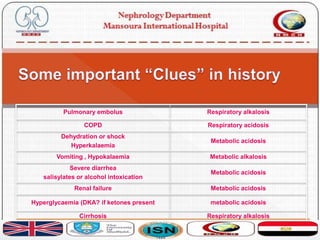
 Step 1.
History taking and physical examination
Comprehensive history taking and physical
examination can often give clues as to the
underlying acid-base disorder
Respiratory alkalosisPulmonary embolus
Respiratory acidosisCOPD
Metabolic acidosis
Dehydration or shock
Hyperkalaemia
Metabolic alkalosisVomiting , Hypokalaemia
Metabolic acidosis
Severe diarrhea
salisylates or alcohol intoxication
Metabolic acidosisRenal failure
metabolic acidosisHyperglycaemia (DKA? if ketones present
Respiratory alkalosisCirrhosis
1. History taking and physical examination
2. Assess accuracy of data (validity).
3. Identify the primary disturbance
1. Check arterial pH-------- acidosis or alkalosis
2. HCO3
- & pCO2 analysis---primary disorder.
4. Compensatory responses
5. Calculate AG
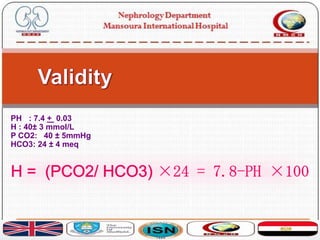
PH : 7.4 + 0.03
H : 40± 3 mmol/L
P CO2: 40 ± 5mmHg
HCO3: 24 ± 4 meq
1. History taking and physical examination
2. Assess accuracy of data (validity).
3. Identify the primary disturbance
1. Check arterial pH-------- acidosis or alkalosis
2. HCO3
- & pCO2 analysis---primary disorder.
4. Compensatory responses
5. Calculate AG
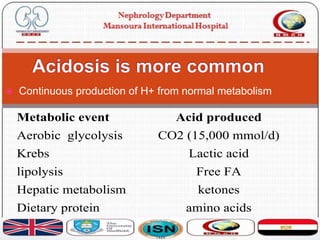
 Continuous production of H+ from normal metabolism
Metabolic event Acid produced
Aerobic glycolysis CO2 (15,000 mmol/d)
Krebs Lactic acid
lipolysis Free FA
Hepatic metabolism ketones
Dietary protein amino acids
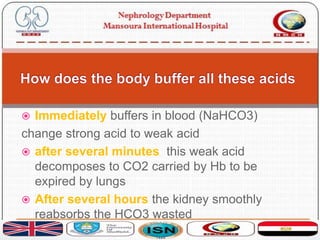
 Immediately buffers in blood (NaHCO3)
change strong acid to weak acid
 after several minutes this weak acid
decomposes to CO2 carried by Hb to be
expired by lungs
 After several hours the kidney smoothly
reabsorbs the HCO3 wasted
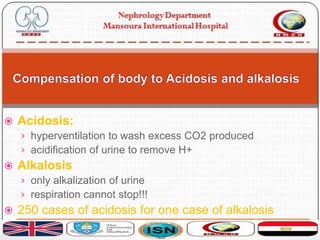
 Acidosis:
› hyperventilation to wash excess CO2 produced
› acidification of urine to remove H+
 Alkalosis
› only alkalization of urine
› respiration cannot stop!!!
 250 cases of acidosis for one case of alkalosis
 Respiratory Acidosis
› CO2 retention due to hypoventilation: type II respiratory failure e.g.COPD
› there is conservation of HCO3 by the kidney
› new steady state of h CO2 and h HCO3 occurs
 Metabolic Acidosis
› H+ buffered a H2CO3 a CO2 + H2O
› CO2 washed by hyperventilation a i CO2 falls
› HCO3 continuously consumed by H+ cannot raise and remains low i HCO3
 These compensatory mechanisms a keep pH constant
 When H+ production or CO2 retention > compensatory mechanisms a fall in pH a
acidosis
 Fixed acids: which produces H+ cannot be excreted except
by kidneys e.g. lactic
 Volatile acids can be changed into CO2 e.g. H2CO3 and
aerobic glycolysis
 fixed : volatile = 100 : 15000 meq/day!!
 Severe acidosis develops rapidly in respiratory
embarrassment
 Acidosis develops slower in renal failure
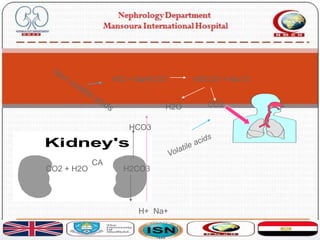
HCl + NaHCO3 H2CO3 + Na Cl
CO2H2O
HCO3
Kidney's
CO2 + H2O H2CO3
H+ Na+
CA
 Normally blood is neutral
› amount of anions = amount of cations
 Most abundant cations are
› Na+ 140 meq/L (135-145)
› K+ 4 meq/L (3.5-5.0)
 Most abundant anions are
› HCO3 25 meq/L (22-26)
› Cl 104 meq/L (100-108)
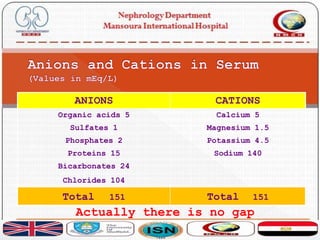
Actually there is no gap
CATIONSANIONS
Calcium 5Organic acids 5
Magnesium 1.5Sulfates 1
Potassium 4.5Phosphates 2
Sodium 140Proteins 15
Bicarbonates 24
Chlorides 104
Total 151Total 151
 If you measure all the anions they should be equal to all the
cations
› cations - anions = zero
 it is difficult to measure them all.
 An easy way is measure the most abundant
 [Na + K] - [HCO3 + Cl] = [144] - [129] = 16
 Why is this difference? Are the cations more?
 Of course not
 It is due to presence of unmeasured anions (and cations) and if you
measure them all definitely your sum will be zero
[Na + K + UC] - [HCO3 + Cl + UA] = 0
 Unmeasured anions are mainly albumin and proteins
 Unmeasured cations are mainly Ca and Mg
 under normal conditions:
[Na + K] - [HCO3 + Cl] = 15 +/- 2
This is called normal anion gap
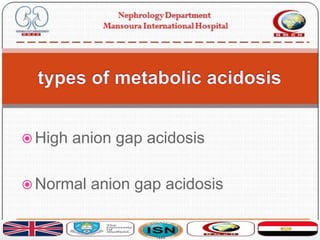
 High anion gap acidosis
 Normal anion gap acidosis
› There is a load of non chloride containing acid e.g. lactic
acid
› lactic acid + NaHCO3 Na lactate + H2CO3
› There is a fall in HCO3 conc and rise in lactate
› calc: [Na + K] - [HCO3 + Cl] = > 17
› The fall in HCO3 is compensated by the unmeasured
lactate
 There is addition of a Cl acid e.g. HCl or Loss of
HCO3 (with renal absorption of chloride)
› HCl + NaHCO3 n NaCl + H2CO3
› There is fall in HCO3 concentration and rise in chloride
› calc: [Na + K] - [HCO3 + Cl] = 15 +/- 2
 since chloride is increased it is easier to name it
hyperchloremic acidosis
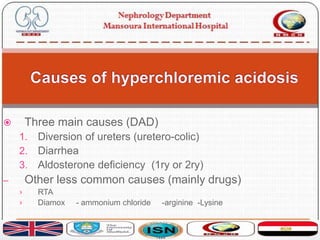
 Three main causes (DAD)
1. Diversion of ureters (uretero-colic)
2. Diarrhea
3. Aldosterone deficiency (1ry or 2ry)
– Other less common causes (mainly drugs)
› RTA
› Diamox - ammonium chloride -arginine -Lysine
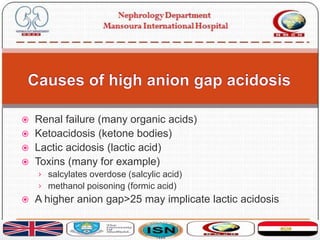
 Renal failure (many organic acids)
 Ketoacidosis (ketone bodies)
 Lactic acidosis (lactic acid)
 Toxins (many for example)
› salcylates overdose (salcylic acid)
› methanol poisoning (formic acid)
 A higher anion gap>25 may implicate lactic acidosis
 Sometimes you can get a mixed type
› renal failure due to obstructive uropathy
› Addison with pre-renal failure
› In such cases chloride is not that high and AG is just above normal
 If there is hypoalbuminemia
› less unmeasured negative charges available
› body has to get rid of Na to reach isoelectric
› anion gap will seem less than it should be
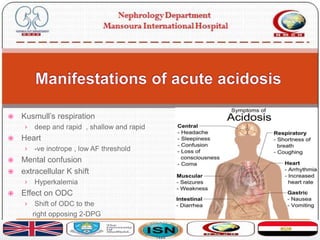
 Kusmull’s respiration
› deep and rapid , shallow and rapid
 Heart
› -ve inotrope , low AF threshold
 Mental confusion
 extracellular K shift
› Hyperkalemia
 Effect on ODC
› Shift of ODC to the
right opposing 2-DPG
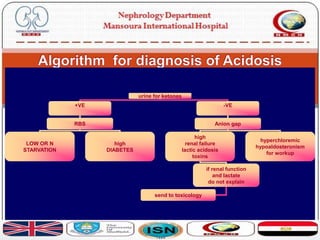
urine for ketones
+VE -VE
RBS
LOW OR N
STARVATION
high
DIABETES
Anion gap
high
renal failure
lactic acidosis
toxins
hyperchloremic
hypoaldosteronism
for workup
if renal function
and lactate
do not explain
send to toxicology
 ECLS Approach
 Emergency
 Cause
 Losses
 Specific
› history
 diarrhea
 drugs
 diabetes
 surgery
 food intake
› general exam
› Urine
› electrolytes
› ABG
› urea
› RBS
You have to identify the cause and treat it
 Hazards of giving
› hypertonic solution
 volume overload (ESP IN RENAL FAILURE)
› Overshoot alkalosis :ketones and lactate could further be
metabolized to bicarbonates
› Rapid correction of acidosis may shift ODC to left and 2DPG will
dominate to cause hypoxia
› Bicarb will decompose to CO2 which passes easily to BBB and
cause CSF paradoxical acidification (the use of carbicarb)
 Hazards of not giving
› effects on heart brain and muscle
 At a certain stage with acidosis (pH7.15) all the
compensatory mechanisms are at their maximum power
› No more compensatory mechanisms available:
› any mild change in concentrations of CO2 or HCO3 will greatly affect
the pH
 Judge your decision by the pH and never by the HCO3
or CO2 levels
 Do not give HCO3 unless pH is lower than 7.2 (7.1 by
some authors)
 Calculate the deficit by the formula
[24-HCO3] x 50% of body weight
 Correction should be slowly over 3 hours guided by
hourly blood gases and HCO3
Acid base balance

Acid base balance

  • 1.
    Dr. Hamed EzzatEl-Eraky Nephrology Specialist Mansoura International Hospital CME Director of Dakahlia Medical Syndicate
  • 2.
    PH Is the –veLog of H+ Concentration Normal Plasma H+ Concentration is 40 nanomoles/litre Thus, doubling or Halving H+ concentration Increases or Decreases PH by Approximately 0.3 Acid An H+ Donor Base An H+ Acceptor
  • 3.
    Blood PH >7.45Alkalaemia Blood PH < 7.35Acidaemia Acidosis Is the Abnormal Process that Tends to Lower the Blood PH Alkalosis Is the Abnormal Process that Tends to Raise the Blood PH
  • 4.
    PaO2 Is thePartial Pressure of O2 in arterial Blood Normal Value when Breathing Air: (Age Dependent) 95-100 mmHg or 12.5-13 Kpa at Age of 20 Years - 80 mmHg or 10.8 Kpa at Age of 65 Years A Substance that Counteracts the Effect of Acid or Base on Blood PHBuffer HCO3- Is the Blood Bicarbonate Concentration Normal Value is : 22-26 mmol/l PaCO2 Is the Partial Pressure of CO2 in Arterial Blood Normal Value: 35-45 mmHg or 4.7-6 Kpa Mixed Disorder Two or More Primary Acid-Base Disorder Coexist Compensation The Normal Body Processes that Returns Blood PH Towards Normal
  • 5.
     Arterial blood ›pH 7.4 7.36-7.44 › PCO2 40mmHg 36-44 › HCO3 24 mm 22-26  Venous Blood › pH 7.38 7.34 -7.42 › PCO2 46mmHg 42-50 › HCO3 22 mm 20-24
  • 6.
     Acid-base balanceis assessed in terms of CO2-HCO3 buffer system. It is expressed in pH: pH = 6.10 + log ([HCO3-] ÷ [0.03 x PCO2])  Large number of metabolic events are sensitive to pH mainly brain and heart  That is why a number of mechanisms are present in acid base regulation holding blood pH in narrow limits 7.38-7.42
  • 7.
     An acidemia(low pH) can result from either a low HCO3 or a high CO2 . • An alkalemia (high pH) can result from either a high HCO3 or a low CO2
  • 9.
    1. History takingand physical examination 2. Assess accuracy of data (validity). 3. Identify the primary disturbance 1. Check arterial pH-------- acidosis or alkalosis 2. HCO3 - & pCO2 analysis---primary disorder. 4. Compensatory responses 5. Calculate AG
  • 10.
     Step 1. Historytaking and physical examination Comprehensive history taking and physical examination can often give clues as to the underlying acid-base disorder
  • 11.
    Respiratory alkalosisPulmonary embolus RespiratoryacidosisCOPD Metabolic acidosis Dehydration or shock Hyperkalaemia Metabolic alkalosisVomiting , Hypokalaemia Metabolic acidosis Severe diarrhea salisylates or alcohol intoxication Metabolic acidosisRenal failure metabolic acidosisHyperglycaemia (DKA? if ketones present Respiratory alkalosisCirrhosis
  • 12.
    1. History takingand physical examination 2. Assess accuracy of data (validity). 3. Identify the primary disturbance 1. Check arterial pH-------- acidosis or alkalosis 2. HCO3 - & pCO2 analysis---primary disorder. 4. Compensatory responses 5. Calculate AG
  • 14.
    PH : 7.4+ 0.03 H : 40± 3 mmol/L P CO2: 40 ± 5mmHg HCO3: 24 ± 4 meq
  • 15.
    1. History takingand physical examination 2. Assess accuracy of data (validity). 3. Identify the primary disturbance 1. Check arterial pH-------- acidosis or alkalosis 2. HCO3 - & pCO2 analysis---primary disorder. 4. Compensatory responses 5. Calculate AG
  • 16.
     Continuous productionof H+ from normal metabolism Metabolic event Acid produced Aerobic glycolysis CO2 (15,000 mmol/d) Krebs Lactic acid lipolysis Free FA Hepatic metabolism ketones Dietary protein amino acids
  • 17.
     Immediately buffersin blood (NaHCO3) change strong acid to weak acid  after several minutes this weak acid decomposes to CO2 carried by Hb to be expired by lungs  After several hours the kidney smoothly reabsorbs the HCO3 wasted
  • 18.
     Acidosis: › hyperventilationto wash excess CO2 produced › acidification of urine to remove H+  Alkalosis › only alkalization of urine › respiration cannot stop!!!  250 cases of acidosis for one case of alkalosis
  • 19.
     Respiratory Acidosis ›CO2 retention due to hypoventilation: type II respiratory failure e.g.COPD › there is conservation of HCO3 by the kidney › new steady state of h CO2 and h HCO3 occurs  Metabolic Acidosis › H+ buffered a H2CO3 a CO2 + H2O › CO2 washed by hyperventilation a i CO2 falls › HCO3 continuously consumed by H+ cannot raise and remains low i HCO3  These compensatory mechanisms a keep pH constant  When H+ production or CO2 retention > compensatory mechanisms a fall in pH a acidosis
  • 20.
     Fixed acids:which produces H+ cannot be excreted except by kidneys e.g. lactic  Volatile acids can be changed into CO2 e.g. H2CO3 and aerobic glycolysis  fixed : volatile = 100 : 15000 meq/day!!  Severe acidosis develops rapidly in respiratory embarrassment  Acidosis develops slower in renal failure
  • 21.
    HCl + NaHCO3H2CO3 + Na Cl CO2H2O HCO3 Kidney's CO2 + H2O H2CO3 H+ Na+ CA
  • 22.
     Normally bloodis neutral › amount of anions = amount of cations  Most abundant cations are › Na+ 140 meq/L (135-145) › K+ 4 meq/L (3.5-5.0)  Most abundant anions are › HCO3 25 meq/L (22-26) › Cl 104 meq/L (100-108)
  • 23.
    Actually there isno gap CATIONSANIONS Calcium 5Organic acids 5 Magnesium 1.5Sulfates 1 Potassium 4.5Phosphates 2 Sodium 140Proteins 15 Bicarbonates 24 Chlorides 104 Total 151Total 151
  • 24.
     If youmeasure all the anions they should be equal to all the cations › cations - anions = zero  it is difficult to measure them all.  An easy way is measure the most abundant  [Na + K] - [HCO3 + Cl] = [144] - [129] = 16  Why is this difference? Are the cations more?  Of course not
  • 25.
     It isdue to presence of unmeasured anions (and cations) and if you measure them all definitely your sum will be zero [Na + K + UC] - [HCO3 + Cl + UA] = 0  Unmeasured anions are mainly albumin and proteins  Unmeasured cations are mainly Ca and Mg  under normal conditions: [Na + K] - [HCO3 + Cl] = 15 +/- 2 This is called normal anion gap
  • 26.
     High aniongap acidosis  Normal anion gap acidosis
  • 27.
    › There isa load of non chloride containing acid e.g. lactic acid › lactic acid + NaHCO3 Na lactate + H2CO3 › There is a fall in HCO3 conc and rise in lactate › calc: [Na + K] - [HCO3 + Cl] = > 17 › The fall in HCO3 is compensated by the unmeasured lactate
  • 28.
     There isaddition of a Cl acid e.g. HCl or Loss of HCO3 (with renal absorption of chloride) › HCl + NaHCO3 n NaCl + H2CO3 › There is fall in HCO3 concentration and rise in chloride › calc: [Na + K] - [HCO3 + Cl] = 15 +/- 2  since chloride is increased it is easier to name it hyperchloremic acidosis
  • 29.
     Three maincauses (DAD) 1. Diversion of ureters (uretero-colic) 2. Diarrhea 3. Aldosterone deficiency (1ry or 2ry) – Other less common causes (mainly drugs) › RTA › Diamox - ammonium chloride -arginine -Lysine
  • 30.
     Renal failure(many organic acids)  Ketoacidosis (ketone bodies)  Lactic acidosis (lactic acid)  Toxins (many for example) › salcylates overdose (salcylic acid) › methanol poisoning (formic acid)  A higher anion gap>25 may implicate lactic acidosis
  • 31.
     Sometimes youcan get a mixed type › renal failure due to obstructive uropathy › Addison with pre-renal failure › In such cases chloride is not that high and AG is just above normal  If there is hypoalbuminemia › less unmeasured negative charges available › body has to get rid of Na to reach isoelectric › anion gap will seem less than it should be
  • 32.
     Kusmull’s respiration ›deep and rapid , shallow and rapid  Heart › -ve inotrope , low AF threshold  Mental confusion  extracellular K shift › Hyperkalemia  Effect on ODC › Shift of ODC to the right opposing 2-DPG
  • 33.
    urine for ketones +VE-VE RBS LOW OR N STARVATION high DIABETES Anion gap high renal failure lactic acidosis toxins hyperchloremic hypoaldosteronism for workup if renal function and lactate do not explain send to toxicology
  • 34.
     ECLS Approach Emergency  Cause  Losses  Specific
  • 35.
    › history  diarrhea drugs  diabetes  surgery  food intake › general exam › Urine › electrolytes › ABG › urea › RBS You have to identify the cause and treat it
  • 36.
     Hazards ofgiving › hypertonic solution  volume overload (ESP IN RENAL FAILURE) › Overshoot alkalosis :ketones and lactate could further be metabolized to bicarbonates › Rapid correction of acidosis may shift ODC to left and 2DPG will dominate to cause hypoxia › Bicarb will decompose to CO2 which passes easily to BBB and cause CSF paradoxical acidification (the use of carbicarb)
  • 37.
     Hazards ofnot giving › effects on heart brain and muscle  At a certain stage with acidosis (pH7.15) all the compensatory mechanisms are at their maximum power › No more compensatory mechanisms available: › any mild change in concentrations of CO2 or HCO3 will greatly affect the pH
  • 38.
     Judge yourdecision by the pH and never by the HCO3 or CO2 levels  Do not give HCO3 unless pH is lower than 7.2 (7.1 by some authors)  Calculate the deficit by the formula [24-HCO3] x 50% of body weight  Correction should be slowly over 3 hours guided by hourly blood gases and HCO3