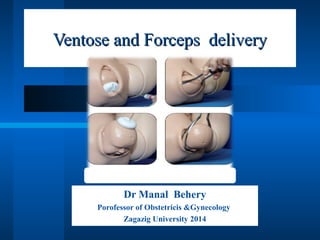
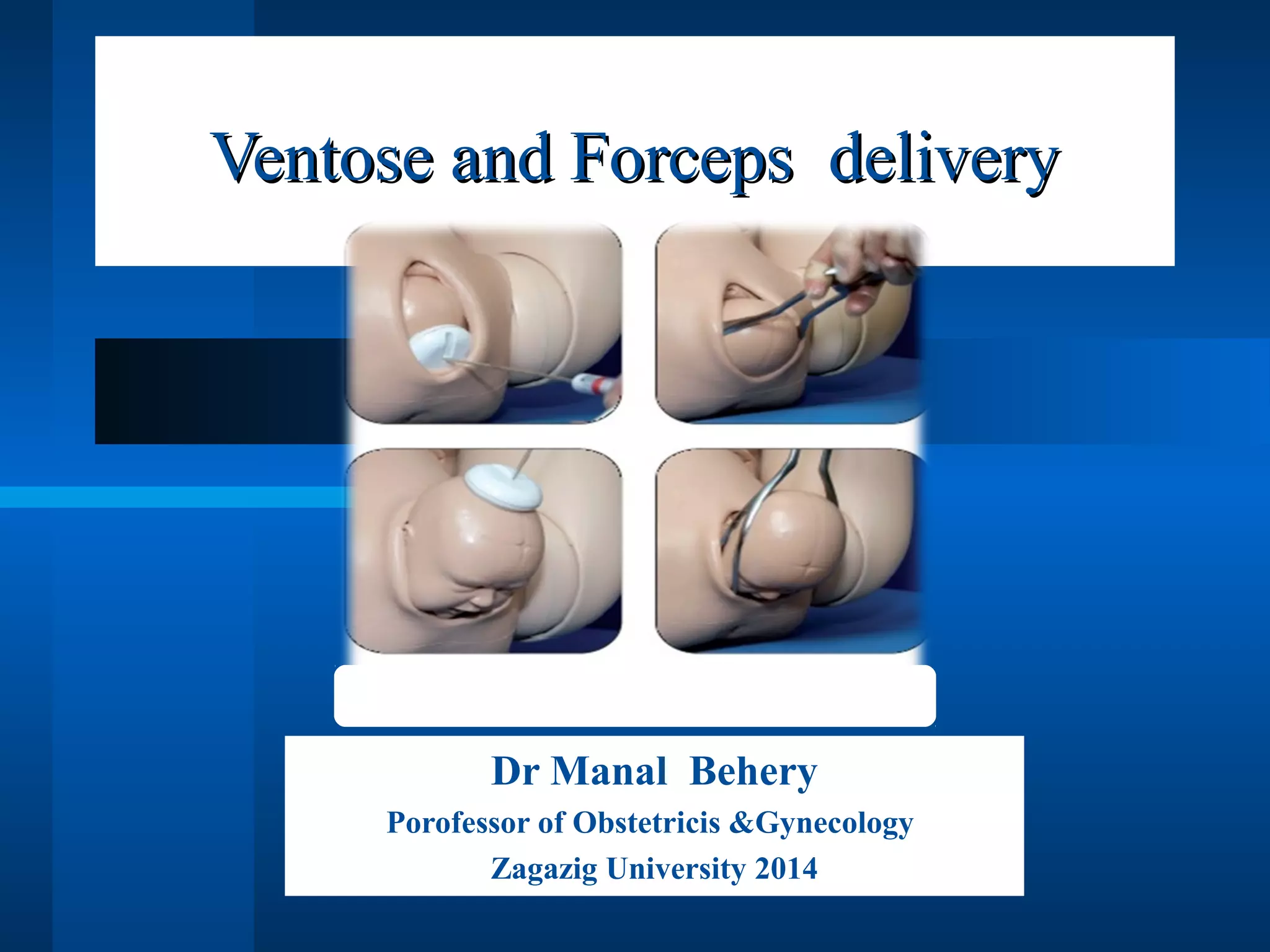
Ventose and Forceps deliveryVentose and Forceps delivery
Dr Manal Behery
Porofessor of Obstetricis &Gynecology
Zagazig University 2014
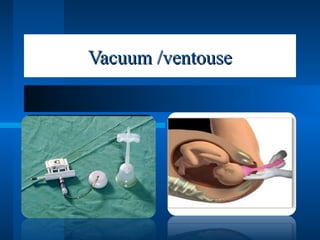
Vacuum /ventouseVacuum /ventouse
IndicationsIndications
MATERNAL
Exhaustion
Prolonged second stage
Cardiac / pulmonary disease
FETAL
Failure of the fetal head to rotate
Fetal distress
Should not be used for preterm, face presentation or
breech
MNEMONICMNEMONIC
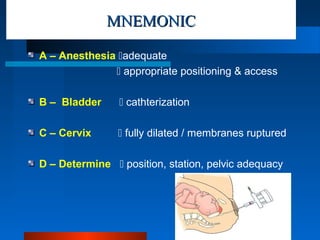
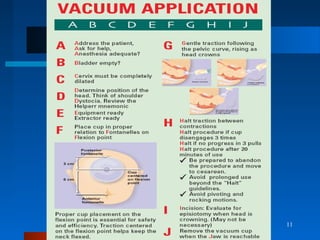
A – Anesthesia adequate
 appropriate positioning & access
B – Bladder  cathterization
C – Cervix  fully dilated / membranes ruptured
D – Determine  position, station, pelvic adequacy
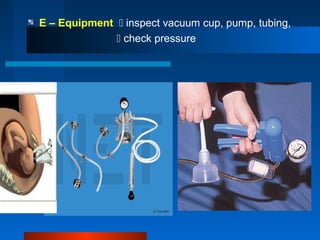
E – Equipment  inspect vacuum cup, pump, tubing,
 check pressure
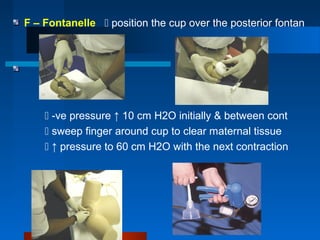
F – Fontanelle  position the cup over the posterior fontan
 -ve pressure ↑ 10 cm H2O initially & between cont
 sweep finger around cup to clear maternal tissue
 ↑ pressure to 60 cm H2O with the next contraction
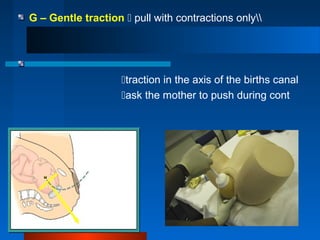
G – Gentle traction  pull with contractions only
traction in the axis of the births canal
ask the mother to push during cont
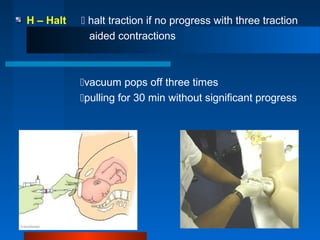
H – Halt  halt traction if no progress with three traction
aided contractions
vacuum pops off three times
pulling for 30 min without significant progress
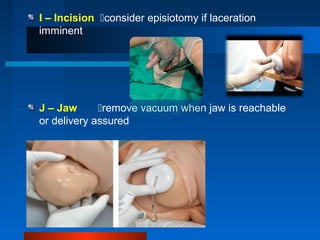
I – Incision consider episiotomy if laceration
imminent
J – Jaw remove vacuum when jaw is reachable
or delivery assured
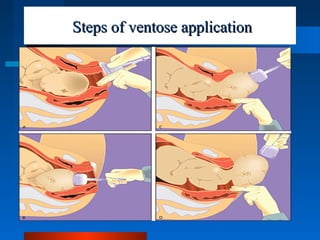
Steps of ventose applicationSteps of ventose application
11
ComplicationsComplications
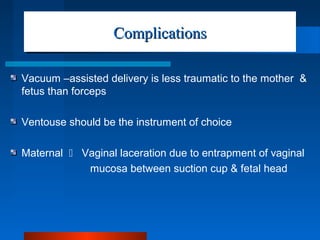
Vacuum –assisted delivery is less traumatic to the mother &
fetus than forceps
Ventouse should be the instrument of choice
Maternal  Vaginal laceration due to entrapment of vaginal
mucosa between suction cup & fetal head
Fetal complicationsFetal complications
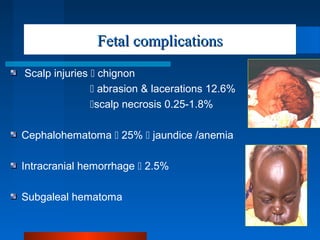
Scalp injuries  chignon
 abrasion & lacerations 12.6%
scalp necrosis 0.25-1.8%
Cephalohematoma  25%  jaundice /anemia
Intracranial hemorrhage  2.5%
Subgaleal hematoma
Fetal complicationsFetal complications
Birth asphyxia  2.6-12%  related to extraction
force & time
Some studies showed decrease birth asphyxia
Retinal hemorrhage 50%
Forceps 31%
SVD 19%
Neonatal jaundice
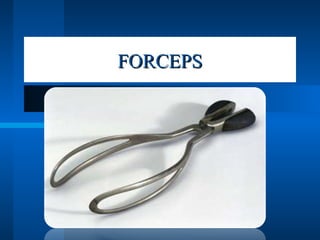
FORCEPSFORCEPS
IndicationsIndications
MATERNAL
Exhaustion
Prolonged second stage
Cardiac / pulmonary disease
FETAL
Failure of the fetal head to rotate
Fetal distress
Control of the fetal head in vaginal beech delivery
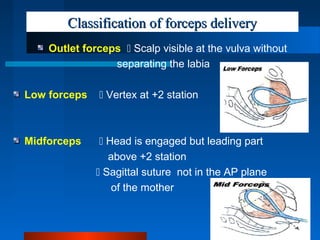
Classification of forceps deliveryClassification of forceps delivery
Outlet forceps  Scalp visible at the vulva without
separating the labia
Low forceps  Vertex at +2 station
Midforceps  Head is engaged but leading part
above +2 station
 Sagittal suture not in the AP plane
of the mother
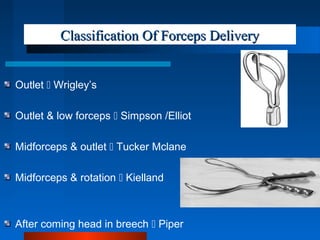
Classification Of Forceps DeliveryClassification Of Forceps Delivery
Outlet  Wrigley’s
Outlet & low forceps  Simpson /Elliot
Midforceps & outlet  Tucker Mclane
Midforceps & rotation  Kielland
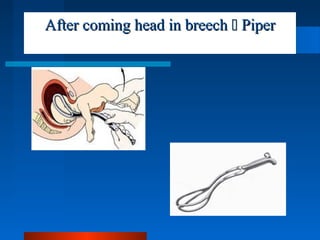
After coming head in breech  Piper
After coming head in breechAfter coming head in breech  PiperPiper
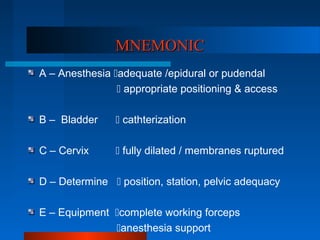
MNEMONICMNEMONIC
A – Anesthesia adequate /epidural or pudendal
 appropriate positioning & access
B – Bladder  cathterization
C – Cervix  fully dilated / membranes ruptured
D – Determine  position, station, pelvic adequacy
E – Equipment complete working forceps
anesthesia support
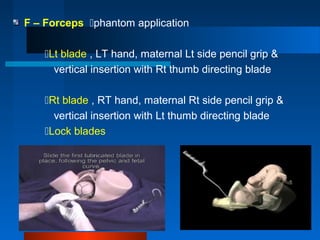
F – Forceps phantom application
Lt blade , LT hand, maternal Lt side pencil grip &
vertical insertion with Rt thumb directing blade
Rt blade , RT hand, maternal Rt side pencil grip &
vertical insertion with Lt thumb directing blade
Lock blades
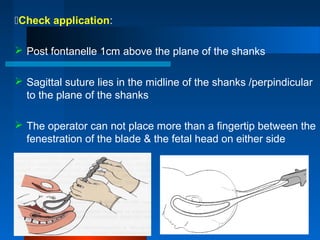
Check application:
 Post fontanelle 1cm above the plane of the shanks
 Sagittal suture lies in the midline of the shanks /perpindicular
to the plane of the shanks
 The operator can not place more than a fingertip between the
fenestration of the blade & the fetal head on either side
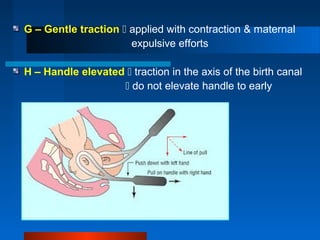
G – Gentle traction  applied with contraction & maternal
expulsive efforts
H – Handle elevated  traction in the axis of the birth canal
 do not elevate handle to early
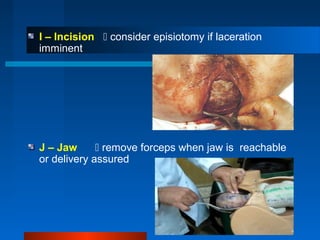
I – Incision  consider episiotomy if laceration
imminent
J – Jaw  remove forceps when jaw is reachable
or delivery assured
ComplicationsComplications
Maternal  trauma to soft tissue 3rd
/4th
degree
double the risk compared to ventouse
bleeding from lacerations
trauma to urethra & bladder  fistula
Pain 17% ventouse 11%
ComplicationsComplications
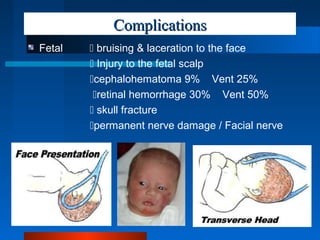
Fetal  bruising & laceration to the face
 Injury to the fetal scalp
cephalohematoma 9% Vent 25%
retinal hemorrhage 30% Vent 50%
 skull fracture
permanent nerve damage / Facial nerve

Ventose and forceps delivery for undergraduate

  • 1.
    Ventose and ForcepsdeliveryVentose and Forceps delivery Dr Manal Behery Porofessor of Obstetricis &Gynecology Zagazig University 2014
  • 2.
  • 3.
    IndicationsIndications MATERNAL Exhaustion Prolonged second stage Cardiac/ pulmonary disease FETAL Failure of the fetal head to rotate Fetal distress Should not be used for preterm, face presentation or breech
  • 4.
    MNEMONICMNEMONIC A – Anesthesiaadequate  appropriate positioning & access B – Bladder  cathterization C – Cervix  fully dilated / membranes ruptured D – Determine  position, station, pelvic adequacy
  • 5.
    E – Equipment inspect vacuum cup, pump, tubing,  check pressure
  • 6.
    F – Fontanelle position the cup over the posterior fontan  -ve pressure ↑ 10 cm H2O initially & between cont  sweep finger around cup to clear maternal tissue  ↑ pressure to 60 cm H2O with the next contraction
  • 7.
    G – Gentletraction  pull with contractions only traction in the axis of the births canal ask the mother to push during cont
  • 8.
    H – Halt halt traction if no progress with three traction aided contractions vacuum pops off three times pulling for 30 min without significant progress
  • 9.
    I – Incisionconsider episiotomy if laceration imminent J – Jaw remove vacuum when jaw is reachable or delivery assured
  • 10.
    Steps of ventoseapplicationSteps of ventose application
  • 11.
  • 12.
    ComplicationsComplications Vacuum –assisted deliveryis less traumatic to the mother & fetus than forceps Ventouse should be the instrument of choice Maternal  Vaginal laceration due to entrapment of vaginal mucosa between suction cup & fetal head
  • 13.
    Fetal complicationsFetal complications Scalpinjuries  chignon  abrasion & lacerations 12.6% scalp necrosis 0.25-1.8% Cephalohematoma  25%  jaundice /anemia Intracranial hemorrhage  2.5% Subgaleal hematoma
  • 14.
    Fetal complicationsFetal complications Birthasphyxia  2.6-12%  related to extraction force & time Some studies showed decrease birth asphyxia Retinal hemorrhage 50% Forceps 31% SVD 19% Neonatal jaundice
  • 15.
  • 16.
    IndicationsIndications MATERNAL Exhaustion Prolonged second stage Cardiac/ pulmonary disease FETAL Failure of the fetal head to rotate Fetal distress Control of the fetal head in vaginal beech delivery
  • 17.
    Classification of forcepsdeliveryClassification of forceps delivery Outlet forceps  Scalp visible at the vulva without separating the labia Low forceps  Vertex at +2 station Midforceps  Head is engaged but leading part above +2 station  Sagittal suture not in the AP plane of the mother
  • 18.
    Classification Of ForcepsDeliveryClassification Of Forceps Delivery Outlet  Wrigley’s Outlet & low forceps  Simpson /Elliot Midforceps & outlet  Tucker Mclane Midforceps & rotation  Kielland After coming head in breech  Piper
  • 19.
    After coming headin breechAfter coming head in breech  PiperPiper
  • 20.
    MNEMONICMNEMONIC A – Anesthesiaadequate /epidural or pudendal  appropriate positioning & access B – Bladder  cathterization C – Cervix  fully dilated / membranes ruptured D – Determine  position, station, pelvic adequacy E – Equipment complete working forceps anesthesia support
  • 21.
    F – Forcepsphantom application Lt blade , LT hand, maternal Lt side pencil grip & vertical insertion with Rt thumb directing blade Rt blade , RT hand, maternal Rt side pencil grip & vertical insertion with Lt thumb directing blade Lock blades
  • 22.
    Check application:  Postfontanelle 1cm above the plane of the shanks  Sagittal suture lies in the midline of the shanks /perpindicular to the plane of the shanks  The operator can not place more than a fingertip between the fenestration of the blade & the fetal head on either side
  • 23.
    G – Gentletraction  applied with contraction & maternal expulsive efforts H – Handle elevated  traction in the axis of the birth canal  do not elevate handle to early
  • 24.
    I – Incision consider episiotomy if laceration imminent J – Jaw  remove forceps when jaw is reachable or delivery assured
  • 25.
    ComplicationsComplications Maternal  traumato soft tissue 3rd /4th degree double the risk compared to ventouse bleeding from lacerations trauma to urethra & bladder  fistula Pain 17% ventouse 11%
  • 26.
    ComplicationsComplications Fetal  bruising& laceration to the face  Injury to the fetal scalp cephalohematoma 9% Vent 25% retinal hemorrhage 30% Vent 50%  skull fracture permanent nerve damage / Facial nerve

Editor's Notes

  • #4 Instrumental deliveries 1-Indications for instrumental deliveries include T1-Prolonged 2nd stage T2-Fetal distress F3-Transverse lie F4-Compound presentation T5-Maternal cardiac disease
  • #5 2-Prerequisite for instrumental delivery include T1-Cervix must be fully dilated T2-Membranes ruptured F3-Fetal head not engaged F4-Obstetrician unsure about position of the fetal head due to caput T5- Bladder empty/ cathetrized
  • #13 3-Complications of ventouse delivery F1-Ventouse causes 3rd & 4th degree perineal tears more frequent than forceps F2-Long term effects on neurological & intellectual development of children delivered by ventouse are evident by 4 years of age T3-Cephalohematoma occur in up to 25% of babies T4-Birth asphyxia is related to the force of traction & prolonged procedure (time from application of vacuum until delivery) T5-Cephalohematomas may result in jaundice & anemia of the neoborne
  • #18 4-Forceps T1-can be applied to the after coming head in assisted vaginal breech delivery T2-Can be applied to face presentation T3-It is not contraindicated for preterm fetuses T4-Can result in facial nerve damage of the fetus T5-Is associated with a higher fetal mortality than ventouse