

NUR FARRA NAJWA
BINTI ABDUL AZIM
082015100035
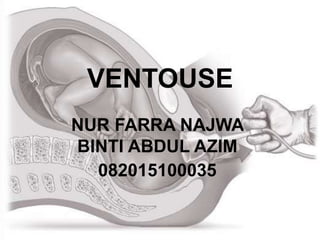
VENTOUSE
LEARNING OBJECTIVE
 Ventouse
 Instrument part
 Indication
 Contraindication
 Procedures
 Complication
 Summary
 Benefits
INTRODUCTION
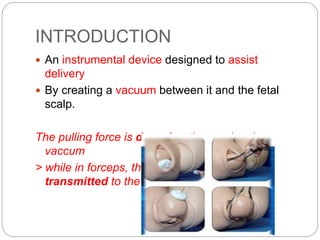
 An instrumental device designed to assist
delivery
 By creating a vacuum between it and the fetal
scalp.
The pulling force is dragging the cranium in
vaccum
> while in forceps, the pulling force is directly
transmitted to the base of the skull
INSTRUMENTS
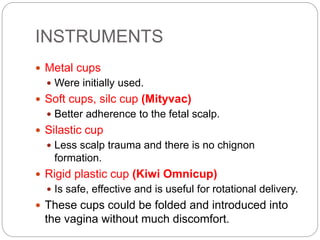
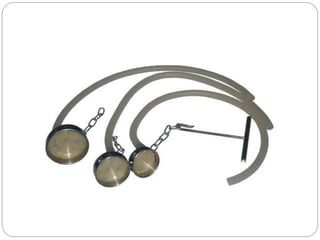
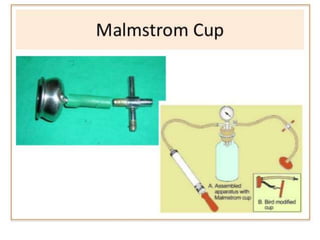
 Metal cups
 Were initially used.
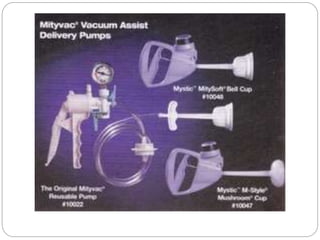
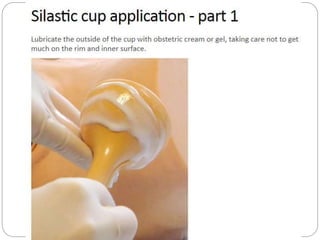
 Soft cups, silc cup (Mityvac)
 Better adherence to the fetal scalp.
 Silastic cup
 Less scalp trauma and there is no chignon
formation.
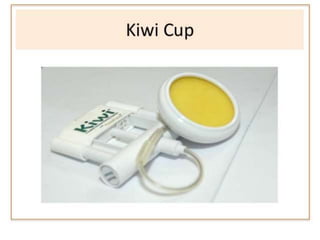
 Rigid plastic cup (Kiwi Omnicup)
 Is safe, effective and is useful for rotational delivery.
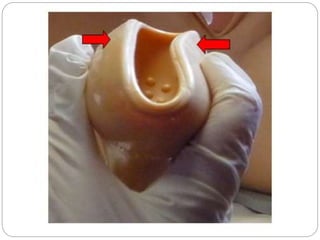
 These cups could be folded and introduced into
the vagina without much discomfort.
PARTS
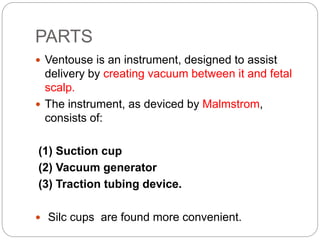
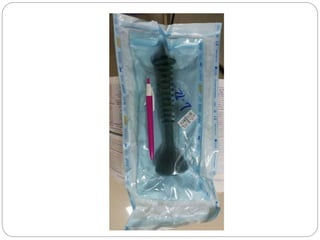
 Ventouse is an instrument, designed to assist
delivery by creating vacuum between it and fetal
scalp.
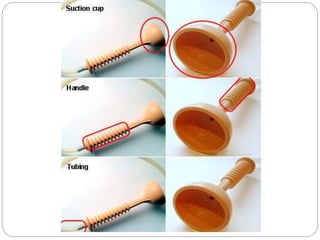
 The instrument, as deviced by Malmstrom,
consists of:
(1) Suction cup
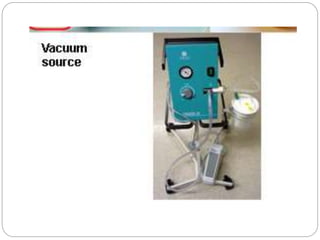
(2) Vacuum generator
(3) Traction tubing device.
 Silc cups are found more convenient.
Cont.
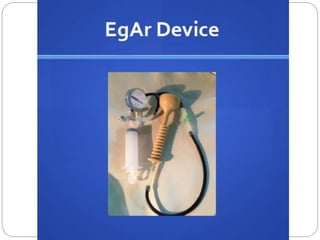
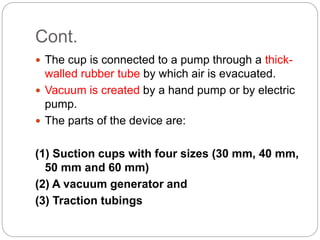
 The cup is connected to a pump through a thick-
walled rubber tube by which air is evacuated.
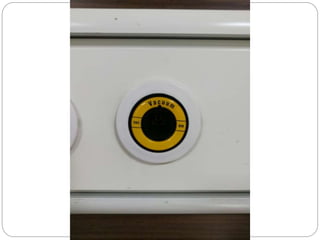
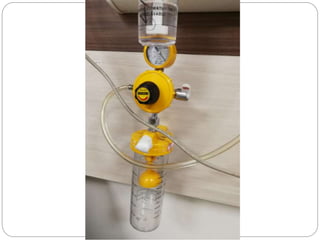
 Vacuum is created by a hand pump or by electric
pump.
 The parts of the device are:
(1) Suction cups with four sizes (30 mm, 40 mm,
50 mm and 60 mm)
(2) A vacuum generator and
(3) Traction tubings
INDICATIONS
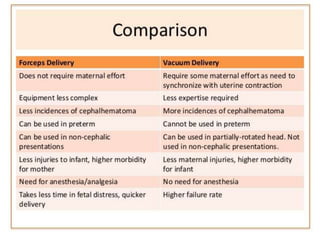
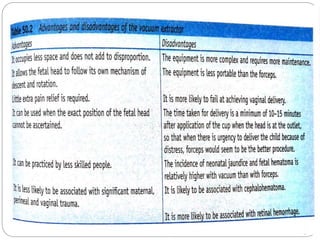
 Same as those of forceps
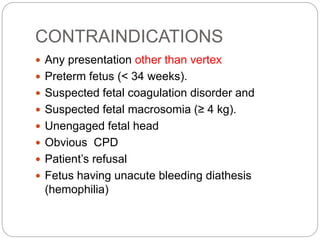
CONTRAINDICATIONS
 Any presentation other than vertex
 Preterm fetus (< 34 weeks).
 Suspected fetal coagulation disorder and
 Suspected fetal macrosomia (≥ 4 kg).
 Unengaged fetal head
 Obvious CPD
 Patient’s refusal
 Fetus having unacute bleeding diathesis
(hemophilia)
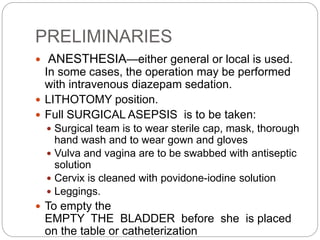
PRELIMINARIES
 ANESTHESIA—either general or local is used.
In some cases, the operation may be performed
with intravenous diazepam sedation.
 LITHOTOMY position.
 Full SURGICAL ASEPSIS is to be taken:
 Surgical team is to wear sterile cap, mask, thorough
hand wash and to wear gown and gloves
 Vulva and vagina are to be swabbed with antiseptic
solution
 Cervix is cleaned with povidone-iodine solution
 Leggings.
 To empty the
EMPTY THE BLADDER before she is placed
on the table or catheterization
Cont.
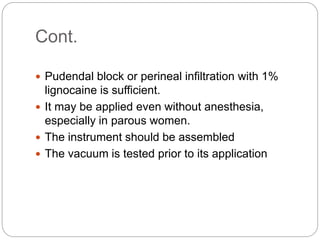
 Pudendal block or perineal infiltration with 1%
lignocaine is sufficient.
 It may be applied even without anesthesia,
especially in parous women.
 The instrument should be assembled
 The vacuum is tested prior to its application
PROCEDURE
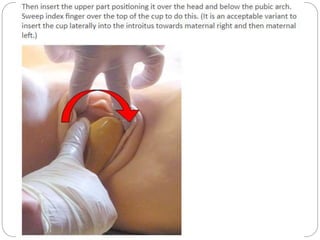
Step I (Application of the cup)
 The largest possible cup is to be selected.
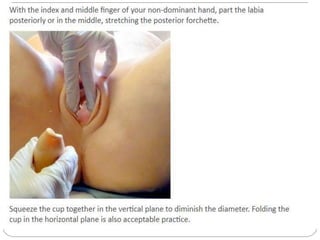
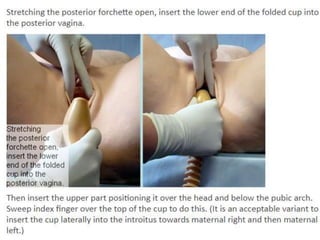
 The cup is introduced after retraction of the
perineum with two fingers of the other hand.
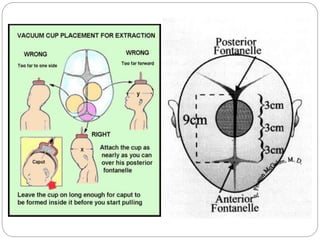
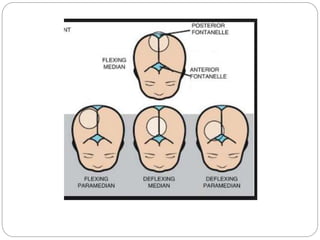
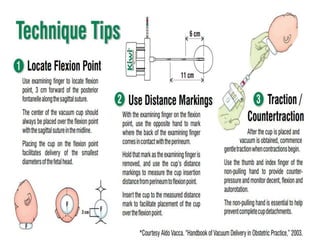
 The cup is placed against the fetal head nearer
the occiput (flexion point) with the “knob” of the
cup pointing towards the occiput.
 Flexion or pivot point is an imaginary site
located midsagittally about 6 cm from the center
of the anterior fontanel or about 3 cm in front of
the posterior fontanel.
Cont.
 Traction over this flexion point facilitates flexion and presents the
smaller diameter to the pelvis
 The knob indicates the degree of rotation.
 Betadine (antiseptic) solution is applied to the rim of the malstrom metal
cup.
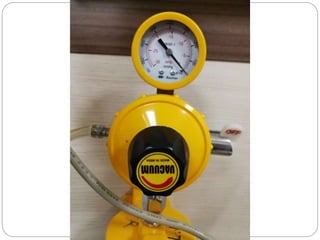
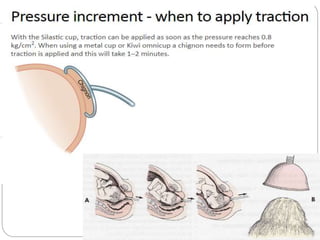
 A vacuum of 0.2 kg/cm2 is induced by the pump slowly, taking at least 2
minutes.
 A check is made using the fingers round the cup to ensure that no
cervical or vaginal tissue is trapped inside the cup.
 The pressure is gradually raised at the rate of 0.1 kg/cm2 per minute
until the effective vacuum of 0.8 kg/cm2 is achieved in about 10 minutes
time.
 The scalp is sucked into the cup and an artificial caput succedaneum
(chignon) is produced. The chignon usually disappears within few hours
Start- 0.2 Kg/cm2
Increment rate/min- 0.1 Kg/cm2
Final- 0.8 Kg/cm2
Within- 8 Min
Max- 10 Min
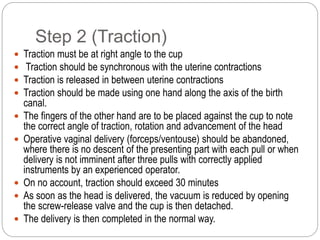
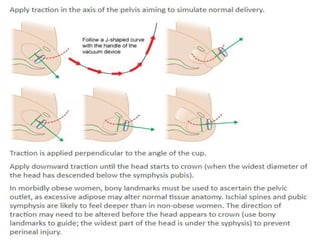
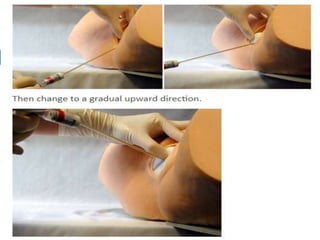
Step 2 (Traction)
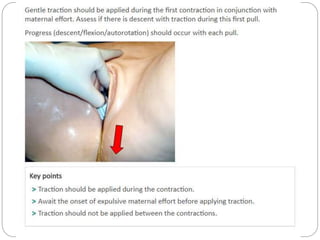
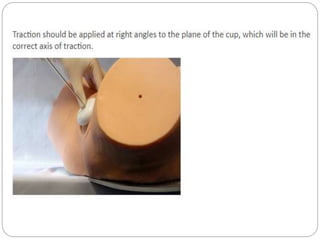
 Traction must be at right angle to the cup
 Traction should be synchronous with the uterine contractions
 Traction is released in between uterine contractions
 Traction should be made using one hand along the axis of the birth
canal.
 The fingers of the other hand are to be placed against the cup to note
the correct angle of traction, rotation and advancement of the head
 Operative vaginal delivery (forceps/ventouse) should be abandoned,
where there is no descent of the presenting part with each pull or when
delivery is not imminent after three pulls with correctly applied
instruments by an experienced operator.
 On no account, traction should exceed 30 minutes
 As soon as the head is delivered, the vacuum is reduced by opening
the screw-release valve and the cup is then detached.
 The delivery is then completed in the normal way.
COMPLICATIONS (Neonate)
(1) Superficial scalp abrasion
(2) Sloughing of the scalp and
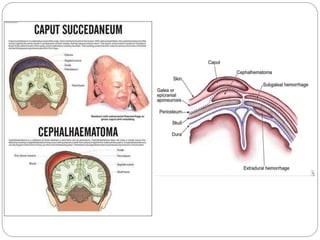
(3) Cephalhematoma
(4) Subaponeurotic (subgaleal) hemorrhage
(5) Intracranial hemorrhage (rare)
(6) Retinal hemorrhage (no long-term effect)
(7) Jaundice.
COMPLICATION (maternal)
 Uncommon
 May be due to inclusion of the soft tissues such
as the cervix or vaginal wall inside the cup.
 The sequential use of ventouse and forceps
increases the risk of trauma both to the mother
and the neonate.
 Outlet forceps may be used following failure of
ventouse.
BENEFITS OF OPERATIVE
VAGINAL DELIVERY
 Most women desire a vaginal delivery.
 Safe and effective use of instrumental delivery
fulfills women’s desire and satisfaction.
 Many women (79%) desire subsequent vaginal
delivery compared with women delivered by
cesarean section (39%).
SUMMARY
 Ventouse
 Instrument part
 Indication
 Contraindication
 Procedures
 Complication
 Summary
 Benefits
REFERENCES
 Mudaliar and Menon’s Clinical Obstetrics, 11th
edition, Sarala Gopalan and Vanita Jain,
Ventouse
 DC Dutta’s Textbook of Obstetrics, 9th edition,
Hiralal Konar, Ventouse
 Essential Of Obstrectric, Lakshmi Seshadri, Gita
Arjun, Ventouse
Ventouse in obgyn

Ventouse in obgyn

  • 1.
    NUR FARRA NAJWA BINTIABDUL AZIM 082015100035 VENTOUSE
  • 2.
    LEARNING OBJECTIVE  Ventouse Instrument part  Indication  Contraindication  Procedures  Complication  Summary  Benefits
  • 3.
    INTRODUCTION  An instrumentaldevice designed to assist delivery  By creating a vacuum between it and the fetal scalp. The pulling force is dragging the cranium in vaccum > while in forceps, the pulling force is directly transmitted to the base of the skull
  • 5.
    INSTRUMENTS  Metal cups Were initially used.  Soft cups, silc cup (Mityvac)  Better adherence to the fetal scalp.  Silastic cup  Less scalp trauma and there is no chignon formation.  Rigid plastic cup (Kiwi Omnicup)  Is safe, effective and is useful for rotational delivery.  These cups could be folded and introduced into the vagina without much discomfort.
  • 6.
    PARTS  Ventouse isan instrument, designed to assist delivery by creating vacuum between it and fetal scalp.  The instrument, as deviced by Malmstrom, consists of: (1) Suction cup (2) Vacuum generator (3) Traction tubing device.  Silc cups are found more convenient.
  • 19.
    Cont.  The cupis connected to a pump through a thick- walled rubber tube by which air is evacuated.  Vacuum is created by a hand pump or by electric pump.  The parts of the device are: (1) Suction cups with four sizes (30 mm, 40 mm, 50 mm and 60 mm) (2) A vacuum generator and (3) Traction tubings
  • 20.
    INDICATIONS  Same asthose of forceps
  • 22.
    CONTRAINDICATIONS  Any presentationother than vertex  Preterm fetus (< 34 weeks).  Suspected fetal coagulation disorder and  Suspected fetal macrosomia (≥ 4 kg).  Unengaged fetal head  Obvious CPD  Patient’s refusal  Fetus having unacute bleeding diathesis (hemophilia)
  • 23.
    PRELIMINARIES  ANESTHESIA—either generalor local is used. In some cases, the operation may be performed with intravenous diazepam sedation.  LITHOTOMY position.  Full SURGICAL ASEPSIS is to be taken:  Surgical team is to wear sterile cap, mask, thorough hand wash and to wear gown and gloves  Vulva and vagina are to be swabbed with antiseptic solution  Cervix is cleaned with povidone-iodine solution  Leggings.  To empty the EMPTY THE BLADDER before she is placed on the table or catheterization
  • 24.
    Cont.  Pudendal blockor perineal infiltration with 1% lignocaine is sufficient.  It may be applied even without anesthesia, especially in parous women.  The instrument should be assembled  The vacuum is tested prior to its application
  • 25.
  • 26.
    Step I (Applicationof the cup)  The largest possible cup is to be selected.  The cup is introduced after retraction of the perineum with two fingers of the other hand.  The cup is placed against the fetal head nearer the occiput (flexion point) with the “knob” of the cup pointing towards the occiput.  Flexion or pivot point is an imaginary site located midsagittally about 6 cm from the center of the anterior fontanel or about 3 cm in front of the posterior fontanel.
  • 27.
    Cont.  Traction overthis flexion point facilitates flexion and presents the smaller diameter to the pelvis  The knob indicates the degree of rotation.  Betadine (antiseptic) solution is applied to the rim of the malstrom metal cup.  A vacuum of 0.2 kg/cm2 is induced by the pump slowly, taking at least 2 minutes.  A check is made using the fingers round the cup to ensure that no cervical or vaginal tissue is trapped inside the cup.  The pressure is gradually raised at the rate of 0.1 kg/cm2 per minute until the effective vacuum of 0.8 kg/cm2 is achieved in about 10 minutes time.  The scalp is sucked into the cup and an artificial caput succedaneum (chignon) is produced. The chignon usually disappears within few hours Start- 0.2 Kg/cm2 Increment rate/min- 0.1 Kg/cm2 Final- 0.8 Kg/cm2 Within- 8 Min Max- 10 Min
  • 37.
    Step 2 (Traction) Traction must be at right angle to the cup  Traction should be synchronous with the uterine contractions  Traction is released in between uterine contractions  Traction should be made using one hand along the axis of the birth canal.  The fingers of the other hand are to be placed against the cup to note the correct angle of traction, rotation and advancement of the head  Operative vaginal delivery (forceps/ventouse) should be abandoned, where there is no descent of the presenting part with each pull or when delivery is not imminent after three pulls with correctly applied instruments by an experienced operator.  On no account, traction should exceed 30 minutes  As soon as the head is delivered, the vacuum is reduced by opening the screw-release valve and the cup is then detached.  The delivery is then completed in the normal way.
  • 44.
    COMPLICATIONS (Neonate) (1) Superficialscalp abrasion (2) Sloughing of the scalp and (3) Cephalhematoma (4) Subaponeurotic (subgaleal) hemorrhage (5) Intracranial hemorrhage (rare) (6) Retinal hemorrhage (no long-term effect) (7) Jaundice.
  • 46.
    COMPLICATION (maternal)  Uncommon May be due to inclusion of the soft tissues such as the cervix or vaginal wall inside the cup.  The sequential use of ventouse and forceps increases the risk of trauma both to the mother and the neonate.  Outlet forceps may be used following failure of ventouse.
  • 47.
    BENEFITS OF OPERATIVE VAGINALDELIVERY  Most women desire a vaginal delivery.  Safe and effective use of instrumental delivery fulfills women’s desire and satisfaction.  Many women (79%) desire subsequent vaginal delivery compared with women delivered by cesarean section (39%).
  • 48.
    SUMMARY  Ventouse  Instrumentpart  Indication  Contraindication  Procedures  Complication  Summary  Benefits
  • 49.
    REFERENCES  Mudaliar andMenon’s Clinical Obstetrics, 11th edition, Sarala Gopalan and Vanita Jain, Ventouse  DC Dutta’s Textbook of Obstetrics, 9th edition, Hiralal Konar, Ventouse  Essential Of Obstrectric, Lakshmi Seshadri, Gita Arjun, Ventouse