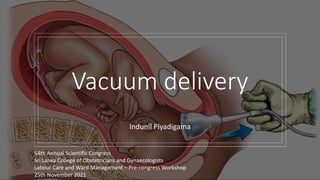
Vacuum delivery
Indunil Piyadigama
54th Annual Scientific Congress
Sri Lanka College of Obstetricians and Gynaecologists
Labour Care and Ward Management – Pre-congress Workshop
25th November 2021
• The initial applications of vacuum in
deliveries began in the 18th century
• Developed in 1705 by Dr. James Yonge
• Was not popular until the 1950s
• Was popularised due to series of studies
published by a Swedish obstetrician called
Dr. Tage Malmström
• Older clinicians preferred forceps – Due to
medical conservatism and original
training, higher success rates, and a
presumption of improved speed and
control of the birth process
• Trends in usage is changing - seemingly
easy to use, requires less
anaesthesia/analgesia, has lower maternal
morbidity, and is commonly believed to be
safe
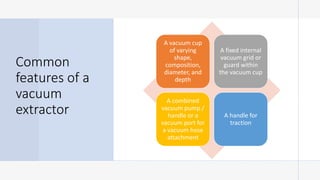
Common
features of a
vacuum
extractor
A vacuum cup
of varying
shape,
composition,
diameter, and
depth
A fixed internal
vacuum grid or
guard within
the vacuum cup
A combined
vacuum pump /
handle or a
vacuum port for
a vacuum hose
attachment
A handle for
traction
Different vacuum extraction instruments
Type of the cup -
Stainless steel,
Polyethylene or
silastic plastic
Location of the
handle
How the vacuum
is generated
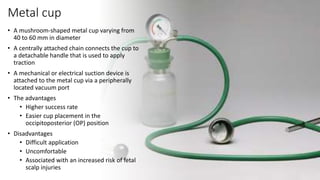
Metal cup
• A mushroom-shaped metal cup varying from
40 to 60 mm in diameter
• A centrally attached chain connects the cup to
a detachable handle that is used to apply
traction
• A mechanical or electrical suction device is
attached to the metal cup via a peripherally
located vacuum port
• The advantages
• Higher success rate
• Easier cup placement in the
occipitoposterior (OP) position
• Disadvantages
• Difficult application
• Uncomfortable
• Associated with an increased risk of fetal
scalp injuries
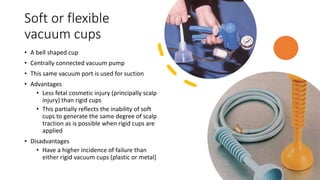
Soft or flexible
vacuum cups
• A bell shaped cup
• Centrally connected vacuum pump
• This same vacuum port is used for suction
• Advantages
• Less fetal cosmetic injury (principally scalp
injury) than rigid cups
• This partially reflects the inability of soft
cups to generate the same degree of scalp
traction as is possible when rigid cups are
applied
• Disadvantages
• Have a higher incidence of failure than
either rigid vacuum cups (plastic or metal)
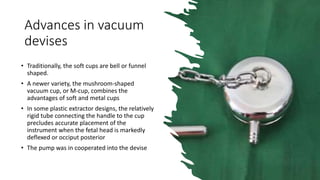
Advances in vacuum
devises
• Traditionally, the soft cups are bell or funnel
shaped.
• A newer variety, the mushroom-shaped
vacuum cup, or M-cup, combines the
advantages of soft and metal cups
• In some plastic extractor designs, the relatively
rigid tube connecting the handle to the cup
precludes accurate placement of the
instrument when the fetal head is markedly
deflexed or occiput posterior
• The pump was in cooperated into the devise
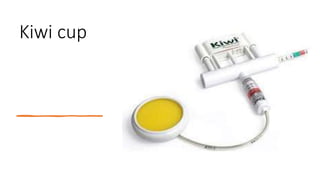
Kiwi cup
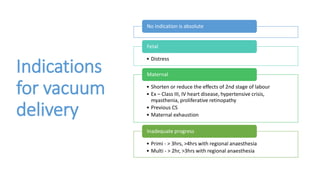
Indications
for vacuum
delivery
No indication is absolute
• Distress
Fetal
• Shorten or reduce the effects of 2nd stage of labour
• Ex – Class III, IV heart disease, hypertensive crisis,
myasthenia, proliferative retinopathy
• Previous CS
• Maternal exhaustion
Maternal
• Primi - > 3hrs, >4hrs with regional anaesthesia
• Multi - > 2hr, >3hrs with regional anaesthesia
Inadequate progress
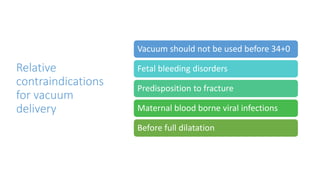
Relative
contraindications
for vacuum
delivery
Vacuum should not be used before 34+0
Fetal bleeding disorders
Predisposition to fracture
Maternal blood borne viral infections
Before full dilatation
Steps in a
successful
vacuum
delivery
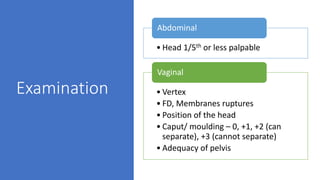
Examination
• Head 1/5th or less palpable
Abdominal
• Vertex
• FD, Membranes ruptures
• Position of the head
• Caput/ moulding – 0, +1, +2 (can
separate), +3 (cannot separate)
• Adequacy of pelvis
Vaginal
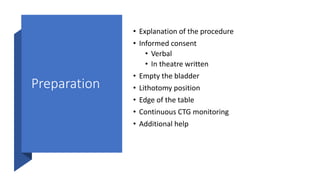
Preparation
• Explanation of the procedure
• Informed consent
• Verbal
• In theatre written
• Empty the bladder
• Lithotomy position
• Edge of the table
• Continuous CTG monitoring
• Additional help
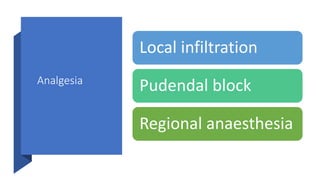
Analgesia
Local infiltration
Pudendal block
Regional anaesthesia
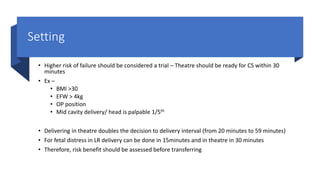
Setting
• Higher risk of failure should be considered a trial – Theatre should be ready for CS within 30
minutes
• Ex –
• BMI >30
• EFW > 4kg
• OP position
• Mid cavity delivery/ head is palpable 1/5th
• Delivering in theatre doubles the decision to delivery interval (from 20 minutes to 59 minutes)
• For fetal distress in LR delivery can be done in 15minutes and in theatre in 30 minutes
• Therefore, risk benefit should be assessed before transferring
Other problems to be expected
• Shoulder dystocia
• PPH
• Neonatal resuscitation
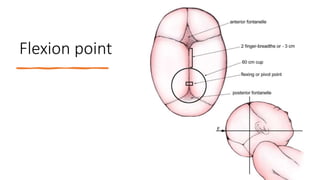
Flexion point
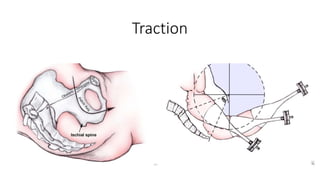
Traction
Proceedure
• Episiotomy - is not recommended as a routine measure during a VE
operation unless the soft tissue impedes the descent of the
presenting part
• Ideally, descent of the presenting part should begin with the initial
traction effort
• If the operator is uncertain that descent has occurred, a maximum of
2 additional tractions may be attempted
• The maximum duration of a vacuum
extraction is unknown
• A maximum of 2-3 pop offs, three
sets of pulls and/or a total application
time of 15-20 minutes have all been
recommended
When to
abandon
When no progressive descent
with moderate traction during
each contraction
Where delivery is not imminent
following 3 contractions of a
correctly applied instrument by
an experience operator
Sequential use of instruments
• Increased risk of trauma to the infant – ICH, seizures, facial nerve injury, low APGAR
• Increase risk of lacerations and PPH
• Changing the delivery instruments can constitute good management. These include those
in which technical problems, such as a malfunctioning hand pump, a misapplied vacuum
cup, or traction in the incorrect vector of force
• The least desirable cases are those in which traction without progress or multiple pop-offs
occur following a correct application of the vacuum extractor and appropriate traction
• Outlet or low cavity forceps following vacuum can be used to reduce the risk of CS
Following procedure
• Cord blood
• Simple analgesics
• Antibiotics
• Documentation – Contemporaneous
• Attention to bladder function
• Counselling before discharge
Comparison of vacuum vs forceps -
Disadvantages
More likely to fail
Slower
More cephalhematomas (10%)
More retinal haemorrhages (50%)
More maternal worries about the baby
Comparison of vacuum vs forceps -
Advantages
3 times less perineal trauma than forceps
Less risk of PPH
Less pain at 24 hours
Lesser chance of feacal incontinence within the first 24 hours
Comparison of vacuum vs forceps - No
difference
CS
Low Apgar
Need of phototherapy
Long term faecal incontinence
Infant outcomes at 5 years
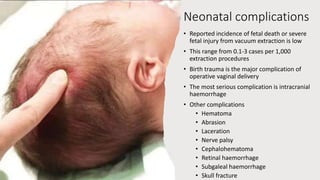
Neonatal complications
• Reported incidence of fetal death or severe
fetal injury from vacuum extraction is low
• This range from 0.1-3 cases per 1,000
extraction procedures
• Birth trauma is the major complication of
operative vaginal delivery
• The most serious complication is intracranial
haemorrhage
• Other complications
• Hematoma
• Abrasion
• Laceration
• Nerve palsy
• Cephalohematoma
• Retinal haemorrhage
• Subgaleal haemorrhage
• Skull fracture
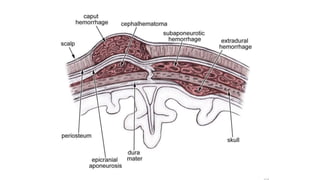
• Cephalohematomas
• Common
• But clinically unimportant
• Subgaleal hemorrhages
• Relatively rare
• But potentially life-threatening
Subgaleal or subaponeurotic haemorrhage
• From rupture of the emissary vein
• Condition is potentially life threatening – Mortality 20%
• These bleeds happen occasionally after spontaneous delivery
• Incidence varies from 0-50 per 1,000 vacuum extractions
Rotational
vacuum vs
Keilands
Rotational vacuum
deliveries are 4 times
more likely to fail
Increased neonatal
trauma and admissions
with rotational vacuum
Summary
• Newer vacum devices are easy to use
• There are no absolute indications for a delivery. Each case must be

individually assessed
• Cooperation of the patient is important
• Systematic approach can reduce complications
• Flexion point and the direction of pull are important technical aspects
to master
• Any procedure can be associated with complications
Thank you

Vaccum delivery

  • 1.
    Vacuum delivery Indunil Piyadigama 54thAnnual Scientific Congress Sri Lanka College of Obstetricians and Gynaecologists Labour Care and Ward Management – Pre-congress Workshop 25th November 2021
  • 2.
    • The initialapplications of vacuum in deliveries began in the 18th century • Developed in 1705 by Dr. James Yonge • Was not popular until the 1950s • Was popularised due to series of studies published by a Swedish obstetrician called Dr. Tage Malmström • Older clinicians preferred forceps – Due to medical conservatism and original training, higher success rates, and a presumption of improved speed and control of the birth process • Trends in usage is changing - seemingly easy to use, requires less anaesthesia/analgesia, has lower maternal morbidity, and is commonly believed to be safe
  • 3.
    Common features of a vacuum extractor Avacuum cup of varying shape, composition, diameter, and depth A fixed internal vacuum grid or guard within the vacuum cup A combined vacuum pump / handle or a vacuum port for a vacuum hose attachment A handle for traction
  • 4.
    Different vacuum extractioninstruments Type of the cup - Stainless steel, Polyethylene or silastic plastic Location of the handle How the vacuum is generated
  • 5.
    Metal cup • Amushroom-shaped metal cup varying from 40 to 60 mm in diameter • A centrally attached chain connects the cup to a detachable handle that is used to apply traction • A mechanical or electrical suction device is attached to the metal cup via a peripherally located vacuum port • The advantages • Higher success rate • Easier cup placement in the occipitoposterior (OP) position • Disadvantages • Difficult application • Uncomfortable • Associated with an increased risk of fetal scalp injuries
  • 6.
    Soft or flexible vacuumcups • A bell shaped cup • Centrally connected vacuum pump • This same vacuum port is used for suction • Advantages • Less fetal cosmetic injury (principally scalp injury) than rigid cups • This partially reflects the inability of soft cups to generate the same degree of scalp traction as is possible when rigid cups are applied • Disadvantages • Have a higher incidence of failure than either rigid vacuum cups (plastic or metal)
  • 7.
    Advances in vacuum devises •Traditionally, the soft cups are bell or funnel shaped. • A newer variety, the mushroom-shaped vacuum cup, or M-cup, combines the advantages of soft and metal cups • In some plastic extractor designs, the relatively rigid tube connecting the handle to the cup precludes accurate placement of the instrument when the fetal head is markedly deflexed or occiput posterior • The pump was in cooperated into the devise
  • 8.
  • 9.
    Indications for vacuum delivery No indicationis absolute • Distress Fetal • Shorten or reduce the effects of 2nd stage of labour • Ex – Class III, IV heart disease, hypertensive crisis, myasthenia, proliferative retinopathy • Previous CS • Maternal exhaustion Maternal • Primi - > 3hrs, >4hrs with regional anaesthesia • Multi - > 2hr, >3hrs with regional anaesthesia Inadequate progress
  • 10.
    Relative contraindications for vacuum delivery Vacuum shouldnot be used before 34+0 Fetal bleeding disorders Predisposition to fracture Maternal blood borne viral infections Before full dilatation
  • 11.
  • 12.
    Examination • Head 1/5thor less palpable Abdominal • Vertex • FD, Membranes ruptures • Position of the head • Caput/ moulding – 0, +1, +2 (can separate), +3 (cannot separate) • Adequacy of pelvis Vaginal
  • 13.
    Preparation • Explanation ofthe procedure • Informed consent • Verbal • In theatre written • Empty the bladder • Lithotomy position • Edge of the table • Continuous CTG monitoring • Additional help
  • 14.
  • 15.
    Setting • Higher riskof failure should be considered a trial – Theatre should be ready for CS within 30 minutes • Ex – • BMI >30 • EFW > 4kg • OP position • Mid cavity delivery/ head is palpable 1/5th • Delivering in theatre doubles the decision to delivery interval (from 20 minutes to 59 minutes) • For fetal distress in LR delivery can be done in 15minutes and in theatre in 30 minutes • Therefore, risk benefit should be assessed before transferring
  • 16.
    Other problems tobe expected • Shoulder dystocia • PPH • Neonatal resuscitation
  • 17.
  • 18.
  • 19.
  • 20.
    • Episiotomy -is not recommended as a routine measure during a VE operation unless the soft tissue impedes the descent of the presenting part • Ideally, descent of the presenting part should begin with the initial traction effort • If the operator is uncertain that descent has occurred, a maximum of 2 additional tractions may be attempted
  • 21.
    • The maximumduration of a vacuum extraction is unknown • A maximum of 2-3 pop offs, three sets of pulls and/or a total application time of 15-20 minutes have all been recommended
  • 22.
    When to abandon When noprogressive descent with moderate traction during each contraction Where delivery is not imminent following 3 contractions of a correctly applied instrument by an experience operator
  • 23.
    Sequential use ofinstruments • Increased risk of trauma to the infant – ICH, seizures, facial nerve injury, low APGAR • Increase risk of lacerations and PPH • Changing the delivery instruments can constitute good management. These include those in which technical problems, such as a malfunctioning hand pump, a misapplied vacuum cup, or traction in the incorrect vector of force • The least desirable cases are those in which traction without progress or multiple pop-offs occur following a correct application of the vacuum extractor and appropriate traction • Outlet or low cavity forceps following vacuum can be used to reduce the risk of CS
  • 24.
    Following procedure • Cordblood • Simple analgesics • Antibiotics • Documentation – Contemporaneous • Attention to bladder function • Counselling before discharge
  • 25.
    Comparison of vacuumvs forceps - Disadvantages More likely to fail Slower More cephalhematomas (10%) More retinal haemorrhages (50%) More maternal worries about the baby
  • 26.
    Comparison of vacuumvs forceps - Advantages 3 times less perineal trauma than forceps Less risk of PPH Less pain at 24 hours Lesser chance of feacal incontinence within the first 24 hours
  • 27.
    Comparison of vacuumvs forceps - No difference CS Low Apgar Need of phototherapy Long term faecal incontinence Infant outcomes at 5 years
  • 28.
    Neonatal complications • Reportedincidence of fetal death or severe fetal injury from vacuum extraction is low • This range from 0.1-3 cases per 1,000 extraction procedures • Birth trauma is the major complication of operative vaginal delivery • The most serious complication is intracranial haemorrhage • Other complications • Hematoma • Abrasion • Laceration • Nerve palsy • Cephalohematoma • Retinal haemorrhage • Subgaleal haemorrhage • Skull fracture
  • 30.
    • Cephalohematomas • Common •But clinically unimportant • Subgaleal hemorrhages • Relatively rare • But potentially life-threatening
  • 31.
    Subgaleal or subaponeurotichaemorrhage • From rupture of the emissary vein • Condition is potentially life threatening – Mortality 20% • These bleeds happen occasionally after spontaneous delivery • Incidence varies from 0-50 per 1,000 vacuum extractions
  • 32.
    Rotational vacuum vs Keilands Rotational vacuum deliveriesare 4 times more likely to fail Increased neonatal trauma and admissions with rotational vacuum
  • 33.
    Summary • Newer vacumdevices are easy to use • There are no absolute indications for a delivery. Each case must be individually assessed • Cooperation of the patient is important • Systematic approach can reduce complications • Flexion point and the direction of pull are important technical aspects to master • Any procedure can be associated with complications
  • 34.