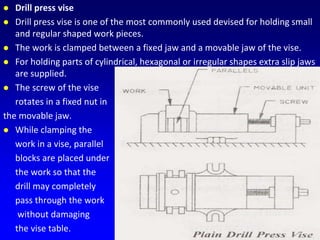
3 Drilling Machine
 Introduction
 Types of Drilling Machine
 Size and Specification of Drilling Machines
 Tool Holding Devices
 Work Holding Devices
 Drilling Machine Operations
 Cutting Parameters
 Drilling Machine Tools
 Twist Drill Nomenclature
 Reamer
 Counter bore
 Taps
Prof.MAYUR S. MODI
ASSISTANT
PROFESSOR,
MED,SSASIT,SURAT
INTRODUCTION
 The drilling machine consists of a spindle which imparts rotary motion to
the drill tool, a table to support and rest the work piece and a feed
mechanism to feed the tool in the work. The hole is generated by rotation
of cutting edge of the drill tool inside of the work.
 Drilling is an operation of making a circular hole by removing a volume of
metal from the job by cutting tool called drill.
 A drill is a rotary end-cutting tool with one or more cutting lips and usually
one or more flutes for the passage of chips out from the work and
introducing the cutting fluid.
 Besides drilling round holes, many other operations can also be performed
on the drilling machine such as counter boring, countersinking, honing,
reaming, lapping, sanding etc.
TYPES OF DRILLING MACHINE
 Portable drilling machine
 Sensitive drilling machine- (a) Bench mounting type (b) Floor mounting
type
 Upright drilling machine- (a) Round column type (b) Box column type
 Radial drilling machine- (a) Plain (b) Semi-universal (c) Universal
 Gang drilling machine
 Multiple spindle drilling machine
 Automatic drilling machine
 Deep hole drilling machine- (a) Vertical (b) Horizontal
 Vertical Turret Type Drilling Machines
Portable Drilling Machine
 A portable drilling machine is a small compact in construction and used for
drilling holes in work pieces in any position, which cannot be drilled by a
standard drilling machine.
 It may be used for drilling small diameter holes in large castings or weld-
ments at any location, without moving bulky work pieces.
 Portable drilling machines are fitted with small electric motors, which may
be driven by both A.C. and D.C. power supply or by air pressure.
 These drilling machines operate at fairly high speeds and accommodate
drills up to 12 mm in diameter.
Sensitive Drilling Machine
 It is a small bench type machine used for drilling small holes in light jobs at
high speed.
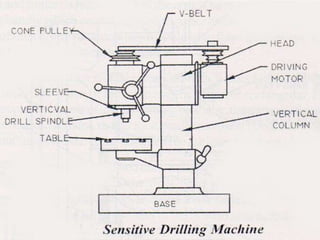
 sensitive drilling machine comprises of a horizontal table, a vertical column,
a head which supports the motor and driving mechanism, and a vertical
spindle which drives and rotates the drill.
 The work piece is mounted on the table and drill is fed into the work by
hand control. High rotating speed of the drill and hand feed are required for
drilling small holes.
 As the operator can sense the drilling action in the work piece at any
instant, it is called sensitive drilling machine.
 This helps operator to release pressure in case the drilling operation is not
performed in normal ways and prevent damage to work and drill bit.
 Typically the smallest diameter which may be drilled is 0.35 mm and largest
diameter is 15.5 mm.
 Classification Based on the mounting of the base……..
– Bench mounted drilling machine,
– Floor mounted drilling machine.
Upright Drilling Machine
 This machine is larger and heavier than a sensitive drilling machine.
 It is designed for handling medium sized work pieces and is provided with
power feed arrangement.
 The spindle is provided with number of speeds and feeds for drilling
different sizes of holes in different types of works.
 The feed clutch is automatically controlled so that spindle is disengaged
when it reaches its upper and lower limit of travel.
 It also has free engagement of taps through clutch and rapid reversing
mechanism for quick withdrawal of drill.
 Upright drilling machines are available in various sizes and drilling
capacities, ranging up to 75 mm diameter drills.
 The table of the machine also has different types of adjustments to
accommodate different shapes of work.
 Based on the construction, Upright drilling machines Classification
– Round column type or pillar type drilling machine
– Box column type
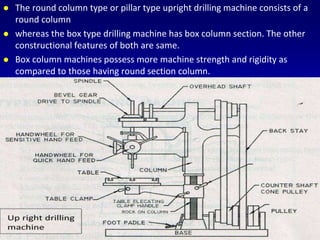
 The round column type or pillar type upright drilling machine consists of a
round column
 whereas the box type drilling machine has box column section. The other
constructional features of both are same.
 Box column machines possess more machine strength and rigidity as
compared to those having round section column.
Upright drilling machine parts
Different parts of an upright drilling machine
 Base
 Column
 Table
 Head
 Spindle, quill and drill head assembly
 Spindle drive and feed mechanism
Base
 It is the part of the machine on which the vertical column is mounted.
 In the belt driven machine the countershaft consisting of a fast and a loose
pulley and a cone is fitted to the base of the machine.
 The base in round column type machine is accurately machined and has T-
slots on it to hold large work pieces.
Column
 Column is a vertical member of which supports the table and the head and
contains all the driving mechanism.
 The column should be sufficiently rigid to take up entire cutting pressure of
the drill during operation.
 The column may be made of box or round section. Box column is a more
rigid construction.
 In some of the round column machines, rack teeth are cut on the face of
the column for vertical movement of the arm and the table.
 Or the rake is fitted on the column and pinion is housed within the arm.
 The movement is given by rotating the table elevating handle which causes
a pinion to rotate on the rack teeth.
 In box column type, the front face of the column is accurately machined to
form guide ways on which the table can slide up and down for vertical
adjustment.
Table
 Table is mounted on the column and is provided with T-slots for clamping
the work pieces directly on its face.
 The shape of the table may be round or rectangular.
 For centering the work below the spindle in case of a pillar drilling machine,
the three motions of the table may be adjusted-
– vertical movement,
– radial/ rotational movement about the column
– circular movement about its own axis.
 Once adjusted the table and arm are clamped in position.
Head
 Head is mounted on the column top and houses the driving and feeding
mechanisms for the spindle.
 In some of the machines the drill head may be adjusted up or down for
accommodating different heights of work over and above table adjustment.
 In lighter machines, the driving motor is mounted at the rear end of the
head to counterbalance the weight of the drill spindle.
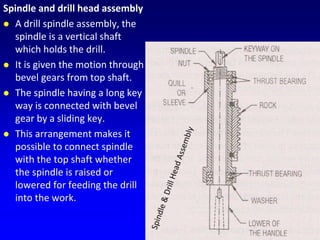
Spindle and drill head assembly
 A drill spindle assembly, the
spindle is a vertical shaft
which holds the drill.
 It is given the motion through
bevel gears from top shaft.
 The spindle having a long key
way is connected with bevel
gear by a sliding key.
 This arrangement makes it
possible to connect spindle
with the top shaft whether
the spindle is raised or
lowered for feeding the drill
into the work.
 The spindle rotates within a non-rotating sleeve which is known as quill.
 Rack teeth are cut on the outer surface of the sleeve, or a block having rack
teeth cut on it is bolted on vertical face of the sleeve.
 By rotating a pinion which meshes with the rack the sleeve may be moved
vertically up or down.
 This movement results in vertical movement of the spindle.
 The downward movement of the spindle is affected by rotating the pinion
which causes the quill to move downward exerting pressure on the spindle
through a thrust bearing and washer.
 The spindle is moved upward by the upward pressure exerted by the quill
acting against a nut attached to the spindle through the thrust bearing.
 At the end of the taper hole of the sleeve a slot is provided which may
accommodate the tang of taper shank of the drill bit. This ensures a
positive drive
Spindle drive mechanism
This mechanism is meant for achieving multiple speeds of spindle for
drilling holes of different sizes in different materials.
 step cone pulley drive
 step cone pulley drive with back gears
 Gearing
Step cone pulley drive
 A spindle driving mechanism using a step cone pulley is shown
 From an overhead line shaft the motion is transmitted to the countershaft
mounted on the base of drilling machine.
 By operating foot pedal the countershaft is started or stopped by shifting
the belt from loose pulley to fast pulley and vice versa.
 The power is transmitted to step cone pulley mounted on the head from
the countershaft step cone pulley through the belt which runs the overhead
shaft.
 From overhead shaft, the power is further transmitted to the drill spindle
through bevel gears.
 The speed of the spindle may be changed by shifting the belt on different
steps of the cone pulley. The number of spindle speeds available depends
upon the number of steps in the cone pulley.
Step cone pulley drive with one or more back gear
 In order to obtain larger number of spindle speeds, in addition to the step
cone pulley, back gears are provided in the machine.
Spindle drive by gearing
 Modern heavy duty drilling machines are powered by individual motor
mounted on the machine frame. It is possible to obtain the multiple speeds
by sliding gear or sliding clutch mechanism or by the combination of them.
Feed mechanism
 The feed is affected by the vertical movement of the drill spindle into the
work.
 It can be controlled manually or by power. For hand feed following two
methods are employed:
– Quick traverse hand feed
– Sensitive hand feed
 The Quick traverse hand feed is used to move the cutting tool rapidly to the
hole location or for withdrawing the drill at the completion of operation.
 The sensitive hand feed is applied for trial cut and for drilling small holes.
 For making larger diameter holes the automatic feed is applied as the
cutting pressure required is substantially great.
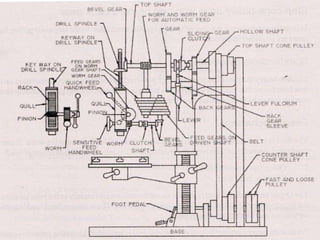
 Automatic feed mechanism is shown in next slide
 Through the worm gearing the automatic feed motion is derived to a six
speed feed box.
 Feed are varied by the lever which operates a sliding key mechanism.
 Inside the feed box, six gears mounted on worm gear shaft are constantly in
mesh with another six gears mounted on the driven shaft.
 Gears are keyed to the driven shaft so that they rotate with it.
 Gears on the worm gear shaft are all free to rotate, but at a time any one of
them maybe keyed by a sliding key to the shaft.
 When the sliding key is engaged to the first gear, the motion is transmitted
to the driven shaft through the corresponding gear keyed.
 Rest of the gears on the worm shaft revolves freely with their mating gears
on the driven shaft.
 Thus by sliding the key to engage with six different gears on the worm gear
shaft six different speeds of driven shaft are obtained.
 Two mating bevel gears and the clutch transmit the motion of the driven
shaft to the shaft. The worm mounted on the shaft operates the worm gear
mounted on a shaft.
 A small pinion fitted at the end of this shaft meshes with the rack which is
bolted to the quill. The rotation of the pinion causes the quill to move up
and down giving spindle feed.
 The clutch is disconnected to apply the sensitive hand feed. The sensitive
feed hand wheel is attached to the rear end of the worm shaft. Rotation of
the hand wheel causes the worm and worm gear to rotate. Due to this a
slow and sensitive feed is obtained.
 To obtained quick hand feed, the hand wheel is rotated and clutch is
operated which is mounted on the worm gear shaft. One turn of the hand
wheel causes one complete rotation of the pinion giving quick hand feed
movement to the spindle.
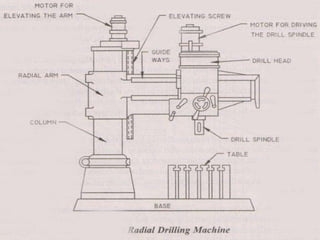
Radial Drilling Machine
 This is most versatile and largest of all drilling machines having single
spindle meant for accommodating large components.
 Radial drilling machine consists of a heavy, round vertical column with a
radial arm carrying the drill head.
 Arm can be vertically raised or lowered on the column.
 It can also be radially adjusted around the column in any position over the
work to accommodate different sizes and shapes of the work.
 It can be locked in any position once set in a particular position.
 The drill head equipped with rotational and feed mechanism for the drill is
mounted on radial arm moves on horizontal guide-ways. It can be clamped
at any desired position.
 These three adjustments of arm and drilling head permit the operator to
locate the drill quickly over any point on the work.
 The movements may be either manual or power driven. The table of radial
drilling machine may also be rotated through 360 deg.
 Procedure to drill a hole:
 The arm is raised or lowered as required and adjusted radially.
 The drill head is positioned and locked on the arm and the arm is also
locked in the set position on column.
 Speed and feed of spindle are adjusted according to work requirement and
depth is set to reach the work.
 The drill is then lowered to drill hole and is withdrawn as required depth of
hole is drilled.
 The locks are then released and arm and head are set to a new position for
drilling another hole.
 Powerful drive motors are geared directly into the head of the machine and
a wide range of power feeds are available as well as sensitive and geared
manual feeds.
 The radial drilling machine is used primarily for drilling medium to large and
heavy work pieces.
Classification
– Based on the different movements of horizontal arm, table & drill head
 Plain radial drilling machine:
– This type of machine allows vertical movement of the drilling arm on
the column, horizontal movement of the drill head along the arm, and
circular/ radial movement of the arm about the vertical axis of column.
 Semi universal drilling machine:
– One additional movement is allowed by this type of machine over and
above three movements possible in plain radial drilling machine.
– This is, swing of the drill head about a horizontal axis perpendicular to
the arm. Due to this fourth movement, it possible to drill a hole at an
angle to the horizontal plane.
 Universal drilling machine:
– An additional rotary movement of the arm holding the drill head about
a horizontal axis is provided in universal drilling machine.
– Using this fifth movement, it possible to drill a hole at any angle on the
work piece.
– This makes the machine highly flexible and reduced the need for
changing the work piece position.
Radial Drilling machine Parts
 Base
 Radial arm
 Column
 Drill head
 Spindale speed and feed mechanism
 Base:
– A heavy rectangular casting serves the purpose as the base of a radial
drilling machine.
– It supports a column on its one end and holds the work table at the
other end.
– Sometimes T-slots are provided on the base for clamping the work,
when it serves as a table.
– In some machines two or more bases are provided.
– When drilling is carried out on a job fixed on one of the bases, another
job may be set up on the other for a continuous production.
– This reduces the idle time of the machine.
 Column:
– is a cylindrical casting mounted vertically at one end of the base.
– The radial arm is supported by the column, which may slide up or down
on the face of the column.
– This vertical movement of the arm is imparted by an electric motor
mounted on top of the column by rotation of a screw passing thought a
nut attached to the arm.
 Radial arm:
– As mentioned above, the radial arm is mounted on the column.
– The arm is made of heavy casting having its length equal to the size of
the base.
– Its front face is accurately machined to provide guide ways to facilitate
the sliding movement of drill head.
– The radial swing of the arm is possible around the column. A separate
motor is provided to control this motion in some machines.
 Drilling head:
– is mounted on the radial arm and drives the drill spindle.
– The mechanism and controls for driving the drill at different speeds and
feeds are housed by the drill head.
– The head can slide on the guide ways of the arm to locate the drill
position on the work piece.
– Once the spindle has been properly positioned the drill head is clamped
on the radial arm.
 Spindle drive and feed mechanism:
– Spindle is either driven by a constant speed motor which is located at
the extreme end of the radial arm.
– A horizontal spindle running through the arm is connected to this
motor, which transmits the motion to the drill head through bevel
gears.
– Speed of the spindle may be varied by gear trains housed within the drill
head.
– Another train of gearing is provided to obtain different feeds of the
spindle.
– In other type of machines, different speeds and the feeds of the spindle
are obtained by a vertical motor fitted directly on the drill head which
drives a gear box.
 Multiple-Spindle Drilling Machine
 This machine is employed in case where a number of holes are to be drilled
simultaneously in the work pieces in a large lot.
 It comprises of several drill bits mounted on spindles which are fed into the
work simultaneously.
 The table is raised or lowered to achieve feeding motion.
 It is also possible to feed the drills by lowering the drill heads.
 The centre distance between spindles can be adjusted as required by
different jobs within the capacity of drill heads.
 Generally these machines are of vertical type.
 The drilling operations consist of rapid advance of drills to work, proper
feed and rapid return of drills to original position.
 Gang Drilling Machine
– Gang drilling machine comprises of a number of single spindle drilling
machine columns placed side by side.
– They are mounted on a common base and have a common worktable.
– In a typical machine six or four spindles are arranged side by side and
speed and depth of each of them may be set independently.
– The spindles can run either simultaneously or in sequence.
– It is possible to perform different operations on the job in a sequence
by shifting the work piece from one location to the other on the
worktable.
– Hence, this machine is normally used for mass production work.
– Quick movement of work pieces from one spindle to another is
important feature of this machine.
– This machine finds application in straight line, multiple holes drilling in
castings, plates and steel sections.
 Automatic Drilling Machine
– These are used for very fast production work.
– They perform a series of machining operations at successive units.
– The work is transferred from one unit to another automatically.
– These machines comprise of a number of unit heads with single or
multiple spindles in horizontal, vertical or angular positions in various
combination on a special type of base.
– Different operations at various units are facilitated by indexing tables
and work holding fixtures.
 Deep Hole Drilling Machine
– Deep hole drilling machines and drills are used for making holes where
the length of the holes exceeds three times the drill size.
– Such type of job requirement arises for making holes in rifle barrels,
long spindles, crank shafts, connecting rods, long shafts and certain oil-
well drilling equipments.
– The machine is operated at high speed and low feed.
– A large quantity of lubricant is pumped to the cutting points to facilitate
chip removal and cooling the cutting edges of drill bit.
– Generally the work is rotated while drill is fed into the work.
– In some machines both drill and work are rotated for accurate location.
A long job is supported at several points through the length, which
prevents its deflection while drilling.
– The machine may be vertical or horizontal type with single or multiple
spindles.
 Vertical Turret Type Drilling Machines
– This type of machines work in similar manner as turret lathe.
– A turret provided on the machine houses different tools such as drill,
reamer, counter boring tool, spot-face, tap etc. in a required sequence.
– Various spindles on the turret can be manually or automatically
indexed.
– The spindles can be driven only when they come to drilling position.
 Size and specification of drilling machines
– Portable drilling machine is specified by maximum diameter of drill
that can be held in the spindle.
– Sensitive and upright drilling machines are specified by the diameter of
the largest piece that can be centered under the spindle.
– Radial drilling machine is specified by the length of the arm and column
diameter.
– Multiple spindle drilling machine is specified by the drilling area, the
size and number of holes that can be drilled by a machine.
General specification of drilling machines
 Maximum size of drill that can be accommodate operated by machine
 Table diameter
 Maximum spindle travel
 Number of spindle speeds and feeds
 Morse taper number of the spindle
 Power input
 Floor space required
 Weight of the machine.
 Tool holding devices
– Direct fitting in the spindle
– Sleeves
– Chucks
 Directly fitting tool in the spindle
– A spindle used in almost all general purpose drilling machines is a
cylindrical component having a hole bored inside to a standard taper.
– This taper hole receives the taper shank of the tool.
– Normally Morse standard taper is used in drill spindle which is
approximately 1:20.
– For fitting the tool in the hole, the shank is forced into the tapered hole
and tool is gripped by friction between outer surface of shank and inner
surface of spindle.
– Because of the frictional grip the tool rotates with the spindle.
– In addition to this, a positive drive is established by fitting of the tang or
tongue of the tool into a slot at the end of the taper hole.
– This prevents slippage of shank in the spindle.
– The drill tool may be withdrawn by pressing a taper wedge known as
drift into the slotted hole of the spindle.
 Sleeve
– The drill spindle can hold only one size of tool shank.
– To accommodate smaller sizes of the taper shank in the spindle hole, a
taper sleeve is used as shown below.
– The outside taper of the sleeve matches to the drill spindle taper while
the inside taper can hold the shank of smaller size tools.
– Thus using different sizes of sleeves, tool shanks of different sizes may
be held in the spindle.
– The taper on outer surface of the sleeve remains same, but that on the
inner surface varies which may suit with the different sizes of the tool
shanks.
 Drill Chucks
– The chuck is a device which is capable to hold different drills of smaller
size and any other tools.
– As compared to sleeve or socket which can hold only one size of tool
shank, chuck may hold different sizes of tool shanks within a specific
range.
– Drill chucks are connected to the spindle by frictional fit between their
tapered shank and inside taper of spindle.
– Different types of drill chucks used for different purpose are:
» Quick change chuck
» Three-j aw self-centering chuck.
 Quick change chuck
– It is capable of quickly changing
the tools in a series for machining
holes without stopping the spindle.
– This helps to reduces machining
– time for faster production.
 Quick change chuck consists of
– body having taper shank which is fitted into the spindle. It houses
– a sleeve which has a taper hole for holding the tool shank, and
– a sliding collar, fitted loosely on the rotating body.
 Next slide shows the sectional view of the sleeve.
 The sleeve holding the tool is fitted inside the body.
 Holes are provided on inner wall of the body of the chuck in which balls are
placed.
 On the corresponding surface of the sleeve, recesses are cut to retain the
balls when sleeve fits inside of the body.
 By raising the collar the sleeve with its tool may be inserted and fitted in
the chuck body.
 At this time the sleeve causes the balls to come out from recess.
 To lock the sleeve and the tool the collar is lowered.
 At this time balls are forced into the recess and the sleeve is locked by the
balls with the body.
 The driving motion is transmitted to the tool from chuck body through the
balls.
 The sleeve can be removed out from the chuck by lifting the collar.
 Three-jaw self-centering chuck
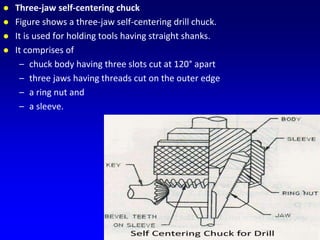
 Figure shows a three-jaw self-centering drill chuck.
 It is used for holding tools having straight shanks.
 It comprises of
– chuck body having three slots cut at 120° apart
– three jaws having threads cut on the outer edge
– a ring nut and
– a sleeve.
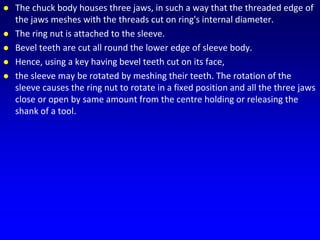
 The chuck body houses three jaws, in such a way that the threaded edge of
the jaws meshes with the threads cut on ring's internal diameter.
 The ring nut is attached to the sleeve.
 Bevel teeth are cut all round the lower edge of sleeve body.
 Hence, using a key having bevel teeth cut on its face,
 the sleeve may be rotated by meshing their teeth. The rotation of the
sleeve causes the ring nut to rotate in a fixed position and all the three jaws
close or open by same amount from the centre holding or releasing the
shank of a tool.
 Work holding Devices
 It is very much essential to clamp the work securely on the table of the
drilling machine before starting any machining operation.
 As the drill exerts very high torque while rotating, if the work is not firmly
fixed it may start rotating with the tool and damage the machine and may
injure the operator.
 The commonly used work holding devices are:
– T-bolt and clamps
– Drill Press vise
– Step block
– Drill Jigs
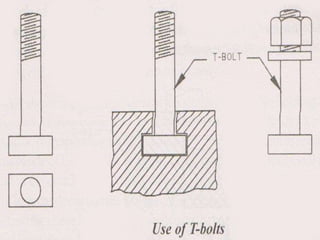
 T- bolts and clamps
 T-slots are provided on the drilling machine table in which T-bolts fitted.
 Different views of T-bolts are shown in Next slide
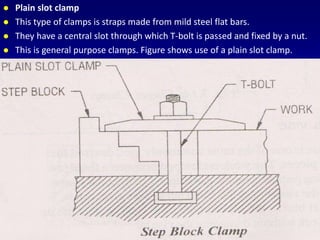
 Plain slot clamp
 This type of clamps is straps made from mild steel flat bars.
 They have a central slot through which T-bolt is passed and fixed by a nut.
 This is general purpose clamps. Figure shows use of a plain slot clamp.
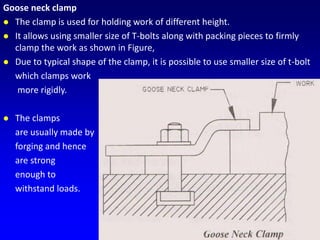
Goose neck clamp
 The clamp is used for holding work of different height.
 It allows using smaller size of T-bolts along with packing pieces to firmly
clamp the work as shown in Figure,
 Due to typical shape of the clamp, it is possible to use smaller size of t-bolt
which clamps work
more rigidly.
 The clamps
are usually made by
forging and hence
are strong
enough to
withstand loads.
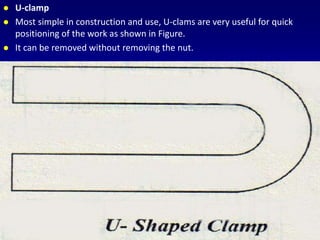
 U-clamp
 Most simple in construction and use, U-clams are very useful for quick
positioning of the work as shown in Figure.
 It can be removed without removing the nut.
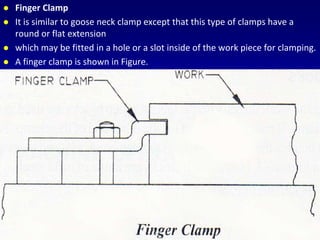
 Finger Clamp
 It is similar to goose neck clamp except that this type of clamps have a
round or flat extension
 which may be fitted in a hole or a slot inside of the work piece for clamping.
 A finger clamp is shown in Figure.
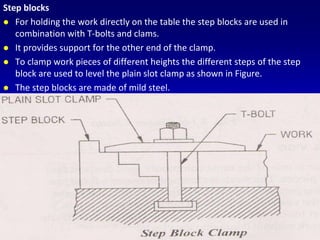
 Drill press vise
 Drill press vise is one of the most commonly used devised for holding small
and regular shaped work pieces.
 The work is clamped between a fixed jaw and a movable jaw of the vise.
 For holding parts of cylindrical, hexagonal or irregular shapes extra slip jaws
are supplied.
 The screw of the vise
rotates in a fixed nut in
the movable jaw.
 While clamping the
work in a vise, parallel
blocks are placed under
the work so that the
drill may completely
pass through the work
without damaging
the vise table.
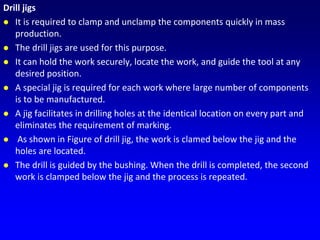
Step blocks
 For holding the work directly on the table the step blocks are used in
combination with T-bolts and clams.
 It provides support for the other end of the clamp.
 To clamp work pieces of different heights the different steps of the step
block are used to level the plain slot clamp as shown in Figure.
 The step blocks are made of mild steel.
Drill jigs
 It is required to clamp and unclamp the components quickly in mass
production.
 The drill jigs are used for this purpose.
 It can hold the work securely, locate the work, and guide the tool at any
desired position.
 A special jig is required for each work where large number of components
is to be manufactured.
 A jig facilitates in drilling holes at the identical location on every part and
eliminates the requirement of marking.
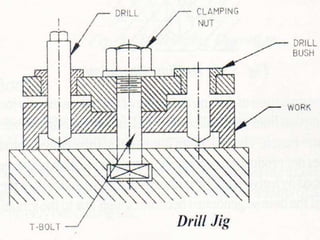
 As shown in Figure of drill jig, the work is clamed below the jig and the
holes are located.
 The drill is guided by the bushing. When the drill is completed, the second
work is clamped below the jig and the process is repeated.
Drill jigs
 It is required to clamp and unclamp the components quickly in mass
production.
 The drill jigs are used for this purpose.
 It can hold the work securely, locate the work, and guide the tool at any
desired position.
 A special jig is required for each work where large number of components
is to be manufactured.
 A jig facilitates in drilling holes at the identical location on every part and
eliminates the requirement of marking.
 As shown in Figure of drill jig, the work is clamed below the jig and the
holes are located.
 The drill is guided by the bushing. When the drill is completed, the second
work is clamped below the jig and the process is repeated.
Drill jigs
 It is required to clamp and unclamp the components quickly in mass
production.
 The drill jigs are used for this purpose.
 It can hold the work securely, locate the work, and guide the tool at any
desired position.
 A special jig is required for each work where large number of components
is to be manufactured.
 A jig facilitates in drilling holes at the identical location on every part and
eliminates the requirement of marking.
 As shown in Figure of drill jig, the work is clamed below the jig and the
holes are located.
 The drill is guided by the bushing. When the drill is completed, the second
work is clamped below the jig and the process is repeated.
Drilling machine operations
 Drilling
 Boring
 Countersinking
 Tapping
 Grinding
 Reaming
 Counter boring
 Spot facing
 Lapping
 Trepanning
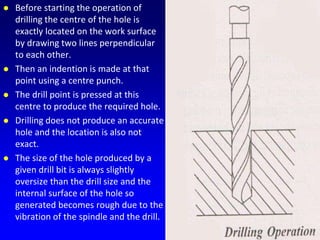
Drilling
 It is the operation of producing a cylindrical hole by removing metal by
rotating edge of a cutting tool called the drill.
 The drilling is one of the simplest methods of producing a hole.
 Before starting the operation of
drilling the centre of the hole is
exactly located on the work surface
by drawing two lines perpendicular
to each other.
 Then an indention is made at that
point using a centre punch.
 The drill point is pressed at this
centre to produce the required hole.
 Drilling does not produce an accurate
hole and the location is also not
exact.
 The size of the hole produced by a
given drill bit is always slightly
oversize than the drill size and the
internal surface of the hole so
generated becomes rough due to the
vibration of the spindle and the drill.
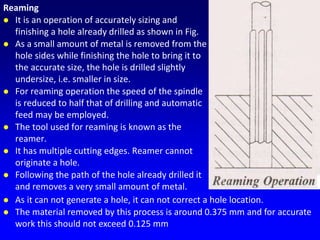
Reaming
 It is an operation of accurately sizing and
finishing a hole already drilled as shown in Fig.
 As a small amount of metal is removed from the
hole sides while finishing the hole to bring it to
the accurate size, the hole is drilled slightly
undersize, i.e. smaller in size.
 For reaming operation the speed of the spindle
is reduced to half that of drilling and automatic
feed may be employed.
 The tool used for reaming is known as the
reamer.
 It has multiple cutting edges. Reamer cannot
originate a hole.
 Following the path of the hole already drilled it
and removes a very small amount of metal.
 As it can not generate a hole, it can not correct a hole location.
 The material removed by this process is around 0.375 mm and for accurate
work this should not exceed 0.125 mm
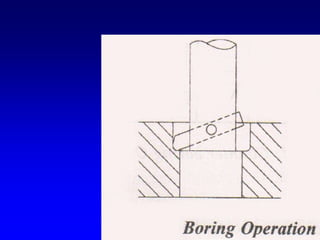
Boring
 Boring is an operation to enlarge the hole already drilled to its final
dimension
 When suitable size of drill is not available for making a hole or the size is
larger than largest drill available, a hole is to be enlarged by means of an
adjustable cutting tool having only one cutting edge.
 To correct a hole accurately and to bring it to the required size.
 To finish the internal surface of a hole already produced in casting.
 To correct the roundness of the hole.
 To correct the location of the hole as the boring tool follows an
independent path in the hole.
 A boring bar holding the cutter is fitted by frictional fit between spindle
socket and taper shank of the boring bar.
 The job is drilled slightly undersize for perfectly finishing a hole.
 In precision machine, the accuracy is as high as ± 0.00125 mm.
 The operation is comparatively slow process than reaming and it requires
several passes of the tool.
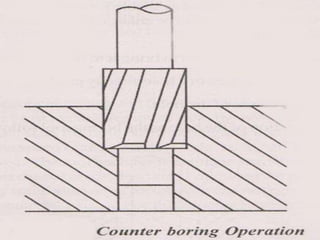
Counter boring
 It is the operation of cylindrically enlarging the end of the hole as shown in
Figure.
 Due to partial enlargement the enlarged hole forms a square shoulder with
the original hole which is necessary in some cases to accommodate the
heads of bolts, studs and pins.
 The tool used for counter boring is called a counter bore.
 The counter bores are having either straight or tapered shank to fit in the
drill spindle.
 The cutting edges are provided with straight or spiral teeth.
 The straight front part of tool is known as pilot which extends beyond the
end of the cutting edges.
 The pilot fits into the small diameter hole having running clearance and
guide the tool and maintains the alignment of the tool.
 These pilots may be interchanged for enlarging different sizes of holes.
 An accuracy of about ± 0.050 mm may be achieved by counter boring
operation.
 The cutting speed for counter boring is 25% less than that of drilling
operation.
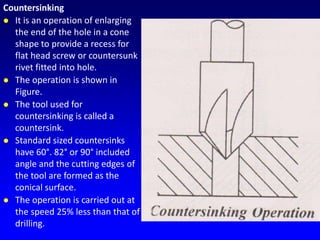
Countersinking
 It is an operation of enlarging
the end of the hole in a cone
shape to provide a recess for
flat head screw or countersunk
rivet fitted into hole.
 The operation is shown in
Figure.
 The tool used for
countersinking is called a
countersink.
 Standard sized countersinks
have 60°. 82° or 90° included
angle and the cutting edges of
the tool are formed as the
conical surface.
 The operation is carried out at
the speed 25% less than that of
drilling.
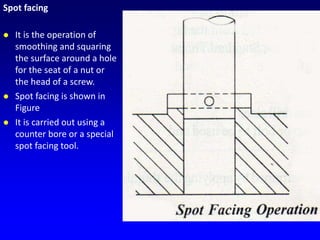
Spot facing
 It is the operation of
smoothing and squaring
the surface around a hole
for the seat of a nut or
the head of a screw.
 Spot facing is shown in
Figure
 It is carried out using a
counter bore or a special
spot facing tool.
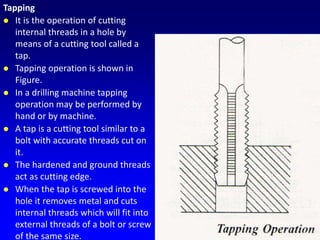
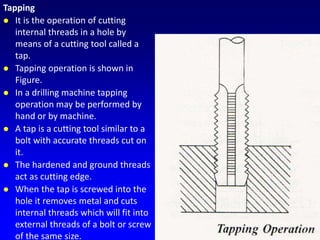
Tapping
 It is the operation of cutting
internal threads in a hole by
means of a cutting tool called a
tap.
 Tapping operation is shown in
Figure.
 In a drilling machine tapping
operation may be performed by
hand or by machine.
 A tap is a cutting tool similar to a
bolt with accurate threads cut on
it.
 The hardened and ground threads
act as cutting edge.
 When the tap is screwed into the
hole it removes metal and cuts
internal threads which will fit into
external threads of a bolt or screw
of the same size.
Tapping
 It is the operation of cutting
internal threads in a hole by
means of a cutting tool called a
tap.
 Tapping operation is shown in
Figure.
 In a drilling machine tapping
operation may be performed by
hand or by machine.
 A tap is a cutting tool similar to a
bolt with accurate threads cut on
it.
 The hardened and ground threads
act as cutting edge.
 When the tap is screwed into the
hole it removes metal and cuts
internal threads which will fit into
external threads of a bolt or screw
of the same size.
Size of the Tap Drill
 The size of the tap is expressed as the outside diameter of its threads.
 Hence, size of the hole in which the threads are to be cut must be smaller
than the tap by twice the depth of the thread.
 The amount to be subtracted from the tap diameter depends on the shape
of the thread, e.g. B.S.W., B.S.F., Indian Standard Thread (IS) etc.
 Thus, the tap drill size may be derived from the following formula:
 D = T - 2d
 Where,
 D= diameter of tap drill size,
 T= diameter of tap or bolt to be used and d- depth of thread.
 Tap drill size can also be determined by applying the 'thumb rule', which is
good enough for all practical purposes.
 Tap drill size = Outside diameter x 0.8
For example:
 Tap drill size = 12x0.8 = 9.6 mm
 Nearest drill size = 9.6 mm
 For commercial purpose a tapped thread need not be full depth thread.
Tapping a thread by 75% of is full depth gives a workable result.
Lapping
 It is the operation of sizing and finishing a small diameter hole already
hardened, using a lapping tool by removing a very small amount of material
by.
 The lapping tool is known as lap.
 There are different types of lapping tools.
 Generally used laps are copper head laps.
 It fits in the hole and removes metal as it is moved up and down while it
revolves.
Grinding
 It is an operation to finely finish the surface or to correct out of roundness
of the hole.
 It may be performed in drilling machine.
 The grinding wheel is inserted in the spindle and made to revolve as well as
moved up and down.
 Out of many different types available, a suitable grinding wheel may be
selected for surface grinding operation.
 Very high accuracy of the order of ±0.0025 mm may be achieved in grinding
operation.
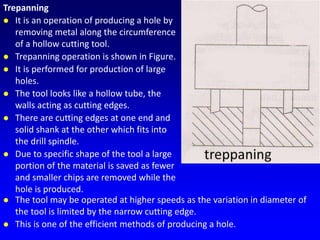
Trepanning
 It is an operation of producing a hole by
removing metal along the circumference
of a hollow cutting tool.
 Trepanning operation is shown in Figure.
 It is performed for production of large
holes.
 The tool looks like a hollow tube, the
walls acting as cutting edges.
 There are cutting edges at one end and
solid shank at the other which fits into
the drill spindle.
 Due to specific shape of the tool a large
portion of the material is saved as fewer
and smaller chips are removed while the
hole is produced.
 The tool may be operated at higher speeds as the variation in diameter of
the tool is limited by the narrow cutting edge.
 This is one of the efficient methods of producing a hole.
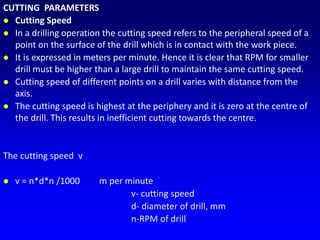
CUTTING PARAMETERS
 Cutting Speed
 In a drilling operation the cutting speed refers to the peripheral speed of a
point on the surface of the drill which is in contact with the work piece.
 It is expressed in meters per minute. Hence it is clear that RPM for smaller
drill must be higher than a large drill to maintain the same cutting speed.
 Cutting speed of different points on a drill varies with distance from the
axis.
 The cutting speed is highest at the periphery and it is zero at the centre of
the drill. This results in inefficient cutting towards the centre.
The cutting speed v
 v = n*d*n /1000 m per minute
v- cutting speed
d- diameter of drill, mm
n-RPM of drill
 The cutting speed of a drill depends upon ……….
 Type of work piece material
 Type of cutting tool material
 Quality of surface finish required
 Use of cutting fluid and
 Method of holding the work.
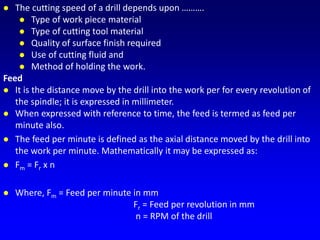
Feed
 It is the distance move by the drill into the work per for every revolution of
the spindle; it is expressed in millimeter.
 When expressed with reference to time, the feed is termed as feed per
minute also.
 The feed per minute is defined as the axial distance moved by the drill into
the work per minute. Mathematically it may be expressed as:
 Fm = Fr x n
 Where, Fm = Feed per minute in mm
Fr = Feed per revolution in mm
n = RPM of the drill
 The amount of feed depends on……
 Type of work piece material
 Rigidity of j ob and machine
 Depth of hole
 Quality of surface finish required
 Power of the drill machine
 Range of feeds available.
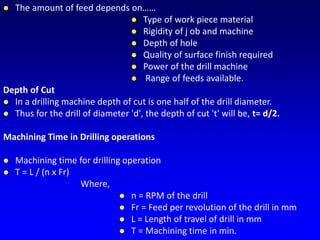
Depth of Cut
 In a drilling machine depth of cut is one half of the drill diameter.
 Thus for the drill of diameter 'd', the depth of cut 't' will be, t= d/2.
Machining Time in Drilling operations
 Machining time for drilling operation
 T = L / (n x Fr)
Where,
 n = RPM of the drill
 Fr = Feed per revolution of the drill in mm
 L = Length of travel of drill in mm
 T = Machining time in min.
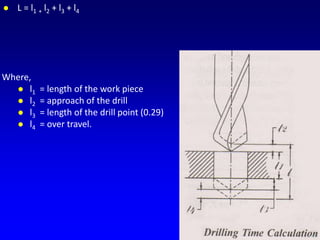
 L = l1 + l2 + l3 + l4
Where,
 l1 = length of the work piece
 l2 = approach of the drill
 l3 = length of the drill point (0.29)
 l4 = over travel.
TOOLS for DRILLING MACHINE
 A drill is a fluted cutting tool used to originate or enlarge a hole in a solid
material.
 Drills are manufactured in a wide variety of types and sizes.
The types of the drill
 Flat or spade drill
 Straight fluted drill
 Two-lip twist drill
» Parallel shank (short series or "Jobbers" twist drill)
» Parallel shanks (stub series) twist drill
» Parallel shank (long series) twist drill
» Taper shank twist drill
 Taper shank core drill (Three or four fluted)
 Oil tube drill
 Centre drill
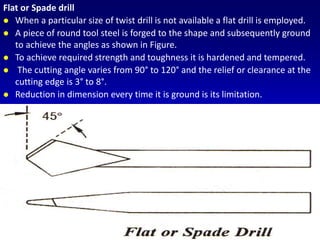
Flat or Spade drill
 When a particular size of twist drill is not available a flat drill is employed.
 A piece of round tool steel is forged to the shape and subsequently ground
to achieve the angles as shown in Figure.
 To achieve required strength and toughness it is hardened and tempered.
 The cutting angle varies from 90° to 120° and the relief or clearance at the
cutting edge is 3° to 8°.
 Reduction in dimension every time it is ground is its limitation.
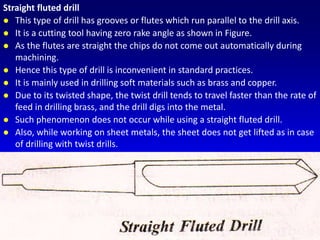
Straight fluted drill
 This type of drill has grooves or flutes which run parallel to the drill axis.
 It is a cutting tool having zero rake angle as shown in Figure.
 As the flutes are straight the chips do not come out automatically during
machining.
 Hence this type of drill is inconvenient in standard practices.
 It is mainly used in drilling soft materials such as brass and copper.
 Due to its twisted shape, the twist drill tends to travel faster than the rate of
feed in drilling brass, and the drill digs into the metal.
 Such phenomenon does not occur while using a straight fluted drill.
 Also, while working on sheet metals, the sheet does not get lifted as in case
of drilling with twist drills.
Twist drills
 Twist drill is the most common type of drill tool used for making holes.
 Originally it was made by twisting a flat piece of tool steel longitudinally for
several revolutions, and then grinding its diameter and the point.
 The two spiral flutes or grooves throughout the length of twist drills
available these days are made by machining.
 Twist drill is a multipoint end cutting tool.
 According to the
 type of the shank
 length of flute
 overall length of the twist drill
 they are classified by various bodies like Bureau of Indian Standards.
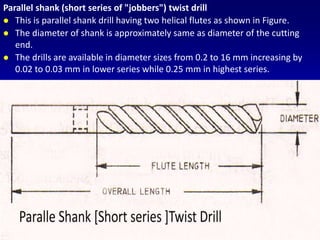
Parallel shank (short series of "jobbers") twist drill
 This is parallel shank drill having two helical flutes as shown in Figure.
 The diameter of shank is approximately same as diameter of the cutting
end.
 The drills are available in diameter sizes from 0.2 to 16 mm increasing by
0.02 to 0.03 mm in lower series while 0.25 mm in highest series.
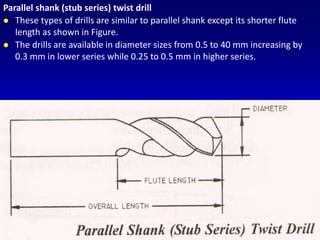
Parallel shank (stub series) twist drill
 These types of drills are similar to parallel shank except its shorter flute
length as shown in Figure.
 The drills are available in diameter sizes from 0.5 to 40 mm increasing by
0.3 mm in lower series while 0.25 to 0.5 mm in higher series.
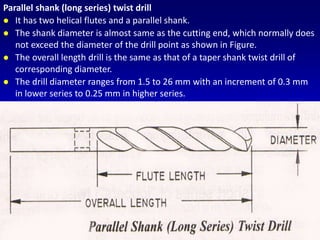
Parallel shank (long series) twist drill
 It has two helical flutes and a parallel shank.
 The shank diameter is almost same as the cutting end, which normally does
not exceed the diameter of the drill point as shown in Figure.
 The overall length drill is the same as that of a taper shank twist drill of
corresponding diameter.
 The drill diameter ranges from 1.5 to 26 mm with an increment of 0.3 mm
in lower series to 0.25 mm in higher series.
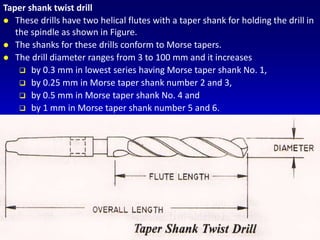
Taper shank twist drill
 These drills have two helical flutes with a taper shank for holding the drill in
the spindle as shown in Figure.
 The shanks for these drills conform to Morse tapers.
 The drill diameter ranges from 3 to 100 mm and it increases
 by 0.3 mm in lowest series having Morse taper shank No. 1,
 by 0.25 mm in Morse taper shank number 2 and 3,
 by 0.5 mm in Morse taper shank No. 4 and
 by 1 mm in Morse taper shank number 5 and 6.
Taper shank core drill (three or four fluted)
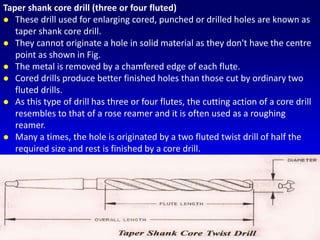
 These drill used for enlarging cored, punched or drilled holes are known as
taper shank core drill.
 They cannot originate a hole in solid material as they don't have the centre
point as shown in Fig.
 The metal is removed by a chamfered edge of each flute.
 Cored drills produce better finished holes than those cut by ordinary two
fluted drills.
 As this type of drill has three or four flutes, the cutting action of a core drill
resembles to that of a rose reamer and it is often used as a roughing
reamer.
 Many a times, the hole is originated by a two fluted twist drill of half the
required size and rest is finished by a core drill.
Oil tube drill
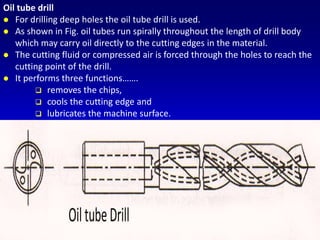
 For drilling deep holes the oil tube drill is used.
 As shown in Fig. oil tubes run spirally throughout the length of drill body
which may carry oil directly to the cutting edges in the material.
 The cutting fluid or compressed air is forced through the holes to reach the
cutting point of the drill.
 It performs three functions…….
 removes the chips,
 cools the cutting edge and
 lubricates the machine surface.
Centre drills
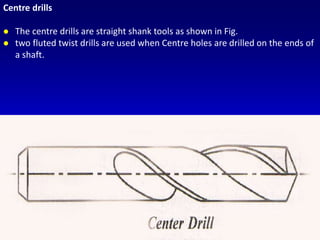
 The centre drills are straight shank tools as shown in Fig.
 two fluted twist drills are used when Centre holes are drilled on the ends of
a shaft.
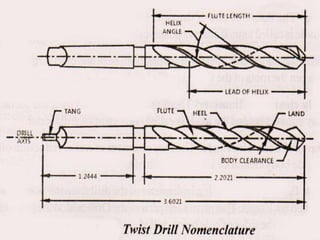
Twist Drill Nomenclature
 Different parts of twist drill, their definitions and function are known as
nomenclature.
 Axis- The imaginary longitudinal line passing through the centre of the
drill is called axis of the drill.
 Body- The part of the drill from its extreme end point to the
commencement of the neck is called body of the drill.
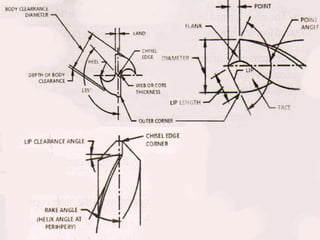
 Chisel edge- The edge formed by the intersection of the flanks is called
chisel edge. It is sometimes called dead Centre also.
 Body clearance- The diameter of lower part of the body surface is
reduced to provide clearance, this is called body clearance.
 Chisel edge corner- The corner formed by the intersection of a lip and
the chisel edge.
 Face- The inside surface of the flute adjacent to the lip is called face.
The chips impinge on it as they are cut from the work.
 Flank- The surface on the drill point which extends behind the lip to the
following flute is called face.
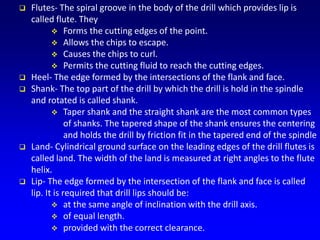
 Flutes- The spiral groove in the body of the drill which provides lip is
called flute. They
 Forms the cutting edges of the point.
 Allows the chips to escape.
 Causes the chips to curl.
 Permits the cutting fluid to reach the cutting edges.
 Heel- The edge formed by the intersections of the flank and face.
 Shank- The top part of the drill by which the drill is hold in the spindle
and rotated is called shank.
 Taper shank and the straight shank are the most common types
of shanks. The tapered shape of the shank ensures the centering
and holds the drill by friction fit in the tapered end of the spindle
 Land- Cylindrical ground surface on the leading edges of the drill flutes is
called land. The width of the land is measured at right angles to the flute
helix.
 Lip- The edge formed by the intersection of the flank and face is called
lip. It is required that drill lips should be:
 at the same angle of inclination with the drill axis.
 of equal length.
 provided with the correct clearance.
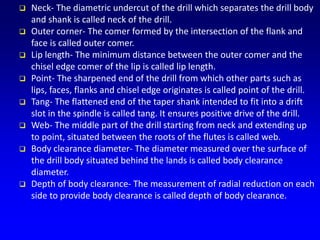
 Neck- The diametric undercut of the drill which separates the drill body
and shank is called neck of the drill.
 Outer corner- The comer formed by the intersection of the flank and
face is called outer comer.
 Lip length- The minimum distance between the outer comer and the
chisel edge comer of the lip is called lip length.
 Point- The sharpened end of the drill from which other parts such as
lips, faces, flanks and chisel edge originates is called point of the drill.
 Tang- The flattened end of the taper shank intended to fit into a drift
slot in the spindle is called tang. It ensures positive drive of the drill.
 Web- The middle part of the drill starting from neck and extending up
to point, situated between the roots of the flutes is called web.
 Body clearance diameter- The diameter measured over the surface of
the drill body situated behind the lands is called body clearance
diameter.
 Depth of body clearance- The measurement of radial reduction on each
side to provide body clearance is called depth of body clearance.
 Back Taper - The reduction in diameter of the drill from the point
toward the shank is called back taper. This permits all parts of the Drill
behind the point to clear and not rub against the sides of hole being
drilled.
 Diameter- The distance across the cylindrical lands at the outer comers
of the drill is called diameter of the drill.
 Flute length- The axial length from the start of the flutes below the neck
to extreme end of the point is called flute length.
 Lead of helix- The distance measured parallel to the drill axis between
the corresponding points on the leading edge of the flute in one
complete revolution of the flute is called lead of the helix.
 Overall length- The length between the extreme ends of the point and
the shank of the drill is called overall length of the drill.
 Right hand cutting drill- When a drill cuts while rotating in a counter
clock-wise direction viewed from the point end, the drill is known as
right hand cutting drill.
Drill Angles
 Helix angle-
 The angle formed between the leading edge of the land and a plane
having the axis of the drill is called helix angle.
 It is called rake angle also.
 The normal - value of rake angle is 30°, and it ranges up to 45°.
 Chisel edge angle-
 The obtuse angle included between the chisel edge and the lip while
viewed from the end of the drill is called chisel edge angle.
 The normal value of this angle varies between 120°-135°.
 Point angle-
 The included angle between two lips projected upon a plane parallel to
the drill axis and parallel to the two cutting lips is called point angle.
 Lip clearance angle-
 The angle formed between the flank and a plane making right angle to
the drill axis is called lip clearance angle.
 It is measured at the periphery of the drill.
 Lip clearance provides the relief to the cutting edge so that the drill can
enter in the work piece without interference.
Drill Size
According to metric system, drills are commonly manufactured from 0.2 to 100
mm, while as per British system the drills are manufactured in three different
sizes. They are:
 Number sizes-
 according to number system the drill sizes range from No. 1 to No.80.
No-80 denotes the smallest size having diameter equal to 0.0135 inch
while No-1 depicts the largest size having diameter equal to 0.228
inch.
 The diameter increases in steps of approximately 0.002 inch.
 Letter sizes-
 according to letter system the drill sizes range from A to Z.
 A represents the smallest, having diameter equal to 0.234 inch while Z
represents largest diameter equal to 0.413 inch.
Designation of Drill
 The standard manner in which the drill is specified is called designation of
the drill.
 As per Indian standard system, twist drills are designated by
 series,
 diameter,
 IS number and
 material of the drill.
 The drills are made in three types;
 normal (N),
 hard (H) and
 soft (S).
 The drill type N and point angle 118° is presumed for the drill unless
mentioned in the designation.
 The designations are decided based on the material of the work piece and
design requirements of drill depending on operations.
 Thus a parallel shank twist drill of stub series, 12 mm dia., conforming to IS
standard, made of carbon steel of type N and point angle 85 is designated
as:
 Parallel shank twist drill (Stub) 12.00-IS: 599-CS-N-85
Drill Material
 The twist drills are manufactured from following materials:
 Manufactured as one piece:
 High speed steel (HSS) or carbon steel
 Manufactured as two piece:
 Body (Cutting) part- High speed steel
 Shank- Carbon steel
 In general purpose applications HSS drills are widely employed because of
their greater cutting efficiency.
 While cemented carbide tipped tools are employed for mass production
because their longer life and ease in replacement.
REAMER
 A tool used to enlarge, finish or to give accurate dimensions to a previously
drilled hole is called reamer.
 The hole may be drilled, bored or cored.
 A reamer is a multi-edge cutter which removes relatively small amount of
material as compared to drilling.
 Commonly used reamers as per IS specification are:
 Chucking reamer with parallel or taper shank
 Machine bridge reamer
 Machine jig reamer
 Parallel hand reamer with parallel shank
 Parallel or taper shank socket hand reamer
 Shell reamer
 Taper pin hand reamer
 Expansion Reamer
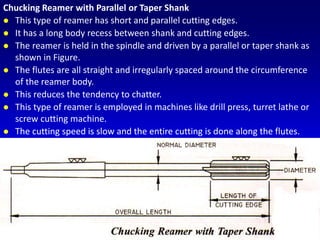
Chucking Reamer with Parallel or Taper Shank
 This type of reamer has short and parallel cutting edges.
 It has a long body recess between shank and cutting edges.
 The reamer is held in the spindle and driven by a parallel or taper shank as
shown in Figure.
 The flutes are all straight and irregularly spaced around the circumference
of the reamer body.
 This reduces the tendency to chatter.
 This type of reamer is employed in machines like drill press, turret lathe or
screw cutting machine.
 The cutting speed is slow and the entire cutting is done along the flutes.
Chucking Reamer
 In this type of reamer the beveled edges remove the material as shown in
Figure .
 The cutting edges are chamfered at an angle of 45°.
 The body is provided slight taper, the diameter is reduced towards shank to
avoid clogging of the reamer in the hole.
 This type of reamer can remove greater amount of metal than a fluted type.
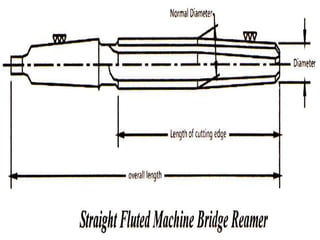
Machine Bridge Reamer
 This type of reamer has parallel cutting edges and the flutes may be straight
or helical.
 A machine bridge reamer as shown in Figure.
 It is used with portable electric or pneumatic tool for reaming in ship-
building, structural, and plate wont to make holes for riveting.
 The reamers are available from 6.4 mm to 37 mm diameter.
 Machine Jig Reamer
 This type of reamer has short and parallel cutting edges with bevel lead and
a guide between the shank and cutting edges as shown in Figure.
 The flutes are helical.
 The plain part of the body accurately locates the reamer as it fits into a
bushing in the jig.
 The reamer is held by taper shank in the spindle.
 The reamers are available in diameter range of 7 to 50 mm.
 Parallel Hand Reamer with Parallel Shank
 As shown in Figure this reamer has virtually parallel cutting edges with
taper and bevel lead.
 The cutting edges are integral with the shank of the nominal diameter
having a square end.
 The flutes are either straight or helical.
 The square tang of the hand reamer facilitates hand operation for accurate
sizing of the holes.
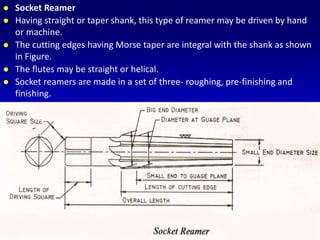
 Socket Reamer
 Having straight or taper shank, this type of reamer may be driven by hand
or machine.
 The cutting edges having Morse taper are integral with the shank as shown
in Figure.
 The flutes may be straight or helical.
 Socket reamers are made in a set of three- roughing, pre-finishing and
finishing.
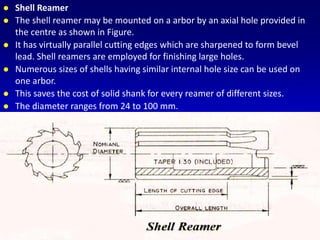
 Shell Reamer
 The shell reamer may be mounted on a arbor by an axial hole provided in
the centre as shown in Figure.
 It has virtually parallel cutting edges which are sharpened to form bevel
lead. Shell reamers are employed for finishing large holes.
 Numerous sizes of shells having similar internal hole size can be used on
one arbor.
 This saves the cost of solid shank for every reamer of different sizes.
 The diameter ranges from 24 to 100 mm.
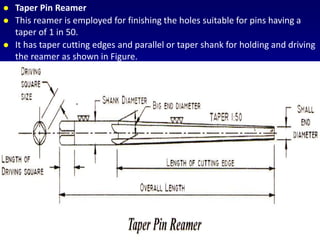
 Taper Pin Reamer
 This reamer is employed for finishing the holes suitable for pins having a
taper of 1 in 50.
 It has taper cutting edges and parallel or taper shank for holding and driving
the reamer as shown in Figure.
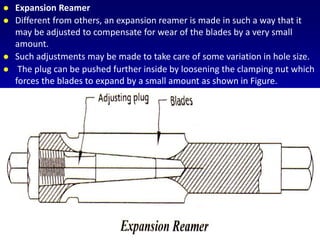
 Expansion Reamer
 Different from others, an expansion reamer is made in such a way that it
may be adjusted to compensate for wear of the blades by a very small
amount.
 Such adjustments may be made to take care of some variation in hole size.
 The plug can be pushed further inside by loosening the clamping nut which
forces the blades to expand by a small amount as shown in Figure.
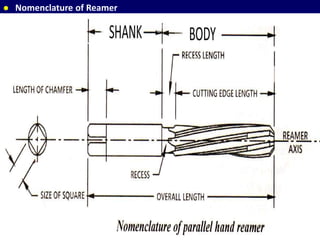
 Nomenclature of Reamer
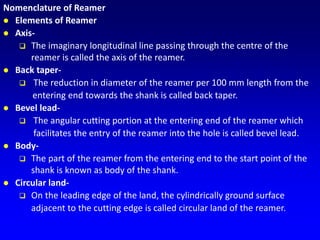
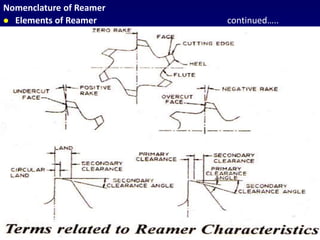
Nomenclature of Reamer
 Elements of Reamer
 Axis-
 The imaginary longitudinal line passing through the centre of the
reamer is called the axis of the reamer.
 Back taper-
 The reduction in diameter of the reamer per 100 mm length from the
entering end towards the shank is called back taper.
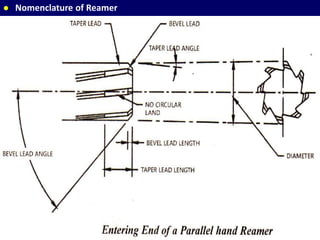
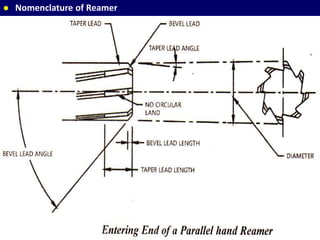
 Bevel lead-
 The angular cutting portion at the entering end of the reamer which
facilitates the entry of the reamer into the hole is called bevel lead.
 Body-
 The part of the reamer from the entering end to the start point of the
shank is known as body of the shank.
 Circular land-
 On the leading edge of the land, the cylindrically ground surface
adjacent to the cutting edge is called circular land of the reamer.
Nomenclature of Reamer
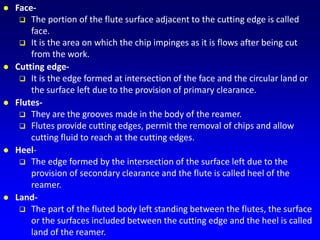
 Elements of Reamer continued…..
 Face-
 The portion of the flute surface adjacent to the cutting edge is called
face.
 It is the area on which the chip impinges as it is flows after being cut
from the work.
 Cutting edge-
 It is the edge formed at intersection of the face and the circular land or
the surface left due to the provision of primary clearance.
 Flutes-
 They are the grooves made in the body of the reamer.
 Flutes provide cutting edges, permit the removal of chips and allow
cutting fluid to reach at the cutting edges.
 Heel-
 The edge formed by the intersection of the surface left due to the
provision of secondary clearance and the flute is called heel of the
reamer.
 Land-
 The part of the fluted body left standing between the flutes, the surface
or the surfaces included between the cutting edge and the heel is called
land of the reamer.
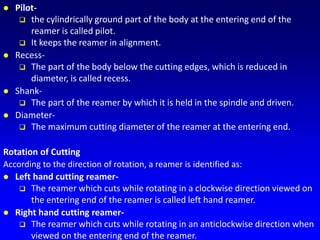
 Pilot-
 the cylindrically ground part of the body at the entering end of the
reamer is called pilot.
 It keeps the reamer in alignment.
 Recess-
 The part of the body below the cutting edges, which is reduced in
diameter, is called recess.
 Shank-
 The part of the reamer by which it is held in the spindle and driven.
 Diameter-
 The maximum cutting diameter of the reamer at the entering end.
Rotation of Cutting
According to the direction of rotation, a reamer is identified as:
 Left hand cutting reamer-
 The reamer which cuts while rotating in a clockwise direction viewed on
the entering end of the reamer is called left hand reamer.
 Right hand cutting reamer-
 The reamer which cuts while rotating in an anticlockwise direction when
viewed on the entering end of the reamer.
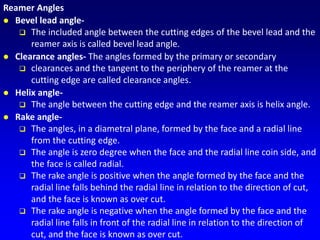
Reamer Angles
 Bevel lead angle-
 The included angle between the cutting edges of the bevel lead and the
reamer axis is called bevel lead angle.
 Clearance angles- The angles formed by the primary or secondary
 clearances and the tangent to the periphery of the reamer at the
cutting edge are called clearance angles.
 Helix angle-
 The angle between the cutting edge and the reamer axis is helix angle.
 Rake angle-
 The angles, in a diametral plane, formed by the face and a radial line
from the cutting edge.
 The angle is zero degree when the face and the radial line coin side, and
the face is called radial.
 The rake angle is positive when the angle formed by the face and the
radial line falls behind the radial line in relation to the direction of cut,
and the face is known as over cut.
 The rake angle is negative when the angle formed by the face and the
radial line falls in front of the radial line in relation to the direction of
cut, and the face is known as over cut.
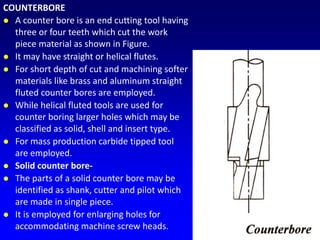
COUNTERBORE
 A counter bore is an end cutting tool having
three or four teeth which cut the work
piece material as shown in Figure.
 It may have straight or helical flutes.
 For short depth of cut and machining softer
materials like brass and aluminum straight
fluted counter bores are employed.
 While helical fluted tools are used for
counter boring larger holes which may be
classified as solid, shell and insert type.
 For mass production carbide tipped tool
are employed.
 Solid counter bore-
 The parts of a solid counter bore may be
identified as shank, cutter and pilot which
are made in single piece.
 It is employed for enlarging holes for
accommodating machine screw heads.
Inserted blade counter bore-
 is used for enlarging larger sizes of holes.
Shell counterbore-
 consists of three piece as holder, cutter and pilot.
 Different sizes of counter bore cutter may be fitted in the holder.
 Pilots are also interchangeable.
Counter sinks And Spot Faces
 Counterbores, spotfacers and countersinks are of similar construction
except for the angle of the cutting edges.
 All are end cutting tools made with two or more flutes with a right hand
helix.
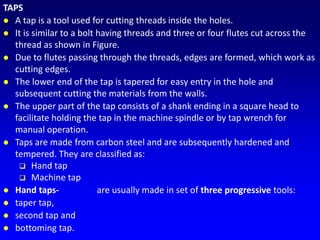
TAPS
 A tap is a tool used for cutting threads inside the holes.
 It is similar to a bolt having threads and three or four flutes cut across the
thread as shown in Figure.
 Due to flutes passing through the threads, edges are formed, which work as
cutting edges.
 The lower end of the tap is tapered for easy entry in the hole and
subsequent cutting the materials from the walls.
 The upper part of the tap consists of a shank ending in a square head to
facilitate holding the tap in the machine spindle or by tap wrench for
manual operation.
 Taps are made from carbon steel and are subsequently hardened and
tempered. They are classified as:
 Hand tap
 Machine tap
 Hand taps- are usually made in set of three progressive tools:
 taper tap,
 second tap and
 bottoming tap.
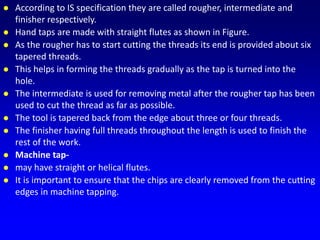
 According to IS specification they are called rougher, intermediate and
finisher respectively.
 Hand taps are made with straight flutes as shown in Figure.
 As the rougher has to start cutting the threads its end is provided about six
tapered threads.
 This helps in forming the threads gradually as the tap is turned into the
hole.
 The intermediate is used for removing metal after the rougher tap has been
used to cut the thread as far as possible.
 The tool is tapered back from the edge about three or four threads.
 The finisher having full threads throughout the length is used to finish the
rest of the work.
 Machine tap-
 may have straight or helical flutes.
 It is important to ensure that the chips are clearly removed from the cutting
edges in machine tapping.
Tap Nomenclature
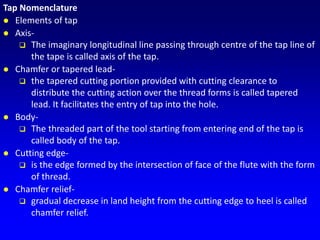
 Elements of tap
 Axis-
 The imaginary longitudinal line passing through centre of the tap line of
the tape is called axis of the tap.
 Chamfer or tapered lead-
 the tapered cutting portion provided with cutting clearance to
distribute the cutting action over the thread forms is called tapered
lead. It facilitates the entry of tap into the hole.
 Body-
 The threaded part of the tool starting from entering end of the tap is
called body of the tap.
 Cutting edge-
 is the edge formed by the intersection of face of the flute with the form
of thread.
 Chamfer relief-
 gradual decrease in land height from the cutting edge to heel is called
chamfer relief.
Tap Nomenclature
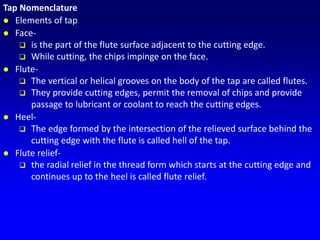
 Elements of tap
 Face-
 is the part of the flute surface adjacent to the cutting edge.
 While cutting, the chips impinge on the face.
 Flute-
 The vertical or helical grooves on the body of the tap are called flutes.
 They provide cutting edges, permit the removal of chips and provide
passage to lubricant or coolant to reach the cutting edges.
 Heel-
 The edge formed by the intersection of the relieved surface behind the
cutting edge with the flute is called hell of the tap.
 Flute relief-
 the radial relief in the thread form which starts at the cutting edge and
continues up to the heel is called flute relief.
Tap Nomenclature
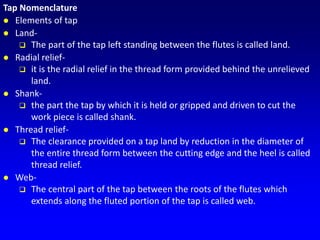
 Elements of tap
 Land-
 The part of the tap left standing between the flutes is called land.
 Radial relief-
 it is the radial relief in the thread form provided behind the unrelieved
land.
 Shank-
 the part the tap by which it is held or gripped and driven to cut the
work piece is called shank.
 Thread relief-
 The clearance provided on a tap land by reduction in the diameter of
the entire thread form between the cutting edge and the heel is called
thread relief.
 Web-
 The central part of the tap between the roots of the flutes which
extends along the fluted portion of the tap is called web.
Tap Nomenclature
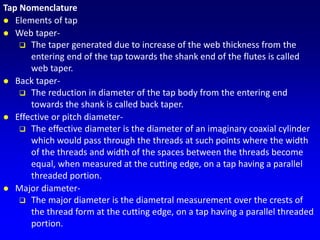
 Elements of tap
 Web taper-
 The taper generated due to increase of the web thickness from the
entering end of the tap towards the shank end of the flutes is called
web taper.
 Back taper-
 The reduction in diameter of the tap body from the entering end
towards the shank is called back taper.
 Effective or pitch diameter-
 The effective diameter is the diameter of an imaginary coaxial cylinder
which would pass through the threads at such points where the width
of the threads and width of the spaces between the threads become
equal, when measured at the cutting edge, on a tap having a parallel
threaded portion.
 Major diameter-
 The major diameter is the diametral measurement over the crests of
the thread form at the cutting edge, on a tap having a parallel threaded
portion.
Tap Nomenclature
 Elements of tap
 Overall length:
 the axial length between the extreme ends of tap is called overall
length.
 Left hand tap-
 A tap which cuts the material while rotating in a clockwise direction
when viewed from the entering end of the tap is called left hand tap.
 Right hand tap-
 A tap which cuts the material while rotating in an anticlockwise
direction when viewed from the entering end of the tap is called right
hand tap.
Tap Nomenclature
 Elements of tap
Angles
 Chamfer angle-
 The angle formed between the cutting edges of the taper lead and the
tap axis is called chamfer angle.
 Flank angle-
 The included angle between the flanks of the thread, measured in an
axial plane is called flank angle.
 Radial rake angle-
 The angle formed in a diametral plane between the face and a radial
line from the cutting edge at the crest of the thread form is called rake
angle.
Tap Nomenclature
 Elements of tap
 Rake angle can be –
 Negative rake-
 If the angle formed by the face and radial line falls in front of the
radial line in relation to the direction of cut, the radial rake angle is
negative and the face in known as overcut.
 Zero rake-
 If the face and the radial line coin-side, the angle is zero, the face is
called radial.
 Positive rake-
 If the angle formed by the face and the radial line falls behind the
radial line in relation to the direction of cut, then the radial angle is
positive and the face is known as undercut.
 Relief angle-
 The equivalent angle between a relieved land surface and the cutting
diameter circle of the tap thread form is called relief angle
Exercise
 State the working principle of a drilling machine.
 Explain principal parts of the drilling machine and sketch the mechanism of
a drilling machine.
 Give the classification of drilling machines.
 How will you specify a drilling machine?
 What operations can be done on a drilling machine? Discuss them with
diagrams.
 With the help of a line diagram, describe the construction of radial drilling
machine.
 List the devices commonly used for holding the work on a drilling machine,
and describe any three.
 Define cutting speed, feed and machining time for drilling.
 Sketch a twist drill and name its different parts.
 What is boring? Sketch a boring tool.
 What is the function of flutes on a twist drill bit? Why are straight flute drills
used for non ferrous materials and metal?
 Draw suitable figure for a drill bit showing:
 point
 lip clearance
 point angle
 Flute
 margin and
 body clearance
 Write short notes on following:
 Drilling
 Boring
 Reaming
 Tapping
 Counter boring
 Counter sinking
 Explain various types of operations performed on a drilling machine by neat
sketches.
 Define the following terms used in drilling operation.
 Cutting speed
 Feed
Thank
you

3. drilling machine

  • 1.
    3 Drilling Machine Introduction  Types of Drilling Machine  Size and Specification of Drilling Machines  Tool Holding Devices  Work Holding Devices  Drilling Machine Operations  Cutting Parameters  Drilling Machine Tools  Twist Drill Nomenclature  Reamer  Counter bore  Taps Prof.MAYUR S. MODI ASSISTANT PROFESSOR, MED,SSASIT,SURAT
  • 2.
    INTRODUCTION  The drillingmachine consists of a spindle which imparts rotary motion to the drill tool, a table to support and rest the work piece and a feed mechanism to feed the tool in the work. The hole is generated by rotation of cutting edge of the drill tool inside of the work.  Drilling is an operation of making a circular hole by removing a volume of metal from the job by cutting tool called drill.  A drill is a rotary end-cutting tool with one or more cutting lips and usually one or more flutes for the passage of chips out from the work and introducing the cutting fluid.  Besides drilling round holes, many other operations can also be performed on the drilling machine such as counter boring, countersinking, honing, reaming, lapping, sanding etc.
  • 3.
    TYPES OF DRILLINGMACHINE  Portable drilling machine  Sensitive drilling machine- (a) Bench mounting type (b) Floor mounting type  Upright drilling machine- (a) Round column type (b) Box column type  Radial drilling machine- (a) Plain (b) Semi-universal (c) Universal  Gang drilling machine  Multiple spindle drilling machine  Automatic drilling machine  Deep hole drilling machine- (a) Vertical (b) Horizontal  Vertical Turret Type Drilling Machines
  • 4.
    Portable Drilling Machine A portable drilling machine is a small compact in construction and used for drilling holes in work pieces in any position, which cannot be drilled by a standard drilling machine.  It may be used for drilling small diameter holes in large castings or weld- ments at any location, without moving bulky work pieces.  Portable drilling machines are fitted with small electric motors, which may be driven by both A.C. and D.C. power supply or by air pressure.  These drilling machines operate at fairly high speeds and accommodate drills up to 12 mm in diameter.
  • 5.
    Sensitive Drilling Machine It is a small bench type machine used for drilling small holes in light jobs at high speed.  sensitive drilling machine comprises of a horizontal table, a vertical column, a head which supports the motor and driving mechanism, and a vertical spindle which drives and rotates the drill.  The work piece is mounted on the table and drill is fed into the work by hand control. High rotating speed of the drill and hand feed are required for drilling small holes.  As the operator can sense the drilling action in the work piece at any instant, it is called sensitive drilling machine.  This helps operator to release pressure in case the drilling operation is not performed in normal ways and prevent damage to work and drill bit.  Typically the smallest diameter which may be drilled is 0.35 mm and largest diameter is 15.5 mm.  Classification Based on the mounting of the base…….. – Bench mounted drilling machine, – Floor mounted drilling machine.
  • 7.
    Upright Drilling Machine This machine is larger and heavier than a sensitive drilling machine.  It is designed for handling medium sized work pieces and is provided with power feed arrangement.  The spindle is provided with number of speeds and feeds for drilling different sizes of holes in different types of works.  The feed clutch is automatically controlled so that spindle is disengaged when it reaches its upper and lower limit of travel.  It also has free engagement of taps through clutch and rapid reversing mechanism for quick withdrawal of drill.  Upright drilling machines are available in various sizes and drilling capacities, ranging up to 75 mm diameter drills.  The table of the machine also has different types of adjustments to accommodate different shapes of work.  Based on the construction, Upright drilling machines Classification – Round column type or pillar type drilling machine – Box column type
  • 8.
     The roundcolumn type or pillar type upright drilling machine consists of a round column  whereas the box type drilling machine has box column section. The other constructional features of both are same.  Box column machines possess more machine strength and rigidity as compared to those having round section column.
  • 9.
    Upright drilling machineparts Different parts of an upright drilling machine  Base  Column  Table  Head  Spindle, quill and drill head assembly  Spindle drive and feed mechanism Base  It is the part of the machine on which the vertical column is mounted.  In the belt driven machine the countershaft consisting of a fast and a loose pulley and a cone is fitted to the base of the machine.  The base in round column type machine is accurately machined and has T- slots on it to hold large work pieces.
  • 10.
    Column  Column isa vertical member of which supports the table and the head and contains all the driving mechanism.  The column should be sufficiently rigid to take up entire cutting pressure of the drill during operation.  The column may be made of box or round section. Box column is a more rigid construction.  In some of the round column machines, rack teeth are cut on the face of the column for vertical movement of the arm and the table.  Or the rake is fitted on the column and pinion is housed within the arm.  The movement is given by rotating the table elevating handle which causes a pinion to rotate on the rack teeth.  In box column type, the front face of the column is accurately machined to form guide ways on which the table can slide up and down for vertical adjustment.
  • 11.
    Table  Table ismounted on the column and is provided with T-slots for clamping the work pieces directly on its face.  The shape of the table may be round or rectangular.  For centering the work below the spindle in case of a pillar drilling machine, the three motions of the table may be adjusted- – vertical movement, – radial/ rotational movement about the column – circular movement about its own axis.  Once adjusted the table and arm are clamped in position. Head  Head is mounted on the column top and houses the driving and feeding mechanisms for the spindle.  In some of the machines the drill head may be adjusted up or down for accommodating different heights of work over and above table adjustment.  In lighter machines, the driving motor is mounted at the rear end of the head to counterbalance the weight of the drill spindle.
  • 12.
    Spindle and drillhead assembly  A drill spindle assembly, the spindle is a vertical shaft which holds the drill.  It is given the motion through bevel gears from top shaft.  The spindle having a long key way is connected with bevel gear by a sliding key.  This arrangement makes it possible to connect spindle with the top shaft whether the spindle is raised or lowered for feeding the drill into the work.
  • 13.
     The spindlerotates within a non-rotating sleeve which is known as quill.  Rack teeth are cut on the outer surface of the sleeve, or a block having rack teeth cut on it is bolted on vertical face of the sleeve.  By rotating a pinion which meshes with the rack the sleeve may be moved vertically up or down.  This movement results in vertical movement of the spindle.  The downward movement of the spindle is affected by rotating the pinion which causes the quill to move downward exerting pressure on the spindle through a thrust bearing and washer.  The spindle is moved upward by the upward pressure exerted by the quill acting against a nut attached to the spindle through the thrust bearing.  At the end of the taper hole of the sleeve a slot is provided which may accommodate the tang of taper shank of the drill bit. This ensures a positive drive
  • 14.
    Spindle drive mechanism Thismechanism is meant for achieving multiple speeds of spindle for drilling holes of different sizes in different materials.  step cone pulley drive  step cone pulley drive with back gears  Gearing Step cone pulley drive  A spindle driving mechanism using a step cone pulley is shown  From an overhead line shaft the motion is transmitted to the countershaft mounted on the base of drilling machine.  By operating foot pedal the countershaft is started or stopped by shifting the belt from loose pulley to fast pulley and vice versa.  The power is transmitted to step cone pulley mounted on the head from the countershaft step cone pulley through the belt which runs the overhead shaft.  From overhead shaft, the power is further transmitted to the drill spindle through bevel gears.
  • 15.
     The speedof the spindle may be changed by shifting the belt on different steps of the cone pulley. The number of spindle speeds available depends upon the number of steps in the cone pulley. Step cone pulley drive with one or more back gear  In order to obtain larger number of spindle speeds, in addition to the step cone pulley, back gears are provided in the machine. Spindle drive by gearing  Modern heavy duty drilling machines are powered by individual motor mounted on the machine frame. It is possible to obtain the multiple speeds by sliding gear or sliding clutch mechanism or by the combination of them. Feed mechanism  The feed is affected by the vertical movement of the drill spindle into the work.  It can be controlled manually or by power. For hand feed following two methods are employed: – Quick traverse hand feed – Sensitive hand feed
  • 16.
     The Quicktraverse hand feed is used to move the cutting tool rapidly to the hole location or for withdrawing the drill at the completion of operation.  The sensitive hand feed is applied for trial cut and for drilling small holes.  For making larger diameter holes the automatic feed is applied as the cutting pressure required is substantially great.  Automatic feed mechanism is shown in next slide  Through the worm gearing the automatic feed motion is derived to a six speed feed box.  Feed are varied by the lever which operates a sliding key mechanism.  Inside the feed box, six gears mounted on worm gear shaft are constantly in mesh with another six gears mounted on the driven shaft.  Gears are keyed to the driven shaft so that they rotate with it.  Gears on the worm gear shaft are all free to rotate, but at a time any one of them maybe keyed by a sliding key to the shaft.  When the sliding key is engaged to the first gear, the motion is transmitted to the driven shaft through the corresponding gear keyed.
  • 18.
     Rest ofthe gears on the worm shaft revolves freely with their mating gears on the driven shaft.  Thus by sliding the key to engage with six different gears on the worm gear shaft six different speeds of driven shaft are obtained.  Two mating bevel gears and the clutch transmit the motion of the driven shaft to the shaft. The worm mounted on the shaft operates the worm gear mounted on a shaft.  A small pinion fitted at the end of this shaft meshes with the rack which is bolted to the quill. The rotation of the pinion causes the quill to move up and down giving spindle feed.  The clutch is disconnected to apply the sensitive hand feed. The sensitive feed hand wheel is attached to the rear end of the worm shaft. Rotation of the hand wheel causes the worm and worm gear to rotate. Due to this a slow and sensitive feed is obtained.  To obtained quick hand feed, the hand wheel is rotated and clutch is operated which is mounted on the worm gear shaft. One turn of the hand wheel causes one complete rotation of the pinion giving quick hand feed movement to the spindle.
  • 19.
    Radial Drilling Machine This is most versatile and largest of all drilling machines having single spindle meant for accommodating large components.  Radial drilling machine consists of a heavy, round vertical column with a radial arm carrying the drill head.  Arm can be vertically raised or lowered on the column.  It can also be radially adjusted around the column in any position over the work to accommodate different sizes and shapes of the work.  It can be locked in any position once set in a particular position.  The drill head equipped with rotational and feed mechanism for the drill is mounted on radial arm moves on horizontal guide-ways. It can be clamped at any desired position.  These three adjustments of arm and drilling head permit the operator to locate the drill quickly over any point on the work.  The movements may be either manual or power driven. The table of radial drilling machine may also be rotated through 360 deg.
  • 20.
     Procedure todrill a hole:  The arm is raised or lowered as required and adjusted radially.  The drill head is positioned and locked on the arm and the arm is also locked in the set position on column.  Speed and feed of spindle are adjusted according to work requirement and depth is set to reach the work.  The drill is then lowered to drill hole and is withdrawn as required depth of hole is drilled.  The locks are then released and arm and head are set to a new position for drilling another hole.  Powerful drive motors are geared directly into the head of the machine and a wide range of power feeds are available as well as sensitive and geared manual feeds.  The radial drilling machine is used primarily for drilling medium to large and heavy work pieces.
  • 21.
    Classification – Based onthe different movements of horizontal arm, table & drill head  Plain radial drilling machine: – This type of machine allows vertical movement of the drilling arm on the column, horizontal movement of the drill head along the arm, and circular/ radial movement of the arm about the vertical axis of column.  Semi universal drilling machine: – One additional movement is allowed by this type of machine over and above three movements possible in plain radial drilling machine. – This is, swing of the drill head about a horizontal axis perpendicular to the arm. Due to this fourth movement, it possible to drill a hole at an angle to the horizontal plane.  Universal drilling machine: – An additional rotary movement of the arm holding the drill head about a horizontal axis is provided in universal drilling machine. – Using this fifth movement, it possible to drill a hole at any angle on the work piece. – This makes the machine highly flexible and reduced the need for changing the work piece position.
  • 23.
    Radial Drilling machineParts  Base  Radial arm  Column  Drill head  Spindale speed and feed mechanism  Base: – A heavy rectangular casting serves the purpose as the base of a radial drilling machine. – It supports a column on its one end and holds the work table at the other end. – Sometimes T-slots are provided on the base for clamping the work, when it serves as a table. – In some machines two or more bases are provided. – When drilling is carried out on a job fixed on one of the bases, another job may be set up on the other for a continuous production. – This reduces the idle time of the machine.
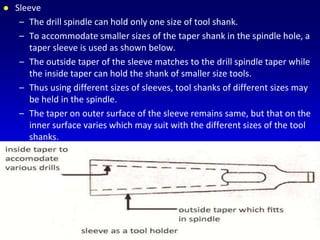
  • 24.
     Column: – isa cylindrical casting mounted vertically at one end of the base. – The radial arm is supported by the column, which may slide up or down on the face of the column. – This vertical movement of the arm is imparted by an electric motor mounted on top of the column by rotation of a screw passing thought a nut attached to the arm.  Radial arm: – As mentioned above, the radial arm is mounted on the column. – The arm is made of heavy casting having its length equal to the size of the base. – Its front face is accurately machined to provide guide ways to facilitate the sliding movement of drill head. – The radial swing of the arm is possible around the column. A separate motor is provided to control this motion in some machines.
  • 25.
     Drilling head: –is mounted on the radial arm and drives the drill spindle. – The mechanism and controls for driving the drill at different speeds and feeds are housed by the drill head. – The head can slide on the guide ways of the arm to locate the drill position on the work piece. – Once the spindle has been properly positioned the drill head is clamped on the radial arm.  Spindle drive and feed mechanism: – Spindle is either driven by a constant speed motor which is located at the extreme end of the radial arm. – A horizontal spindle running through the arm is connected to this motor, which transmits the motion to the drill head through bevel gears. – Speed of the spindle may be varied by gear trains housed within the drill head. – Another train of gearing is provided to obtain different feeds of the spindle. – In other type of machines, different speeds and the feeds of the spindle are obtained by a vertical motor fitted directly on the drill head which drives a gear box.
  • 26.
     Multiple-Spindle DrillingMachine  This machine is employed in case where a number of holes are to be drilled simultaneously in the work pieces in a large lot.  It comprises of several drill bits mounted on spindles which are fed into the work simultaneously.  The table is raised or lowered to achieve feeding motion.  It is also possible to feed the drills by lowering the drill heads.  The centre distance between spindles can be adjusted as required by different jobs within the capacity of drill heads.  Generally these machines are of vertical type.  The drilling operations consist of rapid advance of drills to work, proper feed and rapid return of drills to original position.
  • 27.
     Gang DrillingMachine – Gang drilling machine comprises of a number of single spindle drilling machine columns placed side by side. – They are mounted on a common base and have a common worktable. – In a typical machine six or four spindles are arranged side by side and speed and depth of each of them may be set independently. – The spindles can run either simultaneously or in sequence. – It is possible to perform different operations on the job in a sequence by shifting the work piece from one location to the other on the worktable. – Hence, this machine is normally used for mass production work. – Quick movement of work pieces from one spindle to another is important feature of this machine. – This machine finds application in straight line, multiple holes drilling in castings, plates and steel sections.
  • 28.
     Automatic DrillingMachine – These are used for very fast production work. – They perform a series of machining operations at successive units. – The work is transferred from one unit to another automatically. – These machines comprise of a number of unit heads with single or multiple spindles in horizontal, vertical or angular positions in various combination on a special type of base. – Different operations at various units are facilitated by indexing tables and work holding fixtures.
  • 29.
     Deep HoleDrilling Machine – Deep hole drilling machines and drills are used for making holes where the length of the holes exceeds three times the drill size. – Such type of job requirement arises for making holes in rifle barrels, long spindles, crank shafts, connecting rods, long shafts and certain oil- well drilling equipments. – The machine is operated at high speed and low feed. – A large quantity of lubricant is pumped to the cutting points to facilitate chip removal and cooling the cutting edges of drill bit. – Generally the work is rotated while drill is fed into the work. – In some machines both drill and work are rotated for accurate location. A long job is supported at several points through the length, which prevents its deflection while drilling. – The machine may be vertical or horizontal type with single or multiple spindles.
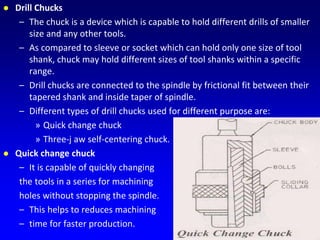
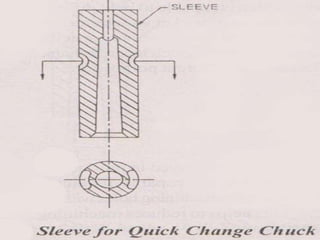
  • 30.
     Vertical TurretType Drilling Machines – This type of machines work in similar manner as turret lathe. – A turret provided on the machine houses different tools such as drill, reamer, counter boring tool, spot-face, tap etc. in a required sequence. – Various spindles on the turret can be manually or automatically indexed. – The spindles can be driven only when they come to drilling position.
  • 31.
     Size andspecification of drilling machines – Portable drilling machine is specified by maximum diameter of drill that can be held in the spindle. – Sensitive and upright drilling machines are specified by the diameter of the largest piece that can be centered under the spindle. – Radial drilling machine is specified by the length of the arm and column diameter. – Multiple spindle drilling machine is specified by the drilling area, the size and number of holes that can be drilled by a machine.
  • 32.
    General specification ofdrilling machines  Maximum size of drill that can be accommodate operated by machine  Table diameter  Maximum spindle travel  Number of spindle speeds and feeds  Morse taper number of the spindle  Power input  Floor space required  Weight of the machine.
  • 33.
     Tool holdingdevices – Direct fitting in the spindle – Sleeves – Chucks  Directly fitting tool in the spindle – A spindle used in almost all general purpose drilling machines is a cylindrical component having a hole bored inside to a standard taper. – This taper hole receives the taper shank of the tool. – Normally Morse standard taper is used in drill spindle which is approximately 1:20. – For fitting the tool in the hole, the shank is forced into the tapered hole and tool is gripped by friction between outer surface of shank and inner surface of spindle. – Because of the frictional grip the tool rotates with the spindle. – In addition to this, a positive drive is established by fitting of the tang or tongue of the tool into a slot at the end of the taper hole. – This prevents slippage of shank in the spindle. – The drill tool may be withdrawn by pressing a taper wedge known as drift into the slotted hole of the spindle.
  • 35.
     Sleeve – Thedrill spindle can hold only one size of tool shank. – To accommodate smaller sizes of the taper shank in the spindle hole, a taper sleeve is used as shown below. – The outside taper of the sleeve matches to the drill spindle taper while the inside taper can hold the shank of smaller size tools. – Thus using different sizes of sleeves, tool shanks of different sizes may be held in the spindle. – The taper on outer surface of the sleeve remains same, but that on the inner surface varies which may suit with the different sizes of the tool shanks.
  • 36.
     Drill Chucks –The chuck is a device which is capable to hold different drills of smaller size and any other tools. – As compared to sleeve or socket which can hold only one size of tool shank, chuck may hold different sizes of tool shanks within a specific range. – Drill chucks are connected to the spindle by frictional fit between their tapered shank and inside taper of spindle. – Different types of drill chucks used for different purpose are: » Quick change chuck » Three-j aw self-centering chuck.  Quick change chuck – It is capable of quickly changing the tools in a series for machining holes without stopping the spindle. – This helps to reduces machining – time for faster production.
  • 37.
     Quick changechuck consists of – body having taper shank which is fitted into the spindle. It houses – a sleeve which has a taper hole for holding the tool shank, and – a sliding collar, fitted loosely on the rotating body.  Next slide shows the sectional view of the sleeve.  The sleeve holding the tool is fitted inside the body.  Holes are provided on inner wall of the body of the chuck in which balls are placed.  On the corresponding surface of the sleeve, recesses are cut to retain the balls when sleeve fits inside of the body.  By raising the collar the sleeve with its tool may be inserted and fitted in the chuck body.  At this time the sleeve causes the balls to come out from recess.  To lock the sleeve and the tool the collar is lowered.  At this time balls are forced into the recess and the sleeve is locked by the balls with the body.  The driving motion is transmitted to the tool from chuck body through the balls.  The sleeve can be removed out from the chuck by lifting the collar.
  • 39.
     Three-jaw self-centeringchuck  Figure shows a three-jaw self-centering drill chuck.  It is used for holding tools having straight shanks.  It comprises of – chuck body having three slots cut at 120° apart – three jaws having threads cut on the outer edge – a ring nut and – a sleeve.
  • 40.
     The chuckbody houses three jaws, in such a way that the threaded edge of the jaws meshes with the threads cut on ring's internal diameter.  The ring nut is attached to the sleeve.  Bevel teeth are cut all round the lower edge of sleeve body.  Hence, using a key having bevel teeth cut on its face,  the sleeve may be rotated by meshing their teeth. The rotation of the sleeve causes the ring nut to rotate in a fixed position and all the three jaws close or open by same amount from the centre holding or releasing the shank of a tool.
  • 41.
     Work holdingDevices  It is very much essential to clamp the work securely on the table of the drilling machine before starting any machining operation.  As the drill exerts very high torque while rotating, if the work is not firmly fixed it may start rotating with the tool and damage the machine and may injure the operator.  The commonly used work holding devices are: – T-bolt and clamps – Drill Press vise – Step block – Drill Jigs  T- bolts and clamps  T-slots are provided on the drilling machine table in which T-bolts fitted.  Different views of T-bolts are shown in Next slide
  • 43.
     Plain slotclamp  This type of clamps is straps made from mild steel flat bars.  They have a central slot through which T-bolt is passed and fixed by a nut.  This is general purpose clamps. Figure shows use of a plain slot clamp.
  • 44.
    Goose neck clamp The clamp is used for holding work of different height.  It allows using smaller size of T-bolts along with packing pieces to firmly clamp the work as shown in Figure,  Due to typical shape of the clamp, it is possible to use smaller size of t-bolt which clamps work more rigidly.  The clamps are usually made by forging and hence are strong enough to withstand loads.
  • 45.
     U-clamp  Mostsimple in construction and use, U-clams are very useful for quick positioning of the work as shown in Figure.  It can be removed without removing the nut.
  • 46.
     Finger Clamp It is similar to goose neck clamp except that this type of clamps have a round or flat extension  which may be fitted in a hole or a slot inside of the work piece for clamping.  A finger clamp is shown in Figure.
  • 47.
     Drill pressvise  Drill press vise is one of the most commonly used devised for holding small and regular shaped work pieces.  The work is clamped between a fixed jaw and a movable jaw of the vise.  For holding parts of cylindrical, hexagonal or irregular shapes extra slip jaws are supplied.  The screw of the vise rotates in a fixed nut in the movable jaw.  While clamping the work in a vise, parallel blocks are placed under the work so that the drill may completely pass through the work without damaging the vise table.
  • 48.
    Step blocks  Forholding the work directly on the table the step blocks are used in combination with T-bolts and clams.  It provides support for the other end of the clamp.  To clamp work pieces of different heights the different steps of the step block are used to level the plain slot clamp as shown in Figure.  The step blocks are made of mild steel.
  • 49.
    Drill jigs  Itis required to clamp and unclamp the components quickly in mass production.  The drill jigs are used for this purpose.  It can hold the work securely, locate the work, and guide the tool at any desired position.  A special jig is required for each work where large number of components is to be manufactured.  A jig facilitates in drilling holes at the identical location on every part and eliminates the requirement of marking.  As shown in Figure of drill jig, the work is clamed below the jig and the holes are located.  The drill is guided by the bushing. When the drill is completed, the second work is clamped below the jig and the process is repeated.
  • 51.
    Drill jigs  Itis required to clamp and unclamp the components quickly in mass production.  The drill jigs are used for this purpose.  It can hold the work securely, locate the work, and guide the tool at any desired position.  A special jig is required for each work where large number of components is to be manufactured.  A jig facilitates in drilling holes at the identical location on every part and eliminates the requirement of marking.  As shown in Figure of drill jig, the work is clamed below the jig and the holes are located.  The drill is guided by the bushing. When the drill is completed, the second work is clamped below the jig and the process is repeated.
  • 52.
    Drill jigs  Itis required to clamp and unclamp the components quickly in mass production.  The drill jigs are used for this purpose.  It can hold the work securely, locate the work, and guide the tool at any desired position.  A special jig is required for each work where large number of components is to be manufactured.  A jig facilitates in drilling holes at the identical location on every part and eliminates the requirement of marking.  As shown in Figure of drill jig, the work is clamed below the jig and the holes are located.  The drill is guided by the bushing. When the drill is completed, the second work is clamped below the jig and the process is repeated.
  • 53.
    Drilling machine operations Drilling  Boring  Countersinking  Tapping  Grinding  Reaming  Counter boring  Spot facing  Lapping  Trepanning Drilling  It is the operation of producing a cylindrical hole by removing metal by rotating edge of a cutting tool called the drill.  The drilling is one of the simplest methods of producing a hole.
  • 54.
     Before startingthe operation of drilling the centre of the hole is exactly located on the work surface by drawing two lines perpendicular to each other.  Then an indention is made at that point using a centre punch.  The drill point is pressed at this centre to produce the required hole.  Drilling does not produce an accurate hole and the location is also not exact.  The size of the hole produced by a given drill bit is always slightly oversize than the drill size and the internal surface of the hole so generated becomes rough due to the vibration of the spindle and the drill.
  • 55.
    Reaming  It isan operation of accurately sizing and finishing a hole already drilled as shown in Fig.  As a small amount of metal is removed from the hole sides while finishing the hole to bring it to the accurate size, the hole is drilled slightly undersize, i.e. smaller in size.  For reaming operation the speed of the spindle is reduced to half that of drilling and automatic feed may be employed.  The tool used for reaming is known as the reamer.  It has multiple cutting edges. Reamer cannot originate a hole.  Following the path of the hole already drilled it and removes a very small amount of metal.  As it can not generate a hole, it can not correct a hole location.  The material removed by this process is around 0.375 mm and for accurate work this should not exceed 0.125 mm
  • 56.
    Boring  Boring isan operation to enlarge the hole already drilled to its final dimension  When suitable size of drill is not available for making a hole or the size is larger than largest drill available, a hole is to be enlarged by means of an adjustable cutting tool having only one cutting edge.  To correct a hole accurately and to bring it to the required size.  To finish the internal surface of a hole already produced in casting.  To correct the roundness of the hole.  To correct the location of the hole as the boring tool follows an independent path in the hole.  A boring bar holding the cutter is fitted by frictional fit between spindle socket and taper shank of the boring bar.  The job is drilled slightly undersize for perfectly finishing a hole.  In precision machine, the accuracy is as high as ± 0.00125 mm.  The operation is comparatively slow process than reaming and it requires several passes of the tool.
  • 58.
    Counter boring  Itis the operation of cylindrically enlarging the end of the hole as shown in Figure.  Due to partial enlargement the enlarged hole forms a square shoulder with the original hole which is necessary in some cases to accommodate the heads of bolts, studs and pins.  The tool used for counter boring is called a counter bore.  The counter bores are having either straight or tapered shank to fit in the drill spindle.  The cutting edges are provided with straight or spiral teeth.  The straight front part of tool is known as pilot which extends beyond the end of the cutting edges.  The pilot fits into the small diameter hole having running clearance and guide the tool and maintains the alignment of the tool.  These pilots may be interchanged for enlarging different sizes of holes.  An accuracy of about ± 0.050 mm may be achieved by counter boring operation.  The cutting speed for counter boring is 25% less than that of drilling operation.
  • 60.
    Countersinking  It isan operation of enlarging the end of the hole in a cone shape to provide a recess for flat head screw or countersunk rivet fitted into hole.  The operation is shown in Figure.  The tool used for countersinking is called a countersink.  Standard sized countersinks have 60°. 82° or 90° included angle and the cutting edges of the tool are formed as the conical surface.  The operation is carried out at the speed 25% less than that of drilling.
  • 61.
    Spot facing  Itis the operation of smoothing and squaring the surface around a hole for the seat of a nut or the head of a screw.  Spot facing is shown in Figure  It is carried out using a counter bore or a special spot facing tool.
  • 62.
    Tapping  It isthe operation of cutting internal threads in a hole by means of a cutting tool called a tap.  Tapping operation is shown in Figure.  In a drilling machine tapping operation may be performed by hand or by machine.  A tap is a cutting tool similar to a bolt with accurate threads cut on it.  The hardened and ground threads act as cutting edge.  When the tap is screwed into the hole it removes metal and cuts internal threads which will fit into external threads of a bolt or screw of the same size.
  • 63.
    Tapping  It isthe operation of cutting internal threads in a hole by means of a cutting tool called a tap.  Tapping operation is shown in Figure.  In a drilling machine tapping operation may be performed by hand or by machine.  A tap is a cutting tool similar to a bolt with accurate threads cut on it.  The hardened and ground threads act as cutting edge.  When the tap is screwed into the hole it removes metal and cuts internal threads which will fit into external threads of a bolt or screw of the same size.
  • 64.
    Size of theTap Drill  The size of the tap is expressed as the outside diameter of its threads.  Hence, size of the hole in which the threads are to be cut must be smaller than the tap by twice the depth of the thread.  The amount to be subtracted from the tap diameter depends on the shape of the thread, e.g. B.S.W., B.S.F., Indian Standard Thread (IS) etc.  Thus, the tap drill size may be derived from the following formula:  D = T - 2d  Where,  D= diameter of tap drill size,  T= diameter of tap or bolt to be used and d- depth of thread.  Tap drill size can also be determined by applying the 'thumb rule', which is good enough for all practical purposes.  Tap drill size = Outside diameter x 0.8 For example:  Tap drill size = 12x0.8 = 9.6 mm  Nearest drill size = 9.6 mm  For commercial purpose a tapped thread need not be full depth thread. Tapping a thread by 75% of is full depth gives a workable result.
  • 65.
    Lapping  It isthe operation of sizing and finishing a small diameter hole already hardened, using a lapping tool by removing a very small amount of material by.  The lapping tool is known as lap.  There are different types of lapping tools.  Generally used laps are copper head laps.  It fits in the hole and removes metal as it is moved up and down while it revolves. Grinding  It is an operation to finely finish the surface or to correct out of roundness of the hole.  It may be performed in drilling machine.  The grinding wheel is inserted in the spindle and made to revolve as well as moved up and down.  Out of many different types available, a suitable grinding wheel may be selected for surface grinding operation.  Very high accuracy of the order of ±0.0025 mm may be achieved in grinding operation.
  • 66.
    Trepanning  It isan operation of producing a hole by removing metal along the circumference of a hollow cutting tool.  Trepanning operation is shown in Figure.  It is performed for production of large holes.  The tool looks like a hollow tube, the walls acting as cutting edges.  There are cutting edges at one end and solid shank at the other which fits into the drill spindle.  Due to specific shape of the tool a large portion of the material is saved as fewer and smaller chips are removed while the hole is produced.  The tool may be operated at higher speeds as the variation in diameter of the tool is limited by the narrow cutting edge.  This is one of the efficient methods of producing a hole.
  • 67.
    CUTTING PARAMETERS  CuttingSpeed  In a drilling operation the cutting speed refers to the peripheral speed of a point on the surface of the drill which is in contact with the work piece.  It is expressed in meters per minute. Hence it is clear that RPM for smaller drill must be higher than a large drill to maintain the same cutting speed.  Cutting speed of different points on a drill varies with distance from the axis.  The cutting speed is highest at the periphery and it is zero at the centre of the drill. This results in inefficient cutting towards the centre. The cutting speed v  v = n*d*n /1000 m per minute v- cutting speed d- diameter of drill, mm n-RPM of drill
  • 68.
     The cuttingspeed of a drill depends upon ……….  Type of work piece material  Type of cutting tool material  Quality of surface finish required  Use of cutting fluid and  Method of holding the work. Feed  It is the distance move by the drill into the work per for every revolution of the spindle; it is expressed in millimeter.  When expressed with reference to time, the feed is termed as feed per minute also.  The feed per minute is defined as the axial distance moved by the drill into the work per minute. Mathematically it may be expressed as:  Fm = Fr x n  Where, Fm = Feed per minute in mm Fr = Feed per revolution in mm n = RPM of the drill
  • 69.
     The amountof feed depends on……  Type of work piece material  Rigidity of j ob and machine  Depth of hole  Quality of surface finish required  Power of the drill machine  Range of feeds available. Depth of Cut  In a drilling machine depth of cut is one half of the drill diameter.  Thus for the drill of diameter 'd', the depth of cut 't' will be, t= d/2. Machining Time in Drilling operations  Machining time for drilling operation  T = L / (n x Fr) Where,  n = RPM of the drill  Fr = Feed per revolution of the drill in mm  L = Length of travel of drill in mm  T = Machining time in min.
  • 70.
     L =l1 + l2 + l3 + l4 Where,  l1 = length of the work piece  l2 = approach of the drill  l3 = length of the drill point (0.29)  l4 = over travel.
  • 71.
    TOOLS for DRILLINGMACHINE  A drill is a fluted cutting tool used to originate or enlarge a hole in a solid material.  Drills are manufactured in a wide variety of types and sizes. The types of the drill  Flat or spade drill  Straight fluted drill  Two-lip twist drill » Parallel shank (short series or "Jobbers" twist drill) » Parallel shanks (stub series) twist drill » Parallel shank (long series) twist drill » Taper shank twist drill  Taper shank core drill (Three or four fluted)  Oil tube drill  Centre drill
  • 72.
    Flat or Spadedrill  When a particular size of twist drill is not available a flat drill is employed.  A piece of round tool steel is forged to the shape and subsequently ground to achieve the angles as shown in Figure.  To achieve required strength and toughness it is hardened and tempered.  The cutting angle varies from 90° to 120° and the relief or clearance at the cutting edge is 3° to 8°.  Reduction in dimension every time it is ground is its limitation.
  • 73.
    Straight fluted drill This type of drill has grooves or flutes which run parallel to the drill axis.  It is a cutting tool having zero rake angle as shown in Figure.  As the flutes are straight the chips do not come out automatically during machining.  Hence this type of drill is inconvenient in standard practices.  It is mainly used in drilling soft materials such as brass and copper.  Due to its twisted shape, the twist drill tends to travel faster than the rate of feed in drilling brass, and the drill digs into the metal.  Such phenomenon does not occur while using a straight fluted drill.  Also, while working on sheet metals, the sheet does not get lifted as in case of drilling with twist drills.
  • 74.
    Twist drills  Twistdrill is the most common type of drill tool used for making holes.  Originally it was made by twisting a flat piece of tool steel longitudinally for several revolutions, and then grinding its diameter and the point.  The two spiral flutes or grooves throughout the length of twist drills available these days are made by machining.  Twist drill is a multipoint end cutting tool.  According to the  type of the shank  length of flute  overall length of the twist drill  they are classified by various bodies like Bureau of Indian Standards.
  • 75.
    Parallel shank (shortseries of "jobbers") twist drill  This is parallel shank drill having two helical flutes as shown in Figure.  The diameter of shank is approximately same as diameter of the cutting end.  The drills are available in diameter sizes from 0.2 to 16 mm increasing by 0.02 to 0.03 mm in lower series while 0.25 mm in highest series.
  • 76.
    Parallel shank (stubseries) twist drill  These types of drills are similar to parallel shank except its shorter flute length as shown in Figure.  The drills are available in diameter sizes from 0.5 to 40 mm increasing by 0.3 mm in lower series while 0.25 to 0.5 mm in higher series.
  • 77.
    Parallel shank (longseries) twist drill  It has two helical flutes and a parallel shank.  The shank diameter is almost same as the cutting end, which normally does not exceed the diameter of the drill point as shown in Figure.  The overall length drill is the same as that of a taper shank twist drill of corresponding diameter.  The drill diameter ranges from 1.5 to 26 mm with an increment of 0.3 mm in lower series to 0.25 mm in higher series.
  • 78.
    Taper shank twistdrill  These drills have two helical flutes with a taper shank for holding the drill in the spindle as shown in Figure.  The shanks for these drills conform to Morse tapers.  The drill diameter ranges from 3 to 100 mm and it increases  by 0.3 mm in lowest series having Morse taper shank No. 1,  by 0.25 mm in Morse taper shank number 2 and 3,  by 0.5 mm in Morse taper shank No. 4 and  by 1 mm in Morse taper shank number 5 and 6.
  • 79.
    Taper shank coredrill (three or four fluted)  These drill used for enlarging cored, punched or drilled holes are known as taper shank core drill.  They cannot originate a hole in solid material as they don't have the centre point as shown in Fig.  The metal is removed by a chamfered edge of each flute.  Cored drills produce better finished holes than those cut by ordinary two fluted drills.  As this type of drill has three or four flutes, the cutting action of a core drill resembles to that of a rose reamer and it is often used as a roughing reamer.  Many a times, the hole is originated by a two fluted twist drill of half the required size and rest is finished by a core drill.
  • 80.
    Oil tube drill For drilling deep holes the oil tube drill is used.  As shown in Fig. oil tubes run spirally throughout the length of drill body which may carry oil directly to the cutting edges in the material.  The cutting fluid or compressed air is forced through the holes to reach the cutting point of the drill.  It performs three functions…….  removes the chips,  cools the cutting edge and  lubricates the machine surface.
  • 81.
    Centre drills  Thecentre drills are straight shank tools as shown in Fig.  two fluted twist drills are used when Centre holes are drilled on the ends of a shaft.
  • 82.
    Twist Drill Nomenclature Different parts of twist drill, their definitions and function are known as nomenclature.  Axis- The imaginary longitudinal line passing through the centre of the drill is called axis of the drill.  Body- The part of the drill from its extreme end point to the commencement of the neck is called body of the drill.  Chisel edge- The edge formed by the intersection of the flanks is called chisel edge. It is sometimes called dead Centre also.  Body clearance- The diameter of lower part of the body surface is reduced to provide clearance, this is called body clearance.  Chisel edge corner- The corner formed by the intersection of a lip and the chisel edge.  Face- The inside surface of the flute adjacent to the lip is called face. The chips impinge on it as they are cut from the work.  Flank- The surface on the drill point which extends behind the lip to the following flute is called face.
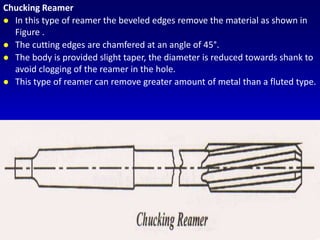
  • 83.
     Flutes- Thespiral groove in the body of the drill which provides lip is called flute. They  Forms the cutting edges of the point.  Allows the chips to escape.  Causes the chips to curl.  Permits the cutting fluid to reach the cutting edges.  Heel- The edge formed by the intersections of the flank and face.  Shank- The top part of the drill by which the drill is hold in the spindle and rotated is called shank.  Taper shank and the straight shank are the most common types of shanks. The tapered shape of the shank ensures the centering and holds the drill by friction fit in the tapered end of the spindle  Land- Cylindrical ground surface on the leading edges of the drill flutes is called land. The width of the land is measured at right angles to the flute helix.  Lip- The edge formed by the intersection of the flank and face is called lip. It is required that drill lips should be:  at the same angle of inclination with the drill axis.  of equal length.  provided with the correct clearance.
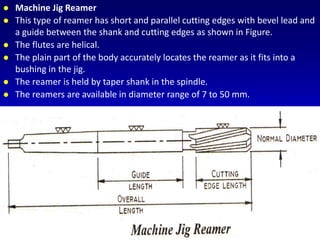
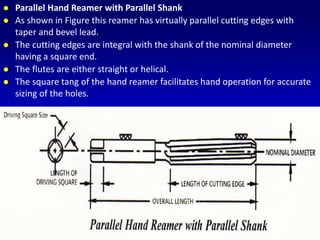
  • 86.
     Neck- Thediametric undercut of the drill which separates the drill body and shank is called neck of the drill.  Outer corner- The comer formed by the intersection of the flank and face is called outer comer.  Lip length- The minimum distance between the outer comer and the chisel edge comer of the lip is called lip length.  Point- The sharpened end of the drill from which other parts such as lips, faces, flanks and chisel edge originates is called point of the drill.  Tang- The flattened end of the taper shank intended to fit into a drift slot in the spindle is called tang. It ensures positive drive of the drill.  Web- The middle part of the drill starting from neck and extending up to point, situated between the roots of the flutes is called web.  Body clearance diameter- The diameter measured over the surface of the drill body situated behind the lands is called body clearance diameter.  Depth of body clearance- The measurement of radial reduction on each side to provide body clearance is called depth of body clearance.
  • 87.
     Back Taper- The reduction in diameter of the drill from the point toward the shank is called back taper. This permits all parts of the Drill behind the point to clear and not rub against the sides of hole being drilled.  Diameter- The distance across the cylindrical lands at the outer comers of the drill is called diameter of the drill.  Flute length- The axial length from the start of the flutes below the neck to extreme end of the point is called flute length.  Lead of helix- The distance measured parallel to the drill axis between the corresponding points on the leading edge of the flute in one complete revolution of the flute is called lead of the helix.  Overall length- The length between the extreme ends of the point and the shank of the drill is called overall length of the drill.  Right hand cutting drill- When a drill cuts while rotating in a counter clock-wise direction viewed from the point end, the drill is known as right hand cutting drill.
  • 88.
    Drill Angles  Helixangle-  The angle formed between the leading edge of the land and a plane having the axis of the drill is called helix angle.  It is called rake angle also.  The normal - value of rake angle is 30°, and it ranges up to 45°.  Chisel edge angle-  The obtuse angle included between the chisel edge and the lip while viewed from the end of the drill is called chisel edge angle.  The normal value of this angle varies between 120°-135°.  Point angle-  The included angle between two lips projected upon a plane parallel to the drill axis and parallel to the two cutting lips is called point angle.  Lip clearance angle-  The angle formed between the flank and a plane making right angle to the drill axis is called lip clearance angle.  It is measured at the periphery of the drill.  Lip clearance provides the relief to the cutting edge so that the drill can enter in the work piece without interference.
  • 89.
    Drill Size According tometric system, drills are commonly manufactured from 0.2 to 100 mm, while as per British system the drills are manufactured in three different sizes. They are:  Number sizes-  according to number system the drill sizes range from No. 1 to No.80. No-80 denotes the smallest size having diameter equal to 0.0135 inch while No-1 depicts the largest size having diameter equal to 0.228 inch.  The diameter increases in steps of approximately 0.002 inch.  Letter sizes-  according to letter system the drill sizes range from A to Z.  A represents the smallest, having diameter equal to 0.234 inch while Z represents largest diameter equal to 0.413 inch.
  • 90.
    Designation of Drill The standard manner in which the drill is specified is called designation of the drill.  As per Indian standard system, twist drills are designated by  series,  diameter,  IS number and  material of the drill.  The drills are made in three types;  normal (N),  hard (H) and  soft (S).  The drill type N and point angle 118° is presumed for the drill unless mentioned in the designation.  The designations are decided based on the material of the work piece and design requirements of drill depending on operations.
  • 91.
     Thus aparallel shank twist drill of stub series, 12 mm dia., conforming to IS standard, made of carbon steel of type N and point angle 85 is designated as:  Parallel shank twist drill (Stub) 12.00-IS: 599-CS-N-85 Drill Material  The twist drills are manufactured from following materials:  Manufactured as one piece:  High speed steel (HSS) or carbon steel  Manufactured as two piece:  Body (Cutting) part- High speed steel  Shank- Carbon steel  In general purpose applications HSS drills are widely employed because of their greater cutting efficiency.  While cemented carbide tipped tools are employed for mass production because their longer life and ease in replacement.
  • 92.
    REAMER  A toolused to enlarge, finish or to give accurate dimensions to a previously drilled hole is called reamer.  The hole may be drilled, bored or cored.  A reamer is a multi-edge cutter which removes relatively small amount of material as compared to drilling.  Commonly used reamers as per IS specification are:  Chucking reamer with parallel or taper shank  Machine bridge reamer  Machine jig reamer  Parallel hand reamer with parallel shank  Parallel or taper shank socket hand reamer  Shell reamer  Taper pin hand reamer  Expansion Reamer
  • 93.
    Chucking Reamer withParallel or Taper Shank  This type of reamer has short and parallel cutting edges.  It has a long body recess between shank and cutting edges.  The reamer is held in the spindle and driven by a parallel or taper shank as shown in Figure.  The flutes are all straight and irregularly spaced around the circumference of the reamer body.  This reduces the tendency to chatter.  This type of reamer is employed in machines like drill press, turret lathe or screw cutting machine.  The cutting speed is slow and the entire cutting is done along the flutes.
  • 94.
    Chucking Reamer  Inthis type of reamer the beveled edges remove the material as shown in Figure .  The cutting edges are chamfered at an angle of 45°.  The body is provided slight taper, the diameter is reduced towards shank to avoid clogging of the reamer in the hole.  This type of reamer can remove greater amount of metal than a fluted type.
  • 95.
    Machine Bridge Reamer This type of reamer has parallel cutting edges and the flutes may be straight or helical.  A machine bridge reamer as shown in Figure.  It is used with portable electric or pneumatic tool for reaming in ship- building, structural, and plate wont to make holes for riveting.  The reamers are available from 6.4 mm to 37 mm diameter.
  • 97.
     Machine JigReamer  This type of reamer has short and parallel cutting edges with bevel lead and a guide between the shank and cutting edges as shown in Figure.  The flutes are helical.  The plain part of the body accurately locates the reamer as it fits into a bushing in the jig.  The reamer is held by taper shank in the spindle.  The reamers are available in diameter range of 7 to 50 mm.
  • 98.
     Parallel HandReamer with Parallel Shank  As shown in Figure this reamer has virtually parallel cutting edges with taper and bevel lead.  The cutting edges are integral with the shank of the nominal diameter having a square end.  The flutes are either straight or helical.  The square tang of the hand reamer facilitates hand operation for accurate sizing of the holes.
  • 99.
     Socket Reamer Having straight or taper shank, this type of reamer may be driven by hand or machine.  The cutting edges having Morse taper are integral with the shank as shown in Figure.  The flutes may be straight or helical.  Socket reamers are made in a set of three- roughing, pre-finishing and finishing.
  • 100.
     Shell Reamer The shell reamer may be mounted on a arbor by an axial hole provided in the centre as shown in Figure.  It has virtually parallel cutting edges which are sharpened to form bevel lead. Shell reamers are employed for finishing large holes.  Numerous sizes of shells having similar internal hole size can be used on one arbor.  This saves the cost of solid shank for every reamer of different sizes.  The diameter ranges from 24 to 100 mm.
  • 101.
     Taper PinReamer  This reamer is employed for finishing the holes suitable for pins having a taper of 1 in 50.  It has taper cutting edges and parallel or taper shank for holding and driving the reamer as shown in Figure.
  • 102.
     Expansion Reamer Different from others, an expansion reamer is made in such a way that it may be adjusted to compensate for wear of the blades by a very small amount.  Such adjustments may be made to take care of some variation in hole size.  The plug can be pushed further inside by loosening the clamping nut which forces the blades to expand by a small amount as shown in Figure.
  • 103.
  • 104.
  • 105.
  • 106.
    Nomenclature of Reamer Elements of Reamer  Axis-  The imaginary longitudinal line passing through the centre of the reamer is called the axis of the reamer.  Back taper-  The reduction in diameter of the reamer per 100 mm length from the entering end towards the shank is called back taper.  Bevel lead-  The angular cutting portion at the entering end of the reamer which facilitates the entry of the reamer into the hole is called bevel lead.  Body-  The part of the reamer from the entering end to the start point of the shank is known as body of the shank.  Circular land-  On the leading edge of the land, the cylindrically ground surface adjacent to the cutting edge is called circular land of the reamer.
  • 107.
    Nomenclature of Reamer Elements of Reamer continued…..
  • 108.
     Face-  Theportion of the flute surface adjacent to the cutting edge is called face.  It is the area on which the chip impinges as it is flows after being cut from the work.  Cutting edge-  It is the edge formed at intersection of the face and the circular land or the surface left due to the provision of primary clearance.  Flutes-  They are the grooves made in the body of the reamer.  Flutes provide cutting edges, permit the removal of chips and allow cutting fluid to reach at the cutting edges.  Heel-  The edge formed by the intersection of the surface left due to the provision of secondary clearance and the flute is called heel of the reamer.  Land-  The part of the fluted body left standing between the flutes, the surface or the surfaces included between the cutting edge and the heel is called land of the reamer.
  • 109.
     Pilot-  thecylindrically ground part of the body at the entering end of the reamer is called pilot.  It keeps the reamer in alignment.  Recess-  The part of the body below the cutting edges, which is reduced in diameter, is called recess.  Shank-  The part of the reamer by which it is held in the spindle and driven.  Diameter-  The maximum cutting diameter of the reamer at the entering end. Rotation of Cutting According to the direction of rotation, a reamer is identified as:  Left hand cutting reamer-  The reamer which cuts while rotating in a clockwise direction viewed on the entering end of the reamer is called left hand reamer.  Right hand cutting reamer-  The reamer which cuts while rotating in an anticlockwise direction when viewed on the entering end of the reamer.
  • 110.
    Reamer Angles  Bevellead angle-  The included angle between the cutting edges of the bevel lead and the reamer axis is called bevel lead angle.  Clearance angles- The angles formed by the primary or secondary  clearances and the tangent to the periphery of the reamer at the cutting edge are called clearance angles.  Helix angle-  The angle between the cutting edge and the reamer axis is helix angle.  Rake angle-  The angles, in a diametral plane, formed by the face and a radial line from the cutting edge.  The angle is zero degree when the face and the radial line coin side, and the face is called radial.  The rake angle is positive when the angle formed by the face and the radial line falls behind the radial line in relation to the direction of cut, and the face is known as over cut.  The rake angle is negative when the angle formed by the face and the radial line falls in front of the radial line in relation to the direction of cut, and the face is known as over cut.
  • 111.
    COUNTERBORE  A counterbore is an end cutting tool having three or four teeth which cut the work piece material as shown in Figure.  It may have straight or helical flutes.  For short depth of cut and machining softer materials like brass and aluminum straight fluted counter bores are employed.  While helical fluted tools are used for counter boring larger holes which may be classified as solid, shell and insert type.  For mass production carbide tipped tool are employed.  Solid counter bore-  The parts of a solid counter bore may be identified as shank, cutter and pilot which are made in single piece.  It is employed for enlarging holes for accommodating machine screw heads.
  • 112.
    Inserted blade counterbore-  is used for enlarging larger sizes of holes. Shell counterbore-  consists of three piece as holder, cutter and pilot.  Different sizes of counter bore cutter may be fitted in the holder.  Pilots are also interchangeable. Counter sinks And Spot Faces  Counterbores, spotfacers and countersinks are of similar construction except for the angle of the cutting edges.  All are end cutting tools made with two or more flutes with a right hand helix.
  • 113.
    TAPS  A tapis a tool used for cutting threads inside the holes.  It is similar to a bolt having threads and three or four flutes cut across the thread as shown in Figure.  Due to flutes passing through the threads, edges are formed, which work as cutting edges.  The lower end of the tap is tapered for easy entry in the hole and subsequent cutting the materials from the walls.  The upper part of the tap consists of a shank ending in a square head to facilitate holding the tap in the machine spindle or by tap wrench for manual operation.  Taps are made from carbon steel and are subsequently hardened and tempered. They are classified as:  Hand tap  Machine tap  Hand taps- are usually made in set of three progressive tools:  taper tap,  second tap and  bottoming tap.
  • 114.
     According toIS specification they are called rougher, intermediate and finisher respectively.  Hand taps are made with straight flutes as shown in Figure.  As the rougher has to start cutting the threads its end is provided about six tapered threads.  This helps in forming the threads gradually as the tap is turned into the hole.  The intermediate is used for removing metal after the rougher tap has been used to cut the thread as far as possible.  The tool is tapered back from the edge about three or four threads.  The finisher having full threads throughout the length is used to finish the rest of the work.  Machine tap-  may have straight or helical flutes.  It is important to ensure that the chips are clearly removed from the cutting edges in machine tapping.
  • 115.
    Tap Nomenclature  Elementsof tap  Axis-  The imaginary longitudinal line passing through centre of the tap line of the tape is called axis of the tap.  Chamfer or tapered lead-  the tapered cutting portion provided with cutting clearance to distribute the cutting action over the thread forms is called tapered lead. It facilitates the entry of tap into the hole.  Body-  The threaded part of the tool starting from entering end of the tap is called body of the tap.  Cutting edge-  is the edge formed by the intersection of face of the flute with the form of thread.  Chamfer relief-  gradual decrease in land height from the cutting edge to heel is called chamfer relief.
  • 116.
    Tap Nomenclature  Elementsof tap  Face-  is the part of the flute surface adjacent to the cutting edge.  While cutting, the chips impinge on the face.  Flute-  The vertical or helical grooves on the body of the tap are called flutes.  They provide cutting edges, permit the removal of chips and provide passage to lubricant or coolant to reach the cutting edges.  Heel-  The edge formed by the intersection of the relieved surface behind the cutting edge with the flute is called hell of the tap.  Flute relief-  the radial relief in the thread form which starts at the cutting edge and continues up to the heel is called flute relief.
  • 117.
    Tap Nomenclature  Elementsof tap  Land-  The part of the tap left standing between the flutes is called land.  Radial relief-  it is the radial relief in the thread form provided behind the unrelieved land.  Shank-  the part the tap by which it is held or gripped and driven to cut the work piece is called shank.  Thread relief-  The clearance provided on a tap land by reduction in the diameter of the entire thread form between the cutting edge and the heel is called thread relief.  Web-  The central part of the tap between the roots of the flutes which extends along the fluted portion of the tap is called web.
  • 118.
    Tap Nomenclature  Elementsof tap  Web taper-  The taper generated due to increase of the web thickness from the entering end of the tap towards the shank end of the flutes is called web taper.  Back taper-  The reduction in diameter of the tap body from the entering end towards the shank is called back taper.  Effective or pitch diameter-  The effective diameter is the diameter of an imaginary coaxial cylinder which would pass through the threads at such points where the width of the threads and width of the spaces between the threads become equal, when measured at the cutting edge, on a tap having a parallel threaded portion.  Major diameter-  The major diameter is the diametral measurement over the crests of the thread form at the cutting edge, on a tap having a parallel threaded portion.
  • 119.
    Tap Nomenclature  Elementsof tap  Overall length:  the axial length between the extreme ends of tap is called overall length.  Left hand tap-  A tap which cuts the material while rotating in a clockwise direction when viewed from the entering end of the tap is called left hand tap.  Right hand tap-  A tap which cuts the material while rotating in an anticlockwise direction when viewed from the entering end of the tap is called right hand tap.
  • 120.
    Tap Nomenclature  Elementsof tap Angles  Chamfer angle-  The angle formed between the cutting edges of the taper lead and the tap axis is called chamfer angle.  Flank angle-  The included angle between the flanks of the thread, measured in an axial plane is called flank angle.  Radial rake angle-  The angle formed in a diametral plane between the face and a radial line from the cutting edge at the crest of the thread form is called rake angle.
  • 121.
    Tap Nomenclature  Elementsof tap  Rake angle can be –  Negative rake-  If the angle formed by the face and radial line falls in front of the radial line in relation to the direction of cut, the radial rake angle is negative and the face in known as overcut.  Zero rake-  If the face and the radial line coin-side, the angle is zero, the face is called radial.  Positive rake-  If the angle formed by the face and the radial line falls behind the radial line in relation to the direction of cut, then the radial angle is positive and the face is known as undercut.  Relief angle-  The equivalent angle between a relieved land surface and the cutting diameter circle of the tap thread form is called relief angle
  • 122.
    Exercise  State theworking principle of a drilling machine.  Explain principal parts of the drilling machine and sketch the mechanism of a drilling machine.  Give the classification of drilling machines.  How will you specify a drilling machine?  What operations can be done on a drilling machine? Discuss them with diagrams.  With the help of a line diagram, describe the construction of radial drilling machine.  List the devices commonly used for holding the work on a drilling machine, and describe any three.  Define cutting speed, feed and machining time for drilling.  Sketch a twist drill and name its different parts.  What is boring? Sketch a boring tool.  What is the function of flutes on a twist drill bit? Why are straight flute drills used for non ferrous materials and metal?
  • 123.
     Draw suitablefigure for a drill bit showing:  point  lip clearance  point angle  Flute  margin and  body clearance  Write short notes on following:  Drilling  Boring  Reaming  Tapping  Counter boring  Counter sinking  Explain various types of operations performed on a drilling machine by neat sketches.  Define the following terms used in drilling operation.  Cutting speed  Feed
  • 124.