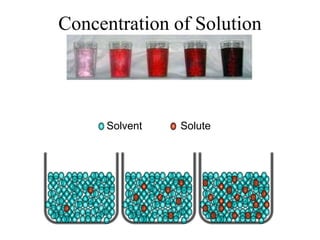
Concentration of Solution
Solvent Solute
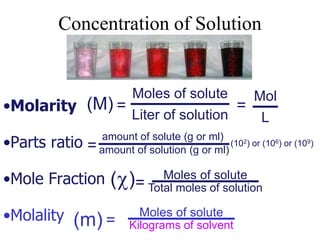
•Molarity
•Parts ratio
•Mole Fraction
•Molality
Concentration of Solution
Moles of solute
Liter of solution
(M) =
=
Mol
L
amount of solute (g or ml)
amount of solution (g or ml)
(102) or (106) or (109)
Moles of solute
Total moles of solution
(c)
=
=
Kilograms of solvent
Moles of solute
(m) =
Molarity
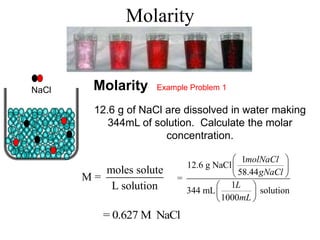
Molarity Example Problem 1
12.6 g of NaCl are dissolved in water making
344mL of solution. Calculate the molar
concentration.
moles solute
M =
L solution
1
12.6 g NaCl
58.44
=
1
344 mL solution
1000
molNaCl
gNaCl
L
mL
 
 
 
 
 
 
= 0.627 M NaCl
NaCl
Molarity
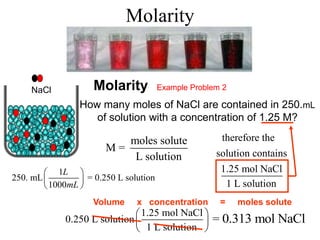
Molarity Example Problem 2
How many moles of NaCl are contained in 250.mL
of solution with a concentration of 1.25 M?
therefore the
solution contains
1.25 mol NaCl
1 L solution
1
250. mL = 0.250 L solution
1000
L
mL
 
 
 
1.25 mol NaCl
0.250 L solution
1 L solution
 
 
 
NaCl
moles solute
M =
L solution
Volume x concentration = moles solute
= 0.313 mol NaCl
Molarity
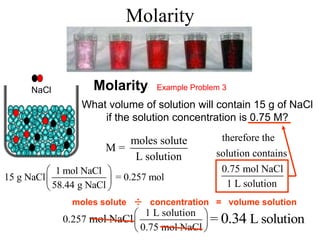
Molarity Example Problem 3
What volume of solution will contain 15 g of NaCl
if the solution concentration is 0.75 M?
therefore the
solution contains
0.75 mol NaCl
1 L solution
1 mol NaCl
15 g NaCl = 0.257 mol
58.44 g NaCl
 
 
 
1 L solution
0.257
0.75 mol NaCl
mol NaCl
 
 
 
NaCl
moles solute
M =
L solution
moles solute ÷ concentration = volume solution
= L solution
0.34
• % (w/w) =
• % (w/v) =
• % (v/v) =
% Concentration
100
x
solution
mass
solute
mass
100
x
solution
volume
solute
mass
100
x
solution
volume
solute
volume
Mass and volume units must match.
(g & mL) or (Kg & L)
% Concentration
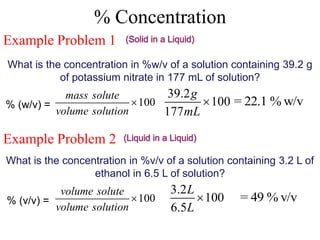
Example Problem 1
What is the concentration in %w/v of a solution containing 39.2 g
of potassium nitrate in 177 mL of solution?
100
mass solute
volume solution

% (w/v) =
39.2
100
177
g
mL
 = 22.1 % w/v
Example Problem 2
What is the concentration in %v/v of a solution containing 3.2 L of
ethanol in 6.5 L of solution?
100
volume solute
volume solution

% (v/v) =
3.2
100
6.5
L
L
 = 49 % v/v
% Concentration
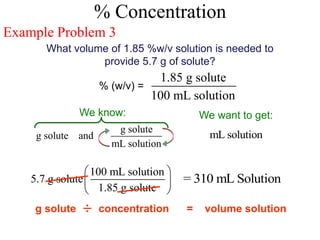
Example Problem 3
What volume of 1.85 %w/v solution is needed to
provide 5.7 g of solute?
100 mL solution
5.7 g solute
1.85 g solute
 
 
 
% (w/v) =
1.85 g solute
100 mL solution
= 310 mL Solution
g solute ÷ concentration = volume solution
We know:
g solute
g solute and
mL solution
We want to get:
mL solution
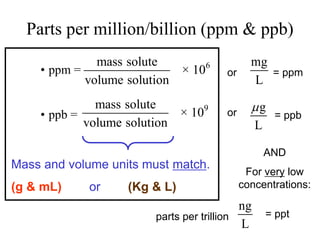
• ppm =
• ppb =
Parts per million/billion (ppm & ppb)
6
mass solute
× 10
volume solution
Mass and volume units must match.
(g & mL) or (Kg & L)
9
mass solute
× 10
volume solution
or
or
mg
L
g
L

= ppm
= ppb
AND
For very low
concentrations:
ng
L
= ppt
parts per trillion
ppm & ppb
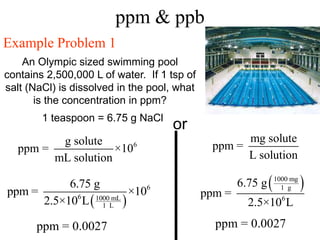
Example Problem 1
An Olympic sized swimming pool
contains 2,500,000 L of water. If 1 tsp of
salt (NaCl) is dissolved in the pool, what
is the concentration in ppm?
1 teaspoon = 6.75 g NaCl
6
g solute
ppm = ×10
mL solution
 
6
6 1000 mL
1 L
6.75 g
ppm = ×10
2.5×10 L
ppm = 0.0027
or
mg solute
ppm =
L solution
 
1000 mg
1 g
6
6.75 g
ppm =
2.5×10 L
ppm = 0.0027
ppm & ppb
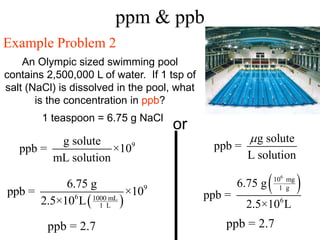
Example Problem 2
An Olympic sized swimming pool
contains 2,500,000 L of water. If 1 tsp of
salt (NaCl) is dissolved in the pool, what
is the concentration in ppb?
1 teaspoon = 6.75 g NaCl
9
g solute
ppb = ×10
mL solution
 
9
6 1000 mL
1 L
6.75 g
ppb = ×10
2.5×10 L
ppb = 2.7
or
g solute
ppb =
L solution

 
6
10 mg
1 g
6
6.75 g
ppb =
2.5×10 L
ppb = 2.7
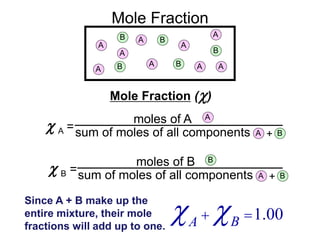
Mole Fraction
Mole Fraction (c)
A
B
B
B
B
B
A
A
A
A
A
A
A
A
c A =
moles of A
sum of moles of all components
A
B
A +
c B =
moles of B
sum of moles of all components
B
B
A +
Since A + B make up the
entire mixture, their mole
fractions will add up to one.
1.00
B
A
c c
 
Mole Fraction
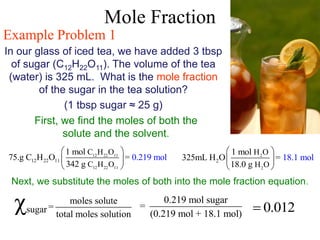
Example Problem 1
In our glass of iced tea, we have added 3 tbsp
of sugar (C12H22O11). The volume of the tea
(water) is 325 mL. What is the mole fraction
of the sugar in the tea solution?
(1 tbsp sugar ≈ 25 g)
First, we find the moles of both the
solute and the solvent.
12 22 11
12 22 11
12 22 11
C H O
C H O
1 mol
75.g C H O =
342
0
g
.2 9 ol
1 m
 
 
 
2
2
2
H O
H O
1 mol
325mL H O =
18.0
18.1 m
g
ol
 
 
 
Next, we substitute the moles of both into the mole fraction equation.
sugar
moles solute
=
total moles solution
χ 0.219 mol sugar
=
(0.219 mol + 18.1 mol)
0.012

Mole Fraction
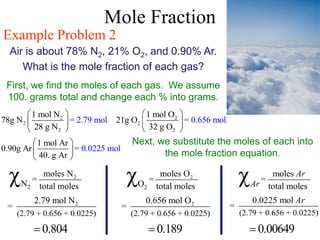
Example Problem 2
Air is about 78% N2, 21% O2, and 0.90% Ar.
What is the mole fraction of each gas?
First, we find the moles of each gas. We assume
100. grams total and change each % into grams.
2
2
2
1 mol N
78g N =
28 g
2.
N
79 mol
 
 
 
Next, we substitute the moles of each into
the mole fraction equation.
2
2
N
moles N
=
total moles
χ
2
(2.79 + 0.656 + 0.0225)
2.79 mol N
=
2
2
2
1 mol O
21g O =
32 g O
0.656 mol
 
 
 
1 mol Ar
0.90g Ar =
40. g
0.0225 m
A
ol
r
 
 
 
2
2
O
moles O
=
total moles
χ moles
=
total moles
χAr
Ar
2
(2.79 + 0.656 + 0.0225)
0.656 mol O
=
(2.79 + 0.656 + 0.0225)
0.0225 mol
=
Ar
0.804
 0.189
 0.00649

Molal (m)
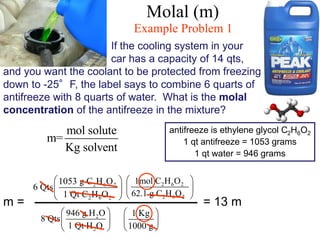
Example Problem 1
If the cooling system in your
car has a capacity of 14 qts,
and you want the coolant to be protected from freezing
down to -25°F, the label says to combine 6 quarts of
antifreeze with 8 quarts of water. What is the molal
concentration of the antifreeze in the mixture?
antifreeze is ethylene glycol C2H6O2
1 qt antifreeze = 1053 grams
1 qt water = 946 grams
mol solute
m=
Kg solvent
2 6 2
2 6 2
1053 g C H O
6 Qts
1 Qt C H O
 
 
 
m =
2 6 2
2 6 2
1mol C H O
62.1 g C H O
 
 
 
2
2
946 g H O
8 Qts
1 Qt H O
 
 
 
1 Kg
1000 g
 
 
 
= 13 m

concentrations.ppt

  • 2.
  • 3.
    •Molarity •Parts ratio •Mole Fraction •Molality Concentrationof Solution Moles of solute Liter of solution (M) = = Mol L amount of solute (g or ml) amount of solution (g or ml) (102) or (106) or (109) Moles of solute Total moles of solution (c) = = Kilograms of solvent Moles of solute (m) =
  • 4.
    Molarity Molarity Example Problem1 12.6 g of NaCl are dissolved in water making 344mL of solution. Calculate the molar concentration. moles solute M = L solution 1 12.6 g NaCl 58.44 = 1 344 mL solution 1000 molNaCl gNaCl L mL             = 0.627 M NaCl NaCl
  • 5.
    Molarity Molarity Example Problem2 How many moles of NaCl are contained in 250.mL of solution with a concentration of 1.25 M? therefore the solution contains 1.25 mol NaCl 1 L solution 1 250. mL = 0.250 L solution 1000 L mL       1.25 mol NaCl 0.250 L solution 1 L solution       NaCl moles solute M = L solution Volume x concentration = moles solute = 0.313 mol NaCl
  • 6.
    Molarity Molarity Example Problem3 What volume of solution will contain 15 g of NaCl if the solution concentration is 0.75 M? therefore the solution contains 0.75 mol NaCl 1 L solution 1 mol NaCl 15 g NaCl = 0.257 mol 58.44 g NaCl       1 L solution 0.257 0.75 mol NaCl mol NaCl       NaCl moles solute M = L solution moles solute ÷ concentration = volume solution = L solution 0.34
  • 7.
    • % (w/w)= • % (w/v) = • % (v/v) = % Concentration 100 x solution mass solute mass 100 x solution volume solute mass 100 x solution volume solute volume Mass and volume units must match. (g & mL) or (Kg & L)
  • 8.
    % Concentration Example Problem1 What is the concentration in %w/v of a solution containing 39.2 g of potassium nitrate in 177 mL of solution? 100 mass solute volume solution  % (w/v) = 39.2 100 177 g mL  = 22.1 % w/v Example Problem 2 What is the concentration in %v/v of a solution containing 3.2 L of ethanol in 6.5 L of solution? 100 volume solute volume solution  % (v/v) = 3.2 100 6.5 L L  = 49 % v/v
  • 9.
    % Concentration Example Problem3 What volume of 1.85 %w/v solution is needed to provide 5.7 g of solute? 100 mL solution 5.7 g solute 1.85 g solute       % (w/v) = 1.85 g solute 100 mL solution = 310 mL Solution g solute ÷ concentration = volume solution We know: g solute g solute and mL solution We want to get: mL solution
  • 10.
    • ppm = •ppb = Parts per million/billion (ppm & ppb) 6 mass solute × 10 volume solution Mass and volume units must match. (g & mL) or (Kg & L) 9 mass solute × 10 volume solution or or mg L g L  = ppm = ppb AND For very low concentrations: ng L = ppt parts per trillion
  • 11.
    ppm & ppb ExampleProblem 1 An Olympic sized swimming pool contains 2,500,000 L of water. If 1 tsp of salt (NaCl) is dissolved in the pool, what is the concentration in ppm? 1 teaspoon = 6.75 g NaCl 6 g solute ppm = ×10 mL solution   6 6 1000 mL 1 L 6.75 g ppm = ×10 2.5×10 L ppm = 0.0027 or mg solute ppm = L solution   1000 mg 1 g 6 6.75 g ppm = 2.5×10 L ppm = 0.0027
  • 12.
    ppm & ppb ExampleProblem 2 An Olympic sized swimming pool contains 2,500,000 L of water. If 1 tsp of salt (NaCl) is dissolved in the pool, what is the concentration in ppb? 1 teaspoon = 6.75 g NaCl 9 g solute ppb = ×10 mL solution   9 6 1000 mL 1 L 6.75 g ppb = ×10 2.5×10 L ppb = 2.7 or g solute ppb = L solution    6 10 mg 1 g 6 6.75 g ppb = 2.5×10 L ppb = 2.7
  • 13.
    Mole Fraction Mole Fraction(c) A B B B B B A A A A A A A A c A = moles of A sum of moles of all components A B A + c B = moles of B sum of moles of all components B B A + Since A + B make up the entire mixture, their mole fractions will add up to one. 1.00 B A c c  
  • 14.
    Mole Fraction Example Problem1 In our glass of iced tea, we have added 3 tbsp of sugar (C12H22O11). The volume of the tea (water) is 325 mL. What is the mole fraction of the sugar in the tea solution? (1 tbsp sugar ≈ 25 g) First, we find the moles of both the solute and the solvent. 12 22 11 12 22 11 12 22 11 C H O C H O 1 mol 75.g C H O = 342 0 g .2 9 ol 1 m       2 2 2 H O H O 1 mol 325mL H O = 18.0 18.1 m g ol       Next, we substitute the moles of both into the mole fraction equation. sugar moles solute = total moles solution χ 0.219 mol sugar = (0.219 mol + 18.1 mol) 0.012 
  • 15.
    Mole Fraction Example Problem2 Air is about 78% N2, 21% O2, and 0.90% Ar. What is the mole fraction of each gas? First, we find the moles of each gas. We assume 100. grams total and change each % into grams. 2 2 2 1 mol N 78g N = 28 g 2. N 79 mol       Next, we substitute the moles of each into the mole fraction equation. 2 2 N moles N = total moles χ 2 (2.79 + 0.656 + 0.0225) 2.79 mol N = 2 2 2 1 mol O 21g O = 32 g O 0.656 mol       1 mol Ar 0.90g Ar = 40. g 0.0225 m A ol r       2 2 O moles O = total moles χ moles = total moles χAr Ar 2 (2.79 + 0.656 + 0.0225) 0.656 mol O = (2.79 + 0.656 + 0.0225) 0.0225 mol = Ar 0.804  0.189  0.00649 
  • 16.
    Molal (m) Example Problem1 If the cooling system in your car has a capacity of 14 qts, and you want the coolant to be protected from freezing down to -25°F, the label says to combine 6 quarts of antifreeze with 8 quarts of water. What is the molal concentration of the antifreeze in the mixture? antifreeze is ethylene glycol C2H6O2 1 qt antifreeze = 1053 grams 1 qt water = 946 grams mol solute m= Kg solvent 2 6 2 2 6 2 1053 g C H O 6 Qts 1 Qt C H O       m = 2 6 2 2 6 2 1mol C H O 62.1 g C H O       2 2 946 g H O 8 Qts 1 Qt H O       1 Kg 1000 g       = 13 m