REMOTE SENSING
ITS APPLICATIONS IN CIVIL ENGINEERING
Dr. Anjana Vyas, CEPT University, Ahmedabad
anjanavyas@yahoo.com
Lecture delivered at 31st
National Convention of Civil Engineers, Ahmedabad on 20th
September 2015
REMOTE SENSINGREMOTE SENSING
Remote Sensing refers to gathering
and processing of information about
earth’s environment and its Natural
& Cultural Resources through Aerial
photography and Satellite scanning.
1903 - The Bavarian Pigeon Corps1903 - The Bavarian Pigeon Corps
Interactions with medium (atmospheric effect
Electromagnetic spectrumElectromagnetic spectrum
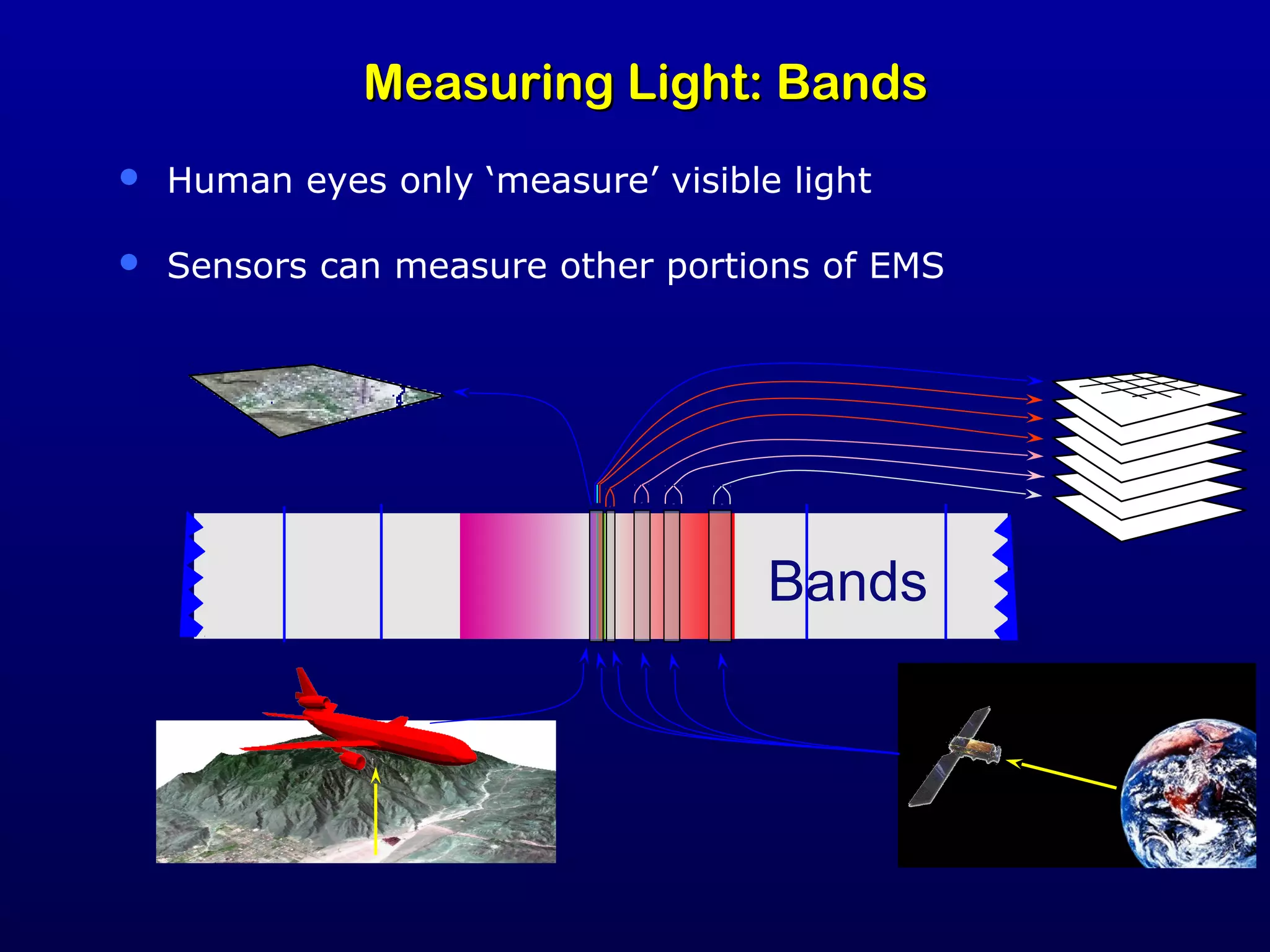
Measuring Light: BandsMeasuring Light: Bands
 Human eyes only ‘measure’ visible light
 Sensors can measure other portions of EMS
Bands
Remote Sensing through instrumentRemote Sensing through instrument
Various
Platforms
Sensors:
LISS-III, WiFS,
PAN etc
Active and Passive RemoteActive and Passive Remote
SensingSensing
GEOSTATIONARY ORBITSGEOSTATIONARY ORBITS

These satellite appears stationary with
respect to the Earth's surface. Generally
placed above 36,000 km from the earth.
FOOTPRINTSFOOTPRINTS
Communication Satellites are in GEOSYNCHRONOUS
ORBIT
(Geo = Earth + synchronous = moving at the same rate).
This means that the satellite always stays over one spot on
Earth. The area on earth that it can “SEE” is called the
satellite’s “FOOTPRINT”
A Polar Orbit is a particular type of
Low Earth Orbit. The satellite
travels a North – South Direction,
rather than more common East-West
Direction.
Panoramic View of Earth Station at Shadnagar
SWATH OF ADJACENT PATH
DESCENDING PATH
Latitude
Longitude
15
Orbit Number
1234567891011 121314
SWATH OF ADJACENT PATHSWATH OF ADJACENT PATH
cending ground traces of IRS-1A/1B for one day.
In 24hrs satellite makes 13.9545 revolutions around the earth. The orbit on
the second day (15th orbit) is shifted westward from orbit No.1 by about
130 km. The ground traces repeat after every 307 orbits in 22 days.
GREEN BAND WITH BLUE
FILTER
STANDARD FALSE COLOUR
COMPOSITE
GENERATION OF FALSE
COLOUR COMPOSITE
RED BAND WITH GREEN FILTER
IR BAND WITH RED FILTER
0.4 0.6 0.8 1.0 1.2 1.4 1.6 1.8 2.0 2.2 2.4 2.6
20
40
60
80
Spectral Reflectance curvesReflectance(%)
Wavelength (µm)
Vegetation
Soil
Water
Snow
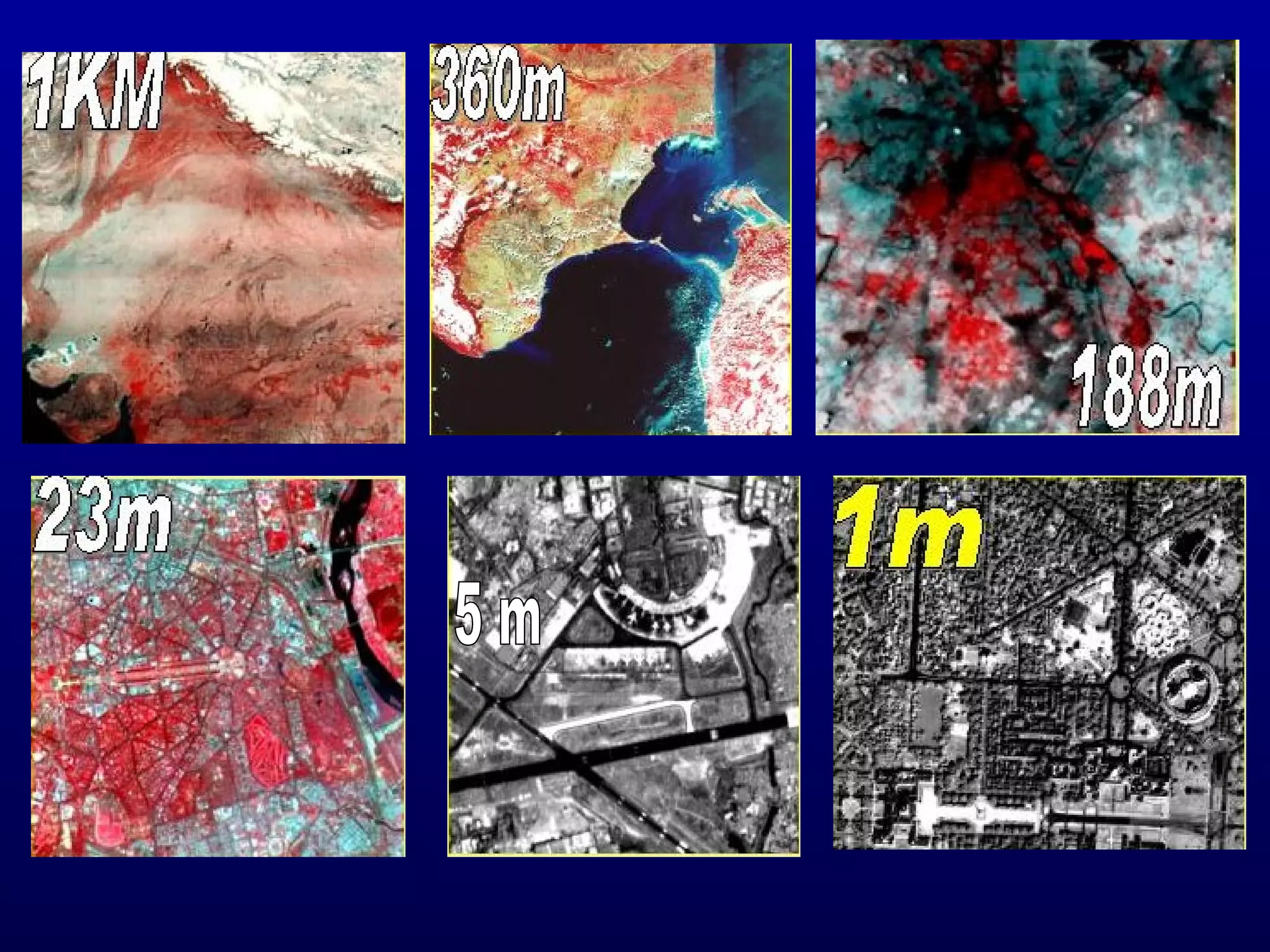
• Spatial Resolution – The smallest
object that can be discerned
•Spectral Resolution – No. of bands
•Temporal Resolution – Periodicity of
data collection
•Radiometric Resolution – Quantization
levels of data
Resolutions
India’s Earth Observation Missions
INSAT-2E
VHRR, CCD (1 km)
1999
INSAT-1D
VHRR
INSAT-2A
VHRR
1992
1990
INSAT-2B
VHRR
1993
KALPANA-1
VHRR
INSAT-3A
VHRR,CCD
2003
2002
Geo stationary
IRS-1A & 1B
LISS-1&2
(72/36m)
1988/91
IRS-1C/1D
LISS-3 (23/70m);
PAN (5.8m);
WiFS (188m)
1995/1997
IRS-P4
OCM
(360m),
MSMR
1999
2001
TES
Step& Stare
PAN (1m)
IRS-P6: Resource Sat
LISS 3 (23m)
LISS 4 (5.8m);
AWiFS (55m)
2003
Sun Synchronous
IRS-P5 PAN-2.5M,
Carto-1, 30 km
2005
Carto-2 PAN-0.8M, 11
km
2007
IRS 1C Sensors overview
PAN
LISS III
WiFS
BANGKOK CITY, PAN DATA
PART OF ROME, LISS-III +PAN DATA
SAMPLE
IMAGES OF
IRS-1C/1D
SENSORS
0.6 m Resolution Space Image
1 m Resolution Space Image
ChinnaswamyChinnaswamy
StadiumStadium
MG RoadMG Road
FM CariappaFM Cariappa
Mem.ParkMem.Park
Cubbon RoadCubbon Road
CubbonCubbon
ParkPark
1m1m
33
Vegetation/Forests/Agriculture
Kharif-1999 (Sep-Oct) Rabi-2000 (Feb-Mar)
A
pplications
Flood due to cyclone (29th
October 1999)
off Orissa coast
IRS LISS III
Pre-cyclone (11.10.99)
IRS LISS III
Post-cyclone (05.11.99)
RADARSAT
DATA of 2nd NOV
• ROCK TYPES
• GEOLOGICAL STRUCTURES (LINEAMENT /FAULT/DYKE)
• VALLEY FILL WITH VEGETATION
• BLACK SOIL COVER
• SALT AFFECTED LAND
WHAT CAN BE SEEN FROM SATELLITE
IMAGES?
• HILLY TERRAIN WITH FOREST
• AGRICULTURAL LANDS - DELTA
• RIVER COURSES
• COASTLINE
WHAT CAN BE SEEN FROM SATELLITE
IMAGES?
• MANGROVE FOREST
• WET LANDS
• WATER TURBIDITY
39
Mapping and monitoring mangroves, coastal
wetlands
PP
P
KRISHNA R.
IRS-1B LISS-I
IMAGE, 1992
KRISHNA R.
P = Prawn cultivation
IRS-1C LISS-III
IMAGE, 2000
Gap Detection in Mango Orchards
High resolution satellite data 20 February 2000
Shadnagar, Mahbubnagar District, AP
(2.5 m)
Natural Resources Inventory
Farm level information in
Hirakud Irrigation Command Area
High resolution satellite data
(0.60 m)
INDIAN IMAGING CAPABILITY
• EVERY 30 MIN.
IMAGING
• 1M+ SCALES
• CLIMATE/WEATHER • EVERY 2 DAYS IMAGING
• 1:250 K SCALES
• OCEAN APPLICATIONS • EVERY 5 DAYS IMAGING
• 1:250 K SCALES
• NATIONAL SURVEYS
• EVERY 22 DAYS
IMAGING
• 1:50 K SCALES
• DETAILED RESOURCES
SURVEY • EVERY 5 DAYS
IMAGING
• 1:12500 SCALES
• LARGE SCALE
MAPPING
• STEREO CAPABILITY
• LOCAL AREA IMAGING
• 1:2000 / 4000 / 8000
SCALES
• STEREO CAPABILITY
INDIAN IMAGING CAPABILITY
0.8m
Elements of Image Interpretation
•Primary
•Secondary
•Tertiary
• Higher
:
:
:
:
Tone / Colour
Size, Shape & Texture
Pattern, Height & Shadow
Site & Association
A
H
M
E
D
A
B
A
D
C
I
T
Y
Example:
Visual
interpretation
on screen
vector
tracing
Road
A
H
M
E
D
A
B
A
D
C
I
T
Y
On screen
Vector
tracing
Road
Builtup land
Vacant land
Waterbody
A
H
M
E
D
A
B
A
D
C
I
T
Y
ON SCREEN VISUAL INTERPRETATION
SATELLITE REMOTE SENSING APPLICATIONS
AGRICULTURE
• CROP ACREAGE AND PRODUCTION ESTIMATION
SOIL RESOURCES
• SOIL MAPPING
• LAND CAPABILITY, LAND IRRIGABILITY
• SOIL MOISTURE ESTIMATION
• MAPPING WATER-LOGGED AREAS
• SALT-AFFECTED SOILS, ERODED LANDS, SHIFTING CULTIVATION
LANDUSE/LAND COVER
• LAND USE/LAND COVER MAPPING
• WASTELAND MAPPING
• URBAN SPRAWL MAPPING
GEOSCIENCES
• GEOLOGICAL / GEOMORPHOLOGICAL MAPPING
• GROUND WATER POTENTIAL ZONE MAPPING
• MINERAL TARGETTING
FORESTRY AND ENVIRONMENT
• FOREST COVER MAPPING
• FOREST MANAGEMENT PLAN - RS INPUTS
• BIODIVERSITY CONSERVATION
• ENVIRONMENTAL IMPACT ASSESSMENT
• GRASSLAND MAPPING
Natural Resources
SATELLITE REMOTE SENSING APPLICATIONS
WATER RESOURCES
• SNOWMELT RUNOFF FORECASTING
• RESERVOIR SEDIMENTATION
OCEAN APPLICATIONS
• COASTAL ZONE MAPPING
• POTENTIAL FISHING ZONE (PFZ) MAPPING
• CORAL REEF MAPPING
DISASTER ASSESSMENT
• FLOOD / CYCLONE DAMAGE ASSESSMENT
• AGRICULTURAL DROUGHT ASSESSMENT
• VOLCANIC ERUPTION, UNDERGROUND COAL
FIRE
• LANDSLIDE HAZARD ZONATION
• FOREST FIRE AND RISK MAPPING
INTEGRATED MISSION FOR SUSTAINABLE
DEVELOPMENT
• SUSTAINABLE WATERSHED DEVELOPMENT
URBAN APPLICATION
ENGINEERING APPLICATIONS
Infrastructure
Creation of 3-D ViewCreation of 3-D View
Study Area
TPS : 19 (Memnagar)
Rasranjan Building
Corresponding
Attributes
3-D Visualization3-D Visualization
Walk ThroughWalk Through
PANORAMIC VIEWERPANORAMIC VIEWER
Fig. (L) :- Street View on the Golden
Gate Bridge on Google Earth
Fig. (R) :- Cylindrical panoramic image
in ArcSoft Panoramic Viewer
Street-View in Google EarthStreet-View in Google Earth
An aerial view of a water
logged area in and
around Ahmedabad
Monday, July 04, 2005
SrSr
NoNo Name of catchmentName of catchment
Area ofArea of
catchmentcatchment
in Hain Ha
WatershedWatershed
runoffrunoff
(cum/sec)(cum/sec)
Total pipeTotal pipe
carryingcarrying
capacity (usingcapacity (using
Manning’sManning’s
hydraulichydraulic
table)table)
(cum/sec)(cum/sec)
VulnerabiliVulnerabili
tyty
11 Vasna catchment areaVasna catchment area 280280 23.4323.43 16.4716.47 HighHigh
22 Paldi catchment areaPaldi catchment area 238238 18.918.9 12.6612.66 HighHigh
33 Ellisbrige catchment areaEllisbrige catchment area 210210 20.3320.33 14.8914.89 HighHigh
44
Navrangpura catchmentNavrangpura catchment
areaarea 142142 12.1212.12 12.6012.60
LowLow
55
Gandhigram catchmentGandhigram catchment
areaarea 179179 15.1415.14 17.8517.85
MediumMedium
66 Stadium catchment areaStadium catchment area 155155 12.8512.85 11.7511.75 LowLow
77 Naranpura catchment areaNaranpura catchment area 301301 23.7523.75 22.6022.60 MediumMedium
88 New wadaj catchment areaNew wadaj catchment area 425425 21.0921.09 24.9024.90 MediumMedium
99
Near old wadaj catchmentNear old wadaj catchment
areaarea 111111 23.6423.64 22.8022.80
LowLow
1010 Sabarmati catchment areaSabarmati catchment area 286286 22.3922.39 21.8021.80 MediumMedium
FLOOD VULNERABILITY OF CATCHMENTS
 The maximum height is 57.5
meters and the minimum
height is 42 meters from mean
sea level.
 The study area is plain, dry
and sandy. It covers an area
of 3844 Ha.
CONTOUR MAP OF STUDY AREA (AMC)
DIGITAL ELEVATION MODEL (AMC)
 DEM is a digital representation of a
continuous variable over a two
dimensional surface by a regular
array of ‘Z’ value represented to a
common datum
 less than 5 percent slope
 Rational method has been used for computing surface runs off
Q = CIA/360
Where: Q = maximum rate of runoff (cum/sec)
C = runoff coefficient representing a ratio of runoff to rainfall
I = average rainfall intensity for a duration equal to the tc (mm/hr)
A = drainage area contributing to the design location (ha)
Percentage coefficients of runoff for the Catchments characteristics:
 Densely built up area of cities with metalled road—0.80
 Residential areas not densely built , with metalled road—0.60
 Ditto, with unmetalled roads --- 0.20 – 0.50
 Lightly covered --- 0.50
 largely cultivated--- 0.30
 Suburbs with gardens, lawns and macadamized roads—0.30
 Sandy soil, light growth—0.20
CONSTANTS
ESTIMATION OF SURFACE RUNOFF USING
RATIONAL METHOD
ESTIMATING STORM WATER DRAINAGE
CARRYING CAPACITY BY MANNING’S METHOD
The Manning Formula is an empirical formula for flow driven by gravity. It was
developed by the Irish engineer Robert Manning.
The available head in the storm water drain is utilized in overcoming internal
resistance.
The Manning Formula given below is commonly used for such design.
The Manning’s Formula states:
V = 1/n (3.968 * 10-3
) D2/3
* S1/2
Q = 1/n (3.118 * 10-6
) D8/3
* S ½
where:
V= velocity in mt per second
Q = Discharge
S = slope of hydraulic gradient (generally slope in SWD)
D = Internal diameter of pipeline in mm
n = Manning’s coefficient of roughness
 Area of catchments:- 80 Ha
 Total Built up Area:- 55 Ha
 Runoff Coefficient:- 0.8
 Main Storm water drain length in
the catchments area:- 274 mt
 Average size of SWD drain:- 600
mm
 Storm Water carrying capacity of
existing SWD line:- 2.65 (cum/sec)
 Runoff of catchments:- 7.11
(cum/sec)
CATCHMENT NO 1
Runoff = CIA/360
= 80*0.8*40*1/360
= 7.11 cum/sec
SOUTH NARANPURA CATCHMENT AREA
L_Section of existing SWD in Naranpura catchment area
0
10
20
30
40
50
60
0
180
363
541
721
911
1091
1274
1454
1754
1924
2104
2664
2848
Chainage in mt.
Ground level
Invert level
North Naranpura
Catchments area
 Area of catchments:- 1400Ha
 Runoff of catchments:-23.22 (cum/sec)
 Main Storm water drain length in the
catchments area:-3100mt
 G.L at start point:-60.46mt
 G.L at end point:-60.38mt
 I.L at start point:-58.48.26mt
 I.L at end point:-50.50mt
 Average size of SWD drain:-900mm
 Storm Water carrying capacity of
existing SWD line:-
22.60(cum/sec)
land use
Area in
hectares
Area
in %
road footpath 206.57 15.16
COMMERCIAL 213.99 15.70
RESIDENTIAL 886.45 65.06
open plot 55.36 4.06
Total 1,362.37
Runoff=886.45*0.8*40*1
/360+213.99*0.85*0.4*1/
360+55.36*0.4*40*1/360
+206.57*0.9*40*1/360=
23.22 cum/sec
PALDI CATCHMENT AREA
L_Section of existing SWD in Ellisbrige catchment area
34
36
38
40
42
44
46
48
0
1
2
0
2
4
0
3
6
0
4
9
0
6
1
0
7
4
0
8
6
0
9
9
0
1
1
1
0
1
2
3
0
1
3
8
0
1
5
2
0
1
6
7
0
1
7
9
0
1
8
5
0Chainage in mt.
Ground level
Invert level
 Area of catchments:- 168 Ha
 Runoff of catchments:-15.03(cum/sec)
 Main Storm water drain length in the
catchments area:-1850 mt
 G.L at start point:-44.66mt
 G.L at end point:-43.87mt
 I.L at start point:-43.50mt
 I.L at end point:-39.42mt
 Average size of SWD drain:-450mm
 Storm Water carrying capacity of existing SWD
line:-14.89(cum/sec)
Land Use Area in Ha
Area
in %
Roads 5.0 2.96
Commercial 8.27 4.90
Residential 154.05 91.39
open
plot/Vegetati
on/lake 1.24 0.74
Total 168.56
Total runoff =
154.05*0.80*40*1/360
+ 8.27*0.85*40*1/360 +
5*0.90*40*1/360 +
1.24*0.40*40*1/360 =
15.03 cum/sec
The areas of Vishwakunj char rasta, near shantivan pumping
stations, near Kochrab ashram, near jivraj hospital, near
yogeshwarnagar, which include many of the important business
FLOOD VUNERABLE ZONE AMC
EXISTING STORM WATER DRAINAGE OF STUDY AREA
PROPOSED STORM WATER DRAIN OF STUDY AREA
FLOOD
VULNERABILITY
Vulnerability Total Area (Ha) Total Area (%)
Very Low Vulnerable
Zone
149 4%
Low Vulnerable Zone 422 11%
Moderate Vulnerable
Zone
1112 29%
High Vulnerable Zone 1453 38%
Very High Vulnerable
Zone
707 18%
GIS BASED EMERGENCY
RESPONSE SYSTEM
Facilities in High Vulnerable Zone Slum Locations in High Vulnerable Zone
Facilities in Low Vulnerable Zone
NOAA’s LIDAR Image of Ground Zero of World Trade
Center in New York City
COLOR
Value
(meters)
Value (feet)
Dark Green -9.272 to 0 -30.42 to 0
Green 0 to 30 0 to 98.43
Yellow 30 to 100
98.43 to
328.08
Magenta 100 to 150
328.08 to
492.12
Red
150 to
201.19
492.12 to
764.59
GROUND PENETRATING RADAR
(GPR)
Planning Scenario for a Major Earthquake
in Ahmedabad City
Anup Karanth [EP 0101]
M 6
M 6.5
M 7
damage area
Location of buildings in groups where there is possibility of maximum
damage to buildings from the scenario earthquake.
EARTH QUAKE
Planning Scenario for a Major Earthquake
in Ahmedabad City
Anup Karanth [EP 0101]
Overlap showing the damage buildings for magnitude M7 with the
existing land use
Planning Scenario for a Major Earthquake in Ahmedabad City
Anup Karanth [EP 0101]
Urban Sprawl
Urban Sprawl
JAN 1999 JAN 2009 JAN 2011
MAY 1999 MAY 2009 MAY 2011
SPATIO-TEMPORAL
ANALYSIS OF LULC
Non builtup
Built up
Vegetation Waterbody AMC Zones
* C – Central, E – East, S – South, N – North, W –
U
R
B
A
N
H
E
A
T
I
S
L
A
N
D
S
JAN 1999 JAN 2011
MAY 1999 MAY 2009 MAY 2011
SPATIO-TEMPORAL ANALYSIS OF NDVI
(Normalized Difference Vegetation Index)NDVI: (NIR - RED)/(NIR + RED)
0.2 – 0.4-0.5 – 0.2 0.4 – 0.6 0.6 – 0.75
JAN 2009
Grass land Dense vegetationBarren/rock sand/ScrubBuilt up
JAN 1999 JAN 2009 JAN 2011
MAY 1999 MAY 2009 MAY 2011
SPATIO-TEMPORAL ANALYSIS OF LAND
SURFACE TEMPERATURE
GRID LEVEL ANALYSIS OF LST WITH LULC DURING JANUARY 1999GRID LEVEL ANALYSIS OF LST WITH LULC DURING JANUARY 1999
AND 2011AND 2011
JAN
1999
JAN
2011
Vegetation
Non built up
Built up
Waterbody
AMC Zones
2 Km Grid
•For a comfortable, normally dressed adult, the weighted average
temperature of the bare skin and clothed surfaces is about 80°F
(27°C). Source: Human comfort & Health requirements, Radiation,Pg:10
< 26◦C:
Lower risk
to UHI
impact (8.6
km2
)
26◦C - 28
◦C :
Moderate
risk to UHI
impact
(208.2 km2
)
> 28◦C :
Higher risk
to UHI
impact
(233.2 km2
)
(Considering an
area of 450 km2
)
Weighted Sum Overlay Analysis For LST( 1999,2009, 2011)Weighted Sum Overlay Analysis For LST( 1999,2009, 2011)
120
Hands on with GPSHands on with GPS
Recording The Tree’s Position
123
““Mobile Mapping”Mobile Mapping”
Integrates GPS technology
and GIS software
Makes GIS data directly
accessible in the field
Can be augmented with
wireless technology
124
Solutions need vision…Solutions need vision…
125
But may be easier than we think…But may be easier than we think…
to use Technologyto use Technology
THANK YOU

Application of Remote Sensing in Civil Engineering

  • 1.
    REMOTE SENSING ITS APPLICATIONSIN CIVIL ENGINEERING Dr. Anjana Vyas, CEPT University, Ahmedabad anjanavyas@yahoo.com Lecture delivered at 31st National Convention of Civil Engineers, Ahmedabad on 20th September 2015
  • 5.
    REMOTE SENSINGREMOTE SENSING RemoteSensing refers to gathering and processing of information about earth’s environment and its Natural & Cultural Resources through Aerial photography and Satellite scanning.
  • 6.
    1903 - TheBavarian Pigeon Corps1903 - The Bavarian Pigeon Corps
  • 7.
    Interactions with medium(atmospheric effect
  • 8.
  • 9.
    Measuring Light: BandsMeasuringLight: Bands  Human eyes only ‘measure’ visible light  Sensors can measure other portions of EMS Bands
  • 10.
    Remote Sensing throughinstrumentRemote Sensing through instrument Various Platforms
  • 11.
  • 12.
    Active and PassiveRemoteActive and Passive Remote SensingSensing
  • 14.
    GEOSTATIONARY ORBITSGEOSTATIONARY ORBITS  Thesesatellite appears stationary with respect to the Earth's surface. Generally placed above 36,000 km from the earth.
  • 15.
    FOOTPRINTSFOOTPRINTS Communication Satellites arein GEOSYNCHRONOUS ORBIT (Geo = Earth + synchronous = moving at the same rate). This means that the satellite always stays over one spot on Earth. The area on earth that it can “SEE” is called the satellite’s “FOOTPRINT”
  • 16.
    A Polar Orbitis a particular type of Low Earth Orbit. The satellite travels a North – South Direction, rather than more common East-West Direction.
  • 17.
    Panoramic View ofEarth Station at Shadnagar
  • 18.
    SWATH OF ADJACENTPATH DESCENDING PATH
  • 19.
    Latitude Longitude 15 Orbit Number 1234567891011 121314 SWATHOF ADJACENT PATHSWATH OF ADJACENT PATH cending ground traces of IRS-1A/1B for one day. In 24hrs satellite makes 13.9545 revolutions around the earth. The orbit on the second day (15th orbit) is shifted westward from orbit No.1 by about 130 km. The ground traces repeat after every 307 orbits in 22 days.
  • 20.
    GREEN BAND WITHBLUE FILTER STANDARD FALSE COLOUR COMPOSITE GENERATION OF FALSE COLOUR COMPOSITE RED BAND WITH GREEN FILTER IR BAND WITH RED FILTER
  • 21.
    0.4 0.6 0.81.0 1.2 1.4 1.6 1.8 2.0 2.2 2.4 2.6 20 40 60 80 Spectral Reflectance curvesReflectance(%) Wavelength (µm) Vegetation Soil Water Snow
  • 22.
    • Spatial Resolution– The smallest object that can be discerned •Spectral Resolution – No. of bands •Temporal Resolution – Periodicity of data collection •Radiometric Resolution – Quantization levels of data Resolutions
  • 23.
    India’s Earth ObservationMissions INSAT-2E VHRR, CCD (1 km) 1999 INSAT-1D VHRR INSAT-2A VHRR 1992 1990 INSAT-2B VHRR 1993 KALPANA-1 VHRR INSAT-3A VHRR,CCD 2003 2002 Geo stationary IRS-1A & 1B LISS-1&2 (72/36m) 1988/91 IRS-1C/1D LISS-3 (23/70m); PAN (5.8m); WiFS (188m) 1995/1997 IRS-P4 OCM (360m), MSMR 1999 2001 TES Step& Stare PAN (1m) IRS-P6: Resource Sat LISS 3 (23m) LISS 4 (5.8m); AWiFS (55m) 2003 Sun Synchronous IRS-P5 PAN-2.5M, Carto-1, 30 km 2005 Carto-2 PAN-0.8M, 11 km 2007
  • 25.
    IRS 1C Sensorsoverview PAN LISS III WiFS
  • 26.
    BANGKOK CITY, PANDATA PART OF ROME, LISS-III +PAN DATA SAMPLE IMAGES OF IRS-1C/1D SENSORS
  • 27.
    0.6 m ResolutionSpace Image
  • 28.
    1 m ResolutionSpace Image
  • 30.
    ChinnaswamyChinnaswamy StadiumStadium MG RoadMG Road FMCariappaFM Cariappa Mem.ParkMem.Park Cubbon RoadCubbon Road CubbonCubbon ParkPark 1m1m
  • 31.
  • 32.
    Flood due tocyclone (29th October 1999) off Orissa coast IRS LISS III Pre-cyclone (11.10.99) IRS LISS III Post-cyclone (05.11.99) RADARSAT DATA of 2nd NOV
  • 33.
    • ROCK TYPES •GEOLOGICAL STRUCTURES (LINEAMENT /FAULT/DYKE) • VALLEY FILL WITH VEGETATION • BLACK SOIL COVER • SALT AFFECTED LAND WHAT CAN BE SEEN FROM SATELLITE IMAGES?
  • 34.
    • HILLY TERRAINWITH FOREST • AGRICULTURAL LANDS - DELTA • RIVER COURSES • COASTLINE WHAT CAN BE SEEN FROM SATELLITE IMAGES? • MANGROVE FOREST • WET LANDS • WATER TURBIDITY
  • 35.
    39 Mapping and monitoringmangroves, coastal wetlands PP P KRISHNA R. IRS-1B LISS-I IMAGE, 1992 KRISHNA R. P = Prawn cultivation IRS-1C LISS-III IMAGE, 2000
  • 36.
    Gap Detection inMango Orchards High resolution satellite data 20 February 2000 Shadnagar, Mahbubnagar District, AP (2.5 m) Natural Resources Inventory Farm level information in Hirakud Irrigation Command Area High resolution satellite data (0.60 m)
  • 37.
    INDIAN IMAGING CAPABILITY •EVERY 30 MIN. IMAGING • 1M+ SCALES • CLIMATE/WEATHER • EVERY 2 DAYS IMAGING • 1:250 K SCALES • OCEAN APPLICATIONS • EVERY 5 DAYS IMAGING • 1:250 K SCALES • NATIONAL SURVEYS
  • 38.
    • EVERY 22DAYS IMAGING • 1:50 K SCALES • DETAILED RESOURCES SURVEY • EVERY 5 DAYS IMAGING • 1:12500 SCALES • LARGE SCALE MAPPING • STEREO CAPABILITY • LOCAL AREA IMAGING • 1:2000 / 4000 / 8000 SCALES • STEREO CAPABILITY INDIAN IMAGING CAPABILITY 0.8m
  • 40.
    Elements of ImageInterpretation •Primary •Secondary •Tertiary • Higher : : : : Tone / Colour Size, Shape & Texture Pattern, Height & Shadow Site & Association
  • 41.
  • 42.
  • 43.
  • 45.
    SATELLITE REMOTE SENSINGAPPLICATIONS AGRICULTURE • CROP ACREAGE AND PRODUCTION ESTIMATION SOIL RESOURCES • SOIL MAPPING • LAND CAPABILITY, LAND IRRIGABILITY • SOIL MOISTURE ESTIMATION • MAPPING WATER-LOGGED AREAS • SALT-AFFECTED SOILS, ERODED LANDS, SHIFTING CULTIVATION LANDUSE/LAND COVER • LAND USE/LAND COVER MAPPING • WASTELAND MAPPING • URBAN SPRAWL MAPPING GEOSCIENCES • GEOLOGICAL / GEOMORPHOLOGICAL MAPPING • GROUND WATER POTENTIAL ZONE MAPPING • MINERAL TARGETTING FORESTRY AND ENVIRONMENT • FOREST COVER MAPPING • FOREST MANAGEMENT PLAN - RS INPUTS • BIODIVERSITY CONSERVATION • ENVIRONMENTAL IMPACT ASSESSMENT • GRASSLAND MAPPING Natural Resources
  • 46.
    SATELLITE REMOTE SENSINGAPPLICATIONS WATER RESOURCES • SNOWMELT RUNOFF FORECASTING • RESERVOIR SEDIMENTATION OCEAN APPLICATIONS • COASTAL ZONE MAPPING • POTENTIAL FISHING ZONE (PFZ) MAPPING • CORAL REEF MAPPING DISASTER ASSESSMENT • FLOOD / CYCLONE DAMAGE ASSESSMENT • AGRICULTURAL DROUGHT ASSESSMENT • VOLCANIC ERUPTION, UNDERGROUND COAL FIRE • LANDSLIDE HAZARD ZONATION • FOREST FIRE AND RISK MAPPING INTEGRATED MISSION FOR SUSTAINABLE DEVELOPMENT • SUSTAINABLE WATERSHED DEVELOPMENT URBAN APPLICATION ENGINEERING APPLICATIONS Infrastructure
  • 47.
    Creation of 3-DViewCreation of 3-D View
  • 48.
    Study Area TPS :19 (Memnagar)
  • 49.
  • 50.
  • 55.
  • 56.
    PANORAMIC VIEWERPANORAMIC VIEWER Fig.(L) :- Street View on the Golden Gate Bridge on Google Earth Fig. (R) :- Cylindrical panoramic image in ArcSoft Panoramic Viewer
  • 57.
    Street-View in GoogleEarthStreet-View in Google Earth
  • 58.
    An aerial viewof a water logged area in and around Ahmedabad Monday, July 04, 2005
  • 59.
    SrSr NoNo Name ofcatchmentName of catchment Area ofArea of catchmentcatchment in Hain Ha WatershedWatershed runoffrunoff (cum/sec)(cum/sec) Total pipeTotal pipe carryingcarrying capacity (usingcapacity (using Manning’sManning’s hydraulichydraulic table)table) (cum/sec)(cum/sec) VulnerabiliVulnerabili tyty 11 Vasna catchment areaVasna catchment area 280280 23.4323.43 16.4716.47 HighHigh 22 Paldi catchment areaPaldi catchment area 238238 18.918.9 12.6612.66 HighHigh 33 Ellisbrige catchment areaEllisbrige catchment area 210210 20.3320.33 14.8914.89 HighHigh 44 Navrangpura catchmentNavrangpura catchment areaarea 142142 12.1212.12 12.6012.60 LowLow 55 Gandhigram catchmentGandhigram catchment areaarea 179179 15.1415.14 17.8517.85 MediumMedium 66 Stadium catchment areaStadium catchment area 155155 12.8512.85 11.7511.75 LowLow 77 Naranpura catchment areaNaranpura catchment area 301301 23.7523.75 22.6022.60 MediumMedium 88 New wadaj catchment areaNew wadaj catchment area 425425 21.0921.09 24.9024.90 MediumMedium 99 Near old wadaj catchmentNear old wadaj catchment areaarea 111111 23.6423.64 22.8022.80 LowLow 1010 Sabarmati catchment areaSabarmati catchment area 286286 22.3922.39 21.8021.80 MediumMedium FLOOD VULNERABILITY OF CATCHMENTS
  • 60.
     The maximumheight is 57.5 meters and the minimum height is 42 meters from mean sea level.  The study area is plain, dry and sandy. It covers an area of 3844 Ha. CONTOUR MAP OF STUDY AREA (AMC)
  • 61.
    DIGITAL ELEVATION MODEL(AMC)  DEM is a digital representation of a continuous variable over a two dimensional surface by a regular array of ‘Z’ value represented to a common datum  less than 5 percent slope
  • 66.
     Rational methodhas been used for computing surface runs off Q = CIA/360 Where: Q = maximum rate of runoff (cum/sec) C = runoff coefficient representing a ratio of runoff to rainfall I = average rainfall intensity for a duration equal to the tc (mm/hr) A = drainage area contributing to the design location (ha) Percentage coefficients of runoff for the Catchments characteristics:  Densely built up area of cities with metalled road—0.80  Residential areas not densely built , with metalled road—0.60  Ditto, with unmetalled roads --- 0.20 – 0.50  Lightly covered --- 0.50  largely cultivated--- 0.30  Suburbs with gardens, lawns and macadamized roads—0.30  Sandy soil, light growth—0.20 CONSTANTS ESTIMATION OF SURFACE RUNOFF USING RATIONAL METHOD
  • 67.
    ESTIMATING STORM WATERDRAINAGE CARRYING CAPACITY BY MANNING’S METHOD The Manning Formula is an empirical formula for flow driven by gravity. It was developed by the Irish engineer Robert Manning. The available head in the storm water drain is utilized in overcoming internal resistance. The Manning Formula given below is commonly used for such design. The Manning’s Formula states: V = 1/n (3.968 * 10-3 ) D2/3 * S1/2 Q = 1/n (3.118 * 10-6 ) D8/3 * S ½ where: V= velocity in mt per second Q = Discharge S = slope of hydraulic gradient (generally slope in SWD) D = Internal diameter of pipeline in mm n = Manning’s coefficient of roughness
  • 68.
     Area ofcatchments:- 80 Ha  Total Built up Area:- 55 Ha  Runoff Coefficient:- 0.8  Main Storm water drain length in the catchments area:- 274 mt  Average size of SWD drain:- 600 mm  Storm Water carrying capacity of existing SWD line:- 2.65 (cum/sec)  Runoff of catchments:- 7.11 (cum/sec) CATCHMENT NO 1 Runoff = CIA/360 = 80*0.8*40*1/360 = 7.11 cum/sec
  • 69.
    SOUTH NARANPURA CATCHMENTAREA L_Section of existing SWD in Naranpura catchment area 0 10 20 30 40 50 60 0 180 363 541 721 911 1091 1274 1454 1754 1924 2104 2664 2848 Chainage in mt. Ground level Invert level North Naranpura Catchments area  Area of catchments:- 1400Ha  Runoff of catchments:-23.22 (cum/sec)  Main Storm water drain length in the catchments area:-3100mt  G.L at start point:-60.46mt  G.L at end point:-60.38mt  I.L at start point:-58.48.26mt  I.L at end point:-50.50mt  Average size of SWD drain:-900mm  Storm Water carrying capacity of existing SWD line:- 22.60(cum/sec) land use Area in hectares Area in % road footpath 206.57 15.16 COMMERCIAL 213.99 15.70 RESIDENTIAL 886.45 65.06 open plot 55.36 4.06 Total 1,362.37 Runoff=886.45*0.8*40*1 /360+213.99*0.85*0.4*1/ 360+55.36*0.4*40*1/360 +206.57*0.9*40*1/360= 23.22 cum/sec
  • 70.
    PALDI CATCHMENT AREA L_Sectionof existing SWD in Ellisbrige catchment area 34 36 38 40 42 44 46 48 0 1 2 0 2 4 0 3 6 0 4 9 0 6 1 0 7 4 0 8 6 0 9 9 0 1 1 1 0 1 2 3 0 1 3 8 0 1 5 2 0 1 6 7 0 1 7 9 0 1 8 5 0Chainage in mt. Ground level Invert level  Area of catchments:- 168 Ha  Runoff of catchments:-15.03(cum/sec)  Main Storm water drain length in the catchments area:-1850 mt  G.L at start point:-44.66mt  G.L at end point:-43.87mt  I.L at start point:-43.50mt  I.L at end point:-39.42mt  Average size of SWD drain:-450mm  Storm Water carrying capacity of existing SWD line:-14.89(cum/sec) Land Use Area in Ha Area in % Roads 5.0 2.96 Commercial 8.27 4.90 Residential 154.05 91.39 open plot/Vegetati on/lake 1.24 0.74 Total 168.56 Total runoff = 154.05*0.80*40*1/360 + 8.27*0.85*40*1/360 + 5*0.90*40*1/360 + 1.24*0.40*40*1/360 = 15.03 cum/sec
  • 71.
    The areas ofVishwakunj char rasta, near shantivan pumping stations, near Kochrab ashram, near jivraj hospital, near yogeshwarnagar, which include many of the important business FLOOD VUNERABLE ZONE AMC
  • 72.
    EXISTING STORM WATERDRAINAGE OF STUDY AREA
  • 73.
    PROPOSED STORM WATERDRAIN OF STUDY AREA
  • 78.
  • 79.
    Vulnerability Total Area(Ha) Total Area (%) Very Low Vulnerable Zone 149 4% Low Vulnerable Zone 422 11% Moderate Vulnerable Zone 1112 29% High Vulnerable Zone 1453 38% Very High Vulnerable Zone 707 18%
  • 80.
  • 82.
    Facilities in HighVulnerable Zone Slum Locations in High Vulnerable Zone
  • 83.
    Facilities in LowVulnerable Zone
  • 88.
    NOAA’s LIDAR Imageof Ground Zero of World Trade Center in New York City COLOR Value (meters) Value (feet) Dark Green -9.272 to 0 -30.42 to 0 Green 0 to 30 0 to 98.43 Yellow 30 to 100 98.43 to 328.08 Magenta 100 to 150 328.08 to 492.12 Red 150 to 201.19 492.12 to 764.59
  • 89.
  • 101.
    Planning Scenario fora Major Earthquake in Ahmedabad City Anup Karanth [EP 0101] M 6 M 6.5 M 7 damage area Location of buildings in groups where there is possibility of maximum damage to buildings from the scenario earthquake. EARTH QUAKE
  • 102.
    Planning Scenario fora Major Earthquake in Ahmedabad City Anup Karanth [EP 0101] Overlap showing the damage buildings for magnitude M7 with the existing land use
  • 103.
    Planning Scenario fora Major Earthquake in Ahmedabad City Anup Karanth [EP 0101]
  • 104.
  • 105.
  • 106.
    JAN 1999 JAN2009 JAN 2011 MAY 1999 MAY 2009 MAY 2011 SPATIO-TEMPORAL ANALYSIS OF LULC Non builtup Built up Vegetation Waterbody AMC Zones * C – Central, E – East, S – South, N – North, W – U R B A N H E A T I S L A N D S
  • 107.
    JAN 1999 JAN2011 MAY 1999 MAY 2009 MAY 2011 SPATIO-TEMPORAL ANALYSIS OF NDVI (Normalized Difference Vegetation Index)NDVI: (NIR - RED)/(NIR + RED) 0.2 – 0.4-0.5 – 0.2 0.4 – 0.6 0.6 – 0.75 JAN 2009 Grass land Dense vegetationBarren/rock sand/ScrubBuilt up
  • 108.
    JAN 1999 JAN2009 JAN 2011 MAY 1999 MAY 2009 MAY 2011 SPATIO-TEMPORAL ANALYSIS OF LAND SURFACE TEMPERATURE
  • 109.
    GRID LEVEL ANALYSISOF LST WITH LULC DURING JANUARY 1999GRID LEVEL ANALYSIS OF LST WITH LULC DURING JANUARY 1999 AND 2011AND 2011 JAN 1999 JAN 2011 Vegetation Non built up Built up Waterbody AMC Zones 2 Km Grid
  • 110.
    •For a comfortable,normally dressed adult, the weighted average temperature of the bare skin and clothed surfaces is about 80°F (27°C). Source: Human comfort & Health requirements, Radiation,Pg:10 < 26◦C: Lower risk to UHI impact (8.6 km2 ) 26◦C - 28 ◦C : Moderate risk to UHI impact (208.2 km2 ) > 28◦C : Higher risk to UHI impact (233.2 km2 ) (Considering an area of 450 km2 ) Weighted Sum Overlay Analysis For LST( 1999,2009, 2011)Weighted Sum Overlay Analysis For LST( 1999,2009, 2011)
  • 111.
    120 Hands on withGPSHands on with GPS
  • 113.
  • 114.
    123 ““Mobile Mapping”Mobile Mapping” IntegratesGPS technology and GIS software Makes GIS data directly accessible in the field Can be augmented with wireless technology
  • 115.
  • 116.
    125 But may beeasier than we think…But may be easier than we think… to use Technologyto use Technology
  • 117.

Editor's Notes

  • #116 Through out the year the amount of vegetation has decrease round the city. The major declination is observed in the from January to May, all over the year. Also, most of the vegetated cover land gets converted into open bare land in the month of May. The increase in the concreted area is remarkably observed around the city periphery.
  • #118 Spatio-Temporal Analysis of LULC: Overall Increase in builtup area in New west zone, south and east zones from 1999 to 2011 , along with much reduction in percentage of open land, followed by areas under waterbody and vegetation.