1
INSTRUMENTALANALYSIS
LAB.
Mr Haydar A.M.S
BSc, MSc
Faculty of Science
Chemistry Department
Email: Haydar.kovly@gmail.com
2
Flame Atomic Absorption
Spectroscopy
Lab 9
Aim of the experiment
3
 To be familiar with using flame atomic absorption spectroscopy.
 Determination of calcium (Ca) in bottled water.
4
Atomic Absorption Spectroscopy
Atomic absorption spectrometry (AAS) is an analytical technique that
measures the concentrations of elements.
• Used for qualitative and quantitative detection.
• It’s used for the determination of the presence and concentrations of
metals in liquid samples.
• Metals that can be detected include Fe, Cu, Al, Pb, Ca, Zn, Cd and many
more.
• Concentrations range is in the low mg/L (ppm) range.
5
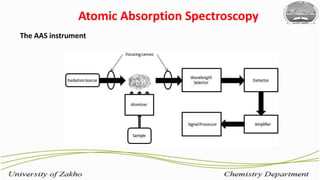
The AAS instrument
Atomic Absorption Spectroscopy
Flame Atomic Absorption Spectroscopy:
6
The technique requires a liquid sample to be aspirated, aerosolized, and mixed with
combustible gases, such as acetylene and air or acetylene and nitrous oxide.
The mixture is ignited in a flame whose temperature ranges from 2100 to 2800 ºC.
Atomic Absorption Spectroscopy
Flame Atomic Absorption Spectroscopy:
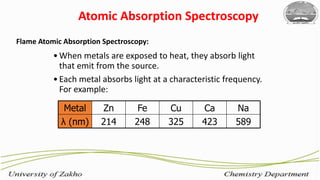
•When metals are exposed to heat, they absorb light
that emit from the source.
•Each metal absorbs light at a characteristic frequency.
For example:
Metal Zn Fe Cu Ca Na
λ (nm) 214 248 325 423 589
Atomic Absorption Spectroscopy
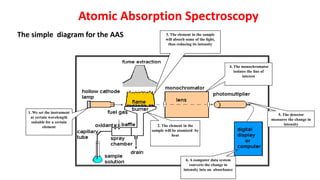
1. We set the instrument
at certain wavelength
suitable for a certain
element 2. The element in the
sample will be atomized by
heat
4. The monochromator
isolates the line of
interest
3. The element in the sample
will absorb some of the light,
thus reducing its intensity
5. The detector
measures the change in
intensity
6. A computer data system
converts the change in
intensity into an absorbance
The simple diagram for the AAS
Atomic Absorption Spectroscopy
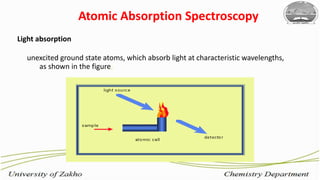
Light absorption
9
unexcited ground state atoms, which absorb light at characteristic wavelengths,
as shown in the figure.
Atomic Absorption Spectroscopy
Lamp (Hollow Cathode Lamp)
10
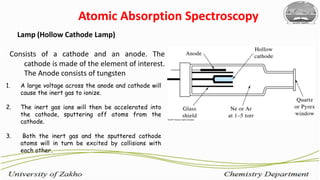
Consists of a cathode and an anode. The
cathode is made of the element of interest.
The Anode consists of tungsten
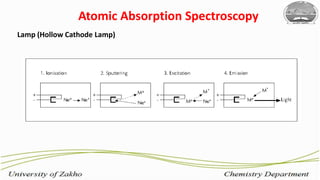
1. A large voltage across the anode and cathode will
cause the inert gas to ionize.
2. The inert gas ions will then be accelerated into
the cathode, sputtering off atoms from the
cathode.
3. Both the inert gas and the sputtered cathode
atoms will in turn be excited by collisions with
each other.
Atomic Absorption Spectroscopy
Lamp (Hollow Cathode Lamp)
11
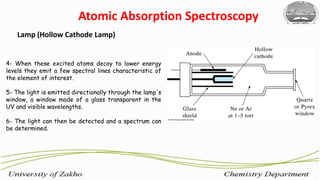
4- When these excited atoms decay to lower energy
levels they emit a few spectral lines characteristic of
the element of interest.
5- The light is emitted directionally through the lamp's
window, a window made of a glass transparent in the
UV and visible wavelengths.
6- The light can then be detected and a spectrum can
be determined.
Atomic Absorption Spectroscopy
Lamp (Hollow Cathode Lamp)
12
Atomic Absorption Spectroscopy
13
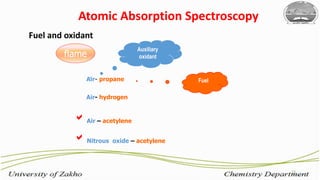
Fuel and oxidant
flame
b Air – acetylene
Air- propane
Air- hydrogen
b Nitrous oxide – acetylene
Auxiliary
oxidant
Fuel
Atomic Absorption Spectroscopy
14
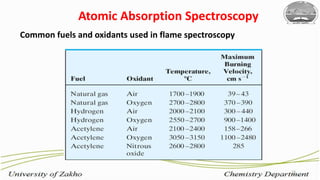
Common fuels and oxidants used in flame spectroscopy
Atomic Absorption Spectroscopy
15
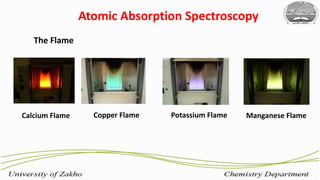
The Flame
Calcium Flame Copper Flame Potassium Flame Manganese Flame
Atomic Absorption Spectroscopy
16
Atomic Absorption Spectroscopy
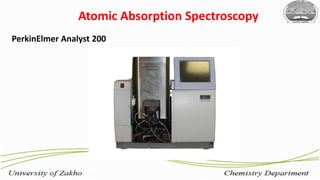
PerkinElmer Analyst 200
17
Atomic Absorption Spectroscopy
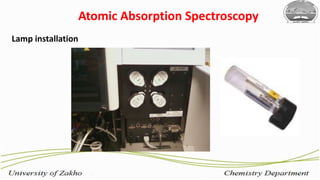
Lamp installation
18
Atomic Absorption Spectroscopy
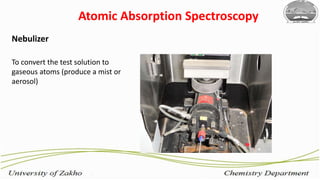
Nebulizer
To convert the test solution to
gaseous atoms (produce a mist or
aerosol)
19
Atomic Absorption Spectroscopy
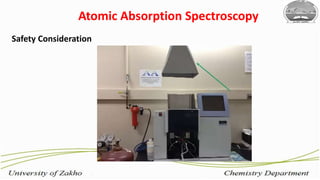
Safety Consideration
20
Atomic Absorption Spectroscopy
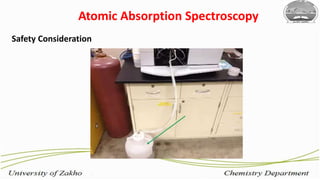
Safety Consideration
21
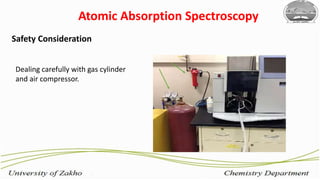
Atomic Absorption Spectroscopy
Safety Consideration
Dealing carefully with gas cylinder
and air compressor.

Flame Atomic Absorption Spectroscopy

  • 1.
    1 INSTRUMENTALANALYSIS LAB. Mr Haydar A.M.S BSc,MSc Faculty of Science Chemistry Department Email: Haydar.kovly@gmail.com
  • 2.
  • 3.
    Aim of theexperiment 3  To be familiar with using flame atomic absorption spectroscopy.  Determination of calcium (Ca) in bottled water.
  • 4.
    4 Atomic Absorption Spectroscopy Atomicabsorption spectrometry (AAS) is an analytical technique that measures the concentrations of elements. • Used for qualitative and quantitative detection. • It’s used for the determination of the presence and concentrations of metals in liquid samples. • Metals that can be detected include Fe, Cu, Al, Pb, Ca, Zn, Cd and many more. • Concentrations range is in the low mg/L (ppm) range.
  • 5.
    5 The AAS instrument AtomicAbsorption Spectroscopy
  • 6.
    Flame Atomic AbsorptionSpectroscopy: 6 The technique requires a liquid sample to be aspirated, aerosolized, and mixed with combustible gases, such as acetylene and air or acetylene and nitrous oxide. The mixture is ignited in a flame whose temperature ranges from 2100 to 2800 ºC. Atomic Absorption Spectroscopy
  • 7.
    Flame Atomic AbsorptionSpectroscopy: •When metals are exposed to heat, they absorb light that emit from the source. •Each metal absorbs light at a characteristic frequency. For example: Metal Zn Fe Cu Ca Na λ (nm) 214 248 325 423 589 Atomic Absorption Spectroscopy
  • 8.
    1. We setthe instrument at certain wavelength suitable for a certain element 2. The element in the sample will be atomized by heat 4. The monochromator isolates the line of interest 3. The element in the sample will absorb some of the light, thus reducing its intensity 5. The detector measures the change in intensity 6. A computer data system converts the change in intensity into an absorbance The simple diagram for the AAS Atomic Absorption Spectroscopy
  • 9.
    Light absorption 9 unexcited groundstate atoms, which absorb light at characteristic wavelengths, as shown in the figure. Atomic Absorption Spectroscopy
  • 10.
    Lamp (Hollow CathodeLamp) 10 Consists of a cathode and an anode. The cathode is made of the element of interest. The Anode consists of tungsten 1. A large voltage across the anode and cathode will cause the inert gas to ionize. 2. The inert gas ions will then be accelerated into the cathode, sputtering off atoms from the cathode. 3. Both the inert gas and the sputtered cathode atoms will in turn be excited by collisions with each other. Atomic Absorption Spectroscopy
  • 11.
    Lamp (Hollow CathodeLamp) 11 4- When these excited atoms decay to lower energy levels they emit a few spectral lines characteristic of the element of interest. 5- The light is emitted directionally through the lamp's window, a window made of a glass transparent in the UV and visible wavelengths. 6- The light can then be detected and a spectrum can be determined. Atomic Absorption Spectroscopy
  • 12.
    Lamp (Hollow CathodeLamp) 12 Atomic Absorption Spectroscopy
  • 13.
    13 Fuel and oxidant flame bAir – acetylene Air- propane Air- hydrogen b Nitrous oxide – acetylene Auxiliary oxidant Fuel Atomic Absorption Spectroscopy
  • 14.
    14 Common fuels andoxidants used in flame spectroscopy Atomic Absorption Spectroscopy
  • 15.
    15 The Flame Calcium FlameCopper Flame Potassium Flame Manganese Flame Atomic Absorption Spectroscopy
  • 16.
  • 17.
  • 18.
    18 Atomic Absorption Spectroscopy Nebulizer Toconvert the test solution to gaseous atoms (produce a mist or aerosol)
  • 19.
  • 20.
  • 21.
    21 Atomic Absorption Spectroscopy SafetyConsideration Dealing carefully with gas cylinder and air compressor.