

By
HANU PRATAP
AUTOMATED BACTERIAL
IDENTIFICATION SYSTEM
INTRODUCTION
 An automated, computerized system, the
automicrobic system, has been developed for
the detection, enumeration & identification of
bacteria & yeasts in clinical specimens.
 The biological basis for the system resides in
lyophilized, highly selective & specific media
enclosed in wells of disposable plastic curette,
or a cartridge.
 Introduction of a suitable specimen rehydrates &
inoculates the media in the wells.
 An automated optical system monitors, & the
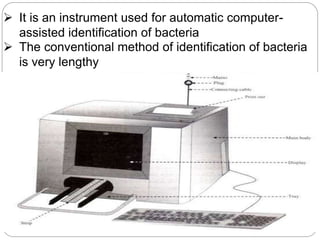
 It is an instrument used for automatic computer-
assisted identification of bacteria
 The conventional method of identification of bacteria
is very lengthy
 It mainly involves staining, motility test, cultural
characteristics, a series of biochemical tests and
finally searching the name of the bacteria in ‘Bergey’s
Manual of Determinative Bacteriology’ by matching
the results with those available in the manual.
 The automatic bacteria identification system
automatically identifies the bacteria in very short
time.
 The system uses disposable cards. One card is
required for the identification of one bacteria.
 The system can accommodate a series of cards,
which can be arranged on a cassette, thus enabling
the identification of several bacteria at a time.
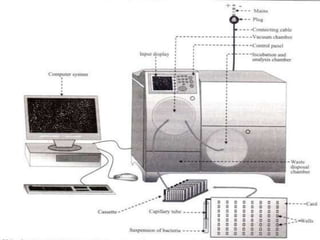
Mains:it is the source of electric current for the
equipment runs using alternating current(AC) supplied
through a three-ply cable. The 3 wires are phase(+),
neutral(-) & earthing(E).the earthing helps in the safe
operation in the equipment against electric shock due
to any short-circuit.
Plug: A three-pin plug provides non-sparkling interface
b/w the equipment & the mains.
Connecting cable: A three-ply cable connects the main
with the equipment.
Control panel: it is the panel or switchboard containing
all the switches , with which the functions of the
systems can be controlled. The different parameters
like temperature, & time of incubation required for the
operation of the system can be programmed on the
 Vaccum chamber: it is the chamber, into which the cassette
containing the card & the bacterial suspensions to be identified
to be put. A high vaccum is created inside the chamber, which
forces the bacterial suspensions to be sucked into the capillary
tubes & dispensed into the wells of the cards. Incubation & analysis chamber: in this chamber, incubation &
color readings takes place simultaneously. The cassette
containing the cards dispensed with the bacteria suspension is
put into it. After scanning the barcodes on the cards, the
capillary tubes are cut & the cut ends seals automatically. Then
, the cards are positioned onto a carosol(a wheel like stru),
which moves in such a ways that in every 15 mins each card
comes in front of the colour reader. The colour reader reads
the changes in colour at three different wavelengths. The
changes in the colour of the media in the wells of the each
card are recorded & sent to the computer for the comparison
of the results with the databaase & display of the names of the
bacteria in terms of genus & species.
 Waste disposal chamber: after analysis, the used cards
automatically get collected in the waste disposal chamber for
the further disposal to outside after sterilization.
 Cards: the identification of each unknown bacteria requires one
disposable card . There are few types of card s each specific for
a particular group of bacteria. The type of card to be used for a
particular unknown bacteria is determined by a preliminary test
like gram staining. wells: Each card has several rows of well. Usually there are
8rows of 8 wells each (8*8=64wells). The wells contain different
dehydrated media for different microbial tests required for the
identification of the bacteria.when the bacteria suspension is
dispensed into alll the wells. the dehydrated media become
hydrated by the suspension liquid. The hydrated media allows
the bacteria to grow. The growth of the bacteria in the wells
results in the change in the colour of the media in the particular
way, which is characteristic for each bacteria species.
 Suspension of bacteria:the unkonwn bacteria grown as
isolated colony on a plate or as pure culture grown on a
slant is taken . A loopful of the bacteria is transferrd
aseptically into sterile saline solution in a test tube & a
suspension of bacteria is made. The suspension should
contain a prescribed density of bacteria as determined by a
densitometer.
 Capillary tube: a capillary tube is fixed to each card, which
sucks the suspension of bacteria& dispenses into all the
wells.
 Cassette:it can hold a series of cards along with their
respective test tubes containing bacteria suspensions. The
test tubes & cards are fixed in such a way that the tips of
the suction capillary tubes of the cards remain deeply
submerged in the suspensions.
 Computer systems: the results of colour changes results by
the analysis chamber to the computer, which automatically
compares them with those available in its library(
ADVANTAGES
 Reduce human errors
 Safety
 Improve turnaround time
 Increase productivity
 Run more tests
 Operate with fewer instruments
DISADVANTAGES
 Automation is too expensive for
microbiology laboratories & labs are too
small to automate.
 Need pure culture
 In mixed cultures, will pick up the
dominant organism
 Antimicrobial susceptibility not possible
 Viruses not identified
 Identifies only organisms in database
BIBLIOGRAPHY
www.americanpharmaceuticalreview
 JOURNAL, OF CLINICAL MICROBIOLOGY,
oct,1997, p.406-413
THANK YOU

Automated microbial identification system

  • 1.
  • 2.
    INTRODUCTION  An automated,computerized system, the automicrobic system, has been developed for the detection, enumeration & identification of bacteria & yeasts in clinical specimens.  The biological basis for the system resides in lyophilized, highly selective & specific media enclosed in wells of disposable plastic curette, or a cartridge.  Introduction of a suitable specimen rehydrates & inoculates the media in the wells.  An automated optical system monitors, & the
  • 3.
     It isan instrument used for automatic computer- assisted identification of bacteria  The conventional method of identification of bacteria is very lengthy
  • 4.
     It mainlyinvolves staining, motility test, cultural characteristics, a series of biochemical tests and finally searching the name of the bacteria in ‘Bergey’s Manual of Determinative Bacteriology’ by matching the results with those available in the manual.  The automatic bacteria identification system automatically identifies the bacteria in very short time.  The system uses disposable cards. One card is required for the identification of one bacteria.  The system can accommodate a series of cards, which can be arranged on a cassette, thus enabling the identification of several bacteria at a time.
  • 6.
    Mains:it is thesource of electric current for the equipment runs using alternating current(AC) supplied through a three-ply cable. The 3 wires are phase(+), neutral(-) & earthing(E).the earthing helps in the safe operation in the equipment against electric shock due to any short-circuit. Plug: A three-pin plug provides non-sparkling interface b/w the equipment & the mains. Connecting cable: A three-ply cable connects the main with the equipment. Control panel: it is the panel or switchboard containing all the switches , with which the functions of the systems can be controlled. The different parameters like temperature, & time of incubation required for the operation of the system can be programmed on the
  • 7.
     Vaccum chamber:it is the chamber, into which the cassette containing the card & the bacterial suspensions to be identified to be put. A high vaccum is created inside the chamber, which forces the bacterial suspensions to be sucked into the capillary tubes & dispensed into the wells of the cards. Incubation & analysis chamber: in this chamber, incubation & color readings takes place simultaneously. The cassette containing the cards dispensed with the bacteria suspension is put into it. After scanning the barcodes on the cards, the capillary tubes are cut & the cut ends seals automatically. Then , the cards are positioned onto a carosol(a wheel like stru), which moves in such a ways that in every 15 mins each card comes in front of the colour reader. The colour reader reads the changes in colour at three different wavelengths. The changes in the colour of the media in the wells of the each card are recorded & sent to the computer for the comparison of the results with the databaase & display of the names of the bacteria in terms of genus & species.
  • 8.
     Waste disposalchamber: after analysis, the used cards automatically get collected in the waste disposal chamber for the further disposal to outside after sterilization.  Cards: the identification of each unknown bacteria requires one disposable card . There are few types of card s each specific for a particular group of bacteria. The type of card to be used for a particular unknown bacteria is determined by a preliminary test like gram staining. wells: Each card has several rows of well. Usually there are 8rows of 8 wells each (8*8=64wells). The wells contain different dehydrated media for different microbial tests required for the identification of the bacteria.when the bacteria suspension is dispensed into alll the wells. the dehydrated media become hydrated by the suspension liquid. The hydrated media allows the bacteria to grow. The growth of the bacteria in the wells results in the change in the colour of the media in the particular way, which is characteristic for each bacteria species.
  • 9.
     Suspension ofbacteria:the unkonwn bacteria grown as isolated colony on a plate or as pure culture grown on a slant is taken . A loopful of the bacteria is transferrd aseptically into sterile saline solution in a test tube & a suspension of bacteria is made. The suspension should contain a prescribed density of bacteria as determined by a densitometer.  Capillary tube: a capillary tube is fixed to each card, which sucks the suspension of bacteria& dispenses into all the wells.  Cassette:it can hold a series of cards along with their respective test tubes containing bacteria suspensions. The test tubes & cards are fixed in such a way that the tips of the suction capillary tubes of the cards remain deeply submerged in the suspensions.  Computer systems: the results of colour changes results by the analysis chamber to the computer, which automatically compares them with those available in its library(
  • 10.
    ADVANTAGES  Reduce humanerrors  Safety  Improve turnaround time  Increase productivity  Run more tests  Operate with fewer instruments
  • 11.
    DISADVANTAGES  Automation istoo expensive for microbiology laboratories & labs are too small to automate.  Need pure culture  In mixed cultures, will pick up the dominant organism  Antimicrobial susceptibility not possible  Viruses not identified  Identifies only organisms in database
  • 12.
    BIBLIOGRAPHY www.americanpharmaceuticalreview  JOURNAL, OFCLINICAL MICROBIOLOGY, oct,1997, p.406-413
  • 13.