HVAC
Fundamentals
02/16/16
Objectives
• Basic industry terms
• Basics of BMS and HVAC
To gain familiarity with:
02/16/16
Why have Controls and BMS ?
Safety
• of People
• of equipment
Economy
• Save money
• Use just the right amount of
energy (electric power, gas
etc.)
• Increase equipment life by
using it efficiently
• Protect equipment and
products (avoids wastage -
paintings in a gallery,
drug/chemical stores)
• People’s productivity
Comfort
• Too hot/cold
• Too dry/humid
• Too polluted
• “Sick Occupancy”
• Health and Safety
• 21 Deg C/ 50% RH
•24 Deg C/ 50% RH
• Enough Fresh Air
• Clean Air
02/16/16
Why have Controls and BMS ?
Comfort
• Need to ADD/REMOVE heat and/or moisture
• Need to clean (filter air) and supply adequate fresh air
People lose heat (feel cold) - amount they lose depends on temperature
around them - cooler it is, more heat they will lose through their skin
OR they “generate” heat (feel warm/hot - WORK TOO HARD!) - need to
cool them down by reducing air temperature around them
People feel “muggy” - the air around them has too much moisture
People feel “dry” - not enough moisture in the air around them
Buildings (where people live and work) also lose or gain heat (through walls,
Windows, floors, roofs, heat generating equipment e.g. VDUs, and
computer equipment)
02/16/16
Why have Controls and BMS ?
Safety
• Need to provide protection against equipment running “wild” / out of control
• Need to make sure people are safe at all times
Can’t have coolers or heaters (boilers) running “wild” - they might
freeze up or blow up!
If too hot or cold for long period of time - affects their health
Sometimes you have special needs for process (making capsules,
fiber, etc)
Hospitals may have special needs for patients / medicines / labs
02/16/16
Why have Controls and BMS ?
Economy
• Use energy efficiently - use plant efficiently - make people comfortable
(they will produce more???)
Electric power or fuel (gas, coal, oil) is expensive and limited (?)- need to use
efficiently
Environmental issues (Clean atmosphere for the occupants)
Need to ensure maximum return on investment - prolong equipment life and get
the best out of it
Increase productivity of people increased profits for offices, hotels, etc.
Ensure that products you are making/ supplying (e.g. supermarket) do not
deteriorate because of bad “environment”
02/16/16
• How do you heat / cool your
home?
• How does the heating /
cooling know when to turn
on?
• How does the Hot / Chilled
water turn on and off ?
You already know Controls.....
02/16/16
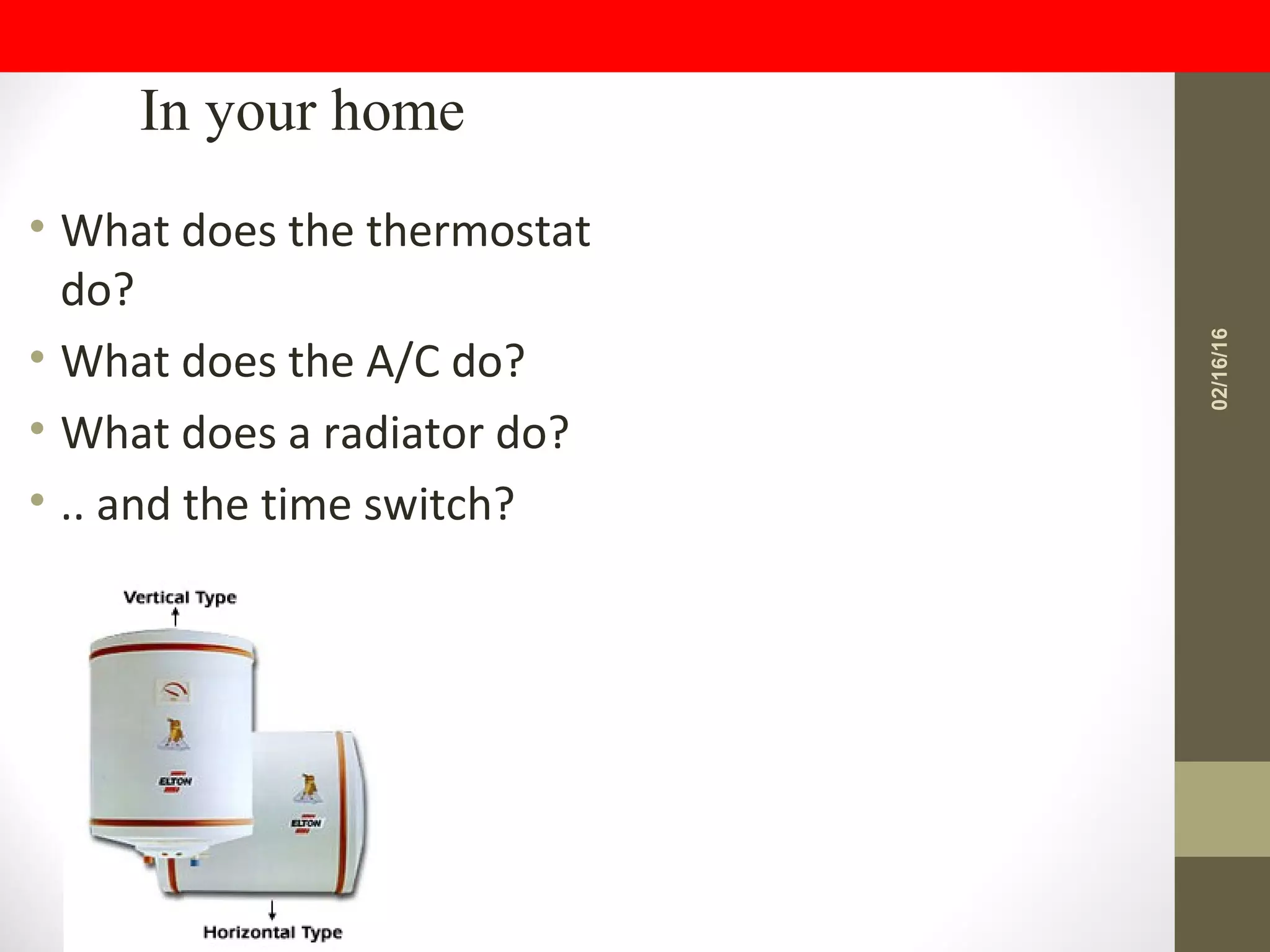
• What does the thermostat
do?
• What does the A/C do?
• What does a radiator do?
• .. and the time switch?
In your home
02/16/16
• Larger areas to be heated or cooled therefore bigger
equipment
(e.g. Chillers, pumps, valves)
• Different types heating/cooling equipment are used.
• Operational needs are different e.g.
• different areas of the buildings occupied at different times
• different areas have differing heating/ cooling requirements
• Central monitoring point for Building Energy Management
System
Air-conditioning in large buildings
Basic issues are same - Comfort, Safety, Economy, BUT
02/16/16
• People working in the industry refer to Wet and Dry
Systems in a building
Wet & Dry Systems?
Wet Systems:
• Any systems to do with water e.g.
– Chillers (cool Water)
– Boilers (heat water)
– Pumps (makes water flow in
pipes)
– Valves (regulates amount of
water flow through heating or
cooling “radiators” or coils
Dry Systems:
• Any systems to do with Air e.g.
– Fans (makes air flow in ducts)
– Filters (clean air)
– Dampers (regulates amount of
Air flow through the ducts)
– Air handling units (cools,
heats, filters air - ALL IN
ONE)
Need to CONTROL and/or MONITOR both Systems
02/16/16
• Control and Monitor
• Room (Air) temperature, humidity, ventilation
• Chillers (chilled/cold water services)
• Boilers (Hot water services)
• Pumps
• Fans
• Lights
• Flow
Managing large building?
• What types of buildings and facilities do you think can use
controls and BMS?
– Any building
02/16/16
Introduce HVAC?
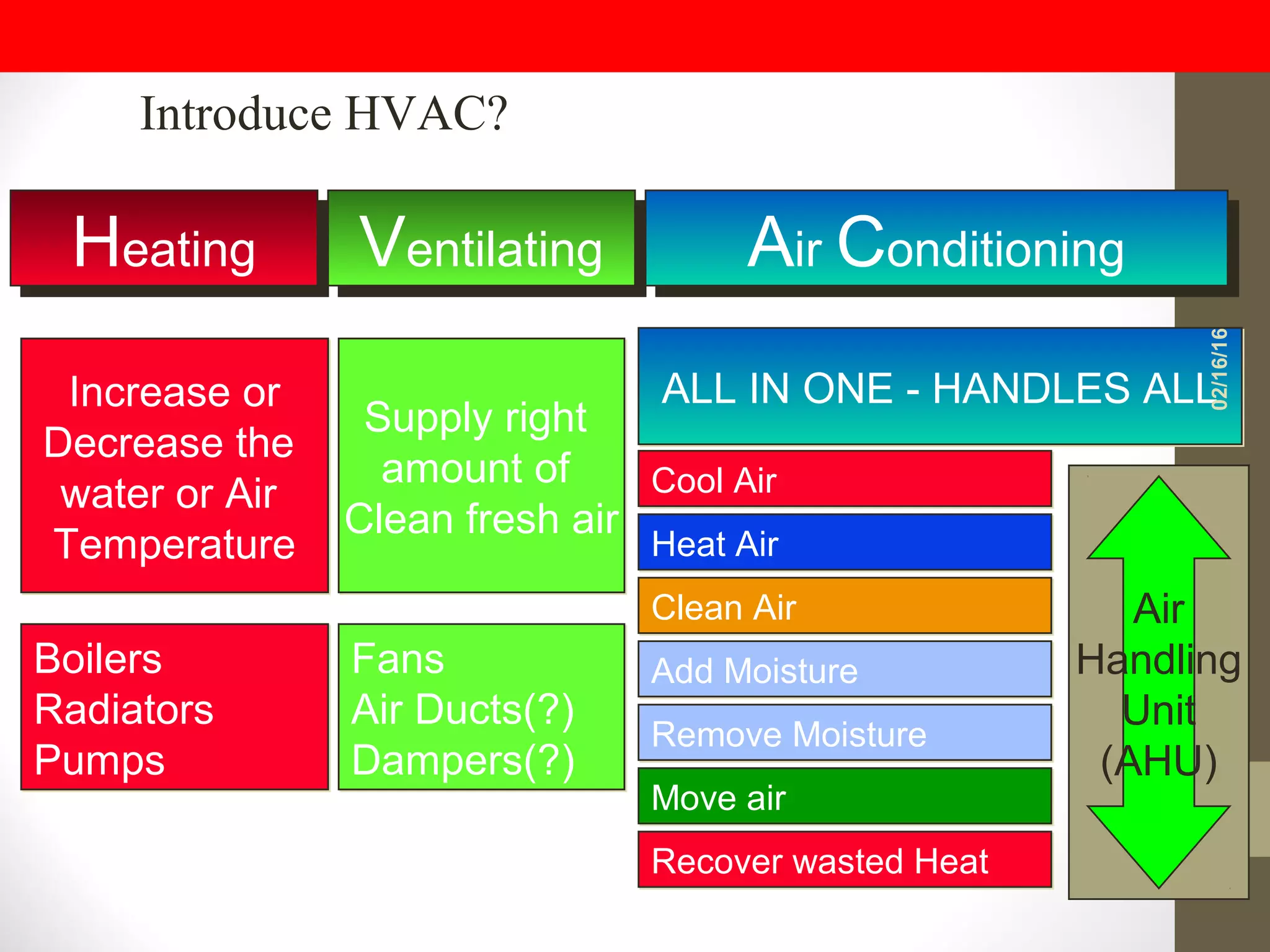
HeatingHeating
Increase or
Decrease the
water or Air
Temperature
Increase or
Decrease the
water or Air
Temperature
Boilers
Radiators
Pumps
Boilers
Radiators
Pumps
VentilatingVentilating
Supply right
amount of
Clean fresh air
Supply right
amount of
Clean fresh air
Fans
Air Ducts(?)
Dampers(?)
Fans
Air Ducts(?)
Dampers(?)
Air ConditioningAir Conditioning
ALL IN ONE - HANDLES ALLALL IN ONE - HANDLES ALL
Cool AirCool Air
Heat AirHeat Air
Clean AirClean Air
Add MoistureAdd Moisture
Remove MoistureRemove Moisture
Move airMove air
Recover wasted HeatRecover wasted Heat
Air
Handling
Unit
(AHU)
02/16/16
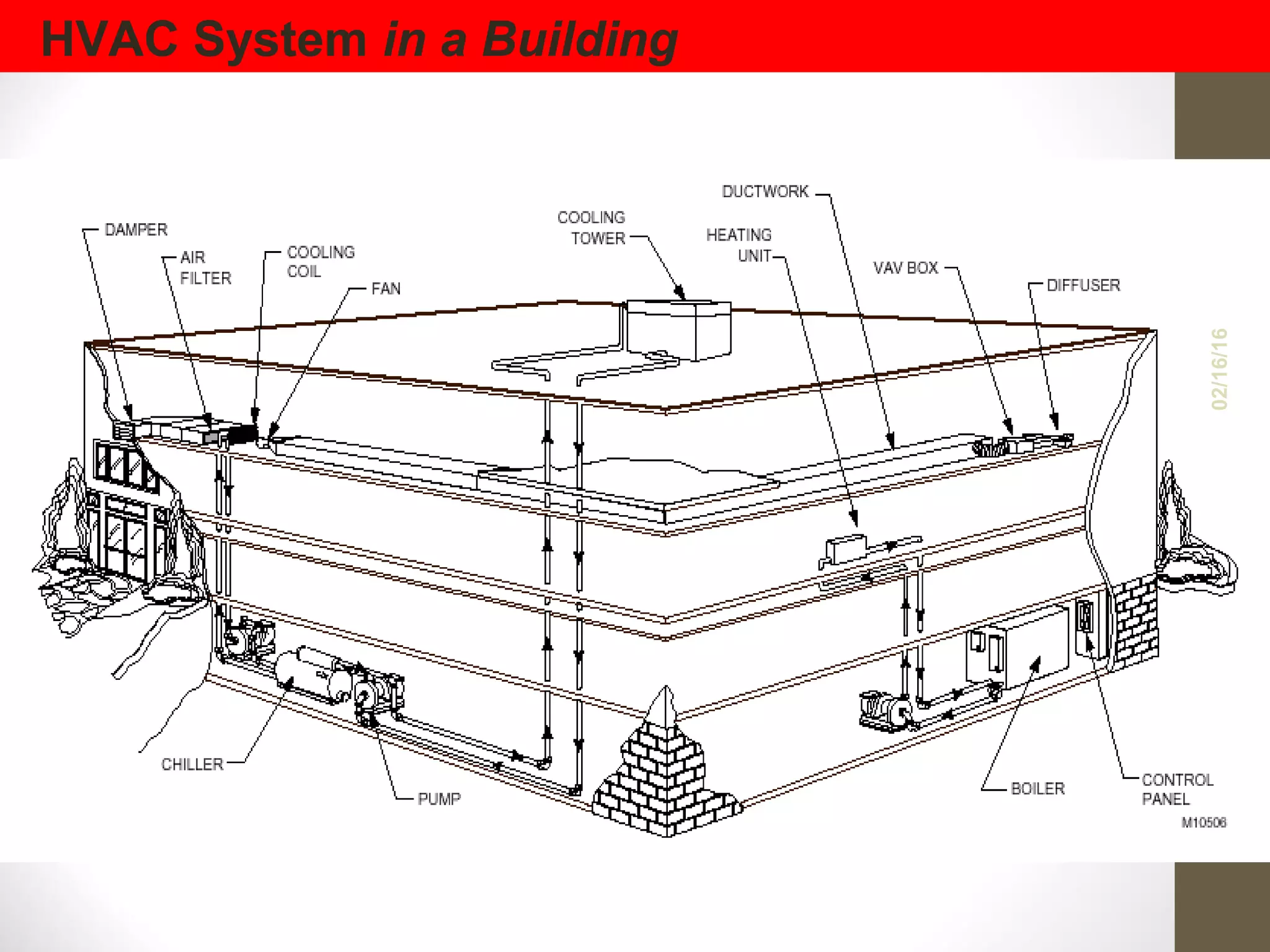
HVAC System in a Building
02/16/16
Basic of Refrigeration
02/16/16
Refrigeration
is
COOLCOOL
How it Works
02/16/16
THERETHERE
IS NO COOLIS NO COOL
ONLYONLY HEATHEAT
AS LONG AS THERE’S ATOMIC MOTIONAS LONG AS THERE’S ATOMIC MOTION
02/16/16
Cold can’t
be given to an object.
Heat must be removed.
02/16/16
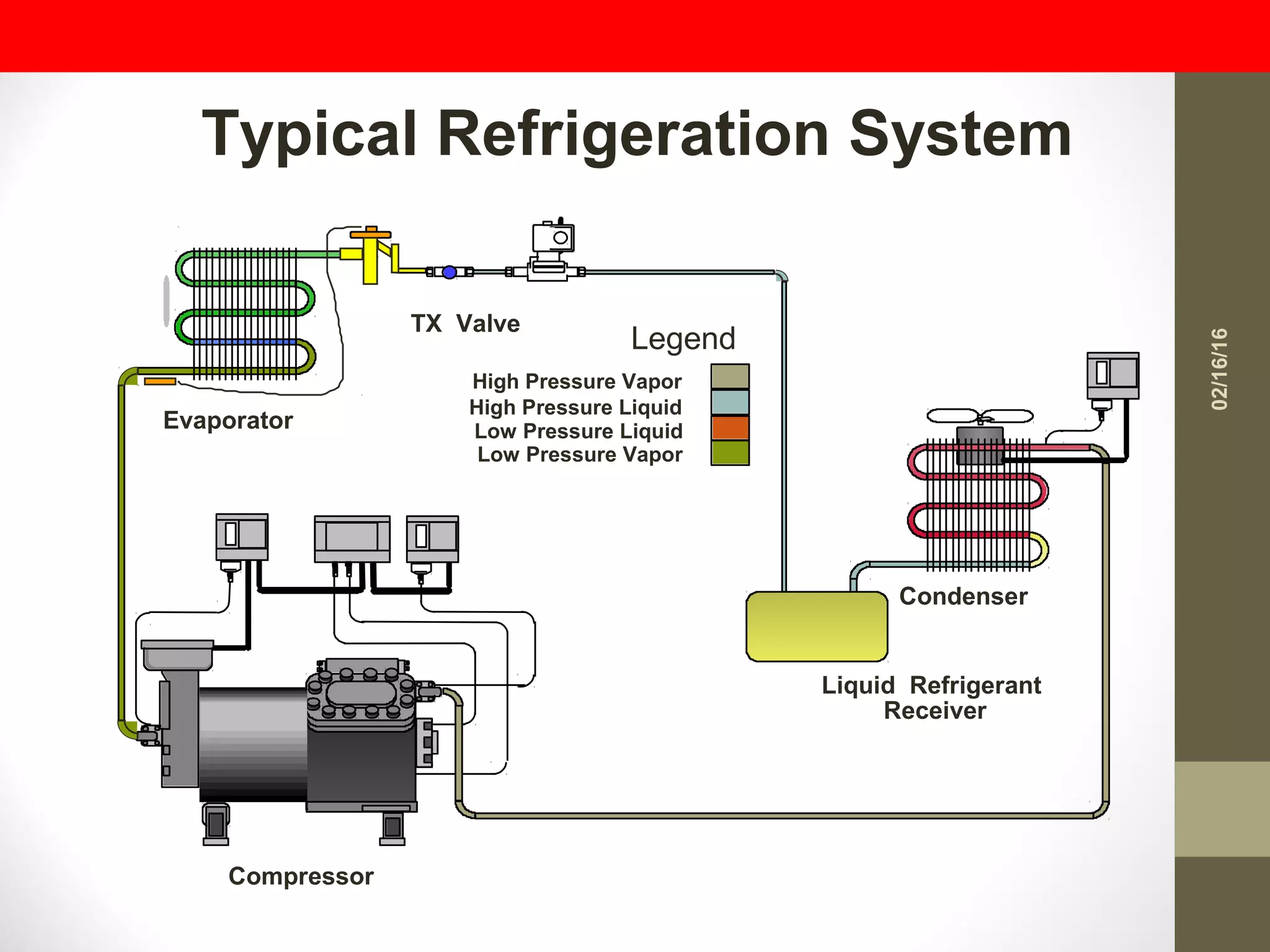
A Refrigeration System is a
Heat Moving Machine
Condenser
Evaporator
02/16/16
Typical Refrigeration System
Low Pressure Vapor
Low Pressure Liquid
High Pressure Liquid
High Pressure Vapor
Legend
Liquid Refrigerant
Receiver
Evaporator
Condenser
Compressor
TX Valve
02/16/16
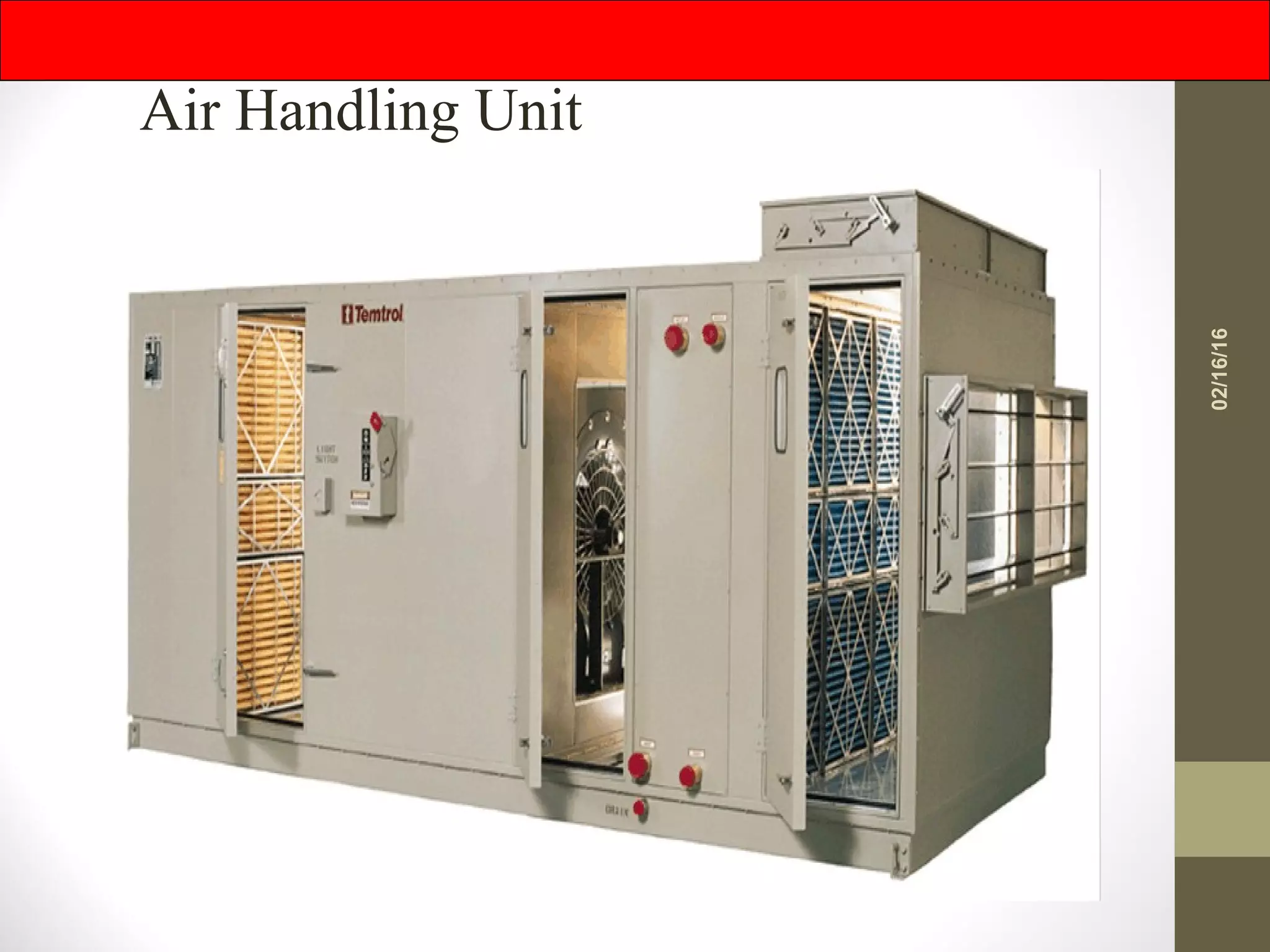
Air Handling Unit
02/16/16
Air Handling Unit
02/16/16
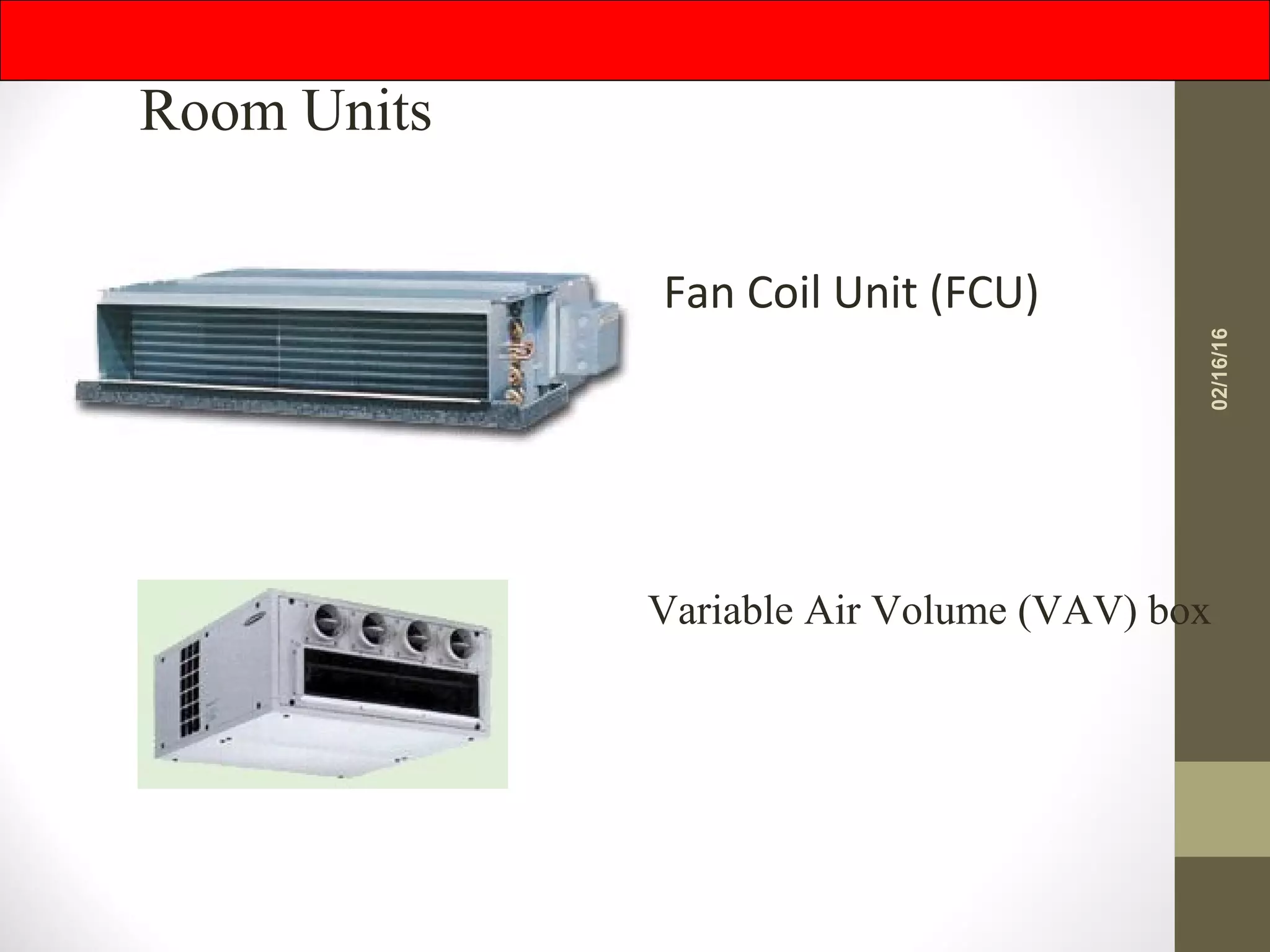
Fan Coil Unit (FCU)
Room Units
Variable Air Volume (VAV) box
02/16/16
Packaged Units
Complete Room A/C Units
Split Air Conditioning Units
02/16/16
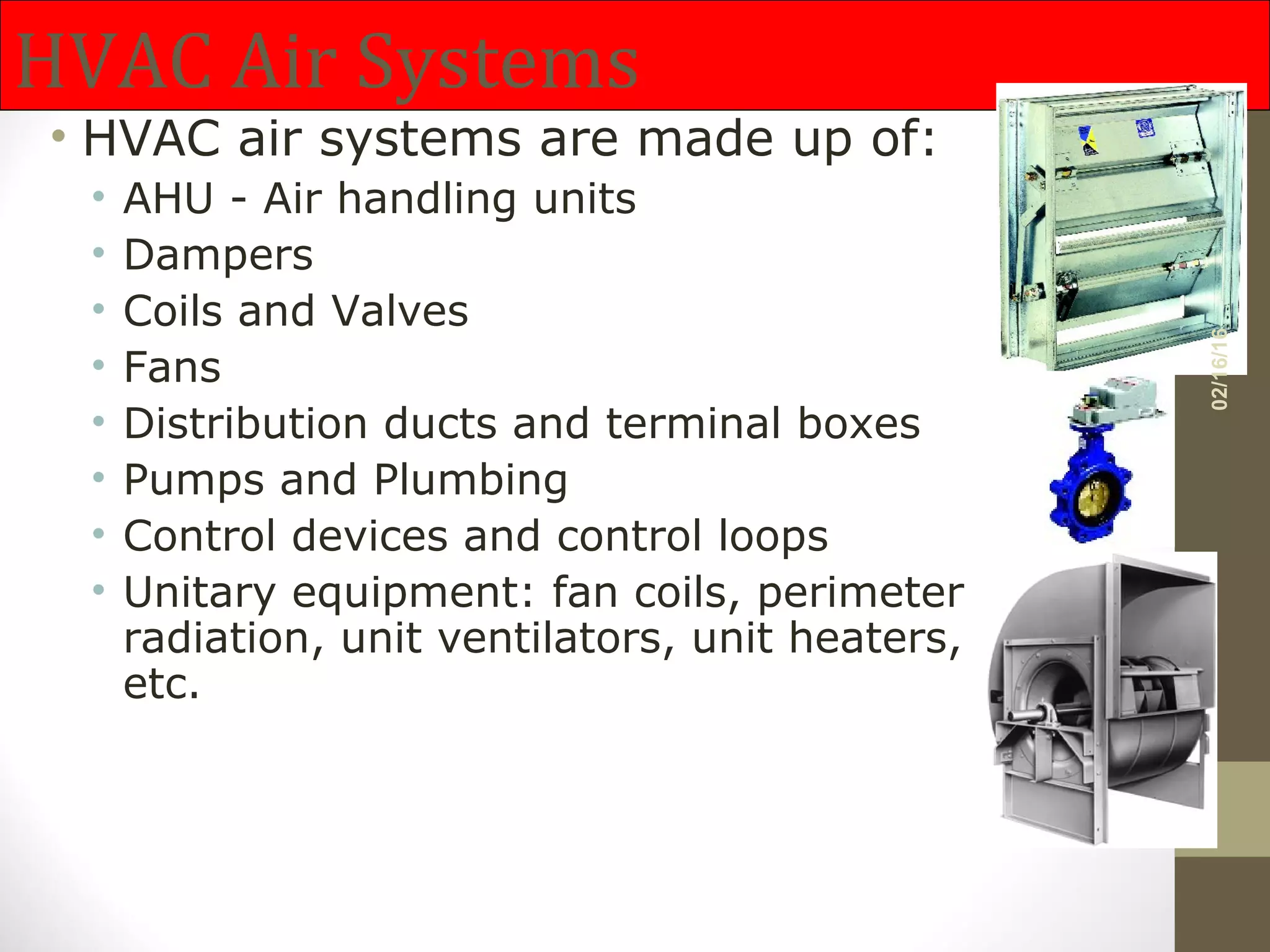
HVAC Air Systems
• HVAC air systems are made up of:
• AHU - Air handling units
• Dampers
• Coils and Valves
• Fans
• Distribution ducts and terminal boxes
• Pumps and Plumbing
• Control devices and control loops
• Unitary equipment: fan coils, perimeter
radiation, unit ventilators, unit heaters,
etc.
02/16/16
AHU - Components & Terminology
RAEA
OA
Return From
Space
Filter
Cooling Coil
Heating
DA
02/16/16
AHU components
02/16/16
What are Functions of AHU ?
• Function:
• Condition the air
• Heat the air
• Cool the air
• Dehumidify the air
• Humidify the air
• Clean the air
• Distribute the conditioned air into the
building space.
• Commercial air handling units can be
compared to home furnaces.
02/16/16
Air Handler Components
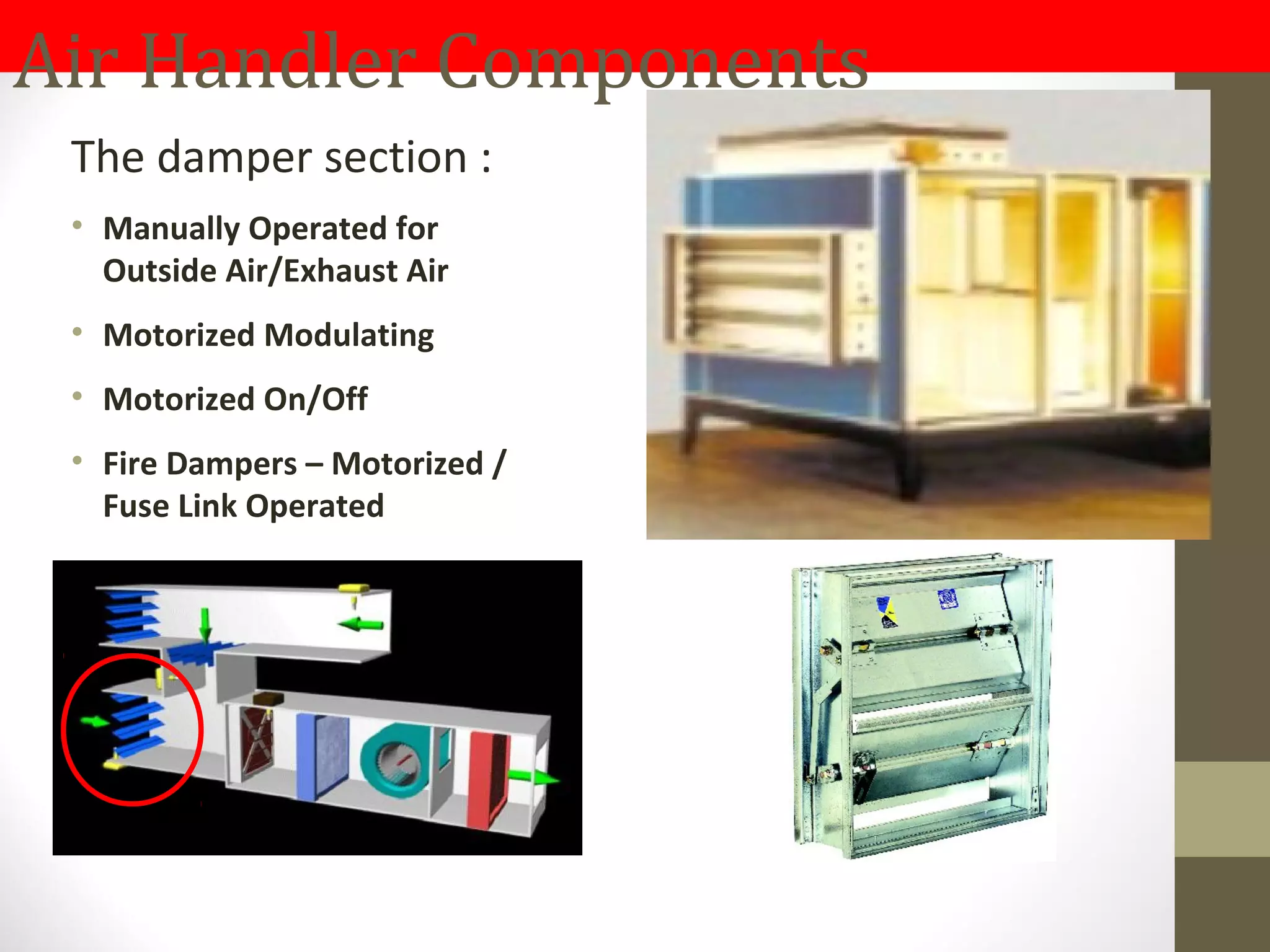
The damper section :
• Manually Operated for
Outside Air/Exhaust Air
• Motorized Modulating
• Motorized On/Off
• Fire Dampers – Motorized /
Fuse Link Operated
Air Handler Components
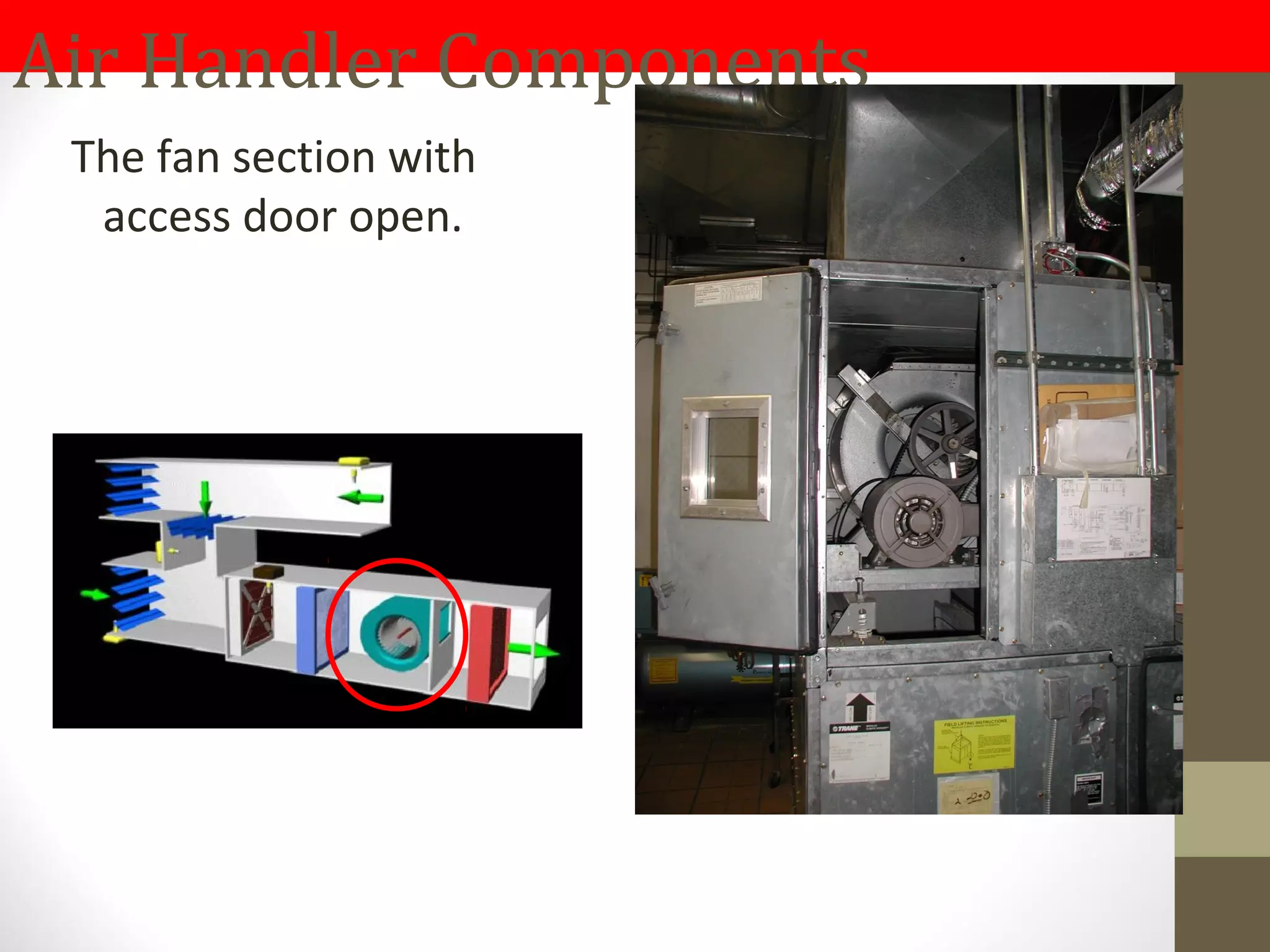
The fan section with
access door open.
Air Handler Components
Filters :
Types of Air Filters
 Pre Filters
 Fine Filters
 HEPA Filters
 ULPA Filters (Ultra Low
Penetration Air)
Air Handler Components
• 70-80-% Efficiency .
• Can filter particles
of size upto 5-10
microns.
• Reusable & Washable
PRE-Filters
Air Handler Components
•90-95 % Efficiency .
• Can filter particles of
size upto 1 to 2 microns.
• Not Reusable
Fine Filters
Air Handler Components
• 99.97-% to 99.99995 %
Efficiency .
• Can filter particles of
size upto 0.1 to 0.3
microns.
• Used in Clean Room
Applications.
•Not Reusable
High Efficiency Particulate Air Filters (HEPA)
Air Handler Components
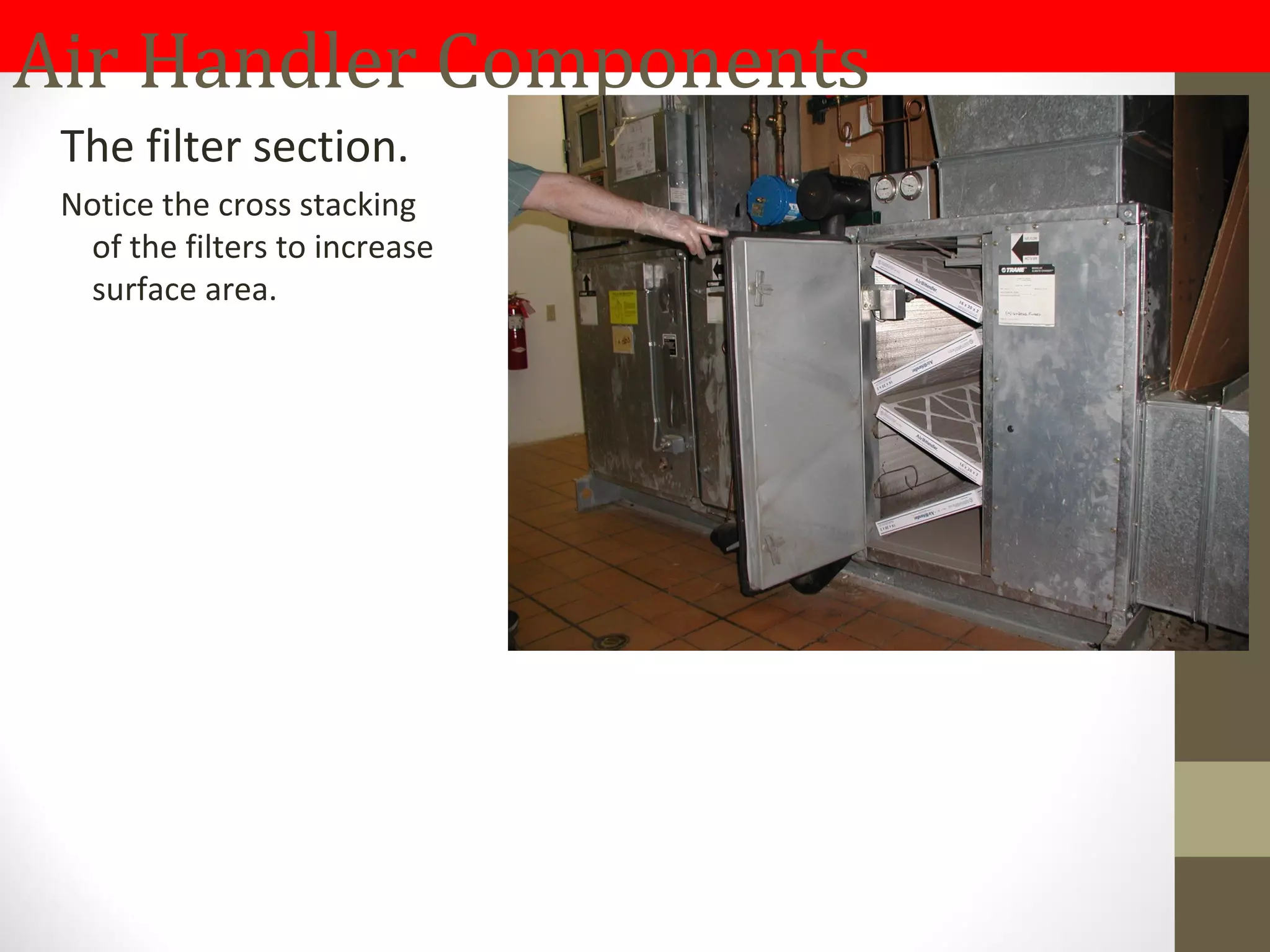
The filter section.
Notice the cross stacking
of the filters to increase
surface area.
Air Handler Components
Temperature Sensor:
• Temperature sensors are used for
measurement of temperature of a
Room, Air Duct, Hot /Cold Water,
Outside Air etc.
• Models are available with PT1000,
NTC20K, BALCO500 sensing
elements.
LF20 : AIR DUCT TEMP. SENSOR (NTC 20k)
T7412 : ROOM TEMP. SENSOR (PT1000/NTC 20k)
T7413A : IMMERSION TEMP. SENSOR (PT1000)
Air Handler Components
Relative Humidity Sensor:
• Relative Humidity sensors are used
for measurement of Relative
humidity of a Room, Air Duct,
Outside Air etc.
• Sensor Type : Capacitance
• Combined Relative Humidity and
Temperature Sensors are available
with PT1000, NTC20K, BALCO500
sensing elements.
H7015 : DUCT RELATIVE HUMIDITY SENSOR
H7012 : ROOM RELATIVE HUMIDITY SENSOR
Air Handler Components
Differential Pressure
Switch:
• Differential Pressure switches are
used for monitoring of Filter, Fan,
Pump, Fire Damper, Water Flow,
Air Flow Status of air handling
systems.
DPS1000 : AIR DIFFERENTIAL PRESSURE SWITCH
TDIAP SERIS : AIR FLOW SWITCH
Air Handler Components
Differential Pressure
Sensors/Transmitter:
• Used for measuring diff. Pressure,
positive pressure and vacuum.
DPT1000 : AIR DIFF. PRESSURE TRANSMITTER
ST 3000 Pressure Transmitter
Air Handler Components
Coils :
Cooling Coils
Heating Coils
Coil Construction
• Copper with Aluminium fins,
• 13 Fins /inch
• Number of Rows, I.e 4/6/8
depending on the latent heat
load & Bypass Factor.
Air Handler Components
The coil section of a AHU.
Note:
There may be a wide
variety of actual configurations
Air Handler Components
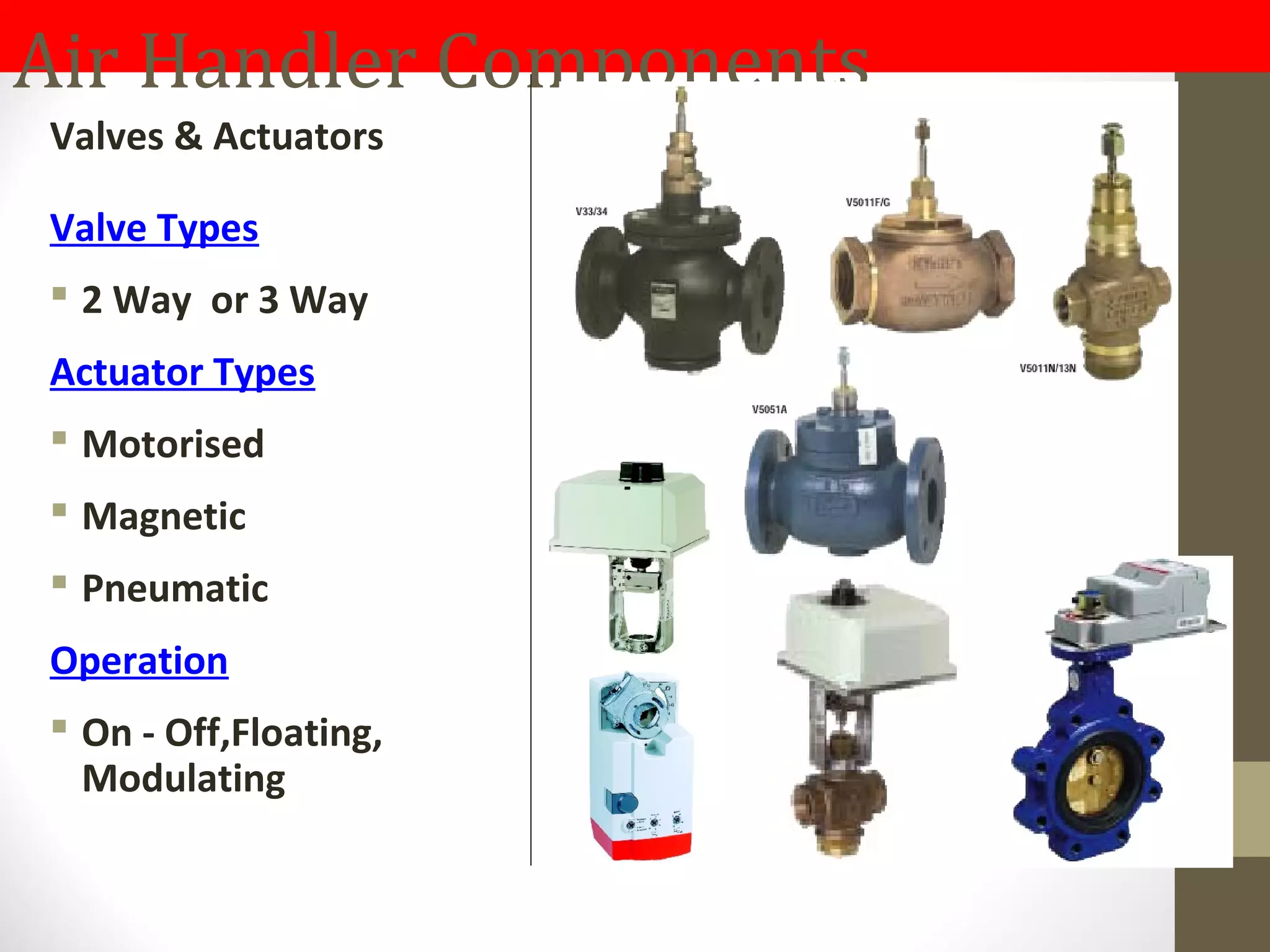
Valves & Actuators
Valve Types
 2 Way or 3 Way
Actuator Types
 Motorised
 Magnetic
 Pneumatic
Operation
 On - Off,Floating,
Modulating
Air Handler Components
Energy Recovery :
A energy-recovery system is
often used in buildings where a
significant quantity of outdoor
air is used. Several types of
heat-recovery systems are
available
 Heat pumps
 Runaround systems
 Rotary heat exchangers
 Heat pipes.
Runaround systems
Heat Wheel
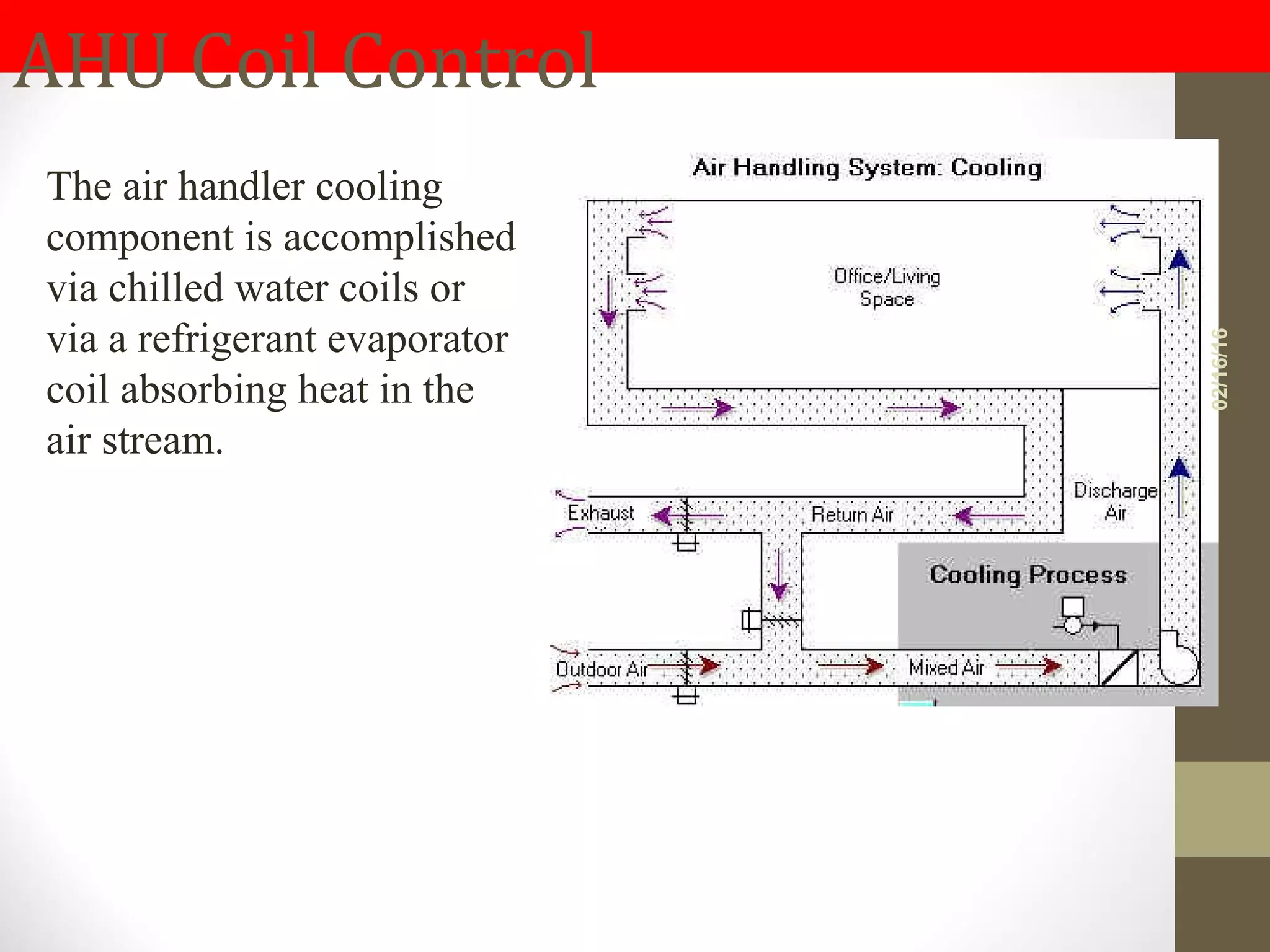
AHU Coil Control
The air handler cooling
component is accomplished
via chilled water coils or
via a refrigerant evaporator
coil absorbing heat in the
air stream.
02/16/16
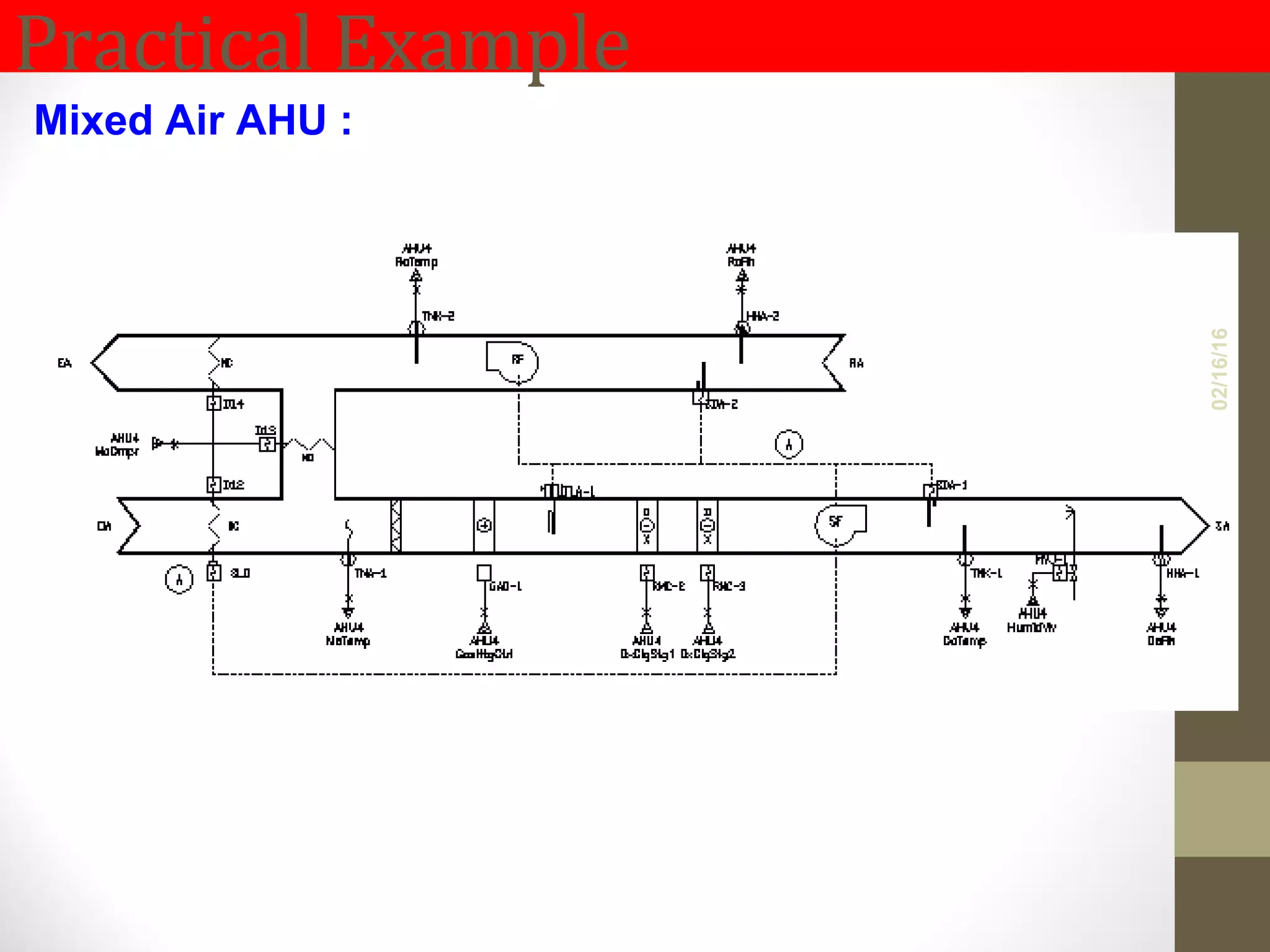
Practical Example
Mixed Air AHU :
02/16/16
Practical Example
100% Outside Air AHU :
02/16/16
Plant
Chiller Plant
02/16/16
Chiller Plant
Chiller Plant systems are made up of:
– Chiller/Condenser Unit
– Chilled Water Pumps
– Condenser Water Pumps
– Cooling Towers
– Makeup Water Tank
– A/C Expansion Water Tank
TRANE Chiller
02/16/16
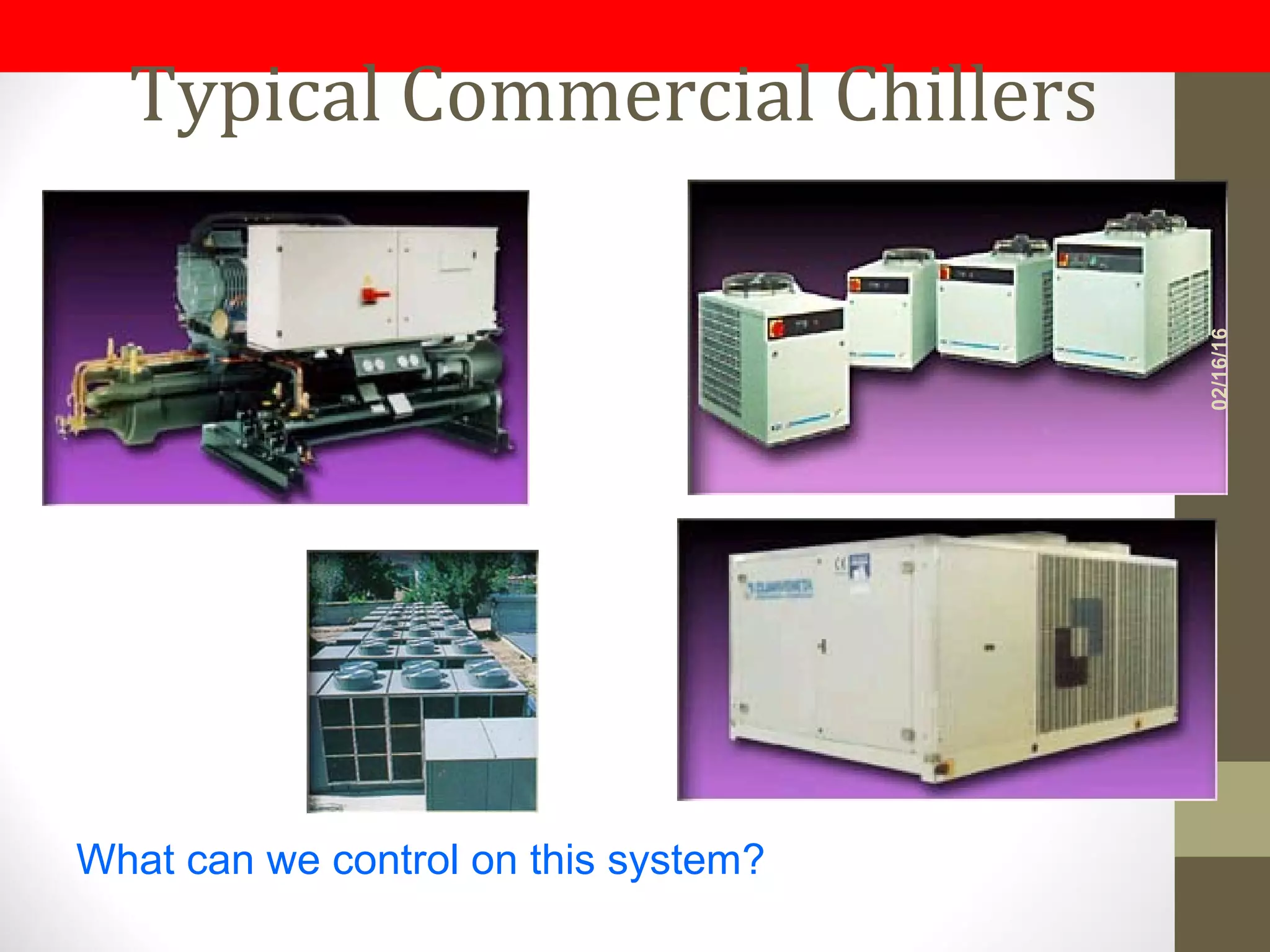
Typical Commercial Chillers
What can we control on this system?
02/16/16
Chiller Plant
Chiller Plant Concept :
02/16/16
Typical Cooling Tower
02/16/16
Typical Chiller Plant
02/16/16
Boiler Plant
Boiler Plant systems are made up of:
– Boiler Units
– Primary Pumps
– Secondary Pumps
Typical Firetube Boiler
02/16/16
Typical Commercial Boiler System
What can we control on this system?
02/16/16
Boiler Plant
02/16/16
Questions ??
02/16/16

HVAC Fundamentals

  • 1.
  • 2.
    Objectives • Basic industryterms • Basics of BMS and HVAC To gain familiarity with: 02/16/16
  • 3.
    Why have Controlsand BMS ? Safety • of People • of equipment Economy • Save money • Use just the right amount of energy (electric power, gas etc.) • Increase equipment life by using it efficiently • Protect equipment and products (avoids wastage - paintings in a gallery, drug/chemical stores) • People’s productivity Comfort • Too hot/cold • Too dry/humid • Too polluted • “Sick Occupancy” • Health and Safety • 21 Deg C/ 50% RH •24 Deg C/ 50% RH • Enough Fresh Air • Clean Air 02/16/16
  • 4.
    Why have Controlsand BMS ? Comfort • Need to ADD/REMOVE heat and/or moisture • Need to clean (filter air) and supply adequate fresh air People lose heat (feel cold) - amount they lose depends on temperature around them - cooler it is, more heat they will lose through their skin OR they “generate” heat (feel warm/hot - WORK TOO HARD!) - need to cool them down by reducing air temperature around them People feel “muggy” - the air around them has too much moisture People feel “dry” - not enough moisture in the air around them Buildings (where people live and work) also lose or gain heat (through walls, Windows, floors, roofs, heat generating equipment e.g. VDUs, and computer equipment) 02/16/16
  • 5.
    Why have Controlsand BMS ? Safety • Need to provide protection against equipment running “wild” / out of control • Need to make sure people are safe at all times Can’t have coolers or heaters (boilers) running “wild” - they might freeze up or blow up! If too hot or cold for long period of time - affects their health Sometimes you have special needs for process (making capsules, fiber, etc) Hospitals may have special needs for patients / medicines / labs 02/16/16
  • 6.
    Why have Controlsand BMS ? Economy • Use energy efficiently - use plant efficiently - make people comfortable (they will produce more???) Electric power or fuel (gas, coal, oil) is expensive and limited (?)- need to use efficiently Environmental issues (Clean atmosphere for the occupants) Need to ensure maximum return on investment - prolong equipment life and get the best out of it Increase productivity of people increased profits for offices, hotels, etc. Ensure that products you are making/ supplying (e.g. supermarket) do not deteriorate because of bad “environment” 02/16/16
  • 7.
    • How doyou heat / cool your home? • How does the heating / cooling know when to turn on? • How does the Hot / Chilled water turn on and off ? You already know Controls..... 02/16/16
  • 8.
    • What doesthe thermostat do? • What does the A/C do? • What does a radiator do? • .. and the time switch? In your home 02/16/16
  • 9.
    • Larger areasto be heated or cooled therefore bigger equipment (e.g. Chillers, pumps, valves) • Different types heating/cooling equipment are used. • Operational needs are different e.g. • different areas of the buildings occupied at different times • different areas have differing heating/ cooling requirements • Central monitoring point for Building Energy Management System Air-conditioning in large buildings Basic issues are same - Comfort, Safety, Economy, BUT 02/16/16
  • 10.
    • People workingin the industry refer to Wet and Dry Systems in a building Wet & Dry Systems? Wet Systems: • Any systems to do with water e.g. – Chillers (cool Water) – Boilers (heat water) – Pumps (makes water flow in pipes) – Valves (regulates amount of water flow through heating or cooling “radiators” or coils Dry Systems: • Any systems to do with Air e.g. – Fans (makes air flow in ducts) – Filters (clean air) – Dampers (regulates amount of Air flow through the ducts) – Air handling units (cools, heats, filters air - ALL IN ONE) Need to CONTROL and/or MONITOR both Systems 02/16/16
  • 11.
    • Control andMonitor • Room (Air) temperature, humidity, ventilation • Chillers (chilled/cold water services) • Boilers (Hot water services) • Pumps • Fans • Lights • Flow Managing large building? • What types of buildings and facilities do you think can use controls and BMS? – Any building 02/16/16
  • 12.
    Introduce HVAC? HeatingHeating Increase or Decreasethe water or Air Temperature Increase or Decrease the water or Air Temperature Boilers Radiators Pumps Boilers Radiators Pumps VentilatingVentilating Supply right amount of Clean fresh air Supply right amount of Clean fresh air Fans Air Ducts(?) Dampers(?) Fans Air Ducts(?) Dampers(?) Air ConditioningAir Conditioning ALL IN ONE - HANDLES ALLALL IN ONE - HANDLES ALL Cool AirCool Air Heat AirHeat Air Clean AirClean Air Add MoistureAdd Moisture Remove MoistureRemove Moisture Move airMove air Recover wasted HeatRecover wasted Heat Air Handling Unit (AHU) 02/16/16
  • 13.
    HVAC System ina Building 02/16/16
  • 14.
  • 15.
  • 16.
    THERETHERE IS NO COOLISNO COOL ONLYONLY HEATHEAT AS LONG AS THERE’S ATOMIC MOTIONAS LONG AS THERE’S ATOMIC MOTION 02/16/16
  • 17.
    Cold can’t be givento an object. Heat must be removed. 02/16/16
  • 18.
    A Refrigeration Systemis a Heat Moving Machine Condenser Evaporator 02/16/16
  • 19.
    Typical Refrigeration System LowPressure Vapor Low Pressure Liquid High Pressure Liquid High Pressure Vapor Legend Liquid Refrigerant Receiver Evaporator Condenser Compressor TX Valve 02/16/16
  • 20.
  • 21.
  • 22.
    Fan Coil Unit(FCU) Room Units Variable Air Volume (VAV) box 02/16/16
  • 23.
    Packaged Units Complete RoomA/C Units Split Air Conditioning Units 02/16/16
  • 24.
    HVAC Air Systems •HVAC air systems are made up of: • AHU - Air handling units • Dampers • Coils and Valves • Fans • Distribution ducts and terminal boxes • Pumps and Plumbing • Control devices and control loops • Unitary equipment: fan coils, perimeter radiation, unit ventilators, unit heaters, etc. 02/16/16
  • 25.
    AHU - Components& Terminology RAEA OA Return From Space Filter Cooling Coil Heating DA 02/16/16
  • 26.
  • 27.
    What are Functionsof AHU ? • Function: • Condition the air • Heat the air • Cool the air • Dehumidify the air • Humidify the air • Clean the air • Distribute the conditioned air into the building space. • Commercial air handling units can be compared to home furnaces. 02/16/16
  • 28.
    Air Handler Components Thedamper section : • Manually Operated for Outside Air/Exhaust Air • Motorized Modulating • Motorized On/Off • Fire Dampers – Motorized / Fuse Link Operated
  • 29.
    Air Handler Components Thefan section with access door open.
  • 30.
    Air Handler Components Filters: Types of Air Filters  Pre Filters  Fine Filters  HEPA Filters  ULPA Filters (Ultra Low Penetration Air)
  • 31.
    Air Handler Components •70-80-% Efficiency . • Can filter particles of size upto 5-10 microns. • Reusable & Washable PRE-Filters
  • 32.
    Air Handler Components •90-95% Efficiency . • Can filter particles of size upto 1 to 2 microns. • Not Reusable Fine Filters
  • 33.
    Air Handler Components •99.97-% to 99.99995 % Efficiency . • Can filter particles of size upto 0.1 to 0.3 microns. • Used in Clean Room Applications. •Not Reusable High Efficiency Particulate Air Filters (HEPA)
  • 34.
    Air Handler Components Thefilter section. Notice the cross stacking of the filters to increase surface area.
  • 35.
    Air Handler Components TemperatureSensor: • Temperature sensors are used for measurement of temperature of a Room, Air Duct, Hot /Cold Water, Outside Air etc. • Models are available with PT1000, NTC20K, BALCO500 sensing elements. LF20 : AIR DUCT TEMP. SENSOR (NTC 20k) T7412 : ROOM TEMP. SENSOR (PT1000/NTC 20k) T7413A : IMMERSION TEMP. SENSOR (PT1000)
  • 36.
    Air Handler Components RelativeHumidity Sensor: • Relative Humidity sensors are used for measurement of Relative humidity of a Room, Air Duct, Outside Air etc. • Sensor Type : Capacitance • Combined Relative Humidity and Temperature Sensors are available with PT1000, NTC20K, BALCO500 sensing elements. H7015 : DUCT RELATIVE HUMIDITY SENSOR H7012 : ROOM RELATIVE HUMIDITY SENSOR
  • 37.
    Air Handler Components DifferentialPressure Switch: • Differential Pressure switches are used for monitoring of Filter, Fan, Pump, Fire Damper, Water Flow, Air Flow Status of air handling systems. DPS1000 : AIR DIFFERENTIAL PRESSURE SWITCH TDIAP SERIS : AIR FLOW SWITCH
  • 38.
    Air Handler Components DifferentialPressure Sensors/Transmitter: • Used for measuring diff. Pressure, positive pressure and vacuum. DPT1000 : AIR DIFF. PRESSURE TRANSMITTER ST 3000 Pressure Transmitter
  • 39.
    Air Handler Components Coils: Cooling Coils Heating Coils Coil Construction • Copper with Aluminium fins, • 13 Fins /inch • Number of Rows, I.e 4/6/8 depending on the latent heat load & Bypass Factor.
  • 40.
    Air Handler Components Thecoil section of a AHU. Note: There may be a wide variety of actual configurations
  • 41.
    Air Handler Components Valves& Actuators Valve Types  2 Way or 3 Way Actuator Types  Motorised  Magnetic  Pneumatic Operation  On - Off,Floating, Modulating
  • 42.
    Air Handler Components EnergyRecovery : A energy-recovery system is often used in buildings where a significant quantity of outdoor air is used. Several types of heat-recovery systems are available  Heat pumps  Runaround systems  Rotary heat exchangers  Heat pipes. Runaround systems Heat Wheel
  • 43.
    AHU Coil Control Theair handler cooling component is accomplished via chilled water coils or via a refrigerant evaporator coil absorbing heat in the air stream. 02/16/16
  • 44.
  • 45.
  • 46.
  • 47.
    Chiller Plant Chiller Plantsystems are made up of: – Chiller/Condenser Unit – Chilled Water Pumps – Condenser Water Pumps – Cooling Towers – Makeup Water Tank – A/C Expansion Water Tank TRANE Chiller 02/16/16
  • 48.
    Typical Commercial Chillers Whatcan we control on this system? 02/16/16
  • 49.
    Chiller Plant Chiller PlantConcept : 02/16/16
  • 50.
  • 51.
  • 52.
    Boiler Plant Boiler Plantsystems are made up of: – Boiler Units – Primary Pumps – Secondary Pumps Typical Firetube Boiler 02/16/16
  • 53.
    Typical Commercial BoilerSystem What can we control on this system? 02/16/16
  • 54.
  • 55.

Editor's Notes

  • #3 If desired, elaborate on these objectives based on the objectives stated in the Training Facilitator’s Guide.
  • #4 If desired, elaborate on these objectives based on the objectives stated in the Training Facilitator’s Guide.
  • #5 If desired, elaborate on these objectives based on the objectives stated in the Training Facilitator’s Guide.
  • #6 If desired, elaborate on these objectives based on the objectives stated in the Training Facilitator’s Guide.
  • #7 If desired, elaborate on these objectives based on the objectives stated in the Training Facilitator’s Guide.
  • #8 If desired, elaborate on these objectives based on the objectives stated in the Training Facilitator’s Guide.
  • #9 If desired, elaborate on these objectives based on the objectives stated in the Training Facilitator’s Guide.
  • #10 If desired, elaborate on these objectives based on the objectives stated in the Training Facilitator’s Guide.
  • #11 If desired, elaborate on these objectives based on the objectives stated in the Training Facilitator’s Guide.
  • #12 If desired, elaborate on these objectives based on the objectives stated in the Training Facilitator’s Guide.
  • #13 If desired, elaborate on these objectives based on the objectives stated in the Training Facilitator’s Guide.
  • #15 If desired, elaborate on these objectives based on the objectives stated in the Training Facilitator’s Guide.
  • #16 If desired, elaborate on these objectives based on the objectives stated in the Training Facilitator’s Guide.
  • #17 If desired, elaborate on these objectives based on the objectives stated in the Training Facilitator’s Guide.
  • #18 If desired, elaborate on these objectives based on the objectives stated in the Training Facilitator’s Guide.
  • #19 If desired, elaborate on these objectives based on the objectives stated in the Training Facilitator’s Guide.
  • #20 If desired, elaborate on these objectives based on the objectives stated in the Training Facilitator’s Guide.
  • #21 If desired, elaborate on these objectives based on the objectives stated in the Training Facilitator’s Guide.
  • #22 If desired, elaborate on these objectives based on the objectives stated in the Training Facilitator’s Guide.
  • #23 If desired, elaborate on these objectives based on the objectives stated in the Training Facilitator’s Guide.
  • #24 If desired, elaborate on these objectives based on the objectives stated in the Training Facilitator’s Guide.