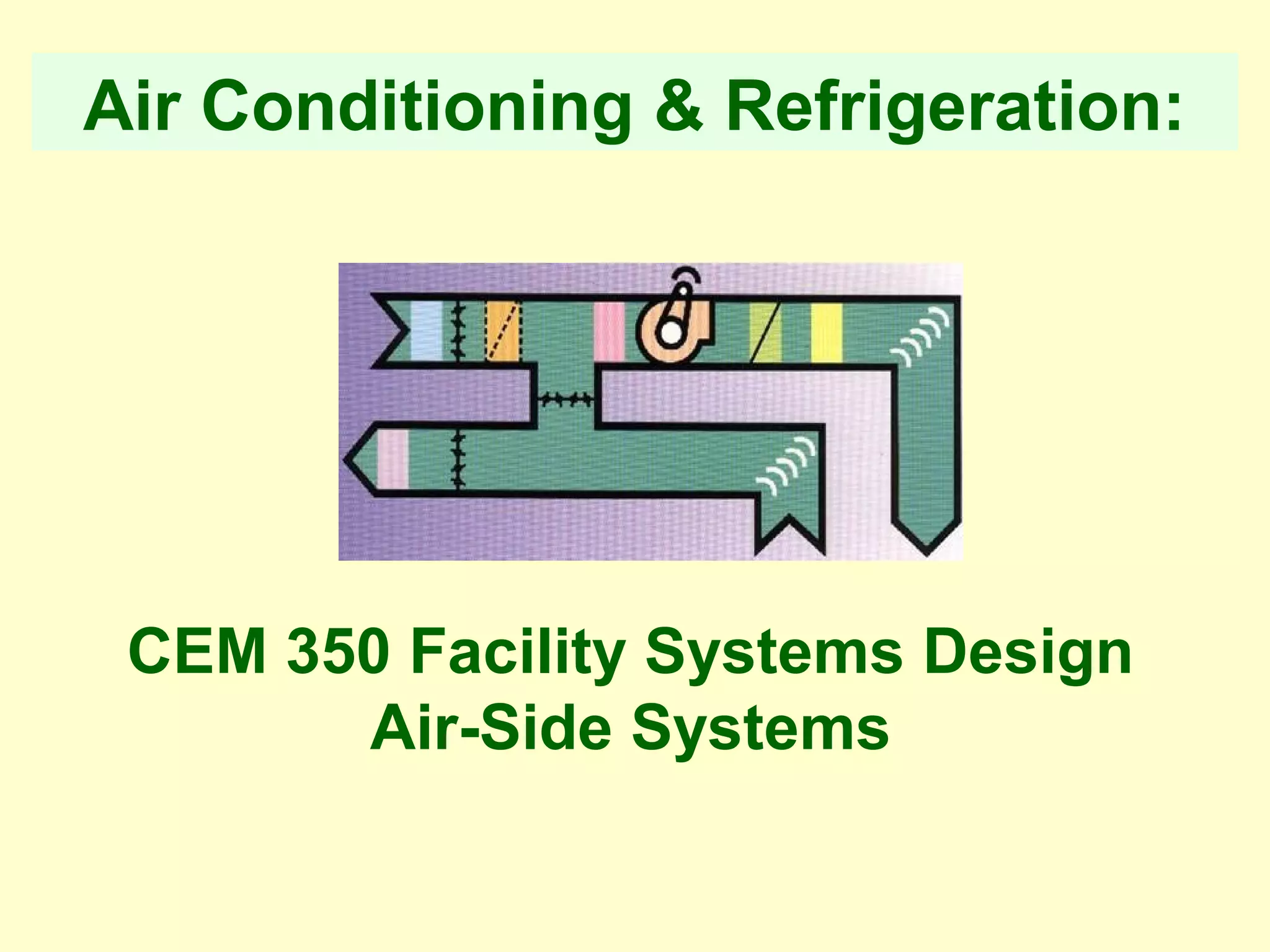
Air Conditioning & Refrigeration:
CEM 350 Facility Systems Design
Air-Side Systems
Contents
• Fundamental HVAC Concepts
• Air Handling Units
• Air System Basics
• Fan-duct systems
• Fan modulation & combinations
• Year-round operation & economizers
• Fan energy use & outdoor air
Fundamental HVAC Concepts
• Five subsystems or loops of HVAC
• Air-side
• Chilled water
• Refrigeration equipment
• Heat rejection
• Controls
33 o
C, 28 o
C
27 o
C33 o
C
25 o
C
Conditioned space
13 o
C 13 o
C
33 o
C, 28 o
C
27 o
C33 o
C
25 o
C
Air side system
13 o
C 13 o
C
12 o
C
7 o
C
33 o
C, 28 o
C
7 o
C
12 o
C
27 o
C33 o
C
25 o
C
Chilled water
system
13 o
C 13 o
C
12 o
C
7 o
C 3 o
C
38 o
C
49 o
C
10 o
C
33 o
C, 28 o
C
7 o
C
12 o
C
27 o
C33 o
C
25 o
C
Refrigeration
equipment
13 o
C 13 o
C
12 o
C
7 o
C 3 o
C
38 o
C
49 o
C
10 o
C
35 o
C
29 o
C
33 o
C, 28 o
C
7 o
C
12 o
C
29 o
C
35 o
C
27 o
C33 o
C
25 o
C
Heat rejection
13 o
C 13 o
C
12 o
C
7 o
C 3 o
C
38 o
C
49 o
C
10 o
C
35 o
C
29 o
C
33 o
C, 28 o
C
7 o
C
12 o
C
29 o
C
35 o
C
27 o
C33 o
C
25 o
C
Control Loop
Individual room air-conditioning system
Primary air fan coil unit system
Dual duct system
What type of air conditioning system it is?
Air Handling Units
• Terminal unit or device
• Such as fan coil units, VAV boxes
• Air handling unit (AHU)
• Primary equipment of the air system
• Handle & condition the air, control it to a required
state, and transport it
• Basic components:
• Supply fan, water cooling coil, filters, mixing box,
dampers, controls & outer casing
• A return or relief fan is optional, so as a humidifier
Air Handling Units
• Types of AHUs:
• Horizontal or vertical
• Draw-through or blow through
• Factory-fabricated and field built-up
• Rooftop and indoor
• Make-up (primary) air
• Recirculating
Air Handling Units
• Package units
• A self-contained air conditioner
• Equipped with a DX (direct expansion) coil
• “Air handler”: the portion inside that handles air
• Rooftop package units
• Gas heating / electric cooling
• Electric heating / electric cooling
• Heat pump system
Air Handling Units
• Indoor package units
• Factory-assembly unit installed in a fan room or
machinery room
• Floor-mounted or ceiling-mounted
• Cooling, cooling/heating, heat pump
• Heat rejection:
• Connected to an air-cooled condenser, OR
• Water-cooled condenser
• Split package units
• Indoor air handler + outdoor condensing unit
Air Handling Units
• Rating conditions & minimum performance
• ARI and ASHRAE standards
• Rating indices:
• Energy efficiency ratio (EER)
• Seasonal EER
• Integrated part-load value (IPLV)
• Heating seasonal performance factor (HSPF)
Air Handling Units
• Coils
• Indirect contact heat exchangers
• Heat transfer between air flowing over the coil and
water, refrigerant, steam or brine insider the coil
• Fins: extended (secondary) surfaces
• Fin spacing and density
• Water circuits
• Number of water flow passages
Air Handling Units
• Direct expansion (DX) coil
• Refrigerant is fed (e.g. R-22 and R-134a)
• Air and refrigerant flow:
• Usually counterflow and cross flow
• Typical evaporating temperature = 3-10 o
C
• Condensate drain pan (to collect condensation)
• Performance factors:
• Face velocity, heat transfer coefficients, air-side
pressure drop, physical size
Air Handling Units
• Water cooling coils - dry-wet coil
• Chilled water flowing at 4-10 o
C
• Brine or glycol-water at 1-4 o
C
• Temperature rise (typical) = 7-14 o
C
• Water cooling coils - dry coil
• Sensible cooling (dry); no condensation
• Poorer heat transfer coefficient
• Steam heating coil
Direct expansion (DX) coil
Water cooling coil
Water heating coil
Steam heating coil
Air Handling Units
• Air filters
• Air cleaning and filtration
• Operating performance:
• Efficiency or effectiveness of dust removal
• Dust holding capacity
• Initial & final pressure drop
• Service life
• Types: low-, medium-, and high-efficiency filters
+ carbon activated filters
Air Handling Units
• Test methods of air filters
• Weight arrestance test
• For low-efficiency air filters
• Atmospheric dust spot efficiency
• For medium-efficiency air filters
• DOP (dioctyl phthalate) penetration and efficiency
test
• For high-efficiency air filters
• HEPA (high-efficiency particle air)
• ULPA (ultra-low penetration air)
Low efficiency (panel-type) Medium efficiency (bag-type)
HEPA and ULPA filters Activated carbon filter
Air Handling Units
• Humidifiers
• Steam humidifiers
• Air washers
• Selection of AHUs
• Face velocity < 3 m/s to prevent entrained droplets
• Proper size of the equipment (energy efficiency)
• Medium-efficiency filter >50% dust spot eff.:
improve IAQ, prevent smudging & discoloring
• Air economizer: save energy
Steam grid humidifier
Air washer
Air-side Components
• EcoAdvisor: Energy Trainer for Energy
Managers: HAVC Module 1 [AV 697 E19]
• HVAC components
• Distribution equipment
• Air-side components
• Dampers, filters, coils, fans, ducts and plenums, terminal
units, diffusers, humidifiers, dehumidifiers
Air System Basics
• Fan-duct systems
• Flow resistance R, pressure drop Δp and volume flow
rate V
• Duct sections in series:
• Duct sections in parallel:
2
VRp ⋅=∆
o
ns RRRR +++= 21
np RRRR
1111
21
+++= 
Air System Basics
• Fan-duct systems
• Terminology
• Primary air (conditioned air or makeup air)
• Secondary air (induced space air, plenum air, or
recirculating air)
• Transfer air (indoor air that moves from an adjacent
area)
• System curve: volume flow vs pressure loss
• System operating point
Air System Basics
• Fan Laws
• Speed (n)
• Volume flow (V)
• Total pressure loss (Δp )
• Air density (ρ)
• For air systems that are
geometrically &
dynamically similar:
(D = impeller diameter)
Air System Basics
• System effect Δpts
• Its additional total pressure loss caused by uneven
or non-uniform velocity profile at the fan inlet, or
at duct fittings after fan outlet
• Due to the actual inlet and outlet connections as
compared with the total pressure loss of the fan test
unit during laboratory ratings
Inlet Outlet
Fan system operating point & system effect
Air System Basics
• Modulation of air systems
• Constant volume system
• Volume flow rate remains constant; supply temperature
is raised during part load
• Variable-air-volume (VAV) system
• Volume flow rate is reduced to match part load
operation
• Modulation curve
Fan modulation curve
Air System Basics
• Fan modulation methods
• Damper (vary the opening of the air flow passage)
• Waste energy
• Inlet vanes (opening & angle of inlet vanes)
• Low cost; less efficient than following types
• Inlet cone (peripheral area of fan impeller)
• Inexpensive; for backward curved centrifugal fan
• Blade pitch (blade angle of axial fan)
• Fan speed (using adjustable frequency drives)
• Most energy-efficient; but more expensive
Damper, inlet vanes & fan speed modulation
Air System Basics
• Fan combinations in AHUs
• Supply and exhaust fan/barometric damper
• Used when no return duct or low return pressure loss
• Barometric relief damper: to prevent excessive high
space pressure
• Suitable for systems w/ no air economizer mode & a
low pressure drop in return system
Supply and exhaust fans
Air System Basics
• Fan combinations in AHUs
• Supply and relief fan
• Relief fan to prevent excessive high space pressure
• Usually operated in air economizer mode
• Outdoor air damper is fully opened; recirculating
damper closed
• Suitable when pressure drop of return system < 75 Pa,
or there is a considerable pressure drop in relief or
exhaust flow passage
Supply and relief fans
Air System Basics
• Fan combinations in AHUs
• Supply and return fan
• Return fan at the upstream of the junction of return,
recirculating and exhaust flow passage (ru)
• Has similar characteristics as supply+relief fan, but a
higher total pressure at junction “ru”
• Careful selection of return fan is needed to avoid
excessive pressure in the duct system
• Suitable when pressure drop of return system > 150 Pa,
or those requiring a negative space pressure
Supply and return fans
Air System Basics
• Year-round operation of a VAV system
• Region I: Refrigeration/evaporative cooling
• Enthalpy of outdoor > that of recirculating air
• Region II: Free cooling & refrigeration
• Enthalpy of outdoor ≤ that of recirculating air
• Region III: Free cooling, evaporative cooling &
refrigeration
• Enthalpy of outdoor ≤ that of recirculating air
• Region VI: Winter heating
Control diagram of a VAV reheat system for year-round operation
Year-round operation
Region I: Refrigeration/evaporative cooling
Region II: Free cooling & refrigeration
Region III: Free cooling, evaporative cooling & refrigeration
Region VI: Winter heating
Air System Basics
• Economizer
• A device consisting of dampers and control that
uses free cooling capacity of either outdoor air or
evaporatively cooled water from cooling tower
instead of mechanical refrigeration
• Air economizer:
• Enthalpy-based
• Temperature-based
• Water economizer
Air System Basics
• Fan energy use
• For each l/s air
supplied:
• For system using
separate outdoor
ventilation:
mf
syp
sl
W
ηη ⋅⋅
∆
=
1000/
mf
sy
SO
p
R
sl
W
ηη ⋅⋅
∆
+=
1000
)1(
/
,
Air System Basics
• Outdoor ventilation air supply
• Aims
• Provide acceptable indoor air quality
• Achieve energy efficiency in the system
• ASHRAE Standard 62-2001 (IAQ standard)
• Demand-based outdoor ventilation air control
using CO2 as an indicator
• CO2 concentration < 800-1,000 ppm
• A specific indoor air contaminant can also be used
Air System Basics
• Outdoor ventilation air supply
• Minimum outdoor air control
• Type I: uses a CO2 or mixed gas sensor + DDC
controller to control the volume flow rate of outdoor air
• The best one but can be expensive
• Type II: uses a CO2 or mixed gas sensor + DDC
controller to control the ratio of the openings between
outdoor and recirculating dampers
• Suitable for VAV system
Air System Basics
• Outdoor ventilation air supply
• Minimum outdoor air control (cont’d)
• Type III: uses a flow sensor or a pressure sensor + DDC
controller to control the dampers to provide nearly
constant volume outdoor air intake
• More complicated & may cause energy waste
• Type IV: adjust the opening of outdoor damper
manually to provide constant volume outdoor air
• Mainly used for constant-volume systems

Cem 350 hvac air side systems 10-2016

  • 1.
    Air Conditioning &Refrigeration: CEM 350 Facility Systems Design Air-Side Systems
  • 2.
    Contents • Fundamental HVACConcepts • Air Handling Units • Air System Basics • Fan-duct systems • Fan modulation & combinations • Year-round operation & economizers • Fan energy use & outdoor air
  • 3.
    Fundamental HVAC Concepts •Five subsystems or loops of HVAC • Air-side • Chilled water • Refrigeration equipment • Heat rejection • Controls
  • 4.
    33 o C, 28o C 27 o C33 o C 25 o C Conditioned space
  • 5.
    13 o C 13o C 33 o C, 28 o C 27 o C33 o C 25 o C Air side system
  • 6.
    13 o C 13o C 12 o C 7 o C 33 o C, 28 o C 7 o C 12 o C 27 o C33 o C 25 o C Chilled water system
  • 7.
    13 o C 13o C 12 o C 7 o C 3 o C 38 o C 49 o C 10 o C 33 o C, 28 o C 7 o C 12 o C 27 o C33 o C 25 o C Refrigeration equipment
  • 8.
    13 o C 13o C 12 o C 7 o C 3 o C 38 o C 49 o C 10 o C 35 o C 29 o C 33 o C, 28 o C 7 o C 12 o C 29 o C 35 o C 27 o C33 o C 25 o C Heat rejection
  • 9.
    13 o C 13o C 12 o C 7 o C 3 o C 38 o C 49 o C 10 o C 35 o C 29 o C 33 o C, 28 o C 7 o C 12 o C 29 o C 35 o C 27 o C33 o C 25 o C Control Loop
  • 10.
  • 11.
    Primary air fancoil unit system
  • 12.
    Dual duct system Whattype of air conditioning system it is?
  • 14.
    Air Handling Units •Terminal unit or device • Such as fan coil units, VAV boxes • Air handling unit (AHU) • Primary equipment of the air system • Handle & condition the air, control it to a required state, and transport it • Basic components: • Supply fan, water cooling coil, filters, mixing box, dampers, controls & outer casing • A return or relief fan is optional, so as a humidifier
  • 15.
    Air Handling Units •Types of AHUs: • Horizontal or vertical • Draw-through or blow through • Factory-fabricated and field built-up • Rooftop and indoor • Make-up (primary) air • Recirculating
  • 18.
    Air Handling Units •Package units • A self-contained air conditioner • Equipped with a DX (direct expansion) coil • “Air handler”: the portion inside that handles air • Rooftop package units • Gas heating / electric cooling • Electric heating / electric cooling • Heat pump system
  • 20.
    Air Handling Units •Indoor package units • Factory-assembly unit installed in a fan room or machinery room • Floor-mounted or ceiling-mounted • Cooling, cooling/heating, heat pump • Heat rejection: • Connected to an air-cooled condenser, OR • Water-cooled condenser • Split package units • Indoor air handler + outdoor condensing unit
  • 21.
    Air Handling Units •Rating conditions & minimum performance • ARI and ASHRAE standards • Rating indices: • Energy efficiency ratio (EER) • Seasonal EER • Integrated part-load value (IPLV) • Heating seasonal performance factor (HSPF)
  • 22.
    Air Handling Units •Coils • Indirect contact heat exchangers • Heat transfer between air flowing over the coil and water, refrigerant, steam or brine insider the coil • Fins: extended (secondary) surfaces • Fin spacing and density • Water circuits • Number of water flow passages
  • 23.
    Air Handling Units •Direct expansion (DX) coil • Refrigerant is fed (e.g. R-22 and R-134a) • Air and refrigerant flow: • Usually counterflow and cross flow • Typical evaporating temperature = 3-10 o C • Condensate drain pan (to collect condensation) • Performance factors: • Face velocity, heat transfer coefficients, air-side pressure drop, physical size
  • 24.
    Air Handling Units •Water cooling coils - dry-wet coil • Chilled water flowing at 4-10 o C • Brine or glycol-water at 1-4 o C • Temperature rise (typical) = 7-14 o C • Water cooling coils - dry coil • Sensible cooling (dry); no condensation • Poorer heat transfer coefficient • Steam heating coil
  • 25.
    Direct expansion (DX)coil Water cooling coil
  • 26.
  • 27.
    Air Handling Units •Air filters • Air cleaning and filtration • Operating performance: • Efficiency or effectiveness of dust removal • Dust holding capacity • Initial & final pressure drop • Service life • Types: low-, medium-, and high-efficiency filters + carbon activated filters
  • 28.
    Air Handling Units •Test methods of air filters • Weight arrestance test • For low-efficiency air filters • Atmospheric dust spot efficiency • For medium-efficiency air filters • DOP (dioctyl phthalate) penetration and efficiency test • For high-efficiency air filters • HEPA (high-efficiency particle air) • ULPA (ultra-low penetration air)
  • 29.
    Low efficiency (panel-type)Medium efficiency (bag-type) HEPA and ULPA filters Activated carbon filter
  • 30.
    Air Handling Units •Humidifiers • Steam humidifiers • Air washers • Selection of AHUs • Face velocity < 3 m/s to prevent entrained droplets • Proper size of the equipment (energy efficiency) • Medium-efficiency filter >50% dust spot eff.: improve IAQ, prevent smudging & discoloring • Air economizer: save energy
  • 31.
  • 32.
  • 33.
    Air-side Components • EcoAdvisor:Energy Trainer for Energy Managers: HAVC Module 1 [AV 697 E19] • HVAC components • Distribution equipment • Air-side components • Dampers, filters, coils, fans, ducts and plenums, terminal units, diffusers, humidifiers, dehumidifiers
  • 35.
    Air System Basics •Fan-duct systems • Flow resistance R, pressure drop Δp and volume flow rate V • Duct sections in series: • Duct sections in parallel: 2 VRp ⋅=∆ o ns RRRR +++= 21 np RRRR 1111 21 +++= 
  • 36.
    Air System Basics •Fan-duct systems • Terminology • Primary air (conditioned air or makeup air) • Secondary air (induced space air, plenum air, or recirculating air) • Transfer air (indoor air that moves from an adjacent area) • System curve: volume flow vs pressure loss • System operating point
  • 37.
    Air System Basics •Fan Laws • Speed (n) • Volume flow (V) • Total pressure loss (Δp ) • Air density (ρ) • For air systems that are geometrically & dynamically similar: (D = impeller diameter)
  • 38.
    Air System Basics •System effect Δpts • Its additional total pressure loss caused by uneven or non-uniform velocity profile at the fan inlet, or at duct fittings after fan outlet • Due to the actual inlet and outlet connections as compared with the total pressure loss of the fan test unit during laboratory ratings Inlet Outlet
  • 39.
    Fan system operatingpoint & system effect
  • 40.
    Air System Basics •Modulation of air systems • Constant volume system • Volume flow rate remains constant; supply temperature is raised during part load • Variable-air-volume (VAV) system • Volume flow rate is reduced to match part load operation • Modulation curve
  • 41.
  • 42.
    Air System Basics •Fan modulation methods • Damper (vary the opening of the air flow passage) • Waste energy • Inlet vanes (opening & angle of inlet vanes) • Low cost; less efficient than following types • Inlet cone (peripheral area of fan impeller) • Inexpensive; for backward curved centrifugal fan • Blade pitch (blade angle of axial fan) • Fan speed (using adjustable frequency drives) • Most energy-efficient; but more expensive
  • 43.
    Damper, inlet vanes& fan speed modulation
  • 44.
    Air System Basics •Fan combinations in AHUs • Supply and exhaust fan/barometric damper • Used when no return duct or low return pressure loss • Barometric relief damper: to prevent excessive high space pressure • Suitable for systems w/ no air economizer mode & a low pressure drop in return system
  • 45.
  • 46.
    Air System Basics •Fan combinations in AHUs • Supply and relief fan • Relief fan to prevent excessive high space pressure • Usually operated in air economizer mode • Outdoor air damper is fully opened; recirculating damper closed • Suitable when pressure drop of return system < 75 Pa, or there is a considerable pressure drop in relief or exhaust flow passage
  • 47.
  • 48.
    Air System Basics •Fan combinations in AHUs • Supply and return fan • Return fan at the upstream of the junction of return, recirculating and exhaust flow passage (ru) • Has similar characteristics as supply+relief fan, but a higher total pressure at junction “ru” • Careful selection of return fan is needed to avoid excessive pressure in the duct system • Suitable when pressure drop of return system > 150 Pa, or those requiring a negative space pressure
  • 49.
  • 50.
    Air System Basics •Year-round operation of a VAV system • Region I: Refrigeration/evaporative cooling • Enthalpy of outdoor > that of recirculating air • Region II: Free cooling & refrigeration • Enthalpy of outdoor ≤ that of recirculating air • Region III: Free cooling, evaporative cooling & refrigeration • Enthalpy of outdoor ≤ that of recirculating air • Region VI: Winter heating
  • 51.
    Control diagram ofa VAV reheat system for year-round operation
  • 52.
    Year-round operation Region I:Refrigeration/evaporative cooling Region II: Free cooling & refrigeration Region III: Free cooling, evaporative cooling & refrigeration Region VI: Winter heating
  • 53.
    Air System Basics •Economizer • A device consisting of dampers and control that uses free cooling capacity of either outdoor air or evaporatively cooled water from cooling tower instead of mechanical refrigeration • Air economizer: • Enthalpy-based • Temperature-based • Water economizer
  • 54.
    Air System Basics •Fan energy use • For each l/s air supplied: • For system using separate outdoor ventilation: mf syp sl W ηη ⋅⋅ ∆ = 1000/ mf sy SO p R sl W ηη ⋅⋅ ∆ += 1000 )1( / ,
  • 55.
    Air System Basics •Outdoor ventilation air supply • Aims • Provide acceptable indoor air quality • Achieve energy efficiency in the system • ASHRAE Standard 62-2001 (IAQ standard) • Demand-based outdoor ventilation air control using CO2 as an indicator • CO2 concentration < 800-1,000 ppm • A specific indoor air contaminant can also be used
  • 56.
    Air System Basics •Outdoor ventilation air supply • Minimum outdoor air control • Type I: uses a CO2 or mixed gas sensor + DDC controller to control the volume flow rate of outdoor air • The best one but can be expensive • Type II: uses a CO2 or mixed gas sensor + DDC controller to control the ratio of the openings between outdoor and recirculating dampers • Suitable for VAV system
  • 57.
    Air System Basics •Outdoor ventilation air supply • Minimum outdoor air control (cont’d) • Type III: uses a flow sensor or a pressure sensor + DDC controller to control the dampers to provide nearly constant volume outdoor air intake • More complicated & may cause energy waste • Type IV: adjust the opening of outdoor damper manually to provide constant volume outdoor air • Mainly used for constant-volume systems