



1
Air Handling, Air Conditioning and
Refrigeration
Compiled & delivered by,
Dr. Asif Mahmood
Assistant Professor, Department of
Pharmaceutics,
The University of Lahore
2018
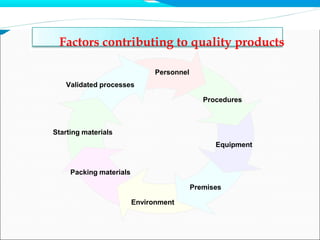
Factors contributing to quality products
Starting materials
Personnel
Procedures
Validated processes
Equipment
Premises
Environment
Packing materials
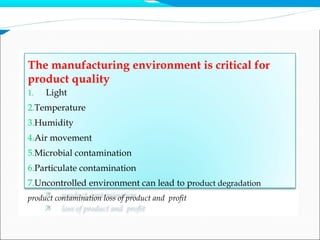
The manufacturing environment is critical for
product quality
1. Light
2.Temperature
3.Humidity
4.Air movement
5.Microbial contamination
6.Particulate contamination
7.Uncontrolled environment can lead to product degradation
product contamination loss of product and profit
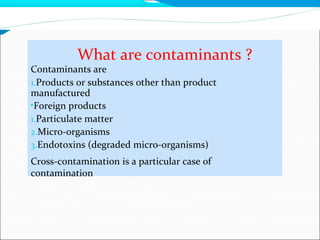
What are contaminants ?
Contaminants are
1.Products or substances other than product
manufactured
•Foreign products
1.Particulate matter
2.Micro-organisms
3.Endotoxins (degraded micro-organisms)
Cross-contamination is a particular case of
contamination
Cross-Contamination
What is Cross-Contamination ?
Contamination of a starting material, intermediate
product, or finished product with another starting
material or product during production.
Cross-Contamination
From where does Cross-Contamination originate?
1.Poorly designed air handling systems and dust extraction
systems
•Poorly operated and maintained air handling systems and
dust extraction systems
1.Inadequate procedures for personnel and equipment
•Insufficiently cleaned equipment
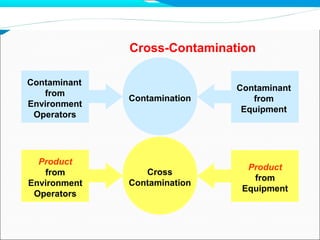
Contamination
Contaminant
from
Environment
Operators
Contaminant
from
Equipment
Cross
Contamination
Product
from
Environment
Operators
Product
from
Equipment
Cross-Contamination
Cross-Contamination
Cross-contamination can be minimized by:
1.Personnel procedures
2.Adequate premises
•Use of closed production systems
1.Adequate, validated cleaning procedures
•Appropriate levels of protection of product
1.Correct air pressure cascade
“CLEANLINESS, CLEANLINESS and
CLEANLINESS”
9
10
11
12
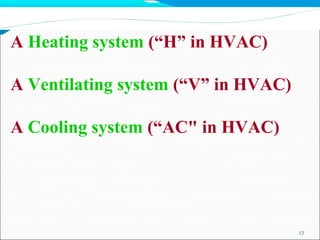
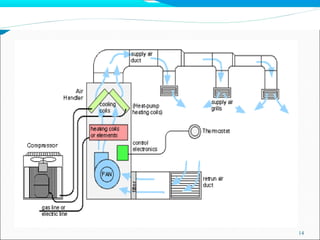
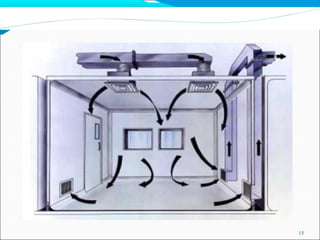
A Heating system (“H” in HVAC)
A Ventilating system (“V” in HVAC)
A Cooling system (“AC" in HVAC)
13
14
15
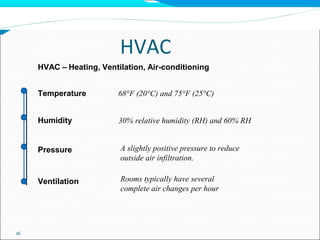
HVAC
16
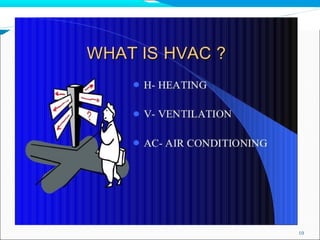
HVAC – Heating, Ventilation, Air-conditioning
Temperature
Humidity
Pressure
Ventilation
68°F (20°C) and 75°F (25°C)
30% relative humidity (RH) and 60% RH
A slightly positive pressure to reduce
outside air infiltration.
Rooms typically have several
complete air changes per hour
What can HVAC do?
Control airborne particles, dust and micro-
organisms
Maintain room pressure (delta P)
Maintain space moisture (Relative Humidity)
Maintain space temperature 17
What HVAC can’t
do?
18
1. HVAC can not clean up the surfaces of a
contaminated places, room or equipment
2. HVAC can not compensate for workers who do not
follow procedures
Local heating systems
heat source, distributors, and Portable electric heaters, built-in
electric resistance heaters, infrared heaters and wood stoves
Local cooling systems
Air circulation devices, such as paddle or desk fans
Local ventilating systems Local air-conditioning
systems
19
Components Of HVAC
System
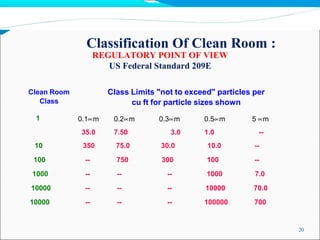
Clean Room
Class
20
Class Limits "not to exceed" particles per
cu ft for particle sizes shown
Classification Of Clean Room :
REGULATORY POINT OF VIEW
US Federal Standard 209E
1 0.1∝m
35.0
0.2∝m
7.50
0.3∝m
3.0
0.5∝m
1.0
5 ∝m
--
10 350 75.0 30.0 10.0 --
100 -- 750 300 100 --
1000 -- -- -- 1000 7.0
10000 -- -- -- 10000 70.0
10000 -- -- -- 100000 700
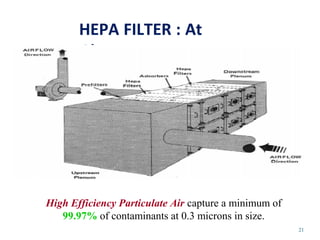
HEPA FILTER : At
Glance
High Efficiency Particulate Air capture a minimum of
99.97% of contaminants at 0.3 microns in size.
21
:
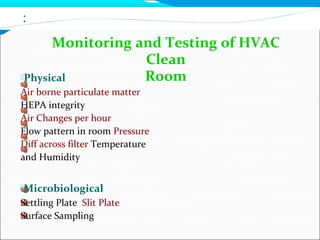
Monitoring and Testing of HVAC
Clean
RoomPhysical
Air borne particulate matter
HEPA integrity
Air Changes per hour
Flow pattern in room Pressure
Diff across filter Temperature
and Humidity
Microbiological
Settling Plate Slit Plate
Surface Sampling
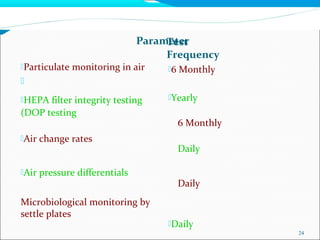
ParameterTest
Frequency
Particulate monitoring in air

HEPA filter integrity testing
(DOP testing
Air change rates
Air pressure differentials
Microbiological monitoring by
settle plates
6 Monthly
Yearly
6 Monthly
Daily
Daily
Daily
24
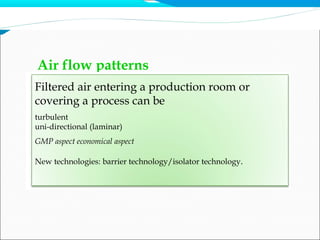
Air flow patterns
Filtered air entering a production room or
covering a process can be
turbulent
uni-directional (laminar)
GMP aspect economical aspect
New technologies: barrier technology/isolator technology.
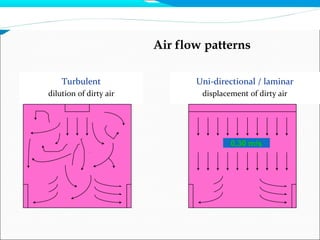
Uni-directional / laminar
displacement of dirty air
Turbulent
dilution of dirty air
0,30 m/s
Air flow patterns
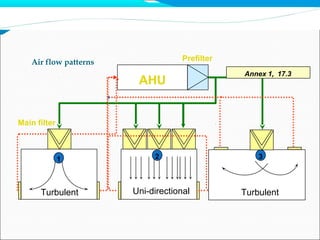
PrefilterAir flow patterns
AHU
Main filter
Uni-directional TurbulentTurbulent
1 2 3
Annex 1, 17.3
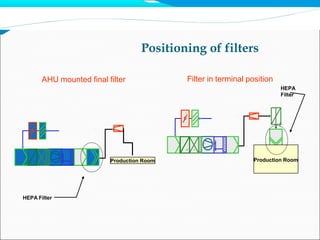
Positioning of filters
Filter in terminal positionAHU mounted final filter
Production Room
+
Production Room
HEPA Filter
HEPA
Filter
Air re-circulation
The filtered air entering a production room can be
100% exhausted or
a proportion re-circulated
GMP aspect economical reasons
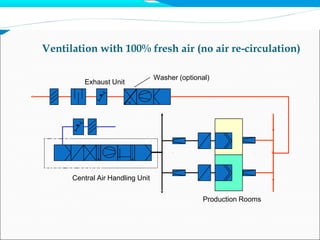
Ventilation with 100% fresh air (no air re-circulation)
W
Washer (optional)
Central Air Handling Unit
Production Rooms
Exhaust Unit
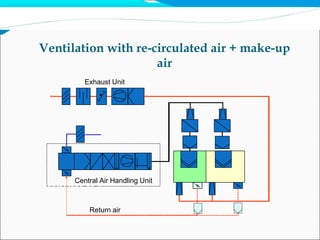
Ventilation with re-circulated air + make-up
air
Central Air Handling Unit
Return air
Exhaust Unit
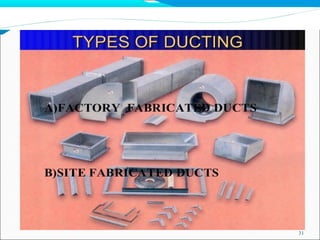
31
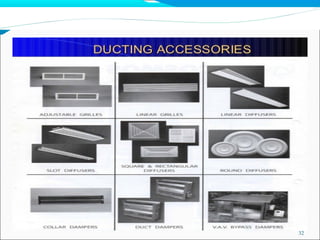
32
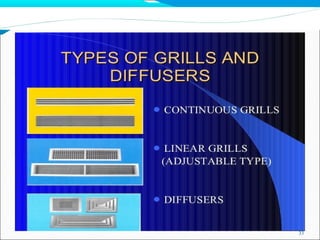
33
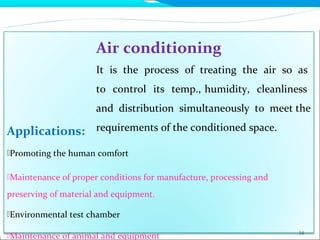
Air conditioning
It is the process of treating the air so as
to control its temp., humidity, cleanliness
and distribution simultaneously to meet the
requirements of the conditioned space.
34
Applications:
Promoting the human comfort
Maintenance of proper conditions for manufacture, processing and
preserving of material and equipment.
Environmental test chamber
Maintenance of animal and equipment
Types of equipment
35
1.Self contained air conditioner/ Unitary/ Packaged 2.Central air
conditioner/ Field erected
1.Self contained air conditioner/ Unitary/ Packaged
These system include window mounted or wall bracket conditioners.
Most of this units are air cooled through water cooled type.
Room air enters the casing at the front panel. It is mixed with part of
the outdoor air and this mixture is forced over a cooling coils by a
centrifugal fans.
Central air conditioning system
36
In this system one or several areas are air conditioned by duct
network.
Air cleaning is done by filters.
Cooling is achieved by using water or by direct expansion in
refrigerated coils or air washers.
Heating is achieved by using steam or hot water coils.
37
Definitions
38
Humidity:
The amount of water vapour present in moist air per unit mass of the
dry air in given volume.
Dew point:
The temperature at which the liquid droplets just appear when the
moist air is cooled continuously.
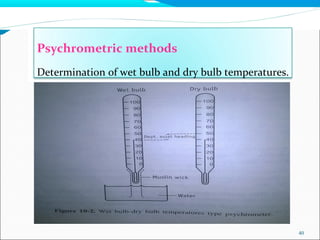
Dry bulb temperature:
The actual temperature of gas or mixture of gases indicated by an error
free temperature measuring device.
Wet bulb temperature:
Dynamic equilibrium temperature attained by a water surface when
exposed to air under adiabatic conditions.
Measurement of humidity
39
Direct method
A known volume of air is drawn through phosphorus pentoxide.
The moisture present in the air get absorbed and determined by
chemical or gravimetric method.
From the difference of initial and final masses humidity is
estimated.
Psychrometric methods
Determination of wet bulb and dry bulb temperatures.
40
Dew point
method
41
In this method formation of mist and disappearance of
mist is considered and dew point is calculated.
A cooled and polished disk is placed in vessel
containing the gas whose humidity is to be determined.
The temp. of the disk is gradually lowered using
liquid air or liquid carbon dioxide or ether.
Soon mist condenses on polished surface.
The temperature at which mist just appeared is noted.
The temp. of disk is slowly increased and disappearance
of mist is observed and temp. is noted.
The average of these two temperatures represent
accurate dew point.
Humidification
The process of increasing the moisture in the air.
Approaches:
The air may be brought in contact with water in
such a way that only a part of the water is
evaporated.
Cooling towers are utilized.
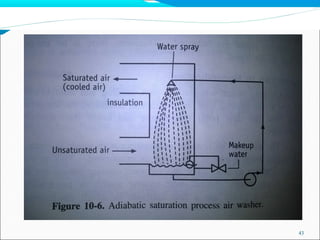
The incoming air is heated to higher temp. then
cooled adiabatically with water to achieve
desired humidity.
The air may be mixed with stream of air of higher
humidity. 42
43
Dehumidification
44
Removal of moisture from the air.
Dehumidification is achieved by bringing the moist air in
contact with cold surface (solid/liquid).
In pharmaceutical industry many operations are carried out at
stated temperature and humidity to get optimum results.
In many parts of India (Bengal, Kerala) air is very humid so
it becomes very difficult to carryon operations with
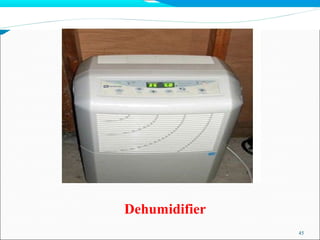
hygroscopic substances even in AC room. Hence, dehumidifiers
are installed for such operations.
Dehumidifier
45
Air handling systems:
Play a major role in the quality of pharmaceuticals
Must be designed properly, by professionals Must be
treated as a critical system
Conclusion
Thank you
52

Hvac

  • 1.
    1 Air Handling, AirConditioning and Refrigeration Compiled & delivered by, Dr. Asif Mahmood Assistant Professor, Department of Pharmaceutics, The University of Lahore 2018
  • 2.
    Factors contributing toquality products Starting materials Personnel Procedures Validated processes Equipment Premises Environment Packing materials
  • 3.
    The manufacturing environmentis critical for product quality 1. Light 2.Temperature 3.Humidity 4.Air movement 5.Microbial contamination 6.Particulate contamination 7.Uncontrolled environment can lead to product degradation product contamination loss of product and profit
  • 4.
    What are contaminants? Contaminants are 1.Products or substances other than product manufactured •Foreign products 1.Particulate matter 2.Micro-organisms 3.Endotoxins (degraded micro-organisms) Cross-contamination is a particular case of contamination
  • 5.
    Cross-Contamination What is Cross-Contamination? Contamination of a starting material, intermediate product, or finished product with another starting material or product during production.
  • 6.
    Cross-Contamination From where doesCross-Contamination originate? 1.Poorly designed air handling systems and dust extraction systems •Poorly operated and maintained air handling systems and dust extraction systems 1.Inadequate procedures for personnel and equipment •Insufficiently cleaned equipment
  • 7.
  • 8.
    Cross-Contamination Cross-contamination can beminimized by: 1.Personnel procedures 2.Adequate premises •Use of closed production systems 1.Adequate, validated cleaning procedures •Appropriate levels of protection of product 1.Correct air pressure cascade
  • 9.
  • 10.
  • 11.
  • 12.
  • 13.
    A Heating system(“H” in HVAC) A Ventilating system (“V” in HVAC) A Cooling system (“AC" in HVAC) 13
  • 14.
  • 15.
  • 16.
    HVAC 16 HVAC – Heating,Ventilation, Air-conditioning Temperature Humidity Pressure Ventilation 68°F (20°C) and 75°F (25°C) 30% relative humidity (RH) and 60% RH A slightly positive pressure to reduce outside air infiltration. Rooms typically have several complete air changes per hour
  • 17.
    What can HVACdo? Control airborne particles, dust and micro- organisms Maintain room pressure (delta P) Maintain space moisture (Relative Humidity) Maintain space temperature 17
  • 18.
    What HVAC can’t do? 18 1.HVAC can not clean up the surfaces of a contaminated places, room or equipment 2. HVAC can not compensate for workers who do not follow procedures
  • 19.
    Local heating systems heatsource, distributors, and Portable electric heaters, built-in electric resistance heaters, infrared heaters and wood stoves Local cooling systems Air circulation devices, such as paddle or desk fans Local ventilating systems Local air-conditioning systems 19 Components Of HVAC System
  • 20.
    Clean Room Class 20 Class Limits"not to exceed" particles per cu ft for particle sizes shown Classification Of Clean Room : REGULATORY POINT OF VIEW US Federal Standard 209E 1 0.1∝m 35.0 0.2∝m 7.50 0.3∝m 3.0 0.5∝m 1.0 5 ∝m -- 10 350 75.0 30.0 10.0 -- 100 -- 750 300 100 -- 1000 -- -- -- 1000 7.0 10000 -- -- -- 10000 70.0 10000 -- -- -- 100000 700
  • 21.
    HEPA FILTER :At Glance High Efficiency Particulate Air capture a minimum of 99.97% of contaminants at 0.3 microns in size. 21
  • 22.
    : Monitoring and Testingof HVAC Clean RoomPhysical Air borne particulate matter HEPA integrity Air Changes per hour Flow pattern in room Pressure Diff across filter Temperature and Humidity Microbiological Settling Plate Slit Plate Surface Sampling
  • 23.
    ParameterTest Frequency Particulate monitoring inair  HEPA filter integrity testing (DOP testing Air change rates Air pressure differentials Microbiological monitoring by settle plates 6 Monthly Yearly 6 Monthly Daily Daily Daily 24
  • 24.
    Air flow patterns Filteredair entering a production room or covering a process can be turbulent uni-directional (laminar) GMP aspect economical aspect New technologies: barrier technology/isolator technology.
  • 25.
    Uni-directional / laminar displacementof dirty air Turbulent dilution of dirty air 0,30 m/s Air flow patterns
  • 26.
    PrefilterAir flow patterns AHU Mainfilter Uni-directional TurbulentTurbulent 1 2 3 Annex 1, 17.3
  • 27.
    Positioning of filters Filterin terminal positionAHU mounted final filter Production Room + Production Room HEPA Filter HEPA Filter
  • 28.
    Air re-circulation The filteredair entering a production room can be 100% exhausted or a proportion re-circulated GMP aspect economical reasons
  • 29.
    Ventilation with 100%fresh air (no air re-circulation) W Washer (optional) Central Air Handling Unit Production Rooms Exhaust Unit
  • 30.
    Ventilation with re-circulatedair + make-up air Central Air Handling Unit Return air Exhaust Unit
  • 31.
  • 32.
  • 33.
  • 34.
    Air conditioning It isthe process of treating the air so as to control its temp., humidity, cleanliness and distribution simultaneously to meet the requirements of the conditioned space. 34 Applications: Promoting the human comfort Maintenance of proper conditions for manufacture, processing and preserving of material and equipment. Environmental test chamber Maintenance of animal and equipment
  • 35.
    Types of equipment 35 1.Selfcontained air conditioner/ Unitary/ Packaged 2.Central air conditioner/ Field erected 1.Self contained air conditioner/ Unitary/ Packaged These system include window mounted or wall bracket conditioners. Most of this units are air cooled through water cooled type. Room air enters the casing at the front panel. It is mixed with part of the outdoor air and this mixture is forced over a cooling coils by a centrifugal fans.
  • 36.
    Central air conditioningsystem 36 In this system one or several areas are air conditioned by duct network. Air cleaning is done by filters. Cooling is achieved by using water or by direct expansion in refrigerated coils or air washers. Heating is achieved by using steam or hot water coils.
  • 37.
  • 38.
    Definitions 38 Humidity: The amount ofwater vapour present in moist air per unit mass of the dry air in given volume. Dew point: The temperature at which the liquid droplets just appear when the moist air is cooled continuously. Dry bulb temperature: The actual temperature of gas or mixture of gases indicated by an error free temperature measuring device. Wet bulb temperature: Dynamic equilibrium temperature attained by a water surface when exposed to air under adiabatic conditions.
  • 39.
    Measurement of humidity 39 Directmethod A known volume of air is drawn through phosphorus pentoxide. The moisture present in the air get absorbed and determined by chemical or gravimetric method. From the difference of initial and final masses humidity is estimated.
  • 40.
    Psychrometric methods Determination ofwet bulb and dry bulb temperatures. 40
  • 41.
    Dew point method 41 In thismethod formation of mist and disappearance of mist is considered and dew point is calculated. A cooled and polished disk is placed in vessel containing the gas whose humidity is to be determined. The temp. of the disk is gradually lowered using liquid air or liquid carbon dioxide or ether. Soon mist condenses on polished surface. The temperature at which mist just appeared is noted. The temp. of disk is slowly increased and disappearance of mist is observed and temp. is noted. The average of these two temperatures represent accurate dew point.
  • 42.
    Humidification The process ofincreasing the moisture in the air. Approaches: The air may be brought in contact with water in such a way that only a part of the water is evaporated. Cooling towers are utilized. The incoming air is heated to higher temp. then cooled adiabatically with water to achieve desired humidity. The air may be mixed with stream of air of higher humidity. 42
  • 43.
  • 44.
    Dehumidification 44 Removal of moisturefrom the air. Dehumidification is achieved by bringing the moist air in contact with cold surface (solid/liquid). In pharmaceutical industry many operations are carried out at stated temperature and humidity to get optimum results. In many parts of India (Bengal, Kerala) air is very humid so it becomes very difficult to carryon operations with hygroscopic substances even in AC room. Hence, dehumidifiers are installed for such operations.
  • 45.
  • 46.
    Air handling systems: Playa major role in the quality of pharmaceuticals Must be designed properly, by professionals Must be treated as a critical system Conclusion
  • 47.