HVAC SYSTEMS :
ENSURING COMFORT &
EFFICIENCY
MD MURSHID ALAM
GCH CENTURY
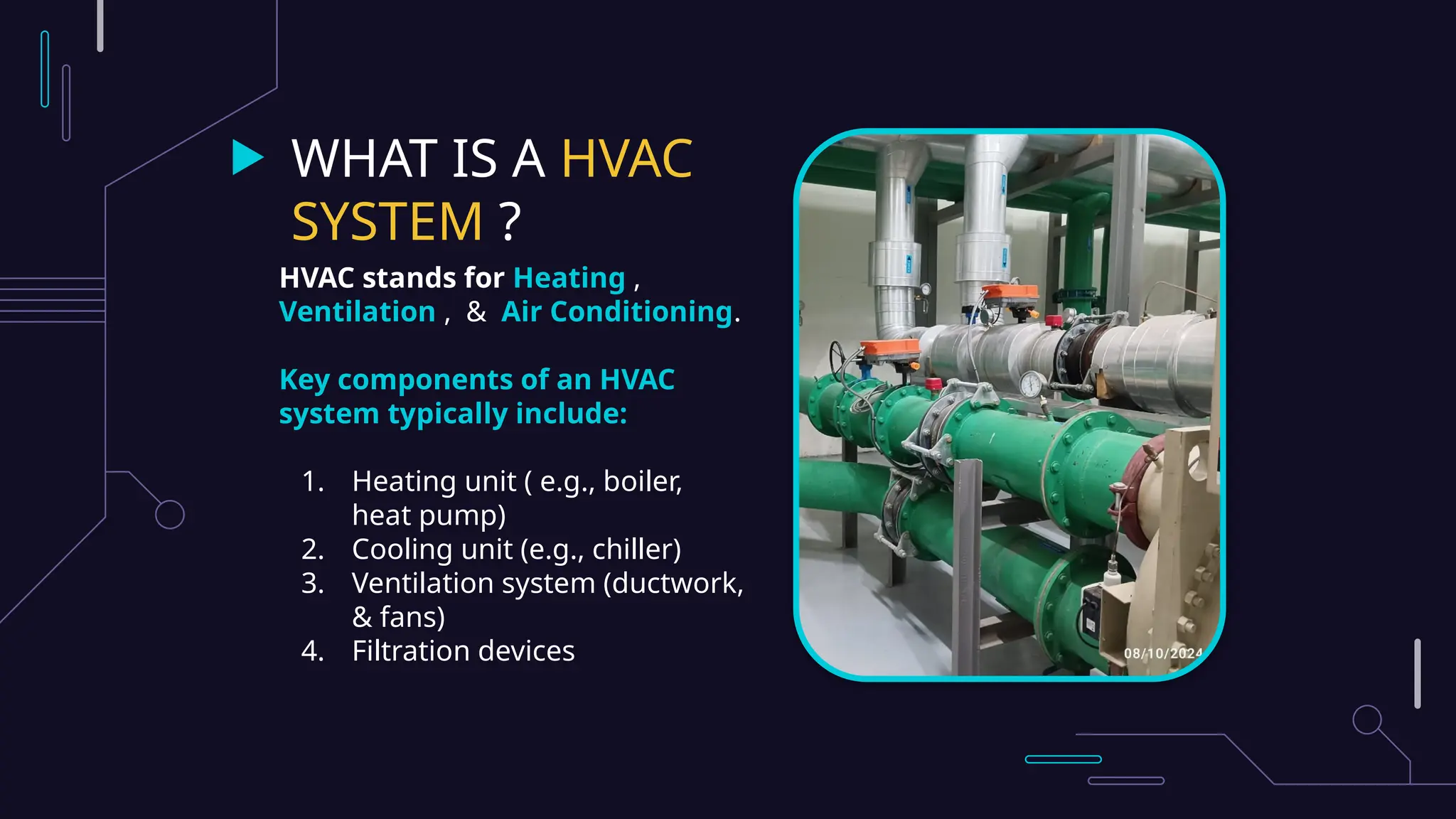
WHAT IS A HVAC
SYSTEM ?
HVAC stands for Heating ,
Ventilation , & Air Conditioning.
Key components of an HVAC
system typically include:
1. Heating unit ( e.g., boiler,
heat pump)
2. Cooling unit (e.g., chiller)
3. Ventilation system (ductwork,
& fans)
4. Filtration devices
INTRODUCTION
● OVERVIEW OF HVAC SYSTEM
● SIGNIFICANCE IN MODERN BUILDING
OVERVIEW OF HVAC SYSTEMS
FUNCTIONS DIFFERENT TYPES
HVAC Systems handle three
main tasks: heating,
ventilation, and air
conditioning. Heating systems
provide warmth during colder
months, ventilation ensures
fresh air circulation, and air
conditioning cools spaces
during hot weather.
Different HVAC systems suit
various project needs. Split
systems are common for
residential use, while ductless
mini-splits work well in retrofits.
Packaged or central systems
are ideal for larger commercial
projects, based on size and
energy needs.
Energy efficiency is key in
modern HVAC design. High
SEER or AFUE rated units,
smart thermostats, advanced
controls, and regular
maintenance lower operating
costs and reduce the
environmental impact of
projects.
EFFICIENCY
COMPLIANCE & SUSTAINABILITY
SIGNIFICANCE OF HVAC IN MODERN BUILDINGS
HVAC systems maintain consistent
temperature, air quality, and humidity,
enhancing comfort and productivity.
Proper ventilation prevents
contaminants, fostering healthier and
more comfortable environments.
Advanced HVAC technologies reduce
energy consumption through smart
controls, variable speed systems, and
heat recovery solutions. This leads to
significant operational cost savings and
sustainable building performance.
Modern HVAC designs ensure compliance
with local and international building codes,
including LEED and ASHRAE standards.
They contribute to reducing the building's
carbon footprint by integrating energy-
efficient equipment and eco-friendly
refrigerants.
IoT, AI, and smart sensors enable real-
time monitoring and predictive
maintenance, optimizing HVAC
performance. These innovations allow for
automated energy management,
improved system diagnostics, and
reduced downtime.
OPTIMAL INDOOR ENVIRONMENT EFFICIENCY & COST SAVING
ADVANCED INNOVATION
CHILLERS IN HVAC SYSTEM
Definition
Large refrigeration units
used in commercial and
industrial
> Cool water or other fluids
for air conditioning or
process cooling
>
Types
> Air-cooled chillers
> Water-cooled chillers
> Absorption chillers
Key Components
> Compressor
> Condenser
> Evaporator
> Expansion valve
Applications
> Industrial processes
> Office buildings
> Hospitals
> Data centers
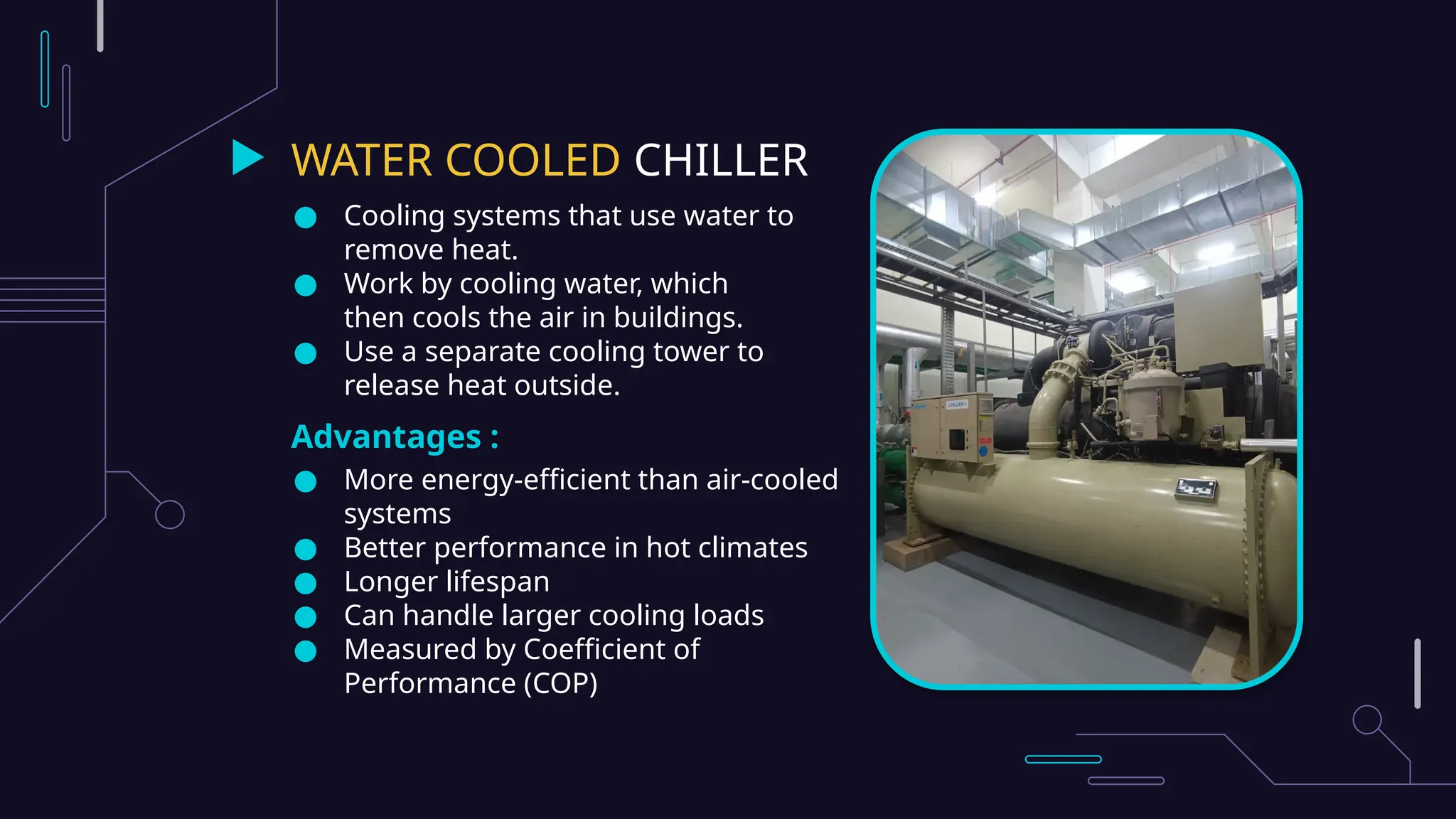
WATER COOLED CHILLER
● Cooling systems that use water to
remove heat.
● Work by cooling water, which
then cools the air in buildings.
● Use a separate cooling tower to
release heat outside.
Advantages :
● More energy-efficient than air-cooled
systems
● Better performance in hot climates
● Longer lifespan
● Can handle larger cooling loads
● Measured by Coefficient of
Performance (COP)
AIR COOLED CHILLER
● Cooling systems that use outside
air to remove heat.
● Work like a refrigerator, but
release heat into the outdoor air.
● Don't need water for cooling,
unlike some other systems.
Advantages :
● Lower initial cost
● Minimal water usage
● Easier installation
● Suitable for areas with water scarcity
● Reduced maintenance
ABSORPTION CHILLER
● Cooling systems that use water to
remove heat.
● Work by cooling water, which
then cools the air in buildings.
● Use a separate cooling tower to
release heat outside.
Advantages :
● More energy-efficient than air-cooled
systems
● Better performance in hot climates
● Longer lifespan
● Can handle larger cooling loads
● Measured by Coefficient of
Performance (COP)
KEY COMPONENTS IN CHILLERS
> Dashboard
> Condenser
> Cooling Tower
> Compressor
> Valves Package
> Evaporator
DASHBOARD
> Chiller Dashboards offer real-time monitoring of chiller
performance metrics, such as temperature, pressure, and flow rates.
> Display energy consumption data to help identify efficiency trends and
cost-saving opportunities.
> Include alerts and notifications for maintenance needs, performance
deviations, or system malfunctions.
VALVES PACKAGE
> Chiller Valves Package includes essential valves that control
refrigerant flow within the chiller system.
> Common types: expansion valves, service valves, and isolation
valves, each serving specific functions.
> Proper valve operation is crucial for system efficiency, performance,
and longevity.
CHILLER COMPRESSOR
> The compressor is the heart of the chiller, responsible for
compressing refrigerant to increase its pressure and temperature.
> Common types include centrifugal, screw, and scroll compressors,
used based on capacity and efficiency needs
> Compressors enable the refrigeration cycle by moving refrigerant
between the evaporator and condenser.
CONDENSER
> The condenser is responsible for releasing heat from the refrigerant
to the outside environment.
> It converts high-pressure refrigerant vapor into a liquid by cooling it
with air (air-cooled condensers) or water (water-cooled condensers).
> Condensers are essential for completing the refrigeration cycle and
maintaining efficient cooling.
COOLING TOWER
> Cooling Towers dissipate heat from water-cooled HVAC systems by
transferring waste heat to the atmosphere.
> Warm water from the condenser is cooled through evaporation as it
passes over fill material inside the tower.
> Commonly used in large commercial or industrial systems for heat
rejection.
PUMPS
> Pumps are essential components that circulate water and refrigerants
in HVAC systems
> They ensure efficient movement of chilled or hot water to coils,
chillers, and heating equipment.
> Pumps help maintain consistent pressure and flow rates for optimal
system performance.
TYPES OF PUMPS
Primary Pump - CHW
Pump
> Circulates chilled water
between the chiller and
building systems to absorb
heat and cool spaces.
> Ensures efficient cooling in
large HVAC systems.
Condenser Pump
> Circulates water between the
cooling tower and chiller
condenser.
> Removes heat from the
refrigerant in cooling systems.
> Essential for efficient heat
rejection in large HVAC systems.
> Key component in
maintaining temperature control
WATER DISTRIBUTION
Definition
> The process of delivering hot
or chilled water from central
equipment (chillers, boilers) to
various parts of a building for
heating or cooling.
Key Components
> Pumps : Maintain water flow and
pressure in the system.
> Valves : Control flow, pressure,
and temperature of water. air.
> Heat Exchangers : Trap dust,
allergens, and other particles.
Importance
> Ensures even heating and
cooling throughout the
building.
> Helps maintain comfort and
energy efficiency.
> Minimizes temperature
fluctuations and enhances
system control.
PMS - Pump Management System
Definition
> An automated system used to
monitor, control, and optimize the
operation of pumps in HVAC systems.
Key Functions
> Monitoring : Tracks pump performance,
energy consumption, and operational
status
> Control : Automates pump start/stop,
adjusts speed, and ensures optimal
performance based on system demand.
air.
> Alarm & Diagnostics : Alerts for
malfunctions, pressure drops, or
inefficiencies, improving maintenance
response.
BTU Meter
Key Functions
> Measurement : Calculates
the amount of heat energy
transferred to or from a space.
> Monitoring : Provides real-
time data on energy usage for
HVAC systems.
Components
> Flow Sensor : Measures the
flow rate of water in the system.
> Temperature Sensors :
Measure the inlet and outlet
temperatures of the fluid.
> Flow Sensor : Measures the
flow rate of water in the system.
Definition
> A device that measures the
energy consumption of heating
or cooling systems in terms of
British Thermal Units (BTUs).
>
CHEMICAL DOSING SYSTEM
Definition
> A system used to inject
precise amounts of chemicals
into water in HVAC systems to
prevent scaling, corrosion, and
biological growth.
Key Functions
> Water Treatment : Ensures water
quality by adding chemicals (e.g.,
biocides, corrosion inhibitors).
> Prevention : Protects pipes,
boilers, chillers, and cooling
towers from damage caused by
corrosion or scaling.
Components
> Dosing Pump : Delivers the
chemicals at controlled rates.
> Storage Tanks : Hold the
chemicals before dosing.
> Control Unit : Manages the
dosing process, often based on
feedback from sensors
DUCTING SYSTEMS
● Network of ducts that distributes
conditioned air throughout the building
● Made of materials like galvanized steel,
aluminum, or flexible plastic
● Ensures proper air circulation between
AHUs, FCUs, and various zones
● Includes supply ducts (delivering air)
and return ducts (removing air)
● Can be insulated to reduce energy loss
and improve efficiency
● Designed for minimal air leakage and
pressure drops
● Essential for maintaining consistent
temperature and air quality
AIR HANDLING UNITS - AHUs
Definition
Why AHUs are Important ?
Air Handling Units (AHUs) are a
critical part of HVAC systems,
responsible for regulating and
circulating air throughout buildings
> Maintain indoor air quality (IAQ).
Provide proper ventilation and air
circulation.
> Control temperature and humidity for
comfort.
Air Handling Unit - AHUs
> AHU’s are connected to duct
work which provides a defined
route for the air to travel around
the building.
> In a simple form, an AHU will use a
fan to suck in fresh ambient outside
air which will then pass through
some filters to remove any dirt and
dust.
> It will then pass through the cooling and heating coil heat exchangers
which, as discussed, are typically fed from central plant units.
> Another set of duct work will be collecting the warm used air from
the rooms and will bring this back to the AHU via another fan. This fan
will then eject the air from the AHU and building.
KEY COMPONENTS IN AHUs
> EC Fans
> Filters
> Coils
> Dampers
> Humidifier
> UV light
EC FAN (Electronically Commutated Fan)
> EC Fans combine the efficiency of DC motors with the simplicity of AC
power.
> These fans offer precise speed control, lower energy consumption,
and quieter operation compared to traditional fans.
> Widely used in HVAC systems, EC fans enhance energy efficiency,
reduce operating costs, and contribute to sustainable building
management.
FILTER
> Filters are essential in HVAC systems to trap dust, allergens, and
contaminants from the air.
> They improve indoor air quality by removing particles before air is
circulated.
> Regular filter maintenance helps maintain system efficiency, extends
equipment life, and ensures a healthy environment for occupants.
COIL
> Coils in HVAC systems are
responsible for heating or
cooling air.
> They transfer heat by
circulating hot or chilled water,
or refrigerant, through the coil
pipes.
> Efficient coil performance is
crucial for maintaining desired
indoor temperatures and
ensuring energy-efficient
operation of the system.
>
UV LIGHT
> UV Lights in HVAC systems
help disinfect air by killing
bacteria, viruses, and mold on
coils and other components.
> UV lights emit ultraviolet
radiation that destroys the DNA
of microorganisms like bacteria,
mold, and viruses.
> Installed near coils and drain
pans, UV lights continuously
sanitize surfaces by breaking
down harmful pathogens.
>
FAN COIL UNITS - FCUs
● Compact units used for heating or cooling individual spaces.
● Consist of a fan and heating/cooling coil.
● Uses chilled or hot water from central plant.
HOW FAN COIL UNITS - FCUs WORK ?
Fan coil units are used to condition the local air to suit the
temperature requirements of the immediate space.
CSUs
● Mounted under the ceiling for space-
saving installation
● Provides heating, cooling, and air
distribution in small to medium-sized
spaces
● Typically uses chilled or hot water for
conditioning
● Includes built-in fan and air filter
● Commonly used in commercial
spaces, offices, and retail stores
● Quiet operation with adjustable
airflow for user comfort
CO SENSOR
> CO Sensors detect carbon monoxide (CO) levels in indoor spaces
to ensure safety.
> When CO levels exceed safe limits, the sensor triggers alarms or
ventilation systems to remove contaminated air.
JET FAN
> Jet Fans are used in enclosed spaces like parking garages to control
air movement and remove exhaust fumes.
> They work by creating high-velocity airflow, pushing contaminated air
towards exhaust points, ensuring proper ventilation and reducing
harmful gas buildup.
VENTILATION OVERVIEW
Definition
Ventilation is the process of
supplying fresh air to indoor
spaces and removing stale air,
maintaining air quality and
comfort.
Key Components
> Supply Air Systems: Deliver
fresh outdoor air.
> Exhaust Air Systems: Remove
stale indoor air.
> Air Filters: Trap dust,
allergens, and other particles.
Importance of
Ventilation:
> Removes indoor pollutants
and odors.
> Controls humidity levels,
preventing mold growth.
> Controls humidity levels,
preventing mold growth.
CAR PARKING VENTILATION SYSTEM
> Car Parking Ventilation Systems ensure proper air circulation in
enclosed parking areas by removing exhaust fumes and pollutants.
> They maintain air quality, prevent the buildup of harmful gases like
carbon monoxide, and ensure compliance with safety standards.
KITCHEN SCRUBBER SYSTEM
> Kitchen Scrubber Systems remove grease, smoke, and odors
from kitchen exhaust air.
> They filter contaminants before releasing air outdoors, improving
air quality and ensuring compliance with environmental regulations.
> These systems help maintain a cleaner, safer kitchen environment.
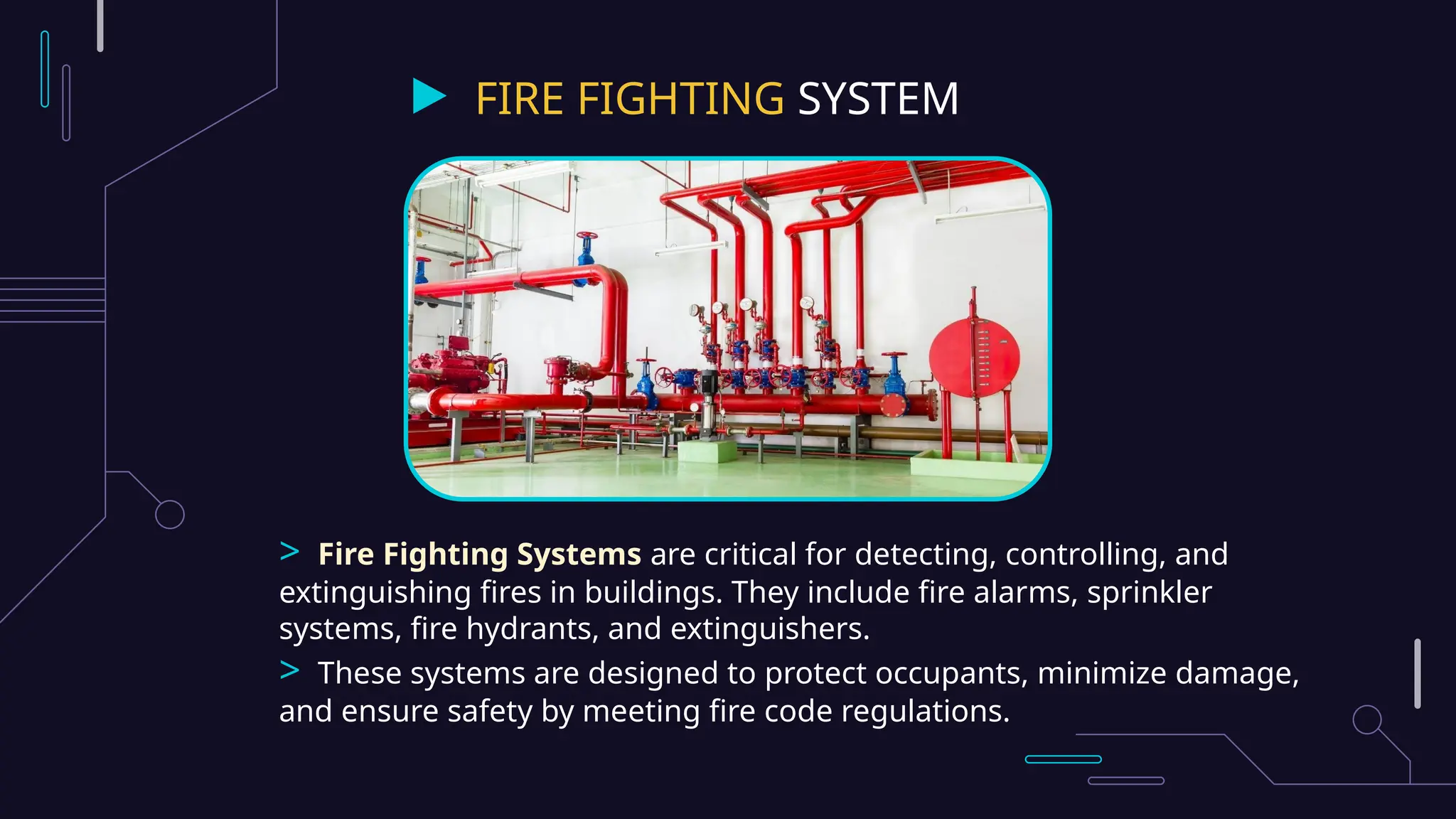
FIRE FIGHTING SYSTEM
> Fire Fighting Systems are critical for detecting, controlling, and
extinguishing fires in buildings. They include fire alarms, sprinkler
systems, fire hydrants, and extinguishers.
> These systems are designed to protect occupants, minimize damage,
and ensure safety by meeting fire code regulations.
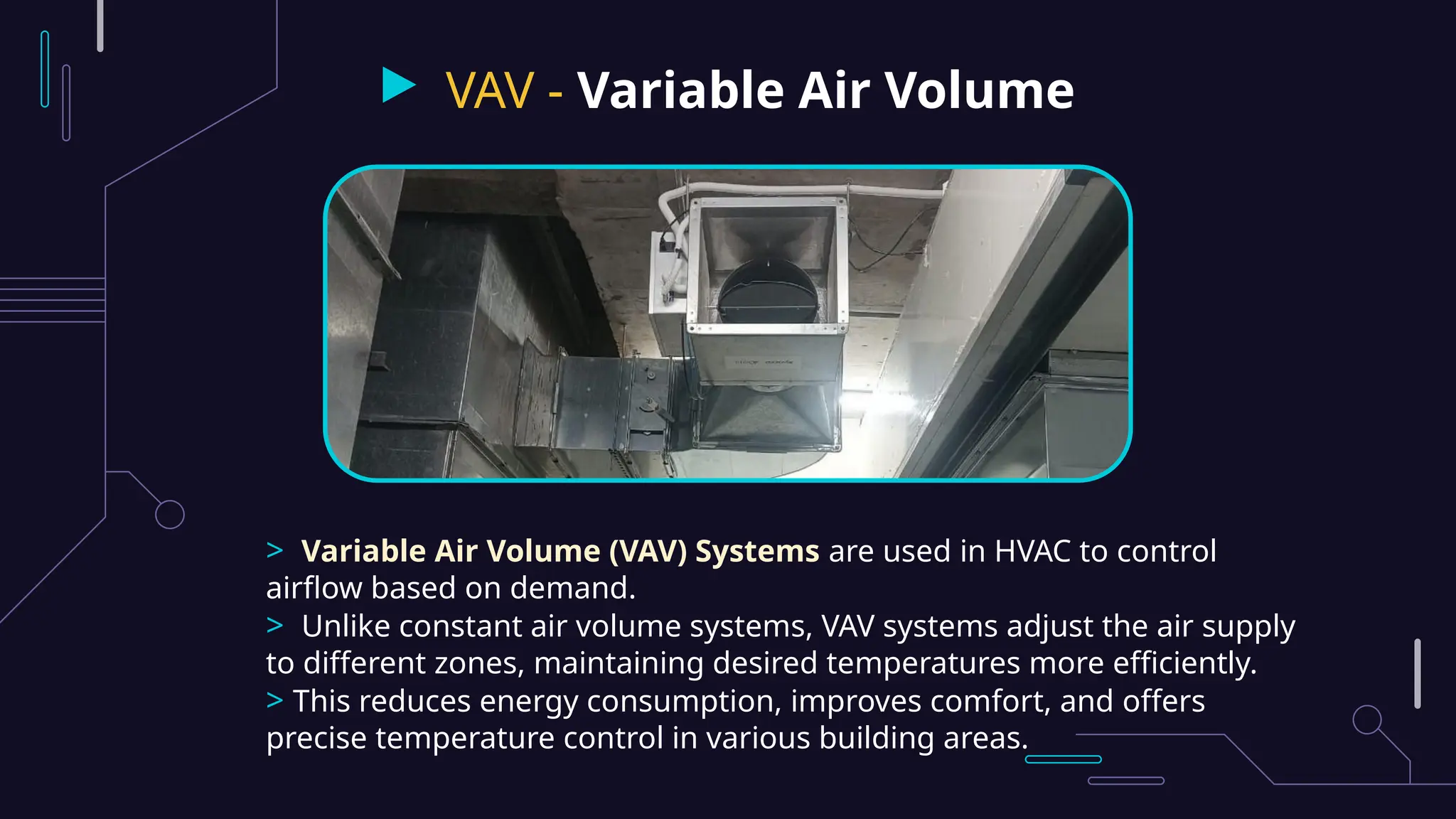
VAV - Variable Air Volume
> Variable Air Volume (VAV) Systems are used in HVAC to control
airflow based on demand.
> Unlike constant air volume systems, VAV systems adjust the air supply
to different zones, maintaining desired temperatures more efficiently.
> This reduces energy consumption, improves comfort, and offers
precise temperature control in various building areas.
CO2 SENSOR
> CO2 Sensors monitor carbon dioxide levels in indoor
environments.
> They help regulate ventilation systems by ensuring adequate
fresh air is supplied when CO2 concentrations rise, improving indoor
air quality and energy efficiency while maintaining a healthy
environment.
FRESH AIR FANS
> Fresh Air Fans are designed to bring in outdoor air into the HVAC
system, improving ventilation and indoor air quality.
> They help maintain oxygen levels, dilute indoor pollutants, and control
humidity, ensuring a healthier and more comfortable indoor
environment.
GRAPHICS
CREDITS: This presentation template was created by Slidesgo,
and includes icons by Flaticon, and infographics & images by
Freepik
THANKS!
Do you have
any
questions?

HVAC | PPT | hvac system| ppt | HVAC System Presentation

  • 1.
    HVAC SYSTEMS : ENSURINGCOMFORT & EFFICIENCY MD MURSHID ALAM GCH CENTURY
  • 2.
    WHAT IS AHVAC SYSTEM ? HVAC stands for Heating , Ventilation , & Air Conditioning. Key components of an HVAC system typically include: 1. Heating unit ( e.g., boiler, heat pump) 2. Cooling unit (e.g., chiller) 3. Ventilation system (ductwork, & fans) 4. Filtration devices
  • 3.
    INTRODUCTION ● OVERVIEW OFHVAC SYSTEM ● SIGNIFICANCE IN MODERN BUILDING
  • 4.
    OVERVIEW OF HVACSYSTEMS FUNCTIONS DIFFERENT TYPES HVAC Systems handle three main tasks: heating, ventilation, and air conditioning. Heating systems provide warmth during colder months, ventilation ensures fresh air circulation, and air conditioning cools spaces during hot weather. Different HVAC systems suit various project needs. Split systems are common for residential use, while ductless mini-splits work well in retrofits. Packaged or central systems are ideal for larger commercial projects, based on size and energy needs. Energy efficiency is key in modern HVAC design. High SEER or AFUE rated units, smart thermostats, advanced controls, and regular maintenance lower operating costs and reduce the environmental impact of projects. EFFICIENCY
  • 5.
    COMPLIANCE & SUSTAINABILITY SIGNIFICANCEOF HVAC IN MODERN BUILDINGS HVAC systems maintain consistent temperature, air quality, and humidity, enhancing comfort and productivity. Proper ventilation prevents contaminants, fostering healthier and more comfortable environments. Advanced HVAC technologies reduce energy consumption through smart controls, variable speed systems, and heat recovery solutions. This leads to significant operational cost savings and sustainable building performance. Modern HVAC designs ensure compliance with local and international building codes, including LEED and ASHRAE standards. They contribute to reducing the building's carbon footprint by integrating energy- efficient equipment and eco-friendly refrigerants. IoT, AI, and smart sensors enable real- time monitoring and predictive maintenance, optimizing HVAC performance. These innovations allow for automated energy management, improved system diagnostics, and reduced downtime. OPTIMAL INDOOR ENVIRONMENT EFFICIENCY & COST SAVING ADVANCED INNOVATION
  • 6.
    CHILLERS IN HVACSYSTEM Definition Large refrigeration units used in commercial and industrial > Cool water or other fluids for air conditioning or process cooling > Types > Air-cooled chillers > Water-cooled chillers > Absorption chillers Key Components > Compressor > Condenser > Evaporator > Expansion valve Applications > Industrial processes > Office buildings > Hospitals > Data centers
  • 7.
    WATER COOLED CHILLER ●Cooling systems that use water to remove heat. ● Work by cooling water, which then cools the air in buildings. ● Use a separate cooling tower to release heat outside. Advantages : ● More energy-efficient than air-cooled systems ● Better performance in hot climates ● Longer lifespan ● Can handle larger cooling loads ● Measured by Coefficient of Performance (COP)
  • 8.
    AIR COOLED CHILLER ●Cooling systems that use outside air to remove heat. ● Work like a refrigerator, but release heat into the outdoor air. ● Don't need water for cooling, unlike some other systems. Advantages : ● Lower initial cost ● Minimal water usage ● Easier installation ● Suitable for areas with water scarcity ● Reduced maintenance
  • 9.
    ABSORPTION CHILLER ● Coolingsystems that use water to remove heat. ● Work by cooling water, which then cools the air in buildings. ● Use a separate cooling tower to release heat outside. Advantages : ● More energy-efficient than air-cooled systems ● Better performance in hot climates ● Longer lifespan ● Can handle larger cooling loads ● Measured by Coefficient of Performance (COP)
  • 10.
    KEY COMPONENTS INCHILLERS > Dashboard > Condenser > Cooling Tower > Compressor > Valves Package > Evaporator
  • 11.
    DASHBOARD > Chiller Dashboardsoffer real-time monitoring of chiller performance metrics, such as temperature, pressure, and flow rates. > Display energy consumption data to help identify efficiency trends and cost-saving opportunities. > Include alerts and notifications for maintenance needs, performance deviations, or system malfunctions.
  • 12.
    VALVES PACKAGE > ChillerValves Package includes essential valves that control refrigerant flow within the chiller system. > Common types: expansion valves, service valves, and isolation valves, each serving specific functions. > Proper valve operation is crucial for system efficiency, performance, and longevity.
  • 13.
    CHILLER COMPRESSOR > Thecompressor is the heart of the chiller, responsible for compressing refrigerant to increase its pressure and temperature. > Common types include centrifugal, screw, and scroll compressors, used based on capacity and efficiency needs > Compressors enable the refrigeration cycle by moving refrigerant between the evaporator and condenser.
  • 14.
    CONDENSER > The condenseris responsible for releasing heat from the refrigerant to the outside environment. > It converts high-pressure refrigerant vapor into a liquid by cooling it with air (air-cooled condensers) or water (water-cooled condensers). > Condensers are essential for completing the refrigeration cycle and maintaining efficient cooling.
  • 15.
    COOLING TOWER > CoolingTowers dissipate heat from water-cooled HVAC systems by transferring waste heat to the atmosphere. > Warm water from the condenser is cooled through evaporation as it passes over fill material inside the tower. > Commonly used in large commercial or industrial systems for heat rejection.
  • 16.
    PUMPS > Pumps areessential components that circulate water and refrigerants in HVAC systems > They ensure efficient movement of chilled or hot water to coils, chillers, and heating equipment. > Pumps help maintain consistent pressure and flow rates for optimal system performance.
  • 17.
    TYPES OF PUMPS PrimaryPump - CHW Pump > Circulates chilled water between the chiller and building systems to absorb heat and cool spaces. > Ensures efficient cooling in large HVAC systems. Condenser Pump > Circulates water between the cooling tower and chiller condenser. > Removes heat from the refrigerant in cooling systems. > Essential for efficient heat rejection in large HVAC systems. > Key component in maintaining temperature control
  • 18.
    WATER DISTRIBUTION Definition > Theprocess of delivering hot or chilled water from central equipment (chillers, boilers) to various parts of a building for heating or cooling. Key Components > Pumps : Maintain water flow and pressure in the system. > Valves : Control flow, pressure, and temperature of water. air. > Heat Exchangers : Trap dust, allergens, and other particles. Importance > Ensures even heating and cooling throughout the building. > Helps maintain comfort and energy efficiency. > Minimizes temperature fluctuations and enhances system control.
  • 19.
    PMS - PumpManagement System Definition > An automated system used to monitor, control, and optimize the operation of pumps in HVAC systems. Key Functions > Monitoring : Tracks pump performance, energy consumption, and operational status > Control : Automates pump start/stop, adjusts speed, and ensures optimal performance based on system demand. air. > Alarm & Diagnostics : Alerts for malfunctions, pressure drops, or inefficiencies, improving maintenance response.
  • 20.
    BTU Meter Key Functions >Measurement : Calculates the amount of heat energy transferred to or from a space. > Monitoring : Provides real- time data on energy usage for HVAC systems. Components > Flow Sensor : Measures the flow rate of water in the system. > Temperature Sensors : Measure the inlet and outlet temperatures of the fluid. > Flow Sensor : Measures the flow rate of water in the system. Definition > A device that measures the energy consumption of heating or cooling systems in terms of British Thermal Units (BTUs). >
  • 21.
    CHEMICAL DOSING SYSTEM Definition >A system used to inject precise amounts of chemicals into water in HVAC systems to prevent scaling, corrosion, and biological growth. Key Functions > Water Treatment : Ensures water quality by adding chemicals (e.g., biocides, corrosion inhibitors). > Prevention : Protects pipes, boilers, chillers, and cooling towers from damage caused by corrosion or scaling. Components > Dosing Pump : Delivers the chemicals at controlled rates. > Storage Tanks : Hold the chemicals before dosing. > Control Unit : Manages the dosing process, often based on feedback from sensors
  • 22.
    DUCTING SYSTEMS ● Networkof ducts that distributes conditioned air throughout the building ● Made of materials like galvanized steel, aluminum, or flexible plastic ● Ensures proper air circulation between AHUs, FCUs, and various zones ● Includes supply ducts (delivering air) and return ducts (removing air) ● Can be insulated to reduce energy loss and improve efficiency ● Designed for minimal air leakage and pressure drops ● Essential for maintaining consistent temperature and air quality
  • 23.
    AIR HANDLING UNITS- AHUs Definition Why AHUs are Important ? Air Handling Units (AHUs) are a critical part of HVAC systems, responsible for regulating and circulating air throughout buildings > Maintain indoor air quality (IAQ). Provide proper ventilation and air circulation. > Control temperature and humidity for comfort.
  • 24.
    Air Handling Unit- AHUs > AHU’s are connected to duct work which provides a defined route for the air to travel around the building. > In a simple form, an AHU will use a fan to suck in fresh ambient outside air which will then pass through some filters to remove any dirt and dust. > It will then pass through the cooling and heating coil heat exchangers which, as discussed, are typically fed from central plant units. > Another set of duct work will be collecting the warm used air from the rooms and will bring this back to the AHU via another fan. This fan will then eject the air from the AHU and building.
  • 25.
    KEY COMPONENTS INAHUs > EC Fans > Filters > Coils > Dampers > Humidifier > UV light
  • 26.
    EC FAN (ElectronicallyCommutated Fan) > EC Fans combine the efficiency of DC motors with the simplicity of AC power. > These fans offer precise speed control, lower energy consumption, and quieter operation compared to traditional fans. > Widely used in HVAC systems, EC fans enhance energy efficiency, reduce operating costs, and contribute to sustainable building management.
  • 27.
    FILTER > Filters areessential in HVAC systems to trap dust, allergens, and contaminants from the air. > They improve indoor air quality by removing particles before air is circulated. > Regular filter maintenance helps maintain system efficiency, extends equipment life, and ensures a healthy environment for occupants.
  • 28.
    COIL > Coils inHVAC systems are responsible for heating or cooling air. > They transfer heat by circulating hot or chilled water, or refrigerant, through the coil pipes. > Efficient coil performance is crucial for maintaining desired indoor temperatures and ensuring energy-efficient operation of the system. >
  • 29.
    UV LIGHT > UVLights in HVAC systems help disinfect air by killing bacteria, viruses, and mold on coils and other components. > UV lights emit ultraviolet radiation that destroys the DNA of microorganisms like bacteria, mold, and viruses. > Installed near coils and drain pans, UV lights continuously sanitize surfaces by breaking down harmful pathogens. >
  • 30.
    FAN COIL UNITS- FCUs ● Compact units used for heating or cooling individual spaces. ● Consist of a fan and heating/cooling coil. ● Uses chilled or hot water from central plant.
  • 31.
    HOW FAN COILUNITS - FCUs WORK ? Fan coil units are used to condition the local air to suit the temperature requirements of the immediate space.
  • 32.
    CSUs ● Mounted underthe ceiling for space- saving installation ● Provides heating, cooling, and air distribution in small to medium-sized spaces ● Typically uses chilled or hot water for conditioning ● Includes built-in fan and air filter ● Commonly used in commercial spaces, offices, and retail stores ● Quiet operation with adjustable airflow for user comfort
  • 33.
    CO SENSOR > COSensors detect carbon monoxide (CO) levels in indoor spaces to ensure safety. > When CO levels exceed safe limits, the sensor triggers alarms or ventilation systems to remove contaminated air.
  • 34.
    JET FAN > JetFans are used in enclosed spaces like parking garages to control air movement and remove exhaust fumes. > They work by creating high-velocity airflow, pushing contaminated air towards exhaust points, ensuring proper ventilation and reducing harmful gas buildup.
  • 35.
    VENTILATION OVERVIEW Definition Ventilation isthe process of supplying fresh air to indoor spaces and removing stale air, maintaining air quality and comfort. Key Components > Supply Air Systems: Deliver fresh outdoor air. > Exhaust Air Systems: Remove stale indoor air. > Air Filters: Trap dust, allergens, and other particles. Importance of Ventilation: > Removes indoor pollutants and odors. > Controls humidity levels, preventing mold growth. > Controls humidity levels, preventing mold growth.
  • 36.
    CAR PARKING VENTILATIONSYSTEM > Car Parking Ventilation Systems ensure proper air circulation in enclosed parking areas by removing exhaust fumes and pollutants. > They maintain air quality, prevent the buildup of harmful gases like carbon monoxide, and ensure compliance with safety standards.
  • 37.
    KITCHEN SCRUBBER SYSTEM >Kitchen Scrubber Systems remove grease, smoke, and odors from kitchen exhaust air. > They filter contaminants before releasing air outdoors, improving air quality and ensuring compliance with environmental regulations. > These systems help maintain a cleaner, safer kitchen environment.
  • 38.
    FIRE FIGHTING SYSTEM >Fire Fighting Systems are critical for detecting, controlling, and extinguishing fires in buildings. They include fire alarms, sprinkler systems, fire hydrants, and extinguishers. > These systems are designed to protect occupants, minimize damage, and ensure safety by meeting fire code regulations.
  • 39.
    VAV - VariableAir Volume > Variable Air Volume (VAV) Systems are used in HVAC to control airflow based on demand. > Unlike constant air volume systems, VAV systems adjust the air supply to different zones, maintaining desired temperatures more efficiently. > This reduces energy consumption, improves comfort, and offers precise temperature control in various building areas.
  • 40.
    CO2 SENSOR > CO2Sensors monitor carbon dioxide levels in indoor environments. > They help regulate ventilation systems by ensuring adequate fresh air is supplied when CO2 concentrations rise, improving indoor air quality and energy efficiency while maintaining a healthy environment.
  • 41.
    FRESH AIR FANS >Fresh Air Fans are designed to bring in outdoor air into the HVAC system, improving ventilation and indoor air quality. > They help maintain oxygen levels, dilute indoor pollutants, and control humidity, ensuring a healthier and more comfortable indoor environment.
  • 42.
  • 43.
    CREDITS: This presentationtemplate was created by Slidesgo, and includes icons by Flaticon, and infographics & images by Freepik THANKS! Do you have any questions?