Por sus características pedogenéticas los suelos agrícolas
pampeanos poseen bajos valores de EPT y por sus
características demográficas y productivas, no han sufrido hasta
el presente incorporación de EPT en forma significativa.
En cambio, los suelos de las ciudades y su periferia, donde se
reúnen masas poblacionales numerosas y se llevan a cabo
innumerables actividades que generan emisiones o residuos ricos
en EPT, suelen presentan acumulación significativa de algunos de
estos contaminantes.
Esto puede afectar las áreas agrícolas intensivas o extensivas
circundantes.
Agricultural soils: no significant contamination
Urban and suburban soils: significant accumulation of PTE is common
Conclusión/ Conclusion
Raúl S. Lavado
School of Agriculture - University of Buenos Aires
Av. San Martín 4453, C1417DSE Buenos Aires
Argentina
lavado@agro.uba.ar
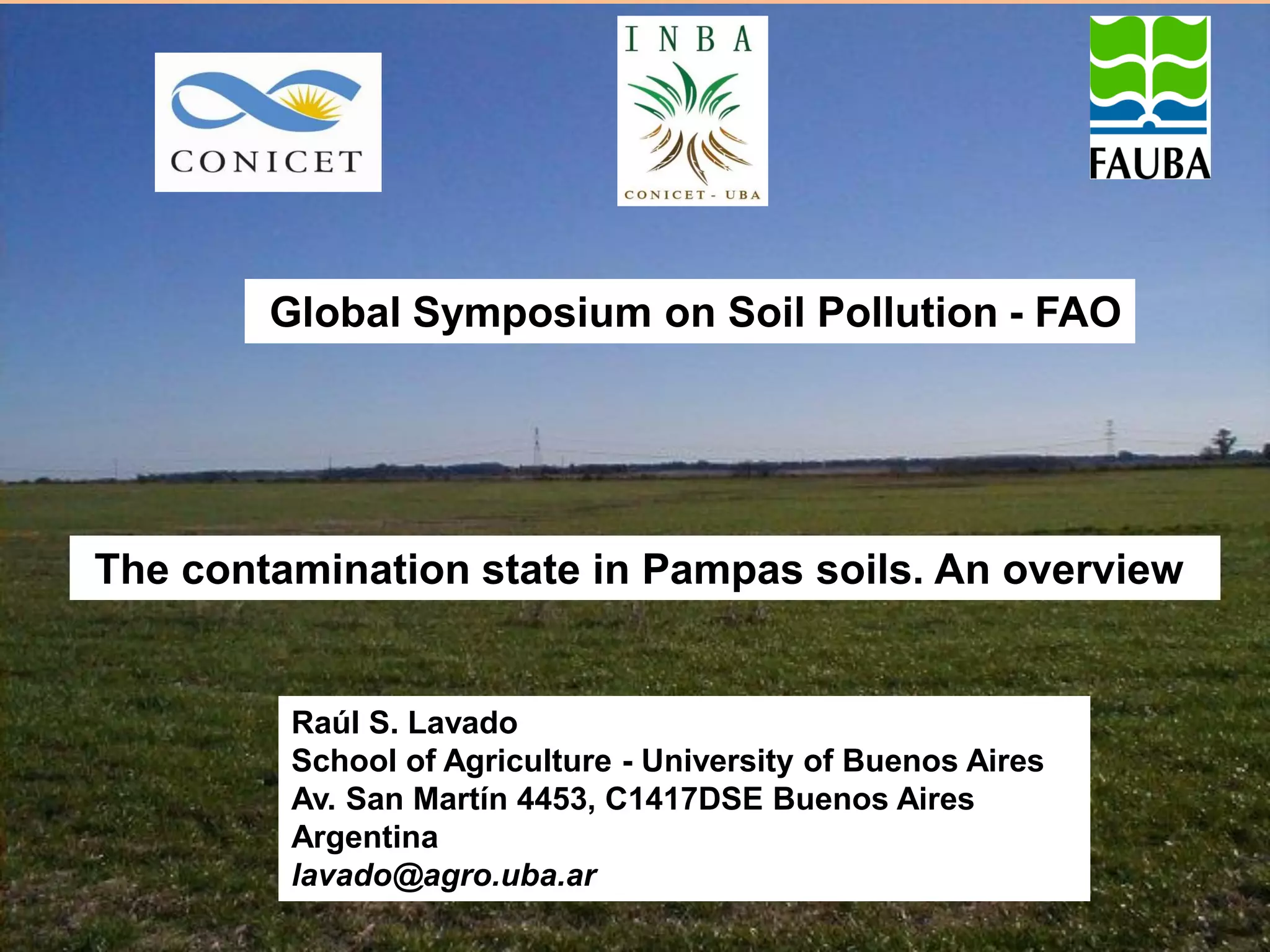
Global Symposium on Soil Pollution - FAO
The contamination state in Pampas soils. An overview
Rough limits of the Pampas region
Parent material, loess-like sediments
Soils, mostly Mollisols.
Natural vegetation, temperate
grassland.
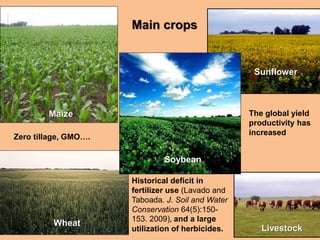
Maize
Wheat
Sunflower
Soybean
Livestock
The global yield
productivity has
increased
Main crops
Zero tillage, GMO….
Historical deficit in
fertilizer use (Lavado and
Taboada. J. Soil and Water
Conservation 64(5):150-
153. 2009), and a large
utilization of herbicides.
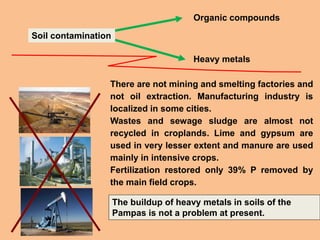
The buildup of heavy metals in soils of the
Pampas is not a problem at present.
There are not mining and smelting factories and
not oil extraction. Manufacturing industry is
localized in some cities.
Wastes and sewage sludge are almost not
recycled in croplands. Lime and gypsum are
used in very lesser extent and manure are used
mainly in intensive crops.
Fertilization restored only 39% P removed by
the main field crops.
Soil contamination
Organic compounds
Heavy metals
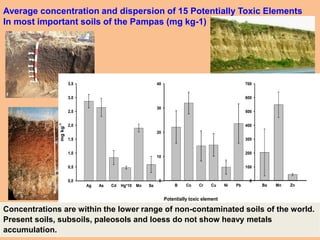
Average concentration and dispersion of 15 Potentially Toxic Elements
In most important soils of the Pampas (mg kg-1)
Concentrations are within the lower range of non-contaminated soils of the world.
Present soils, subsoils, paleosols and loess do not show heavy metals
accumulation.
Ag As Cd Hg*10 Mo Se
mgkg-1
0,0
0,5
1,0
1,5
2,0
2,5
3,0
3,5
B Co Cr Cu Ni Pb
0
10
20
30
40
Potentially toxic element
Ba Mn Zn
0
100
200
300
400
500
600
700
0
30
60
90
120
0 1 2 3 4 5 6 7 8
Arsénico (mg kg
-1
)
Profundidad(cm)
Suelo contaminado
Suelo no contaminado
S S T T
S = Soluble
T = Total
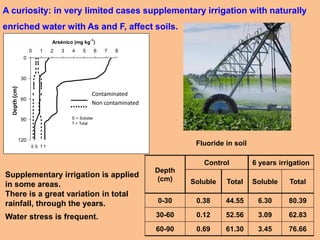
A curiosity: in very limited cases supplementary irrigation with naturally
enriched water with As and F, affect soils.
Depth
(cm)
Control 6 years irrigation
Soluble Total Soluble Total
0-30 0.38 44.55 6.30 80.39
30-60 0.12 52.56 3.09 62.83
60-90 0.69 61.30 3.45 76.66
Fluoride in soil
Supplementary irrigation is applied
in some areas.
There is a great variation in total
rainfall, through the years.
Water stress is frequent.
Depth(cm)
Contaminated
Non contaminated
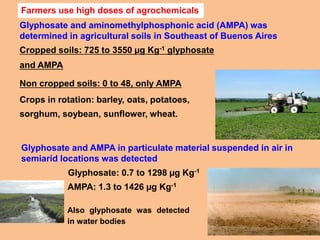
Glyphosate and aminomethylphosphonic acid (AMPA) was
determined in agricultural soils in Southeast of Buenos Aires
Cropped soils: 725 to 3550 µg Kg-1 glyphosate
and AMPA
Non cropped soils: 0 to 48, only AMPA
Crops in rotation: barley, oats, potatoes,
sorghum, soybean, sunflower, wheat.
Glyphosate and AMPA in particulate material suspended in air in
semiarid locations was detected
Glyphosate: 0.7 to 1298 µg Kg-1
AMPA: 1.3 to 1426 µg Kg-1
Farmers use high doses of agrochemicals
Also glyphosate was detected
in water bodies
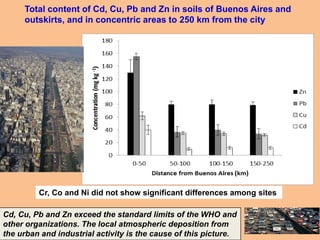
Cr, Co and Ni did not show significant differences among sites
Total content of Cd, Cu, Pb and Zn in soils of Buenos Aires and
outskirts, and in concentric areas to 250 km from the city
Cd, Cu, Pb and Zn exceed the standard limits of the WHO and
other organizations. The local atmospheric deposition from
the urban and industrial activity is the cause of this picture.
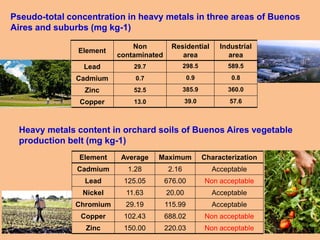
Pseudo-total concentration in heavy metals in three areas of Buenos
Aires and suburbs (mg kg-1)
Element
Non
contaminated
Residential
area
Industrial
area
Lead 29.7 298.5 589.5
Cadmium 0.7 0.9 0.8
Zinc 52.5 385.9 360.0
Copper 13.0 39.0 57.6
Element Average Maximum Characterization
Cadmium 1.28 2.16 Acceptable
Lead 125.05 676.00 Non acceptable
Nickel 11.63 20.00 Acceptable
Chromium 29.19 115.99 Acceptable
Copper 102.43 688.02 Non acceptable
Zinc 150.00 220.03 Non acceptable
Heavy metals content in orchard soils of Buenos Aires vegetable
production belt (mg kg-1)
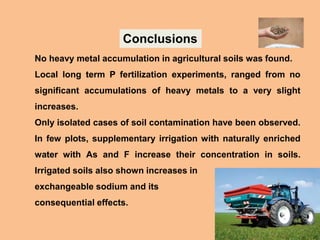
No heavy metal accumulation in agricultural soils was found.
Local long term P fertilization experiments, ranged from no
significant accumulations of heavy metals to a very slight
increases.
Only isolated cases of soil contamination have been observed.
In few plots, supplementary irrigation with naturally enriched
water with As and F increase their concentration in soils.
Irrigated soils also shown increases in
exchangeable sodium and its
consequential effects.
Conclusions
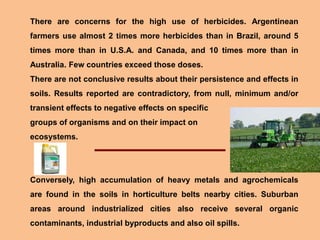
There are concerns for the high use of herbicides. Argentinean
farmers use almost 2 times more herbicides than in Brazil, around 5
times more than in U.S.A. and Canada, and 10 times more than in
Australia. Few countries exceed those doses.
There are not conclusive results about their persistence and effects in
soils. Results reported are contradictory, from null, minimum and/or
transient effects to negative effects on specific
groups of organisms and on their impact on
ecosystems.
Conversely, high accumulation of heavy metals and agrochemicals
are found in the soils in horticulture belts nearby cities. Suburban
areas around industrialized cities also receive several organic
contaminants, industrial byproducts and also oil spills.
Thank you very much
Most information for this talk was taken from
Lavado R.S. and V. Aparicio. 2018. Contamination. In
Rubio, G., F. X. Pereyra and R. S. Lavado (Editors). 2018.
Soils of Argentina. World Soils Book Series (Ed. Alfred
E. Hartemink). Springer International Publishing AG,
New York. ISBN 978-3-319-76851-9. In Press.

The contamination state in Pampas soils

  • 1.
    Por sus característicaspedogenéticas los suelos agrícolas pampeanos poseen bajos valores de EPT y por sus características demográficas y productivas, no han sufrido hasta el presente incorporación de EPT en forma significativa. En cambio, los suelos de las ciudades y su periferia, donde se reúnen masas poblacionales numerosas y se llevan a cabo innumerables actividades que generan emisiones o residuos ricos en EPT, suelen presentan acumulación significativa de algunos de estos contaminantes. Esto puede afectar las áreas agrícolas intensivas o extensivas circundantes. Agricultural soils: no significant contamination Urban and suburban soils: significant accumulation of PTE is common Conclusión/ Conclusion Raúl S. Lavado School of Agriculture - University of Buenos Aires Av. San Martín 4453, C1417DSE Buenos Aires Argentina lavado@agro.uba.ar Global Symposium on Soil Pollution - FAO The contamination state in Pampas soils. An overview
  • 2.
    Rough limits ofthe Pampas region Parent material, loess-like sediments Soils, mostly Mollisols. Natural vegetation, temperate grassland.
  • 3.
    Maize Wheat Sunflower Soybean Livestock The global yield productivityhas increased Main crops Zero tillage, GMO…. Historical deficit in fertilizer use (Lavado and Taboada. J. Soil and Water Conservation 64(5):150- 153. 2009), and a large utilization of herbicides.
  • 4.
    The buildup ofheavy metals in soils of the Pampas is not a problem at present. There are not mining and smelting factories and not oil extraction. Manufacturing industry is localized in some cities. Wastes and sewage sludge are almost not recycled in croplands. Lime and gypsum are used in very lesser extent and manure are used mainly in intensive crops. Fertilization restored only 39% P removed by the main field crops. Soil contamination Organic compounds Heavy metals
  • 5.
    Average concentration anddispersion of 15 Potentially Toxic Elements In most important soils of the Pampas (mg kg-1) Concentrations are within the lower range of non-contaminated soils of the world. Present soils, subsoils, paleosols and loess do not show heavy metals accumulation. Ag As Cd Hg*10 Mo Se mgkg-1 0,0 0,5 1,0 1,5 2,0 2,5 3,0 3,5 B Co Cr Cu Ni Pb 0 10 20 30 40 Potentially toxic element Ba Mn Zn 0 100 200 300 400 500 600 700
  • 6.
    0 30 60 90 120 0 1 23 4 5 6 7 8 Arsénico (mg kg -1 ) Profundidad(cm) Suelo contaminado Suelo no contaminado S S T T S = Soluble T = Total A curiosity: in very limited cases supplementary irrigation with naturally enriched water with As and F, affect soils. Depth (cm) Control 6 years irrigation Soluble Total Soluble Total 0-30 0.38 44.55 6.30 80.39 30-60 0.12 52.56 3.09 62.83 60-90 0.69 61.30 3.45 76.66 Fluoride in soil Supplementary irrigation is applied in some areas. There is a great variation in total rainfall, through the years. Water stress is frequent. Depth(cm) Contaminated Non contaminated
  • 7.
    Glyphosate and aminomethylphosphonicacid (AMPA) was determined in agricultural soils in Southeast of Buenos Aires Cropped soils: 725 to 3550 µg Kg-1 glyphosate and AMPA Non cropped soils: 0 to 48, only AMPA Crops in rotation: barley, oats, potatoes, sorghum, soybean, sunflower, wheat. Glyphosate and AMPA in particulate material suspended in air in semiarid locations was detected Glyphosate: 0.7 to 1298 µg Kg-1 AMPA: 1.3 to 1426 µg Kg-1 Farmers use high doses of agrochemicals Also glyphosate was detected in water bodies
  • 8.
    Cr, Co andNi did not show significant differences among sites Total content of Cd, Cu, Pb and Zn in soils of Buenos Aires and outskirts, and in concentric areas to 250 km from the city Cd, Cu, Pb and Zn exceed the standard limits of the WHO and other organizations. The local atmospheric deposition from the urban and industrial activity is the cause of this picture.
  • 9.
    Pseudo-total concentration inheavy metals in three areas of Buenos Aires and suburbs (mg kg-1) Element Non contaminated Residential area Industrial area Lead 29.7 298.5 589.5 Cadmium 0.7 0.9 0.8 Zinc 52.5 385.9 360.0 Copper 13.0 39.0 57.6 Element Average Maximum Characterization Cadmium 1.28 2.16 Acceptable Lead 125.05 676.00 Non acceptable Nickel 11.63 20.00 Acceptable Chromium 29.19 115.99 Acceptable Copper 102.43 688.02 Non acceptable Zinc 150.00 220.03 Non acceptable Heavy metals content in orchard soils of Buenos Aires vegetable production belt (mg kg-1)
  • 10.
    No heavy metalaccumulation in agricultural soils was found. Local long term P fertilization experiments, ranged from no significant accumulations of heavy metals to a very slight increases. Only isolated cases of soil contamination have been observed. In few plots, supplementary irrigation with naturally enriched water with As and F increase their concentration in soils. Irrigated soils also shown increases in exchangeable sodium and its consequential effects. Conclusions
  • 11.
    There are concernsfor the high use of herbicides. Argentinean farmers use almost 2 times more herbicides than in Brazil, around 5 times more than in U.S.A. and Canada, and 10 times more than in Australia. Few countries exceed those doses. There are not conclusive results about their persistence and effects in soils. Results reported are contradictory, from null, minimum and/or transient effects to negative effects on specific groups of organisms and on their impact on ecosystems. Conversely, high accumulation of heavy metals and agrochemicals are found in the soils in horticulture belts nearby cities. Suburban areas around industrialized cities also receive several organic contaminants, industrial byproducts and also oil spills.
  • 12.
    Thank you verymuch Most information for this talk was taken from Lavado R.S. and V. Aparicio. 2018. Contamination. In Rubio, G., F. X. Pereyra and R. S. Lavado (Editors). 2018. Soils of Argentina. World Soils Book Series (Ed. Alfred E. Hartemink). Springer International Publishing AG, New York. ISBN 978-3-319-76851-9. In Press.